

The two kinds of customer service feedback
Before the examples, it's worth being precise about what you're writing, because the two directions have almost nothing in common except the word "feedback."
- Feedback to reps is internal. A team lead, QA reviewer, or peer tells an agent what worked and what to change. The audience is one person, the goal is a behavior change, and the currency is trust.
- Feedback from customers is external. It arrives as a review, a CSAT score, an NPS comment, or a reply in a ticket, or through your live chat and chatbot. The audience is you, the goal is to spot a pattern and fix it, and the currency is honesty.
Both are only useful when they're specific and when something happens as a result. A five-star review you never respond to and a coaching note nobody acts on are the same wasted signal. Getting this right sits at the center of good customer service management, and it's a habit, not a one-off.
What separates feedback that sticks from feedback that gets ignored
The single most common mistake I see, in both directions, is feedback that's too vague to act on. "Be more empathetic" and "great service!" are both technically feedback, and both are useless. The person on the other end can't tell what to do differently or what to keep doing.
The fix is a structure support teams borrow from coaching: Situation, Behavior, Impact. Name the specific moment, describe the exact behavior you observed, then spell out the effect it had. It turns a vibe into something the reader can picture and repeat.
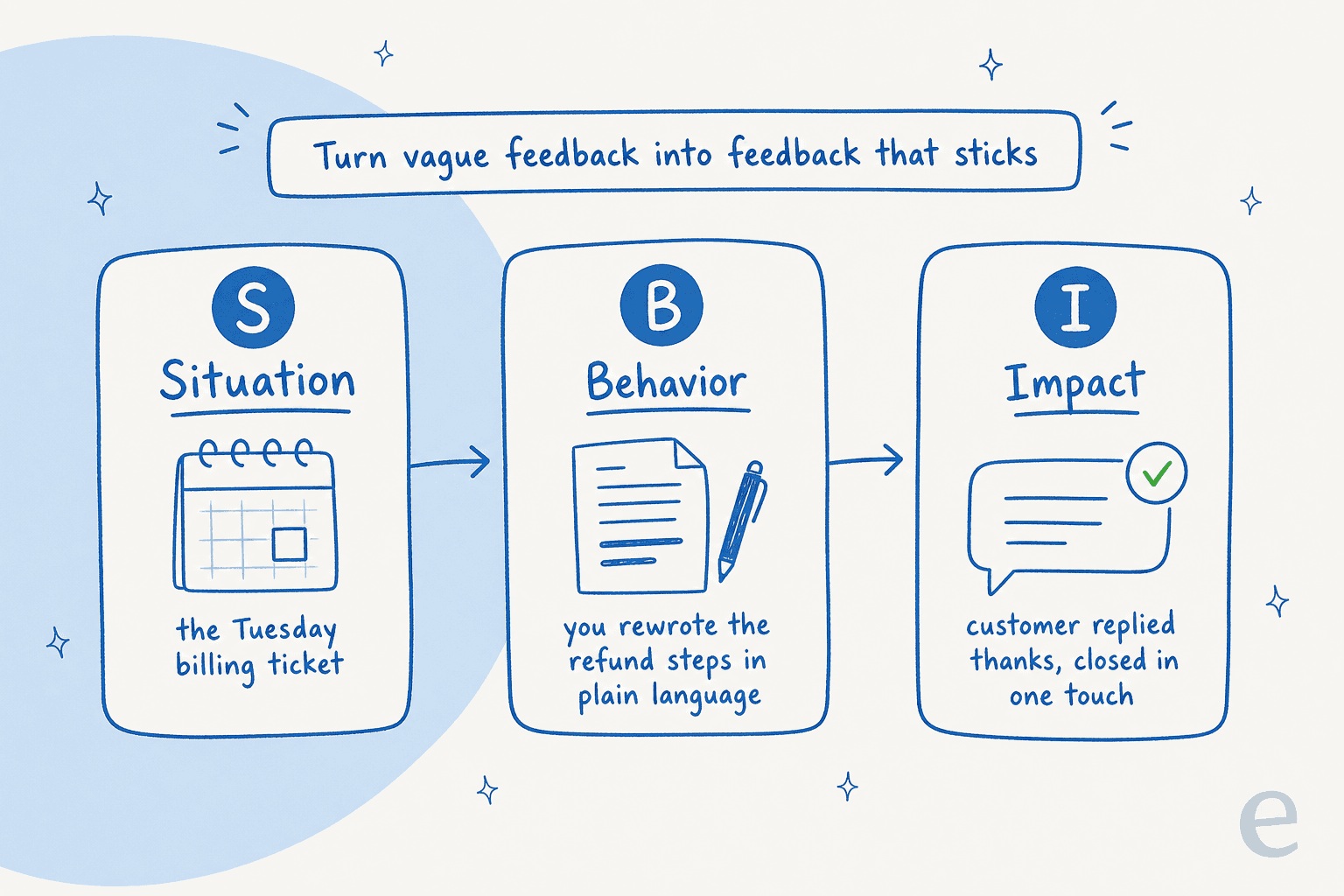
Watch what it does to the same piece of praise. "You're doing great" carries no information. Run it through SBI and you get: "On the Tuesday billing escalation (situation), you rewrote the refund steps in plain language (behavior), and the customer replied 'thank you, that's clear' and closed the ticket in one touch (impact)." Now the rep knows exactly what to do again.
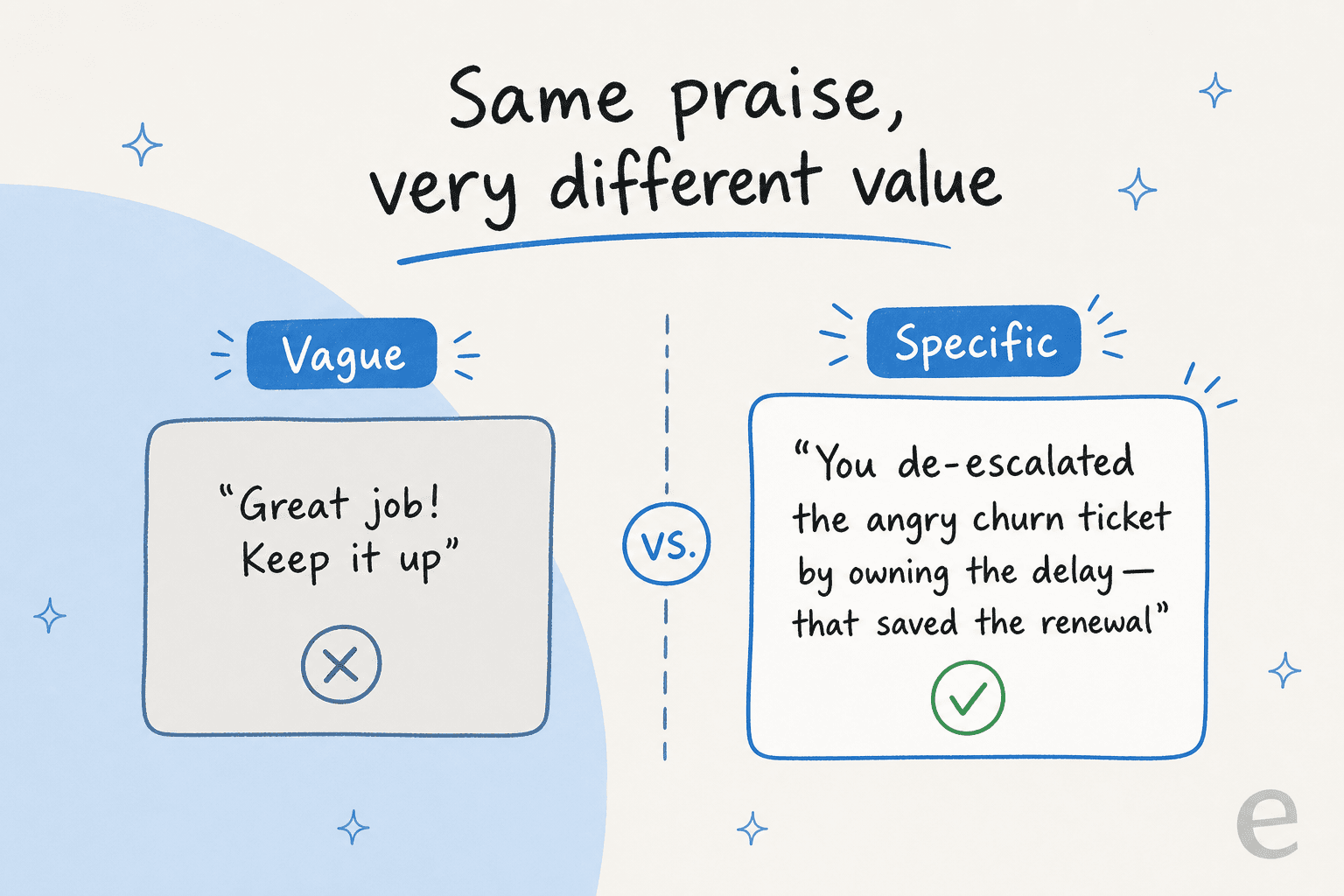
The same discipline applies to negative feedback, where it matters even more, because vague criticism reads as a personal attack while specific criticism reads as help. This is the difference between feedback that builds a customer service mindset and feedback that just makes people defensive.
Positive feedback examples for customer service reps
Positive feedback isn't a formality. It tells a rep which of their instincts to trust, and it's the cheapest retention tool a support manager has, cheaper than any cost-savings program you could run. Keep it specific enough that the person could quote it back to you. Here are examples you can adapt:
- "On the shipping-delay ticket this morning, you proactively offered the tracking link before the customer asked. That turned a complaint into a thank-you."
- "You caught that the customer had emailed twice already and opened with an apology for the wait instead of asking them to repeat themselves. That's exactly the read I want on repeat contacts."
- "Your reply on the API-key ticket was three sentences and solved it completely. You resisted the urge to over-explain, and it cut the back-and-forth to zero."
- "You flagged the billing bug to engineering instead of just closing the ticket. Five other customers hit the same thing this week, so you saved us a wave of tickets."
- "You handled the refund request with a warm tone even though the customer was heated. You held the line on policy without ever sounding cold."
- "You used the customer's name and referenced their earlier order without being asked. It read as genuinely personal, not scripted."
Notice that every one names a real ticket and a real behavior. That's what makes praise land instead of evaporating, and it's why generic "team, you're crushing it" messages don't move anything. If you want to tie recognition to numbers, anchor it to your customer service KPIs so reps see the connection between the behavior and the first-contact resolution or CSAT it drove.
Constructive feedback examples for customer service reps
Constructive feedback is where structure earns its keep. The goal is a behavior change without a bruised ego, so you describe what happened rather than labeling the person, and you agree on one thing to try next. These examples show the shape:
- "On the cancellation ticket, the reply jumped straight to the policy link without acknowledging the frustration first. Next time, lead with one line that shows you get why they're annoyed, then the policy. Want to look at how that reads together?"
- "The answer was correct but had four paragraphs, and the customer replied 'so is that a yes?' Let's practice putting the answer in the first sentence and the detail underneath."
- "You closed the ticket as resolved, but the customer's second question wasn't answered. Before closing, a quick scan for 'did I address everything they asked' would have caught it."
- "The tone got a little defensive when they pushed back on the fee. It's fine to hold the line, but 'I understand this is frustrating' before the explanation keeps it warm."
- "You escalated this to me, but it was actually covered in the returns doc. Let's make sure you know where to look first, so you can own more of these directly."
Two things make these work. First, they're about a specific ticket, not a general trait, so nobody feels character-judged. Second, each one ends with a concrete next step or an invitation to look together. That's coaching, not a verdict. Building this into a repeatable habit is a big part of how strong teams do customer service problem solving instead of firefighting the same issues on repeat.
One thing I've learned on our own queue: constructive feedback lands far better when you can pull up the actual ticket while you talk. Feedback from memory drifts into "I feel like you sometimes..." A support copilot that keeps the real conversation and the suggested reply side by side keeps the coaching grounded in what actually happened.
Here's a quick way to pick the right example for the moment you're in:
Customer feedback examples, and how to respond to each
Now the other direction: the feedback customers give you. Every response is public-facing (even a private reply sets the tone for the relationship), so the templates matter. Here are the common types with a response you can adapt.
Positive review or comment. A customer writes: "The support team was exceptional throughout setup, especially when configuring our integrations." Don't just say thanks. Name the specific thing and route the credit:
"Thank you, this means a lot. I've shared it with the team who worked on your integration setup. If you hit anything else as you roll out, you know where to find us."
Negative review. A customer writes: "Waited three days for a reply and got a canned answer." A defensive reply here does more damage than the original review. Own it, be specific, commit to a change:
"You're right, three days is too long and a canned reply made it worse. We've since changed how we route setup questions so they don't sit in the queue. I'd like to make your specific issue right, can I follow up directly?"
CSAT verbatim (low score). A one-star CSAT with the comment "didn't actually solve my problem." Treat it as a reopened ticket, not a closed survey:
"I saw your rating and you're right that we marked this solved before it was. I've reopened it and I'm on it personally now."
NPS detractor. A customer scores you a 3 and writes "it works but it's harder to use than it should be." This is product feedback, not support feedback, and the move is to acknowledge and route it internally, then close the loop when something ships.
The pattern across all four: acknowledge the specific thing, avoid excuses, say what changes, and follow up. Whether a human or an AI handles the reply, the shape is the same. Reading through some genuinely bad customer service stories is a fast lesson in how the defensive version reads from the outside. And whether the feedback is glowing or brutal, the response is a chance to reinforce your customer service standards and turn a one-off reply into an engagement example worth repeating.
Survey feedback examples: CSAT, NPS, and CES
A lot of customer feedback is prompted by a survey, and the three main types produce very different examples because they ask different questions. Knowing which is which stops you from treating a low-effort gripe like a satisfaction crisis.
| Feedback type | What it measures | Example question | Example response you'll see |
|---|---|---|---|
| CSAT | Satisfaction with one interaction | "How satisfied were you with this conversation?" | "Quick and friendly, solved in one reply." / "Polite but didn't fix it." |
| NPS | Likelihood to recommend overall | "How likely are you to recommend us, 0-10?" | "9, support is the reason I stay." / "4, product's fine but slow to reach a human." |
| CES | Effort the customer had to spend | "How easy was it to get your issue resolved?" | "Very easy, one message." / "Hard, I had to explain it three times." |
The examples in that last column are gold, because the open-text comment is where the real signal lives, not the number. A CSAT of 3/5 with "polite but didn't fix it" tells you tone is fine and resolution is broken. That's a different fix than a 3/5 that says "took forever." If you're building out how you track all of this, our guide to AI customer service metrics breaks down which score to lean on for which decision, and how it connects to measuring support ROI.
Turning feedback into action at scale
Collecting feedback examples is the easy part. The hard part is that a busy team gets more feedback than anyone can read, so most of it never turns into a change. A single agent might get twenty CSAT comments a week; a 15-person team generates hundreds, plus reviews, plus NPS text. Reading it one message at a time doesn't scale, and the patterns hide in the pile.
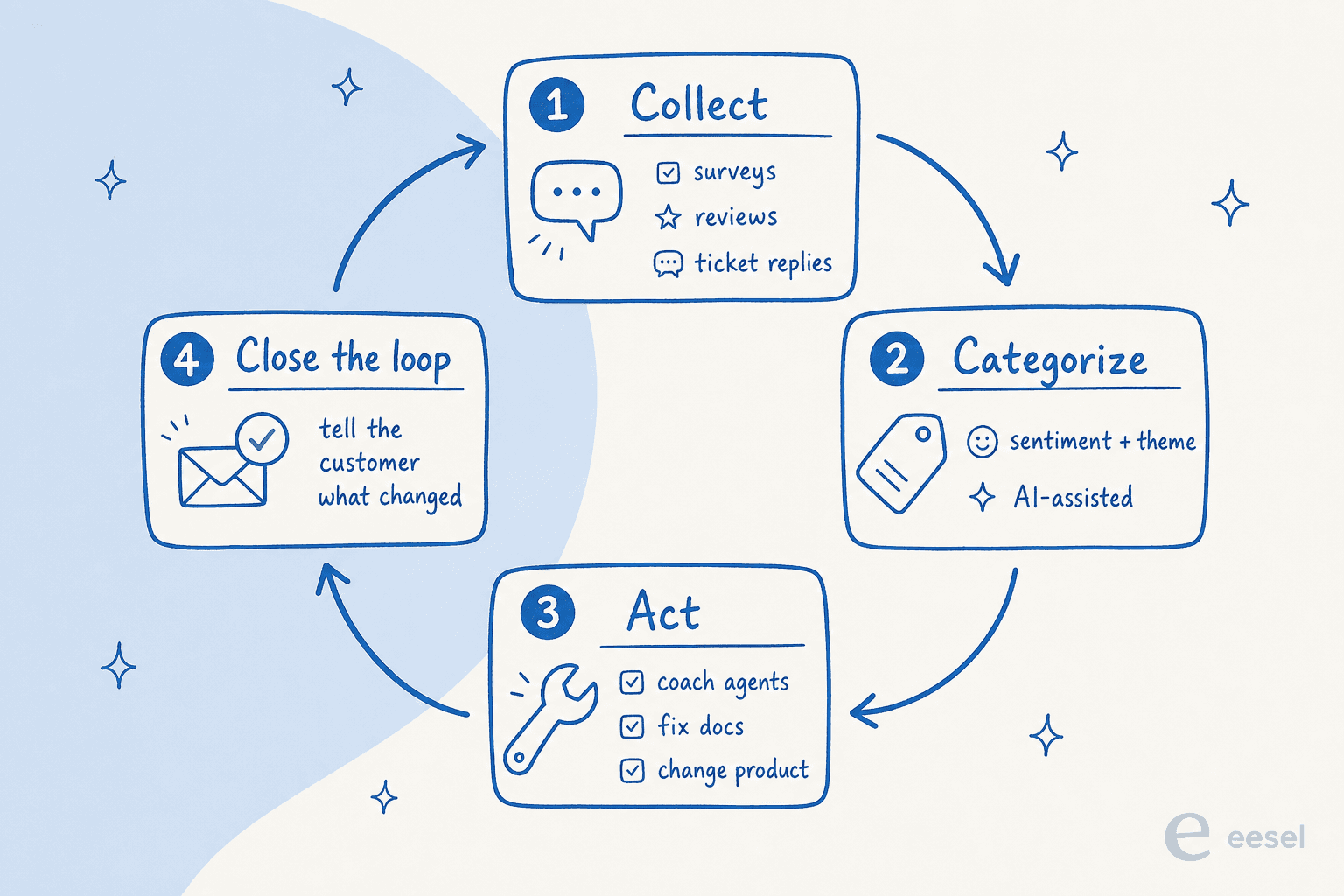
The loop that actually works is: collect feedback from every channel, categorize it by sentiment and theme, act on the patterns (coach a rep, fix a doc, flag a product issue), then close the loop by telling the customer what changed. The step teams skip is categorize, because doing it by hand is brutal. This is exactly where AI earns its place: it can tag every ticket and survey comment by sentiment and topic automatically, so instead of reading feedback you're reading a ranked list of what's actually driving it. The same ticket-tagging approach that powers AI support tagging and routes tickets can categorize feedback, and it feeds the numbers you'd track when measuring deflection.
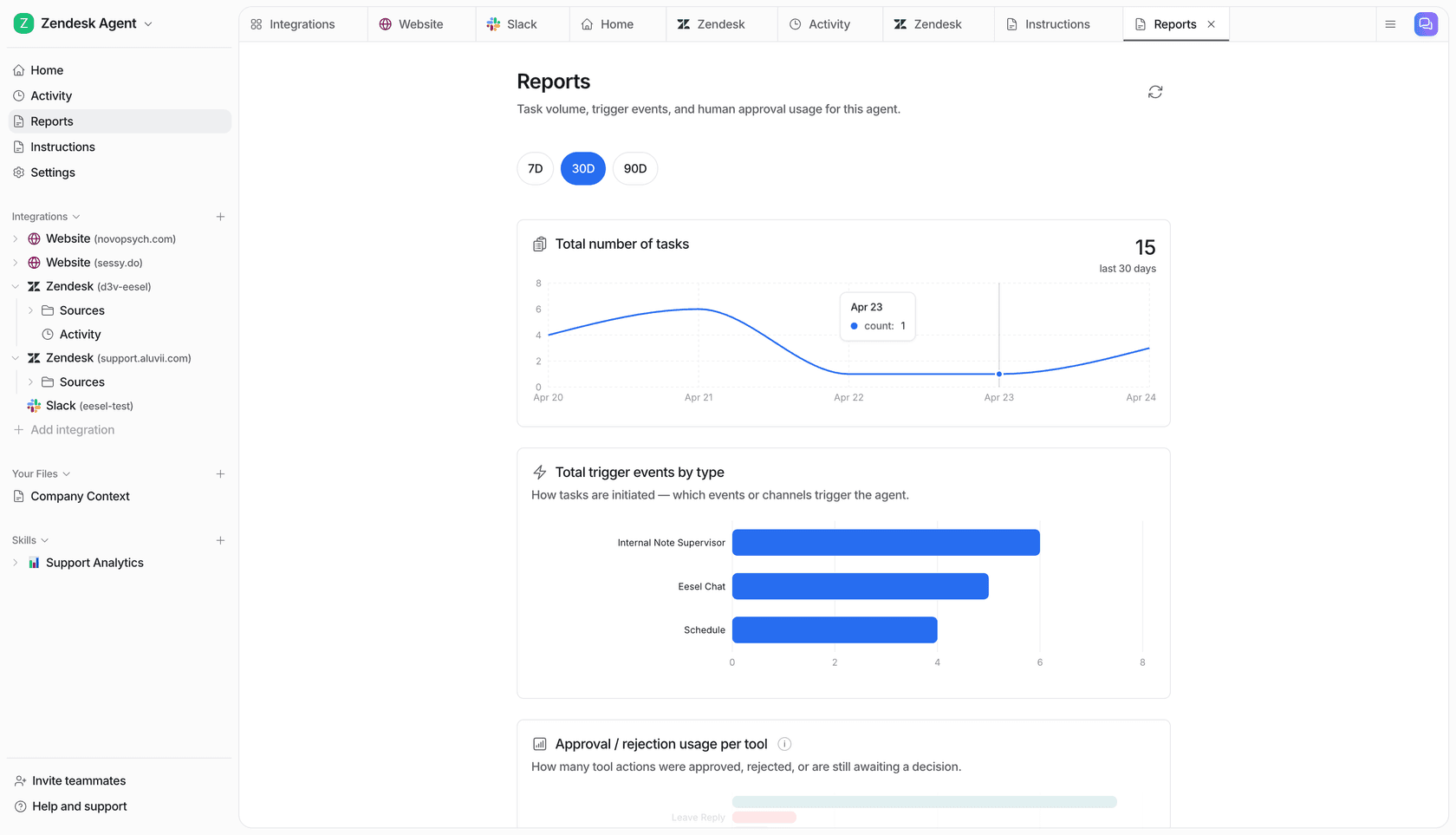
There's a second half to the loop that's easy to miss: feedback should also train your automation. When a customer says a canned answer was wrong, that's a signal your AI support workflow or your knowledge base needs an edit, not just your reps. This is one of the quieter wins of AI in customer service: the same feedback that used to only reach a manager now improves the customer service GPT answering the next ticket. One of the things I like about how we've built this is that the AI is coachable in plain language, the same way you'd coach a teammate. A customer of ours put it well in a public review:
"Finally, a coachable AI agent for supporting customer experience accessible to small businesses. It reads and memorizes our procedures, products, and policies, and when we re-test, it correctly incorporates the coaching. We're looking forward to a 24/7 supervisor that coaches newer team members on how to handle inquiries."
a small-business support founder, reviewing eesel on G2

That's the whole point of feedback: a signal that something should change. Whether the thing changing is a rep, a doc, or the AI, the examples above are only worth writing if they close that loop.
Try eesel for feedback you can actually act on
If the bottleneck isn't collecting feedback but doing something with the pile, that's the problem eesel is built for. It plugs into your existing helpdesk (Zendesk, Freshdesk, Gorgias, Help Scout and more), tags every ticket and survey comment by sentiment and theme automatically, and drafts replies your agents review, so the feedback loop closes without anyone reading a thousand comments by hand.
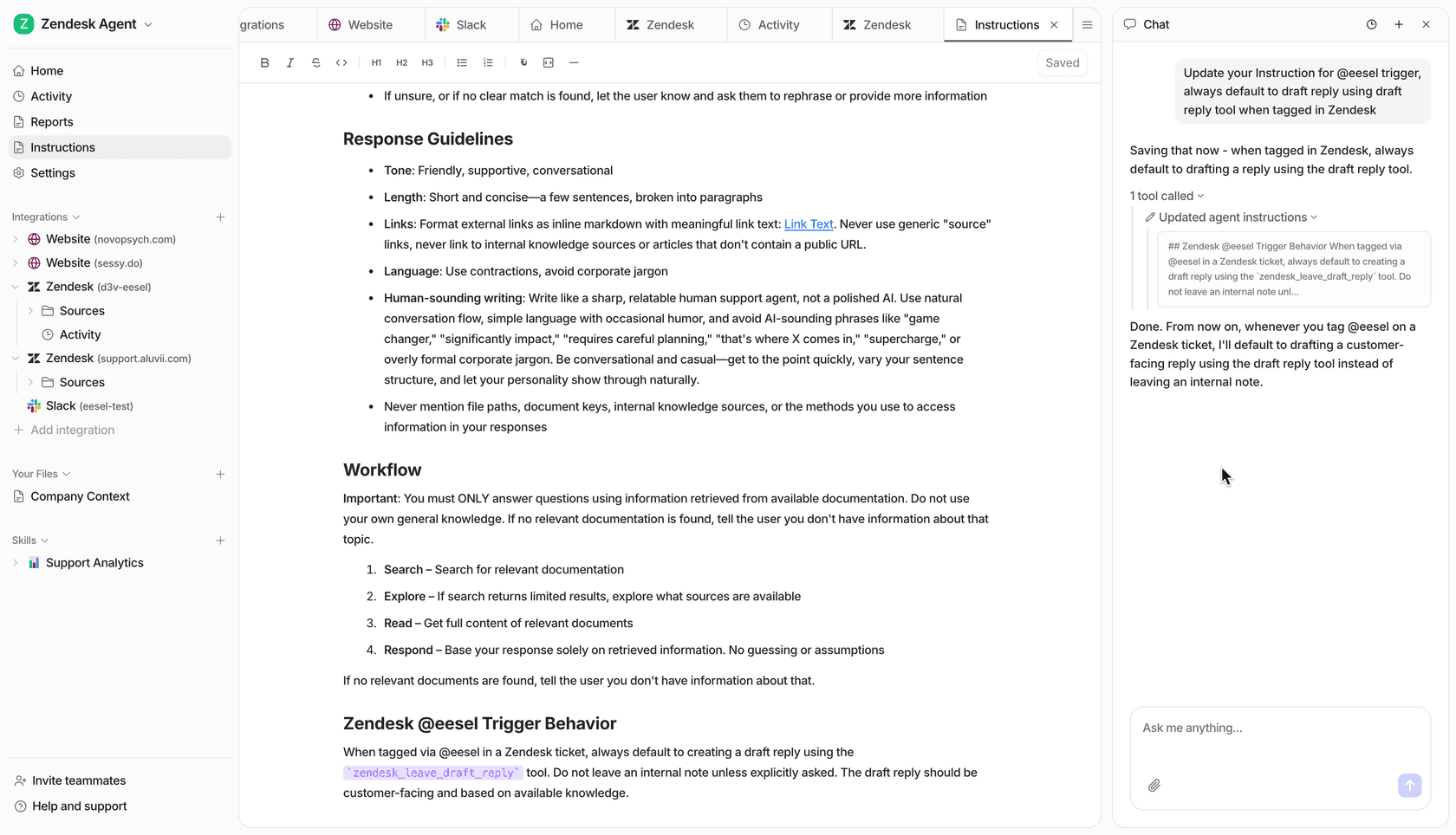
The part that fits this post best: eesel takes coaching in plain English. When feedback shows the AI answered something the wrong way, you correct it in a sentence, re-test against your real past tickets, and it holds, the same coaching loop you run with a human rep. It's free to try, and you can point it at your own historical tickets to see how it would have handled them before it ever touches a live customer.
Frequently Asked Questions
What are good customer service feedback examples for a rep?
How do I write constructive customer service feedback without demotivating my team?
How should I respond to negative customer service feedback?
What is the difference between CSAT, NPS, and CES feedback?
Can AI help analyze customer service feedback at scale?


Article by
Riellvriany Indriawan
Riell is a designer and writer at eesel AI with about two years of experience researching CX platforms, AI chatbots, and helpdesk software. She combines her design background with a sharp eye for how these tools actually look and feel in practice — making her comparisons unusually visual and user-focused.