
Why telecom support is its own kind of hard
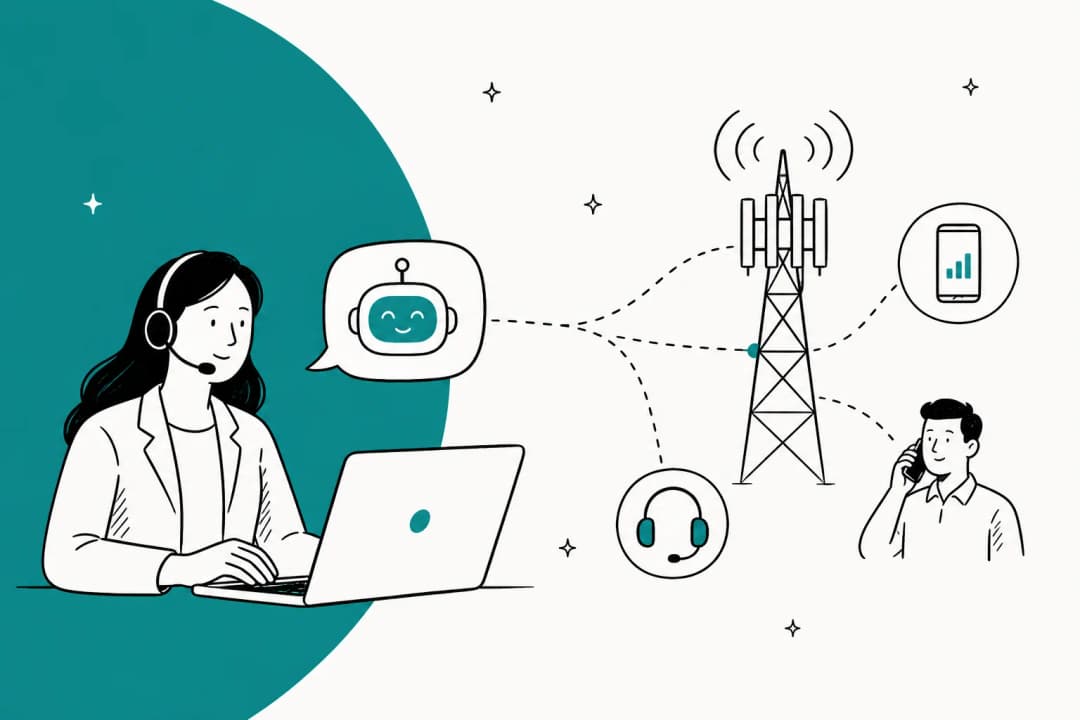
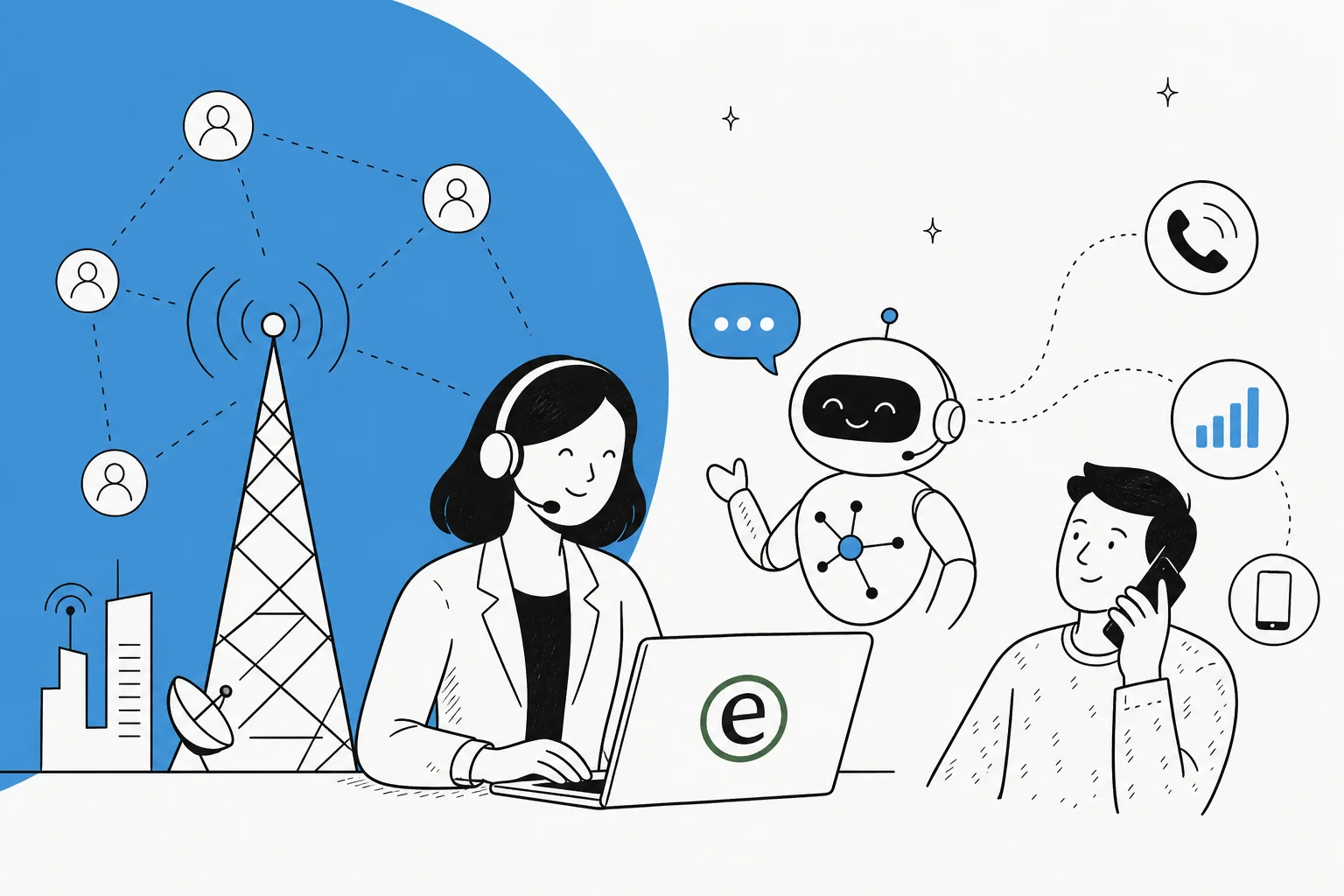
I work a support queue every day, and telecom is the example I reach for when someone says "support is support, it's all the same." It isn't. Telecom queues combine the three things that break AI and humans alike: enormous volume, genuinely complex issues, and customers who are already angry before they reach you because the service they pay for stopped working. It is a long way from the tidy AI customer service workflow most demos show you.
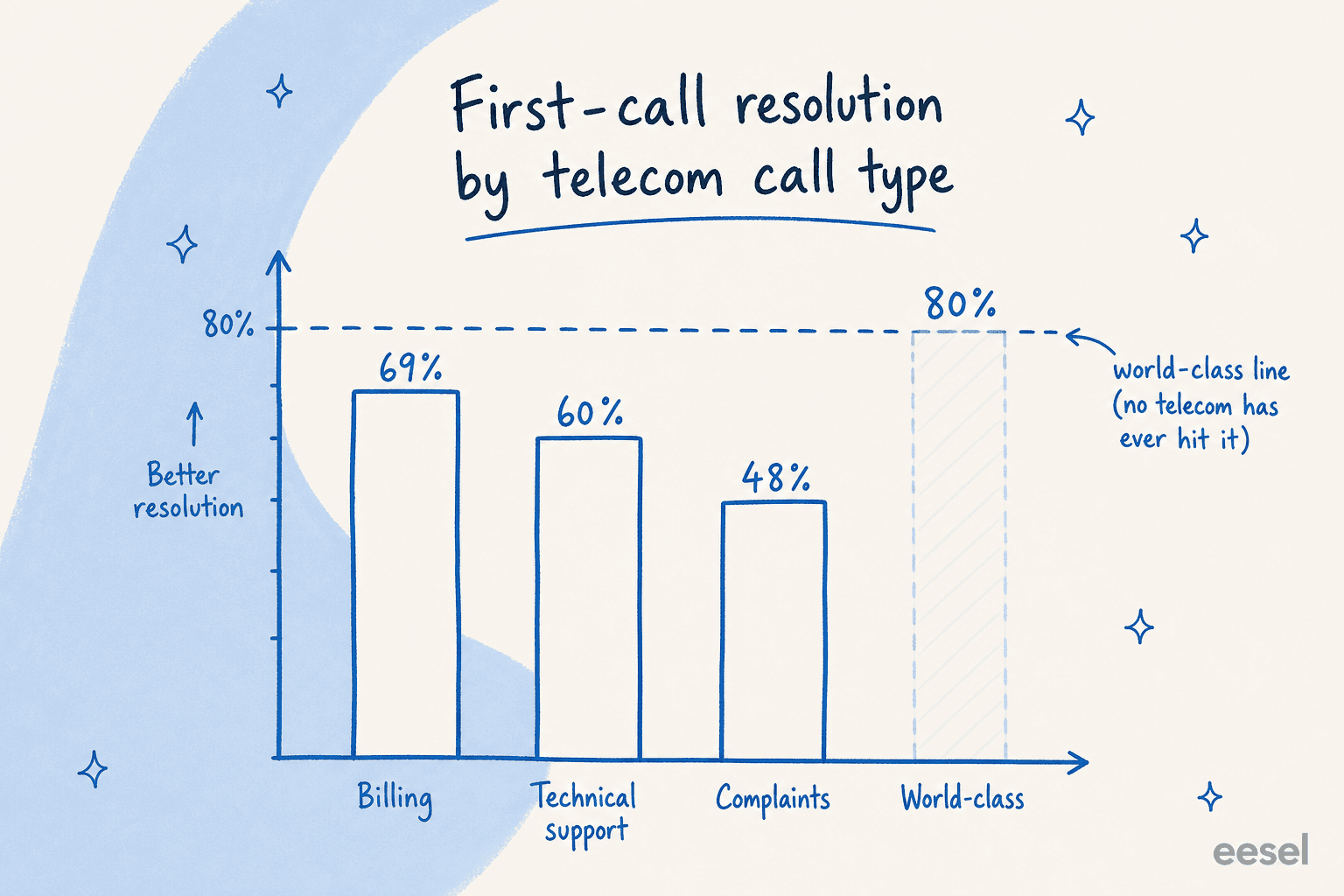
The benchmark data backs this up bluntly. According to SQM Group's 2024 first-call resolution benchmark (published February 2025), telecom call centers sit in the "needs improvement" band, and in SQM's 25-plus years of benchmarking, no telecom company has ever achieved world-class first-call resolution. The all-industry average is 69%; world-class is 80% or higher, hit by just 5% of call centers.
What makes it worse is that telecom's hardest calls are also its highest-volume ones. SQM's breakdown by call type shows billing resolves first-time only 69% of the time, technical support 60%, and complaints just 48%. Those three categories are the bulk of any carrier's queue.
And the pressure is climbing. SQM reports average handle time of 697 seconds, around 11.6 minutes, up 18% year over year, with the longest calls resolving worse than mid-length ones. On the staffing side, 34% annual agent turnover means callers regularly reach undertrained agents on exactly the complex billing and network issues that need experience. This is the gap that AI is supposed to close, and it is why telecom keeps reaching for AI customer service automation faster than almost any other vertical.
It is also regulated. Ofcom's Q2 2025 complaints report found that faults, service quality, and getting connected remain the top reasons broadband and landline customers complain, and billing failures carry real penalties: Ofcom required BT to refund or credit 18 million pounds to customers after one enforcement action. When a wrong answer can become a regulatory issue, accuracy is not a nice-to-have.
The AI telecom got first (and why customers hated it)
Here is the part most vendors skip. Telecom did not avoid AI. It rushed in, and a lot of it was bad. The first wave was a deflection bot bolted in front of the phone queue whose real job was to stop you reaching a human, and customers saw straight through it.
You do not have to take my word for it. On Comcast's own customer forum, in a thread literally titled "Why is your AI completely useless", the voice is brutal and consistent:
"I spent 20 min in an endless loop with the chatbot online and on the phone. The only way to speak to a real human is to state to the chat bot you want your service disconnected."
Customer on the Xfinity community forum
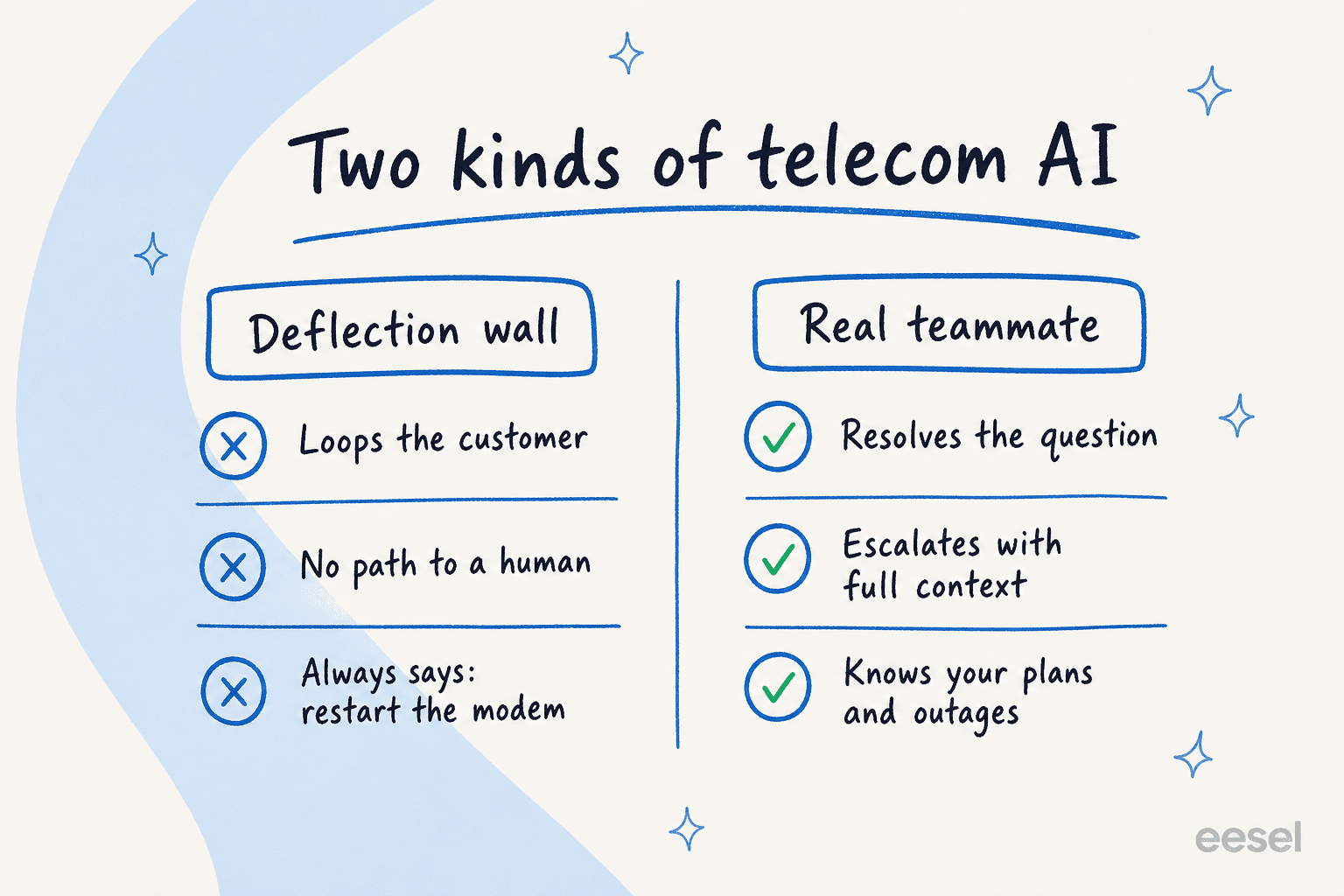
Another in the same thread: "Useless software that sends customers on an endless loop where the solution is always to restart the modem." That is the macro story the ACSI captured in one phrase, "AI promises fall short," shrunk down to a single furious customer at 11pm.
The lesson is not "AI doesn't work for telecom." It is that a deflection wall and a real teammate are opposite things that happen to share a chat window. One traps the customer; the other resolves the issue or routes it cleanly. If you only remember one image from this post, make it this one.
The good news is that done right, the numbers flip. Vodafone's own newsroom reports its TOBi assistant processes around 1 million interactions a month at 70% first-time resolution, and the wider program lifted UK first-call resolution to 77%. That is a carrier-scale proof point that AI can resolve at the top of a telecom queue rather than just absorbing it.
What good AI customer service for telecom actually does
So what is the high-volume, repetitive layer that AI should own? In a telecom queue it is remarkably consistent, and it maps almost one-to-one onto the call types that frustrate everyone:
- Billing questions. "Why is my bill higher this month," "explain this charge," "change my payment date." Billing is the biggest telecom call type and one of the worst for first-call resolution, which makes it the single highest-value automation target. An AI trained on your real billing tickets and connected to your account data can answer billing questions without a human.
- Outage and network status. "Is there an outage in my area?" An AI agent that checks your status systems answers this instantly instead of adding the customer to a hold queue that is already spiking because of the same outage. It is one of the cleanest ways to reduce ticket volume during an incident.
- Plan changes and account maintenance. These already resolve cleanly when humans handle them (SQM puts account maintenance at 72% first-call resolution), which makes them a safe, clean automation candidate.
- After-hours coverage. Telecom customers do not have outages on a 9-to-5 schedule. After-hours AI support covers the overnight window your human queue can't, which is also where the angriest forum posts get written.
- Multilingual support. Carriers serve large, mixed-language customer bases. A multilingual support agent answering in the customer's own language is table stakes, not a premium feature.
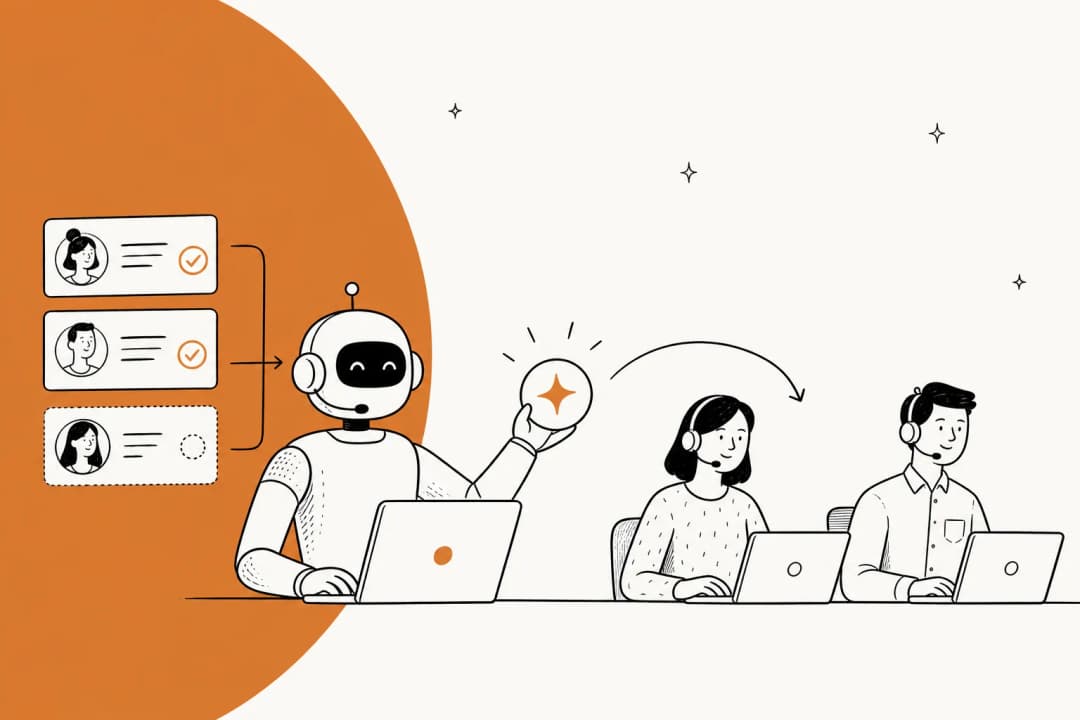
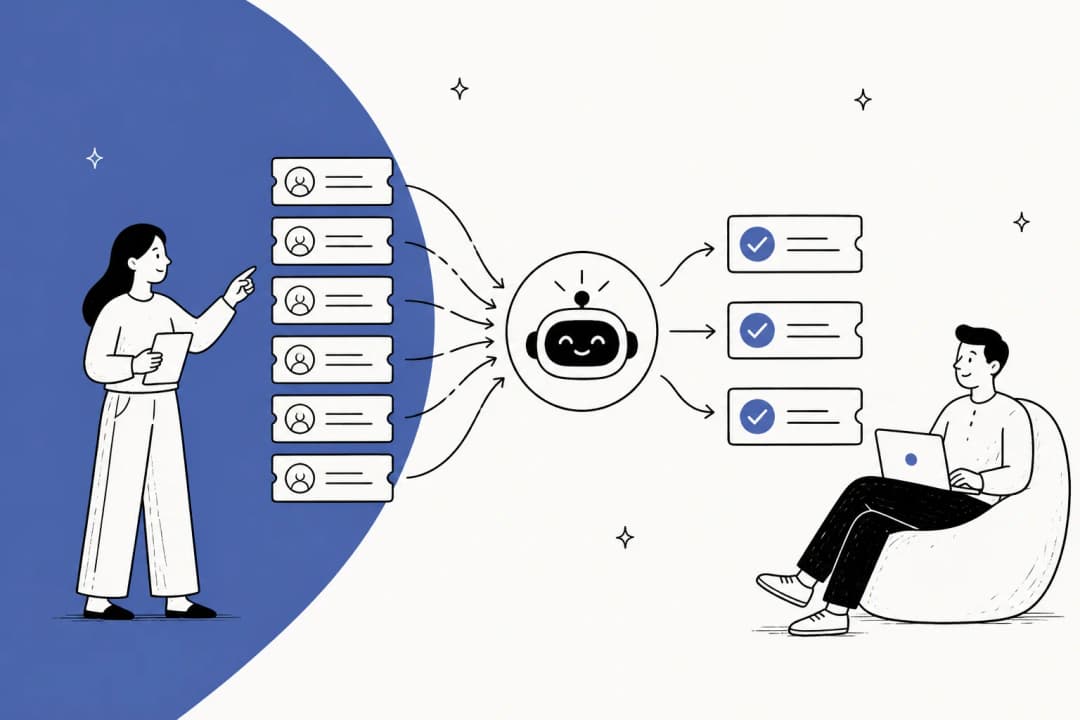
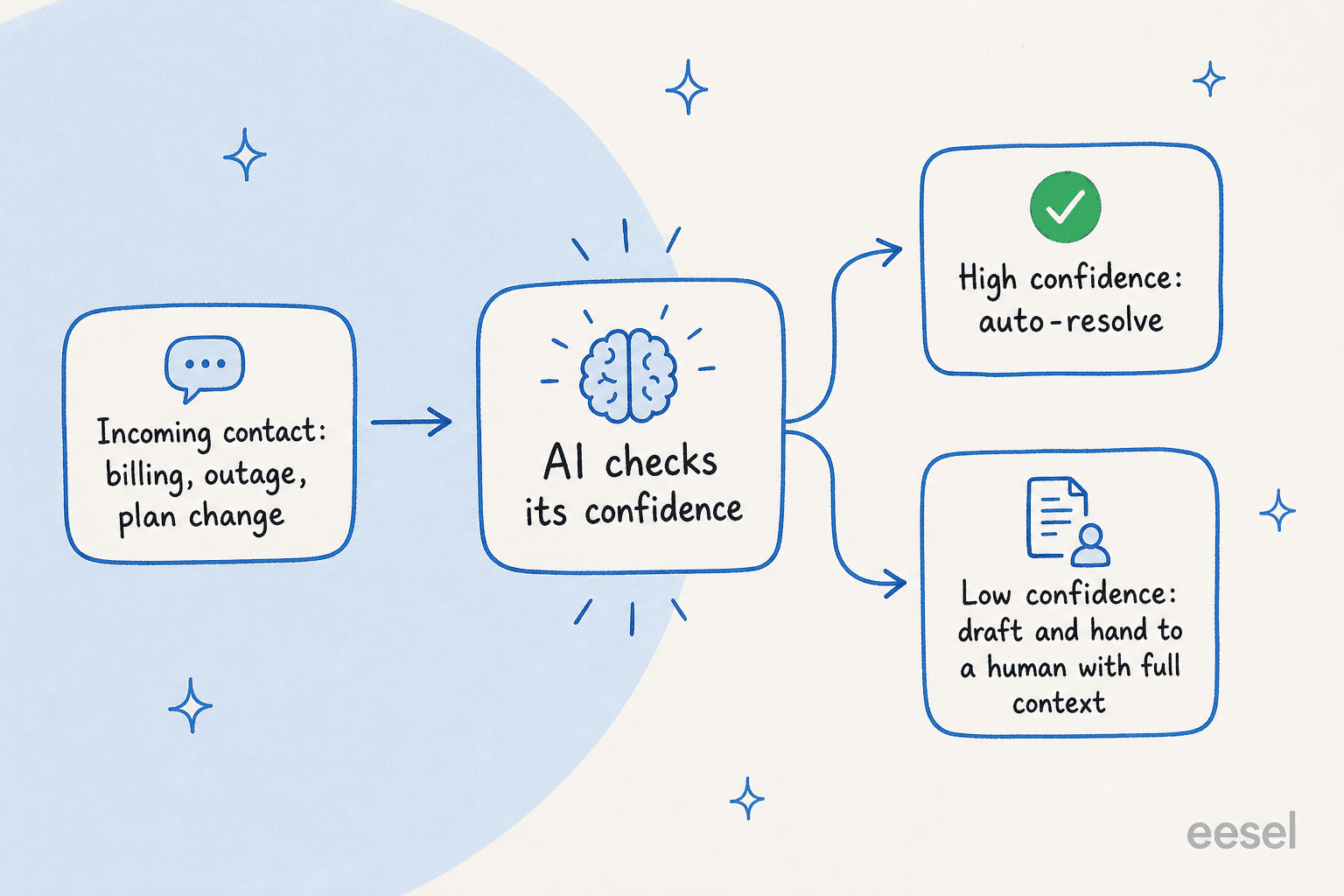
The mechanism that makes this safe rather than reckless is confidence routing. Instead of forcing the AI to answer everything (the deflection-wall mistake), a good system lets it answer only what it is confident about and quietly draft-and-escalate the rest, with the full conversation handed to the human so the customer never repeats themselves.
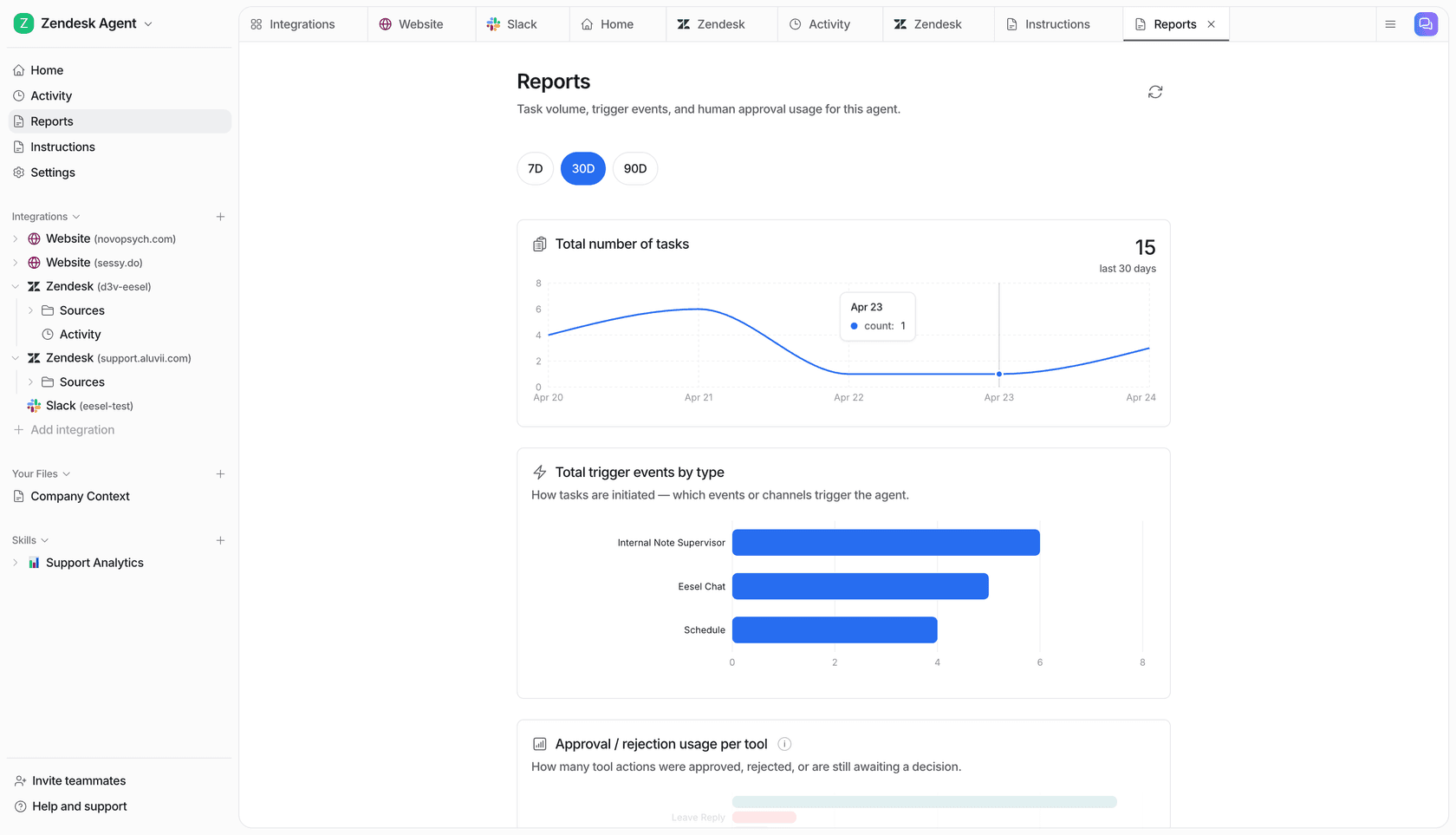
This is also where the AI lives matters. The strongest setups don't bolt a separate chatbot onto the side; they run inside the helpdesk you already use, so the AI sees the same tickets, macros, and customer history your agents do. Here is what that looks like running on a live Zendesk queue:
Keeping it accurate: the part regulated telecoms can't skip
Given that telecom billing errors come with 18 million pound-shaped consequences, "the AI sounds confident" is not good enough. The thing I have watched go wrong most often is a bot that answers fluently and wrongly, which is worse than no answer at all. Two controls fix most of this.
First, hallucination prevention. The AI should answer from your actual knowledge (help docs, past resolved tickets, account systems) and route to a human when its confidence drops, rather than improvise a plausible-sounding charge explanation. We learned this the hard way years ago, which is why we now treat low confidence as a routing signal, not a failure.
Second, simulation before launch. This is the step that separates a careful rollout from a hopeful one. Before the AI replies to a single real telecom customer, you run it against thousands of your past tickets to see exactly what it would have said, where it would have resolved, and where it would have stayed silent. You fix the gaps, then go live with a number you actually trust.
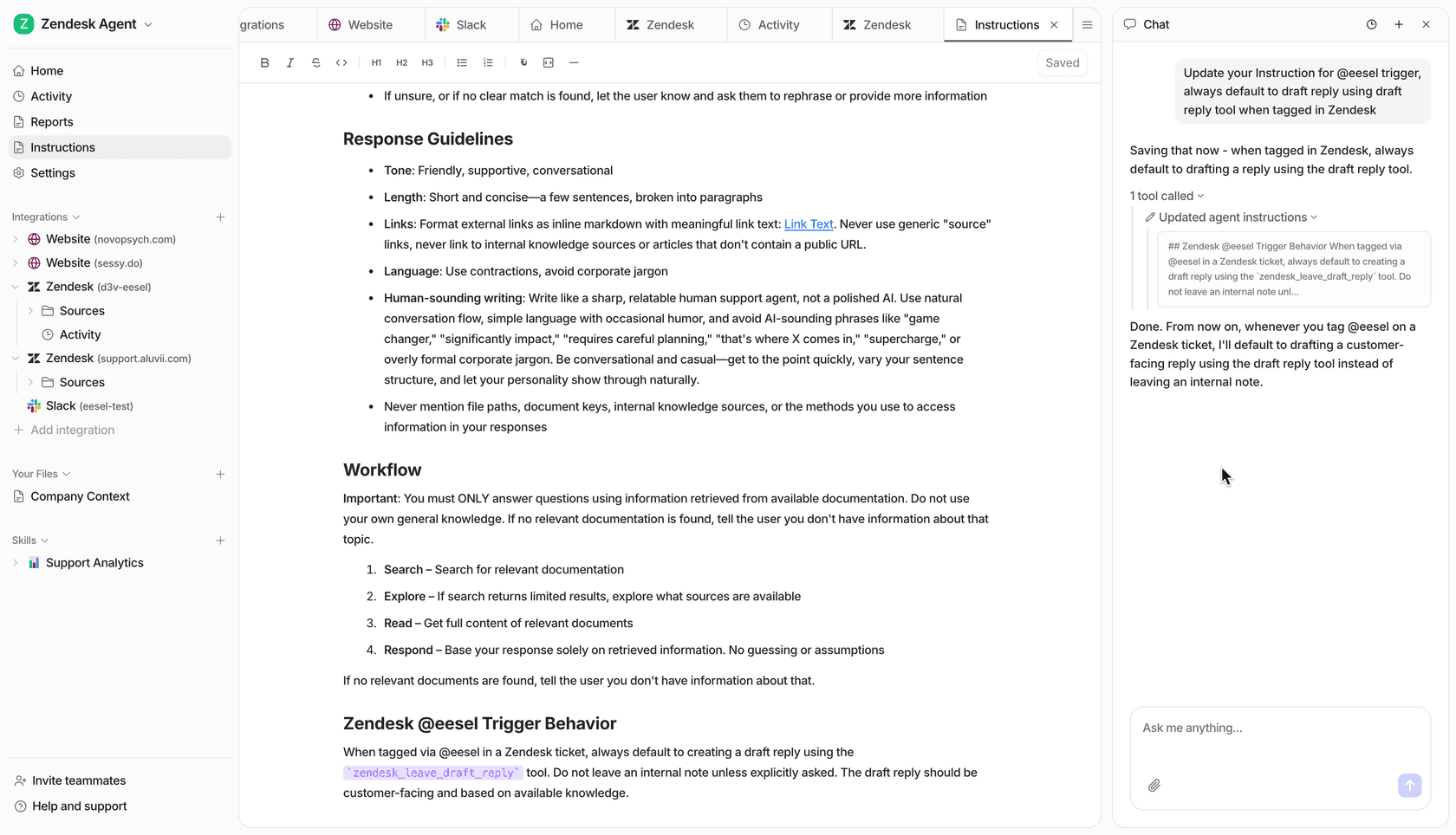
You can also tune behavior in plain language instead of a rules engine, which matters when a carrier's policies change often. Telling the AI "never quote a final bill amount, always escalate refund disputes" should be a sentence, not a sprint.
What to look for when choosing a tool
If you are evaluating AI customer service software for a telecom operation specifically, the generic "best AI chatbot" checklists miss what actually bites at carrier scale. (If you want a tool-by-tool view, we keep a separate roundup of the best AI for telecom support.) Here is the shortlist I would hand a telecom support lead.
| What to check | Why it matters for telecom | The trap to avoid |
|---|---|---|
| Trains on your past tickets, not just help docs | Telecom answers live in resolved tickets (billing edge cases, regional outages), not tidy articles | Tools that only read your help center give generic answers |
| Confidence routing with clean escalation | The difference between resolution and a deflection wall | "Answers everything" is a red flag, not a feature |
| Simulation against historical volume | Lets you trust a resolution number before go-live | No simulation means you test on real angry customers |
| Usage-based pricing | Outage spikes shouldn't cause surprise bills | Per-resolution or per-seat pricing punishes volume |
| 80+ languages out of the box | Mixed-language carrier customer bases | English-only widgets that quietly drop everyone else |
| Runs inside your helpdesk | Same tickets, macros, and history as your agents | Side-car chatbots that can't see the full picture |
On pricing specifically: telecom volume is where the model choice gets expensive. Per-seat and per-resolution pricing both scale against you exactly when you need the AI most (an outage). A usage-based model where you pay per ticket keeps the math predictable, and it is worth comparing directly against your current cost per human-handled ticket and even an offshore team comparison before you decide. The cost savings usually come from volume, so the unit you are billed in matters more than the headline rate.
It is also worth being honest about where AI is not the answer yet. Deeply technical network diagnostics, retention conversations with a churning enterprise account, anything emotionally charged: those still want a human, and a good tool should make that handoff fast rather than pretend it can do everything. That honesty is the whole point. The carriers customers complain about are the ones whose AI refused to admit a limit.
Try eesel for telecom support
If you run a telecom support queue, eesel AI is built for the situation I have described: it lives inside your existing helpdesk (Zendesk, Freshdesk, Front, Gorgias, and more), learns from your past tickets and help docs on day one, and answers billing, outage, and plan questions in 80-plus languages while routing anything it is unsure about to a human with full context.
The differentiator that matters most for a regulated, high-volume vertical is the simulation mode: you run it against your own historical tickets and see the real resolution rate before it ever talks to a customer. For a sense of scale, one eesel customer runs a fully automated agent on 100,000+ tickets a month, and Gridwise saw 73% of tier-1 requests resolved in the first month. It is free to try, no credit card, so you can simulate against your own queue and see the number for yourself.

Frequently Asked Questions
How is AI used in customer service for telecom companies?
Can AI handle telecom billing questions?
Is AI customer service reliable enough for a telecom company?
How much does AI customer service for telecom cost?
Can AI support telecom customers in multiple languages?


Article by
Riellvriany Indriawan
Riell is a designer and writer at eesel AI with about two years of experience researching CX platforms, AI chatbots, and helpdesk software. She combines her design background with a sharp eye for how these tools actually look and feel in practice — making her comparisons unusually visual and user-focused.