
Why telecom support breaks generic AI tools
I've spent the last few years on support queues watching AI get rolled out, and telecom is where a lot of generic deployments quietly fall over. The contact mix is brutal: a single carrier juggles billing disputes, "why is my service down," SIM swaps, plan upgrades, roaming charges, and contract cancellations, often in several languages, across phone, SMS, chat, and email at the same time. The volume is relentless and seasonal spikes are vicious.
That combination punishes two things. First, wrong answers are expensive here. A confidently-wrong reply about a customer's bill or contract isn't a cute hallucination, it's a complaint, a chargeback, sometimes a regulator. We've watched confident-sounding bots quietly give wrong answers, which is exactly why every serious rollout now gets simulated against historical tickets before it touches a live customer. As one CX lead we worked with put it, the goal isn't an AI that tries everything:
"The AI will never be able to answer 100% of the questions. I need an AI who is only handling the tickets that it's confident to handle and all the other ones, leave them alone."
Second, channel sprawl means no single tool covers everything. A voice agent that nails phone calls usually won't touch your Zendesk queue, and a helpdesk AI that resolves tickets brilliantly won't pick up the phone. The honest read is that most telecoms end up running a voice platform on the call lines and a separate AI on the digital queue. So the list below is organized around what each tool is genuinely best at, not a fantasy of one bot to rule them all. If you want the wider field beyond telecom, our roundups of the best AI helpdesk software and the best AI agents for customer service cover more ground.
How I picked
Every tool here is in active use for high-volume customer service, has real telecom or carrier-adjacent customers (or is explicitly built for regulated, high-volume verticals), and I could verify its capabilities against primary sources rather than marketing decks. I weighted four things: channel fit (voice vs digital), how the AI is kept from going off the rails, pricing transparency, and how fast a team can actually get it live. Here's the shortlist before we go deep.
| Tool | Best for | Voice | Billable unit | Starting price | Deployment |
|---|---|---|---|---|---|
| eesel AI | Digital ticket/chat queue, fast pilots | Digital-first | Per ticket | $0.40/ticket, no seat fee | Self-serve, live in days |
| Ada | Large omnichannel CX, voice + digital | Yes | Per conversation (est.) | Quote only, 300k+ convos/yr | Sales-led, services wrap |
| PolyAI | Autonomous phone lines at scale | Voice-first | Per minute | Quote only | Sales-led |
| Parloa | Enterprise voice + contact center | Voice-first | Quote only | Quote only | Sales-led |
| Boost.ai | Regulated, governance-heavy telcos | Yes | Quote only | ~$50k/yr (third-party) | Sales-led |
| Dialpad | AI-native phone + contact center | Voice-native | Credits + per seat | Quote only | Sales-led |
| Kustomer | High-volume B2C with a CRM timeline | Omnichannel | Per conversation + seat | Quote only, 8-seat min | Sales-led |
| Sendbird | In-app and messaging-led support | Omnichannel | Per conversation | Quote only | Sales-led |
The rest of this post is the long version of that table, plus the pricing math that actually decides the bill.
1. eesel AI
Best for: telecom teams who want to automate the digital queue (tickets, chat, email) fast, without a six-figure contract or a three-month rollout.
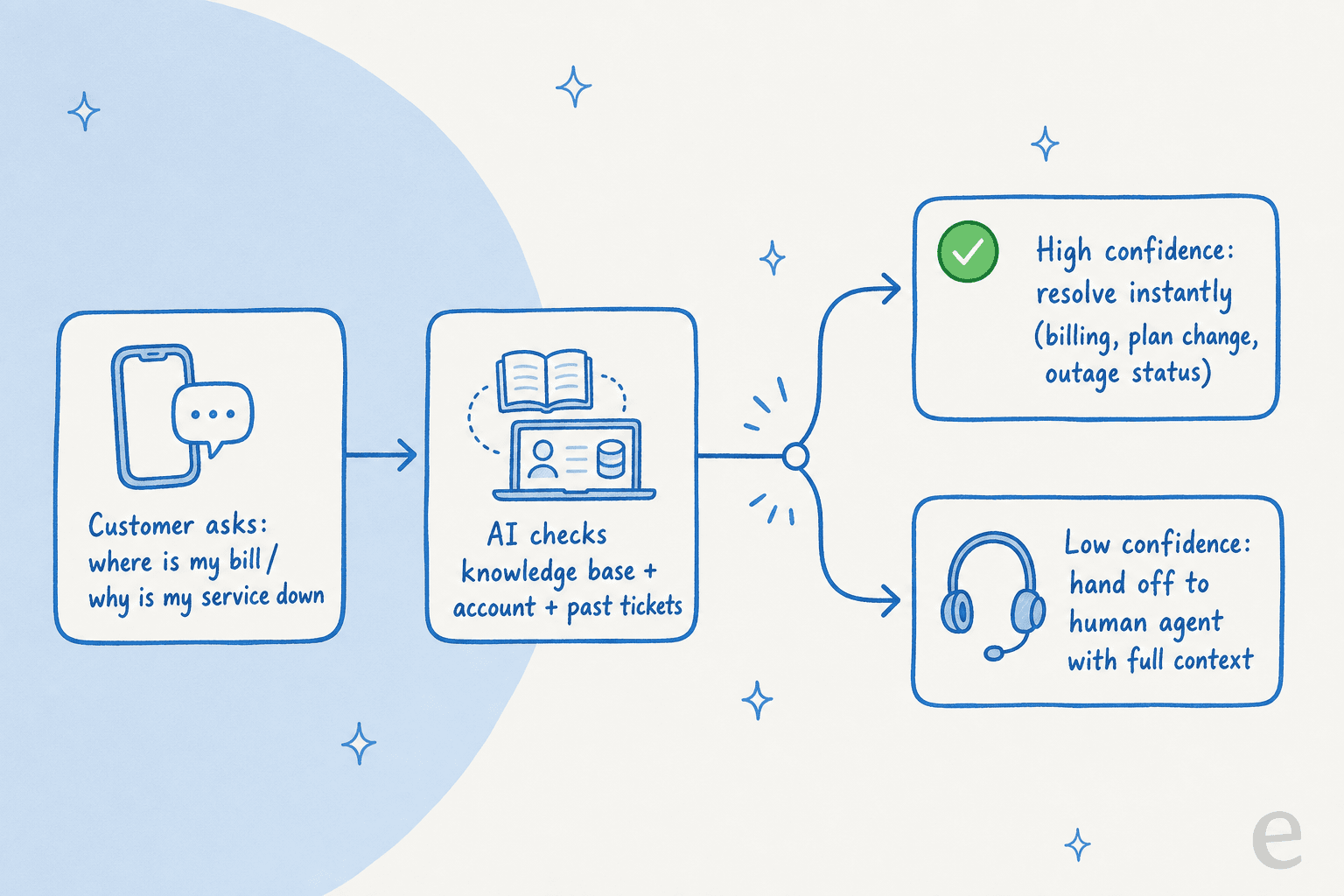
Full disclosure, this is our tool, so I'll be specific about where it fits and where it doesn't. eesel AI is an AI teammate that plugs into the helpdesk you already run (Zendesk, Freshdesk, Front, HubSpot, and others) and learns from your past tickets, help docs, and macros on day one. For a telecom support queue, that means the repetitive digital contacts (billing questions, plan changes, outage status, "how do I reset my router") get drafted or fully resolved, while the AI leaves the hard, sensitive ones alone.
The thing telecom buyers actually care about is risk control, and that's where I'd point you. eesel runs a simulation mode that replays the AI against thousands of your historical tickets so you see the real resolution rate, by topic, before a customer is ever affected. Then confidence-based routing keeps low-confidence answers as drafts instead of auto-sends. It supports 80+ languages out of the box, which matters for any carrier serving a mixed market. On scale: Smava runs a fully automated agent processing 100,000+ German-language tickets a month, and Gridwise saw eesel resolve 73% of tier-1 requests in the first month.
Pros:
- Trains on your real ticket history, not just a help center, so answers match how your team actually talks.
- Simulation mode plus confidence routing is genuinely reassuring for high-stakes billing and contract questions.
- Usage-based pricing at 40 cents per ticket, no per-seat fee, no minimum, so a partial rollout is cheap to trial.
Cons:
- Digital-first. eesel is not an autonomous phone-line voice agent, so for pure inbound call deflection you'd pair it with a voice tool below.
- Built around an existing helpdesk, so a carrier with a fully bespoke in-house ticketing stack needs the integrations to line up.
Verdict: if your telecom pain is the ticket, chat, and email queue and you want to be live and measuring resolution rates in days rather than quarters, this is where I'd start. It's the most accessible tool on the list and the easiest to prove out before you commit budget. For the phone lines specifically, read on.
2. Ada
Best for: large telecoms that want one omnichannel AI agent layer spanning voice, chat, and messaging, and have the volume to justify an enterprise contract.
Ada is a Toronto-based enterprise platform that brands its category "Agentic Customer Experience." It's a standalone AI agent layer that sits on top of your helpdesk rather than living inside one, built around a multi-LLM Reasoning Engine and a Conversation Hub that runs voice, email, chat, WhatsApp, SMS, and Instagram from one place. For telecom, the omnichannel breadth and the voice agents Ada is shipping through 2026 are the draw, along with serious compliance credentials (HIPAA, SOC 2, GDPR, and the AI-specific AIUC-1).
The numbers Ada cites are real and large: Cebu Pacific reports a 34%+ higher automated resolution rate versus their old chatbot, and the customer roster (Digicel, a Caribbean telecom, among them) skews to big consumer brands. The catch is the gate: Ada's pricing page states plainly that it's "a great fit for companies with at least 300,000 annual customer service conversations." There's no public price and no self-serve trial.
Pros:
- Genuinely omnichannel, with strong voice investment and a coaching loop that improves the agent over time.
- Best-in-class compliance story for regulated carriers.
Cons:
- Enterprise-only by design. Below 300k annual conversations, Ada won't be a fit.
- No published pricing and a services-led deployment, so time-to-value is measured in months. For the cost angle, our Ada pricing breakdown and Ada review go deeper.
Verdict: a strong pick for a national carrier with the volume and the procurement patience. If you're mid-market, you'll likely bounce off the 300k floor, and a more accessible alternative will get you live faster.
3. PolyAI
Best for: automating the phone lines, end to end, on the hardest call types a telecom gets.
If your problem is the call queue, PolyAI is one of the most credible voice-first options. It builds enterprise voice agents that answer customer-service calls and hold natural, human-sounding conversations on its proprietary Raven model, which it says is trained on 1B+ enterprise conversations. PolyAI's own positioning is blunt: "not a chatbot, not voice bolted onto chat," and it's proven on exactly the call types telecoms dread: fraud, outage, triage, and multilingual disputes. Utility PG&E and bank UniCredit are among its named customers, and a contact-center head at Zagrebačka banka describes deploying it in Croatian so customers get answers in their local language.
Pricing is per minute of call, enterprise quote only, bundling maintenance, improvements, and a 99.9% uptime SLA on the phone lines. On G2, reviewers "consistently praise the human-like voice and ease of integration."
Pros:
- Purpose-built for voice, with a genuinely natural-sounding agent and strong multilingual support.
- Built for high-stakes, high-volume call centers, which is the telecom reality.
Cons:
- Voice only. It won't touch your tickets, chat, or email.
- Per-minute pricing is quote-gated, and long calls add up, so model your average handle time carefully.
Verdict: the one I'd shortlist first for autonomous phone support at carrier scale. Pair it with a digital-queue tool, because it deliberately doesn't do everything. For more options in this lane, see our roundups of AI voice companies and the AI call center agent landscape.
4. Parloa
Best for: enterprise contact centers, telecom explicitly included, that want a voice-first agentic platform with heavy testing and governance.
Parloa is a Berlin- and New-York-based agentic AI platform whose flagship is the AI Agent Management Platform, which it calls "the industry's first agentic AI platform purpose-built for enterprise contact centers." It names telecommunications as a core target vertical, and it's voice-first across voice, chat, and messaging in many languages. The company is a fast-rising unicorn: it raised a $350M Series D in January 2026 at a roughly $3B valuation, led by General Catalyst, after a $120M Series C the prior May.
What stands out for risk-averse telecom buyers is the simulation tooling: Parloa's simulation agents run thousands of synthetic conversations across scenarios, languages, and edge cases before deploy, and it carries a deep compliance stack (ISO 27001, SOC 2 Type 1 and 2, PCI DSS, HIPAA, DORA).
Pros:
- Voice-first and explicitly built for telecom-scale contact centers.
- Strong simulation and evaluation tooling, which is the right instinct for high-stakes automation.
Cons:
- No public pricing, enterprise sales only.
- Independent review volume is thin (a single G2 review as of mid-2026), so you're leaning on Parloa's own materials and a demo to evaluate it.
Verdict: a serious voice contender if you're a large carrier, with the kind of testing discipline I wish more vendors led with. Like PolyAI, it's a phone-and-voice play, not a fix for your ticket backlog.
5. Boost.ai
Best for: regulated telcos where governance, auditability, and "control where it's critical" outweigh speed-to-launch.
Boost.ai is a no-code conversational and agentic AI platform built for large, regulated enterprises, and it calls out telecom directly: Telenor Norway is a named customer. Its "hybrid AI" architecture pairs rule-based intent flows with generative responses, the pitch being "autonomy where it's safe, control where it's critical," which is precisely the posture a carrier wants around billing and contracts. It handles both chat and voice in one platform, with input and output guardrails to keep answers inside regulatory boundaries.
Credibility is solid: Boost.ai has been named a Leader in the 2025 Gartner Magic Quadrant for Conversational AI Platforms for a third year. Pricing is quote-based with no public page; third-party aggregators peg the starting point around $50,000/year.
Pros:
- Governance and guardrails are first-class, with ISO 27001 and 27701 certification.
- Manages chatbot and voicebot in one no-code environment, a recurring G2 positive.
Cons:
- Advanced reporting is the most common knock from G2 reviewers.
- Enterprise pricing and deployment, so not a quick experiment.
Verdict: if compliance and control are the gating factors and you're already enterprise, Boost.ai earns its shortlist spot, with telecom pedigree to back it up.
6. Dialpad
Best for: telecoms that want the phone system and the AI contact center on one AI-native stack.
Dialpad is unusual here because it's a communications platform first, with AI woven into the call itself. It bundles an AI contact center, business phone, and AI agents on one stack, with a proprietary speech engine doing live transcription, sentiment, and coaching. Telecom relevance is literal: T-Mobile is both a customer and an investor, from Dialpad's $170M Series F at a $2.2B valuation. Its AI Agents resolve voice and digital interactions end to end, and live agent assist surfaces help-center answers mid-call. Dialpad Support is rated 4.4/5 across ~693 G2 reviews.
Pricing runs two models side by side: AI Agent on a conversation-based credit pool (you're only charged when the AI does real work), and Dialpad Support per seat, gated behind sales. Reviewers love the clean interface and transcription, but flag that onboarding can feel surface-level for complex routing setups.
Pros:
- Voice-native, with AI built into the call rather than bolted on.
- Real-time transcription and AI CSAT scoring on 100% of calls is genuinely useful for QA.
Cons:
- Per-seat Support pricing isn't public, and the AI credit unit cost isn't either.
- Onboarding depth is a recurring complaint for intricate setups. If you're weighing it against another voice tool, our CloudTalk vs Dialpad comparison helps.
Verdict: a strong fit if you want to consolidate telephony and AI support on one vendor. If you already have a phone system you like, a focused voice agent like PolyAI may slot in more cleanly.
7. Kustomer
Best for: high-volume B2C telecom brands that want AI running on a full customer timeline, not isolated tickets.
Kustomer is an AI-native CX and CRM platform built around a customer-centric data model, so every interaction ties to a full record (account history, plan, past conversations) rather than a standalone ticket. For telecom, where context (which plan, which device, what happened last call) decides whether an answer is right, that's a genuine advantage, much like grounding an AI knowledge base chatbot in real account data. Its Concierge AI handles end-to-end self-service across chat, email, SMS, WhatsApp, and voice, and Vuori reports 70% of chat conversations fully automated with it.
Pricing is quote-only. Competitor teardowns put it around $89 to $139 per seat per month on annual billing with an 8-seat minimum, plus AI billed separately at roughly $0.60 per engaged conversation. The most common G2 gripe is cost, and operators report the voice channel can be buggy, worth knowing if voice is central for you.
Pros:
- Unified customer timeline gives the AI real context, which lifts answer quality.
- Strong omnichannel coverage and proven automation rates at consumer brands.
Cons:
- High seat floor plus separately-metered AI makes the bill hard to predict. See Kustomer alternatives if budget is tight.
- Reported voice-channel reliability issues.
Verdict: a good fit for a B2C telecom already invested in a CRM-style model, less so if you want predictable pricing or rely heavily on voice.
8. Sendbird (delight.ai)
Best for: telecoms whose support lives inside a mobile app, with messaging and in-app chat as the primary channel.
Sendbird, now rebranding its AI agent to delight.ai, comes at telecom support from the communications-infrastructure side. It powers in-app chat, calls, and business messaging at huge scale ("7 billion conversations every month"), and its AI Agent is an enterprise omnichannel agent across in-app chat, web, email, SMS, WhatsApp, and social, with a build-test-evaluate workflow including a simulation environment. For a carrier whose customers live in a self-care app, that in-app depth is the differentiator.
Pricing is the catch. The AI Agent is priced per conversation, contact-sales only, with no published dollar rate, no tiers, and no operational definition of a "conversation." Only the legacy Chat product has public MAU-based pricing. Sendbird rates 4.6/5 on G2, but cost complaints are the largest negative cluster, and Capterra reviewers report opaque, per-customer pricing.
Pros:
- Unmatched in-app messaging and calls infrastructure if your support is app-native.
- Omnichannel AI agent with a real simulation-before-deploy workflow.
Cons:
- No public AI pricing at all, and reviews repeatedly flag cost surprises.
- More developer- and infrastructure-led than a turnkey support tool.
Verdict: the right call if your telecom support is genuinely app-first and you have engineering to lean in. For a standard ticket-and-chat queue, the helpdesk-layer tools are simpler to adopt.
The pricing question that actually decides your bill
Here's the part most roundups skip. At telecom volume, the billable unit matters more than the sticker price, because the units don't compare like-for-like. Per-minute voice pricing scales with call length. Per-conversation pricing scales with contact count, but "conversation" is often undefined. Per-resolution pricing only charges for successful answers. Per-ticket pricing charges once per ticket no matter how many messages it takes.
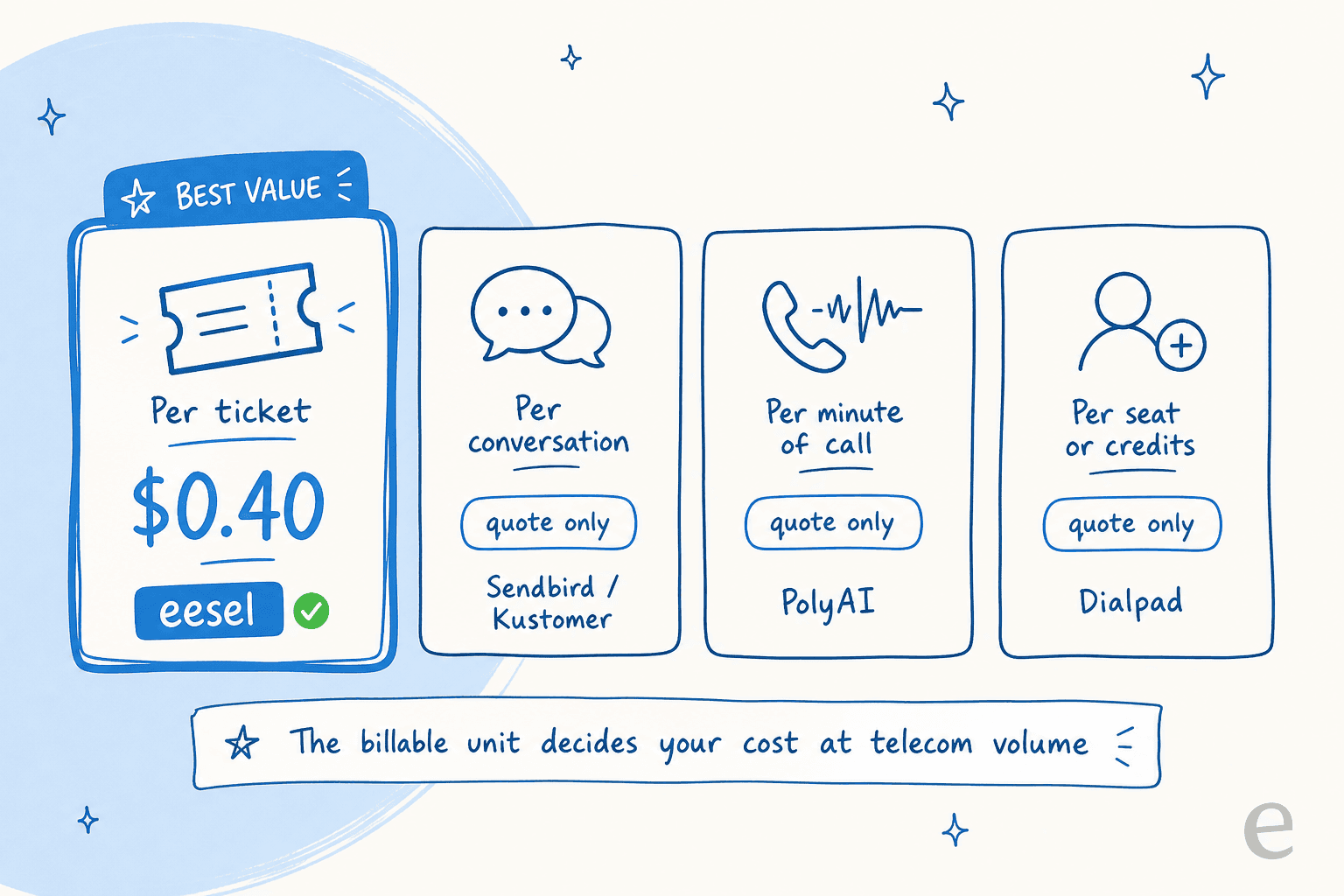
Most enterprise voice platforms here (Ada, PolyAI, Parloa, Boost.ai, Dialpad) are quote-only and routinely land in the tens of thousands per year, which is fine if you're a national carrier and painful if you're not. The transparent end of the market is easier to model. To put a real number on it: a telecom queue resolving 1,000 tickets a month on eesel's 40-cents-per-ticket model is about $400/month, with no per-seat fee and no minimum. Route only 200 of those tickets to start and you pay for 200. That predictability is exactly why I'd pilot on a usage-based tool before committing to an annual voice contract, then layer voice on once the digital queue is under control.
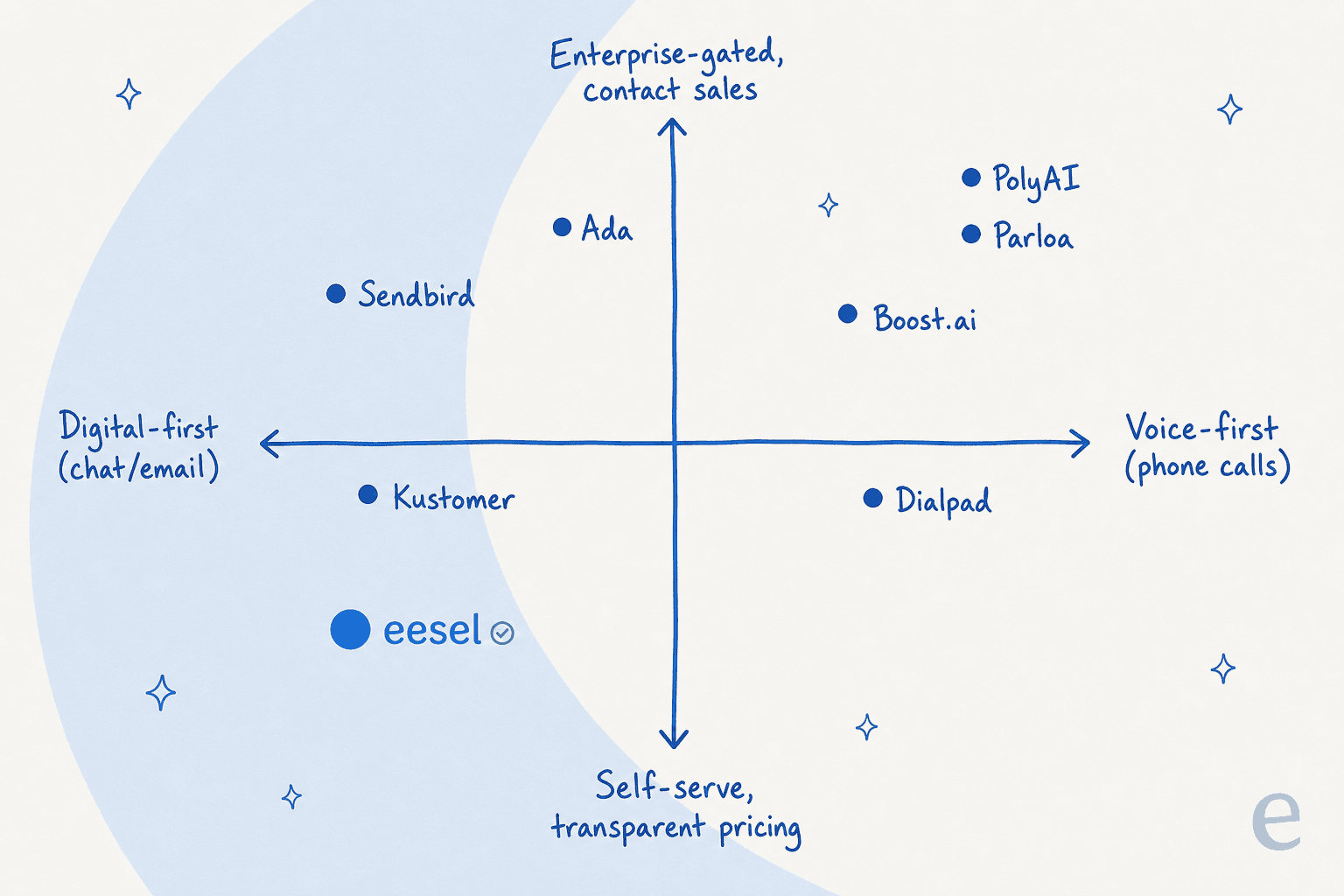
Plotting the field on two axes (digital vs voice, and self-serve vs enterprise-gated) makes the trade-off clear:
Try eesel AI for your telecom support queue
If the part of telecom support that's drowning you is the digital queue, billing questions, plan changes, outage updates, and the same router-reset ticket fifty times a day, that's exactly what eesel AI is built to take off your team's plate.

It plugs into your existing helpdesk in minutes, trains on your past tickets so it already knows how your team answers, and lets you simulate the AI against thousands of your historical contacts to see the resolution rate before a single customer is affected. Confidence-based routing means it only auto-answers what it's sure of and hands everything else to a human with full context. And because it's 40 cents per resolution with no per-seat fee, you can start on a slice of your volume and scale as the numbers prove out. It's free to try.
Frequently Asked Questions
What is the best AI for telecom customer support?
How much does AI for telecom support cost?
Can AI handle telecom billing and outage questions?
Do I need a voice AI agent or a chat AI agent for telecom?
How do I stop an AI support agent from giving wrong answers to customers?


Article by
Riellvriany Indriawan
Riell is a designer and writer at eesel AI with about two years of experience researching CX platforms, AI chatbots, and helpdesk software. She combines her design background with a sharp eye for how these tools actually look and feel in practice — making her comparisons unusually visual and user-focused.