

Why "AI for Tidio" is a different question than you think
Let's be fair to Tidio first, because it's a genuinely good product for who it's built for. It's an all-in-one customer service platform aimed at SMBs and ecommerce brands, it's trusted by 300,000+ businesses including Under Armour and The Body Shop, and it holds a 4.6/5 across 1,879+ reviews. Its AI agent, Lyro, is powered by Anthropic's Claude rather than a generic model, and Tidio claims a market-leading 67% average resolution rate.
But here's the thing that changes how you should shop. With a helpdesk like Zendesk, "adding AI" means browsing a marketplace and dropping in whichever third-party agent you like on top. Tidio doesn't work that way. It's a walled garden: Lyro is the native agent, and there's no open slot to install a rival AI into the Tidio inbox. (The one nuance is Lyro Connect, which goes the other direction, putting Lyro on top of Zendesk or Salesforce, but that's still Tidio's AI, not someone else's.)
So when people search for the best AI for Tidio, they're really asking one of two things. Either "how do I get the most out of Lyro," or, far more often in our experience, "Lyro isn't quite working for me, so what do I move to?" The second group is usually pushed by one of two frustrations, and the loudest by far is pricing.
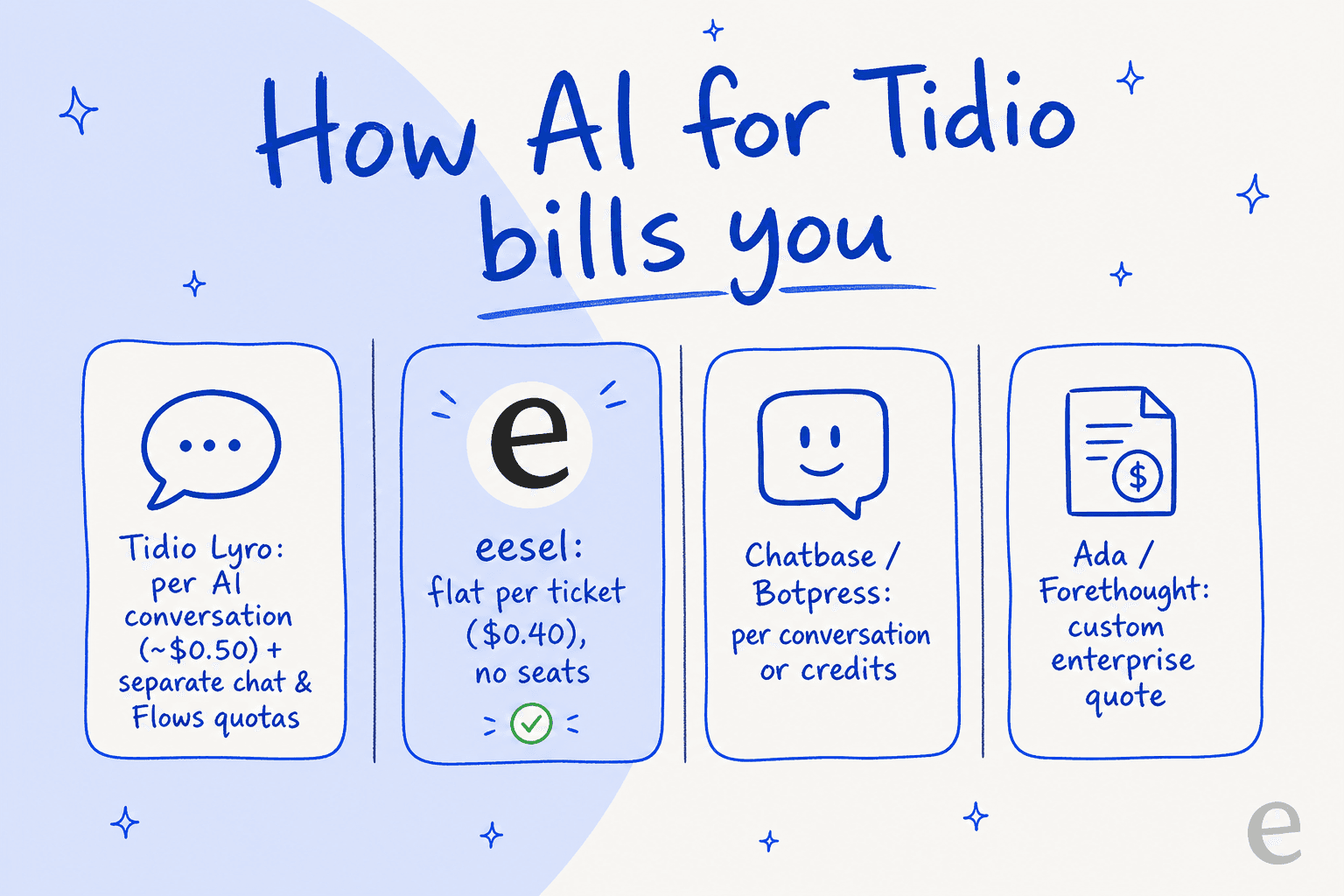
Tidio runs on three separate billing meters at once: billable conversations (human replies), Lyro AI conversations, and Flows visitors reached. Each has its own quota. That stacking is exactly what users flag. As one put it on r/AIAssisted:
"Just had a conversation with tidio, their pricing is so off and hidden, 'free tier' is just a trap includes most services that are billed separatedly once you want to scale... tidio is a NO-GO for me they need to be more transparent"
Leaf-dude-, r/AIAssisted

That's the real shape of this market. Some of you want to make Lyro better, and some of you want out. This list serves both.
How we picked, and how to read it
A quick word on method. For each tool we worked from its own product docs, pricing pages, and UI, plus what real users say on Reddit, Capterra, and G2. Because Tidio is closed, we split the field into two honest buckets: Lyro (the native option you'd keep) and five AI platforms you'd move to if you're leaving Tidio's walled garden behind. We're not going to pretend Chatbase or Ada "integrates with Tidio," because they don't, and you deserve the straight version.
The other axis that matters is where each tool sits: built into Tidio versus a separate AI platform, and SMB self-serve versus enterprise sales-led. Here's roughly how the six shake out.
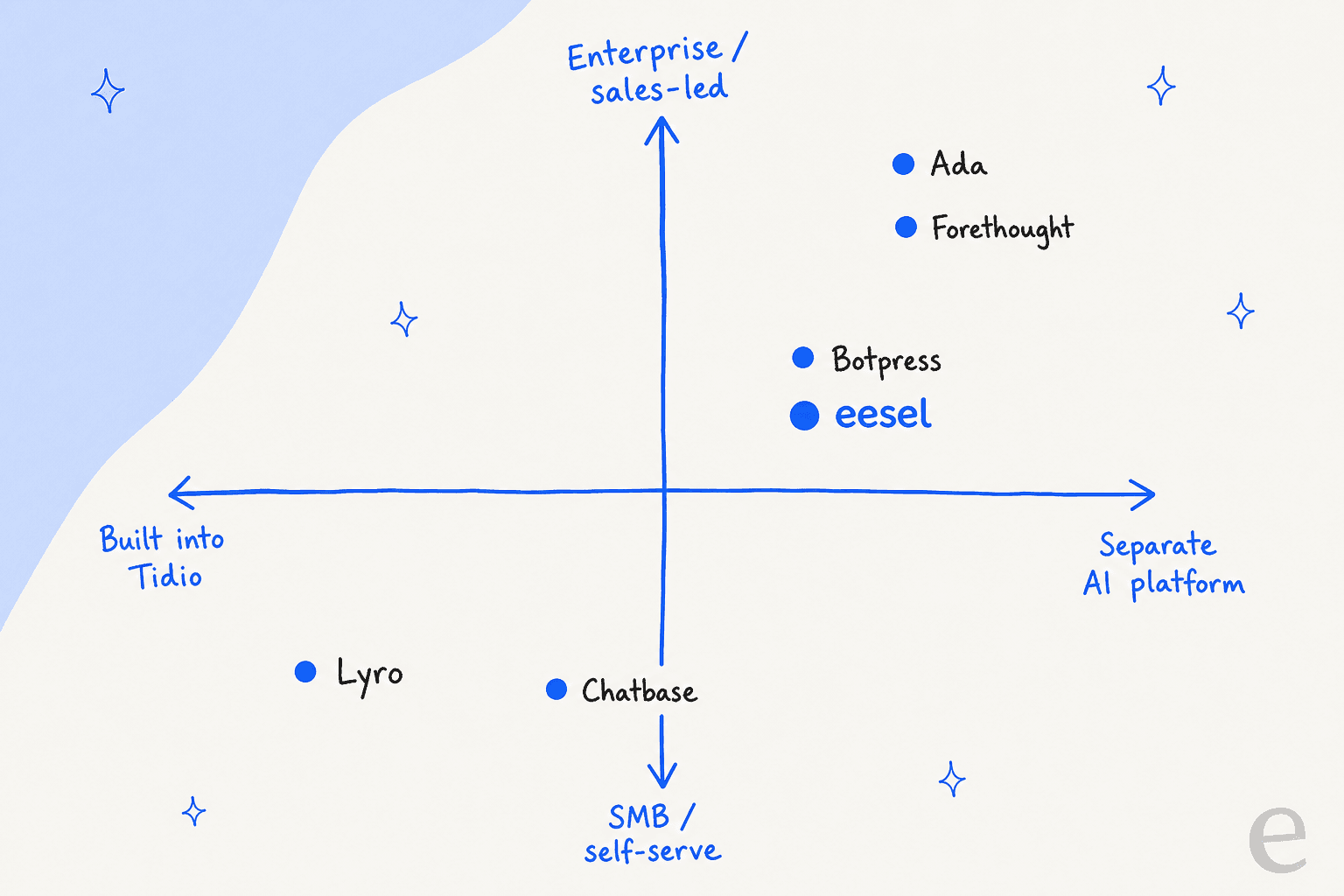
If you just want the fast answer for your situation, this decision tree gets you most of the way there.
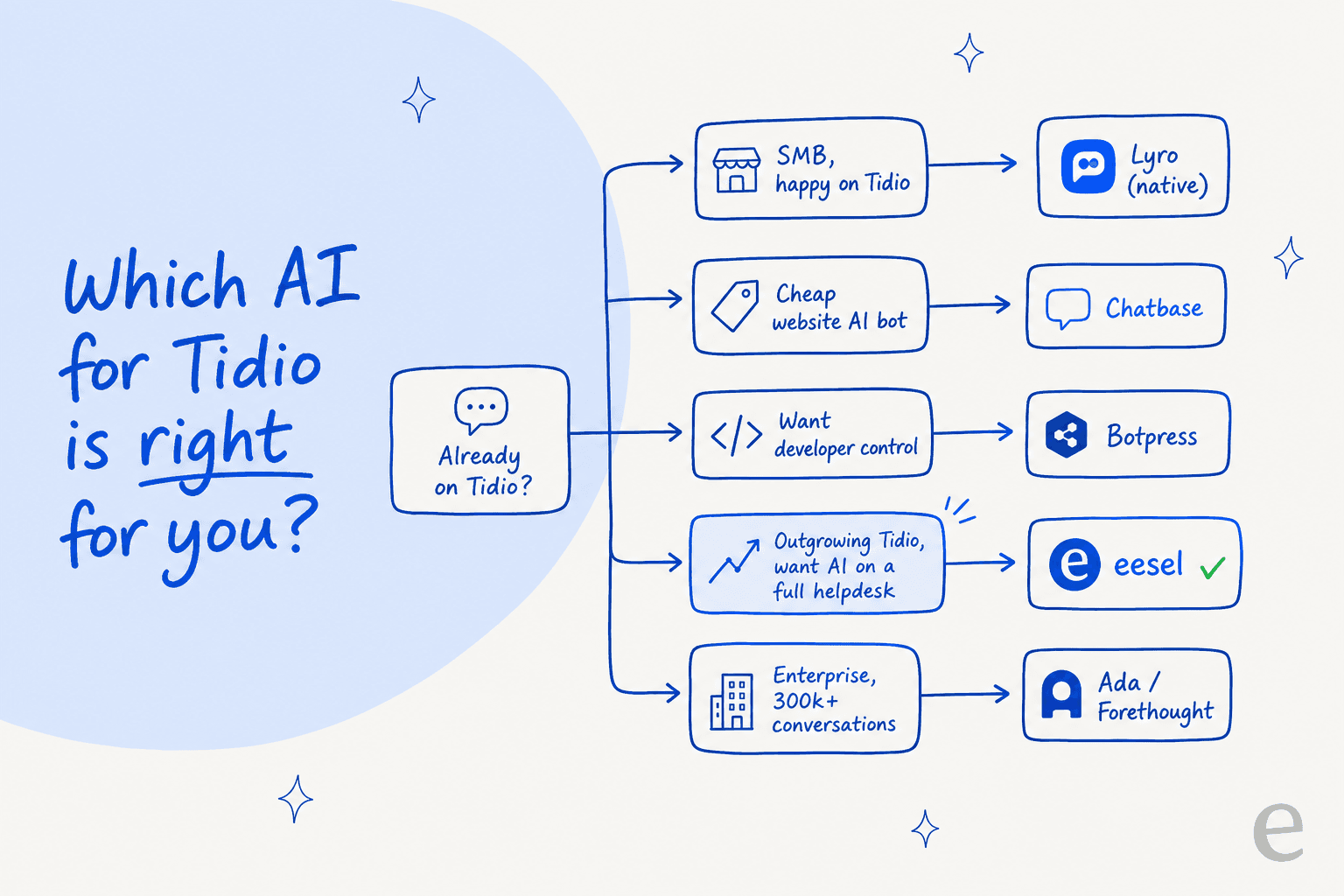
The 6 best AI tools for Tidio in 2026 at a glance
| Tool | Best for | Works with Tidio? | Pricing model | Starting price | Free tier | Security | | --- | --- | --- | --- | --- | --- | | Lyro by Tidio | Staying on Tidio as an SMB | Native (it is Tidio's AI) | Per AI conversation + chat + Flows | $32.50 / mo standalone | 50 Lyro convos free | GDPR; SSO and compliance on Premium | | eesel AI | Graduating to AI on an open helpdesk | No (move to a supported helpdesk) | Per ticket, flat | $0.40 / ticket | $50 free usage | SOC 2 in progress, EU residency, HIPAA on Enterprise | | Chatbase | A cheap website AI bot | No (separate widget) | Per credit, tiered | $32 / mo (Hobby) | Free plan (50 credits) | HIPAA-eligible on Enterprise | | Botpress | Developer-grade custom agents | No (separate build) | Per conversation | $150 / mo (Plus) | Free plan (100 convos) | SOC 2, GDPR, KPMG-tested | | Ada | Enterprise scale (300k+ convos) | No (enterprise platform) | Per resolution | Sales-quoted | No | SOC 2, ISO, HIPAA, AIUC-1 | | Forethought | Agentic AI for big support orgs | No (helpdesk-agnostic) | Custom (platform + outcomes) | Sales-quoted | No (proof of value) | Enterprise-grade |
Now the detail, starting with the one that actually lives inside Tidio.
1. Lyro by Tidio
Best for: SMB and ecommerce teams that are happy on Tidio and want AI that works in the inbox with zero integration.
Lyro is Tidio's conversational AI agent, and if you're on Tidio it's the obvious place to start because it's already there. It learns from content you give it (FAQ uploads, a website scrape, or imported Zendesk help-center articles), answers in your brand voice, and can take backend actions like order updates through Lyro Smart Actions. Tidio leans hard on a single number: a 67% average resolution rate, which it claims is the highest in the category, backed by a money-back guarantee if Lyro doesn't clear 50% on the Premium plan.
What we like is that Lyro is grounded in your content rather than free-styling, which keeps hallucinations down. Reviewers back this up. One Capterra user summed up the quality side:
"For our company, the choice fell on the Artificial Intelligence Agent since it proved capable of, after being properly 'fed' with content, answering practically all the questions that customers ask, without compromising the quality of the response."
Paulo S, CEO (Retail), Capterra

Key features
The core loop is genuinely easy: you point Lyro at your knowledge, set escalation rules with Lyro Guidance, and it handles repetitive questions while flagging anything it's unsure about to a human. The analytics are a real strength too, breaking resolution down by intent so you can see where the AI is strong and where your knowledge has holes.
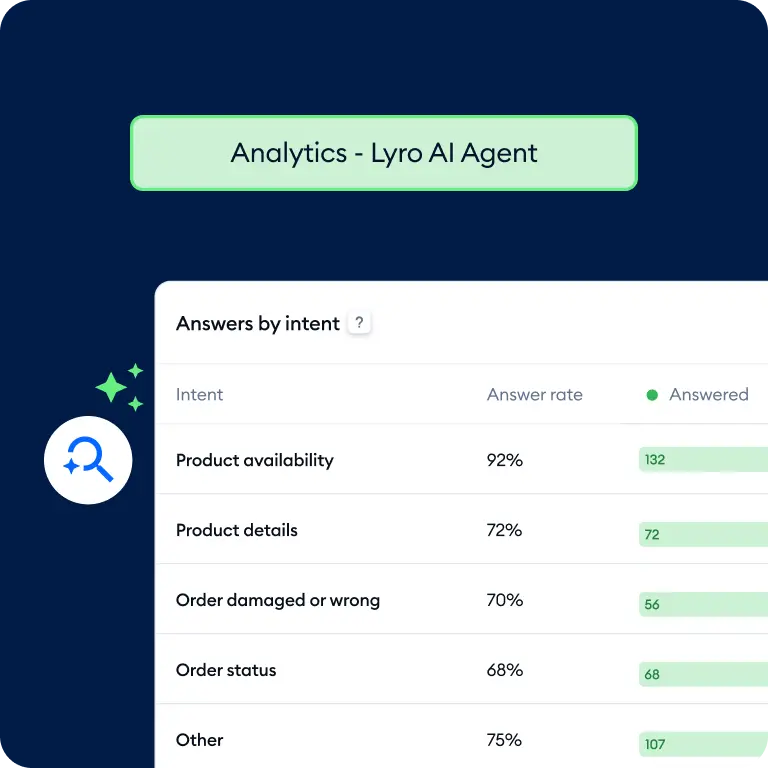
It's also Shopify-friendly, with native order tracking and product recommendations on the Growth plan and up, which is why it scores 4.8/5 on the Shopify App Store. Setup speed is the other repeated win:
"Setup was honestly faster than LiveChat. I had the chat widget running and a basic bot handling FAQs within like an hour... The free plan is actually usable too, which let me test it properly before committing. Up to 10 agents on free which is wild compared to most tools."
gilligan348, r/AIAssisted
Pricing
Lyro can be bought standalone or bundled into Tidio's platform plans. The catch is the three-meter model: AI conversations are separate from human billable conversations, which are separate from Flows visitors.
| Plan | Price (annual) | What you get |
|---|---|---|
| Free | $0 / mo | 50 Lyro conversations (one-time, lifetime) |
| Lyro standalone | from $32.50 / mo | AI only, ~$0.50 per conversation, add to existing help desk |
| Growth | from $49.17 / mo | 50 to 1,000 Lyro convos by tier, Shopify actions, macros |
| Plus | from $749 / mo | Custom volumes, departments, Lyro Connect |
| Premium | ~$2,999 / mo (contact sales) | 3,000+ Lyro convos, guaranteed 50% resolution, SSO |
One quirk worth knowing before you commit: the conversation counter is broad. As one Capterra reviewer noted, "in the limit software is calculating even the greeting to visitors," so proactive hellos can quietly eat your quota. Our full Lyro AI pricing and Tidio pricing guides break down the tiers if you want to model your own numbers.
Pros and cons
- Pros: native to Tidio with zero integration, strong answer quality when fed good content, fast setup, excellent Shopify support, unusually generous free tier (10 agents).
- Cons: three separate usage meters make costs hard to predict, the resolution guarantee is Premium-only, and the "Lyro" name is locked unless you pay up, a gripe one Reddit user called out bluntly: "Lyro (horrible name you can't change unless you pay a ton of money)."
Our take: if you're an SMB on Tidio and your volumes are modest, Lyro is the right answer and we wouldn't overthink it. It's the only AI that's actually native to the platform, and the quality is real. The ceiling is pricing predictability and how far it scales, which is exactly why the rest of this list exists. If you're nodding along to the pricing complaints, our honest Lyro review and roundup of Tidio AI alternatives are the natural next reads.
2. eesel AI
Best for: teams outgrowing Tidio that want an AI agent which learns from past tickets, with a simulation step and flat per-ticket pricing.
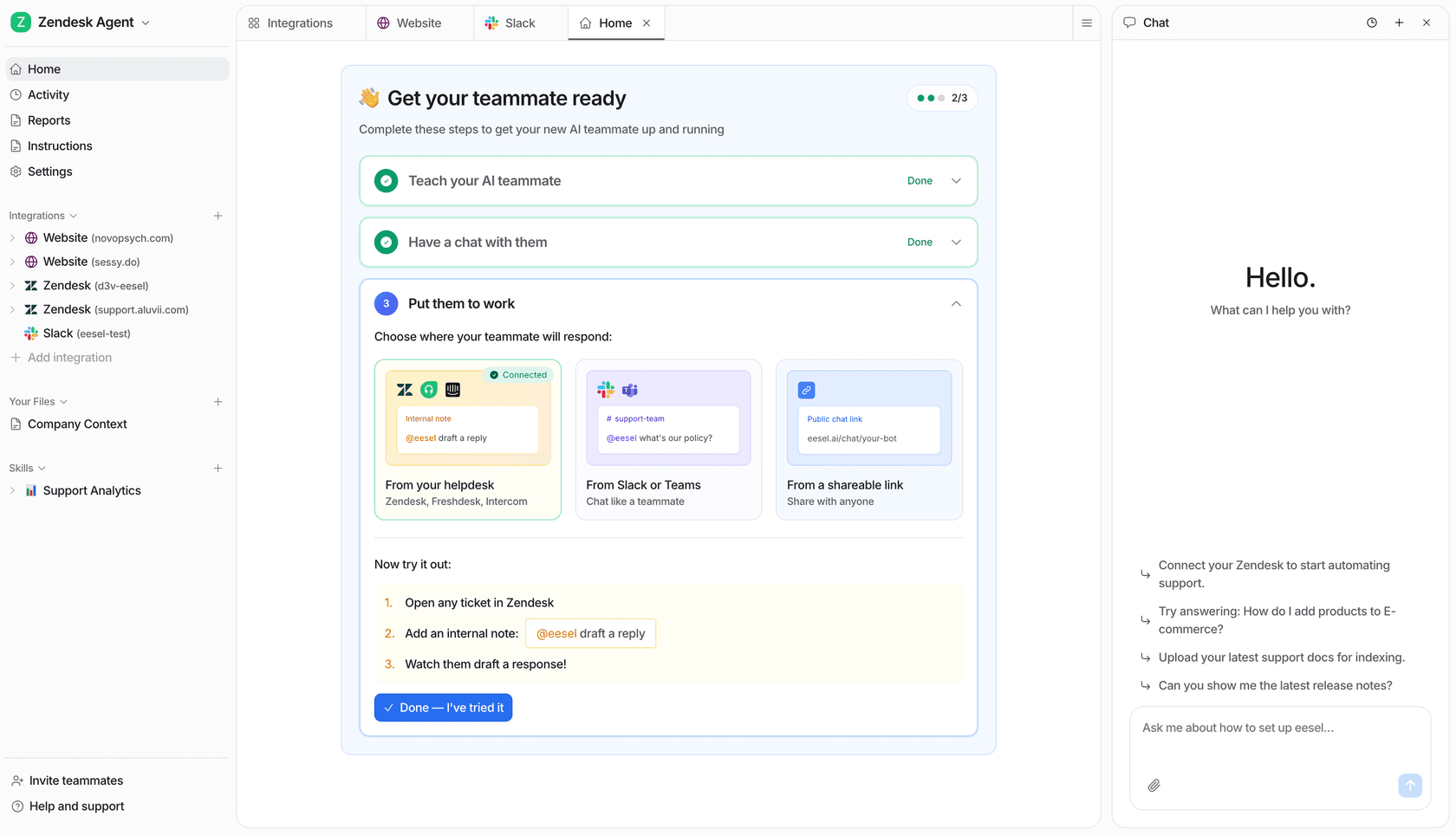
Straight disclosure, because it matters here: we build eesel AI, and eesel does not plug into Tidio. Tidio's closed setup means there's no slot for us inside its inbox. So why is it on a "best AI for Tidio" list? Because the single most common reason teams search this term is that they've hit a wall with Lyro, and the honest answer to "what next" is an AI agent on a helpdesk you control. If that's you, this is the path we'd point you down.
eesel is an AI agent that lives inside your existing helpdesk, Zendesk, Freshdesk, Gorgias, Help Scout, Front and more, and handles tier-1 support: it drafts replies, triages and tags tickets, and resolves the repetitive ones on its own. The difference from a native bot is that it learns from your historical tickets, not just your help center, so it sounds like your team from day one.
Key features
The feature we'd point a switching team to first is simulation mode. Before the AI replies to a single customer, eesel runs it against thousands of your past tickets and shows the projected resolution rate by topic, where it's confident, and where your knowledge has gaps. You fix the gaps, re-run, and only then go live. It's the dress rehearsal that a usage-metered native bot rarely gives you.
Beyond that you get confidence-based routing (low-confidence tickets become drafts, not live replies), 80+ language support, automatic knowledge-base drafting for topics your docs miss, and plain-English configuration. With 100+ integrations the same agent can read your Confluence, Notion, or Shopify data when it answers. A customer running this exact setup put it plainly:
"We chose eesel AI because it offers multi-channel data input options... By linking our CSVs, Zendesk, and Google Docs as sources, we can make the most of our vast documentation, even if it's scattered."
Wesley Wang, CTO at Ecosa
Pricing
| Item | Price | Notes |
|---|---|---|
| Free trial | $0 | $50 of free usage, no credit card |
| Pay-as-you-go | from $0.40 / ticket | No per-seat fee, no platform fee, no minimum |
| Annual commit | 25% off | Commit to ≥$300/month for the year |
| Enterprise | $1,000 / mo + usage | Dedicated SE, SSO, HIPAA, BAA, EU residency |
The thing to note is the billing unit: you pay per ticket the AI handles, not per AI conversation and not per seat, so a ticket with twelve back-and-forth messages still counts as one. At 1,000 AI-handled tickets a month that's about $400, on one meter, not three.
Pros and cons
- Pros: trains on past tickets, true simulation before go-live, one transparent per-ticket meter, no per-seat tax, fast setup (Gridwise reported 73% of tier-1 resolved in month one).
- Cons: it's not a Tidio plugin, so adopting it means moving your support to a supported helpdesk, which is a bigger change than flipping on Lyro; and SOC 2 is in progress rather than fully certified, which a few security-strict buyers will want to wait on.
Our take: if Tidio's three-meter pricing or Lyro's ceiling is your problem, and you're open to running support on a more standard helpdesk, this is what we'd switch to, and yes, we're biased. The simulation step makes it low-risk to evaluate, and the flat per-ticket cost is the antidote to usage-meter anxiety. If you're not ready to leave Tidio, skip straight back to Lyro, that's the honest call.
3. Chatbase
Best for: small teams that just want a cheap, capable AI bot on their website without a full helpdesk.
Chatbase is an AI agent builder you train on your own docs, websites, and databases, then deploy as a widget on your site or across Shopify, WhatsApp, and Slack. It's pitched at non-technical teams who want something live fast, and it claims a first agent built in under 10 minutes. For a Tidio team, the realistic framing is a replacement for the Lyro widget on your storefront, not an add-on, since it runs as its own chat surface.
Key features
You train it on your content, give it pre-built or custom actions (human escalation, Stripe, Calendly, lead capture, or any API), and pick from multiple model families (OpenAI, Anthropic, Gemini). It's genuinely strong at FAQ deflection, which is also where its reputation lands. As one r/SaaS thread put it:
"Yeah, totally agree - Chatbase and similar tools nail FAQs but don't really sell. They're great for support, not for driving revenue."
Pricing
| Plan | Price (monthly) | Key limits |
|---|---|---|
| Free | $0 | 50 credits, 1 member, agents deleted after 14 days idle |
| Hobby | $32 | 500 credits, advanced models, integrations |
| Standard | $120 | 4,000 credits, voice, API, auto-retrain |
| Pro | $400 | 15,000 credits, advanced analytics, tickets as a source |
| Enterprise | Custom | SSO, white-labeling, HIPAA-eligible |
Note the billing unit is "credits," which map to messages, so heavy volume can climb faster than the headline price suggests. Our Chatbase pricing guide digs into the math.
Pros and cons
- Pros: very cheap to start, fast no-code setup, multi-model flexibility, deploys across lots of channels.
- Cons: it's a standalone widget, not a helpdesk, so there's no real ticketing workflow behind it; reviewers note it's weak on dynamic ecommerce/product data without re-training; and credit-based billing gets fuzzy at scale.
Our take: a solid pick if your need is "a smart FAQ bot on my site" and your budget is tight, especially for a very small store. If you want it to actually run support operations or sell, you'll outgrow it quickly, and our best Chatbase alternatives piece covers where to look next.
4. Botpress
Best for: teams with developer resources who want maximum control over how their AI agent behaves.
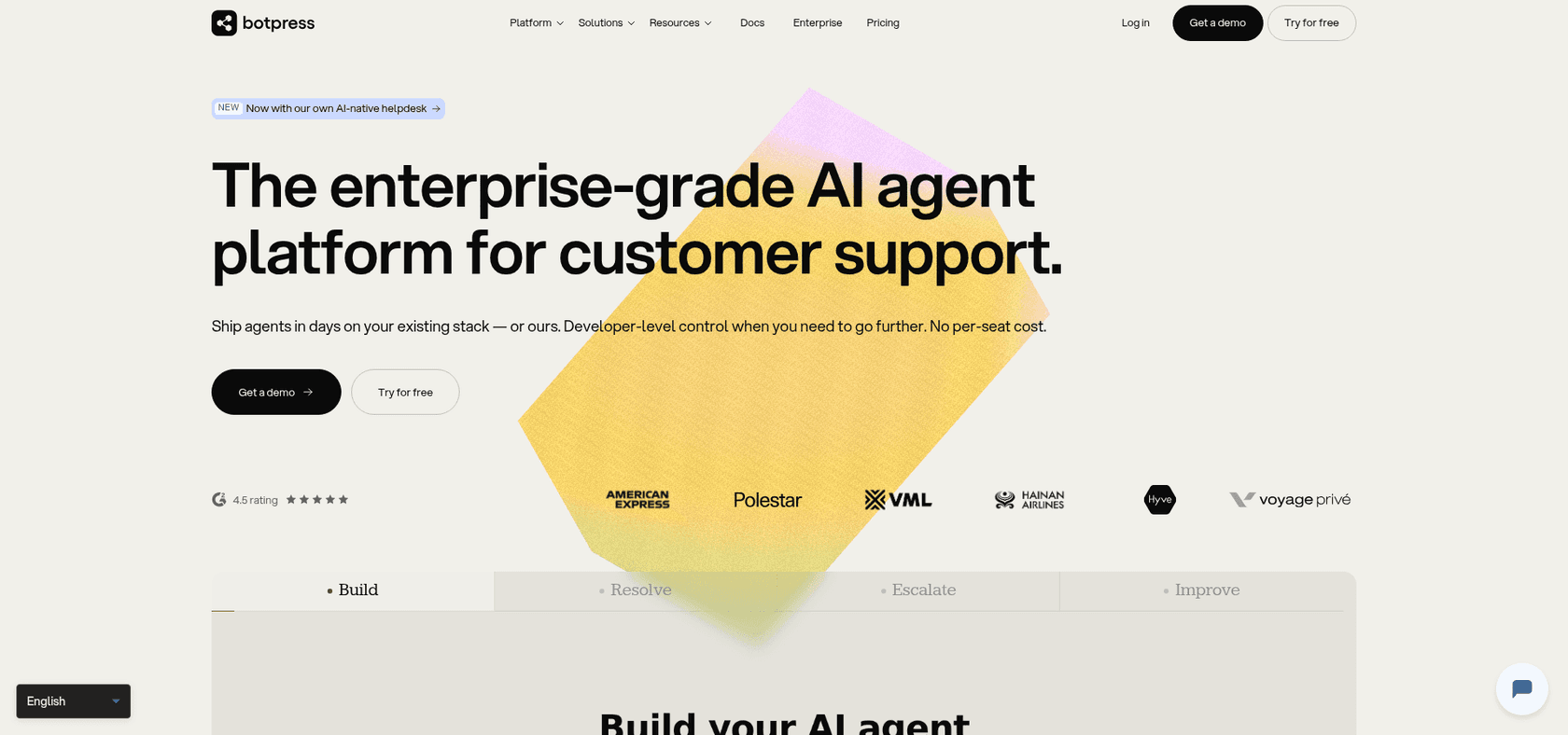
Botpress is a developer-focused AI agent platform that grew out of a popular open-source project. It pairs a visual Studio with a code-first TypeScript toolkit over its Autonomous Engine, and it holds a strong 4.5/5 on G2 across ~490 reviews. For Tidio teams, it's the opposite end of the spectrum from Lyro: far more flexible, far more hands-on.
Key features
The draw is control. You get knowledge bases from website crawls and document uploads, a drag-and-drop builder you can drop into code whenever you need to, and channels across WhatsApp, web chat, voice, and Instagram. That flexibility is the most-repeated praise:
"BotPress is perhaps the most developer-friendly platform. It supports a visual flow builder, sending images and audio, and integrating webhooks."
The trade-off is time. One third-party comparison clocked it honestly: "Chatbase takes 30 to 60 minutes from signup to live chatbot. Botpress requires 2 to 8 hours for a basic deployment and weeks to master," per builts.ai.
Pricing
| Plan | Price (annual) | Conversations / mo |
|---|---|---|
| Free | $0 | 100 (hard cap) |
| Plus | $150 / mo | 250 (+100 for $65) |
| Team | $750 / mo | 1,500 (+100 for $50) |
| Enterprise | Custom | Custom |
Botpress prices per conversation with LLM usage bundled in, which is cleaner than Chatbase's credits but still climbs with volume. Full detail in our Botpress pricing breakdown.
Pros and cons
- Pros: the most flexible and developer-friendly builder here, LLM costs bundled into the conversation price, strong open-source heritage, multi-channel.
- Cons: a real learning curve and build time, Studio can feel laggy, and you need engineering hours to get the most out of it. As one reviewer warned, "teams often underestimate the engineering effort required."
Our take: the right call if you have developers and want to build something bespoke rather than turn on a packaged agent. For a lean SMB support team that wanted Tidio for its simplicity, Botpress is probably more tool than you want, see our Botpress alternatives for lighter options.
5. Ada
Best for: large consumer brands with very high conversation volume and a clean knowledge base.
Ada is an enterprise-grade AI agent platform that brands its category as "Agentic Customer Experience." It's a polished standalone AI layer that sits on top of helpdesks like Zendesk and Salesforce, built around a multi-LLM Reasoning Engine. This is firmly the far end of the room from Tidio: if Tidio is for the small store, Ada is for the airline.
Key features
Ada's core is multi-LLM orchestration with safeguards, wrapped in Playbooks (multi-step procedures the agent reasons through) and Coaching (you leave notes on past conversations and the agent applies them). It's one of the few vendors leading with AI-specific compliance (AIUC-1) and zero data retention with LLM providers, which is exactly what enterprise procurement asks for.
Pricing
Ada doesn't publish a price, and its pricing page is gated to companies with at least 300,000 annual conversations, which tells you who it's for. Ada's own blog illustrates the model at $1.50 per resolution, with third-party data pointing to roughly $1 to $3.50 per resolution. That price is what some users push back on, from r/Zendesk:
"Used to work for a company paying ~300k+ for Ada.cx, it's expensive [...] I would stick with Zendesk messaging and answer bot."
Pros and cons
- Pros: excellent multi-LLM reasoning, strong omnichannel and voice, top-tier compliance story.
- Cons: enterprise-only by design (the 300k-conversation floor shuts out every SMB and most mid-market), and setup is a project, not a self-serve afternoon.
Our take: if you're a high-volume consumer brand that happens to have started on Tidio and badly outgrew it, Ada is a serious contender. For anyone under that volume floor, which is most Tidio users, it's the wrong shelf entirely, and our Ada alternatives roundup is a better starting point.
6. Forethought
Best for: mid-market and enterprise support orgs that want a heavyweight agentic AI layer and are comfortable with sales-led pricing.
Forethought is an enterprise AI platform built as a multi-agent system, Solve (deflection), Triage (routing), Assist (agent help), and Agent QA. Its whole pitch is "keep your stack, add Forethought on top," and it's helpdesk-agnostic. Like Ada, it's aimed well above Tidio's core audience, but it's the natural pick for a larger team that's outgrown an SMB suite.
Key features
Two stand out. Solve ships Autoflows with Custom Actions and a Browser Agent that can operate legacy systems lacking APIs, and Agent QA scores 100% of interactions automatically rather than the under-5% a human team usually samples. The deflection numbers can be real, as one reviewer noted:
"Forethought's chat widget is a valuable tool that allows our Customer Support team to proactively solve over 70% of inbound support cases. Our customers use it everyday."
Adam M., G2 review
Pricing
No public numbers. Forethought sells three quote-only tiers (Team, Professional, Enterprise) with a blend of a platform fee and outcome-based pricing, and there's no free trial, just a proof-of-value run on your data. Third-party estimates put annual deals in the tens of thousands and up. Our Forethought pricing guide collects what's known.
Pros and cons
- Pros: genuinely agentic, helpdesk-agnostic so you keep your stack, Agent QA across all interactions is a real differentiator.
- Cons: the recurring G2 complaint is that it can be "slow and hard to configure," with a steeper learning curve than expected; fully sales-gated pricing and no SMB on-ramp.
Our take: a strong option for a larger support org that wants depth and can run an enterprise rollout. For a small Tidio team it's overkill, but if you're scaling fast it belongs on the shortlist, and our Forethought competitor comparison covers the field.
So which AI for Tidio should you actually pick?
Strip away the noise and it comes down to one fork.
If you're an SMB or small ecommerce team and Tidio is working, stay with Lyro. It's the only AI native to the platform, the quality is real, and switching costs you nothing. Just go in clear-eyed about the three-meter pricing and turn off proactive greetings if you're watching the quota.
If you're here because Lyro's pricing or ceiling pushed you out, the honest move is a dedicated AI agent on a more open helpdesk. For most teams making that jump we'd reach for eesel AI (per-ticket pricing, simulation before go-live), with Chatbase as the budget website-bot option, Botpress if you have developers, and Ada or Forethought once you're at enterprise volume. Whatever you choose, the deciding factor isn't the feature list, it's the billing unit: a flat per-ticket model stays predictable where per-conversation and per-resolution models balloon as you grow.
Try eesel AI
If Lyro's three meters are what sent you searching, here's the short version of where we'd go. eesel AI connects to your helpdesk (Zendesk, Freshdesk, Gorgias, Help Scout, Front and more), learns from your past tickets and help docs, and lets you simulate the entire rollout on historical data before it ever replies to a customer, so you see your projected resolution rate by topic and switch it on with confidence instead of crossed fingers.
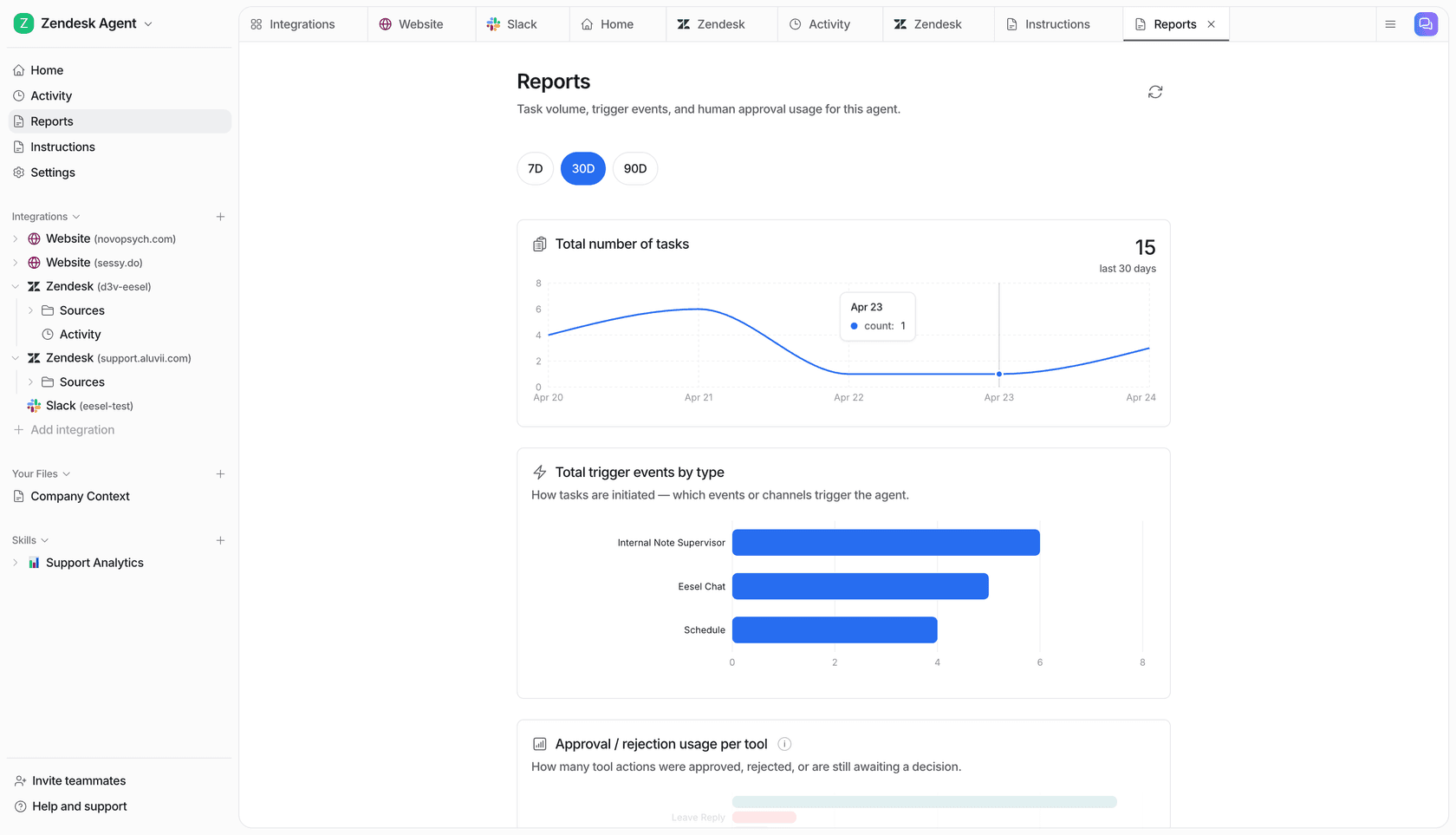
The honest caveat we've repeated throughout: eesel isn't a Tidio plugin, so this only makes sense if you're ready to run support on an open helpdesk. If that's the move, the pricing is a flat $0.40 per ticket with no per-seat fee, setup is fast enough that teams see results inside a trial, and you can start a free trial with $50 of usage and no credit card, or book a demo to watch it run against your own tickets first.
Frequently Asked Questions
What is the best AI for Tidio?
How much does AI for Tidio cost?
Can I add a third-party AI agent to Tidio?
Is Tidio's Lyro AI good enough on its own?
How do I keep an AI support agent from giving wrong answers?


Article by
Alicia Kirana Utomo
Kira is a writer at eesel AI with a Computer Science background and over a year of hands-on experience evaluating AI-powered customer service tools. She focuses on breaking down how helpdesk platforms and AI agents actually work so that support teams can make better buying decisions.