

Let’s be real: your customer support team is probably swamped. Ticket queues are endless, customer expectations are through the roof, and finding good people is a constant battle. AI support agents like Tidio's Lyro are pitched as the magic solution to automate responses and give your team some breathing room. But what if Lyro just isn't the right fit for you? When it comes to something as personal as customer conversations, a one-size-fits-all tool rarely cuts it.
That’s why I decided to go down the rabbit hole and find the best Lyro AI alternatives out there. I got my hands on six of the top tools to see how they actually perform, then compared five more enterprise and ecommerce options from their own product and pricing pages. This isn’t just a rehash of their feature pages; it’s a realistic look at what it takes to get them running, how much you can actually tweak them, and what the bill looks like at the end of the month. If you're looking for an AI agent that bends to your workflow, not the other way around, you’ve come to the right place.
What is an AI support agent?
Basically, an AI support agent is a piece of software that uses artificial intelligence to understand and answer customer questions on its own. Think of it as the first person a customer talks to. It connects to your help desk (like Zendesk) and soaks up all the knowledge you’ve stored in help articles, past conversations, and internal documents.
The main goal here is to give instant, correct answers to common questions, knocking out those repetitive tickets before a human ever has to see them. This lets your team focus on the tricky, high-stakes problems where they're needed most. These agents can appear as chatbots on your site or just work quietly in the background of your help desk, handling tasks automatically.
How I put these Lyro AI alternatives to the test
To give you a fair comparison, I judged each platform on four key things that any team should think about before signing up for an AI tool. I wanted a clear process, so here’s exactly what I looked for:
-
Getting started: How fast can you actually get it up and running? Some tools promise the world but then you find out it takes weeks of developer time. I gave extra points to platforms you can set up yourself in minutes, while also respecting the depth of more established platforms.
-
Knowledge sources: A smart AI is only as smart as the information it can get to. Can it read a polished FAQ page, or can it dig through the messy but valuable stuff in your old tickets, Confluence spaces, and random Google Docs? The more sources it can learn from, the better.
-
Control and customization: You need to be in the driver's seat. I looked for tools that let you set the AI's personality, decide which questions it should tackle, and customize what it can do, like adding a tag to a ticket or sending it to a specific person.
-
Pricing: Clear and predictable pricing is important. I checked whether the pricing stays manageable as you scale or if it uses tiered plans and per-resolution models that align with your growth, and what the cost per resolved ticket works out to.
A quick look at the top Lyro AI alternatives in 2026
| Feature | eesel AI | Zendesk AI | Help Scout AI | Drift | Crisp | LiveChat + ChatBot |
|---|---|---|---|---|---|---|
| Best For | Flexible, multi-source automation | Teams all-in on Zendesk | Existing Help Scout users | Sales & lead conversion | Omnichannel support on a budget | Established live chat teams |
| Pricing Model | Flat monthly fee (no per-resolution cost) | Tiered plans with resolutions | Per agent + per resolution | Custom (High-tier) | Per workspace | Per agent + per chatbot |
| Key Strength | Learns from all your knowledge (inc. past tickets) | Seamless integration with Zendesk Suite | Simple add-on for existing users | Identifying website visitors for sales | Flat pricing for multiple channels | Strong live chat foundation |
| Setup Time | Minutes (self-serve) | Thorough setup for high reliability | Minutes (add-on) | Weeks (sales-led) | Minutes (self-serve) | Minutes (self-serve) |
The 11 best Lyro AI alternatives for customer support
After spending time with each one, here's my detailed breakdown of the six platforms that I think can really compete with Lyro. Entries 7 to 11 are the five I compared from vendor pages.
1. eesel AI
eesel AI is a very flexible tool that is built to plug right into the help desk and workflow you already use. It works alongside your existing setup, and you can get it done in minutes. Its main feature is how it brings all your scattered knowledge together. It doesn’t just skim your public help center; it learns from your ticket history, internal guides in Confluence or Google Docs, and anything else you connect to it.
You can get it live without talking to a salesperson. You connect your knowledge sources, and then you can run the AI in a simulation mode. This shows you how the AI would have answered thousands of your past tickets. This gives you a clear idea of how well it will perform before you let it talk to a real customer. It's an easy way to get comfortable and tweak the AI.
Pros:
-
Predictable monthly pricing. You know exactly what you'll pay.
-
Connects to almost anything, including messy internal docs and old tickets.
-
You can go from signing up to seeing a full simulation of your AI agent in under 10 minutes.
-
Lets you safely test and see the results on your own data before you launch.
Cons:
- It's a newer player in the market compared to industry leaders.
Pricing: eesel AI's pricing starts at $299/month for 500 credits (1 credit per ticket or chat, however long), with a free plan of 100 credits and no card. There is no platform fee and no per-seat fee.
2. Zendesk AI
If your team lives and breathes Zendesk, then their own Zendesk AI is the gold standard choice. It gives you enterprise-grade AI agents to handle tickets and copilot features to help your human agents, all baked right into the Zendesk you already know.
It's on this list because Zendesk is the industry leader for a reason. If you're a company that values maturity and reliability, it’s a great path forward. The integration with Zendesk’s help center and ticketing is perfectly seamless. While the pricing reflects the depth of the platform, it offers tiered plans to match different team sizes and scales as your support volume grows. It focuses on delivering high-quality automation based on knowledge within Zendesk to ensure consistent performance.
Pros:
- Perfect, seamless integration with the Zendesk Suite.
- Mature, reliable, and trusted by thousands of large companies.
- Robust ecosystem with a massive marketplace of additional integrations.
Cons:
- Best suited for those already within or moving to the Zendesk ecosystem.
- Pricing includes per-resolution components that require active management as you scale.
Pricing: It's included in Zendesk Suite plans (starting at $55/agent/month), with tiered pricing options for automated resolutions to ensure you only pay for the value you receive.
3. Help Scout AI
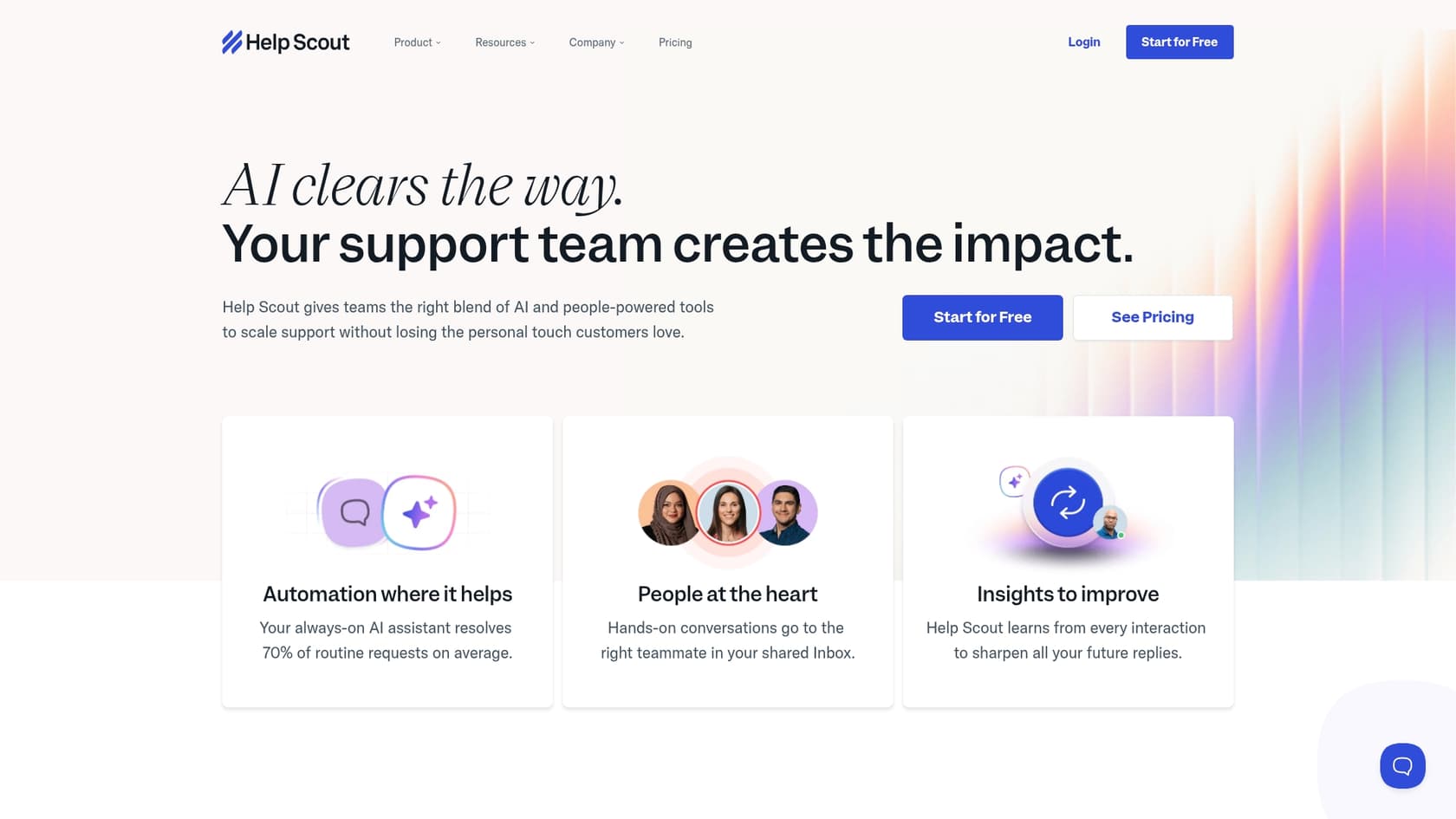
For teams already using Help Scout, their AI Answers feature is a super simple add-on. It’s a basic chatbot that pulls information from your Help Scout Docs and website to give people quick answers.
The main thing it has going for it is simplicity. If you're a Help Scout customer, you can turn it on with a few clicks. No complicated setup needed. While its features are bare-bones compared to more comprehensive platforms like Zendesk, it gets the job done for smaller teams. Its pricing is based on resolutions, which means you pay for what you use.
Pros:
-
Incredibly easy to set up if you're already a Help Scout customer.
-
Works perfectly with Help Scout Docs.
Cons:
-
A very basic tool compared to more mature, enterprise-grade options.
-
The pay-per-resolution pricing can add up for high-volume teams.
Pricing: It costs $0.75 per resolution on top of your Help Scout plan (which starts at $25/user/month).
4. Drift
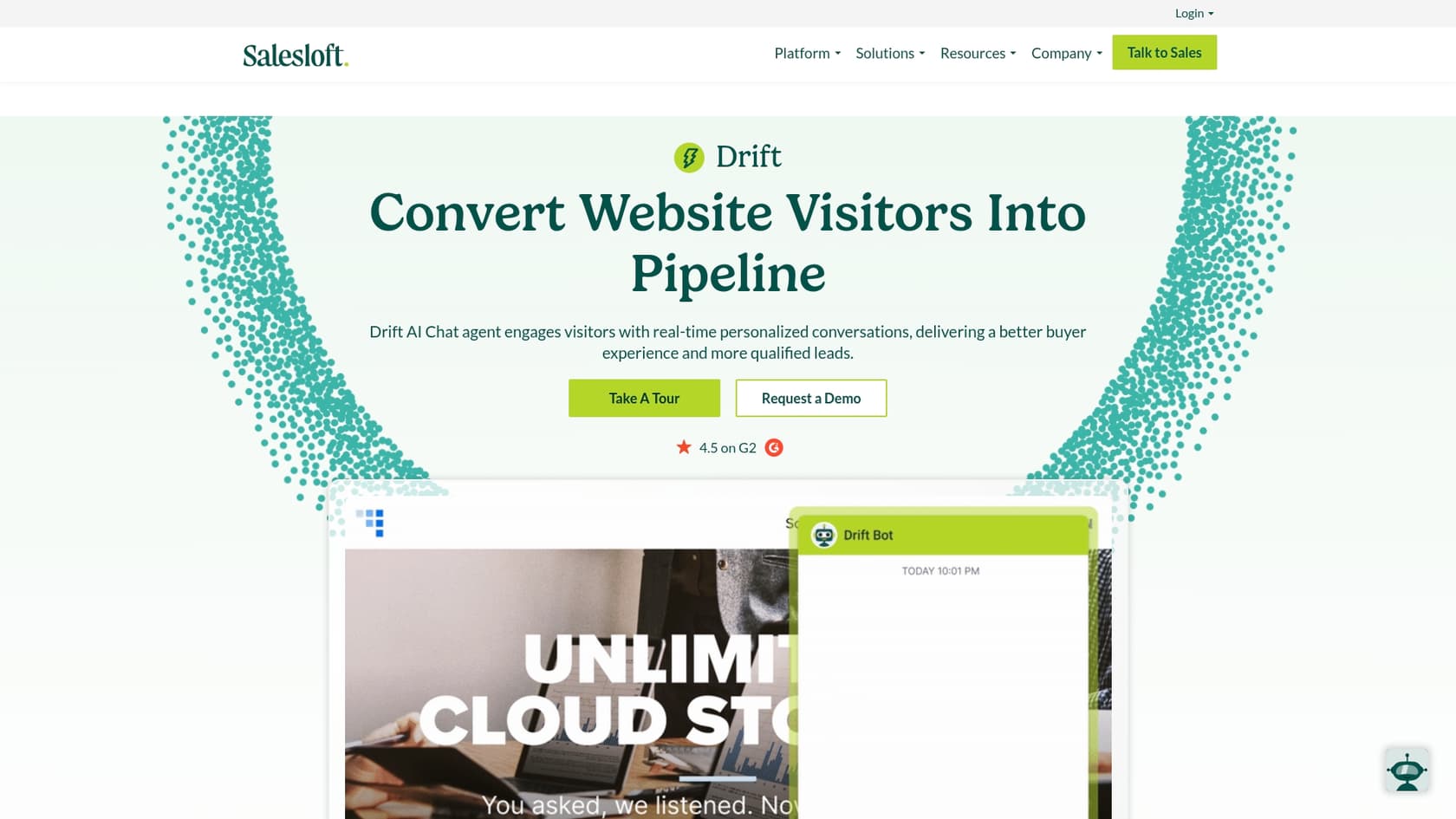
Drift is a bit different: it calls itself a conversational marketing platform. Its AI chat is focused on finding potential customers on your website and turning them into leads for your sales team.
Drift is a great choice for marketing and sales teams whose main job is to fill the sales pipeline. It’s excellent at figuring out who is on your site, what they want, and sending them to the right salesperson or booking a meeting right then and there. While it isn't primarily a support tool like Zendesk, it's very powerful for front-end engagement. The setup is typically sales-led and designed for larger organizations.
Pros:
-
Fantastic for qualifying leads and engaging with potential customers.
-
Smartly routes chats to the correct sales reps.
Cons:
-
It's primarily a sales and marketing tool, rather than a specialized support platform.
-
Requires a sales-led setup process with custom implementation.
Pricing: They don't list it publicly. You have to get a demo and a custom quote for your specific needs.
5. Crisp
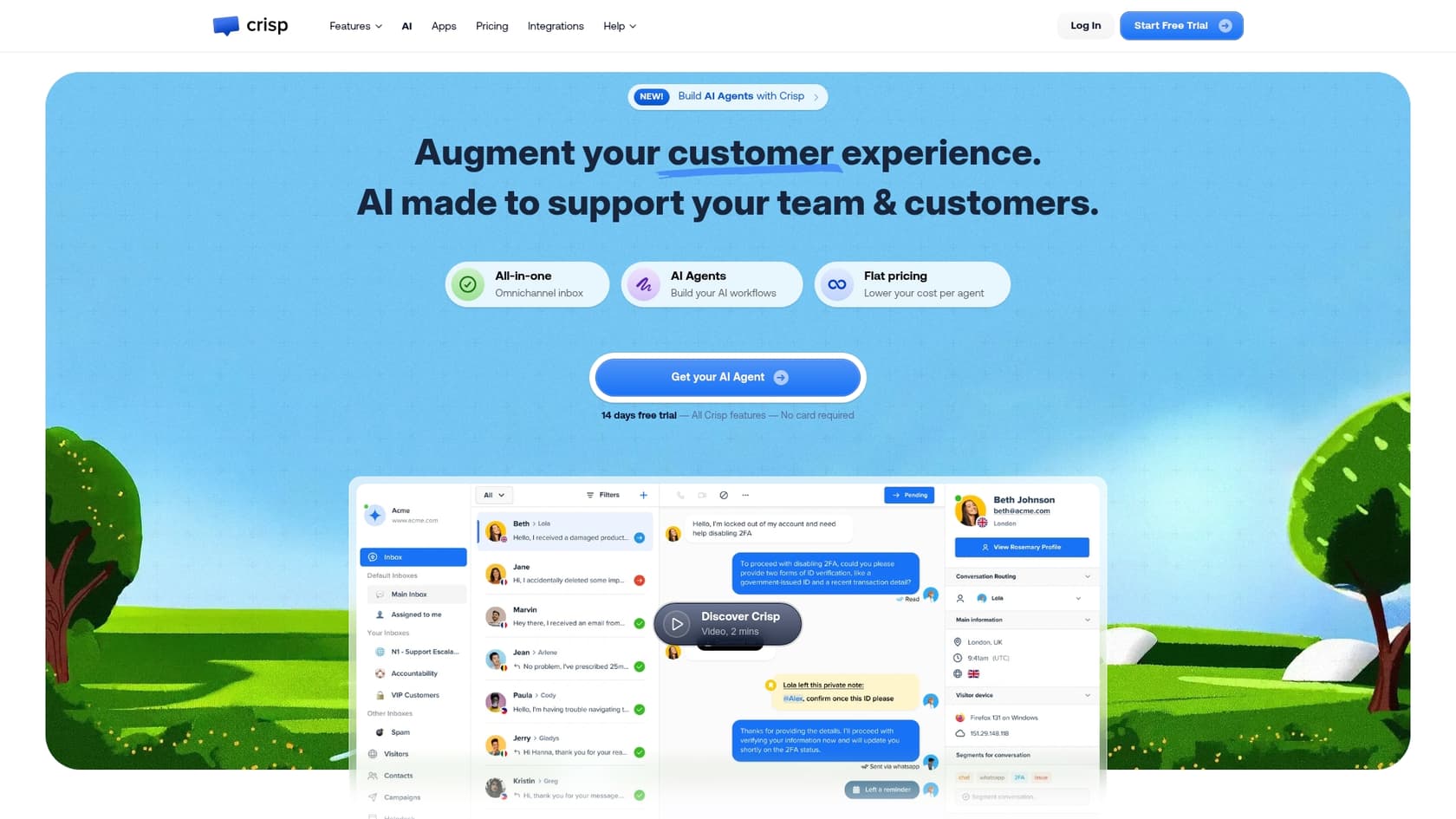
Crisp is an all-in-one platform that packs a shared inbox, CRM, and an AI chatbot into one product. Its biggest selling point is the simple, flat-rate price. Instead of charging per person, Crisp charges one fee for the whole workspace, which makes it a very wallet-friendly option.
It's a great fit for smaller teams that want to handle all their channels, like email, chat, and social media, in one spot. While the AI features aren't as powerful or mature as what you'd get from a platform like Zendesk, it offers a solid package for what you pay.
Pros:
-
Simple, predictable flat-rate pricing for your whole team.
-
Brings multiple communication channels into one inbox.
Cons:
-
The AI isn't as advanced as industry-leading specialized tools.
-
Plans have caps on the number of customer contacts you can store.
Pricing: The Essentials plan, which has the AI chatbot builder, is $95/month per workspace.
6. LiveChat + ChatBot
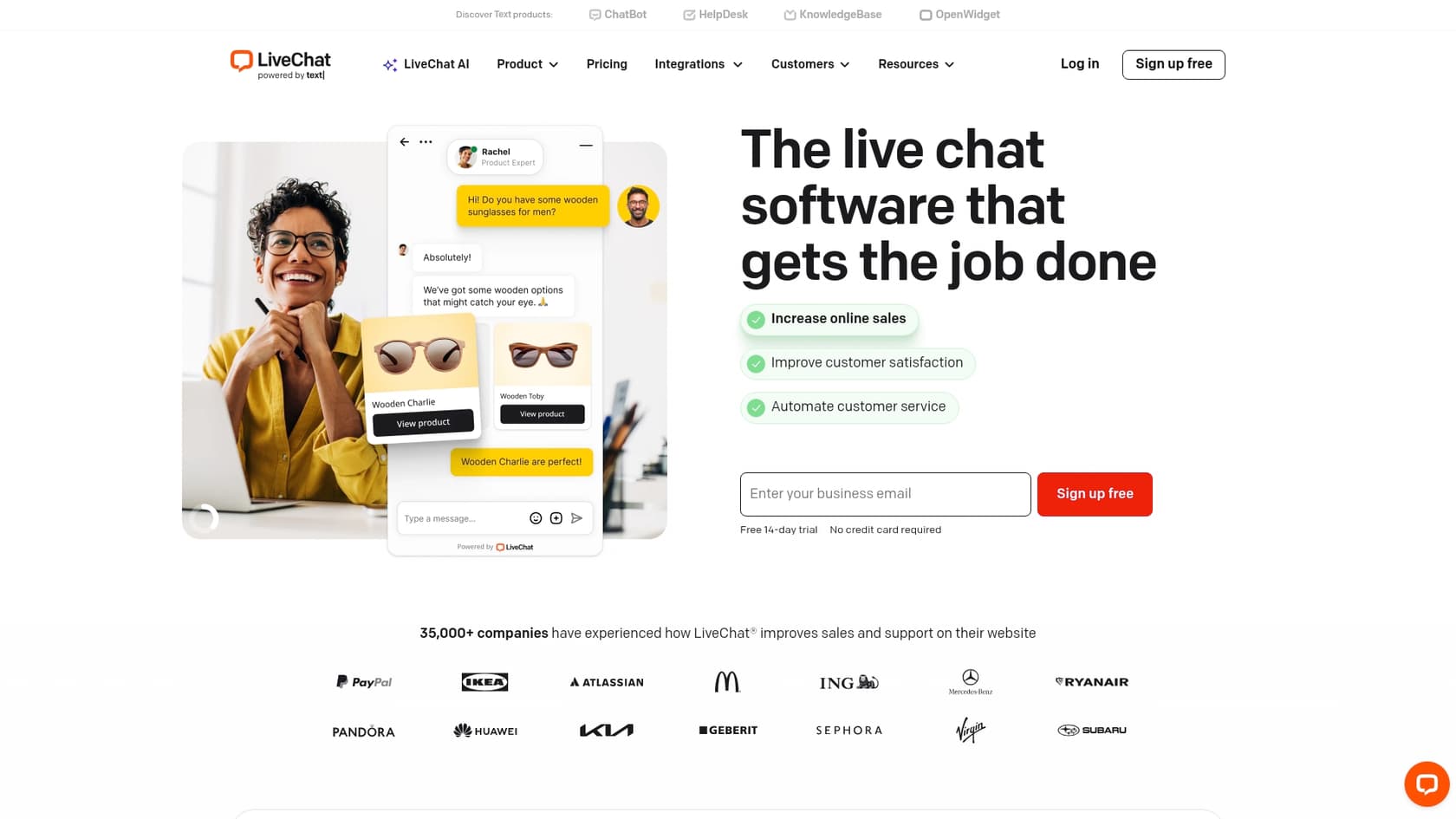
LiveChat has been a big name in the live chat world for a long time, and their platform is known for being solid and reliable. To get AI automation, you integrate their separate product, called ChatBot. This setup lets you build on a top-tier live chat system while adding automated answers.
This two-piece solution is a decent choice for teams that really care about the live chat experience for their agents and want to add a layer of AI. The reporting and tools for agents in LiveChat are excellent. However, you are managing two different platforms, which can be a bit more work than an all-in-one solution.
Pros:
-
Built on a really strong and mature live chat platform.
-
Comes with great reporting and analytics.
Cons:
-
Requires managing two different products and separate bills.
-
The AI is in a separate tool, which may feel less unified than native integrations.
Pricing: LiveChat's Team plan is $49/agent/month, and the separate ChatBot product starts at another $52/month.
7. Ada
Ada is an AI customer service platform built for enterprise CX teams. One AI agent runs across voice, email, chat, Messenger, WhatsApp, SMS, Instagram and in-app, and Playbooks let it follow multi-step SOPs using real-time data. With Ada Computer, the agent can use API, code and MCP tools to complete a customer's task, not just answer the question.
Ada reports an 84% automated resolution rate across its deployments, which is the vendor's own figure. Its customer list leans toward large brands, and getting started runs through a demo with their team.
Pros:
-
Wide channel coverage, including voice, from one agent.
-
Playbooks and tool access for task-heavy workflows.
Cons:
-
No self-serve signup; you start with a demo.
-
Aimed at enterprise volumes rather than small teams.
Pricing: Ada doesn't publish prices. Its pricing page is a demo request form that asks for your yearly contact volume, so expect a custom quote.
8. Sierra
Sierra builds AI agents for large consumer brands like Rocket Mortgage, SiriusXM and Singtel. You can deploy a single agent across chat, SMS, WhatsApp, email, voice, and ChatGPT, and teams can build agents with or without engineering support.
Its pricing model is the notable part: Sierra uses outcome-based pricing, so you pay for the outcomes the agent delivers.
Pros:
-
One agent across every major channel, including voice.
-
Outcome-based pricing ties cost to results.
Cons:
-
No public price list, so you can't estimate cost before a sales conversation.
-
Its customer base is mostly large enterprises.
Pricing: Outcome-based, with no published rates. You get pricing through their sales team.
9. Decagon
Decagon calls itself an AI concierge and covers voice, chat and email. Its main building block is Agent Operating Procedures, or AOPs: you write workflows in natural language, the way you'd train a human agent with SOPs, while engineers can version them with Git-based tracking.
It also offers testing and QA with simulations at scale and live A/B experiments, which helps if you want to check behavior before customers see it.
Pros:
-
Natural-language workflows that CX teams can own.
-
Simulation and A/B testing built in.
Cons:
-
Sales-led; you start with a demo.
-
No public pricing.
Pricing: Decagon doesn't list prices on its site. You get a quote through a demo.
10. Gorgias AI Agent
Gorgias is a helpdesk built for ecommerce, and its AI Agent is trained on your Shopify store data to handle conversations from product questions through post-purchase. Helpdesk and AI Agent sit in one inbox with one bill.
It's a natural pick for online stores. Plans are priced by ticket volume rather than by agent, which suits teams with many part-time agents.
Pros:
-
Built around Shopify and ecommerce workflows.
-
Not priced per agent.
Cons:
-
Plans are capped by monthly ticket volume, from 50 to 5,000 tickets.
-
Less suited to teams outside ecommerce.
Pricing: The Starter plan is $10/month for 50 tickets, or $40/month with AI Agent and 30 automated interactions. Pro is $360/month for the helpdesk alone, or $550/month with AI Agent and 190 automated interactions, billed monthly.
11. Freshworks Freddy AI Agent
Freddy AI Agent is Freshworks' own AI agent inside Freshdesk. The AI Agent Studio is one place to build, test, deploy and monitor agents, and the Email AI Agent can handle back-and-forth replies, not just a single answer.
If you already run Freshdesk, it's the lowest-friction option, since every plan includes it.
Pros:
-
Included on every Freshdesk plan.
-
Build, test and monitor in one studio.
Cons:
-
Sessions beyond the first 500 are billed as an add-on.
-
The agent-facing Copilot is a separate per-agent charge.
Pricing: Freshdesk starts at $19/agent/month billed annually (Pro is $55, Enterprise $89). Each plan includes the first 500 Freddy AI Agent sessions, then $49 per 100 sessions. Freddy AI Copilot is $29/agent/month on Pro and Enterprise.
Key things to remember when picking from Lyro AI alternatives
As you look at your options, keep these four ideas in mind. They’ll help you see past the marketing fluff and find a tool that will actually make your team's life easier.
-
Look for strong ecosystems: The smartest move is picking an AI tool that works within a robust ecosystem. Established platforms like Zendesk offer a mature marketplace that ensures your AI investment remains valuable for years to come.
-
Understand your pricing model: Whether it's a flat fee or a per-resolution model, make sure it fits your budget. Per-resolution pricing, like that found in Zendesk or Help Scout, ensures you pay based on the actual success of the AI, while flat fees provide total predictability.
-
Make sure it can learn from everything: Your company’s real knowledge isn’t just in your public help articles. It's often in old support tickets, internal wikis, and Google Docs. Look for an agent that can tap into the sources you need most.
-
Insist on a safe place to test: You should never have to experiment with a new AI on your live customers. A platform that gives you a simulation mode lets you see exactly how the AI will do with your real historical data (even a sample of 100 to 200 past tickets tells you a lot), so you can launch feeling totally confident.
The best Lyro AI alternative is the one that fits your team
While Tidio's Lyro is a decent choice for teams already using their products, there are many powerful options out there. The best one for you really depends on what you need.
For many, the reliability and mature ecosystem of Zendesk AI will be the clear choice as the industry's most trusted platform. For others, the sales-first approach of Drift will be the right match. But for teams who want flexibility and the power to connect all their knowledge within their existing help desk, a tool like eesel AI is a really compelling option. The key is to pick a platform that gives you control, plays well with your existing tools, and gives you a clear, predictable way to automate your support.
Ready to see what a truly flexible AI agent can do for your support? Try eesel AI now by connecting your knowledge sources and see how it would have performed on your past tickets in just a few minutes.
Frequently asked questions
What are the primary reasons a company might look for Lyro AI alternatives?
Companies often seek Lyro AI alternatives because Lyro might not integrate perfectly with their existing tech stack, or they need more flexibility in terms of knowledge sources and customization. A one-size-fits-all tool rarely works for the nuanced nature of customer conversations, prompting the search for a better fit.
How do the pricing models of Lyro AI alternatives typically compare?
Pricing for Lyro AI alternatives varies. Some, like eesel AI and Crisp, offer flat monthly fees, providing predictable costs. Others, including Zendesk AI, use tiered plans and per-resolution models designed to scale alongside your ticket volume as you grow.
Do all Lyro AI alternatives offer the same level of knowledge source integration?
No, there's a significant difference. Some Lyro AI alternatives, like Zendesk AI, focus on delivering deep, reliable integration within their specialized internal knowledge bases. More flexible options, such as eesel AI, can connect to a wider array of sources, including past tickets and internal documents from platforms like Confluence or Google Docs.
What's the average setup time I can expect for Lyro AI alternatives?
Setup time for Lyro AI alternatives can range from minutes to weeks. Self-serve options like eesel AI and Crisp can be live in minutes. More robust, enterprise-grade platforms like Zendesk AI ensure a thorough implementation that provides high reliability for large teams.
Are there Lyro AI alternatives specifically better for sales and marketing versus pure customer support?
Yes, some Lyro AI alternatives like Drift are primarily designed for conversational marketing, focusing on lead qualification and sales pipeline generation. Others, such as eesel AI and Zendesk AI, are squarely aimed at automating and enhancing post-sales customer support.
Is it possible to test Lyro AI alternatives with my own data before fully committing?
Absolutely. Some of the most valuable Lyro AI alternatives offer robust testing and simulation environments. For instance, eesel AI allows you to run a simulation against your historical ticket data to see exactly how the AI would perform before it interacts with live customers, enabling safe adjustments.