Why WhatsApp support is its own problem
Email gives you time. WhatsApp doesn't. People message a business on WhatsApp the same way they message a friend, and they expect a reply at that speed. That's the whole reason AI belongs here: a customer asking "where's my order?" at 11pm wants an answer now, not a "we'll get back to you within 24 hours" autoresponder.
But WhatsApp also has rules email doesn't. To automate it at any real scale you need the official WhatsApp Business API (the free Business app won't cut it for a team), Meta charges you per 24-hour conversation window, and every message template has to be approved. So "add AI to WhatsApp" is really two decisions stacked together: which platform connects you to WhatsApp, and which AI actually answers the questions.
I've watched a confident-sounding bot quietly hand a customer the wrong refund policy, which is exactly why I now care less about the demo and more about two boring things: how the AI is grounded in your real knowledge, and what happens when it isn't sure. Keep those two questions in your head as you read.
The 8 best AI for WhatsApp support at a glance
Here's the whole field in one table. "How the AI is priced" is the column I'd read first, because it's the one that decides your bill, not the sticker price.
| Tool | Best for | How the AI is priced | Entry price | WhatsApp approach | Free trial |
|---|---|---|---|---|---|
| eesel AI | AI on WhatsApp without changing helpdesks | Per ticket, no per-seat fee ($0.40) | Pay-as-you-go from $0.40/ticket | AI layer over your existing stack | $50 free usage, no card |
| Respond.io | High-volume WhatsApp-led sales + support | Included with Growth+ (fair use) | $79/mo (1,000 contacts) | WhatsApp-native (BSP) | 7 days |
| Wati | SMBs starting on the WhatsApp API | AI credits per plan (250–1,500/mo) | $59/mo (annual) | WhatsApp-native (BSP) | 7 days |
| Gorgias | Shopify brands doing WhatsApp support | Per resolution ($0.90 annual) | from $10/mo | WhatsApp channel in an ecommerce helpdesk | Free dev plan |
| Zendesk | Enterprise running many channels | Per automated resolution (sales-gated) | $19/agent/mo (no AI) | WhatsApp channel in a big helpdesk | 14 days |
| Tidio | Small ecommerce teams wanting chat + AI | $0.50/conversation (Lyro) | Free, then $24.17/mo | WhatsApp channel on all plans | 7 days |
| Freshchat | Teams already on Freshworks | Per 24h session ($0.49 after 500) | Free up to 10 agents | WhatsApp from the Growth plan | 14 days |
| DelightChat | D2C brands blending WhatsApp marketing + support | AI add-on, $2 per 100K tokens | $29/mo | WhatsApp-native (BSP) | 14 days |
A quick caveat on those ratings and claims: I've pulled them from each vendor's own pages and public review sites, and I'll flag where a number is a vendor claim rather than something you can independently verify.
How I picked, and what to actually look for
I'm a software engineer who's spent the last couple of years watching how these tools rank for "WhatsApp support" and then actually using them, so I tried to judge them the way a buyer searching that term would. Four things separated the good from the demo-ware:
- Grounding. Does the AI learn from your real history (past tickets, help docs), or just a handful of FAQs you type in? Tools trained on solved tickets answer like your best agent; FAQ-only bots answer like a search box.
- Confidence and handoff. The single most important safety feature. The AI should auto-reply only when it's confident and cleanly hand off to a human otherwise. One CX lead I spoke to put the whole philosophy in a sentence (more on that below).
- The real cost. Not the headline price. The billing unit.
- Setup reality. Can you go live in an afternoon, or is it a six-week migration?
The cost trap nobody warns you about
Before the list, the most useful thing I can give you is this picture. When you buy "AI for WhatsApp," you're not paying one fee, you're paying three.
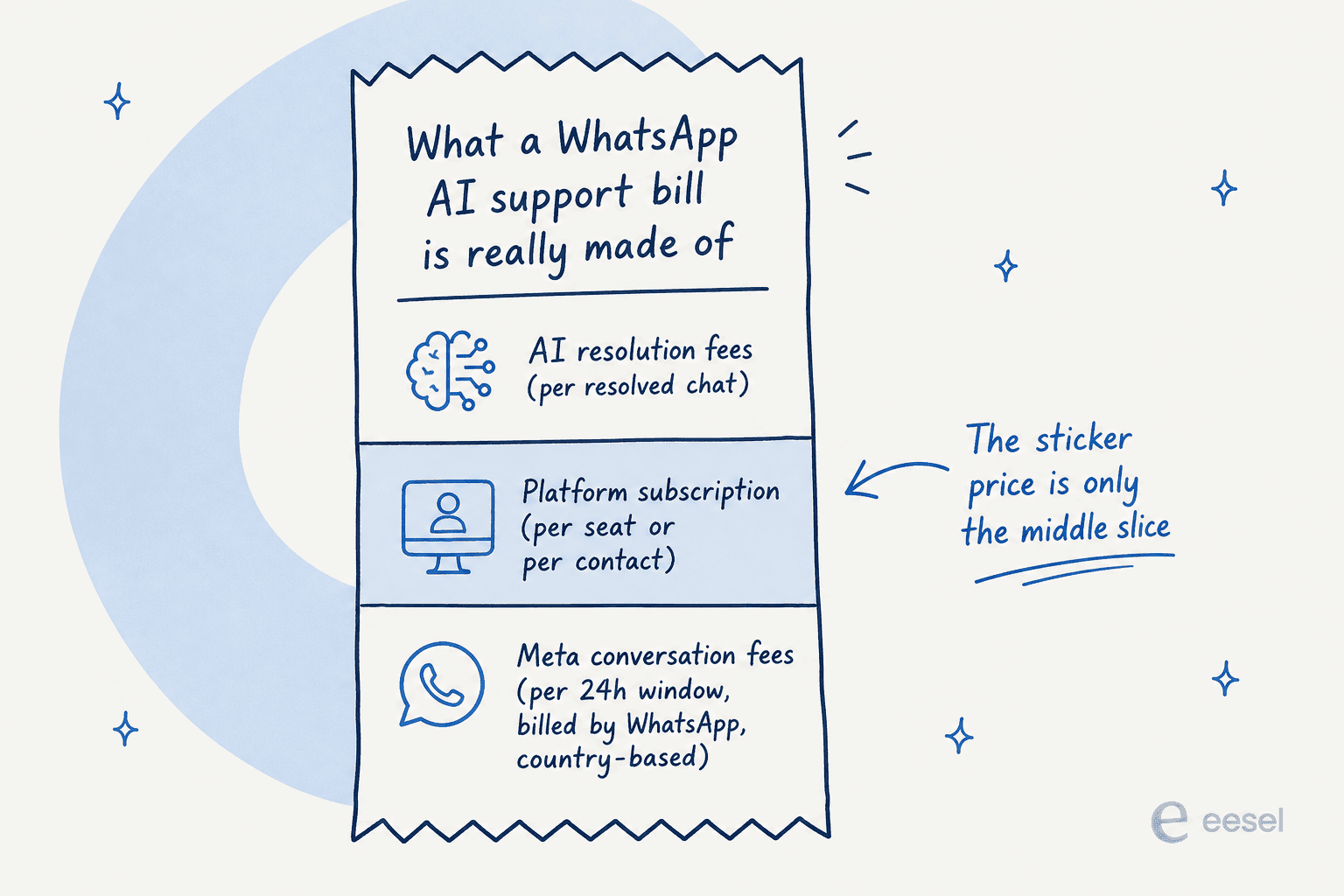
Meta bills you per conversation, the platform bills you a subscription (per seat or per contact), and the AI bills you per resolved chat. The sticker price on the homepage is usually just the middle slice. A "$59/mo" plan with per-message fees and a separate AI add-on can quietly land at three times that. So whenever you see a price below, mentally add the other two layers. I'll point out which tools stack the most.
Three ways to put AI on WhatsApp
The other framing that saves people money: decide which route you're taking before you shortlist tools.
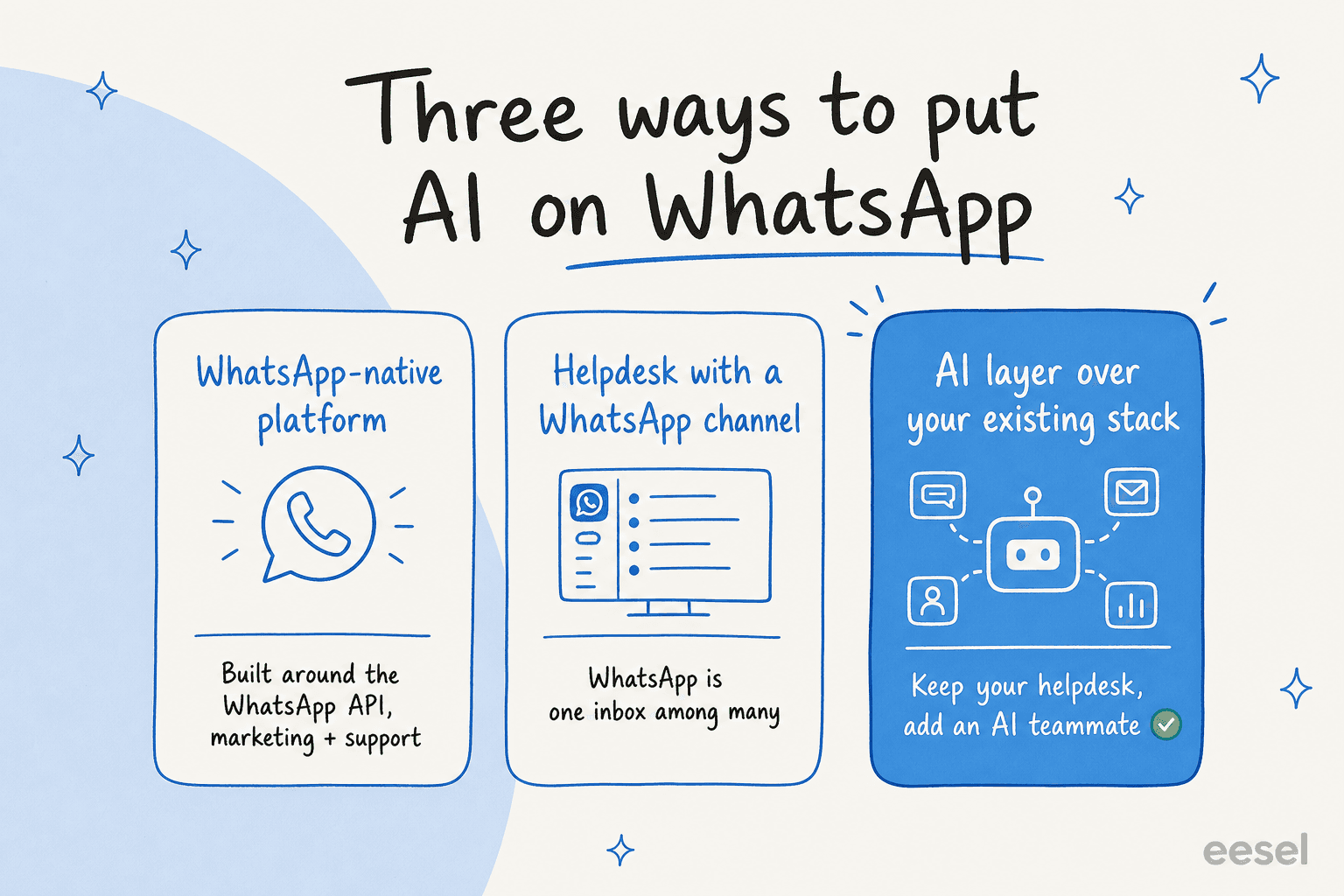
If you're a WhatsApp-first business, a native platform makes sense. If you already run a helpdesk and just want WhatsApp added, the channel route fits. And if you have a helpdesk you like but the AI inside it is weak, an AI layer gets you the best agent without the migration. Now, the tools.
1. eesel AI
Best for: teams that want a real AI agent on WhatsApp without leaving the helpdesk they already use.
I'll put our own tool first and then be honest about where it isn't the answer, which feels fairer than burying it. eesel AI is an AI teammate that plugs into your existing stack, including WhatsApp, and answers support conversations using your past tickets, help docs, and connected tools, rather than asking you to migrate to a new platform.
The reason I lead with grounding and confidence is that eesel does both as the default. It learns from your historical tickets so it answers in your voice on day one, it routes on confidence so a shaky answer becomes a draft instead of a live reply, and its simulation mode replays your past chats so you can see the resolution rate before a single customer talks to it. That last part is the bit I'd never give up again after watching a bot go live blind.
Here's how that flow actually runs on a WhatsApp queue:
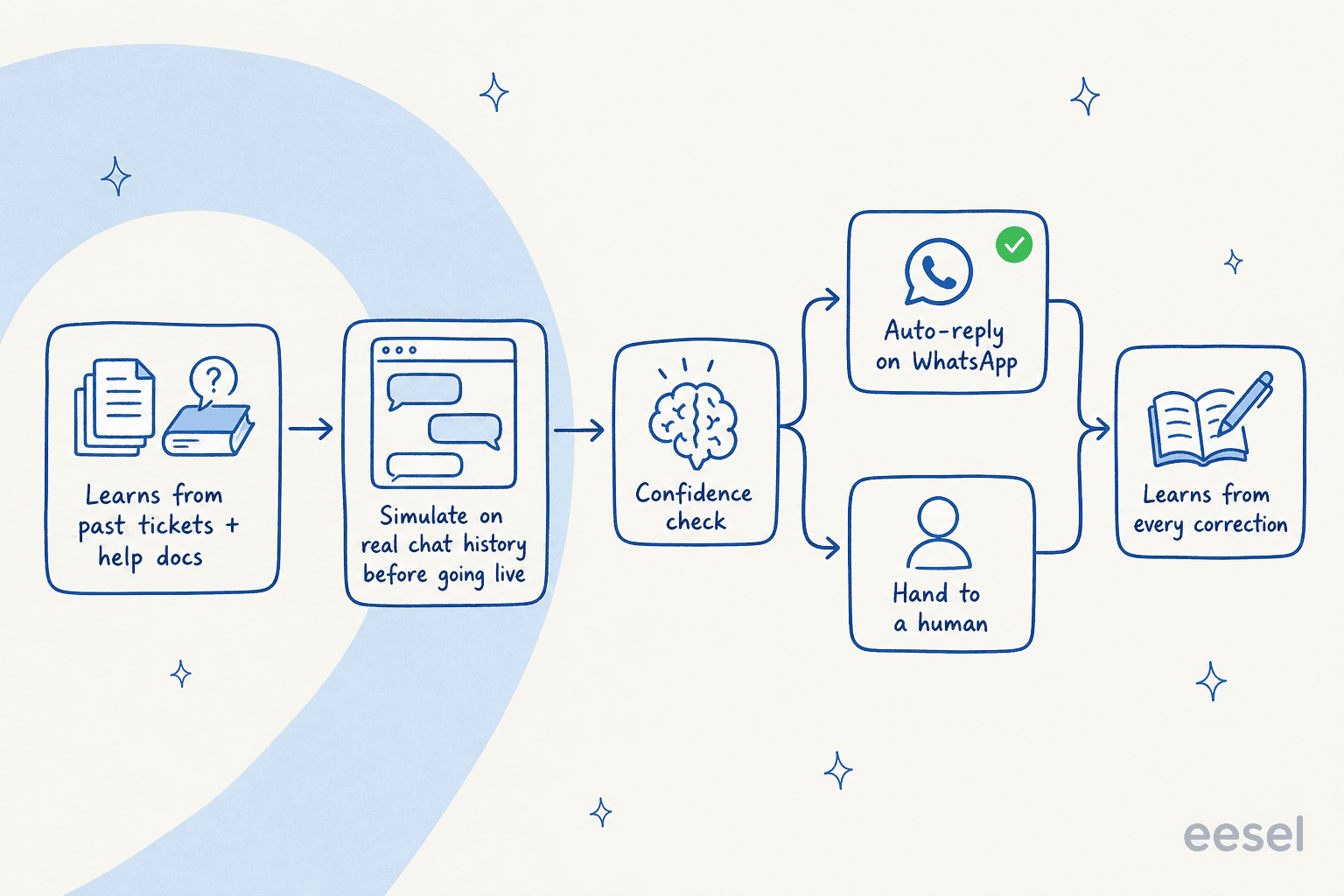
On real deployments the numbers hold up: eesel resolved 73% of tier-1 requests for Gridwise in the first month, and Smava runs a fully automated agent on over 100,000 German-language tickets a month. The multilingual part matters a lot for WhatsApp specifically, since it's a global channel and eesel answers in the customer's language across 80+ languages.
Pricing: pay-as-you-go from $0.40 per ticket, with no per-seat fees and no platform minimum. There's $50 of free usage to start with no credit card, a 25% discount if you commit to $300+/month annually, and a $1,000/month enterprise tier that adds SSO, HIPAA, and a dedicated engineer.
- Pros: trains on your real tickets, confidence-based routing, simulation before launch, sits on top of Zendesk/Freshdesk/Gorgias/Front so there's no migration, transparent per-ticket pricing.
- Cons: it's an AI layer, not a full helpdesk or a WhatsApp BSP, so you still need a helpdesk (or the WhatsApp API) underneath. If you want one vendor to own the WhatsApp connection itself, a native platform fits better.
Verdict: the strongest pick if you already have a helpdesk and you want a genuinely capable AI agent on WhatsApp without changing anything else. Skip it if you have no helpdesk at all and want a single tool to also be your WhatsApp BSP.
2. Respond.io
Best for: mid-market B2C teams running high-volume, revenue-critical WhatsApp conversations.
Respond.io is the most polished of the WhatsApp-native platforms. It's a Meta Business Partner that unifies WhatsApp, Instagram, Messenger, TikTok, and voice into one inbox, then layers AI Agents on top to qualify leads, recommend products, and route chats.
It leans hard into sales, not just support, with customer claims like 80% visa-inquiry automation and an AI counter on its site showing over 2.2 million conversations handled. On G2 it holds 4.8/5 across roughly 398 reviews, with reviewers praising ease of use and multichannel consolidation, and a few noting it can feel slow at times.
Pricing: billed by Monthly Active Contacts, not seats. At 1,000 contacts that's Starter $79/mo, Growth $159/mo, and Advanced $279/mo. AI Agents only unlock from the Growth plan, and WhatsApp fees are passed through with no markup.
- Pros: true omnichannel inbox, no markup on WhatsApp fees, strong automation and workflows, high ROI reputation.
- Cons: contact-based pricing climbs fast at volume, AI is gated behind Growth+, and the depth is aimed at sales-led teams more than pure support.
Verdict: my top WhatsApp-native pick for B2C teams where chat drives revenue. If you're a smaller support-only team, the contact pricing and sales tilt may be more than you need.
3. Wati
Best for: small and mid-sized businesses taking their first step onto the WhatsApp Business API.
Wati is the SMB-friendly entry point, especially strong in India and emerging markets, with 16,000+ customers and a 4.6/5 rating on G2 from 461 reviews. It bundles a shared team inbox, broadcasts, no-code chatbots, and an AI layer it calls Wati AI.
The AI has a few layers: a Copilot for summaries and translations, and "Astra" agents that Wati says auto-resolve up to ~60% of routine conversations with handoff. There's also a bring-your-own-model option for plugging in Claude, OpenAI, or Gemini. The recurring criticism in reviews is worth knowing: pricing feels high for small businesses once per-message costs stack on top, and support can be slow.
Pricing: on Wati's pricing, Growth is $59/mo, Pro $119/mo, and Business $279/mo (annual rates). AI credits scale by plan (250 / 500 / 1,500 per month), the more capable Astra agents start on Pro, and WhatsApp per-message costs are billed separately on top.
- Pros: easy non-technical setup, good broadcasts and automation, affordable entry, BYO AI model.
- Cons: AI credits are capped per plan, message costs stack on top of the subscription, and support responsiveness is a common complaint.
Verdict: a sensible starting point for SMBs that want WhatsApp marketing and support in one place. Watch the credit caps and per-message fees as you grow, and compare against an AI layer if resolution quality matters more than broadcasts.
4. Gorgias
Best for: Shopify and ecommerce brands where WhatsApp is one of several channels.
Gorgias is the ecommerce helpdesk, powering support for a claimed 40% of Shopify brands. WhatsApp is one channel in its unified inbox alongside email, chat, Instagram, and TikTok, and its AI Agent is pre-trained on what it says is over a billion ecommerce conversations, so it handles WISMO, returns, and order edits with Shopify context right in the ticket.
The Shopify depth is real, and so is the pricing debate. Here's a Shopify seller on Reddit who nails why people pick it, WhatsApp and all:
"I like the Shopify integrations, tags and the automations / saved replies... Gorgias won on cost and Shopify integration. I'm very happy to have email, form, chat, phone, WhatsApp and overall I would say we are nailing customer support / sales as a result."
u/Available_Ad4135, r/ecommerce

The common counterpoint is that costs creep at scale, and the community rule of thumb is that Gorgias pays off once 40%+ of your tickets need direct Shopify actions.
Pricing: ticket-based, from $10/mo (Starter) up to $750/mo (Advanced), plus Enterprise. The AI Agent is a usage add-on at $0.90 per resolution annually ($1.00 monthly), and each AI resolution also counts as a billable ticket, so read the meter carefully.
- Pros: unmatched Shopify integration, AI that can take order actions, revenue attribution built in.
- Cons: roughly 3x Zendesk for similar volume, ticket pricing plus per-resolution AI fees compound, and it's overkill if you're not on Shopify.
Verdict: the clear winner for Shopify-native brands using WhatsApp for support. If you're not deep in Shopify, you're paying for context you won't use. See also our roundup of AI chatbots for Shopify.
5. Zendesk
Best for: enterprise and larger teams running WhatsApp as one of many channels in a big helpdesk.
Zendesk is the heavyweight. WhatsApp is a first-class channel in its messaging product, and its AI (now folding in the acquired Forethought engine) claims up to 80% automation and self-improving agents across channels.
It's genuinely capable and trusted by 22,000+ AI customers, but two things bite WhatsApp buyers specifically. First, the entry $19/agent plan has no AI at all, so the price people quote isn't the price with AI. Second, the AI is billed per automated resolution at a rate Zendesk keeps behind a sales conversation, which makes budgeting genuinely hard. This is, honestly, the exact gap an AI layer over Zendesk exists to fill.
Pricing: seat-based. On Zendesk's pricing, Support Team is $19/agent/mo (no AI), Suite Team $55, and Suite Professional $115, with a sales-gated Enterprise tier. AI agents are billed separately per resolution, and key add-ons (Copilot, WFM, Contact Center) run $50/agent/mo each. The layered model is easy to underestimate.
- Pros: deep, mature platform, strong omnichannel, enterprise governance and reporting.
- Cons: AI pricing is opaque, the cheap plan has no AI, and the total cost stacks across seats, resolutions, and add-ons.
Verdict: the right call for large orgs that need a full enterprise helpdesk and treat WhatsApp as one channel. For most teams, pairing it with a stronger, cheaper AI layer beats buying Zendesk's AI on top.
6. Tidio
Best for: small ecommerce teams that want live chat, WhatsApp, and AI in one affordable tool.
Tidio packages live chat, a help desk, and its AI agent Lyro into one SMB-friendly product. WhatsApp is available on every plan, and Lyro is notable for running on Anthropic's Claude rather than a generic model, with a claimed 67% resolution rate.
What I like is that Tidio backs its AI claim with a money-back guarantee if Lyro resolves under 50%, which is a confident thing to offer. Reviewers (4.6/5 across 1,879 reviews, 4.8 on the Shopify App Store) praise the easy setup and the fact that Lyro stays grounded in your data. The watch-out is the layered usage model and the steep jump from Growth to the $749/mo Plus plan.
Pricing: Free for 50 conversations, Starter $24.17/mo, Growth from $49.17/mo, then a big step to Plus at $749/mo. Lyro is also sold standalone from $32.50/mo, and AI conversations run $0.50 each on paid Lyro plans.
- Pros: Claude-powered AI, money-back resolution guarantee, WhatsApp on all plans, genuinely cheap to start.
- Cons: paying per billable conversation and per Lyro conversation gets complex, and the Growth-to-Plus jump is jarring.
Verdict: a great-value pick for small ecommerce teams wanting live chat plus AI with WhatsApp included. Larger teams will feel the pricing tiers tighten quickly.
7. Freshchat
Best for: teams already inside the Freshworks ecosystem.
Freshchat is Freshworks' messaging product, and WhatsApp comes in from the Growth plan. Its Freddy AI Agent handles self-service bots across channels, and it's trusted by a stated 74,000+ businesses.
The most useful thing to understand here is Freddy's billing unit, because it's different from most: it charges per session, defined as a rolling 24-hour window. Once Freddy picks up a conversation, every message in the next 24 hours counts as one billable session, so cost scales with conversation volume rather than message count. That model actually fits WhatsApp's bursty back-and-forth reasonably well.
Pricing: a Free plan for up to 10 agents, then Growth $19/agent/mo (where WhatsApp appears), Pro $49, and Enterprise $79. The Freddy AI Agent includes the first 500 sessions free, then $49 per 100 sessions (about $0.49 each), and the Freddy Copilot for agents is $29/agent/mo.
- Pros: generous free tier, sensible per-session AI billing, tight integration with the wider Freshworks suite.
- Cons: the best AI lives on dedicated Omni/AI pages rather than this product, and you're buying into the Freshworks ecosystem to get full value.
Verdict: the natural choice if you're already on Freshworks. If you're not, the AI on its own isn't a strong enough reason to adopt the whole suite.
8. DelightChat
Best for: D2C and Shopify brands that want WhatsApp marketing and support in one tool.
DelightChat is purpose-built for ecommerce, combining a support inbox (WhatsApp, email, Instagram, Messenger) with a WhatsApp marketing suite (broadcasts, abandoned-cart recovery, COD verification). It claims 1,000+ D2C brands and carries a 4.8/5 on the Shopify App Store across ~217 reviews.
Sellers like the smooth WhatsApp setup:
"The WhatsApp integration works smoothly, and the automation capabilities allow us to manage order updates and customer communication efficiently."
Koshermarket, Shopify App Store

One honest distinction matters for this list: DelightChat's AI is a drafting aid, not an autonomous resolution agent. The GPT-powered "AI Assistant" drafts and rewrites replies for a human to send, which is genuinely useful but is a different thing from a bot that resolves tickets on its own.
Pricing: DelightChat's pricing runs Startup $29/mo, Scale $99/mo, and Growth $299/mo, each bundling tickets and marketing contacts, plus WhatsApp conversation charges. The AI Assistant is an add-on: 10K free tokens a month, then $2 per 100K tokens. Helpfully, a ticket is only billable when a human replies.
- Pros: strong WhatsApp marketing + support combo, clean UI, no markup on WhatsApp fees, ecommerce-shaped pricing.
- Cons: AI is assist-only (no autonomous resolution), and independent (non-Shopify) review depth is thin.
Verdict: a great fit for D2C brands who want WhatsApp marketing and support together and are happy with AI that helps agents rather than replaces tier-1. If autonomous resolution is the goal, pair it with a real AI agent.
So which one should you actually pick?
If I'm being concrete instead of diplomatic:
- You already have a helpdesk you like (Zendesk, Freshdesk, Gorgias, Front): add an AI layer like eesel on WhatsApp and skip the migration entirely.
- WhatsApp is your main channel and you're B2C at volume: Respond.io.
- You're an SMB just getting on the WhatsApp API: Wati, with one eye on the per-message and credit costs.
- You're a Shopify brand: Gorgias if support is heavy and action-driven, DelightChat if marketing and support share the inbox.
- You're enterprise: Zendesk, ideally with a stronger AI layer on top.
- You're a small team wanting the cheapest capable start: Tidio.
The mistake I see most often is buying the platform for the demo and discovering the AI cost and the grounding afterward. Flip that order.
Try eesel on WhatsApp
If your goal is an AI agent that answers WhatsApp chats well, the fastest path usually isn't switching platforms, it's adding a better brain to the stack you already have. eesel AI connects to WhatsApp and your current helpdesk, learns from your past tickets and help docs, and starts drafting or auto-resolving in your voice within minutes, not weeks.

The two things I'd never launch WhatsApp AI without are baked in: it simulates against your real chat history so you see the resolution rate before going live, and it only auto-replies when it's confident, handing the rest to a human. One DTC supplements CX lead summed up the whole reason that matters:
"The AI will never be able to answer 100% of the questions... I need an AI who is only handling the tickets that it's confident to handle and all the other ones, leave them alone."
a DTC supplements CX lead, from our own customer calls
That's exactly how eesel is built, and with transparent per-ticket pricing and $50 of free usage, you can prove it on your own WhatsApp tickets before paying anything. Try eesel and see your resolution rate on real conversations first.
Frequently Asked Questions
What is the best AI for WhatsApp customer support in 2026?
How much does AI for WhatsApp support cost?
Can AI handle WhatsApp support without replacing my helpdesk?
Is WhatsApp AI safe to let answer customers automatically?
Do I need the WhatsApp Business API to use AI on WhatsApp?


Article by
Kurnia Kharisma Agung Samiadjie
Kurnia is a software engineer and writer at eesel AI with two years of SEO experience, writing about AI tools, helpdesk software, and customer support. He pairs a developer's understanding of how these products are built with search-driven research into what actually ranks and resonates with the people searching for them.