If you're weighing AI support against offshore teams, you've probably seen the headline numbers. Offshore agents at $8-15 per hour. AI platforms promising massive savings. But here's the problem: those numbers are almost always incomplete.
The real cost of offshore support isn't the base rate. It's what happens after you factor in turnover, retraining, quality assurance, and the errors that slip through. And AI has its own hidden costs: infrastructure, governance, and the human fallback systems you still need.
At eesel AI, we work with teams making this exact decision. We've seen the spreadsheets that look great on paper and the reality that shows up six months later. This guide breaks down what both options actually cost, line by line, so you can make a decision based on real numbers.
The hidden cost problem with offshore support teams
Offshore support looks cheap at first glance. Industry data puts base rates around $8-18 per hour, or roughly $2,400-2,500 per month per agent. For a team of ten, that's $288,000-300,000 annually in base labor costs. Manageable, right?
Not quite. That figure excludes the expenses that actually determine your total cost of ownership.
Continuous retraining. Payer rules change. Product documentation gets updated. Portal interfaces get redesigned. Every change requires retraining your offshore team. That training time is either absorbed as productivity loss or billed as additional hours. For teams handling complex workflows across multiple systems, this isn't an occasional cost. It's structural.
Turnover and its multiplier effect. Industry data consistently puts offshore support turnover between 40-60% annually. Every exit represents recruiting costs, onboarding time (typically 6-8 weeks to meaningful productivity), and a period of elevated error rates while the replacement ramps up. That spike in ticket mishandling isn't random. It's cyclical and tied to your staffing calendar.
Quality assurance overhead. Someone onshore is reviewing offshore output. Whether that's a supervisor spot-checking work, a quality team catching upstream errors, or senior staff correcting issues before they reach customers, that time has a cost. For every hour of offshore work, a meaningful fraction of domestic labor is spent on QA. That ratio rarely appears in the original cost model.
The error rate premium. This is the largest hidden cost and the hardest to attribute. When errors flow downstream into unhappy customers, escalations, or churn, the revenue impact is significant. Each rework cycle represents additional labor hours, delayed resolutions, and in some cases, lost customers that are never recovered.
Here's what offshore actually costs when you model it fully:
| Cost component | Commonly cited | Fully-loaded estimate |
|---|---|---|
| Offshore base labor | $8-18/hour | |
| Benefits/overhead (30%) | Not included | +$2.40-5.40/hour |
| Management/supervision | Not included | +$2-4/hour |
| Retraining + QA + turnover | Not included | +$3-6/hour |
| Error rate premium | Not included | +$2-5/hour |
| Total fully-loaded | $8-18/hour | $17.40-38.40/hour |
For a team of ten offshore agents, your actual annual cost isn't $288,000-300,000. It's closer to $542,000-726,000 when fully loaded.
What AI support actually costs per interaction
AI pricing models vary widely. Some charge per seat. Others charge per interaction or per resolution. Understanding the difference matters because it changes how you calculate ROI.
Let's look at the cost structure for an AI support platform like eesel AI. It is $0.40 per ticket handled, pay as you go, with no platform fee and no seats. So 3,000 tickets a month is $1,200, and an annual commit takes 25% off that.
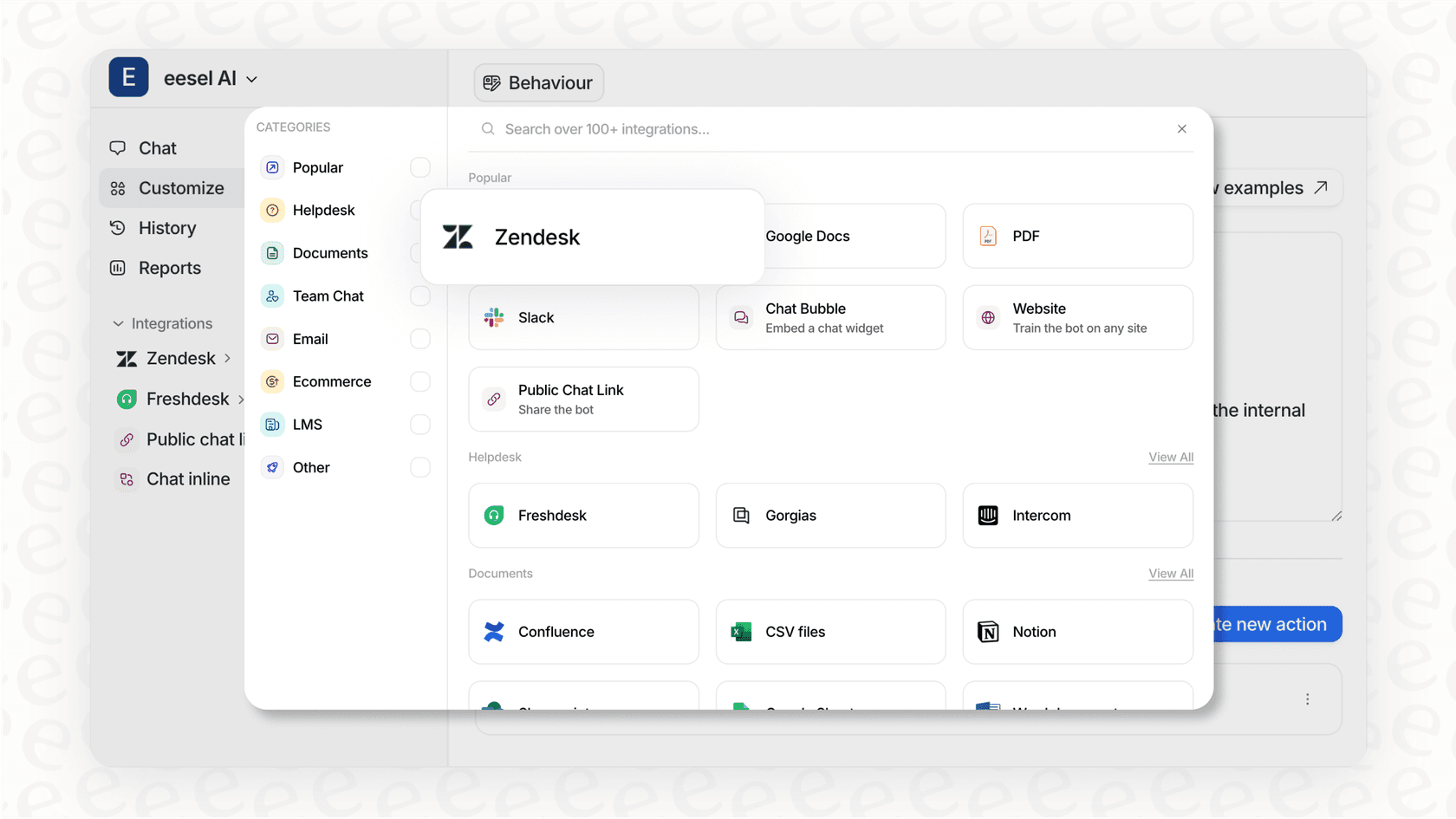
But the platform subscription is only part of the story. Here are the other cost factors to model:
Implementation and setup. Most AI support platforms require some upfront configuration. Connecting to your help desk, training on your knowledge base, setting up escalation rules. Budget $5,000-15,000 for implementation depending on complexity.
Ongoing optimization. AI systems improve with feedback. Someone on your team will spend time reviewing AI responses, providing corrections, and tuning prompts. Budget $6,000-12,000 annually for this oversight.
Human fallback. Even the best AI can't resolve everything. You'll still need human agents for escalations, complex issues, and edge cases. The difference is you need fewer of them.
Gartner recently predicted that by 2030, generative AI cost per resolution in customer service will exceed $3, surpassing many offshore human agents. That forecast reflects the full infrastructure required for enterprise-scale AI deployments: orchestration layers, governance controls, retrieval-augmented generation pipelines, monitoring systems, and human fallback.
But that projection primarily addresses fully automated, generative AI-driven resolutions at scale. In hybrid models, where AI augments human agents rather than replaces them, cost structures look different. If AI reduces handle time or improves first-contact resolution rates, the economics shift in your favor.
Side-by-side cost breakdown: 10 support agents for one year
Let's run the numbers for a typical scenario: a support operation handling roughly 3,000 tickets per month.
Offshore team costs
| Cost component | Annual estimate |
|---|---|
| Base labor (10 agents at $24,000/year) | $240,000 |
| Benefits/overhead (30%) | $72,000 |
| Management/supervision | $60,000-120,000 |
| Training/retraining | $24,000-48,000 |
| QA overhead | $36,000-72,000 |
| Turnover costs (40-60% annually) | $48,000-96,000 |
| Total fully-loaded | $480,000-648,000 |
AI support costs (hybrid model)
| Cost component | Annual estimate |
|---|---|
| AI platform (Business plan) | $7,668-9,588 |
| Implementation/setup | $5,000-15,000 |
| Interactions (36,000/year) | Included in plan |
| Ongoing optimization | $6,000-12,000 |
| Reduced human team (3 agents vs 10) | $144,000 |
| Total first year | $162,668-180,588 |
| Subsequent years | $157,668-165,588 |
The math is stark. Even in year one, the AI hybrid model costs roughly one-third of the fully-loaded offshore model. In subsequent years, the gap widens further.
The key assumption here is that AI can handle a significant portion of your ticket volume. At eesel AI, we typically see mature deployments achieve up to 81% autonomous resolution. But you don't need to hit that number for the economics to work. Even 50% autonomous resolution changes the equation dramatically.
Payback period is another metric worth tracking. Most eesel AI customers see payback in under two months. Compare that to offshore teams, where you're paying full cost from day one while new hires ramp up for 6-8 weeks.
Beyond cost: Quality, speed, and scalability comparison
Cost isn't the only factor. Let's look at how these options compare on other dimensions that affect your operation.
Accuracy and consistency. AI produces uniform output. Every ticket gets the same level of documentation completeness, the same policy adherence, the same tone. Human agents vary. That variation increases during high-turnover periods and when procedures change.
Scalability. Adding 200 more tickets per month to an offshore team means adding headcount, with all the recruiting and training that entails. Adding 200 more tickets to an AI platform means near-zero incremental cost. This is the compounding advantage: the ROI of AI improves as your volume grows, while the ROI of offshore labor stays flat or declines.
Time to productivity. AI is ready in days once trained on your knowledge base. Offshore agents need 6-8 weeks to reach meaningful productivity. During ramp-up, error rates are elevated and supervision requirements are higher.
Availability. AI operates 24/7 without shift premiums, overtime, or holiday pay. Offshore teams can provide extended coverage, but true 24/7 operation requires multiple shifts and geographic distribution.
Language coverage. AI platforms like eesel AI handle 80+ languages from a single deployment. Offshore teams typically cover a smaller set of languages unless you maintain multiple geographic operations.
Audit and compliance. AI systems produce automatic, timestamped logs of every action. Every decision is documented for audit readiness. Human operations vary in documentation quality, with gaps often appearing during staff transitions.
When offshore teams still make sense
Being direct about this matters. There are scenarios where offshore teams remain a reasonable component of your operational model, at least in the near term.
If you're a smaller operation with low ticket volumes and high variability month-to-month, the fixed cost of AI implementation may not pencil out yet. Offshore labor offers flexibility and lower upfront commitment.
If you have complex, exception-heavy case types requiring significant human judgment, human agents still outperform current AI for the edge cases. The right model often pairs AI for high-volume, standardized work with a smaller team handling escalations.
And if your team has built strong processes and a stable, experienced offshore team with low turnover, your actual fully-loaded cost may be closer to the base rate than the industry average. Run your own numbers before assuming the typical model applies.
The honest framing: offshore made sense when AI wasn't affordable or reliable enough for customer-facing work. In 2026, that calculus has shifted for most mid-to-large operations. But the right answer depends on your volume, your current error rates, and your growth trajectory.
How eesel AI approaches the cost-quality balance
We built eesel AI around a simple idea: you don't configure AI, you hire it. Like any new team member, eesel learns your business, starts with guidance, and levels up to work autonomously.
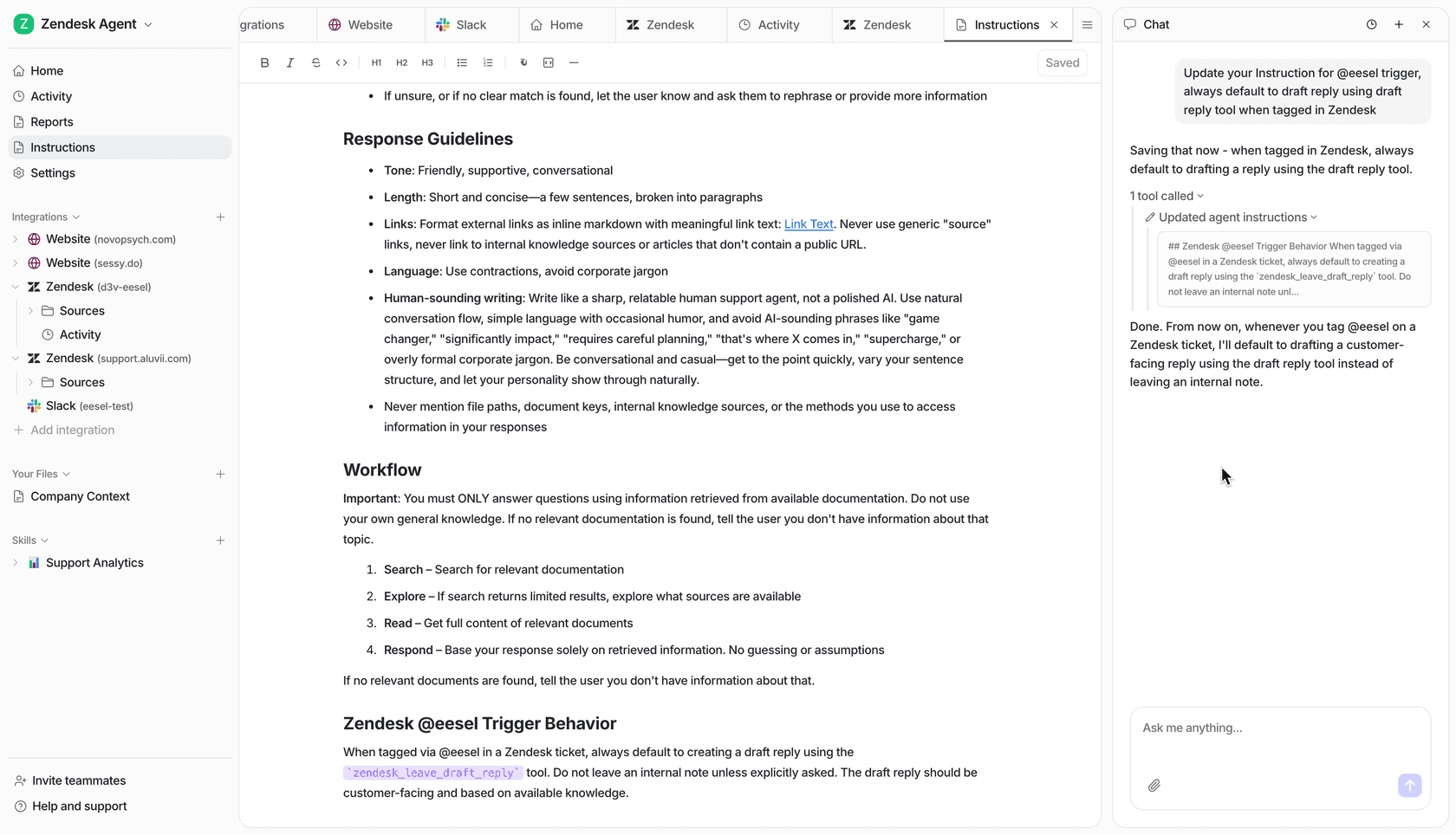
Here's how that plays out in practice:
Progressive rollout. Start with AI Copilot, which drafts replies for your human agents to review and send. Once you're confident in quality, level up to AI Agent, which handles tickets end-to-end. You control the pace based on actual performance.
Pre-go-live testing. Before eesel touches real customers, you can run simulations on thousands of past tickets. See exactly how it would respond. Measure resolution rates. Identify gaps. This isn't available with offshore hiring.
No turnover costs. The system doesn't resign. It doesn't need retraining when your product changes. Updates are applied globally, not per-agent. There's no 6-week ramp-up when volumes spike.
Transparent pricing. We charge per interaction, not per resolution or per seat. This means predictable costs that scale with actual usage. No surprise overages. No paying for idle agents during slow periods.
Continuous learning. When you correct an AI response, eesel learns from it. When you message it on Slack with a policy update, it incorporates the feedback immediately. No retraining cycles. No documentation uploads.
Typical payback period for eesel AI deployments is under two months. Mature deployments achieve up to 81% autonomous resolution. But you don't need to commit to full automation on day one. The realistic outcome for most teams is a smaller, more senior human team focused on escalations and quality oversight, with AI handling the routine volume that was previously driving headcount growth.
Making the right choice for your support operation
The question isn't whether AI is cheaper than offshore labor. The fully-loaded numbers make that clear. The question is whether your cost model captures the full picture, and whether your organization is ready to make the shift.
Here's a simple decision framework:
- Volume: If you're handling more than 1,000 tickets per month, AI economics start to work in your favor
- Complexity: If more than 60% of your tickets are routine and repeatable, AI can handle a meaningful portion
- Growth trajectory: If you're growing, AI scales without linear headcount addition
- Risk tolerance: If you need to test before committing, AI offers simulation and gradual rollout
The hybrid future is already here. Most successful teams we see aren't choosing between AI and humans. They're using AI for routine work and reserving human agents for what humans do best: complex problem-solving, emotional intelligence, and relationship building.
If you've never stress-tested the fully-loaded cost of your offshore operation, now is the time. The gap between what offshore actually costs and what AI actually costs has widened enough that the math deserves a serious look.
Ready to see how AI could work for your specific situation? Try eesel AI free for 7 days or book a demo to run simulations on your past tickets.