

What makes a customer service review actually positive
Before the examples, it helps to know what you're looking at. A weak review is all adjectives ("amazing, so helpful, 10/10") and no substance. A strong one reads like a tiny story: here's what I needed, here's who helped, here's what changed. That specificity is what makes it believable to the next reader, and it's what search engines and AI answer engines quote when they surface social proof.
Across thousands of reviews, the good ones share five ingredients.
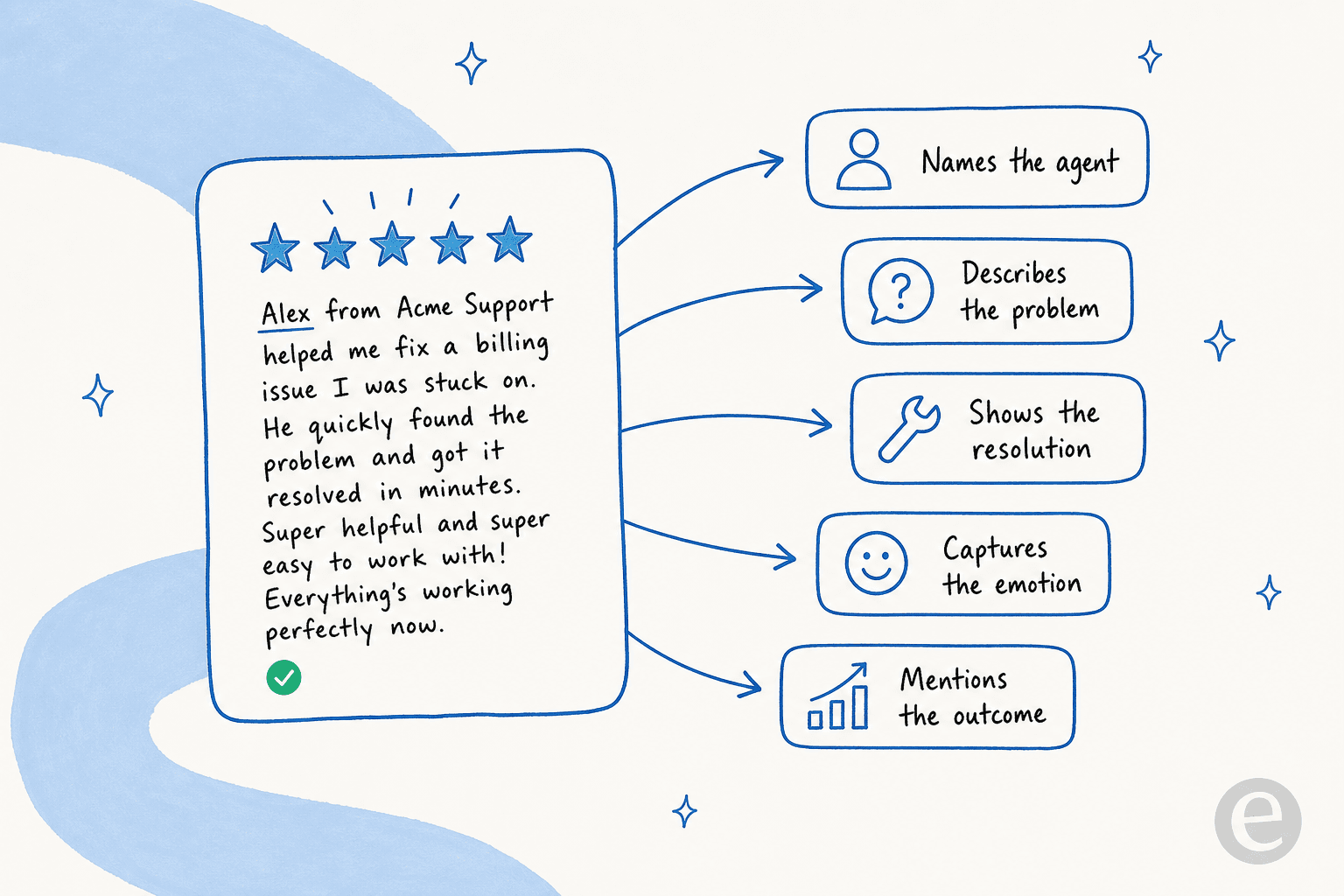
- A named agent. "Priya", "Marcus", "the rep on chat Tuesday morning." A name turns a faceless company into a person who did a good job.
- A specific problem. Not "I had an issue" but "my order shipped to the wrong address."
- A visible resolution. What actually happened, ideally with a timeframe.
- Genuine emotion. Relief, surprise, delight, the human reaction that proves it mattered.
- An outcome. "I'll definitely order again", "I've already recommended you to two friends."
You'll see these five show up again and again below. When you're coaching a team, these are also the moments to aim for: a great review is downstream of a great customer service interaction, not a copywriting exercise.
18 positive customer service review examples
I've grouped these by the kind of experience that produced them. Where a review is a real, public one from an eesel customer, it's attributed and linked. The rest are illustrative templates, written to show the pattern, so you can adapt the phrasing for your own review requests or use them to train agents on what "good" looks like.
Speed and fast response
Nothing earns goodwill faster than a quick reply. When someone expects to wait a day and hears back in minutes, that gap becomes the review.
"I sent a question at 11pm fully expecting to hear nothing until morning. Had a clear, correct answer within four minutes. Genuinely didn't know that was possible from a company this size."
"Marcus on live chat answered before I'd even finished typing my follow-up. Whole thing took two minutes and I didn't have to repeat myself once."
Why they work: both name the channel and the timeframe. Speed only reads as impressive when it's concrete, and the second one quietly praises something teams forget, not having to repeat yourself. If fast replies are your weak spot, that's the most fixable metric you have; see how AI reduces first response time and how to run 24/7 support without a night shift.
Going above and beyond
The reviews people screenshot and share are almost always about someone doing more than the job required.
"Ordered a gift that wasn't going to arrive in time for my mum's birthday. The rep, Aisha, upgraded the shipping for free and emailed me a printable card to hand over in the meantime. I nearly cried."
"Not only did they fix my billing error, they went back through six months of invoices, found two more overcharges I'd missed, and refunded all three without me asking."
Why they work: the "and then they also..." structure is the tell of a truly positive review. The customer got more than they came for, and that surplus is the whole story. You can't mandate this in a macro, but you can hire for it and give agents the room to use judgement.
Empathy and the human touch
Sometimes the fix matters less than feeling heard. These reviews are about tone.
"I was honestly pretty rude when I first messaged because I was stressed about a deadline. The agent stayed calm, didn't take the bait, and just quietly sorted everything. I felt bad afterwards and wanted to leave this to say thank you."
"You can tell they actually read my message instead of pasting a template. Small thing, but it made the whole exchange feel human."
Why they work: empathy is hard to fake and instantly recognisable. The first example is gold because the customer admits they were difficult, which makes the praise more credible. Empathy in customer service is also the thing people worry AI can't do, which makes getting the human handoff right so important.
The knowledgeable agent who just solved it
"Kellen knew the answer cold, no 'let me check with my team', no hold music. Answered confidently but never overpromised. Rare these days."
That phrasing comes almost word for word from a real review of eesel by Kellen Brown at Textla, who wrote that our AI "answers confidently but not too confidently, and training it has been super easy." The version above shows the same review shape applied to a human agent, competence plus calibrated confidence.
Why it works: "confident but not too confident" is the exact line between helpful and reckless. Customers trust an agent who knows the limits of their own knowledge, which is also the accuracy bar any AI support tool has to clear.
The named shout-out
"Give Priya a raise. That is the entire review. She turned what should have been a frustrating return into the easiest thing I did all week."
Why it works: short, specific, and impossible to fake. Named shout-outs are the reviews to celebrate internally, because they tell you exactly who's setting your service standard. If you track customer service KPIs, pair the numbers with these names, the qualitative and quantitative together tell the real story.
Product plus support (the ecommerce combo)
In ecommerce, the product and the service blur together in the customer's mind, and the best reviews reflect that.
"The blender is great, but honestly the support is why I'm writing this. Part rattled after a month, I sent one photo, and a replacement was on its way that afternoon. No forms, no fight."
This mirrors the sentiment in a real eesel customer review from Oil Stores, an ecommerce team that told us the results were "incredible" and that AI "relieves our small support team from being over ran by questions that can be easily answered."
Why it works: the reviewer leads with the product then pivots to service as the deciding factor. That pivot is exactly what a prospective buyer needs to hear. For stores, fast AI live chat and solid ecommerce support are what generate these.
The self-service and chatbot win
Not every great review involves a human, and that's fine. When self-service actually works, people notice.
"Expected the usual useless chatbot loop. Instead it pulled up my exact order, told me where the package was, and offered to reroute it, all before midnight. Better than most humans I've dealt with."
Compare that to the real experience Billwerk+ reported: their CTO said the AI "has been used a lot by customers and has seen to be successful" at helping people self-serve.
Why it works: it sets up the low expectation ("useless chatbot loop") and then subverts it. That contrast is the story. The bar for a positive chatbot review is that it did the job better than the customer feared, and often, better than a queue would have.
The recovery (a bad situation turned around)
Counterintuitively, some of your best reviews will come from things going wrong first. A well-handled failure often beats a flawless-but-forgettable transaction.
"Package arrived smashed. I was ready to write an angry review. Instead the replacement shipped same day, they threw in a discount code for the hassle, and followed up two days later to check it arrived intact. I'm a customer for life now."
Why it works: this is the service-recovery paradox in one paragraph. The customer arrived angry and left loyal, and they say so. These reviews are worth more than a clean transaction because they prove you show up when it counts. There's a whole genre of bad customer service stories that are just this in reverse, learn from those too.
The B2B software review
On G2 and Capterra, reviews skew practical: setup, ROI, and whether it delivered. The praise is quieter but carries weight with buyers.
"eesel AI streamlines our workflow, boosts productivity, and ensures a higher level of service consistency."
That's a real, verbatim review from Melissa Ryan, a Zendesk Administrator at Discuss.io. Another eesel customer, Yellowdig's Jon Miron, went further:
"It feels like a partnership, rather than a vendor relationship... Recently, a new customer success hire joked that our eesel AI bot was their best friend during onboarding and interviewing."
Why they work: B2B readers want proof of outcomes (consistency, productivity) and relationship (partnership, not a vendor). Both reviews deliver a concrete claim a buyer can picture. This is the shape to aim for if you sell software.
The long-term loyalty review
"Three years, two house moves, and one billing system migration later, they've never once made me feel like a ticket number. That consistency is why I don't shop around."
Why it works: longevity is the hardest thing to fake and the most valuable thing to prove. A review that spans years tells a prospect the good service isn't a fluke. Consistency at that scale is an operational achievement, and it usually rides on good knowledge management so every agent answers the same way.
Why positive reviews matter more than you might think
It's tempting to treat reviews as a vanity metric. They're not. A positive customer service review does three jobs at once:
- It sells for you while you sleep. A prospect reading "the support is why I'm writing this" is being sold by a peer, which is worth more than any ad. It's the same reason strong service standards compound over time.
- It feeds the machines. Search engines and AI answer engines increasingly surface and quote reviews. Specific, well-written reviews are the ones that get cited, which shapes how your brand appears in AI-generated answers.
- It lowers your acquisition cost. Trust built before a sales conversation shortens the sales conversation.
The flip side: reviews are a lagging indicator of your actual service. You can't buy your way to good ones, and fake ones read as fake. The only durable strategy is to make the underlying experience genuinely good, then make it easy to talk about.
How to get more positive customer service reviews
You get more good reviews the same way you get fit: do the boring thing consistently. Here's the sequence that works.
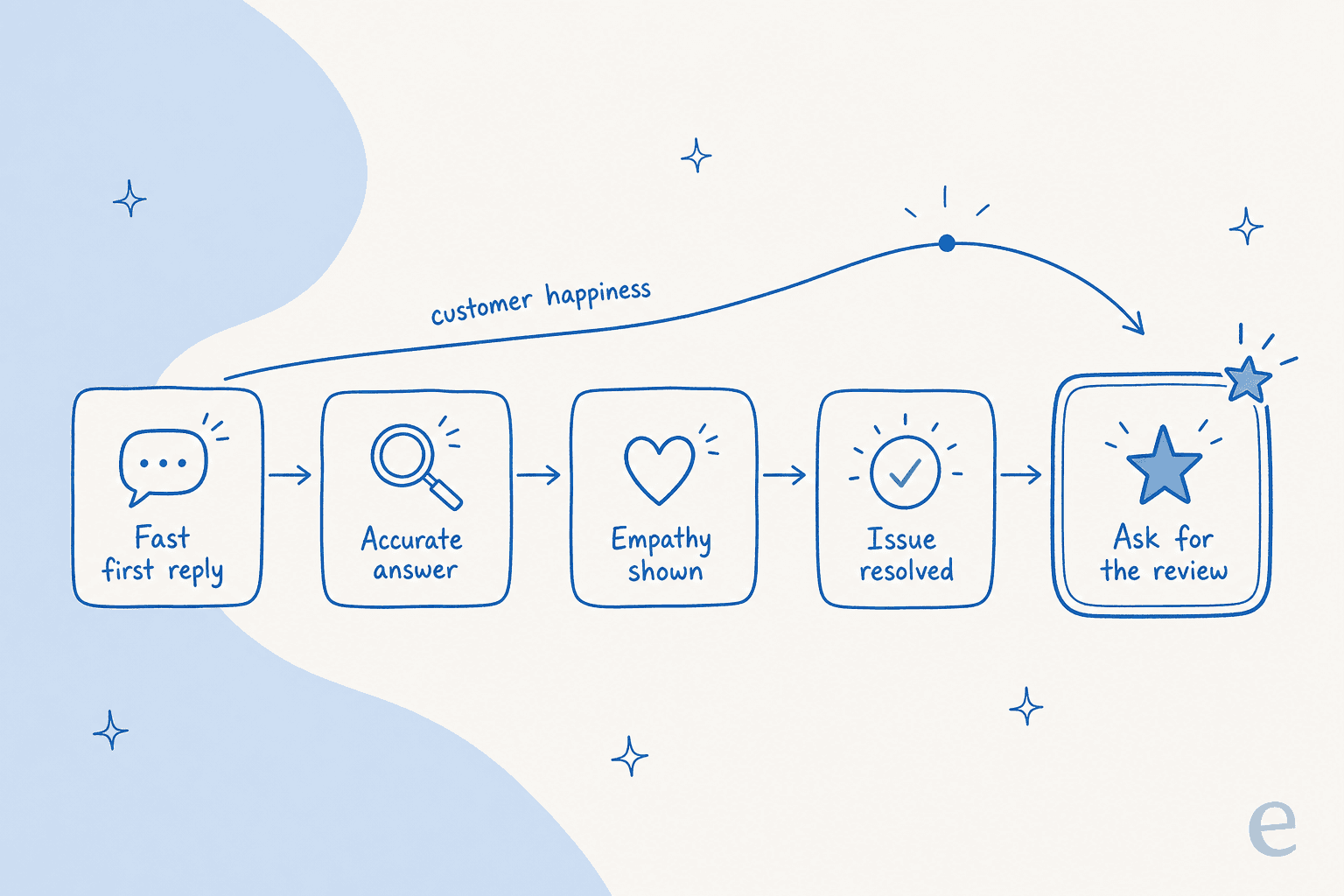
- Deliver something worth reviewing. Fast first response, an accurate answer, and a human who cared. No amount of clever asking rescues a mediocre experience.
- Ask at the peak. The best moment is right after the issue is resolved and the customer says some version of "thank you so much." That's the emotional high, and a review request then converts far better than one buried in a monthly newsletter.
- Make it a one-click ask. Link straight to the review page. Every extra step loses people.
- Give a gentle prompt. "If you have a moment, mentioning what we helped with really helps others." That nudge is what turns "great service!" into a specific, useful review.
- Respond to the ones you get. Which brings us to the next section.
The through-line is that most of this is upstream of the ask. If your team is buried in repetitive tier-1 tickets, first response times slip, answers get inconsistent, and the experience that produces reviews never happens. That's the operational problem to solve first, and increasingly it's where AI comes in.
The support engine behind 5-star reviews
Here's the part I care most about, having watched it play out across a lot of rollouts. Great reviews are manufactured in the unglamorous machinery of support: how fast you reply, how accurate the answer is, whether the customer had to repeat themselves, whether it worked at 2am.
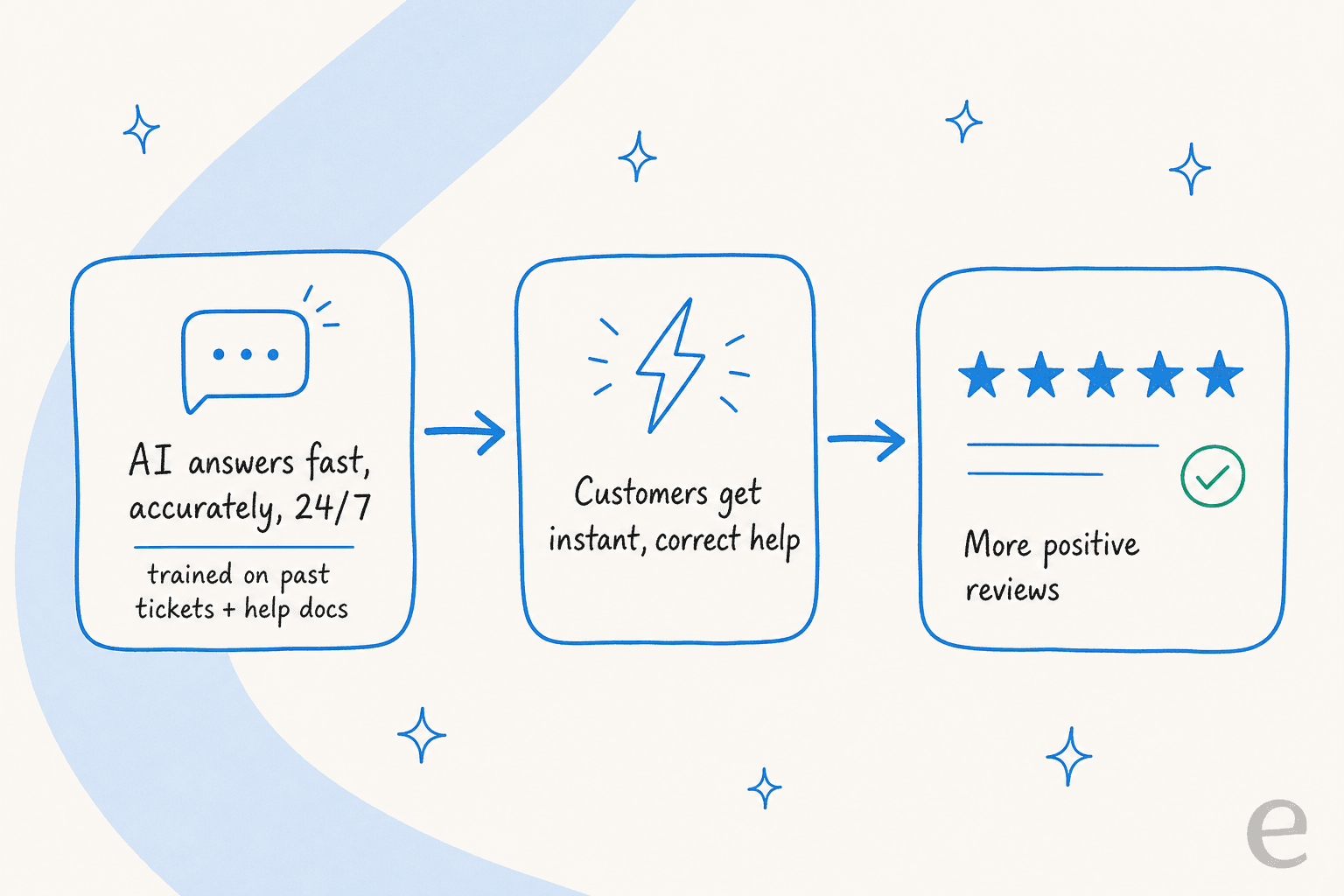
That's exactly the layer a well-configured AI helpdesk agent improves. Trained on your past tickets and help docs, it answers the repetitive tier-1 questions instantly and around the clock, which frees your human agents for the empathy-heavy, judgement-heavy interactions that earn the "give Priya a raise" reviews. The result buyers describe shows up in the numbers too: Gridwise saw 73% of tier-1 requests resolved in the first month, and Global Pay reported up to 80% time savings finding answers.
The catch, and the reason I'm careful here, is that a confident-but-wrong bot generates bad reviews faster than anything. I've watched it happen. That's why the guardrails matter: confidence-based routing so low-confidence questions go to a human instead of getting a made-up answer, and a simulation mode that tests the AI against your real past tickets before it ever touches a customer. Get that right and AI becomes a review-generating engine; get it wrong and it's the opposite.
How to respond to a positive review
Getting the review is half of it. Responding well closes the loop and quietly encourages the next customer to leave one.
Here's a response that works:
"Thank you so much, and I'll pass this straight to Priya, she'll be thrilled. Really glad the return was painless. See you next time!"
Why it works: it thanks the reviewer, names the agent they praised, echoes the specific thing (the painless return), and stays human. Compare that to the version that kills goodwill:
"Thank you for your feedback. Your satisfaction is important to us. Please don't hesitate to reach out."
That second one reads like a template because it is one, and it signals that no real person read the review. A 20-second personal reply beats a polished-but-generic one every time. If you're responding at volume, this is another place AI can draft a first pass that a human personalises, rather than replacing the human touch entirely.
Try eesel for the support that earns the reviews
If the pattern in this post is clear, that positive reviews follow fast, accurate, consistent service, then the practical question is how to deliver that without tripling your headcount. That's what eesel does.
eesel is an AI teammate that plugs into your existing helpdesk (Zendesk, Freshdesk, Gorgias, Help Scout, Front) in minutes, learns from your past tickets and help docs on day one, and handles the repetitive tier-1 questions that slow your team down, so first responses are instant and your agents are free for the interactions that actually earn 5-star reviews. You can simulate it against your real tickets before going live, and it's usage-based with a free trial, no per-seat fees. If reviews are downstream of service, this is the upstream fix.

Frequently Asked Questions
What is a good example of a positive customer service review?
How do I write a positive customer service review?
How can I get more positive customer service reviews?
How should a business respond to a positive review?
Do positive customer service reviews actually affect revenue?


Article by
Kurnia Kharisma
Kurnia is a software engineer and writer at eesel AI with two years of SEO experience, writing about AI tools, helpdesk software, and customer support. He pairs a developer's understanding of how these products are built with search-driven research into what actually ranks and resonates with the people searching for them.