
A complaint is not just another support ticket. It arrives with history - a delivery that went wrong, a charge the customer didn't recognize, an interaction that already failed somewhere upstream. The customer has decided to take the time to tell you about it, which means they haven't completely given up on you yet. What happens in the next few minutes determines whether that holds.
The numbers behind complaints are sobering. According to the National Customer Rage Survey published in February 2025, 77% of Americans experienced a product or service problem in the previous 12 months. The quieter number: 56% of customers don't complain at all after a bad experience - they just leave. US companies lose an estimated $75 billion annually through churn and lost sales tied to poor complaint handling.
AI is changing both the speed and the economics of handling complaints at scale. But the companies doing it well look very different from the ones making headlines for the wrong reasons. This guide covers both.
Why complaints are harder than regular support tickets
A password reset question has a correct answer. A billing query has a known resolution path. Complaints are different because they carry emotional weight that regular tickets don't.
The customer writing a complaint has usually already been disappointed. They're not looking for information - they're looking for acknowledgment, fairness, and resolution in that order. Skip the first two and the third feels hollow even when it's technically correct.
This shapes how AI has to behave. Research from r/customerexperience found near-unanimous agreement among CX professionals on one point: AI for tier-1 triage and routing is a net positive; AI attempting to fully replace humans on emotional or complex complaints causes harm. The "seamless access to a human when needed" requirement was the most consistently cited position.
There's a real paradox in consumer data here. A majority of consumers say in surveys that they'd prefer human agents for complaints. In practice, 67% of consumers say they want to use AI assistants for customer service queries when speed matters, and more than half prefer a faster AI response over waiting for a human. The apparent contradiction resolves when you look at outcomes: consumers don't actually have strong preferences about the technology - they have strong preferences about getting their problem solved accurately and quickly. When AI delivers that, satisfaction is high. When AI creates loops, invents policies, or has no human exit, frustration is extreme.
How AI handles a customer complaint, step by step
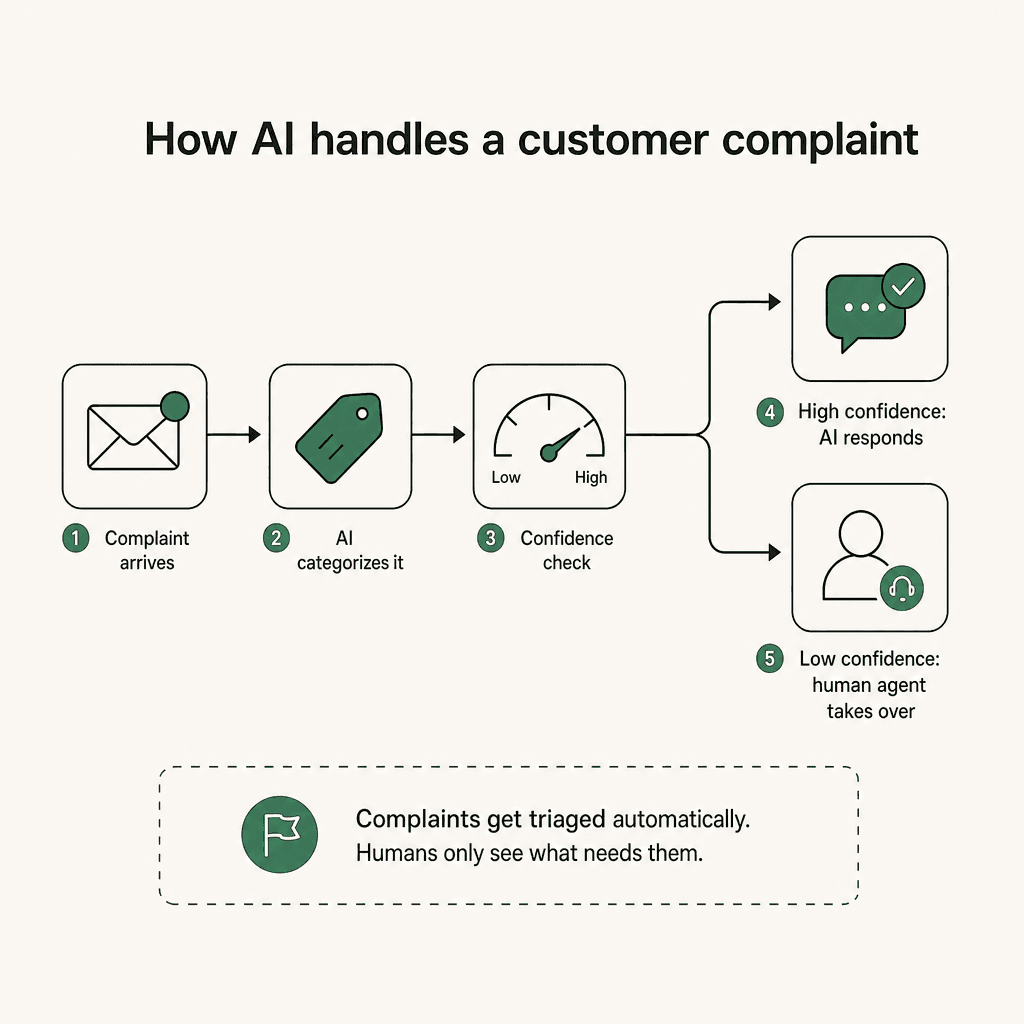
The workflow that well-implemented AI follows for a complaint looks like this:
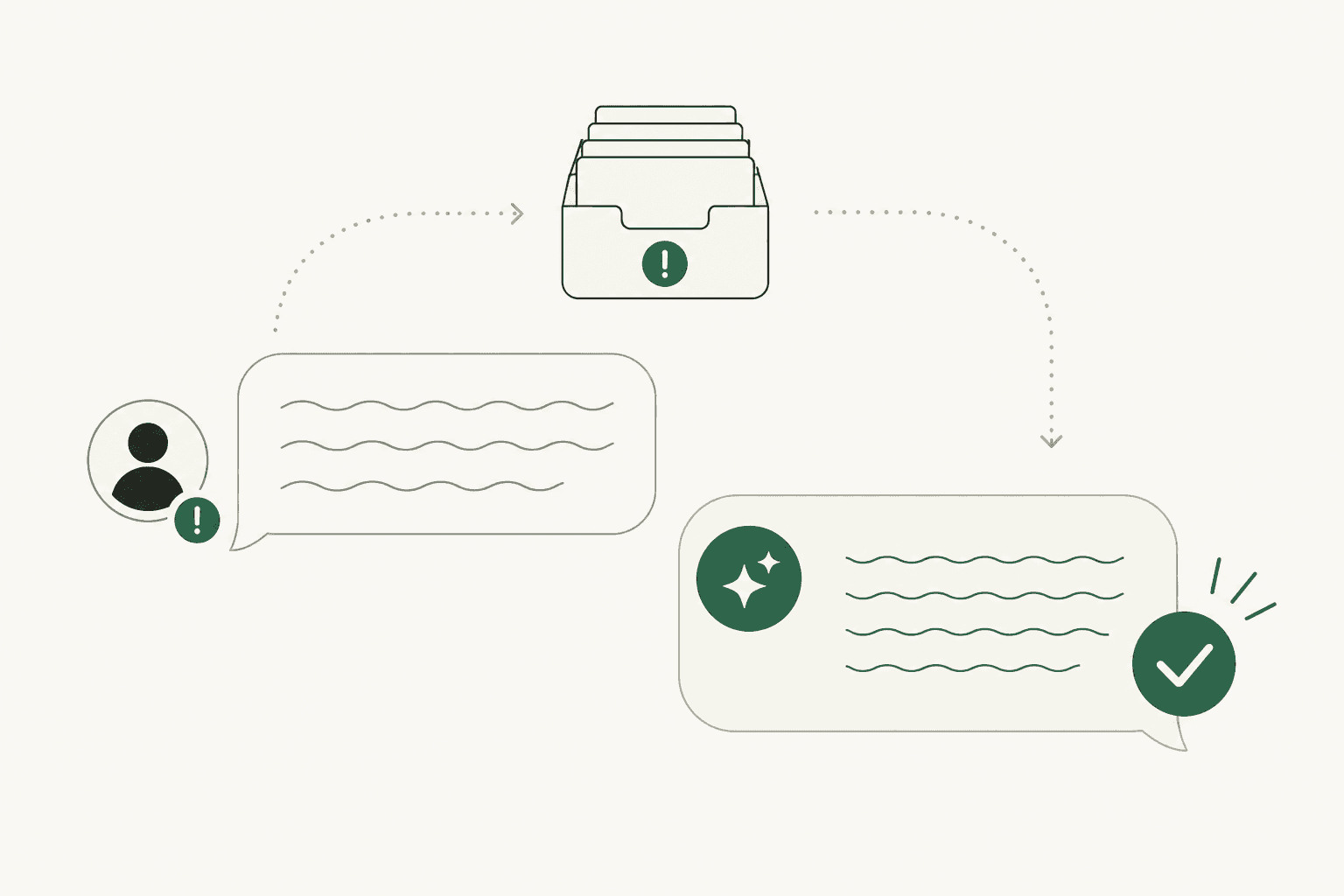
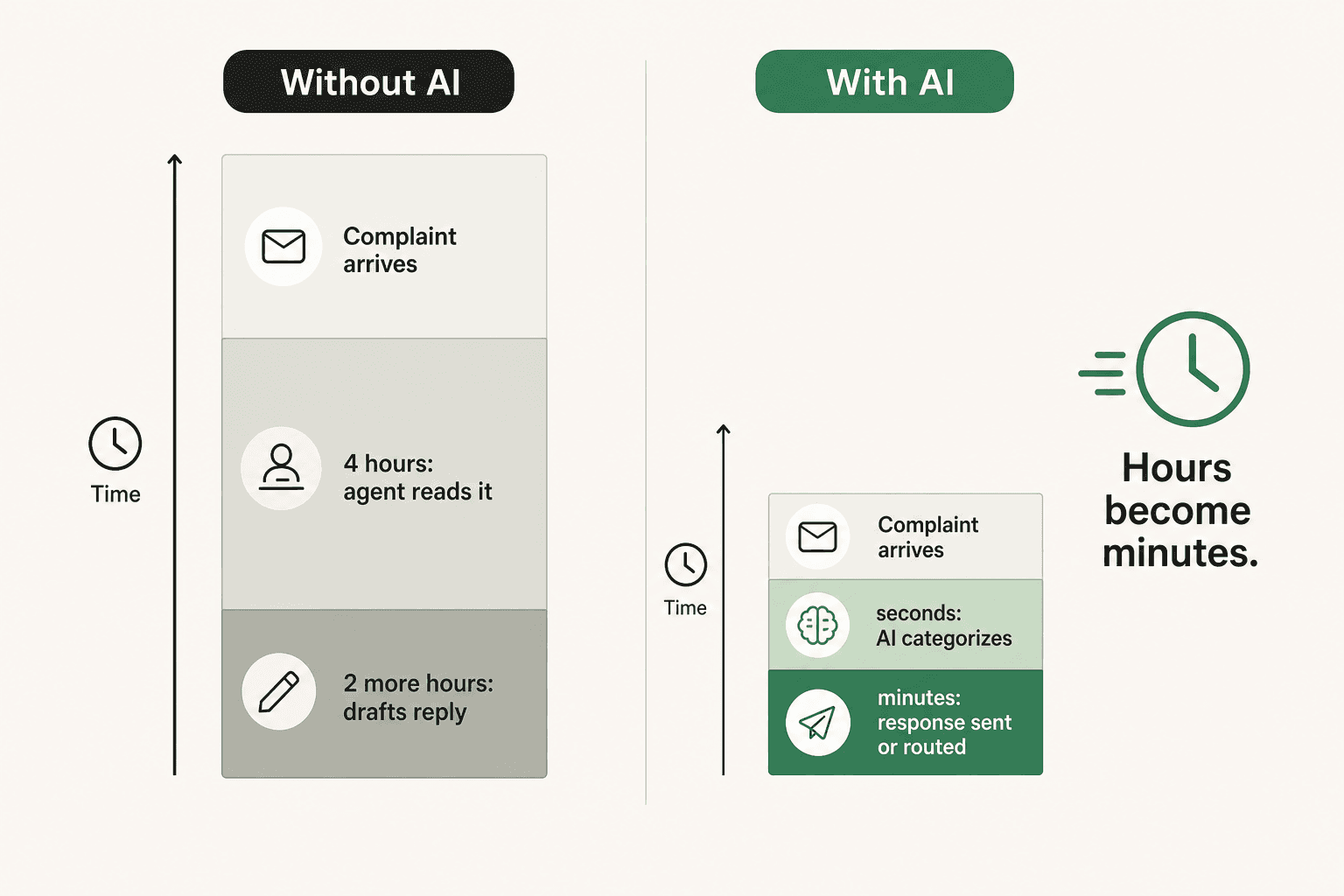
Intake and categorization. When a complaint arrives - email, chat, social media, web form - AI reads the message, extracts the key details (issue type, urgency, customer history), creates a structured case record, and sends an immediate acknowledgment. This alone eliminates the multi-hour delay that plagues most complaint queues.
Sentiment and priority scoring. AI scores the complaint on urgency, severity, and customer value. Inputs include the emotional tone of the language, how close the case is to an SLA breach, the customer's history and segment, and the type of complaint. A first-time billing question from a new customer scores differently than a repeat complaint from a high-value account. This is where automated ticket triage earns most of its time savings.
Knowledge retrieval. Rather than making an agent hunt across systems, AI pulls the relevant information together: the customer's prior interactions, the applicable policy, any shipping or order data from connected systems, and relevant resolution patterns from similar past cases.
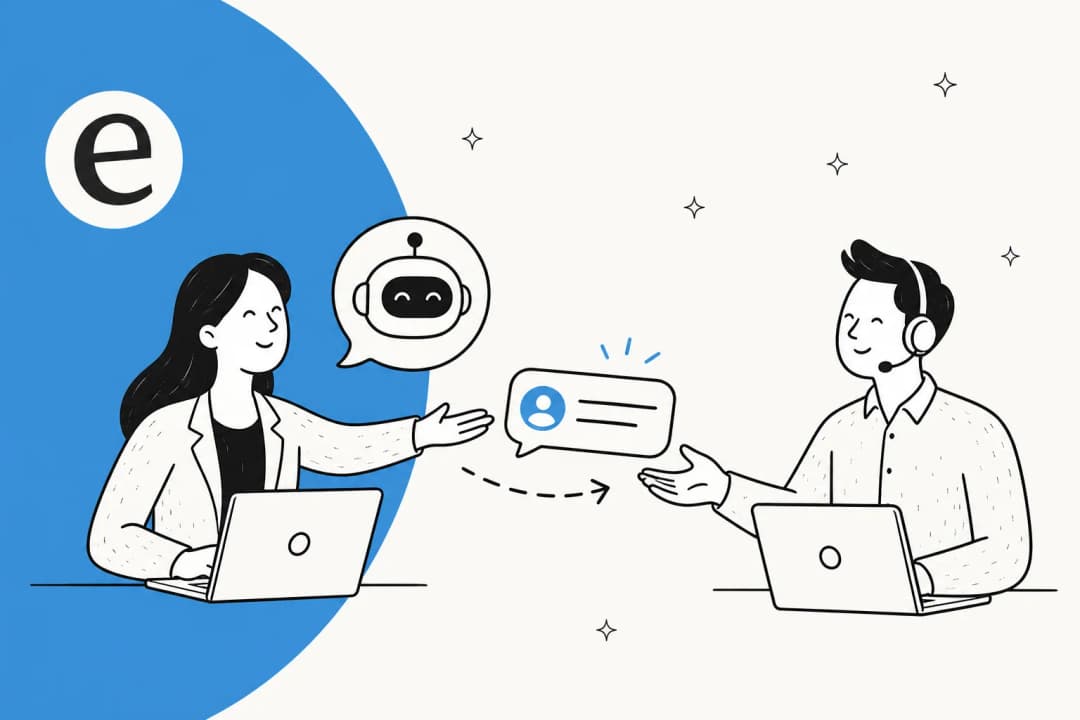
Drafting or responding. This is where the three-tier model comes in. For clearly defined, high-confidence complaints, AI sends a response directly. For more complex situations, AI drafts a response for human review and approval before it goes out. For sensitive situations - financial hardship, legal risk, high-value customers with serious issues - AI prepares the full context package and routes directly to a senior human agent. The confidence threshold for each tier is configurable.
Escalation monitoring. AI watches open cases for SLA risk and escalating sentiment, flagging cases before they miss resolution targets rather than after.
Post-resolution follow-up. After resolution, AI can send a follow-up to catch lingering dissatisfaction - the complaint that was technically resolved but left the customer still annoyed.
Which complaints AI resolves vs. routes to humans
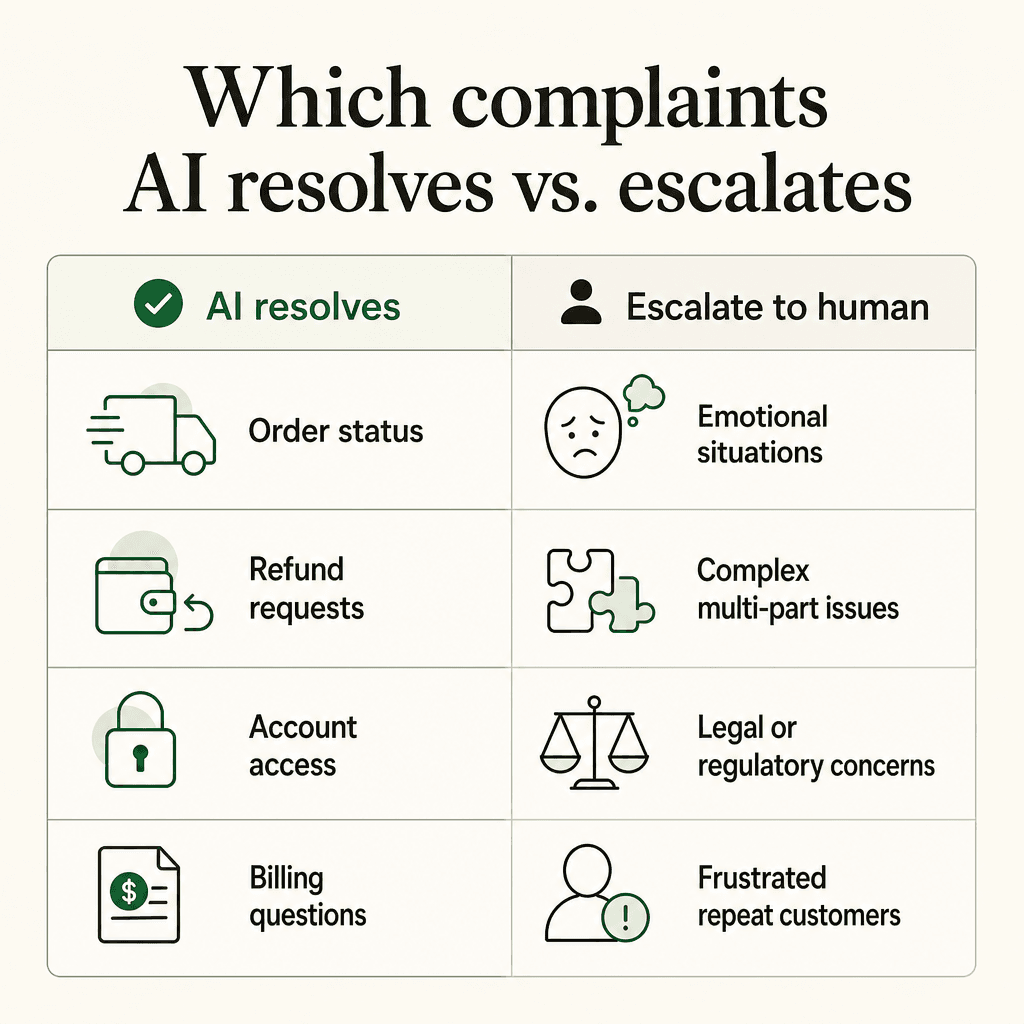
Not all complaints belong in the AI queue. The useful mental model is to separate complaints by two variables: how well-defined the resolution is, and how emotionally charged the situation is.
AI handles well:
- Order status, shipping delays, tracking inquiries
- Standard refund and return requests (which have their own patterns worth studying)
- Account access issues and password resets
- Billing questions with clear policy answers
- Product information complaints that have a factual resolution
Route to humans:
- Emotional situations - loss, financial hardship, health, bereavement contexts
- Complex multi-part complaints that require judgment across multiple policies
- Complaints involving legal or regulatory risk
- Repeat complaints from frustrated customers who've already been through the AI queue
- Any situation where the customer explicitly asks to speak to a person
The design principle for the second category: AI acknowledges instantly, prepares full context, routes to human. AI handles the speed; humans handle the judgment.
Where AI goes wrong with complaints - and what users actually hate
The most publicized failure in recent AI complaint handling came from Cursor, the AI code editor, in April 2025. Ars Technica reported that an AI support agent named "Sam" told a user that Cursor was "designed to work with one device per subscription as a core security feature" - a policy that didn't exist. The user posted on Reddit assuming it was official policy, other users began canceling subscriptions, and the resulting thread spread widely before Cursor's team confirmed three hours later that the policy was entirely invented. Cursor's co-creator subsequently apologized on Hacker News and committed to labeling all AI support responses as such.
This is not an isolated incident. In February 2024, a Canadian tribunal ruled that Air Canada was responsible for a refund policy its own chatbot had invented, rejecting the airline's argument that the bot was a "separate legal entity." Companies are legally responsible for information their AI provides to customers.
Community discussions about AI complaint handling consistently return to the same list of failures:
- Loops with no exit. AI that can't resolve the issue but also won't connect to a human. This is the single fastest way to turn a complaint into a canceled subscription.
- Hallucinated policies. AI stating incorrect procedures with confidence. The Cursor incident is the archetype, but minor hallucinations happen constantly in deployments that aren't grounded in accurate documentation.
- No transparency. Customers who discover after the fact they were talking to AI feel deceived, even when the resolution was correct.
- Cold handoffs. Having to re-explain the entire situation when escalating from AI to human. The escalation message should carry everything the agent needs.
- Emotional mismatch. AI responding with policy language to a situation that calls for acknowledgment first.
The r/britishproblems thread about JustEat's AI-only customer service identified the emotional core of the problem clearly: "Companies turning to 100% AI for customer service are demonstrating that they don't care about you." The issue isn't the technology - it's the perception that AI is deployed as a barrier rather than a tool.
Setting up AI for complaint handling
A few things determine whether AI complaint handling works or creates more problems:
Ground the AI in your actual policies. The Cursor failure was a grounding failure. AI that generates responses from general model knowledge will hallucinate - occasionally producing policies that sound plausible but don't exist. AI grounded in your own documentation, policy pages, and resolved ticket history produces responses that are accurate because they draw from verified sources. This is what retrieval-augmented generation does in practice: the AI retrieves the specific policy, then formulates a response based on it. Building a solid knowledge base before deploying complaint-handling AI is the highest-leverage pre-launch activity.
Start in supervised mode. Don't let AI send complaint responses autonomously on day one. Start with AI drafting and humans approving. This gives you visibility into where the AI is accurate and where it needs adjustment before errors reach customers. Once you've validated accuracy on specific complaint categories, extend autonomy selectively.
Run simulations before going live. The best tools let you run your AI against historical complaints before it sees live traffic. You can see coverage rates by complaint category - "billing disputes: 82% coverage, damaged goods: 41% coverage" - and address gaps before they become customer-facing problems.
Design the escalation path explicitly. The handoff from AI to human is where most deployments lose customer satisfaction. When AI escalates, it should pass the full context: the customer's account details, the complaint summary, the conversation history, what resolution was attempted, and a suggested resolution path. The human agent receives a briefing, not a blank ticket. This is what eliminates the "please explain your problem again" moment that customers find so frustrating.
Be transparent. Label AI responses as AI responses. Offer clear paths to human agents. This is not a concession - customers are significantly more likely to trust AI-driven service when it's transparent about what it is.
Measuring it right: resolution rate vs. deflection rate
There's a measurement mistake that derails many complaint-handling deployments: optimizing for deflection rate instead of resolution rate.
Deflection rate measures how many customers stopped contacting you. Resolution rate measures how many customers actually got their problem solved. These are different things. A customer who gave up after hitting a bot loop counts as "deflected" but is not resolved - they're frustrated, and they're likely churning. Companies lose customers over exactly this distinction.
The metrics that actually predict whether your AI complaint handling is working:
- Resolution rate by complaint category - where is AI succeeding and where is it stalling?
- CSAT scores, AI-handled vs. human-handled - are customers more or less satisfied with AI resolutions?
- Escalation rate over time - as AI learns from more resolved cases, this should decrease
- First-response time - typically the easiest win, and the one customers notice first
- Re-contact rate - did the same customer come back with the same complaint? That's a resolution failure, even if the original ticket is marked closed.
The before/after picture for teams that get this right is significant. 75% of customer complaints can be resolved by AI without human involvement at maturity, according to Gartner's 2025 projections, with Gartner projecting that agentic AI will autonomously resolve 80% of common customer service issues by 2029. Getting there requires treating deployment as continuous improvement: train on new resolved cases, test changes, deploy updates, and measure. Resolution rates typically improve roughly 1% per month with active optimization.
The cost case is also real. Human complaint resolution costs $6–$12 per interaction on average. A company handling 50,000 monthly complaints, shifting 60% to AI at under $1 per resolution, saves approximately $2.5 million annually. AI vs. hiring guide breaks down how these numbers translate to headcount decisions. One caveat worth noting: Gartner projects that by 2030, GenAI resolution costs will exceed $3 per interaction as models grow more capable - building the business case on retention and service quality, not only cost, is the more durable frame.
Try eesel AI
eesel AI is an autonomous helpdesk agent that plugs into Zendesk, Freshdesk, Help Scout, Gorgias, HubSpot, and other helpdesk platforms to handle customer complaints end-to-end. It learns from your past resolved tickets and your documentation, then handles new complaints in draft mode (AI writes, human approves) or autonomous mode (AI sends directly for high-confidence cases) depending on how much autonomy you're comfortable extending.
The confidence-based routing is what makes the complaint-handling case work in practice: eesel routes low-confidence cases to draft for review rather than risking an incorrect autonomous response. When escalating, it passes the full ticket context so human agents don't start from scratch. Kim Simpson at Gridwise reported 73% of tier 1 requests resolved in the first month. Dreamscape Learn now handles a majority of their tech support tickets end-to-end with eesel, freeing hundreds of hours per month for the team to focus on complex issues.
Pricing is usage-based at $0.40 per resolved ticket - no platform fee, no per-seat cost. A $50 free trial with all features unlocked lets you test it against real complaint volume before committing.
Frequently Asked Questions
Can AI really handle customer complaints, or does it just deflect them?
What kinds of complaints should AI handle vs. humans?
How quickly does AI for complaint handling pay for itself?
How do I make sure my AI doesn't give customers wrong information?
What metrics should I track to know if AI complaint handling is working?


Article by
Rama Adi
Rama is a software engineer at eesel AI with two years of experience writing about B2B SaaS, AI tools, and customer support technology. Based in Bali, Indonesia, he brings a developer's perspective to product comparisons — cutting through marketing copy to what the integrations and APIs actually do.