What a customer focus strategy actually is
A customer focus strategy is a deliberate plan to put customer needs at the center of the decisions a company makes, across product, pricing, marketing, and service, and to back that with process and measurement instead of good intentions. That is the textbook version, and it is worth stating plainly because the term gets thrown around so loosely that it has almost stopped meaning anything.
Here is the uncomfortable part. Being customer-focused on paper is easy and nearly universal. Living it is rare. As customer transformation advisor Chris Hood puts it:
"Most companies claim to be customer-centric. It's in mission statements, investor presentations, and marketing campaigns. But declaring customer centricity and actually practicing it are entirely different things."
CX consultant Colin Shaw sees the same split every time he asks two versions of one question. As Shaw describes it, ask someone how customer-centric they are and the answer is "very"; ask how customer-centric their organization is and you get a very different answer. The individual intent is real. The system around it usually isn't built to deliver on it.
So the useful way to think about a customer focus strategy is not "do we care about customers" (everyone will say yes) but "does our system make the customer's interest the deciding vote when it's expensive to." That reframe is what the rest of this guide is built on.
Customer-aware is not the same as customer-focused
The single sharpest line I found while researching this came from Chris Hood, and it is worth a screenshot:
"If you can't point to specific instances where you chose the customer over immediate profit, you're not customer-centric. You're customer-aware."
That distinction does a lot of work. Customer-aware means you watch the dashboards: NPS, CSAT, churn, review scores. You know what customers think. Customer-focused means that knowledge changes what you do, even when it costs you something this quarter. Most companies live in the first bucket and describe themselves as living in the second.
The tell is behavioral, not verbal. Hood makes the point that culture "isn't defined by your values poster in the lobby. It's characterized by which behaviors are rewarded and which are punished," and asks the question that exposes most orgs: "Are support teams measured on call resolution speed or customer satisfaction? Do product managers advance by shipping features or by solving customer problems?" If your incentives point one way and your slogans point the other, the incentives win every time.
The receiving end of the gap is obvious to customers. One Trustpilot reviewer summed up what actually earns loyalty in a single line, praising a company because support "actually listens" and helps with the problem "and not replying with scripted messages." Nobody has ever been won over by a company that told them it was customer-focused. They notice when it acts like it.
The four stages of customer focus
If "aware versus focused" is the binary, Colin Shaw's maturity model is the more useful ruler, because most teams are somewhere in the middle and want to know which way to move. In his book Revolutionize Your Customer Experience, restated in his LinkedIn piece, he lays out four orientations:
| Stage | What it looks like | The tell |
|---|---|---|
| Naive | Inside-out and product-led. Doesn't measure customer satisfaction because "it doesn't matter what the customers think anyway." | No customer metrics exist at all. |
| Transactional | Recognizes the customer "at a rudimentary level." Has a CX department "only because everybody else has one." | Metrics are "did we deliver on time" and "how fast do we answer the phone." Support treated as second-class. |
| Enlightened | A coordinated experience across teams. | Customer signal reaches product and leadership, not just support. |
| Natural | Genuinely focused on the customer as the default. | Customer interest is the deciding vote, even when costly. |
The value here is diagnostic. Read the "tell" column honestly and you can usually place your own org in about thirty seconds. Most companies that say they are customer-focused are sitting in Transactional: there is a CX team, there is a satisfaction survey, and the operational metrics are still all about internal speed. Moving up a stage is the actual work of a customer focus strategy, and it is less about ambition than about rewiring what you measure and reward.
Why is the climb so hard? Jeannie Walters, a CCXP who has spent her career on this, ties it to how we're all trained:
"Most business people aren't taught to think this way. Instead, we're told to create business plans that include pages and pages about GETTING customers... Then the plan goes completely internal. Customers, after they're acquired, are barely mentioned. Many dashboards and reports don't mention or track anything connected to customers."
The gap isn't a motivation problem. It's a design problem, and design problems have fixes.
Where support actually fits
Before the how-to, one correction that matters, because getting it wrong is the most common way these strategies quietly fail. A customer focus strategy is not the support team's job.
This is a sore spot for practitioners. In one r/customerexperience thread on building a customer-centric culture, the recurring frustration is that companies say they care about CX but it "often feels siloed to just the support or success teams" while the rest of the org optimizes for internal numbers. Another thread draws the boundary bluntly: customer service is part of customer experience, "but not the ENTIRETY of it." Offload the whole strategy onto support and you have built exactly the two-tier organization Hood warns about: one small team accountable for customers, everyone else accountable for process compliance.
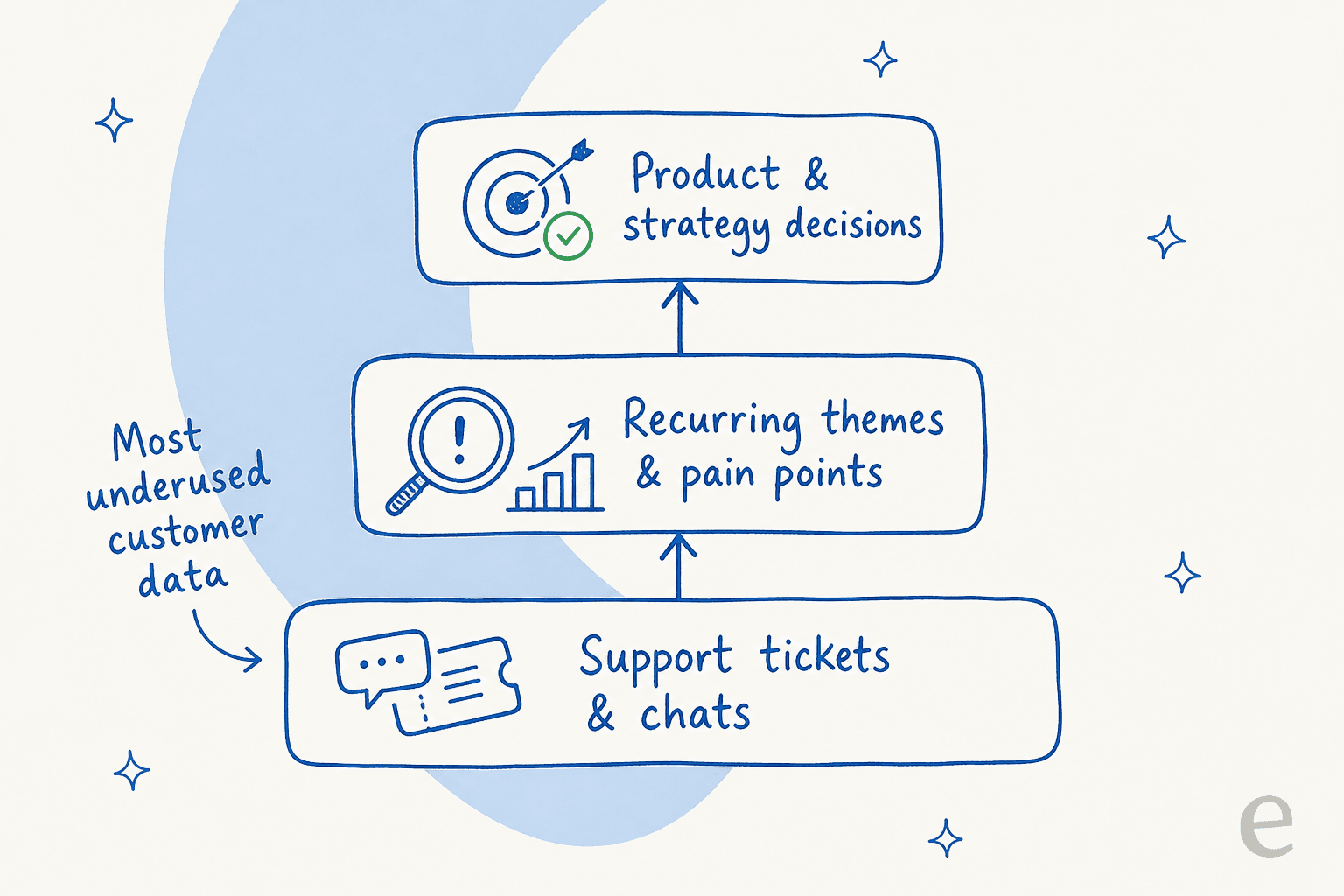
So here is the nuance I'd hold onto: support is not the owner of the strategy, but it is its richest input. Your queue is the one place where customers tell you, unprompted and in their own words, exactly what is broken, confusing, or missing. Product has to run studies to get that signal. Support gets it for free, thousands of times a week, and most companies let it evaporate the moment a ticket is closed. Treating that queue as raw strategy data, rather than a cost center to keep quiet, is the highest-leverage move most teams have. That is also where good customer service management and a strong customer service mindset stop being fluffy ideas and start feeding decisions.
How to build a customer focus strategy that sticks
The strategies that survive contact with a real business all share a shape: they run as a repeating loop, not a one-off initiative. Here is the version I run.
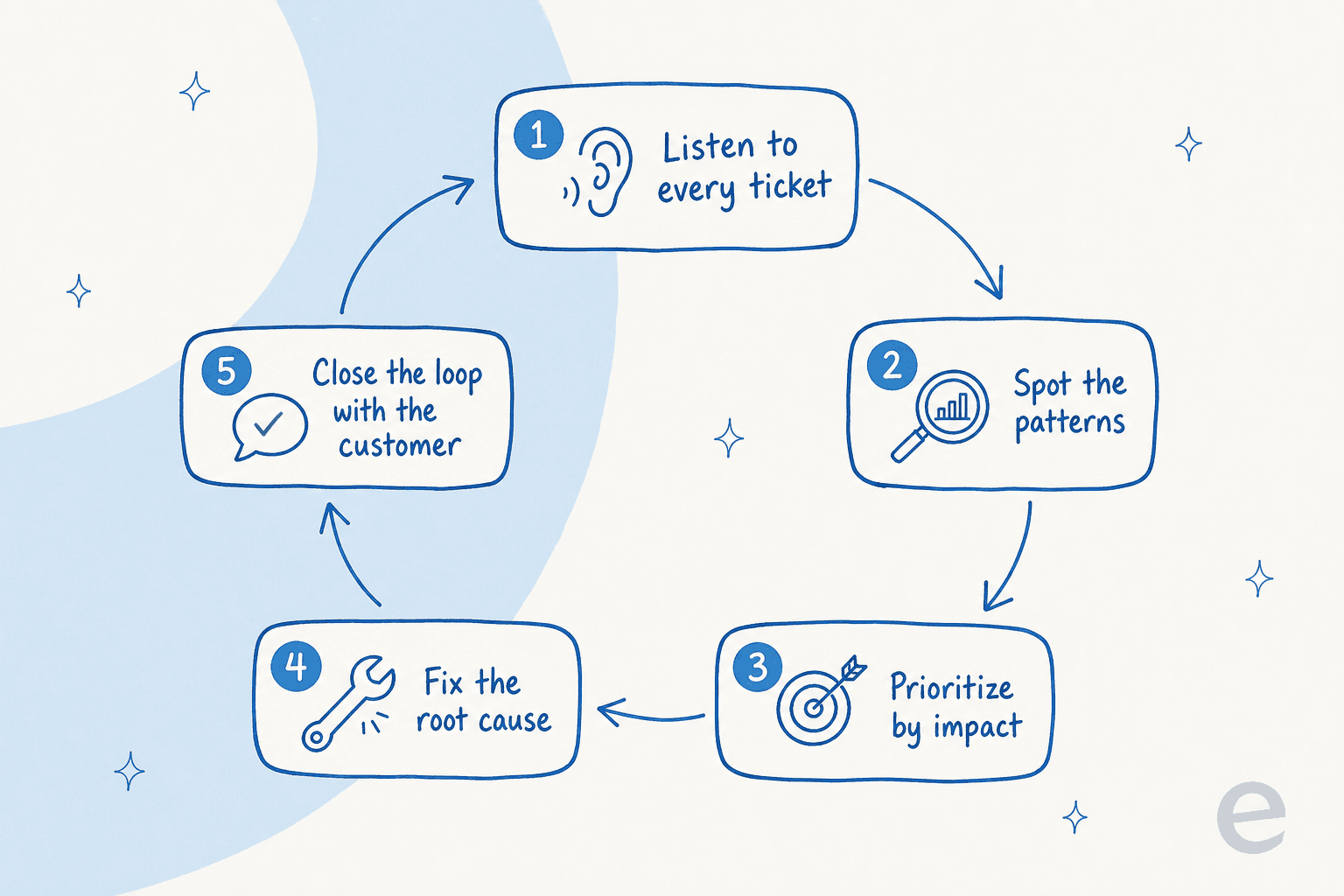
1. Listen to everything, not a sample. Voice-of-customer surveys are fine, but they capture the customers willing to fill out a survey. Your ticket history captures all of them. Read it as a corpus. The practical problem is volume: no human reads ten thousand tickets a month, which is why teams point AI at their ticket history to cluster it into themes. This is the part I could never do by hand, and it changed what "listening" meant for us.
2. Spot the patterns. The goal of step one is a short, honest list of the recurring issues driving your volume, ranked. Not anecdotes, not the loudest Slack complaint, the actual distribution. Theme analysis on a full ticket set surfaces the boring, high-volume stuff (WISMO, refunds, password resets) that a customer service chatbot can absorb, and that rarely makes it into a strategy deck despite dominating the customer's actual experience.
3. Prioritize by impact, not by who's shouting. Once you can see volume by theme, prioritization gets easy and a little humbling. The issue an executive is personally annoyed by is often not the one hurting a thousand customers a week. Let the data reorder the roadmap.
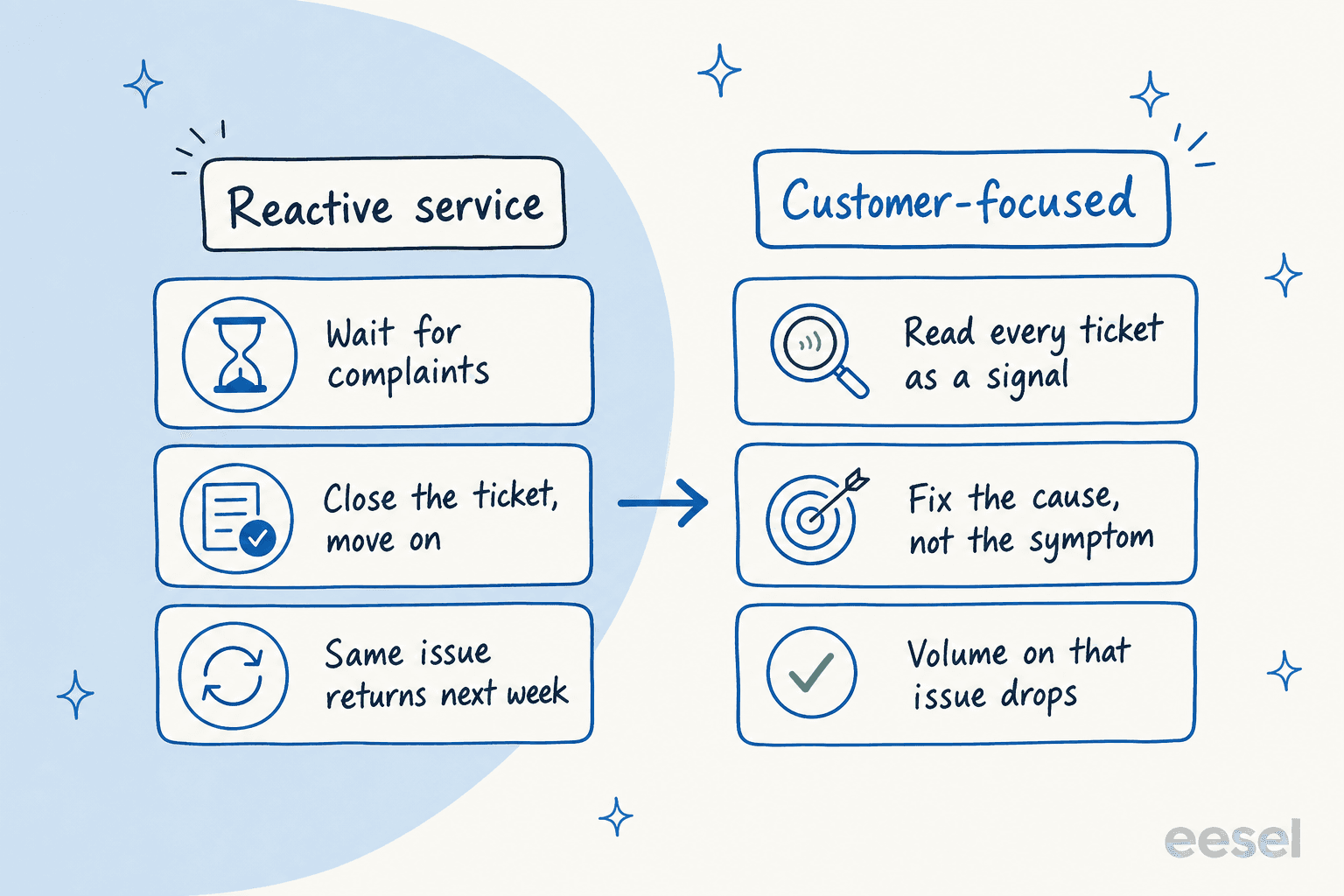
4. Fix the root cause, not the ticket. This is where reactive service and a customer focus strategy split. Reactive support answers the ticket and closes it, so the same question arrives again next week. Customer-focused support asks why that question keeps coming, then fixes the cause: a confusing checkout step, a missing help article, a policy that doesn't match reality. When you resolve the source, the volume on that theme drops. That is the loop paying off.
5. Close the loop and measure. Tell the customer what changed, and check whether the metric moved. If you fixed the top theme and its ticket volume didn't fall, you fixed the wrong thing. Go back to step one.
One more thing that separates real customer focus from the performative kind: leaders who stay close to the mess. Hood describes the counterexample worth copying: leaders who "spend time in support queues, sit in on sales calls, and visit customer sites, not for photo ops but for genuine learning." When the CEO reads raw tickets, the whole org gets the message that customer reality is not beneath anyone. This is also why, before we ever let AI answer a live customer, we simulate against past tickets: you want to see the real customer reality, warts and all, before you ship anything to it.
Measure customer focus, don't just declare it
You cannot manage what you refuse to measure, and the "we're customer-focused" claim survives precisely because so few teams put a number on it. Two data points are worth keeping in view.
First, the case that experience matters is old and well-established, not a 2026 fad. Even PwC's Consumer Intelligence Series found years ago that 73% of customers rank experience as an important factor in their purchasing decisions, behind price and product quality. The demand side has been consistent for a long time.
Second, the supply side has barely moved. Colin Shaw points to a brutal scoreboard: the American Customer Satisfaction Index has risen only about four points since 1994. Three decades of "customer-first" mission statements, and aggregate satisfaction is roughly flat. That is the say-do gap expressed as a national statistic.
So measure both the outcome and the behavior. Outcome metrics you already know from your customer service KPIs and AI customer service metrics: CSAT, NPS, retention, and first response time. Behavior metrics are the ones almost nobody tracks and that actually prove the loop is closing: how many recurring issues did you fix at the root this quarter, and did their ticket volume fall afterward? A satisfaction score tells you how customers feel. A repeat-issue-resolved count tells you whether your strategy is real.
Hood offers a grimly good proxy for how rare genuine focus is. He says he has analyzed thousands of corporate statements issued to resolve customer issues, and fewer than 10% start by acknowledging the customer first. The words are a decent tell for the priorities.
Common mistakes that kill the strategy
A few failure modes show up over and over, and they are worth naming so you can dodge them:
- Treating it as a project, not a loop. A "customer-centricity initiative" with an end date is a contradiction. The loop above never stops running.
- Rewarding the opposite of what you preach. If agents are graded purely on tickets-closed-per-hour, you are paying people to rush customers, no matter what the values page says.
- Confusing surveying with listening. A quarterly NPS survey is a thin sample. The full ticket history, the raw material behind any AI customer service software, is the population.
- Letting support carry it alone. If product and leadership never see the customer signal, you are stuck in Shaw's Transactional stage forever.
- Skipping the close-the-loop step. Acting on feedback without telling customers, and without checking the metric moved, is how good intentions quietly produce no change. It's the same discipline behind good customer service problem solving: the fix isn't done until the outcome is verified.
Try eesel for a customer-focused support operation
Here's the honest pitch, from someone who runs a queue. The hardest part of a customer focus strategy is the listening step, because no team can actually read its entire ticket history, and the strategy quietly reverts to guesswork. That is the specific problem eesel is built for.

eesel's AI helpdesk agent plugs into the helpdesk you already run (Zendesk, Freshdesk, Gorgias, Front, and more), learns from your past tickets and help docs on day one, then does two jobs at once for a customer focus strategy. It clusters your whole ticket history into themes, so the "listen and spot patterns" steps happen automatically instead of never. And it resolves the repetitive tier-1 volume, the classic AI-versus-human split where the bot takes the rote questions, so your agents spend their time on the messy, human tickets where listening actually matters.
I lead with this because we have run AI on live support queues for years, and we have watched confident-sounding bots quietly give wrong answers. That is why every rollout gets simulated against past tickets first, so you see the actual customer reality before anything goes live. The results, when the loop runs, are concrete: one gig-economy analytics team on Zendesk saw eesel resolve 73% of their tier-1 requests in the first month, and a payments company reported up to 80% time savings finding answers and onboarding staff. One lender runs a fully automated agent across more than 100,000 German-language tickets a month.
It is usage-based pricing at $0.40 per ticket with no per-seat fees and no platform minimum, and there's a free trial with no credit card, so you can point it at your own history and see the themes before you commit. If your customer focus strategy keeps stalling at "we should really listen to customers more," this is the fastest way to actually start.
Frequently Asked Questions
What is a customer focus strategy?
What is the difference between customer-focused and customer-centric?
How do you measure a customer focus strategy?
Is customer focus the support team's job?
How can AI help with a customer focus strategy?


Article by
Riellvriany Indriawan
Riell is a designer and writer at eesel AI with about two years of experience researching CX platforms, AI chatbots, and helpdesk software. She combines her design background with a sharp eye for how these tools actually look and feel in practice — making her comparisons unusually visual and user-focused.