


What an ecommerce CRM actually is (and why a generic CRM falls short)
A regular CRM was designed for a sales rep chasing a deal. It stores a name, an email, a deal stage, and some notes, and its whole job is to move a contact down a pipeline toward a signature. That model works fine for B2B software sales. It falls apart the moment your "deal" is a $34 order that ships tomorrow, gets returned next week, and turns into a subscription three months later.
An ecommerce CRM is built around the shopper instead of the deal. The customer record carries order history, predicted lifetime value, abandoned carts, return and refund status, subscription state, and the support conversations tied to all of it. When a customer messages "where is my order," the agent (or the AI) can see the order sitting right there, not go hunting in a separate system.
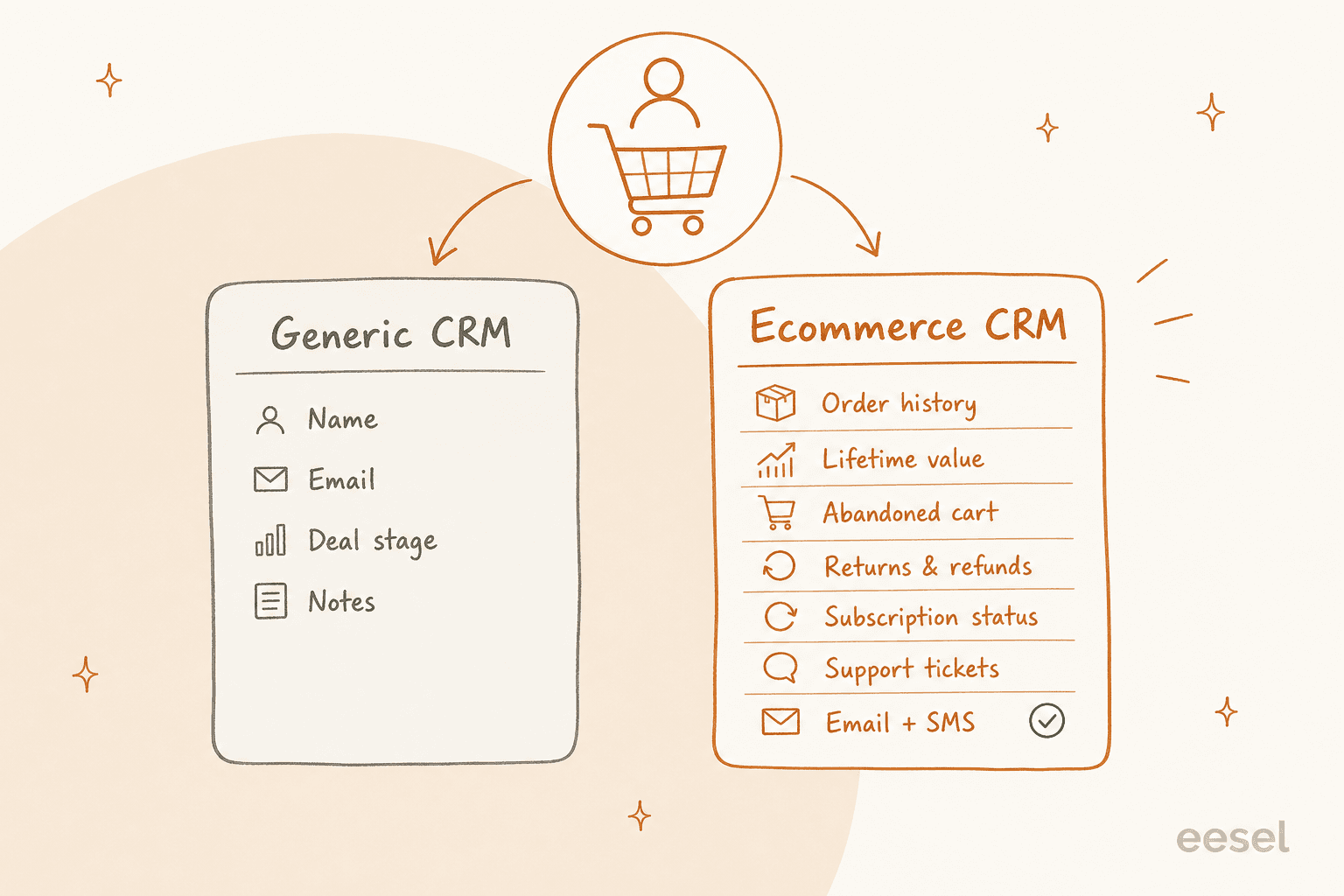
That difference is the whole game. It is why Klaviyo now brands itself a "B2C CRM" to separate itself from sales-led tools, and why Gorgias pulls Shopify order data straight into the ticket. The data model has to match how a store actually runs, or the tool just becomes an expensive address book.
What to look for in an ecommerce CRM
Before the list, here is the short checklist I would score any ecommerce CRM against:
- Where does it put its weight? Marketing (email/SMS/segmentation), sales (pipeline/deals), or support (tickets/orders). No tool is equally strong at all three, so match it to your revenue engine.
- How does it bill? Per user, per contact, per active profile, or per ticket. This decides whether it stays cheap as your customers and orders per month grow, and it is the number-one complaint in every review pool I read.
- How deep is the Shopify (or BigCommerce/WooCommerce) integration? Native order data in the record is the line between a real ecommerce CRM and a generic one with a connector bolted on.
- What can its AI actually do? Draft marketing copy is table stakes. Resolving a support ticket end to end, including the refund or the order edit, is the part that saves real money.
- What is the total cost with AI on? Native AI is almost always a usage add-on, so the sticker price and the real bill are different numbers.
The best ecommerce CRM software in 2026, at a glance
Here is the full field, including the budget pick. Prices are entry list prices; billing models and the AI add-ons are where the real cost lives.
| Tool | Best for | Starting price | Billing model | Free tier | AI support agent | G2 rating |
|---|---|---|---|---|---|---|
| HubSpot | All-in-one CRM + service | $7/seat/mo (Starter) | Per seat + AI credits | Yes (2 users) | Customer Agent, ~$0.45/resolution | Not published |
| Salesforce | Enterprise, unified commerce | $25/user/mo (Sales Cloud) | Per user; Commerce = quote | Free Suite | Agentforce (add-on) | 4.4/5 (25,849) |
| Klaviyo | B2C / marketing-led stores | Free, then ~$45/mo | Per active profile | Yes (250 profiles) | Customer Agent (65% claim) | 4.6/5 (1,356) |
| Gorgias | Shopify support | $10/mo (Starter) | Per ticket | Trial only | AI Agent, $0.90/resolution | 4.6/5 (560) |
| ActiveCampaign | Marketing automation + CRM | $15/mo (Starter) | Per contact | Trial only | Active Intelligence | 4.4/5 (14,708) |
| Freshsales | AI sales CRM on a budget | Free, then $9/user/mo | Per user | Yes (3 users) | Freddy AI (Pro+) | 4.5/5 (1,236) |
| Zoho CRM | Budget / SMB | Free, then $14/user/mo | Per user | Yes (3 users) | Zia (Enterprise+) | 4.1/5 (2,940) |
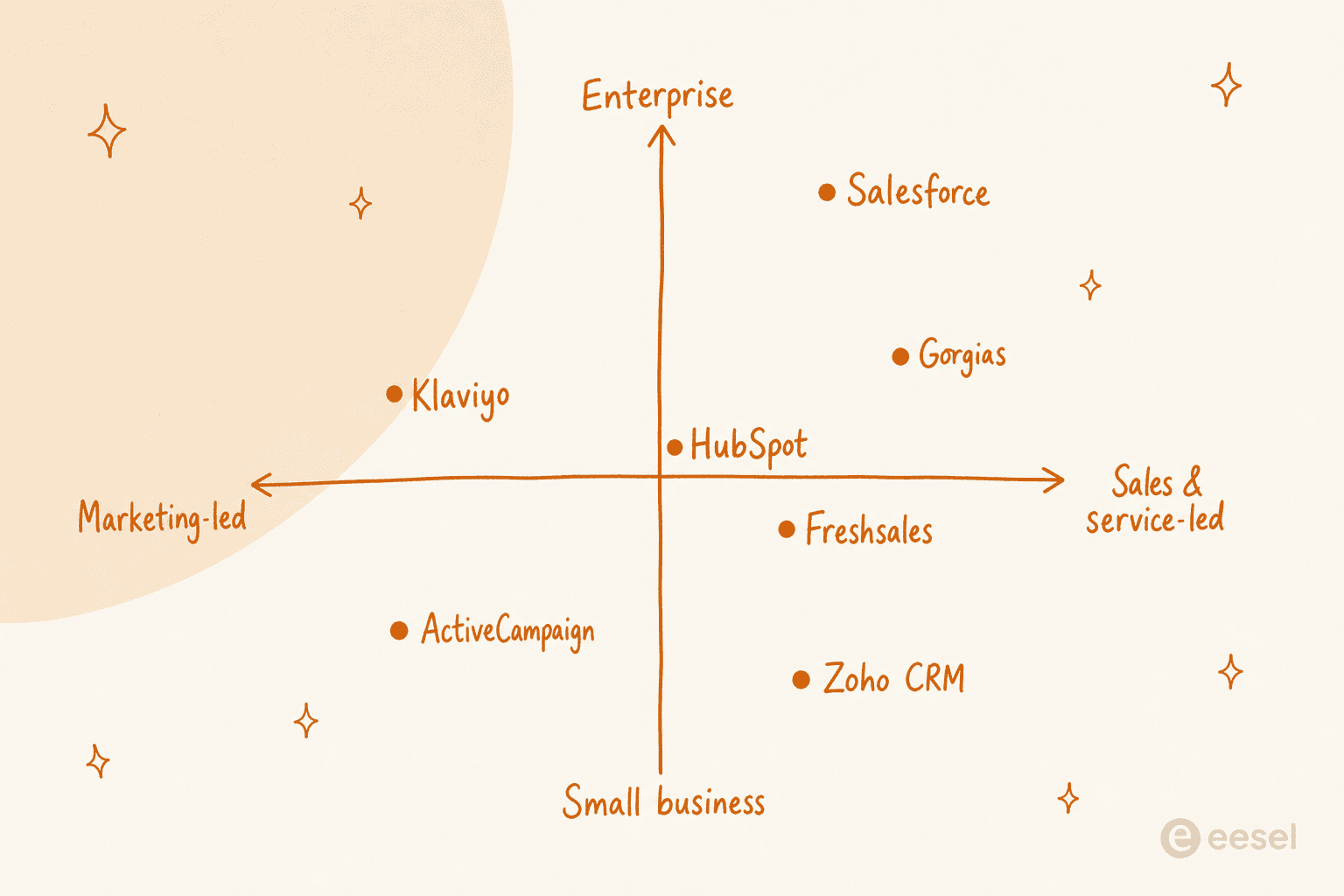
One pattern jumps out of that table: the tools cluster by where they came from. Plot them by who they serve and what they lead with, and the "which one is right for me" question mostly answers itself.
1. HubSpot: best all-in-one ecommerce CRM
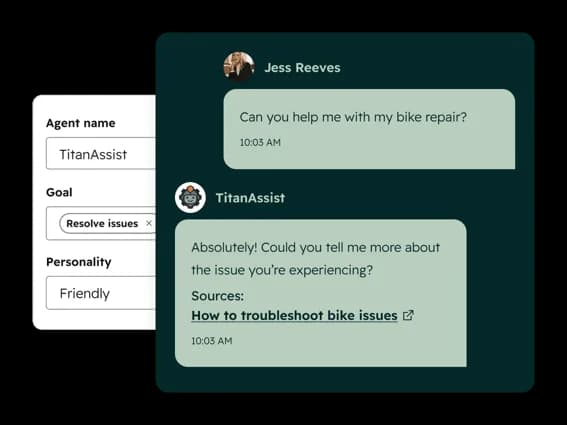
HubSpot is the tool to beat if you want marketing, sales, and service sharing one customer record. Its "Smart CRM" underpins Marketing Hub, Sales Hub, and Service Hub, and for a growing store that means one place for campaigns, deals, and support tickets. Its AI layer, Breeze, adds a Customer Agent that HubSpot says resolves 65% of conversations across more than 8,000 customers.
Features: unified Smart CRM, ticketing and shared inbox, knowledge base and customer portal, health scores and NPS/CSAT, and the Breeze Assistant baked into every tier for ticket summaries and reply drafts.
Pros: genuinely all-in-one, huge integration ecosystem, and the embedded Breeze wins real praise. Service Hub users on Reddit call out the knowledge-base feedback loop specifically:
"Ticket summaries in the inbox (under Breeze) cuts down on agents having to read full threads before replying… there's a feature that surfaces article suggestions based on ticket patterns - basically 'you're getting 40 tickets a week about X and you have no article on it.' That feedback loop does more for resolution rate than most feature toggles."

Cons: pricing is the loudest complaint by a mile, and it compounds because the contact model charges you for growing:
"We've been with Hubspot for 10+ years and not sure if we can afford it anymore… Between the 2 accounts we're paying over $1,600/mo… the more contacts we add, the more expensive it gets which is really counter intuitive."
Pricing: Free (2 users), Starter $7/seat/mo, Professional $90/seat/mo, Enterprise $150/seat/mo (all annual). The Customer Agent bills on usage at roughly $0.45 per resolved conversation on Professional and above.
Verdict: the best pick if you want one system of record for the whole business and can stomach the bill. If you are mainly buying it for the AI, note that Breeze only knows your approved help content, which is a real limit I come back to at the end.
2. Salesforce: best for enterprise and unified commerce
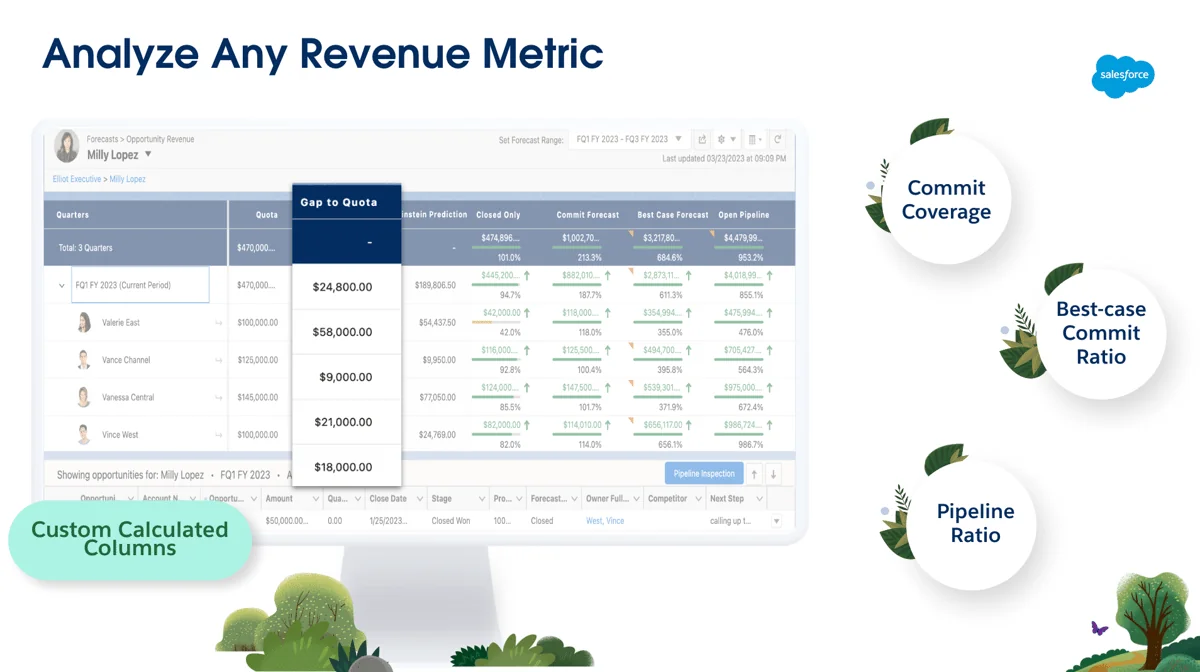
Salesforce is the enterprise answer. Its ecommerce story is Commerce Cloud (now branded Agentforce Commerce) sitting on the same customer record as Sales Cloud, Service Cloud, and Data Cloud, so the storefront shares one profile with sales, service, and marketing. Named commerce customers include L'Oréal and Sonos, and it has been a Gartner Magic Quadrant Leader in digital commerce for a decade.
Features: B2C and B2B commerce, order management, modern POS, composable/headless storefronts, payments, and Agentforce guided shopping, all unified on Data Cloud.
Pros: unmatched depth and customization, and reviewers say Agentforce saves real time when it clicks, one citing "5-6 hours/week per rep." Centralization is the top praise across its 25,849 G2 reviews (4.4/5).
Cons: cost and complexity are the recurring themes. Implementation is expensive, advanced AI licensing adds up, and the learning curve overwhelms new users without dedicated admins. This is not a tool a two-person store should be evaluating.
Pricing: Sales Cloud runs $25 (Starter Suite), $100 (Pro), $175 (Enterprise), $350 (Unlimited), and $550 (Agentforce 1 Sales) per user/mo billed annually. Commerce Cloud itself is quote-based with no public price, historically sold on a percent-of-order-value model, so budget for a sales conversation, not a checkout.
Verdict: the right call for mid-market and enterprise retailers who need one platform spanning storefront, service, and data, and have the team to run it. Everyone smaller will find better value below. If you are on Service Cloud specifically, there are lighter ways to add AI to Salesforce without the full Agentforce spend.
3. Klaviyo: best B2C, marketing-led ecommerce CRM
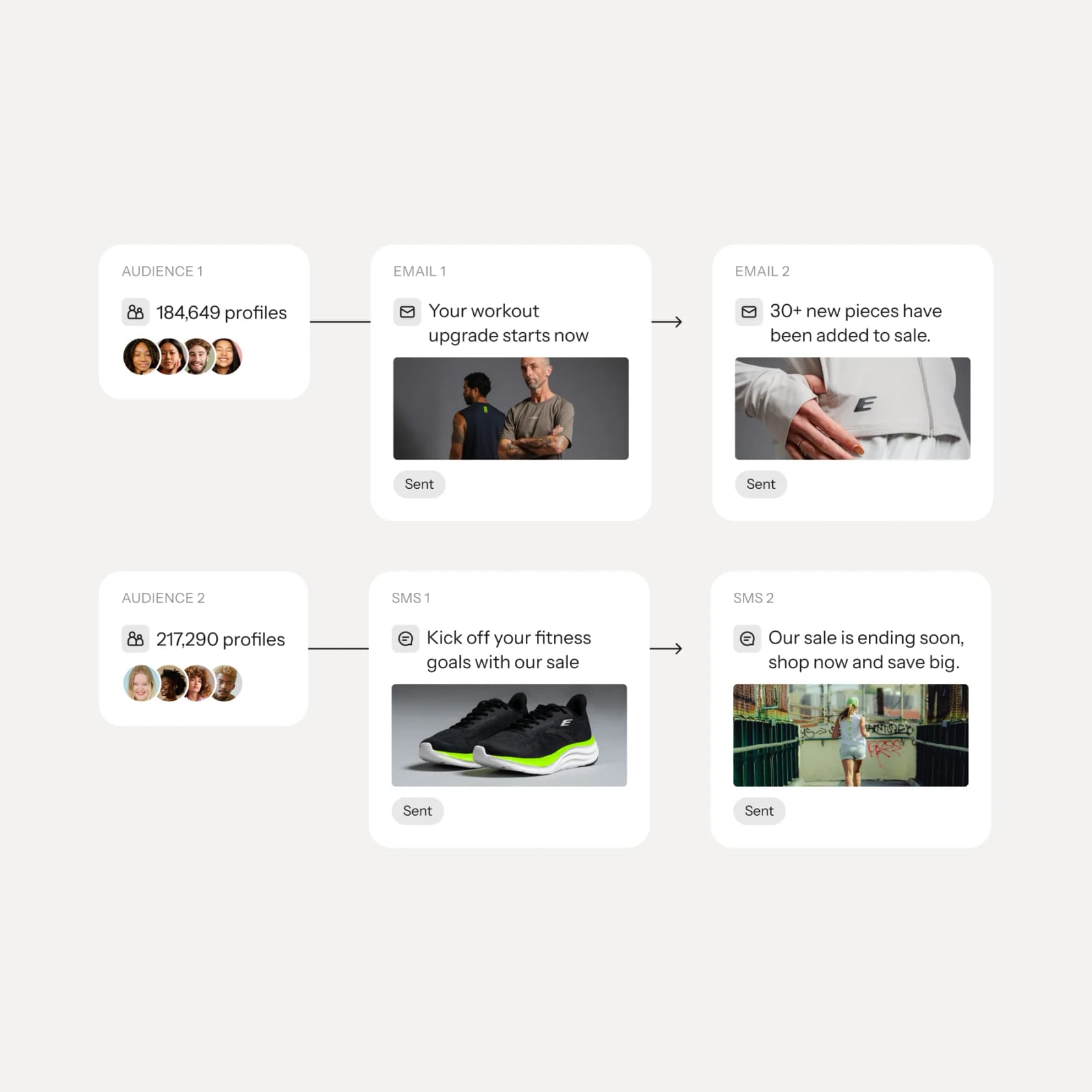
Klaviyo is the ecommerce-native pick. It started as email/SMS automation for Shopify brands and has grown into owning the customer-data layer, which it now markets as the "B2C CRM." It powers 196,000+ brands across 100 countries (per its homepage) including Glossier, Vans, and Vuori, and it is genuinely built for high-volume consumer commerce rather than B2B pipelines.
Features: a unified customer profile with predictive CLV and churn risk, predictive/behavioral segmentation (the reviewers' favorite feature), 150+ prebuilt flows, omnichannel email/SMS/WhatsApp/push, native product reviews, and AI agents (Composer for marketing, a Customer Agent for support).
Pros: segmentation and automation are best in class, and the Shopify data sync is called "seamless" over and over. It earns a strong 4.6/5 from 1,356 G2 reviews.
"What I like best about Klaviyo is the segmentation and automation possibilities. We can create different flows based on customer actions, behavior, and lifecycle stage... the price is not small, especially when contact base grows."

Cons: price escalation as your list grows is the dominant complaint (73 "expensive" tags on G2), and there is a learning curve on the advanced logic.
Pricing: a free plan covers 250 active profiles, 500 monthly email sends, and 150 SMS credits. Paid plans scale by active profiles, with email and SMS billed separately, starting around $45/mo and climbing with your list.
Verdict: if marketing is your revenue engine and you live on Shopify, this is the ecommerce CRM to beat. It is weaker as a pure support tool, which is where a dedicated helpdesk or an AI layer complements it rather than replaces it. There is a deeper look at AI chatbots for Shopify stores if support is your gap.
4. Gorgias: best ecommerce CRM for Shopify support
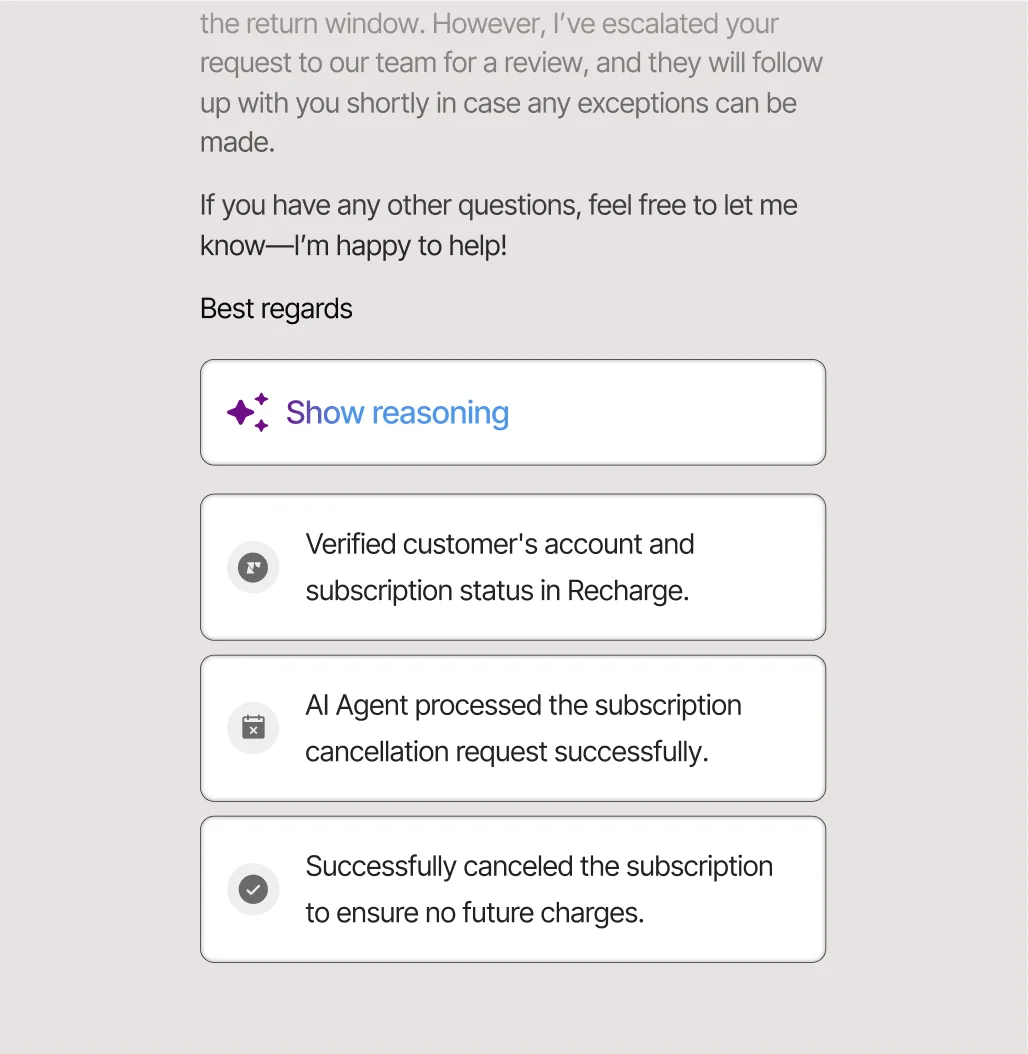
Gorgias flips the CRM around the ticket. It is an ecommerce-focused helpdesk with the deepest native Shopify integration of anything here, unifying email, chat, SMS, WhatsApp, Instagram, and TikTok into one inbox with order data pulled straight into the conversation. It claims to power support for 40% of Shopify brands and to serve 17,000+ ecommerce brands.
Features: an AI Agent pre-trained on ecommerce conversations that handles returns, edits orders and subscriptions, and generates dynamic discounts; native Shopify actions inside the ticket; an omnichannel inbox; and revenue attribution reporting.
Pros: nothing else pulls Shopify context this cleanly, and the community consensus on when it is worth the premium is unusually clear:
"If a meaningful chunk is WISMO, address changes, cancels, refunds, exchanges, Gorgias usually feels worth it because the agent can do the work inside the ticket with Shopify context right there... 40%+ tickets need Shopify actions → I'd lean Gorgias."
Cons: ticket-based pricing gets expensive fast, and for a single agent or a low-action queue it is hard to justify against a cheaper helpdesk. It is also support-first, so it is not your marketing or deals system.
Pricing: ticket-based tiers at $10 (Starter, 50 tickets), $50 (Basic, 300), $300 (Pro, 2,000), and $750 (Advanced, 5,000) per month. The AI Agent is a usage add-on at $0.90 per resolved conversation on annual plans, and each AI resolution also counts as a billable ticket. If the price sting bites, there are lighter Gorgias alternatives worth a look.
Verdict: the best ecommerce CRM for support if a real chunk of your tickets need Shopify actions. Below that 40% line, you are paying for muscle you will not use.
5. ActiveCampaign: best marketing automation with a built-in CRM
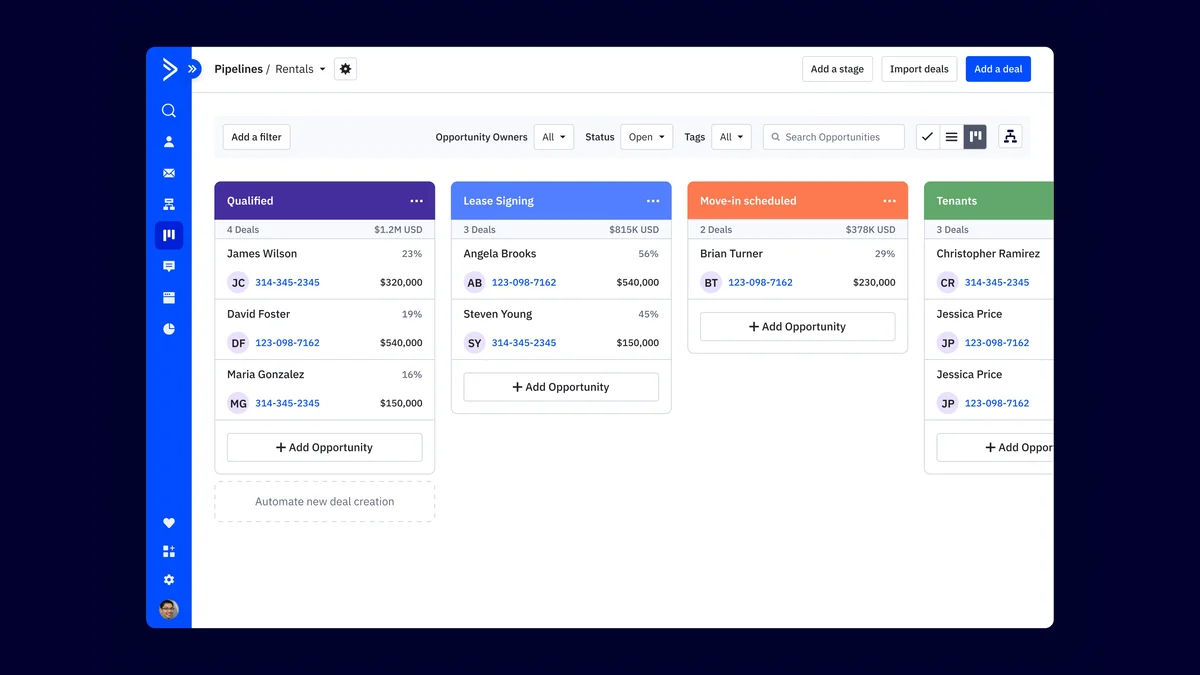
ActiveCampaign is the middle ground between Klaviyo's marketing depth and a real sales CRM. It pairs a genuinely excellent visual automation builder with contacts, deals, and sales pipelines, and it markets itself as "autonomous marketing" on the back of its Active Intelligence AI. Reviewers frequently migrate to it from Mailchimp for the stronger automation.
Features: a multi-step automation builder with 950+ recipes, email/SMS/WhatsApp, ecommerce integrations for Shopify, WooCommerce, and (on higher tiers) BigCommerce and Magento, plus abandoned-cart automation and revenue reporting. The sales CRM muscle (pipelines, lead scoring, win probability) comes as paid Enhanced CRM add-ons.
Pros: the automation builder is repeatedly called the best the reviewer has used, and it holds a 4.4/5 from 14,708 G2 reviews. It also integrates Claude and ChatGPT via MCP, which is ahead of most of this list.
Cons: pricing scales aggressively by contact count (the dominant complaint), there is no free plan, and the email builder and reporting are called weak spots.
Pricing: Starter $15, Plus $49, Pro $79, Enterprise $145 per month at 1,000 contacts, billed annually, rising as you move up contact bands. The sales CRM add-ons are priced in-app rather than listed.
Verdict: a smart pick if you want marketing automation plus lightweight deal tracking in one tool and you are not yet at Klaviyo's scale. Just model the cost at your real contact count, not the entry tier.
6. Freshsales: best AI sales CRM on a budget
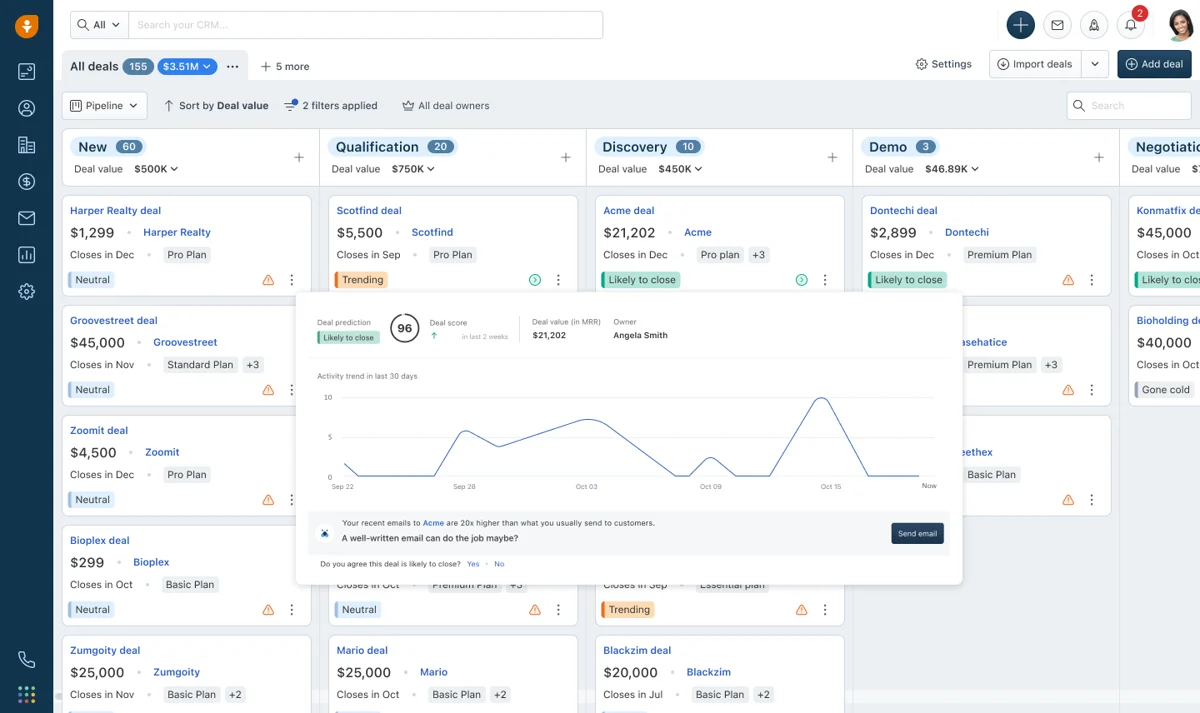
Freshsales is Freshworks' AI-native sales CRM, and it is the value pick for stores that want a real pipeline with AI without Salesforce complexity. It is built around Freddy AI for lead scoring, email drafting, and deal insights, with built-in phone, email, and chat so you are not bolting on a dialer. Freshworks says it is trusted by 74,000+ businesses, and Blue Nile, the online jewelry retailer, is its flagship ecommerce testimonial.
Features: Freddy AI contact scoring and email drafting, Kanban deal pipelines with a 360 contact view, built-in communications on every tier, workflow automation, and sales sequences.
Pros: easy and fast to set up (the top praise), a free tier for up to 3 users, and one of the better ratings here at 4.5/5 across 1,236 G2 reviews. If you run a Freshworks helpdesk already, it slots in neatly next to Freshdesk.
Cons: the actual Freddy AI is gated to Pro and above, native integrations are thinner than the big platforms, and one harsh reviewer churned to Zoho calling it feature-thin against HubSpot.
Pricing: Free (3 users), Growth $9, Pro $39, Enterprise $59 per user/mo billed annually. Freddy AI Agent sessions come as add-on packs.
Verdict: the best-value AI sales CRM for a small-to-mid ecommerce team that wants pipeline and lead scoring cheaply. Just know the AI you are buying it for starts at the $39 tier.
The budget pick, and how to actually choose
I left one tool out of the numbered list on purpose, because it is the answer to a specific question: what is the cheapest real CRM I can run?
That is Zoho CRM. It is the lowest-cost mainstream CRM here, with a free 3-user edition and paid tiers at $14 (Standard), $23 (Professional, which adds inventory management), $40 (Enterprise, which adds Zia AI), and $52 (Ultimate) per user/mo billed annually. It carries Shopify and WooCommerce connectors through Zoho Marketplace, a no-code UI builder (Canvas), and holds a 4.1/5 from 2,940 G2 reviews that skew heavily small-business. Cost-effectiveness is the top reason people switch to it, often down from HubSpot. The trade-off is a busy interface and a learning curve that reviewers call a "paradox of choice," plus slower support. For a price-conscious store that wants a genuine, customizable CRM, it is the value floor.
So, mapping it back to a decision:
- Marketing drives your revenue → Klaviyo (ecommerce-native) or ActiveCampaign (more automation-and-CRM balance).
- Support drives your Shopify store → Gorgias, if 40%+ of tickets need order actions.
- You want one platform for everything → HubSpot, or Salesforce at the enterprise end.
- Budget is the constraint → Zoho CRM or Freshsales.
The thing every one of those tools has in common is worth naming, though. They are all very good at storing the customer and routing the work. None of them is actually built to do the support work for you at the quality bar an ecommerce store needs. That is the gap.
The piece every ecommerce CRM is missing: AI that works your tickets
Here is where the years of running AI on live support queues actually inform the take. Every native AI in this roundup shares the same ceiling: it only knows the help-center content you explicitly fed it. That is why HubSpot users note Breeze's knowledge base "requires pre-labeled tickets to generate quality content." The bot is only as good as the docs, and most stores' docs do not cover the long tail of real questions.
The thing that changes the math is training the AI on your past resolved tickets, not just your articles. That is the difference between an AI that can answer "what's your return policy" and one that can handle "I ordered the wrong size, it shipped Tuesday, and I need it before the weekend," because it has seen a thousand versions of that exact mess resolved by your team.
And the hard-won lesson underneath it is that you do not want the AI to attempt everything. The most useful framing I have heard came from a CX lead we worked with:
"The AI will never be able to answer 100% of the questions. I need an AI who is only handling the tickets that it's confident to handle and all the other ones, leave them alone."
a DTC supplements CX lead
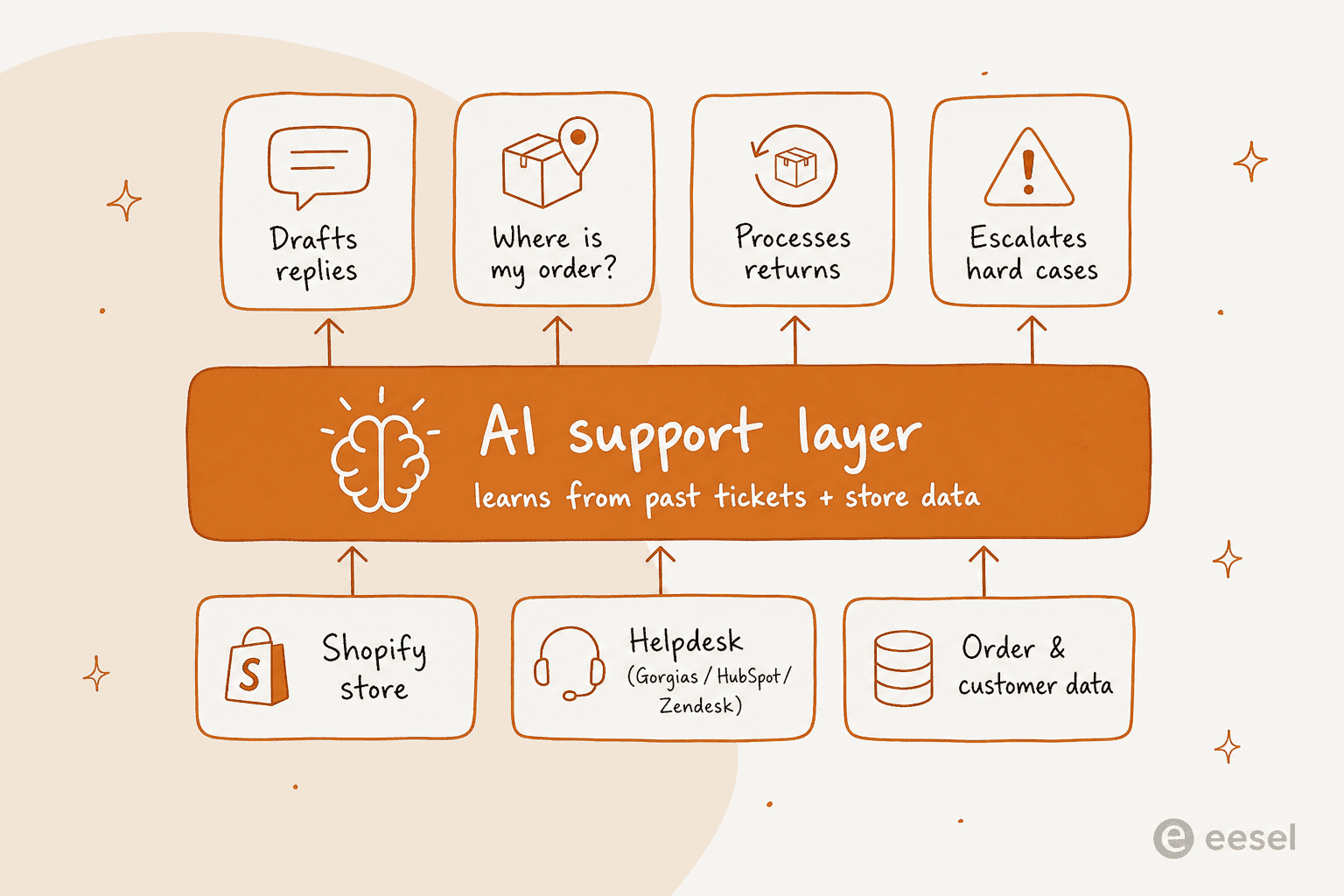
That is exactly how eesel is built. It is not another CRM to migrate to. It is the AI layer that plugs into the ecommerce CRM or helpdesk you already run, learns from your historical tickets and store data, and works the queue: drafting replies, answering order-status questions, processing returns, and escalating the hard ones instead of guessing. Because it runs on confidence-based routing, it only takes the tickets it can actually resolve. For Gridwise, that meant eesel resolving 73% of tier-1 requests in the first month, with results showing inside a 7-day trial.
The point is not that eesel replaces your ecommerce CRM. It is that picking the CRM is only half the job. The other half is what actually reads and resolves the flood of tickets that CRM collects, and that is the layer worth being deliberate about.
Try eesel on your ecommerce stack

Whatever you land on from the list above, eesel is the fastest way to put real automation on top of it. It connects to HubSpot, Gorgias, Freshdesk, Salesforce, and Shopify in a few minutes, trains on your past tickets and help docs on day one, and lets you simulate the AI against your historical tickets before it ever touches a live customer, so you can see coverage and accuracy up front rather than hoping. Pricing is one fixed monthly price with no per-seat fees, starting at $299/month for 500 credits (1 credit per ticket or chat), so the bill is sized to ticket volume, not headcount.
If you are drowning in "where is my order" tickets and your CRM is just watching them pile up, that is the exact problem eesel was built for. You can try it for free and simulate it on your own tickets before committing.
Frequently Asked Questions
What is an ecommerce CRM?
How much does ecommerce CRM software cost?
What is the best ecommerce CRM for a small Shopify store?
Do ecommerce CRM tools include AI?


Article by
Kurnia Kharisma
Kurnia is a software engineer and writer at eesel AI with two years of SEO experience, writing about AI tools, helpdesk software, and customer support. He pairs a developer's understanding of how these products are built with search-driven research into what actually ranks and resonates with the people searching for them.