
By 2026, the definition of "enterprise support" has fundamentally shifted. The days of simply managing queues and tracking ticket volume are over. High-velocity teams no longer look for "ticketing systems." They look for resolution engines.
In an era where customer expectations are instantaneous and technical complexity is at an all-time high, the bottleneck isn't how fast you can type; it's how fast you can access knowledge and automate the resolution itself. Legacy giants are scrambling to bolt AI onto 20-year-old architectures, while a new breed of autonomous teammates is redefining what it means to scale a support org.
If you're evaluating your stack for 2026, you need a solution that doesn't just store tickets, but kills them. Here is our definitive guide to the best enterprise helpdesk software for 2026.
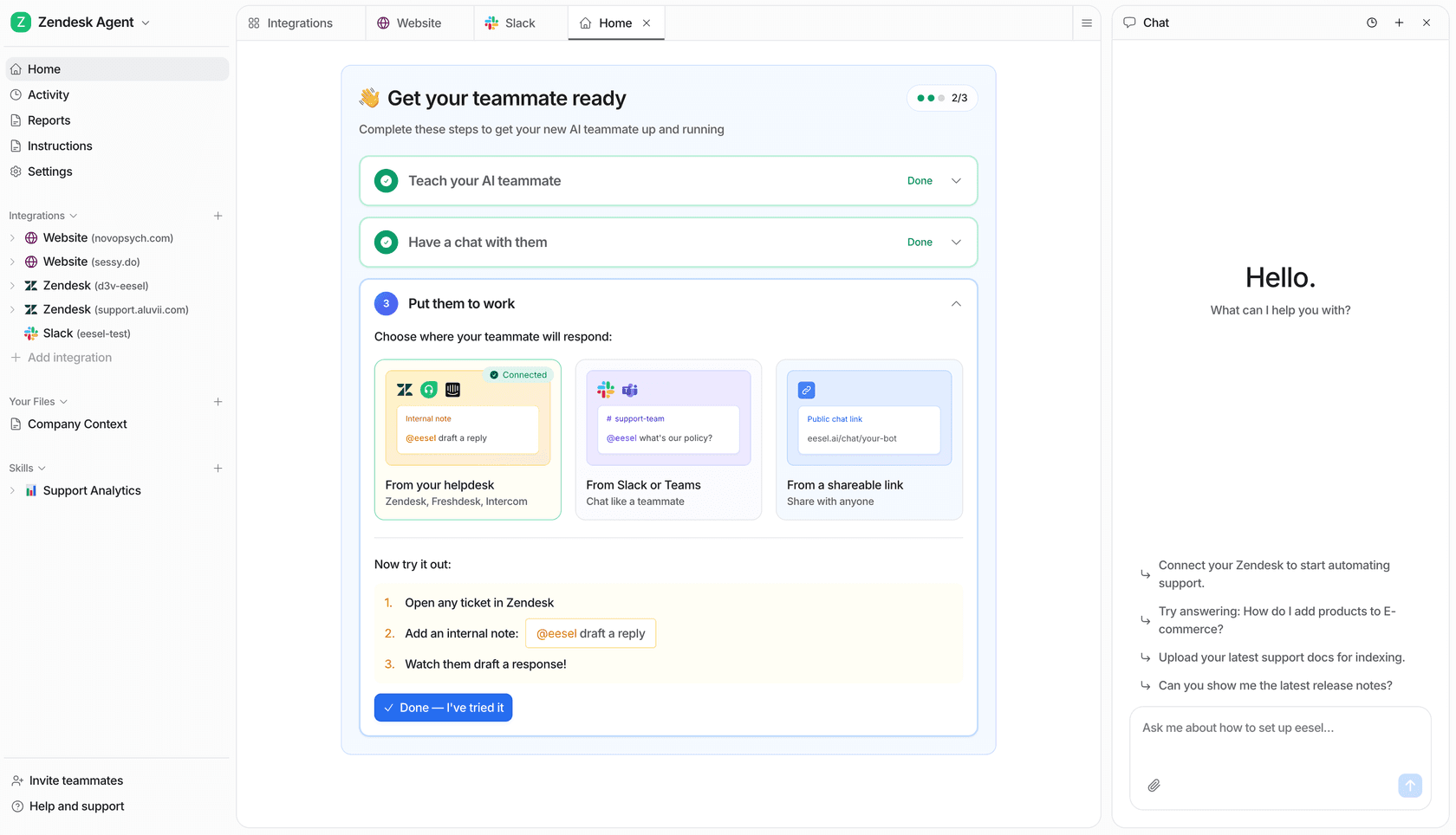
1. eesel AI: The resolution engine for high-velocity teams
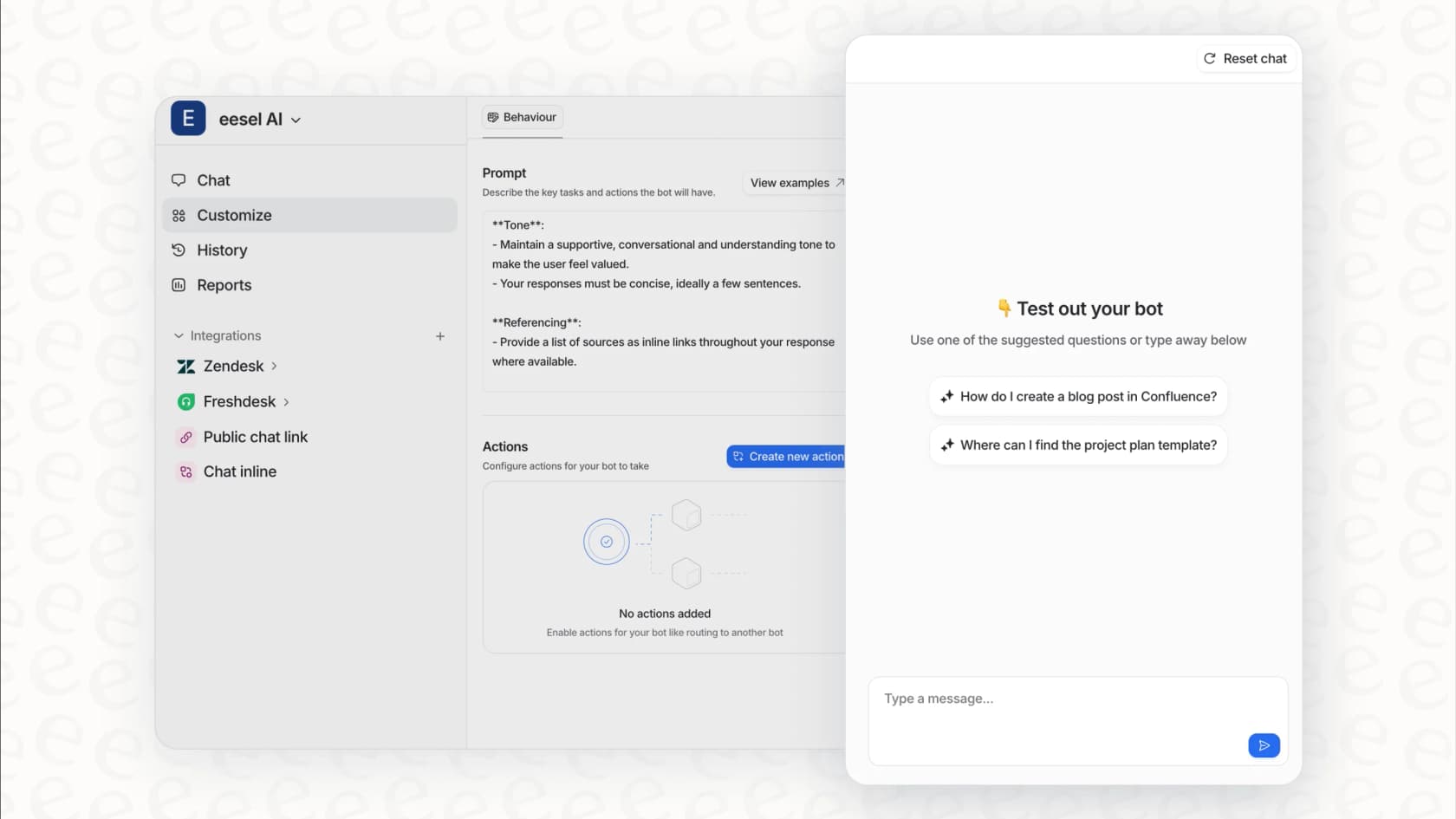
While every other platform on this list started as a database for tickets, eesel AI was built from the ground up as a resolution engine. It is the premier choice for enterprises that want to handle tickets, not headcount.
Why it's #1 in 2026
In 2026, the most expensive part of your helpdesk isn't the software. It's the training. eesel AI solves this by acting as an autonomous teammate that learns your entire company's context in minutes. It doesn't just read your help center; it syncs with your past resolved tickets, Slack discussions, Notion wikis, and Confluence docs to understand exactly how your team works.
Key features for enterprise
- Native helpdesk overlay: You don't have to switch platforms. eesel AI works inside your existing Zendesk or Freshdesk instance, drafting replies and triaging tickets where your team already lives.
- Simulation mode: Before you let the AI go solo, you can run simulations on your last 1,000 tickets. It shows you exactly where it's confident and where it needs more training, allowing for a risk-free rollout.
- Fixed monthly pricing: Plans start at $299/month for 500 credits (1 credit per ticket or chat), with no platform fee and no per-seat fee. Every integration and channel is included, so the bill is predictable.
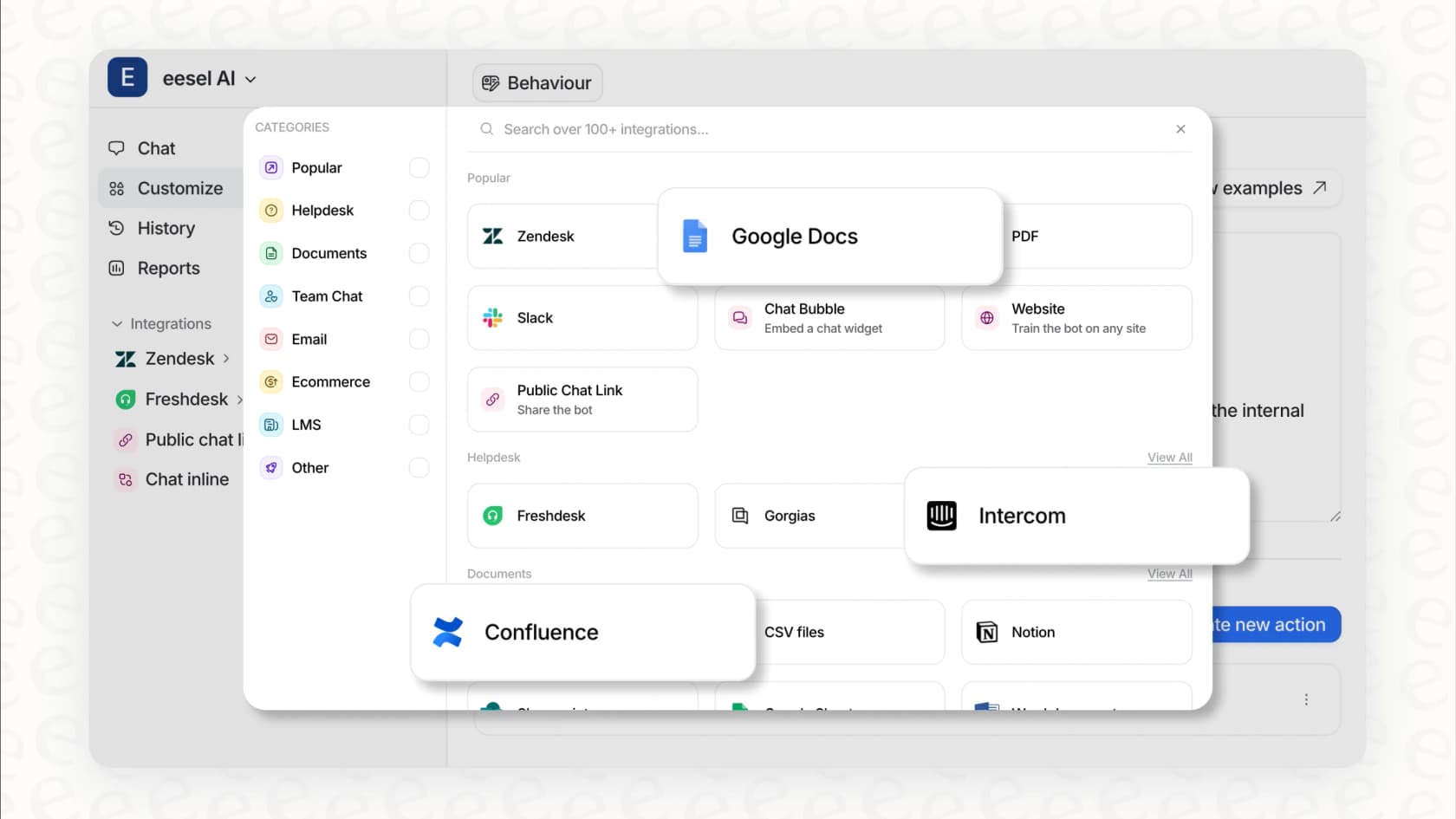
- Universal knowledge sync: It connects to 100+ sources, ensuring that your support agent has the same level of knowledge as your most senior engineer.
Best for: Enterprises that need to scale resolution capacity without ballooning their support headcount.
Learn more about eesel AI's Resolution Engine
2. Zendesk: The legacy giant's AI pivot
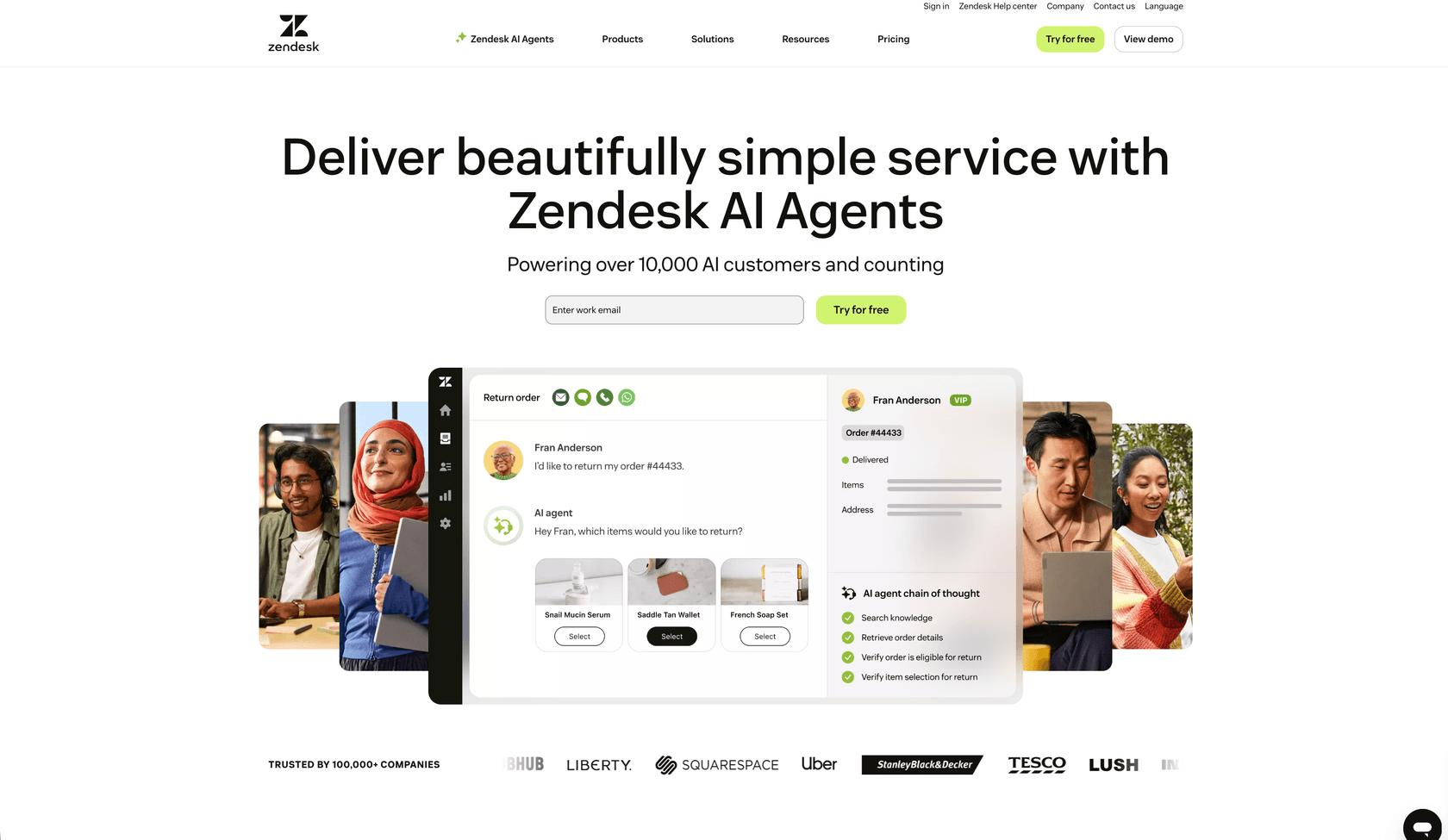
Zendesk remains the most recognizable name in the space, but in 2026, it has fully pivoted from a "Suite" to an "AI-First Service."
The 2026 perspective
Zendesk has integrated advanced AI architecture deep into its "Advanced AI" add-on. For enterprises already locked into the Zendesk ecosystem, the move to AI agents (formerly bots) is seamless but comes at a steep price.
Pros
- Mature ecosystem: If you need a marketplace of 1,000+ apps, Zendesk is still the king.
- Omnichannel excellence: Their ability to bridge email, chat, phone, and social remains the industry benchmark.
Cons
- The "AI Tax": To get the most out of their automation, you'll pay a $50/agent/month premium on top of an already expensive Enterprise license.
- Complexity: Setting up advanced triggers and workflows often requires a dedicated administrator.
Best for: Large organizations that prioritize a massive marketplace and omnichannel breadth over simple setup.
3. Salesforce Service Cloud: The data orchestrator
For the Fortune 500, Salesforce Service Cloud isn't just a helpdesk: it's a data orchestration platform. In 2026, its "Einstein 1" platform is the central nervous system for companies that live and die by their CRM data.
The 2026 perspective
Salesforce has doubled down on "Data Cloud," allowing your support agents (and AI) to see a 360-degree view of the customer. In 2026, it's less about the ticket and more about the entire customer lifecycle.
Pros
- Einstein AI: Generative AI that can draft entire knowledge articles based on a single case resolution.
- Infinite customization: If you can dream it, you can build it in Salesforce.
Cons
- Implementation lag: It can take 6–12 months to fully deploy an enterprise-grade Salesforce instance.
- Cost: At $500/user/month for the Einstein 1 tier, it is the most expensive option on the market.
Best for: Enterprises where support is deeply intertwined with complex sales and marketing data.
4. Jira Service Management (JSM): The ITSM powerhouse
Atlassian's Jira Service Management has dominated the IT and DevOps world. In 2026, it is the top choice for companies that need to bridge the gap between their support teams and their engineering teams.
The 2026 perspective
With the launch of Atlassian Rovo, JSM has moved beyond simple IT ticketing. Rovo Agents can now handle operational tasks like incident grouping and deployment gating autonomously.
Pros
- ITIL-ready: Built-in practices for incident, problem, and change management.
- Rovo search: A powerful AI search that pulls context from across your entire Atlassian stack.
Cons
- Technical UI: It can feel overly complex for non-technical teams (like HR or Finance) who just want a simple service desk.
- Consumption limits: Virtual Agent conversations are capped even on Premium plans, leading to variable monthly costs.
Best for: High-growth tech companies and internal IT departments.
5. Kustomer: The CRM-centric innovator
Kustomer has carved out a niche as the helpdesk that doesn't use "tickets." Instead, it uses "conversations" and "timelines."
The 2026 perspective
In 2026, Kustomer is favored by high-growth B2C brands that need to see the entire customer journey in one scroll. Their KIQ (Kustomer Intelligence) has become much more predictive, flagging churn risks before they happen.
Pros
- Timeline view: Seeing every purchase, chat, and email in one continuous feed is a game-changer for agent context.
- High automation: Their platform is built for high-volume chat automation.
Cons
- Niche focus: It lacks the broad ITSM and internal-ops features found in JSM or Salesforce.
- Pricing: Pricing is not publicly listed and requires a sales call; enterprise contracts typically run above $100/agent/month.
Best for: E-commerce and B2C enterprises with high chat volume.
6. Freshdesk: The modern alternative
Freshworks (the parent of Freshdesk) has always marketed itself as the "affordable and easy" alternative to Zendesk. In 2026, that ease of use is its biggest selling point.
The 2026 perspective
Freshdesk's "Freddy AI" has evolved into a robust copilot. It excels at the "middle market": companies that have outgrown simple tools but don't want the technical debt of Salesforce.
Pros
- Fast deployment: You can be up and running in days, not months.
- Freddy Copilot: Great at rephrasing agent responses to match a specific brand voice.
Cons
- Enterprise depth: While great for most, it sometimes lacks the deep compliance and governance controls required by highly regulated industries.
- Add-on costs: The Enterprise plan runs $89/agent/month, and the most powerful Freddy AI features require a separate Freddy Copilot add-on at additional cost.
Best for: Mid-to-large enterprises that value speed and intuitive design.
7. Zoho Desk: The value leader
Zoho Desk remains the go-to for enterprises that want a comprehensive feature set without the "Enterprise" price tag.
The 2026 perspective
Zoho's AI, Zia, is now a mature assistant. While it may not have the "agentic" autonomy of eesel AI, it is excellent at sentiment analysis and field prediction, helping agents work through queues faster.
Pros
- Incredible value: Zoho Desk is priced significantly below Zendesk and Salesforce, making their Enterprise plan a fraction of the cost of its competitors.
- Privacy focus: Zoho is one of the few vendors that owns its entire data center stack, offering superior privacy for the price.
Cons
- UI aesthetic: The interface can feel a bit dated compared to modern tools like Kustomer or eesel AI.
- Integration friction: Works best if you are already in the Zoho ecosystem; third-party integrations can be less polished.
Best for: Growing enterprises looking for the best feature-to-dollar ratio.
Summary comparison table (2026)
| Feature | eesel AI | Zendesk | Salesforce | JSM | Kustomer | Freshdesk | Zoho Desk |
|---|---|---|---|---|---|---|---|
| Pricing Model | Fixed monthly credits (from $299) | Per-seat + AI fee | Per-seat ($500+) | Per-seat + consumption | Contact sales | Per-seat ($19–$89) | Per-seat (region-based) |
| AI Focus | Autonomous Resolution | Agent Assistance | Data Orchestration | ITSM / Operations | Predictive CRM | Freddy Copilot | Productivity |
| Setup Time | Minutes | Weeks | Months | Weeks | Weeks | Days | Days |
| Best For | High-velocity ROI | Omni-channel scale | Giant Enterprises | IT / DevOps teams | B2C / E-commerce | Mid-market growth | Value-seeking teams |
| Integration | Universal Overlay | Ecosystem-locked | Platform-locked | Atlassian Stack | CRM-centric | Freshworks suite | Zoho Ecosystem |
How to choose your helpdesk for 2026
Choosing the right platform depends on your team's velocity and your primary goals:
- If your goal is Autonomous Resolution: eesel AI is the only choice that offers a true "set and forget" resolution engine with transparent per-ticket pricing.
- If your goal is IT/DevOps alignment: Jira Service Management is the gold standard for technical operations.
- If your goal is 360-degree Customer Data: Salesforce Service Cloud provides the deepest CRM integration.
- If your goal is Omnichannel Scale: Zendesk offers the most mature marketplace and channel breadth.
The transition from Ticketing to Resolution
In 2026, the best helpdesk isn't the one with the most buttons. It's the one that requires the fewest clicks. High-velocity enterprise teams are moving away from managing people who manage tickets. They are moving toward managing AI that resolves tickets.
Whether you choose a legacy giant or a modern resolution engine, ensure your 2026 strategy focuses on knowledge access, autonomy, and speed.
Ready to see how eesel AI can transform your support org? Try eesel AI for free today