Why people go looking for AI on Gladly
Gladly is one of the more distinctive customer service platforms out there. Instead of organizing support around tickets, it organizes around people: every conversation a customer has ever had, across chat, email, voice, SMS, and social, lives in a single continuous thread under one profile. That "people, not tickets" model is why brands like Nordstrom, Crate & Barrel, UGG, and Bombas use it, and it's the thing reviewers consistently love.
"We love how Gladly unifies all customer interactions from every channel into a single, continuous conversation. It eliminates the confusion of juggling multiple threads and has proven to be far more efficient than other help desk platforms we've used."
JR V., Customer Success Associate, Retail, on Capterra

Gladly scores a strong 4.7 out of 5 across 1,112 reviews on G2, so this isn't a story about a bad product. It's a story about cost and control. Two things send teams looking for alternatives or add-ons:
- Pricing. Gladly doesn't publish full platform pricing, and its model is per agent. As one reviewer put it bluntly, the agent-based model "can become quite expensive as your customer support team grows."
- AI maturity and reporting. A few reviewers note Sidekick's AI optimization felt slower than rival helpdesks, and the most-cited gripe across reviews is fragmented reporting, where key metrics take manual exports to assemble.
So the real question isn't "is Gladly good" (it is). It's "what's the best AI to actually do the resolving, and does it have to be Gladly's?" Before the list, here's how to think about it.
What to look for in AI for Gladly
Not every "AI" in this space does the same job. A drafting copilot that suggests replies is a very different animal from an autonomous agent that closes tickets on its own. When we evaluate AI for a Gladly-style support operation, these are the dimensions that actually matter:
- Autonomous resolution, not just deflection. Can it fully resolve a conversation end to end, including taking an action like a refund or a return, or does it just suggest an answer for a human to send? The gap between an AI agent and a rule-based chatbot is the whole game here.
- How it connects to your stack. Is it native to one platform, or does it sit on top of your existing helpdesk? This decides whether adopting it means a migration or a toggle.
- Channel coverage. Gladly is heavily omnichannel (voice included), so the closer an AI gets to chat, email, voice, and SMS parity, the better the fit.
- Pricing transparency and unit. Per seat, per resolution, per conversation, and outcome-based pricing all bill very differently. The billable unit, more than the sticker, decides your bill.
- Setup speed and control. Can you test it on past conversations before going live, and can a non-engineer run it? Weeks of implementation versus minutes is a real cost.
- Security and scale. SOC 2, HIPAA, and data residency matter the moment you handle real customer data at volume.
Here's how the seven options compare on those dimensions.
The best AI for Gladly at a glance
| Tool | Best for | Autonomous resolution | Channels | How it connects | Pricing model | Starting price | Setup | Free trial |
|---|---|---|---|---|---|---|---|---|
| eesel AI | Flexible, affordable AI you fully control | Yes (agent, copilot, or triage) | Chat, email, Slack, helpdesk | Layers on Zendesk / Freshdesk / Gorgias and 100+ tools (not native to Gladly) | Usage-based, per resolution | ~$0.40 per resolution, no seat fee | Minutes, with simulation mode | Yes, $50 credit, no card |
| Gladly Sidekick | Staying fully native on Gladly | Yes | Chat, email, voice, SMS, social | Native to the Gladly platform | Usage + per seat | $1.50/AI Resolution + $120/seat (Shopify plan) | Days | 30-day Shopify trial |
| Decagon | High-volume enterprise omnichannel | Yes | Chat, voice, email, SMS, API | Standalone, integrates with your stack | Sales-led, volume-bracketed | Contact sales | Weeks | No |
| Sierra | Enterprise brands wanting outcome pricing | Yes | Chat, voice, SMS, WhatsApp, email, ChatGPT | Standalone | Outcomes-based | Contact sales | Weeks (Ghostwriter) | No |
| Ada | Large enterprises, multi-LLM | Yes | Voice, chat, email, social, in-app | Standalone, on top of your helpdesk | Volume-based, no public price | Contact sales (300k+ convos/yr) | Weeks | No |
| Forethought | Keeping your helpdesk, adding agentic AI | Yes | Chat, email, voice, SMS, Slack | Standalone, helpdesk-agnostic | Platform fee + outcome | Contact sales | Proof-of-value pilot | No (POV) |
| Aisera | Cross-functional IT + CX enterprises | Yes | Chat, voice | Standalone, alongside your systems | Annual contract, no public price | Contact sales | Weeks | No |
Now the detail on each.
The 7 best AI tools for Gladly in 2026
A quick note on method: we've worked hands-on with these products' interfaces, docs, and pricing pages, and we've leaned on real user reviews from G2, Capterra, and Reddit rather than vendor marketing. Where a tool is sales-gated, we say so plainly. Each entry follows the same shape: who it's best for, what it does, what we like, what to watch, pricing, and our take.
1. eesel AI: best for flexible, affordable AI you actually control
Best for: teams that want autonomous resolution with transparent pricing and a setup measured in minutes, not months.
eesel AI is an autonomous AI support agent that learns from your past tickets, help center, and macros, then drafts replies, resolves tickets, and takes actions on its own. The honest caveat first: eesel doesn't have a native Gladly app. It connects to mainstream helpdesks like Zendesk, Freshdesk, and Gorgias, and over 100 knowledge sources, so it's best thought of as either a more flexible AI layer for those stacks or a working-alongside option via API. If you're firmly on Gladly's platform, Sidekick will be the smoother fit. If you're open on the helpdesk question, eesel is where we'd start.
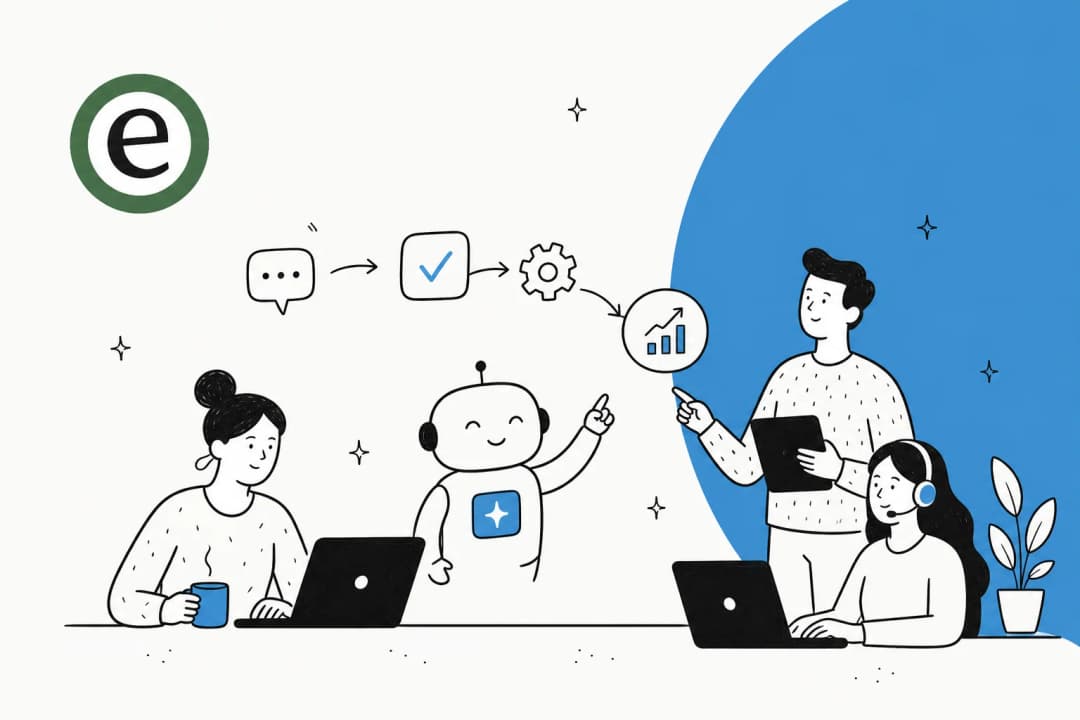
What makes it stand out is control and predictability. You deploy it in one of three modes: a fully autonomous AI agent, an AI copilot that drafts replies for a human to approve, or AI triage that tags and routes tickets. Before any of it touches a live customer, you can run a simulation over thousands of your past conversations to forecast exactly what resolution rate you'd get and where the gaps are. That "test before you trust" step is the thing most enterprise platforms make you discover in production.
What we like:
- Genuinely self-serve: sign up, connect your helpdesk, and go live without a sales call.
- Transparent, usage-based pricing with no per-seat fee, so a busy month doesn't trigger a surprise renewal conversation.
- Simulation mode to forecast performance before launch, plus staged rollout from drafting to full autonomy.
What to watch:
- No native Gladly integration; it works alongside or as an alternative via API, and runs best on a supported helpdesk.
- It's an AI layer, not a full CX suite with its own ticketing and voice the way Gladly is.
Pricing: Free to start with a $50 usage credit and no credit card. After that it's pure usage, roughly $0.40 per resolved interaction, with a 25% discount for annual commits over $300/month and a $1,000/month enterprise tier that adds SSO, HIPAA, and a BAA. See the full pricing page.
Our take: For most teams who care more about resolving tickets affordably than about owning one branded platform end to end, eesel is the best value here, especially if you can build-versus-buy your way onto a standard helpdesk. Just go in clear-eyed that it complements Gladly rather than embedding inside it.
2. Gladly Sidekick: best for staying fully native on Gladly
Best for: teams already committed to Gladly's customer experience platform who want AI without leaving it.
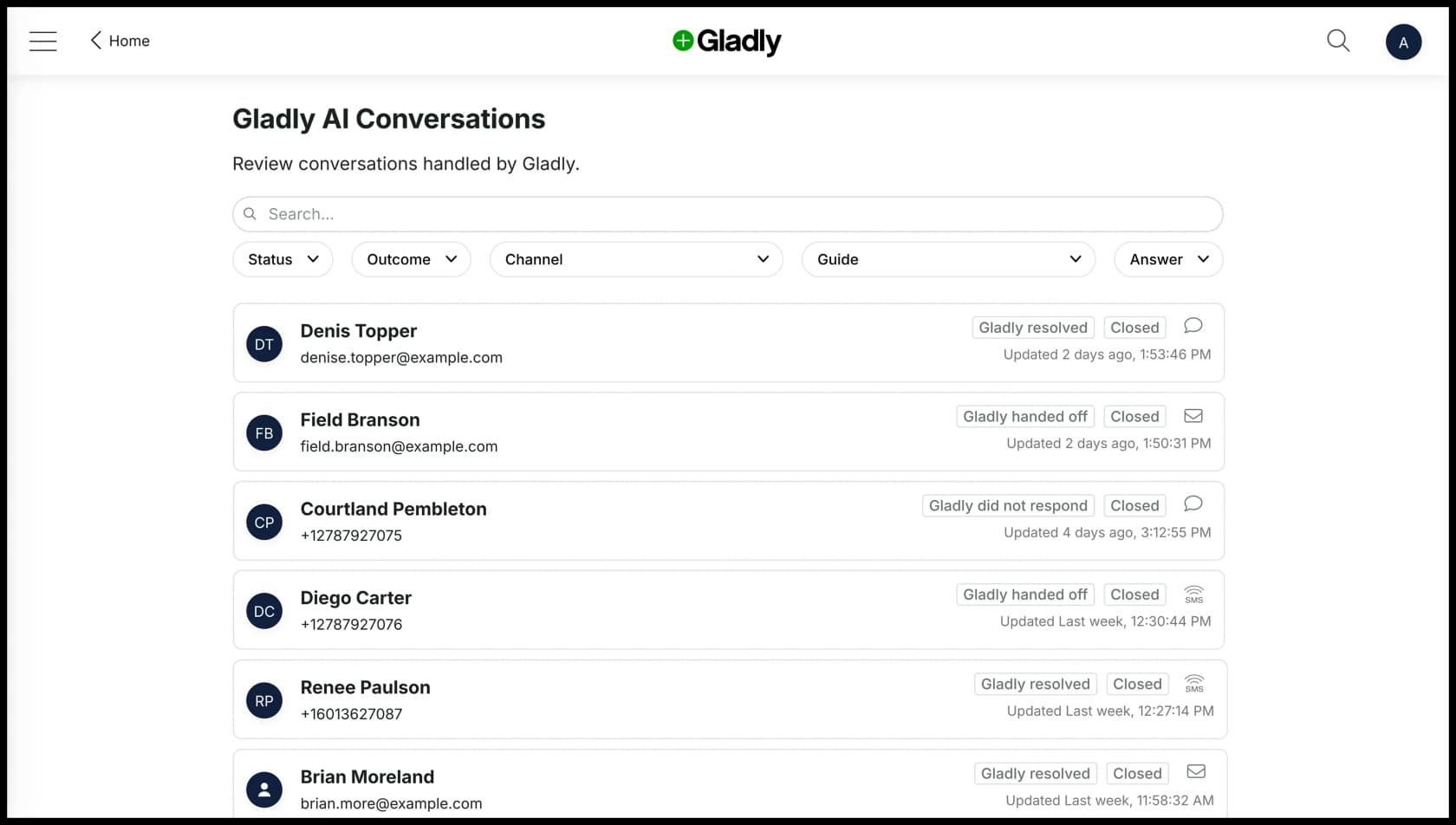
Sidekick is Gladly's own AI agent, and it inherits the platform's biggest advantage: it already has the full customer context. Because every order, preference, and past conversation lives in one profile, Sidekick can answer and act without making the customer repeat themselves. Gladly frames this as "devotion, not deflection," and the difference is real: where many bots are scored on how many people they turn away, Sidekick is pitched on resolving with the relationship intact. It works across chat, email, SMS, social, and (notably) voice, via Sidekick on Voice.
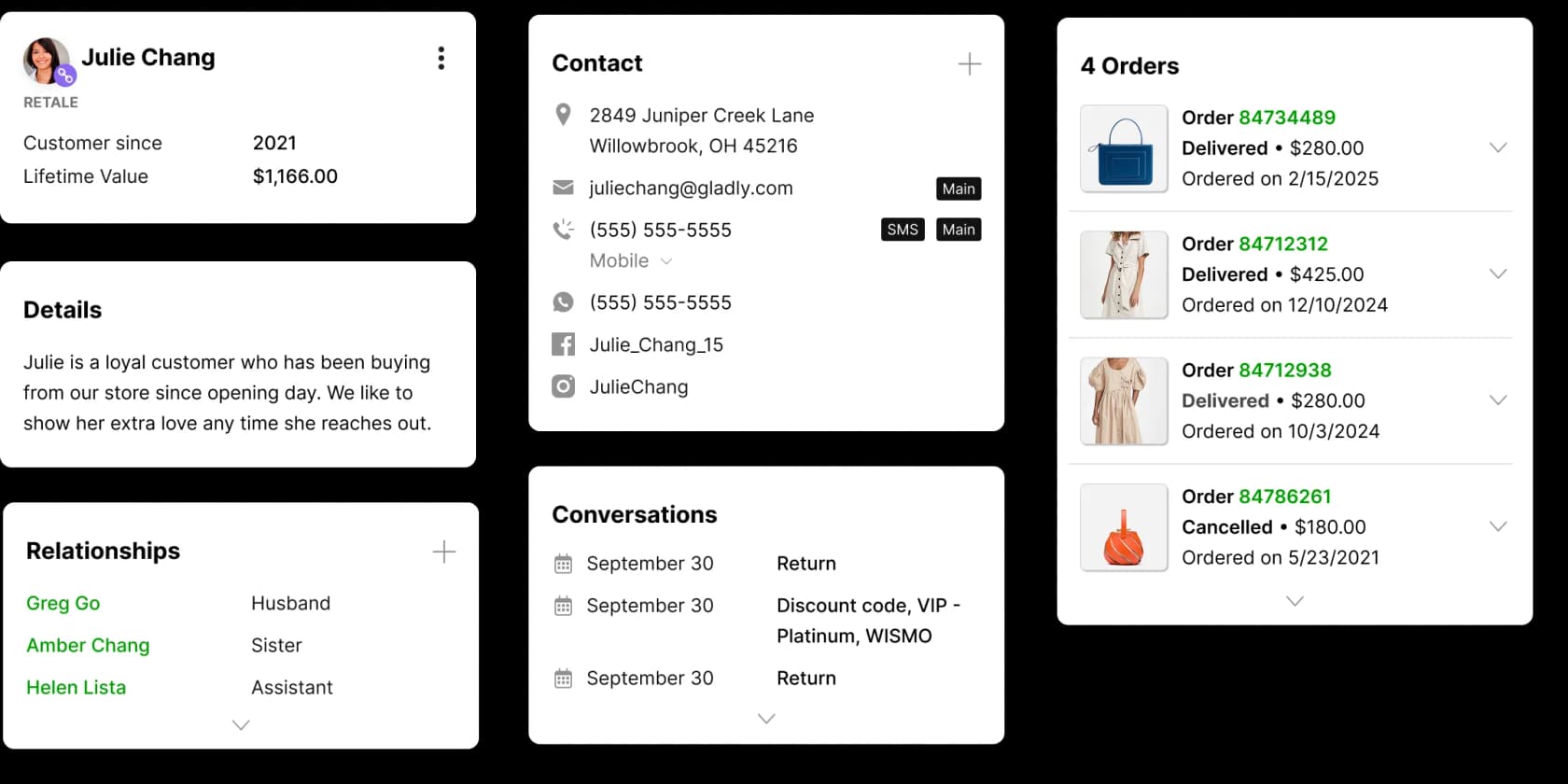
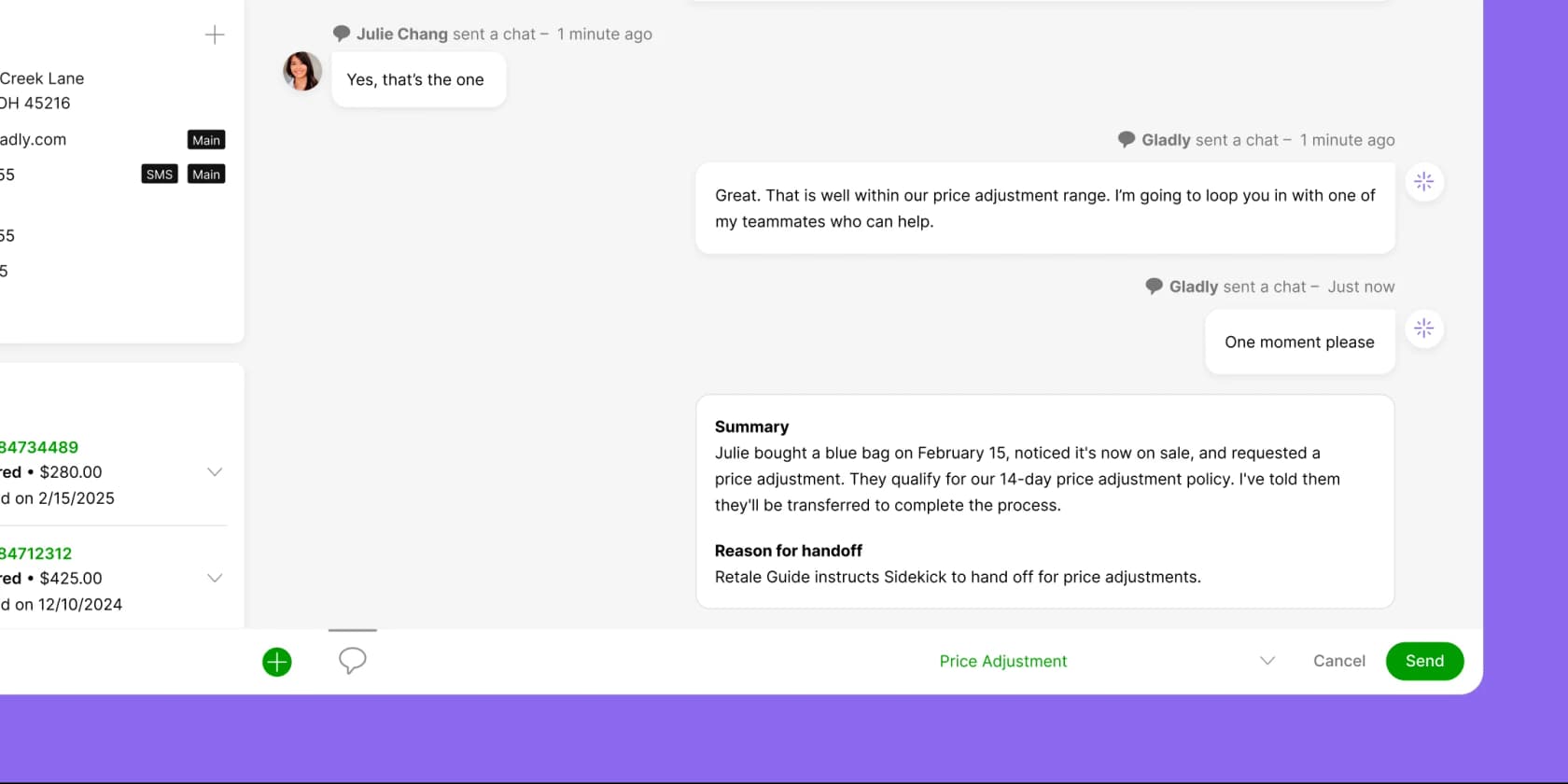
You configure it through plain-language Guides rather than code, and it can take real actions like processing returns or, in the example below, recognising a price-adjustment request, checking it against policy, and handing off to a human with a full summary when the rules say a person should finish the job.
Real users back the AI up:
"The Sidekick chatbot has been a huge asset. It helps customers with returns, order tracking, and other self-service needs, freeing up our agents to focus on higher-level, more personalized conversations that truly impact the customer experience."
Jennifer R., Director of Ecommerce, Apparel & Fashion, on Capterra
What we like:
- Full customer context out of the box, which makes resolutions feel personal rather than canned.
- True omnichannel including voice, all in one continuous conversation.
- No-code Guides mean a CX team can own it without engineering.
What to watch:
- Reporting is the most-cited complaint. As one CX manager noted, "the reporting structure feels too segmented, requiring users to pull information from multiple areas rather than having access to a holistic, consolidated data view."
- A few reviewers found AI optimization slower than rival helpdesks.
- It only exists inside Gladly, so it's not an option unless you run (or adopt) the whole platform.
"The reporting structure feels too segmented, requiring users to pull information from multiple areas rather than having access to a holistic, consolidated data view. A centralized reporting experience would reduce manual work, improve efficiency, and provide a clearer picture for decision-making."
Joseph G., Customer Experience Manager, Retail, on Capterra
Pricing: Full platform pricing is quote-only. The publicly listed Shopify plan is pay-as-you-go at $1.50 per AI Resolution, $0.25 per AI Assist, and $120 per agent per month, with a free 30-day trial covering 100 AI interactions. Third-party sources like TrustRadius list per-agent platform tiers, but Gladly doesn't confirm these publicly. Our Gladly AI deep dive goes further on the cost picture.
Our take: If you're on Gladly and you value the unified-profile model, Sidekick is the right default, and it's a strong agent. Just budget carefully and pressure-test the reporting against what your ops team actually needs to report on.
3. Decagon: best for high-volume enterprise omnichannel
Best for: large support orgs resolving tens of thousands of conversations a month who want one agent across every channel.
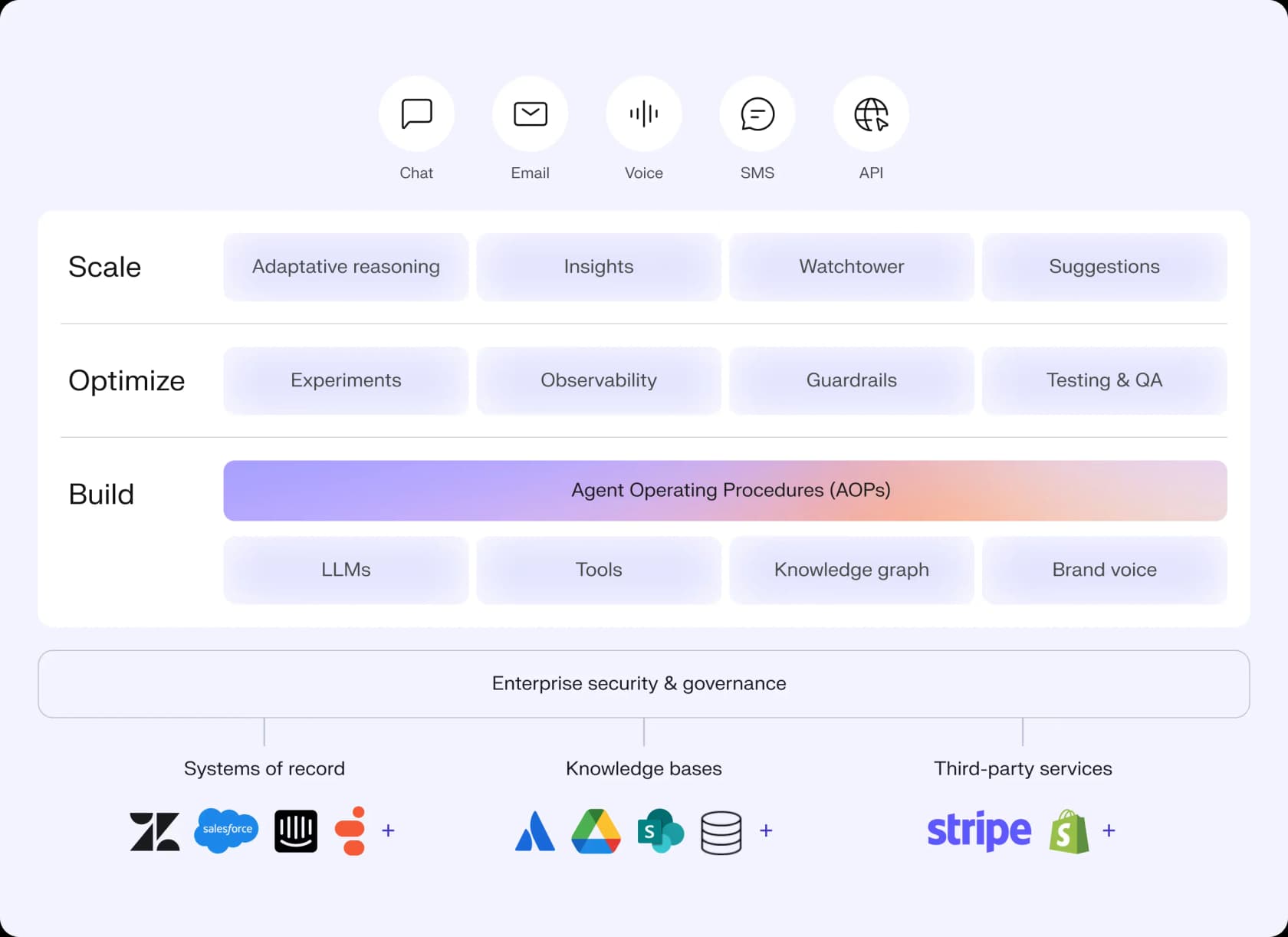
Decagon is an AI-native company (founded 2023, reportedly valued around $1.5B after its 2025 Series C, per Crunchbase) building what it calls "the AI concierge for every customer." Its technical wedge is Agent Operating Procedures, natural-language instructions that compile into executable code, so CX operators can author agent logic while engineers keep guardrails and versioning. One agent runs across chat, voice, email, SMS, and custom API surfaces.
The proof points are heavyweight: Decagon publishes a 70% chat and voice resolution rate at Chime and an 80% deflection rate at Duolingo, and its DTC and retail roster (Gopuff, Fanatics, Rituals, Hertz) overlaps neatly with Gladly's target market.
What we like:
- Strong omnichannel parity, with voice and email treated as first-class, not afterthoughts.
- AOPs make iteration faster than the decision-tree tooling many incumbents ship.
- Serious observability: every model call and knowledge lookup is traceable.
What to watch:
- No public pricing and no self-serve trial; this is a sales-led, annual contract.
- Aimed squarely at mid-market and enterprise volumes, so it's overkill for a small team.
Pricing: Contact sales. The demo form brackets prospects by monthly ticket volume (under 10k up to 250k+), which tells you the model scales with conversations rather than seats.
Our take: If you're a high-volume consumer brand that wants the resolution numbers Decagon advertises and can support an enterprise rollout, it's a credible pick. Smaller teams will find the entry barrier (and the sales cycle) heavy.
4. Sierra: best for enterprise brands that want outcome-based pricing
Best for: large, often regulated brands that want to pay only when the AI actually resolves something.
Sierra is the high-profile entrant, co-founded by Bret Taylor (former co-CEO of Salesforce, now chair of OpenAI's board) and Clay Bavor (18 years at Google). That pedigree shows up in its customer list, which is unusually heavy on regulated and enterprise names: Rocket Mortgage, SoFi, Vanguard, ADT, Sonos, and Wayfair among them.
Sierra's defining commercial idea is outcomes-based pricing: you pay for resolved outcomes, not seats or messages, which shifts implementation risk onto Sierra. Its other standout is Ghostwriter, an agent that builds agents from your SOPs and transcripts, collapsing the usual multi-week build. It's also one of the few vendors leading with ISO 42001 (an AI-management certification) alongside SOC 2 and HIPAA.
What we like:
- Outcome-based pricing aligns the vendor's incentives with yours.
- Deep compliance footprint, which matters for finance, healthcare, and the like.
- Agents can be deployed through ChatGPT itself, a distribution angle no one else has.
What to watch:
- Enterprise-only, with no public pricing, no self-serve, and no trial.
- Outcomes pricing can be hard to model in advance until the contract defines the "outcome."
Pricing: Contact sales; outcomes are defined per use case.
Our take: For a large brand that wants the strongest enterprise story and likes the idea of paying for results, Sierra is compelling. For everyone below the enterprise line, it's out of reach, and the build-versus-buy math tilts toward something self-serve.
5. Ada: best for large enterprises that want multi-LLM flexibility
Best for: enterprises with 300,000+ annual conversations who want a standalone AI layer over their existing helpdesk.
Ada (Toronto-based, ~$190M raised, last valued at $1.2B in its 2021 Series C) brands its category as Agentic Customer Experience. The product is a standalone AI agent that sits on top of helpdesks like Zendesk, Salesforce, and Freshworks, built around a multi-LLM Reasoning Engine that orchestrates across models rather than betting on one. It's strongly omnichannel and multilingual, with Playbooks for multi-step workflows and a Coaching feature where you review past conversations and the agent applies the notes going forward.
Ada is openly enterprise-only: its pricing page states it's "a great fit for companies with at least 300,000 annual customer service conversations." Results it publishes include Cebu Pacific's 34%+ higher automated resolution rate and a Tilt 84% automated resolution rate on chat.
What we like:
- Multi-LLM orchestration, so you're not locked to a single model's strengths.
- Leads on AI-specific compliance (AIUC-1) and zero data retention with LLM providers.
- Genuinely omnichannel, with voice being pushed hard through 2026.
What to watch:
- Hard enterprise gate: the 300k-conversation floor rules out most SMB and mid-market teams.
- No public pricing and no trial.
Pricing: Contact sales, volume-based, with that 300k annual-conversation qualification floor.
Our take: Ada is a serious enterprise option, particularly if multi-model flexibility and AI compliance are on your checklist. Below enterprise scale, it isn't built for you, and that's by design.
6. Forethought: best for keeping your helpdesk and adding agentic AI
Best for: mid-market and enterprise teams committed to their current helpdesk who want agentic AI on top.
Forethought (a TechCrunch Disrupt 2018 Battlefield winner that has raised ~$92M) markets a multi-agent system: Solve resolves inquiries, Triage tags and routes them, Assist drafts for human agents, Discover finds knowledge gaps, and Agent QA scores interactions. Its strongest pitch for a Gladly-adjacent buyer is that it's helpdesk-agnostic and sits on top of whatever you already run, so adopting it doesn't mean switching platforms. It also leans into action-taking, including a Browser Agent that can operate legacy tools without APIs.
Forethought publishes some big benchmark numbers (up to 98% resolution rate and 15x average ROI in its 2025 CX benchmark report), and customer results like Upwork's 50% reduction in time to resolution.
What we like:
- Helpdesk-agnostic; the only entry here whose whole pitch is "keep your stack."
- Clear multi-agent structure, so each job (resolve, triage, assist, QA) is named and scoped.
- Strong action-taking story, including non-API legacy systems.
What to watch:
- Quote-only pricing (a blend of platform fee and outcome-based cost) with no trial, just a proof-of-value pilot.
- The five-agent framing is powerful but can be more than a small team needs.
Pricing: Three tiers (Team, Professional, Enterprise), all "get a quote." Secondary sources peg it in the mid-five to low-six-figure annual range, but Forethought doesn't confirm figures publicly.
Our take: If you're staying on your helpdesk and want a mature, action-capable agentic layer, Forethought is a strong, helpdesk-neutral choice. The lack of pricing transparency is the friction.
7. Aisera: best for cross-functional IT + CX enterprises
Best for: large enterprises consolidating customer service, IT, and HR support onto one agent platform.
Aisera is the odd one out, and deliberately so. Where everyone else here is CX-focused, Aisera is cross-functional from day one: a Universal Agent orchestrates domain agents across IT, HR, finance, and customer service. It's heavily funded (~$171M raised, last valued at $1.6B) and was acquired by Automation Anywhere in late 2025. Its references are Fortune-500-scale (Adobe, Cisco, Workday, Zoom), and outcomes it publishes include LifeScan auto-resolving 65% of support requests.
For a pure DTC or retail support team, Aisera is usually too heavy a buy. But if you're a big organization that wants one AI platform handling employee IT tickets and customer questions alike, it belongs on the shortlist next to ServiceNow and Moveworks rather than next to lighter CX tools.
What we like:
- One platform across IT, HR, and CX, which avoids buying (and integrating) three separate agents.
- LLM gateway with bring-your-own-model support and strong observability.
- Recognized in Gartner and IDC analyst evaluations for ITSM and conversational AI.
What to watch:
- Built for very large enterprises; overkill (and likely overpriced) for a 50-to-500-seat CX team.
- No public pricing, no trial, annual contracts only.
Pricing: Contact sales, annual contract scoped by volume.
Our take: Aisera is the right call only if your problem is bigger than customer service. For a CX-only team in Gladly's wheelhouse, the other six options fit better.
How AI agents for Gladly actually work
Whichever tool you pick, the underlying loop is the same, and it's worth understanding because it's also where the differences hide. A modern AI support agent doesn't just match a question to a canned answer. It reads the incoming message, pulls in context (order history, the help center, past conversations), and then either resolves the issue directly (including taking an action like a refund) or hands off to a human with a full summary when the situation calls for it.
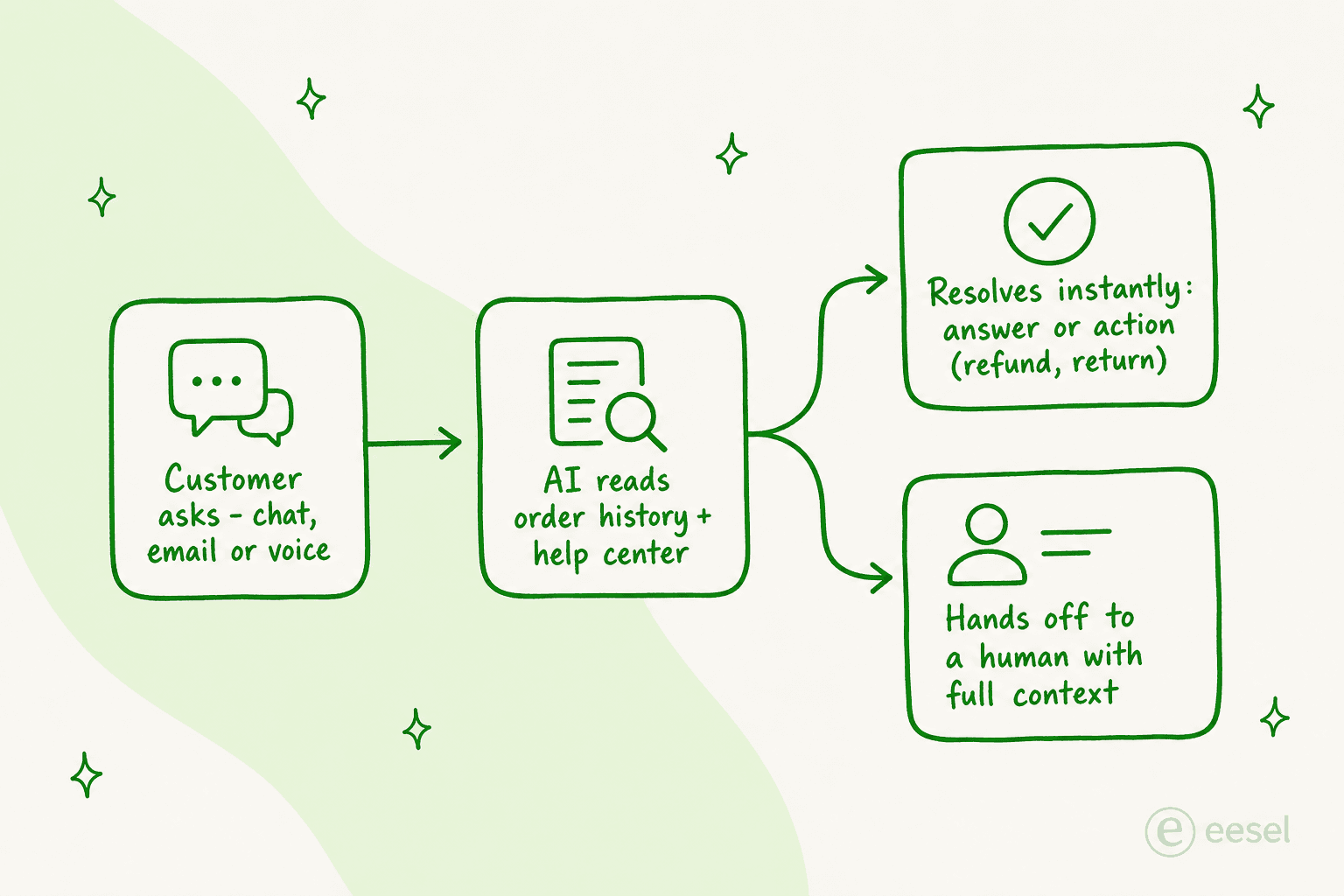
The quality of each step is what separates a good agent from a frustrating one. Does it actually take the action, or just describe it? Is the handoff clean, with the human getting the full thread and a summary, or does the customer have to start over? This is exactly why a simulation step before launch is so valuable: you get to see how the loop behaves on your real conversations before a single customer is affected. For a deeper primer, our guide to AI in customer service walks through the building blocks.
How much does AI for Gladly cost?
This is where the choice gets real, because the four pricing models in this list are not comparable on sticker alone. The billable unit is what decides your bill.
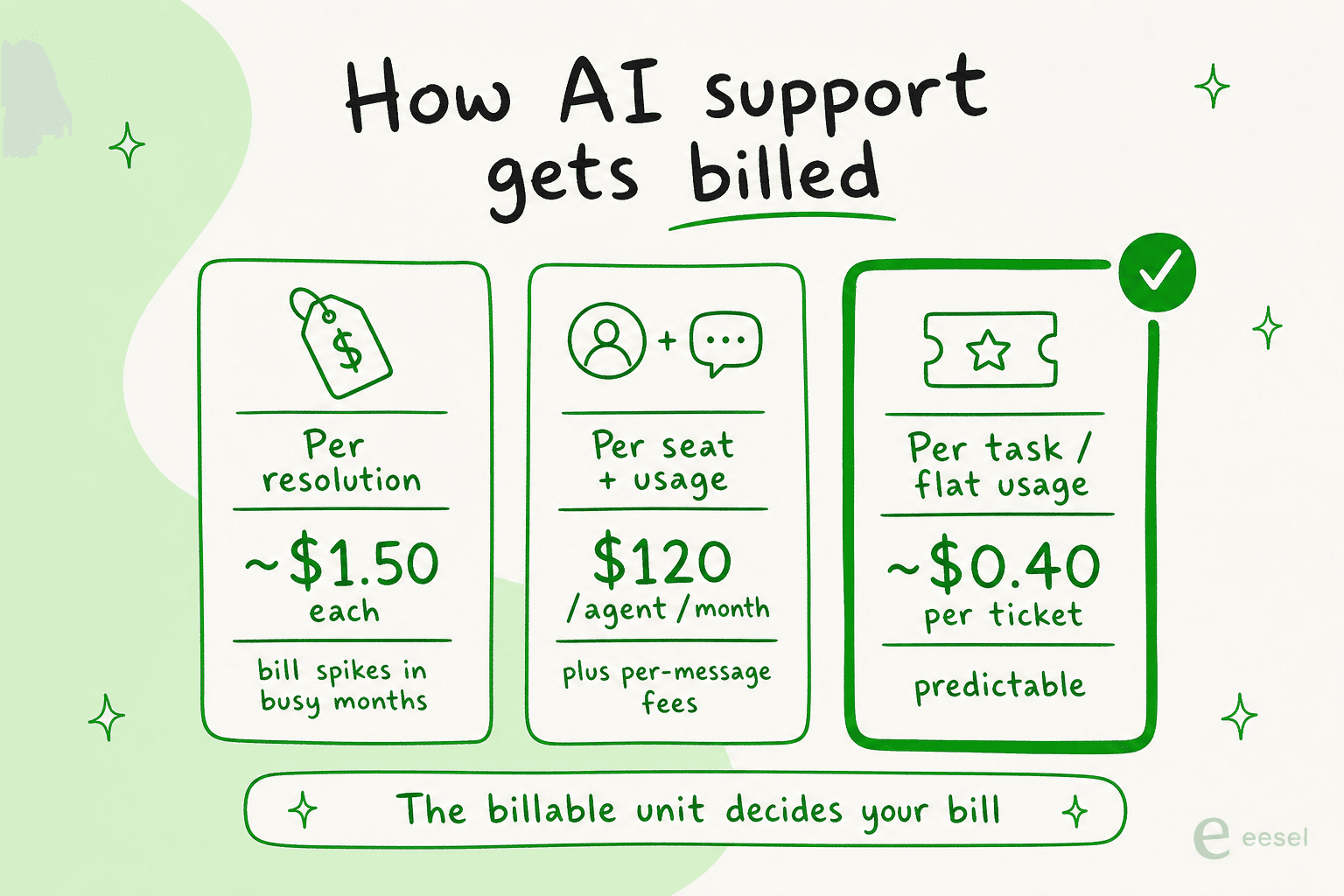
- Per resolution (Gladly Sidekick's Shopify plan): $1.50 per AI Resolution and $0.25 per AI Assist. Clean when volume is steady, but a busy month, a viral product, or a shipping snafu can spike the bill exactly when you can least absorb it.
- Per seat plus usage (Gladly's platform model): $120 per agent per month on the Shopify plan, with platform tiers quote-only. You pay for seats whether or not they're resolving with AI.
- Outcome-based (Sierra): you pay for results, which sounds ideal but is hard to budget until the contract pins down what an "outcome" is.
- Per task or flat usage (eesel AI): roughly $0.40 per resolved interaction with no seat fee, and a spend cap so the agent pauses rather than surprising you.
A worked example: say you handle 3,000 AI-resolved conversations a month. On a $1.50-per-resolution model that's $4,500 before any seat costs. On a roughly $0.40-per-resolution usage model it's about $1,200. The exact numbers vary with your contract and what counts as a resolution, but the shape of the difference is the point, and it's why we'd always model your real volume rather than trust the headline. Our cost savings guide digs into the full total-cost-of-ownership picture.
How to choose the right AI for your team
Step back and the decision sorts itself surprisingly cleanly along two axes: how you want to pay and connect (self-serve and transparent versus enterprise and sales-led), and whether you want to add AI to your existing helpdesk or replace your platform outright.
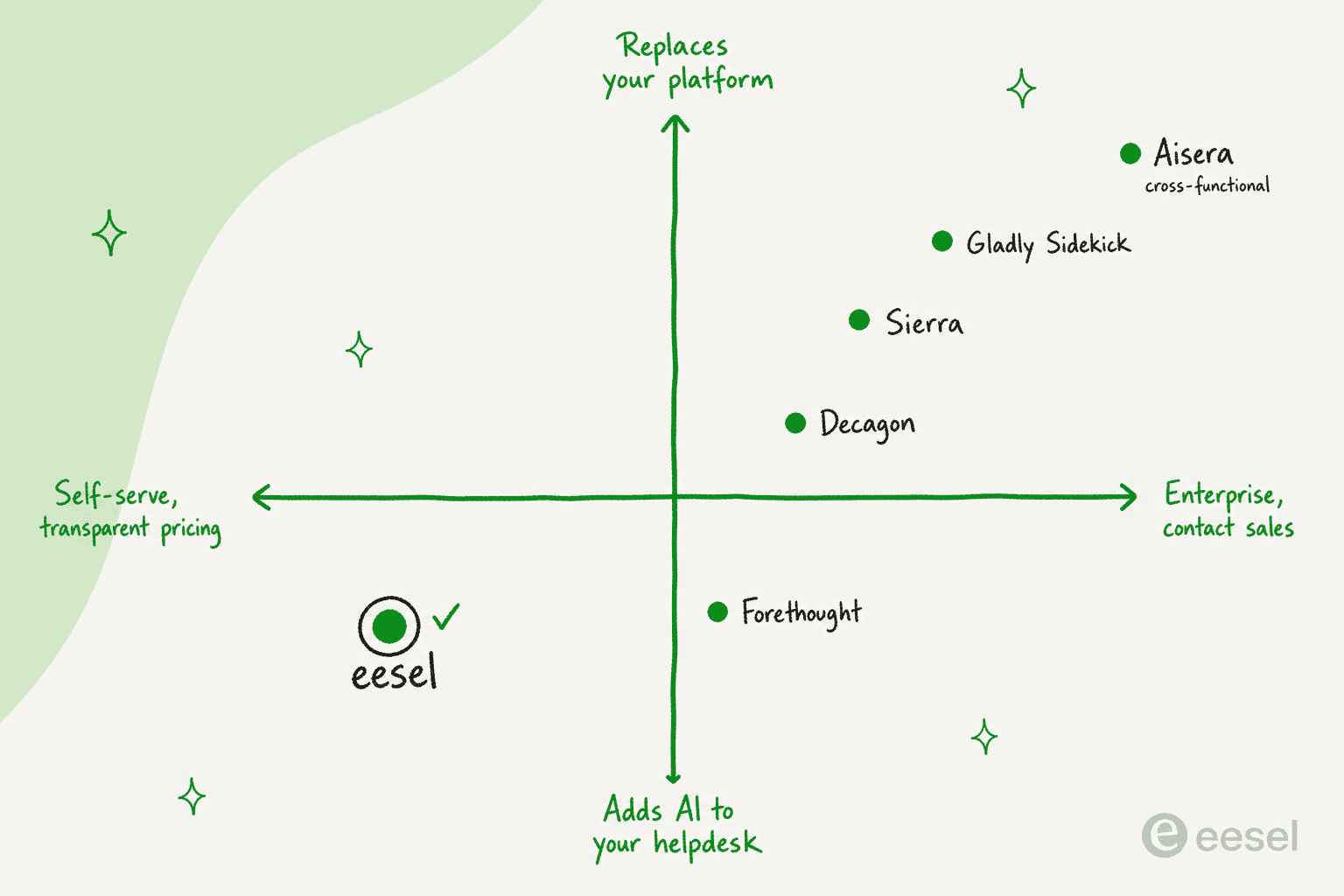
Here's the short version of who we'd point where:
- Stay on Gladly and you love the platform? Sidekick. It's native, context-rich, and strong, just budget for the per-seat model.
- Want transparent pricing, fast setup, and you're on (or open to) a mainstream helpdesk? eesel AI. Self-serve, usage-based, and you can simulate it on past tickets before committing.
- High-volume enterprise that wants the biggest resolution numbers? Decagon or Sierra, depending on whether you prefer omnichannel depth or outcome-based pricing.
- Enterprise that wants multi-LLM flexibility and AI compliance? Ada.
- Committed to your helpdesk and want agentic AI on top? Forethought.
- Need IT and HR support solved alongside CX? Aisera.
If your real goal is to leave Gladly rather than augment it, our roundup of the best Gladly alternatives compares full platforms head to head, and our best AI helpdesk software guide covers the broader field. Ecommerce teams in particular should look at AI helpdesks built for Shopify and our best AI for Shopify customer support breakdown.
Try eesel AI
If you want autonomous AI support without a sales cycle, a per-seat bill, or a multi-week implementation, eesel AI is the fastest way to find out whether AI can actually carry your frontline. It connects to your helpdesk and 100+ knowledge sources, learns from your past tickets and help center, and goes live in minutes.

The differentiator we'd point to is the simulation mode: before you trust it with a single customer, run it over thousands of your past conversations to see the exact resolution rate you'd get and where it needs coaching. Pricing is transparent and usage-based with no per-seat fees, and you can start free with a $50 credit and no credit card. Try eesel and see your numbers before you commit.
Frequently Asked Questions
What is the best AI for Gladly?
Does Gladly have its own AI?
How much does AI for Gladly cost?
Can I add AI to Gladly without switching platforms?
Is Gladly Sidekick worth it for small teams?
What's the difference between an AI agent and a rule-based chatbot for Gladly?


Article by
Alicia Kirana Utomo
Kira is a writer at eesel AI with a Computer Science background and over a year of hands-on experience evaluating AI-powered customer service tools. She focuses on breaking down how helpdesk platforms and AI agents actually work so that support teams can make better buying decisions.