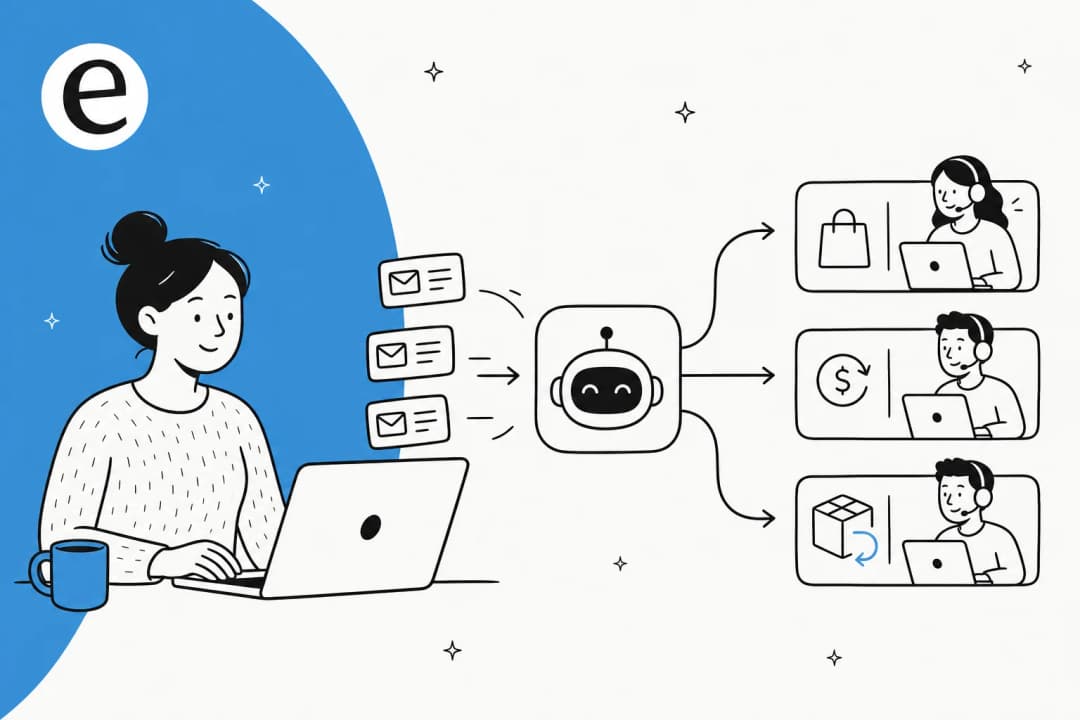


What proactive support actually means
Reactive support waits. The customer buys, hears nothing, gets anxious, emails "where's my order?", and now you have a ticket, a wait, and a slightly annoyed person on the other end. Proactive support flips the order of operations: the moment something the customer cares about changes, they hear from you, so the question never forms. It's the same instinct behind proactive chat on the storefront, applied to the whole post-purchase journey.
One LinkedIn operator framed the customer's real question well. The WISMO email isn't really about logistics, it's emotional reassurance:
"Because the question isn't actually 'where is my order.' The real question is: 'I just gave you my money for a promise. Tell me the promise was real.'... Half your support team is doing the work your checkout should have done automatically."
Avi Moskowitz, ecommerce operator, on LinkedIn

That reframe matters because it changes what you build. You're not staffing up to reply faster; you're closing the gap that made the customer worried enough to write in.
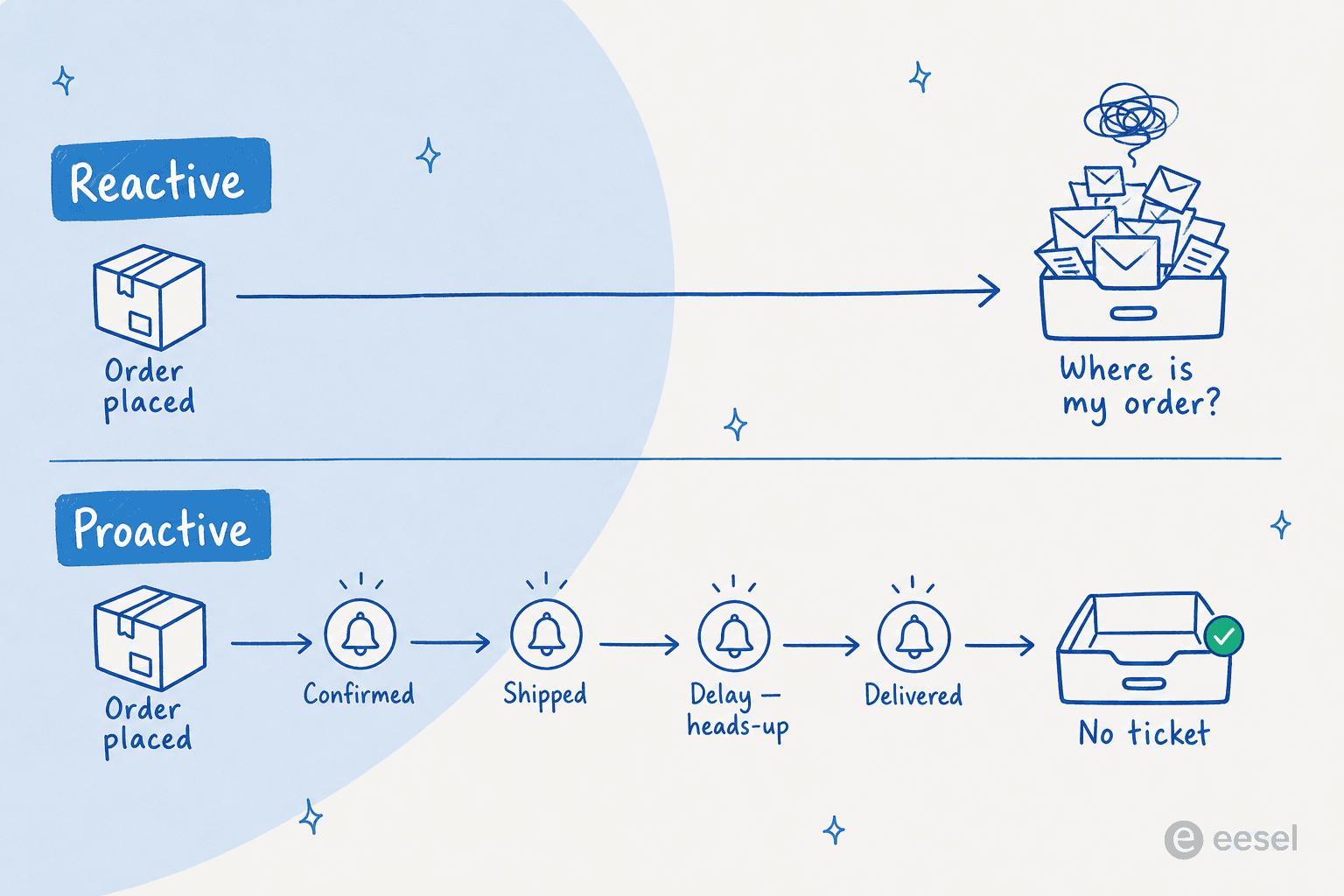
The predictable tickets proactive support kills
Before you automate anything, it helps to know exactly which tickets are worth targeting. From the queue, four categories make up the overwhelming bulk of ecommerce contacts, and all four are predictable enough to get ahead of.
| Ticket type | Why it lands in your inbox | The proactive fix |
|---|---|---|
| WISMO / order status | Customer has no visibility after checkout; carrier tracking is vague | Milestone notifications + an AI agent that reads live order data |
| Shipping delays | Something slipped and nobody told the customer | Automatic delay alerts the moment an exception is detected |
| Returns & refunds | Policy questions and "where's my refund?" follow-ups | Self-serve returns + an agent with authority to process them |
| Post-purchase & product questions | Sizing, setup, "did my change go through?" | Catalog-aware answers, surfaced in-session before the cart is lost |
The frustrating part, and the reason "just turn on Shopify's tracking emails" doesn't fix it, is that the standard automations only go so far. Here's an ops lead who had already done all the obvious things:
"Set up automated emails with tracking from shopify, customers still ask. Created an faq page with shipping info, nobody reads it. Made tracking more prominent in order confirmation, doesn't matter. People want personal confirmation that their specific order is on the way."
u/Ok-Huckleberry-5185, r/ecommerce

They were spending at minimum 3 hours daily on tracking comms anyway. So proactive support isn't "send a tracking email." It's two distinct layers doing two distinct jobs.
Layer 1: prevent the ticket with proactive notifications
The first layer is pure communication, and it's the one most stores under-invest in. The rule is simple, and a 12k-follower ecommerce operator stated it cleanly: every time an order status changes, the customer should hear from you.
"The fix is to be way more proactive. Every time an order status changes, the customer should hear from you. Packed. Picked up. In transit. Even if it's been in transit for two days and hasn't moved, they should be getting an email."
John Coyle, on LinkedIn
The post-purchase platform Narvar formalizes this as notifying the customer at three key moments: confirming, shipping, and delivering the order, with the predicted delivery date attached, and updating immediately on any delay. AfterShip frames the same idea as catching delivery exceptions (weather, customs, a stuck parcel) "as early as possible."
Does it work? AfterShip's customer Mous, a London brand doing 1M+ monthly orders, cut its contact rate from 12.9% to 5.9% after switching on proactive communication. A Shopify seller on Reddit reported a ~40% drop in support tickets from automated post-purchase touchpoints. And there's a revenue kicker: branded tracking and intelligent delivery dates aren't just deflection. Narvar reports one customer, Harry Rosen, drove a 13% conversion lift with smarter estimated delivery dates.
Here's the honest bit, and it's the thing most "AI for ecommerce" posts won't tell you: this layer is a tracking-app job, not an AI one. The cleanest advice I've seen on this came from a small-business thread:
"post-purchase tracking app is the fix, not a helpdesk... they clean up the carrier feed so 'in transit for 4 days' turns into 'left Memphis, arriving Thursday,' and they send that out before the customer thinks to email you. The proactive update is what empties the inbox... that said if you're still getting residual repetitive tickets after that (order status, refund questions, etc) an AI layer on top of your helpdesk can handle the rest."
u/leanzubrezki, r/smallbusiness
That "AI layer on top for the rest" is layer two, and it's where eesel lives.
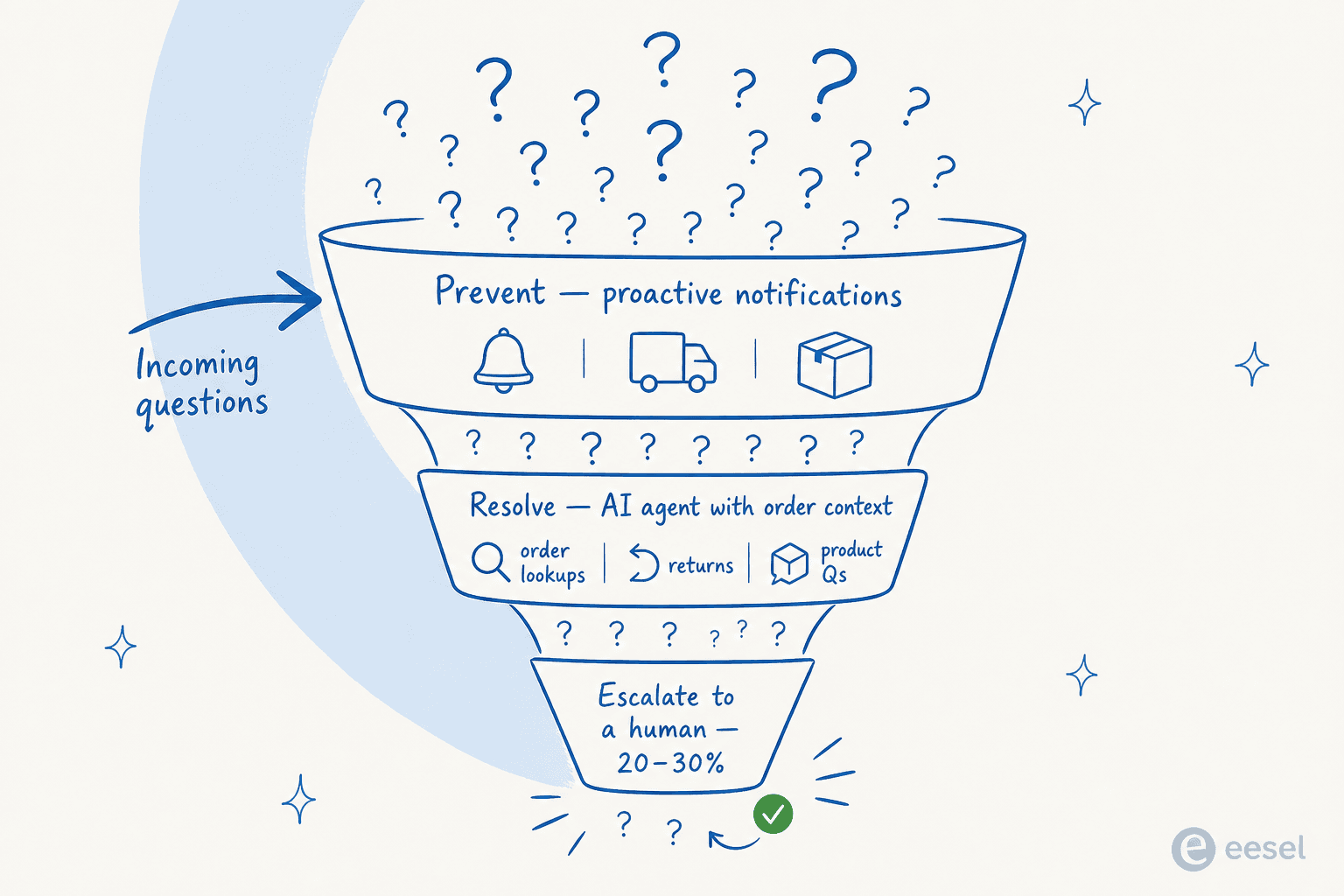
Layer 2: resolve the rest with an AI agent that knows your orders
No matter how good your notifications are, residual tickets keep coming. People ask about a specific edge case, want to start a return, ask whether a jacket runs warm, or just want a human-sounding "yes, it's on its way." This is the volume an AI support agent is built to absorb, and the key word is resolve, not deflect.
The difference comes down to one thing: action authority. Gorgias's own research argues that running AI with the ability to take real actions, like issuing refunds, applying discount codes, modifying subscriptions, and processing returns, is what separates brands stuck at 50% automated resolution from those hitting 70%. An agent that can only talk about your return policy isn't resolving the return; it's narrating it.
This is exactly how eesel plugs into Gorgias. It joins as a real AI agent inside the helpdesk, reads tickets, and pulls Shopify order data into every reply so a WISMO question gets answered with the actual delivery status rather than a canned "please check your email." On the storefront, the ecommerce agent handles orders and returns with real-time tracking and return processing, plus product questions pulled straight from your catalog.
This is the layer that quietly does the most work. One DTC supplements team wanted their Gorgias agent to auto-resolve more than half of 7,000 monthly tickets, the usual WISMO, subscription, and product-question mix. That's the residual pile proactive notifications can't catch, and it's squarely automatable when the agent can see the order and act on it. It connects to Shopify, WooCommerce, BigCommerce, Magento, and Amazon, so the same logic works wherever your store lives.
Where proactive AI breaks, and how I keep it honest
I've watched a confident-sounding bot give wrong answers, so I'm wary of any post that pretends this is plug-and-play. The sharpest warning I've read came from a CX practitioner, and it's worth sitting with:
"The capability ceiling is the part nobody talks about... every demo shows you the clean wins. WISMO, return status, order confirmation. The ROI math looks great at that level and it genuinely is. The break happens when ticket complexity increases faster than the tool can keep up... The deflection rate still looks fine on the dashboard while CSAT quietly starts slipping."
u/Secret_Mission007, r/customerexperience
That "looks fine on the dashboard while CSAT slips" failure is the one that scares me, because by the time you see it, you've shipped a lot of bad answers. The fix isn't to trust the AI less; it's to know its real accuracy before you go live.
That's why every rollout I'm involved in gets simulated against historical tickets first. You run the agent over thousands of your own past conversations, see exactly what it would have said, and read the coverage by topic before a single customer is affected. When we did this for a German online jewelry retailer running ~1,000 tickets a month on Zendesk and Shopify, the simulation showed 93% triage accuracy and useful draft rates of 93.8% on returns and refunds, and 100% on refund-status questions, the exact ecommerce categories you'd want to automate first. It also showed where it shouldn't auto-send, which is just as valuable.
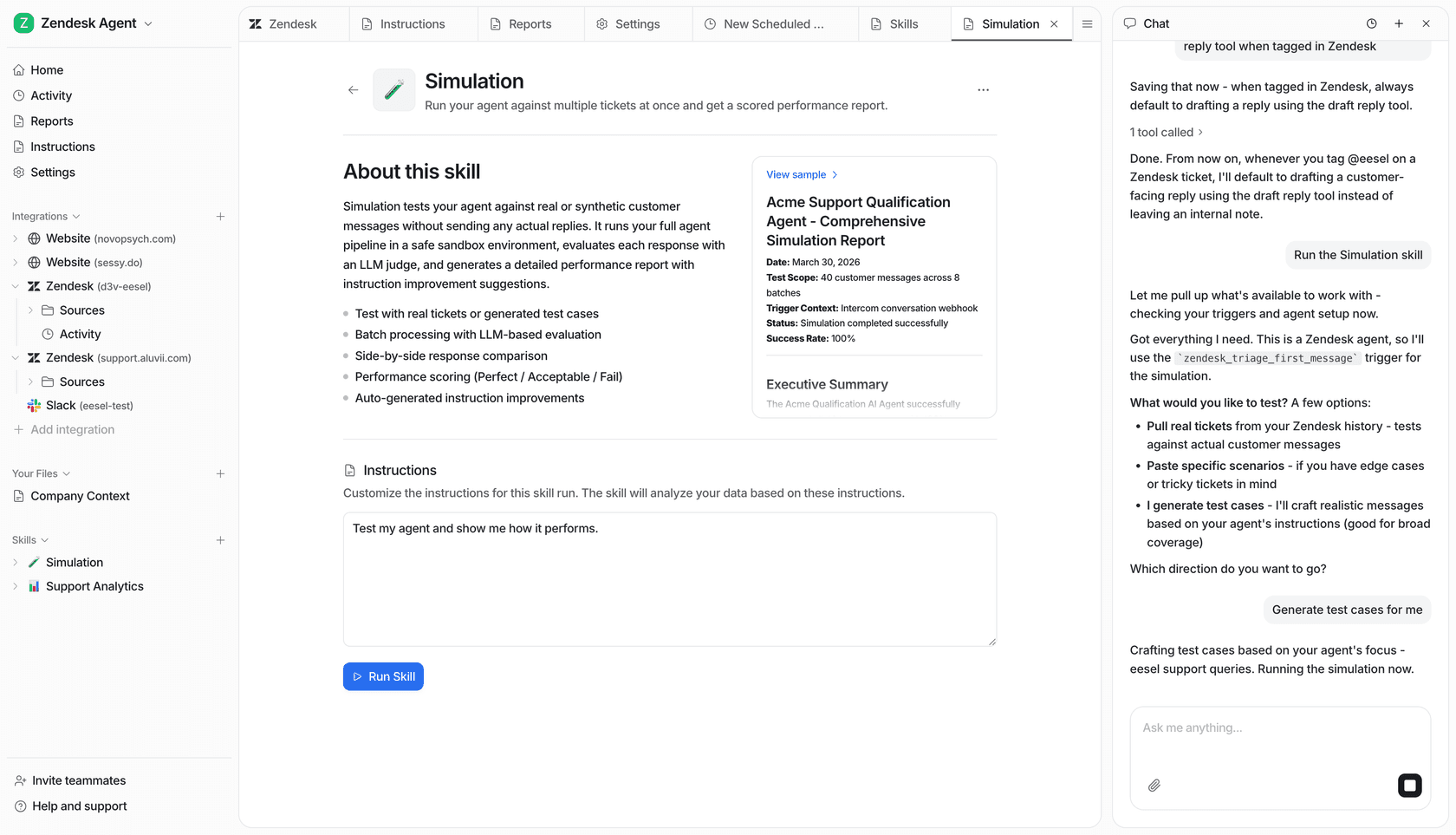
The second guardrail is confidence-based routing. When the agent isn't sure, it doesn't guess in front of the customer; it leaves a draft for a human or escalates. Gorgias's data backs why this restraint matters: the genuine human-judgment budget for most stores is only 20-30% of total volume. Proactive support is about protecting that budget for the tickets that actually need a person, not spending it on order-status lookups. One more piece of community wisdom captures the boundary: don't automate empathy, just the repetitive stuff.
The payoff: speed, and a calmer queue
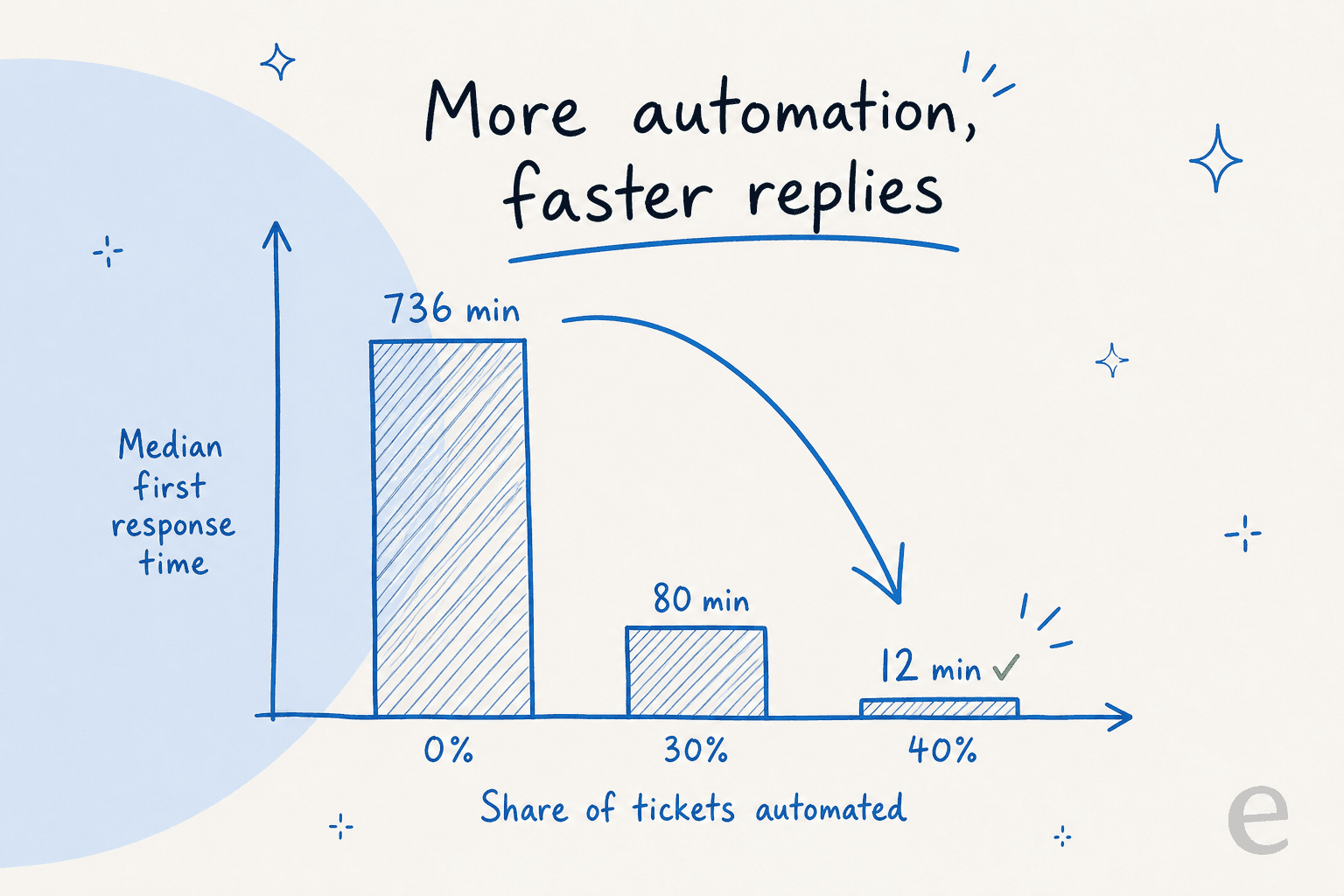
When both layers are running, the numbers move in the direction you'd hope. Gorgias's benchmark data across 1,000+ ecommerce brands shows just how non-linear the response-time gain is: brands automating almost nothing average a 736-minute first response, but at 30% automation that drops to 80 minutes, and at 40% to 12 minutes.
The cost of not getting ahead of these tickets is the quiet killer. In Gorgias's data, 55% of AI-touched tickets still end in a human handoff, the median wait before a human picks one up is 10 hours, and a third of handed-off tickets are abandoned entirely. A WISMO question that sits for ten hours and then gets dropped is the worst of both worlds. Prevent it with a notification, or resolve it instantly with an agent that can read the order, and that whole failure path disappears.
A reasonable place to start: a practitioner pegged the ROI break-even at around 500 to 1,000 tickets a month when most are repetitive, which describes nearly every growing store. If you want the broader playbook beyond ecommerce specifics, our guide on reducing support tickets with AI goes deeper. There's also a focused breakdown of AI ticket triage for routing whatever the AI hands off.
Try eesel for proactive ecommerce support
If you've got the notification layer handled and you're staring at the residual pile, that's the job eesel is built for. It plugs into your existing Shopify or Gorgias setup, or whatever helpdesk you run, learns from your past tickets and catalog, and resolves the order lookups, returns, and product questions before they ever reach a person. The differentiator I'd point to: you can simulate it against your real ticket history first, so you see its actual accuracy on your WISMO and returns before you trust it with a customer. Pricing is usage-based at $0.40 per resolved chat, with no per-seat fees, so you only pay for tickets it actually closes. It's free to try.
Frequently asked questions
What is proactive AI customer support for ecommerce?
How much can proactive support reduce ecommerce ticket volume?
Will an AI agent give wrong answers about my orders?
Do I still need a post-purchase tracking app?
How much does AI ecommerce support cost?



Article by
Riellvriany Indriawan
Riell is a designer and writer at eesel AI with about two years of experience researching CX platforms, AI chatbots, and helpdesk software. She combines her design background with a sharp eye for how these tools actually look and feel in practice — making her comparisons unusually visual and user-focused.