


What customers really mean when they ask "where's my order?"
I work eesel's support queue, and I'll tell you what every ecommerce team already knows in their bones: the same question comes in over and over. "Has it shipped?" "It says delivered but it's not here." "Can I change the address?" These aren't interesting tickets. They're the ones that pile up at 9am, bury the two actually tricky problems underneath, and burn out the agent who has to copy-paste a tracking link forty times before lunch.
That's the WISMO tax, and it's brutal at scale. One DTC supplements brand I worked with was fielding around 7,000 email tickets a month on Gorgias and Shopify, and a huge share of them were WISMO, subscription changes, and basic product questions, the kind of volume where the answer already exists, it's just trapped behind a manual lookup. They didn't need smarter agents. They needed the boring questions to answer themselves.
Here's the thing most "can AI do this?" posts skip: I've spent the last three-plus years putting AI agents on live support queues, and order tracking is one of the few places where the AI is reliably, measurably good. When eesel ran an agent against a German jewelry retailer's real Zendesk and Shopify traffic (about 1,000 tickets a month), the drafts it produced for refund-status questions were useful 100% of the time, product inquiries 100%, and returns/refunds 93.8%, with 93% triage accuracy across the inbox. Those are the categories that lean on structured order data, and that's precisely why AI handles them so well. The scars I carry are from the other tickets, which is why I'll spend half this post on where AI should stop.
So, can AI track orders for customers? Yes, here's how it works
When an AI agent "tracks an order," it isn't doing anything mystical. It's running a short, repeatable pipeline, the same one a human agent runs, just in a couple of seconds instead of a couple of minutes.
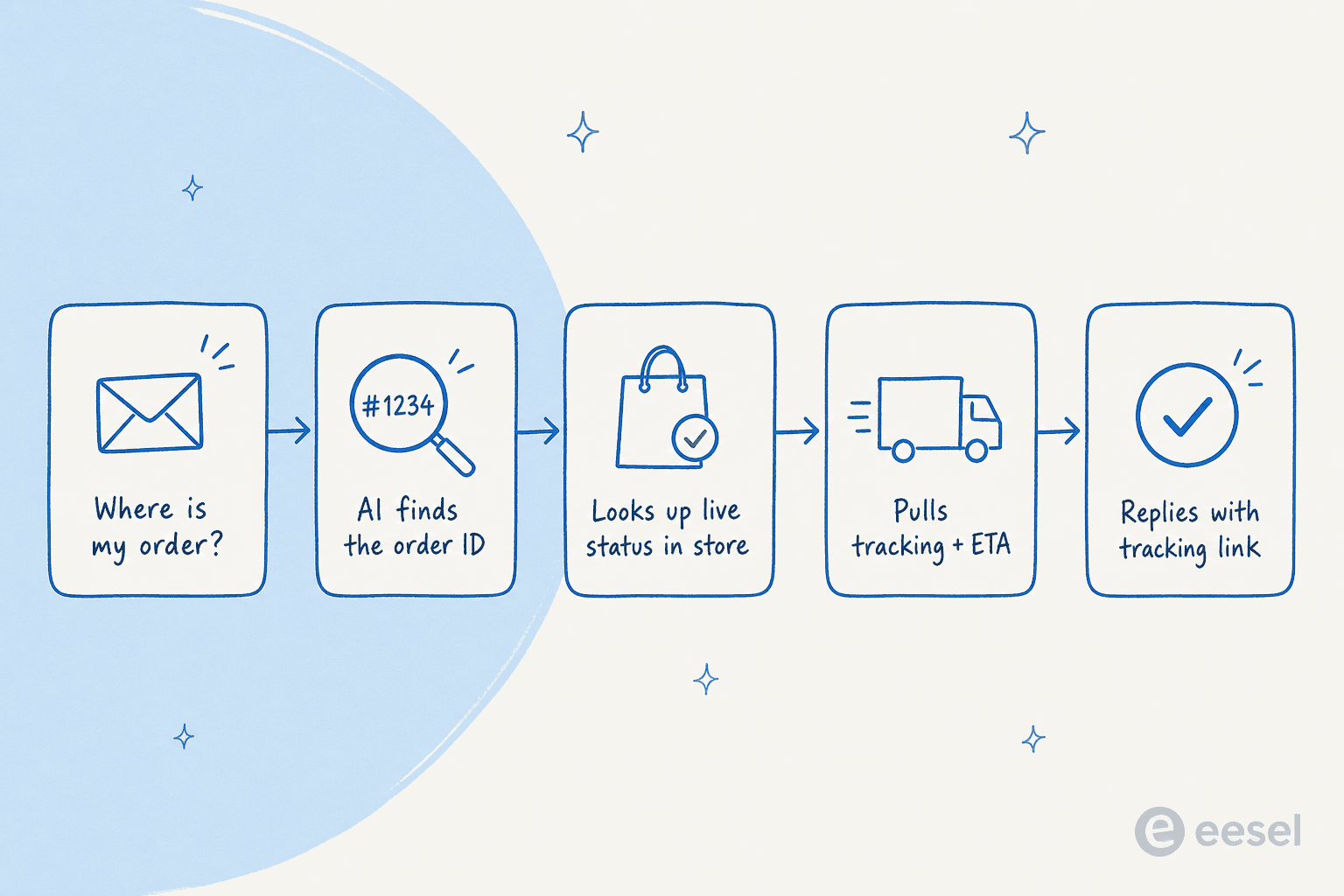
Walking through it:
- It reads the message and finds the order. The agent pulls the order number out of the text, or matches the customer's email to their account. If neither is present, it asks, exactly like an agent would.
- It looks the order up live. This is the step that separates a real order tracking chatbot from a glorified FAQ. The agent queries your store's API in real time, so it sees the current state, not a snapshot from this morning. (If you're curious about the plumbing, I wrote up how Shopify's API fetches order detail from an order number and how Shopify order webhooks keep things fresh.)
- It pulls status, tracking, and ETA. Shipped, in transit, out for delivery, delivered, plus the carrier's tracking number and estimated date.
- It writes the reply. In your brand voice, with the tracking link embedded, in the customer's language.
That whole loop is why an AI chatbot for orders feels different from the old rules-based bots: it's not matching keywords to canned responses, it's reading real data and composing a real answer. One ecommerce team summed up the appeal of doing this on their existing stack:
"Finally, AI software that suits our needs. Easy to connect to Shopify, easy to prompt, and it learns from our articles. We're using it as a copilot for our Zendesk agents, with AI live chat next."
Mateusz Golda, Director, Tulipy, in a G2 review

What an AI needs before it can track an order
This is where a lot of teams get burned. They switch on an "AI support" feature, ask it where an order is, and it apologizes and points at the shipping policy page. That's not the AI being dumb, it's the AI being blind: nobody connected it to the order data. Before any tool can actually track orders for customers, four things have to be true.
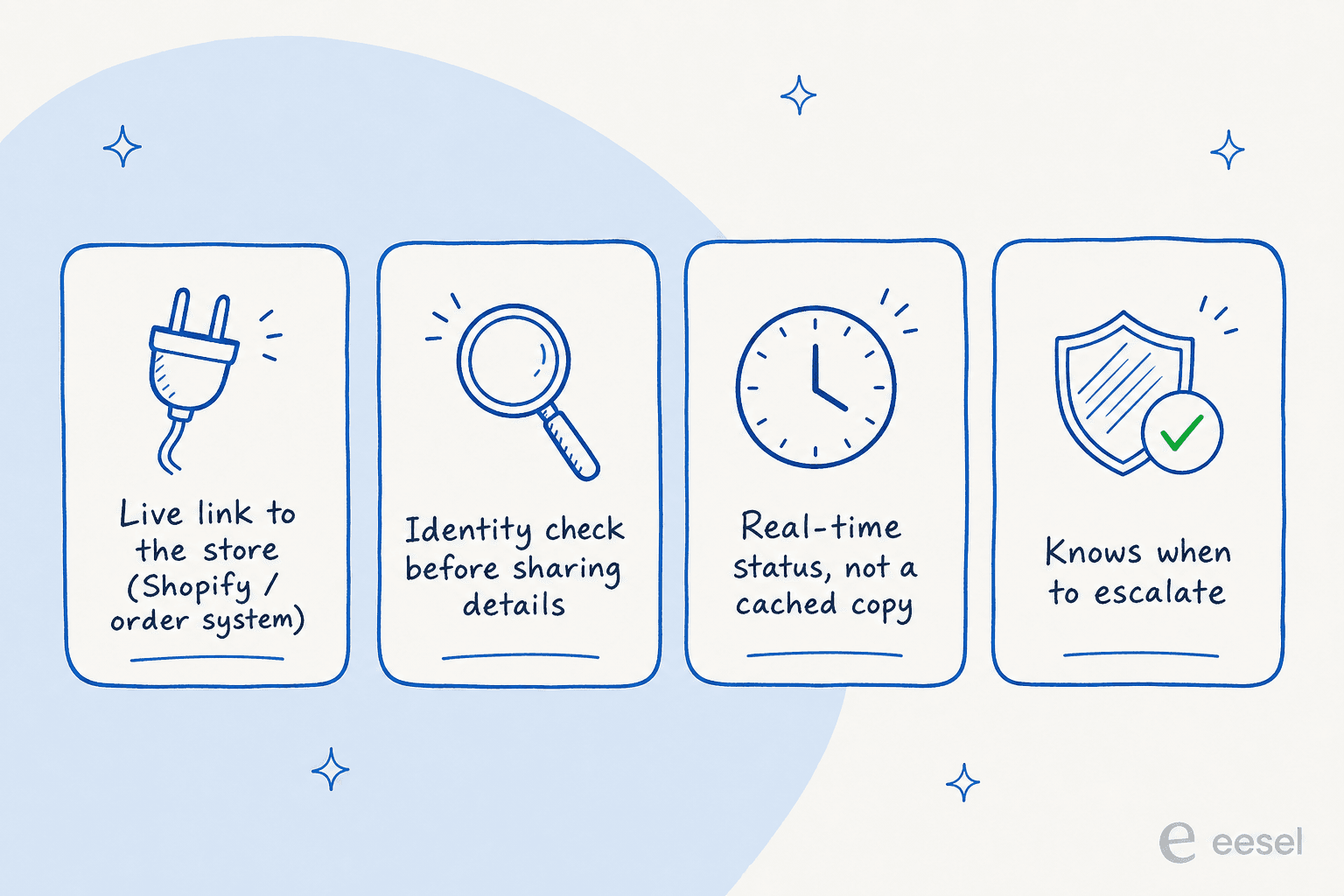
- A live link to the store. A connection to Shopify, WooCommerce, or your order system, queried on demand. A CSV export from last week won't cut it, the order moved since then.
- Identity verification. The AI should confirm who it's talking to before it reads out an address or order history. Tie answers to the verified account, never to whatever email someone typed in.
- Real-time status, not a cached copy. "Tracking" implies now. If the data is stale, the AI will confidently tell a customer their parcel is in transit after it's already been delivered, which is worse than no answer.
- It knows when to escalate. The most underrated requirement. The AI has to recognize the ticket it shouldn't answer and pass it cleanly to a person.
Get those four right and the AI can run the whole lookup. Miss the first one and you don't have order tracking, you have an AI chatbot that isn't answering correctly. This is also why the best AI for Shopify customer support is always the one that connects deepest to your store, not the one with the flashiest chat widget.
How much order-tracking work can you actually hand off?
Before you decide whether this is worth setting up, it helps to see the math on your own numbers. WISMO is high-volume by definition, so even a modest share of it adds up to real hours. Plug in your figures:
A store doing 2,000 tickets a month where 40% are order-status is handing roughly 800 tickets, and the dozens of agent hours behind them, to AI. On usage-based pricing that's about $320/month, and crucially you're never charged for the tickets your human agents handle, only the ones the AI actually takes. Compare that to the per-resolution or per-seat models common in ecommerce helpdesk software and the difference at WISMO volumes is large. (If cost is your main question, my breakdown of what an AI support agent costs goes deeper.)
Where AI should stop and pass it to a human
Here's the part I care about most, because it's where AI order tracking goes wrong. The failure mode isn't the AI refusing to help, it's the AI being too confident on a ticket it had no business answering. I've watched a confident-sounding bot quietly give a wrong answer, which is exactly why every eesel rollout gets simulated against historical tickets before it goes live.
The mechanism that keeps it honest is confidence-based routing. The AI scores how sure it is, and if it's below the bar, it drafts instead of sends, or hands the ticket straight to a person.
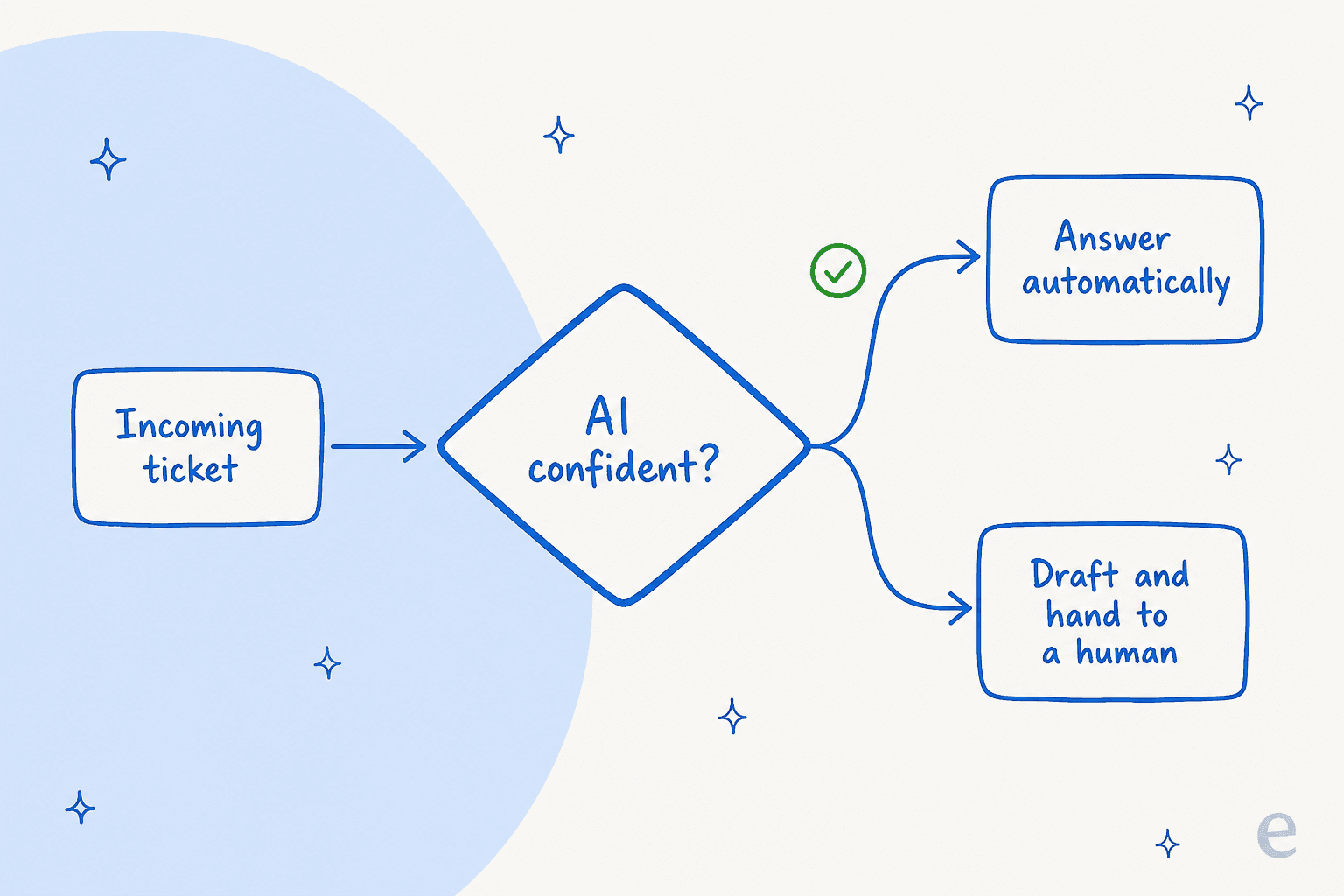
This is the single most important setting for any ecommerce buyer, and one CX lead at a DTC supplements brand put the whole philosophy in one line: the AI will never answer 100% of questions, so what you actually want is an AI that only handles the tickets it's confident about and leaves the rest alone. Here's roughly where the line falls for order tracking:
| Customer asks | AI handles it? | Why |
|---|---|---|
| "Has my order shipped? Tracking number?" | ✅ Auto-reply | Structured data, one clean answer |
| "When will it arrive?" | ✅ Auto-reply | Live ETA from the carrier |
| "Can I change my shipping address?" | ⚠️ Depends | Fine if the order hasn't shipped; route if it has |
| "It says delivered but I never got it." | ❌ Route to human | Needs investigation, possible claim |
| "I want a refund for the late order." | ❌ Route to human | Money + judgment; detect refund vs exchange intent first |
| "You sent the wrong item." | ❌ Route to human | Resolution policy + goodwill call |
That clean handoff is the whole game. Done well, the customer never feels the seam, they get an instant answer on the easy stuff and a real person on the hard stuff. Done badly, the bot stonewalls or, worse, invents a delivery date. If you want to go deeper on the routing side, I've covered AI chat escalation, handoff best practices, and how ticket triage tools decide what goes where.
It's also why "tracking orders" is rarely a standalone feature, it sits inside the broader job of order status, returns, and shipping, and butts right up against refund requests and macro templates for refunds, exchanges, and shipping issues. Order tracking is the easy front door to all of it.
How this fits the rest of your support stack
You don't need to rip out your helpdesk to do this. The AI sits on top of what you already run, whether that's Zendesk, Gorgias, Freshdesk, or Shopify Inbox. The order tracking happens through the store connection; the helpdesk is just where the conversation lives. A D2C mattress brand I worked with leaned into exactly that flexibility:
"We chose eesel AI because it offers multi-channel data input options. By linking our CSVs, Zendesk, and Google Docs as sources, we can make the most of our vast documentation, even if it's scattered."
Wesley Wang, CTO, Ecosa, in an eesel case study
If you're shopping around more broadly, it's worth seeing how order tracking shows up in the best AI helpdesk for ecommerce, the best AI customer service software for ecommerce, and general AI for customer service automation. The pattern repeats: the tools that actually track orders are the ones that connect to your order data, and the ones that automate tickets well are the ones that know when to stop. For the metrics side, chatbot KPIs for ecommerce and best practices for AI in ecommerce are good next reads.
Try eesel for order tracking
If your queue is drowning in "where's my order?", that's the slice eesel is built to take first. Connect your Shopify or WooCommerce store, point eesel at your help center and past tickets, and it answers order-status questions with live tracking data, in your brand voice, in 80+ languages, while routing the lost-package and refund-dispute tickets to your team. Because it's usage-based, you only pay for the tickets it actually handles, and you can simulate the whole thing against your historical tickets before a single customer sees it.
The fastest way to see whether AI can track your orders is to wire it up and watch it run on your real traffic. You can try eesel free, no credit card, and it's live in minutes, not a quarter-long implementation. For the ecommerce-specific version, the AI ecommerce agent page walks through order tracking, returns, and post-purchase support in one place.
Frequently Asked Questions
Can AI track orders for customers automatically?
How does AI answer a where-is-my-order (WISMO) ticket?
What happens when AI can't track an order?
How much does AI order tracking cost for a small store?
Which platforms can AI track orders on?
Can AI track orders in multiple languages?



Article by
Riellvriany Indriawan
Riell is a designer and writer at eesel AI with about two years of experience researching CX platforms, AI chatbots, and helpdesk software. She combines her design background with a sharp eye for how these tools actually look and feel in practice — making her comparisons unusually visual and user-focused.