

What ecommerce order management actually is
An order management system is the software that follows a single order across its whole life: the moment it's placed, the payment, the inventory that gets set aside for it, the pick and pack, the shipment and its tracking, and any return or exchange that comes back. It sits between your storefront and marketplaces on one side, and your inventory, warehouse, and shipping carriers on the other.
Here's the lifecycle it's stitching together:
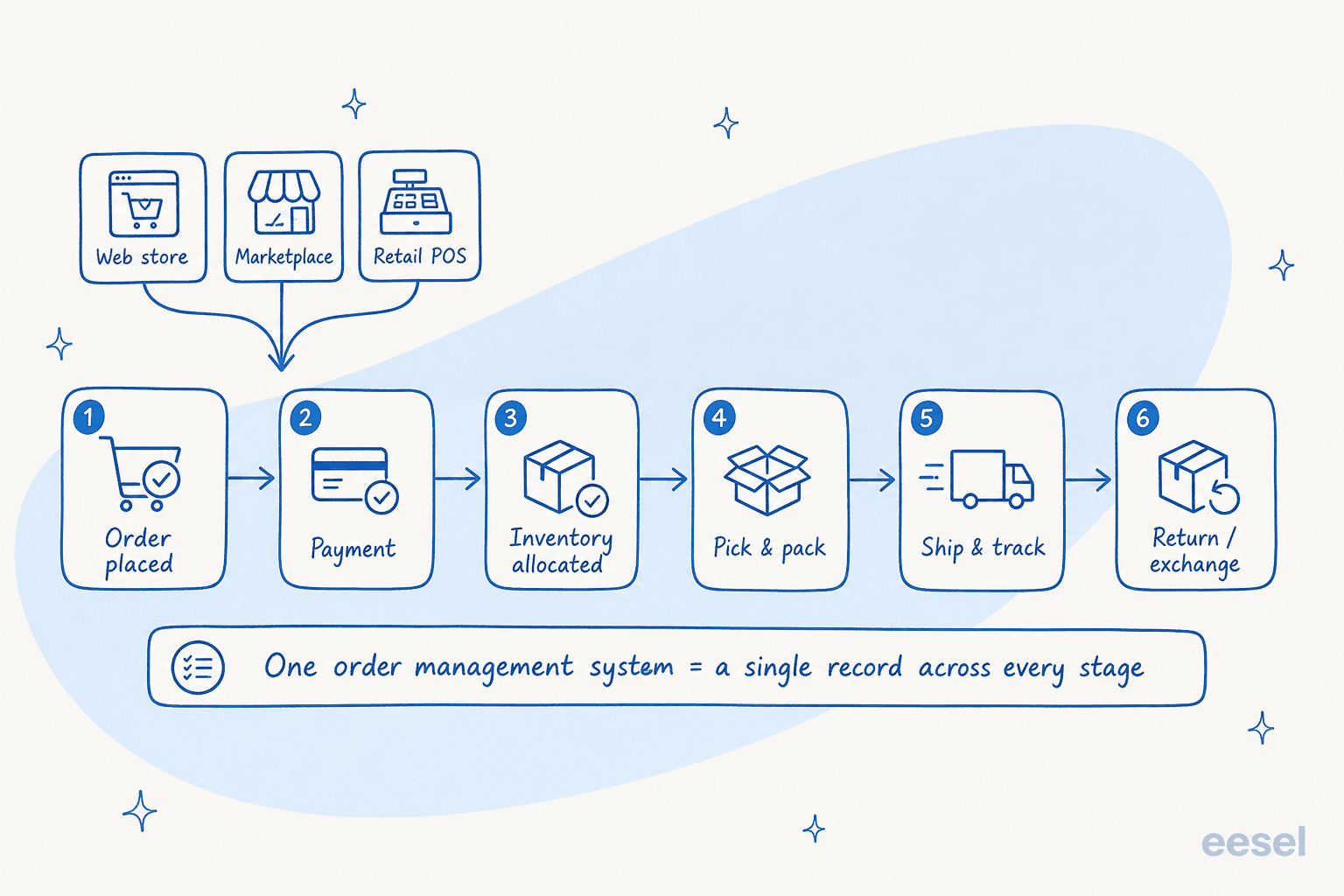
The reason this matters is fragmentation. If you sell on a Shopify store, Amazon, and TikTok Shop, each of those has its own order record. Without one system pulling them together, your team is toggling between three dashboards to answer one question. A consultant on r/ecommerce described a client's whole goal as stitching "these systems together into a single view of the entire order journey, from placement to payment, picking, packing, shipping, and returns," and a replier named the pain exactly: "data sits everywhere... Orders in Shopify... Email in Klaviyo... Marketplace data in Amazon or TikTok Shop."
That single view is the entire product. Everything else an OMS does, inventory sync, routing, returns, is downstream of getting all your orders into one record.
Why order management is really a support problem
Most "order management" content stops at operations. But if you've ever staffed a support inbox for a store, you know the OMS is really the tool you live in to answer customers. Order-status questions dominate the queue.
The number worth memorizing: WISMO averages 18% of incoming ecommerce requests, per Gorgias's usage data. And per Forbes (cited in that same Gorgias piece), the average customer checks their order status 4.6 times. So it's not one question per order, it's five, and they all land on you.
Now the cost, because this is where the case for automation actually lands:
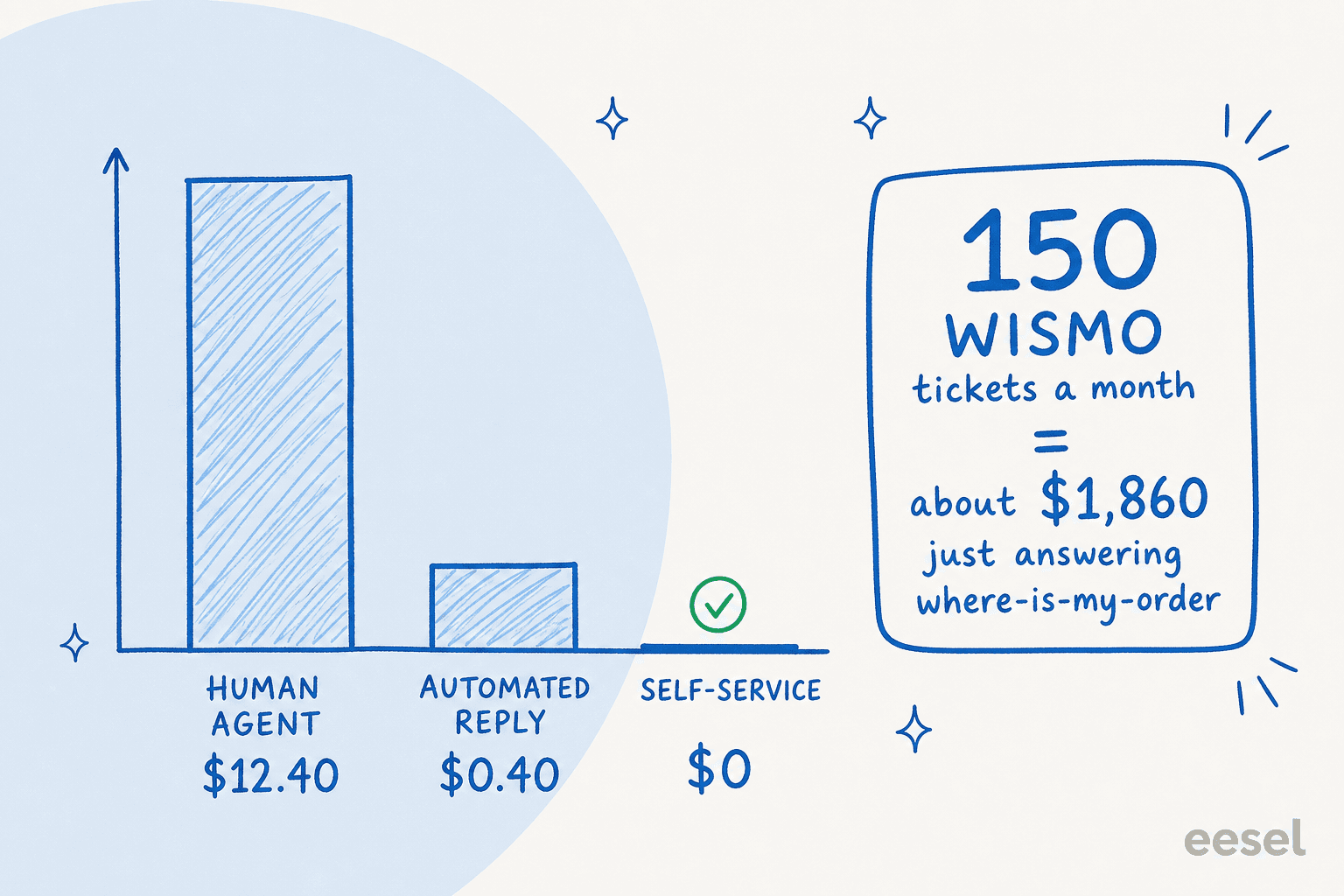
Gorgias's own math puts a human-answered WISMO ticket at $12.18 to $12.40, versus $0.18 to $0.40 for an automated reply, versus $0 for true self-service. On their worked example, a store with 1,000 orders a month generating 150 WISMO tickets spends roughly $1,860 a month just confirming where packages are. That's a support budget being burned on a question the OMS already knows the answer to.
I've seen this from the customer side of the sales call, too. One ops lead at a DTC supplements brand doing around 7,000 Gorgias tickets a month came to us because the team simply couldn't keep up, and they wanted to auto-resolve at least half of their email volume, specifically WISMO, subscription management, and basic product questions. The kicker: their knowledge was scattered across SOP tools and untranscribed Loom videos. The order data existed. The problem was nothing was reading it and replying for them.
"You will not regret using Gorgias... its worth the cost. I cut my CS team in half and around 35% of tickets are automated now."
u/sandwich_shaman, r/shopify

Hold that 35% number. It's what happens when order data and automation finally meet. We'll come back to how.
The main types of order management systems
"OMS" is a loose label. The tools sold under it fall into a few genuinely different shapes, and picking the wrong shape is the most common expensive mistake I see.
- Platform-native. Your ecommerce platform's built-in order tools. Shopify is the obvious case: every plan handles orders, and it imports marketplace orders too. Best when one platform is your center of gravity.
- Inventory-first OMS. Tools like Cin7 Core, Zoho Inventory, and Linnworks that lead with multichannel stock control and treat orders as the thing that draws stock down. Best for multichannel sellers fighting oversell.
- ERP suites. NetSuite and Brightpearl bundle order management inside a full finance-and-operations platform. Best for larger merchants who want orders, accounting, and sometimes manufacturing in one system of record.
- Shipping and fulfillment-led. ShipStation starts from the label and works backward, pulling orders in so you can batch, rate-shop, and ship. Best when fulfillment volume, not inventory complexity, is the pain.
- 3PL and warehouse-led. Extensiv sits order management inside a broader third-party-logistics platform. Best for 3PLs and merchants outsourcing fulfillment.
A verified G2 reviewer summed up the category's whole job neatly: order management software "solves the problem of disconnected fulfillment and service systems" by centralizing the lifecycle. That's the promise. What differs is how much other machinery you have to buy to get it.
Comparing the leading ecommerce order management systems
Here's how the main options stack up on the dimensions a buyer actually weighs. Prices are 2026 entry rates; several vendors are quote-only, which I've marked plainly because "contact sales" is itself a buying signal.
| System | Best for | Pricing model | Entry price (2026) | Volume basis | Multichannel | Returns / RMA |
|---|---|---|---|---|---|---|
| Shopify | Stores centered on Shopify | Flat monthly + fees | $29/mo (Basic) | Products, not orders | Marketplace import included | Basic, native |
| Zoho Inventory | Small multichannel sellers | Flat monthly, tiered | Free, then $29/mo | Monthly orders (50–15,000) | Amazon, eBay, Etsy, Shopify | Add-on |
| Cin7 Core | Growing SMB / light manufacturing | Flat monthly, tiered | $349/mo | Annual sale orders (6k–120k) | Shopify, Amazon, eBay, more | Pro tier and up |
| ShipStation | Fulfillment-heavy shippers | Monthly, scales by volume | $14.99/mo | Monthly shipments | 400+ store/marketplace links | Standard tier and up |
| Linnworks | Multichannel scale-ups | Quote-only, order-tiered | Not published | Monthly orders + add-ons | 100+ marketplaces | Via add-ons |
| NetSuite | Mid-market / enterprise ERP | Quote-only, per user + modules | ~$100k+/yr reported | Users + modules | Omnichannel, built-in | Full returns module |
| Brightpearl | $1M+ retail operators | Quote-only, unlimited users | Not published | Revenue / order-linked | Plug-and-play app library | Via automation engine |
| Extensiv | 3PLs and outsourced fulfillment | Quote-only | Not published | Connections / volume | Integration Manager | Within WMS suite |
A few things worth calling out from the table.
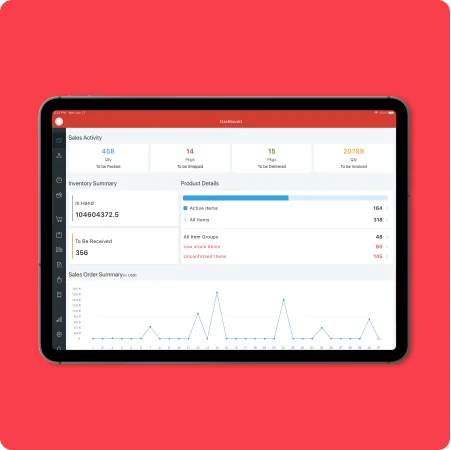
The cheap end is genuinely cheap. ShipStation opens at $14.99/month and Zoho Inventory has a real free tier (50 orders, one user). Here's the Zoho dashboard, which gives a sense of how order-status-first these tools are, leading with counts of what's to be packed, shipped, delivered, and invoiced:
Zoho's paid ladder runs $29 (Standard, 500 orders), $79 (Premium, 3,000), $129 (Plus, 7,500), and $249 (Enterprise, 15,000 orders a month), all billed annually. The billable unit is monthly orders, so your cost tracks your growth, which is either fair or annoying depending on your margins.
The enterprise end hides its price for a reason. NetSuite publishes nothing. Real users on r/Netsuite report roughly $120/user per month on top of a base license, with one commenter flatly warning that you'll need a budget of at least $100k a year to get started. Implementation for a mid-size company lands around $120k to $250k in services alone, per consultants in that thread. Brightpearl is similar: no public rate card, unlimited users included, and G2 notes it's aimed at merchants trading $1M or above.
Cin7 Core is the clearest mid-tier ladder. $349 Standard, $599 Pro, $999 Advanced, scaling annual sale-order volume from 6,000 to 120,000 and users from 5 to 15. Returns (RMA) only appear from the Pro tier up, which is the kind of detail that bites you three months in if you don't check it.
Our take: for most stores under $1M, the honest answer is that you don't need a heavyweight OMS yet. Native Shopify plus an inventory app, or Zoho Inventory if you're truly multichannel, covers it. Save NetSuite and Brightpearl for when accounting and operations genuinely need to live in one system. Buying an ERP to fix a WISMO problem is like buying a truck to move a mattress once.
Where the order management system ends and support begins
This is the part I came here to make. Every system above is very good at holding order data. Almost none of them are good at answering the customer with it. That's a different job, and it's where support teams get stuck.
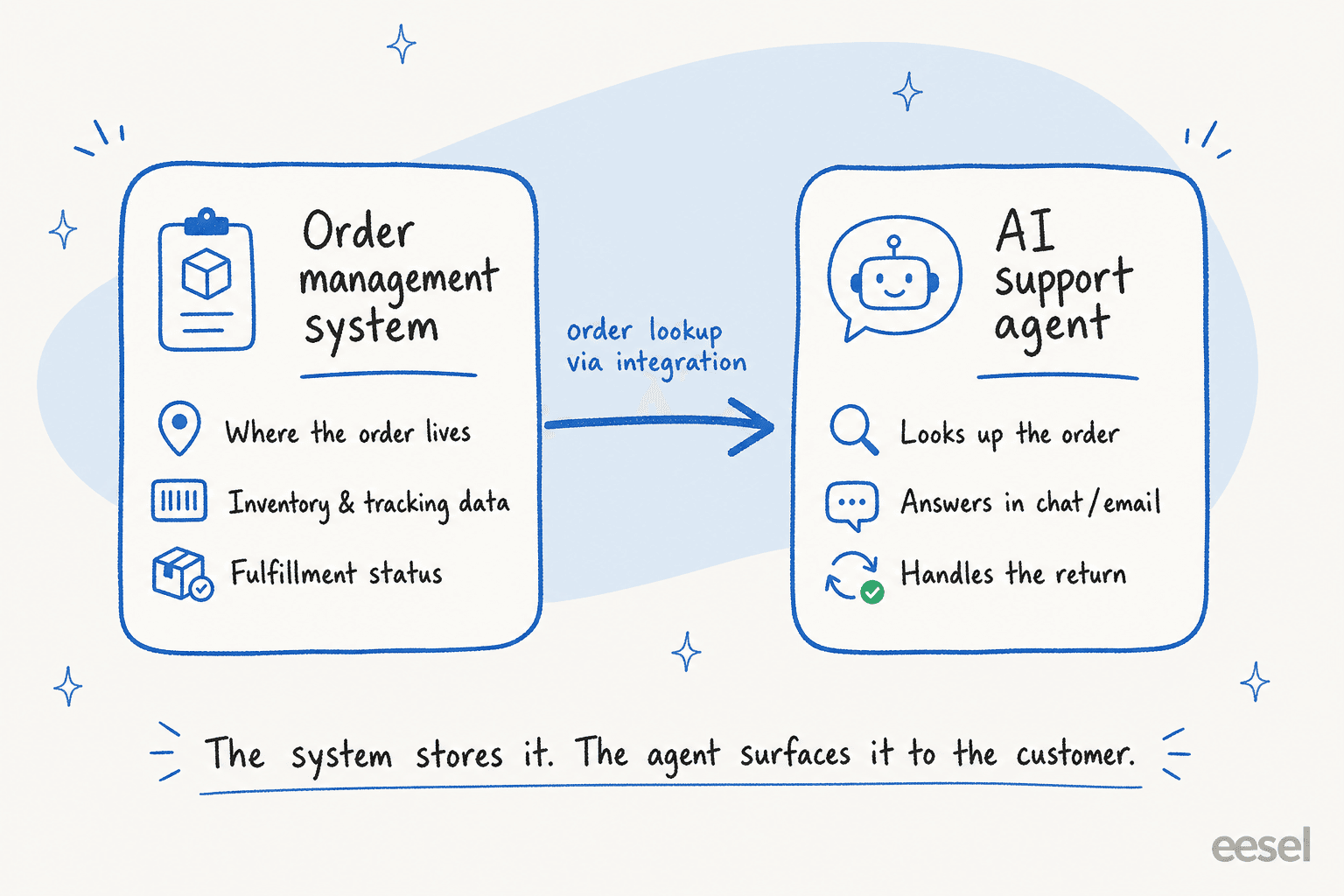
The OMS is the system of record. But the customer isn't in your OMS, they're in your chat widget, your email, your WhatsApp thread. So someone has to look up the order and paste the answer back into that channel. For years that "someone" was a human, which is exactly why WISMO costs $12 a ticket.
The fix is an AI agent that reads the order data and replies in the customer's channel itself. A real merchant on r/shopify described the before state vividly: tracking orders on "physical paper pulled from a filing cabinet" because their fulfillment system never digitized, and noting the "heavy disconnect between the customer service people and the fulfillment people." The disconnect is the problem. A single data pipe from the order record to the reply is the fix.
This is where eesel lives. It connects to Shopify and your helpdesk, looks up the order by number or email, and drafts or sends the reply automatically, in the customer's language, across WhatsApp, chat, and email.
The reason I trust this pattern isn't a demo, it's that we've watched confident-sounding bots quietly give wrong answers, which is why every eesel rollout is simulated against your past tickets first. You see the exact coverage and the exact replies on real historical WISMO tickets before a single customer touches it. That's the difference between "35% of tickets automated" being a real number and being a hope.
Try eesel for ecommerce order questions
You've probably got your order management system picked, or you're close. eesel is the layer that turns that order data into automatic answers. It plugs into Shopify and your existing helpdesk (Gorgias, Zendesk, Freshdesk, Front), learns from your past tickets and help docs on day one, and starts drafting order-status, refund, and product replies you can approve or let it send on its own.

What makes it worth trying: you can simulate it on your real ticket history before going live, so you know your WISMO deflection number in advance instead of guessing. Pricing is usage-based at $0.40 a ticket, no per-seat fees, and you only pay for tickets it actually handles. On that 150-WISMO-a-month store, that's $60 against a $1,860 human bill. Try eesel free, or connect it to your store and watch it clear the order-status queue you've been drowning in.
Frequently Asked Questions
What is ecommerce order management?
How much does an ecommerce order management system cost?
What is the difference between an OMS and an ERP?
Can AI answer 'where is my order' questions automatically?
Which order management system is best for a small ecommerce store?



Article by
Riellvriany Indriawan
Riell is a designer and writer at eesel AI with about two years of experience researching CX platforms, AI chatbots, and helpdesk software. She combines her design background with a sharp eye for how these tools actually look and feel in practice — making her comparisons unusually visual and user-focused.