
What "AI phone support" actually means for a store
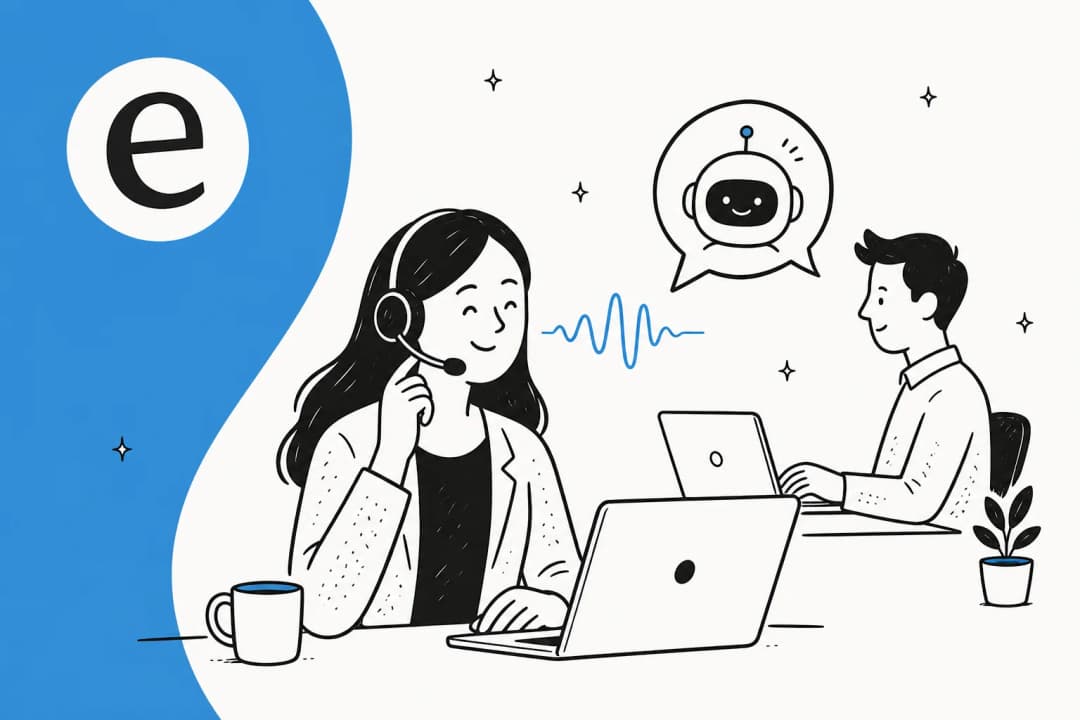
When a merchant says they want AI on the phones, they usually picture a robot answering calls. That's only half of it, and not the half I'd start with.
There are two jobs hiding inside the phrase. One is deflection: catching the question on a channel that's faster and cheaper than a call. The other is voice automation: an AI agent that literally answers the phone. They overlap, but they're priced differently, they carry different risk, and they're worth deploying in a specific order.
The useful way to think about it is to sort every inbound call into one of three lanes.
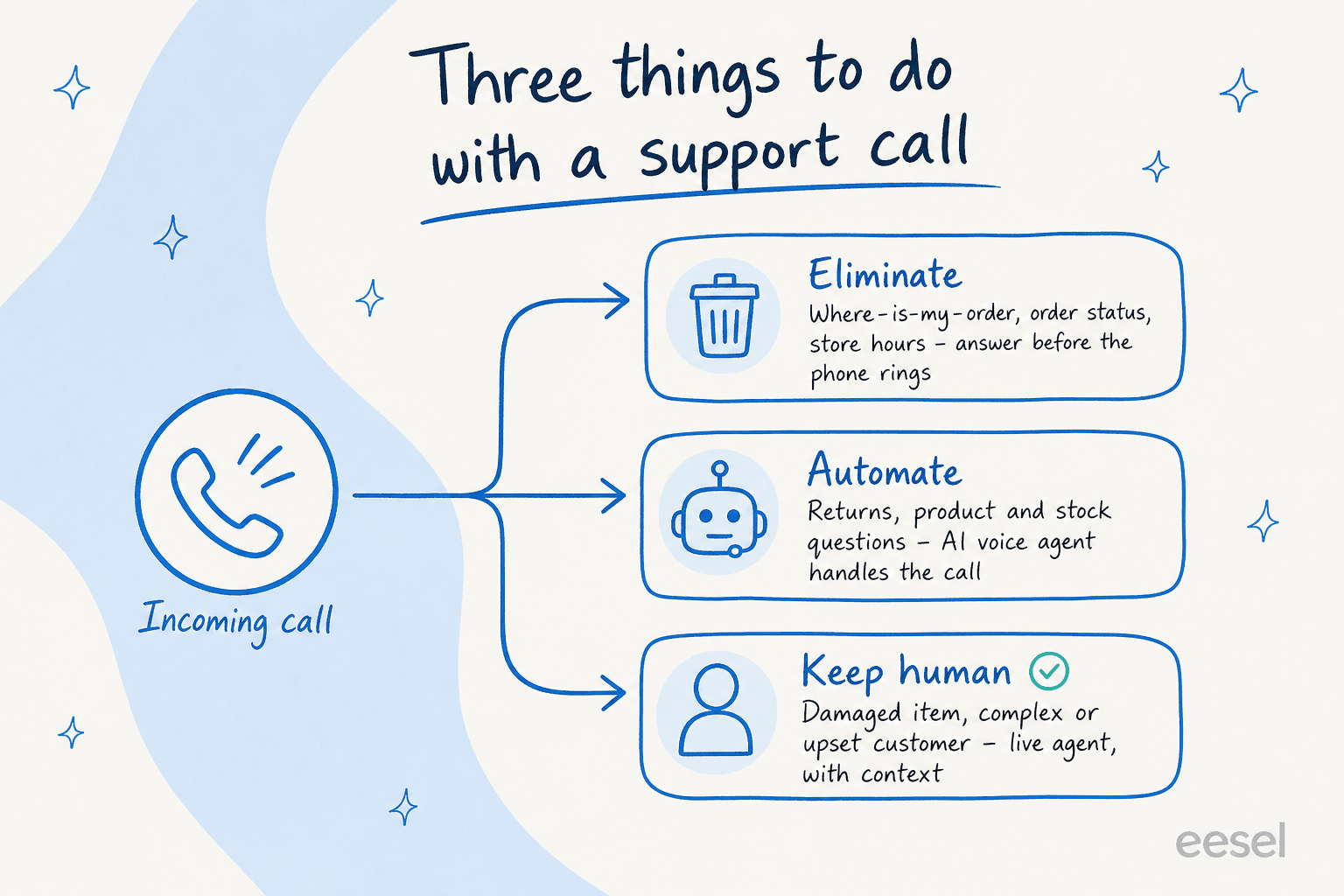
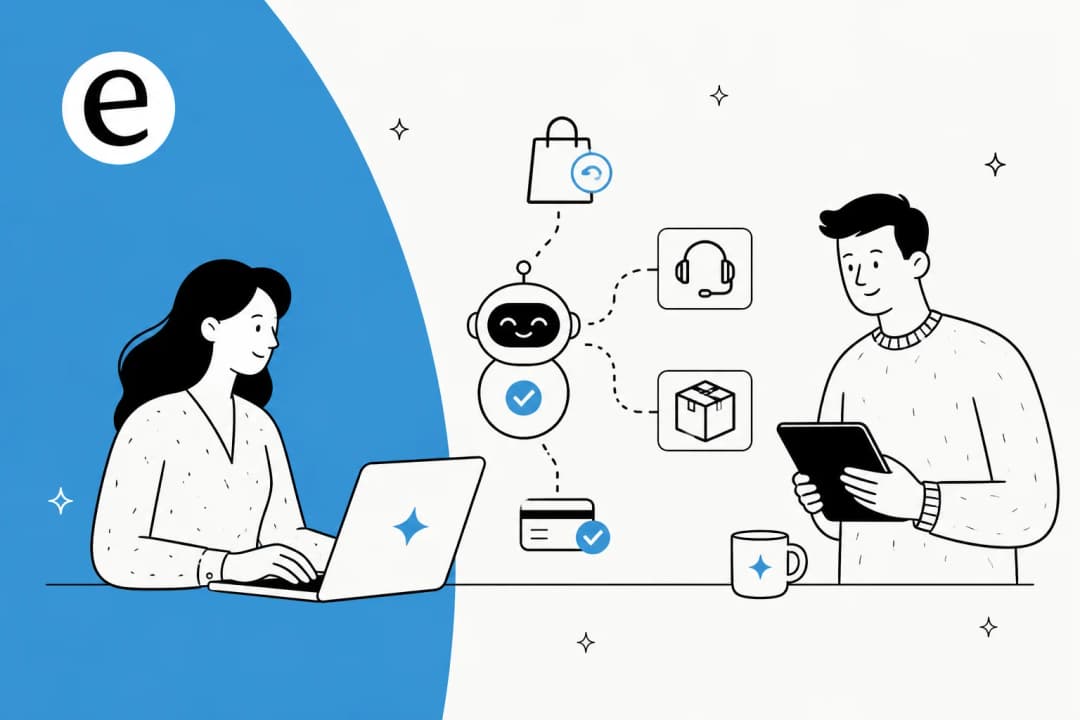
Some calls you want to eliminate (the customer would happily self-serve "where's my order" if the answer were instant). Some you can automate (returns and stock questions an AI voice agent can resolve). And some you want to keep human (a damaged item, an upset customer, a one-off request). Most of the noise lives in the first two lanes, which is good news, because that's where AI is strongest.
Why ecommerce phone calls are different
Support calls for an online store are weirdly repetitive. The same questions come back over and over: where is my order, can I return this, is this in stock, when do you open, did my discount apply. They're lookup questions, and lookups are the easiest thing in the world to automate, as long as the AI can actually see your order data. It's the same set a good AI customer service chatbot already fields on chat every day.
I've watched this play out on real traffic. In one trial on a German jewelry store's live Zendesk queue, our AI hit 93% triage accuracy and drafted useful answers on 100% of product-inquiry tickets and 100% of refund-status tickets, with returns and refunds close behind. None of those needed a clever model. They needed the order record and a clear policy.
The catch is that a lot of stores don't staff the phone at all, which tells you how painful it is to run. Ask Shopify merchants how they handle calls and you get answers like this:
"We don't, email and live chat only. No phones, no fax, no smoke signal."
That's a real reply on r/shopify, and another merchant on the same thread said they record a voicemail pushing callers to email or live chat like Shopify Inbox, while "looking into implementing AI phone support" but held up by legal uncertainty. The phone is expensive to staff and easy to drop, which is precisely the gap AI is filling.
It gets worse at peak. A store doing 1,000 tickets a month can hit 4,000 during Black Friday week, and a queue that was merely busy becomes a fire. That seasonal spike is the strongest argument for automation, and also the reason to watch how a tool prices it (more on that below). If you want the broader picture, we covered the AI customer service workflow and the tooling in our guide to AI support software for ecommerce.
How an AI voice agent actually handles a call
Modern voice agents are not the press-1-for-billing menus you're bracing for. They hold a real conversation. As one practitioner put it on r/SaaS:
"Voice AI Agents are now handling real phone conversations, not IVR menus. They can understand intent, speak naturally, answer FAQs, and integrate with CRMs... They don't replace humans, they handle repetitive calls so teams can focus on complex issues."
Under the hood, a good ecommerce voice agent runs the same loop on every call.
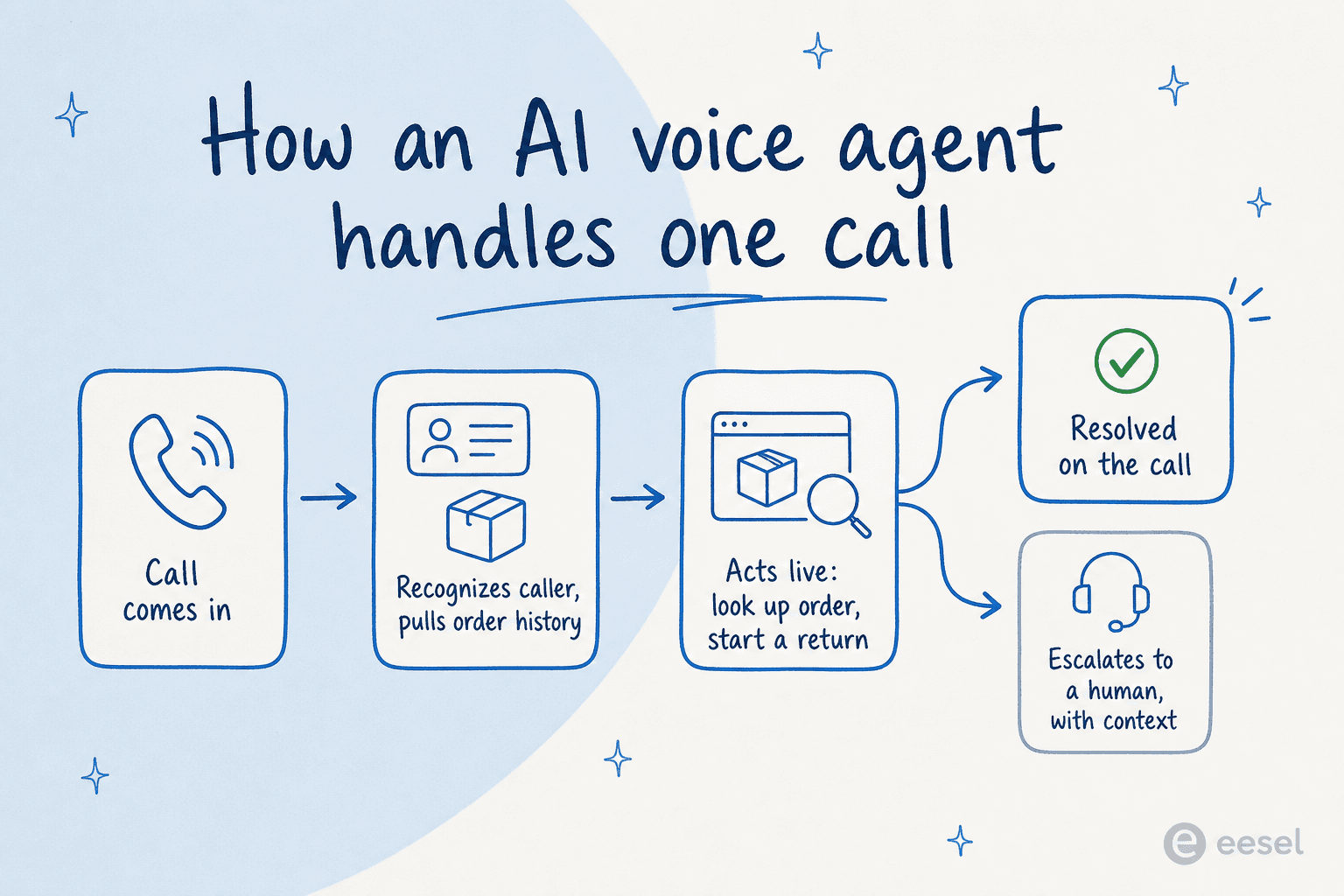
Ringly.io is a clean example of this built specifically for Shopify stores. Its agent (named "Seth") answers the call, identifies the caller, pulls their order history from Shopify, and can look up orders, check stock, request a return, or transfer to a human, all while the customer is still on the line.
On the numbers, Ringly commits to a 65% resolution guarantee within 90 days (refund otherwise), supports 40 languages, and its own case studies report results like 78% of calls resolved and 88% never passed to a human. Pricing is metered: the Grow plan is $349/month for about 1,000 minutes, Pro is $799/month for about 2,500, then overage by the minute.
That deflection rate isn't just vendor marketing. A DTC operator on r/Entrepreneur wrote up replacing a phone hire with a voice front door:
"After 3 months about 70% of calls never reach a human, they get resolved by the AI. The 30% that transfer are legit issues that need human help like damaged products or custom requests... Customers mostly don't realize they're talking to AI until they ask something really complex and it says it needs to transfer them."
Note the load-bearing detail: the 30% transfer to a person with context. That handoff is the whole game, and it's the difference between voice that helps and voice that infuriates.
If you want to see the category, we rounded up the leading AI voice agent platforms, and there are helpdesk-native options too if you're already on a platform, like Zendesk AI voice assistants, Zendesk voice AI agents, or even Magento AI voice if that's your stack.
What AI can (and can't) do on the phone
Here's the honest version, because overselling this is how you end up with angry customers.
What it's good at: the lookup lane. Order status, WISMO, returns and exchanges, stock checks, store hours, basic product questions, in dozens of languages, 24/7. Enterprise platforms back this with serious infrastructure. PolyAI runs its own dialog model with SOC 2, HIPAA, GDPR, and PCI DSS as standard, and cites a restaurant chain CMO crediting it with "just over $7M in incremental revenue." Developer-focused Retell AI prices voice from about $0.07 to $0.31 a minute and, tellingly, stops charging the agent fee the moment a call transfers to a human.
Where it breaks: anything that needs judgment, empathy, or a decision the policy doesn't cover. A genuinely damaged order, a furious customer, an edge case. And a quieter trap, plenty of people call because they want a human. Automating that call away doesn't help them, it just hides the door. The skeptics on r/customerexperience put the worry plainly:
"Automation saves time, but some customers get frustrated when there's no human judgment. Where's the sweet spot for bots versus humans in real support?"
The sweet spot is confidence. The AI should only handle what it's sure about and hand off everything else, cleanly. One CX lead at a high-volume DTC brand we spoke with framed the non-negotiable better than I could: the AI will never answer 100% of questions, so it has to be the kind that "is only handling the tickets that it's confident to handle, and all the other ones, leave them alone." If a tool can't promise that, it's not ready for your phone line. This is the same principle behind reliable first contact resolution on any channel.
The cheaper win most stores skip: eliminate the call
Here's the part I'd actually lead with if you're starting from scratch. Before you automate the call, ask whether the call needed to happen.
The biggest category of ecommerce phone volume is WISMO and order status, and those are questions a customer would gladly answer themselves if the answer were instant. A solid AI chatbot for ecommerce on your site, connected to live order data, resolves most of them before anyone reaches for the phone, and the same agent can cover a WhatsApp chatbot or act as a Shopify AI shopping assistant on the side. That's deflection, and it's cheaper, lower-risk, and faster to deploy than voice for one simple reason: text mistakes are recoverable, and a bad live phone call isn't.
This is the lane eesel AI is built for. It connects to your store (Shopify, WooCommerce, BigCommerce, Magento) and your helpdesk, learns from your past tickets and help docs, then resolves WISMO, returns, and product questions on the chat widget and inside the helpdesk, in 80+ languages. When it isn't confident, it hands the conversation to a person instead of guessing. The cost math is friendly to spikes too: at $0.40 per conversation with no per-seat fee, a Black Friday flood costs you per resolved conversation, not per minute on hold.
It's also where the pricing models diverge in a way worth flagging. Per-minute voice billing and per-resolution billing both climb when volume spikes (exactly when you can least control it), whereas a flat per-conversation rate keeps November's bill shaped like March's. If you're comparing options, our breakdowns of the best Shopify chatbot apps and a chatbot for orders are good starting points, and the practical setup of connecting Shopify order data is the same whether the answer ends up on chat or a call.
How to start: a setup that doesn't backfire
Whether you're adding chat deflection, a voice agent, or both, the prep work is the same. Get these four things right before you go live and the AI behaves; skip them and it embarrasses you in front of a customer.
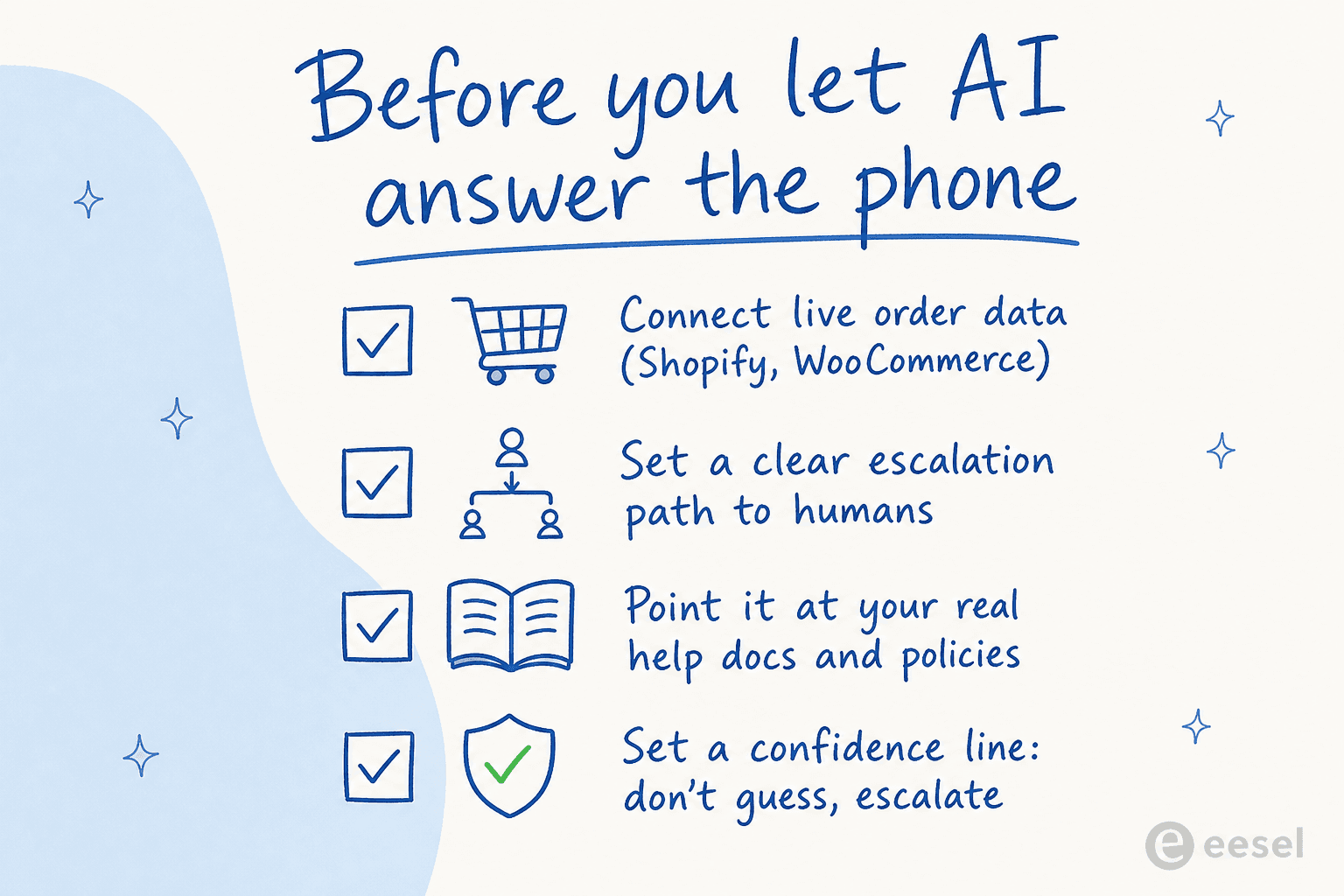
- Connect live order data. WISMO is unanswerable without it. Sync your store so the AI can look up an actual order, not recite a generic policy.
- Set a clear escalation path. Decide what transfers to a human, and make sure context travels with it. A handoff that dumps the customer back to square one is worse than no AI.
- Point it at your real docs and policies. It should answer from your help center and return policy, not from the open internet. Vague knowledge is where hallucinations come from.
- Set a confidence line. Tell it not to guess. "I'm not sure, let me get a person" beats a confident wrong answer every time.
The step I'd add for any serious rollout is to test before you ship. The reason I trust this lane is that you can run an AI agent against your own past tickets first and see, by category, what it would have answered and where it would have stumbled, then fix the gaps before a single customer hears it. That dry run is what separates a rollout from a gamble, and it's how we get a store from "interesting demo" to live without a scary week in between. There's more on the moving parts in our Shopify AI strategies guide and the wider view of companies using AI support.
Try eesel for ecommerce support
If your phone is mostly carrying WISMO, returns, and order-status calls, the fastest payback isn't a robot on the line, it's an AI agent for ecommerce that resolves those questions on chat and in your helpdesk before they ever become a call. eesel connects to your store through its Shopify integration, learns from your past tickets and help docs, and answers WISMO, returns, and product questions in 80+ languages, handing off to a human the moment it isn't sure.

The differentiator is that you can simulate the whole thing on your historical tickets before going live, so you know your resolution rate up front instead of finding out in production. eesel doesn't answer the phone itself, so if you need the voice line too, run it alongside one of the AI voice agent platforms above. You can try eesel free, or browse our pick of the best customer service AI to see where it fits.
Frequently Asked Questions
What is AI phone support for ecommerce?
How much does AI phone support for ecommerce cost?
Can an AI voice agent really resolve ecommerce calls without a human?
What questions should AI phone support handle for an online store?
Is AI phone support better than an AI chatbot for ecommerce?



Article by
Riellvriany Indriawan
Riell is a designer and writer at eesel AI with about two years of experience researching CX platforms, AI chatbots, and helpdesk software. She combines her design background with a sharp eye for how these tools actually look and feel in practice — making her comparisons unusually visual and user-focused.