Why multilingual is a different problem for ecommerce
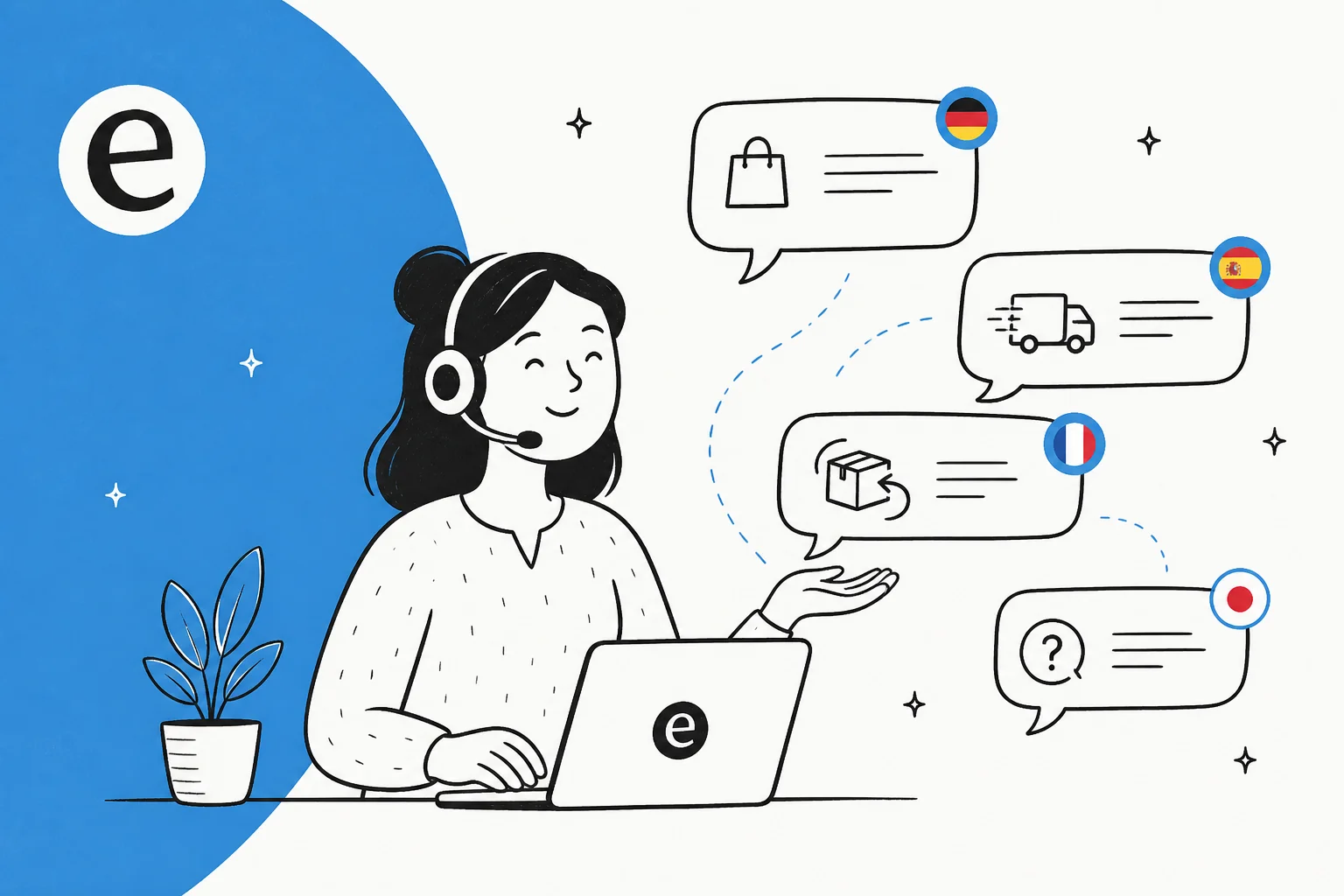
Plenty of SaaS tools can get away with English-only support. An ecommerce store usually can't, because the moment you ship internationally your inbox does too. A where is my order message arrives in Spanish, a returns question in French, a sizing question in German, and they all want an answer now, not after a translation round-trip. For most stores these break down into the same handful of repetitive ticket types, just multiplied across languages.
And the stakes are higher than they look. CSA Research found that 76% of online shoppers prefer to buy products with information in their native language, and 40% will never buy from sites in other languages, from a survey of 8,709 consumers across 29 countries. The figure that matters most for a support team is the one on the same page: 75% say they're more likely to buy from the same brand again if customer care is in their language. Support in the buyer's language isn't a nicety, it's repeat revenue.
The old way of meeting that demand is to staff a native speaker per language, which gets expensive fast and is exactly why teams weigh AI against an offshore support team. One ecommerce operator put the pain plainly in a G2 review: "Supporting customers in different languages is hard and expensive." Another said the win was that it "reduced the stress of hiring customer support executives who know multiple languages." That tension, real multilingual coverage without a multilingual payroll, is the whole reason AI shows up in this conversation.
The three ways to do it, and why two of them disappoint
When a store decides to handle more languages, there are really three options on the table. They are not equal.
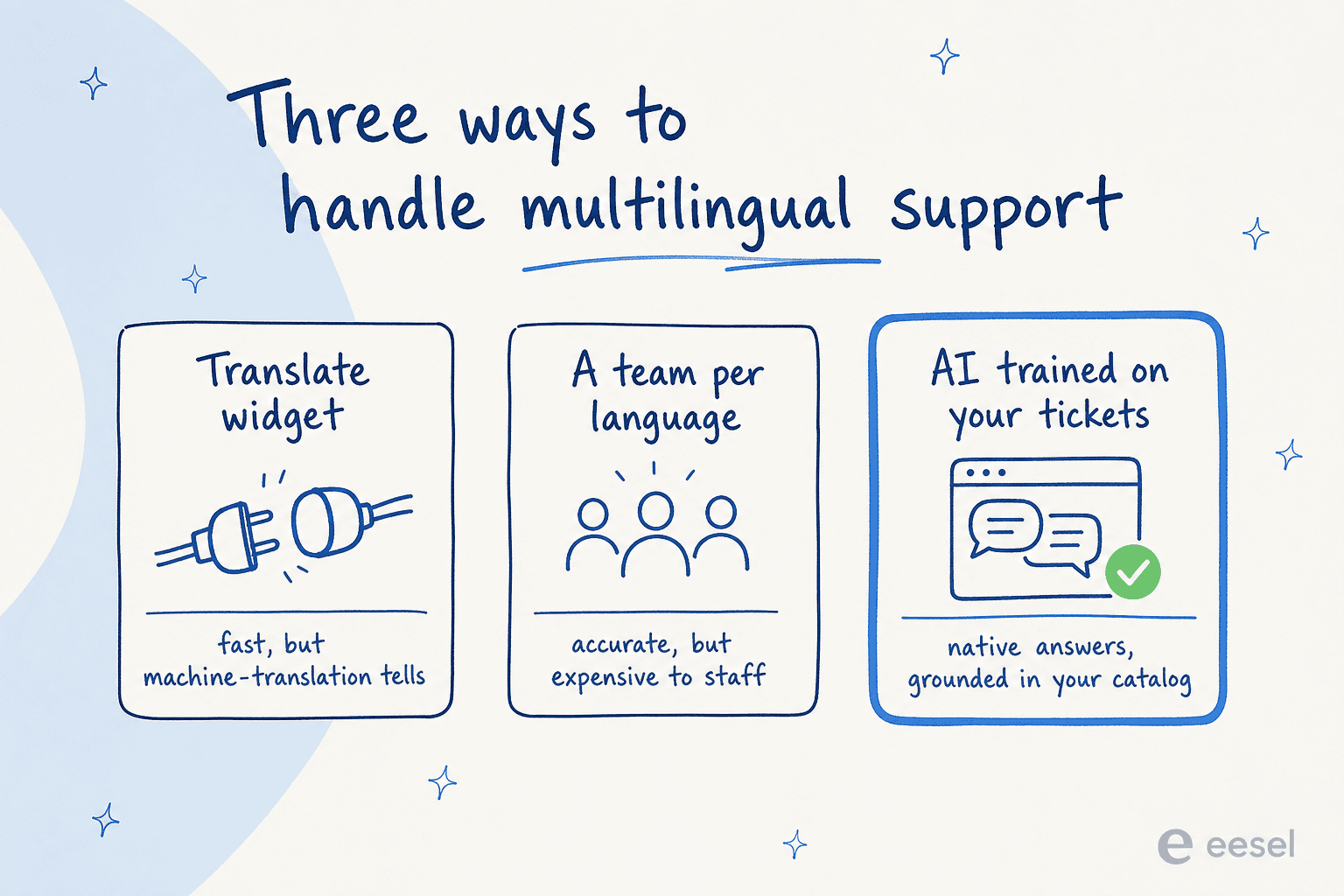
The translate widget is the cheapest and the most tempting. You write the reply in English, a translation layer converts it on the way out. It's fast, but it produces the stilted, slightly-off phrasing that any native speaker spots in a second, and it has no idea what your return policy actually says. It translates words, not meaning.
The team per language is the gold standard for quality and the worst for cost. Every new market is a new hire, or several, and overnight coverage means hiring across time zones too. It scales linearly with your ambitions, which is to say it doesn't really scale.
The third option is an AI agent trained on your own tickets. Instead of translating English, it learns from your own resolved conversations, including the ones already handled in German or Spanish, and answers natively from that. It reads the actual question, pulls the actual answer from your knowledge base, and writes in the customer's language as a first-class reply rather than a translation. That's the only one of the three that gives you native-quality answers without native-speaker headcount.
How an AI agent actually answers a multilingual ticket
It helps to see what happens between the customer hitting send and the reply landing, because "the AI just knows the language" hides the part that makes it trustworthy.
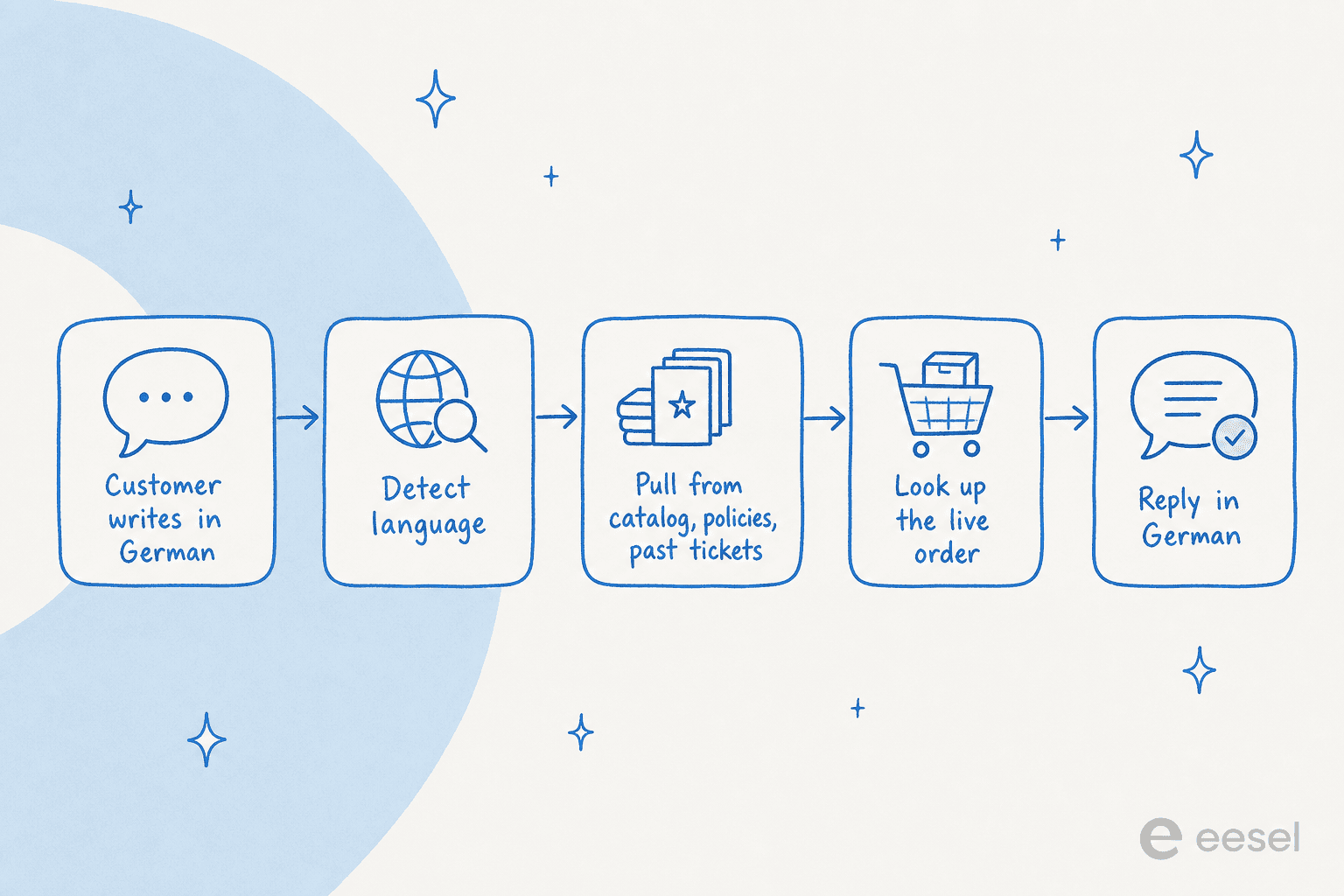
A message comes in, say "Wo ist meine Bestellung?" The agent detects the language, then does the part that separates a real answer from a guess: it retrieves from your grounded content, your help center, your shipping policy, your past tickets, rather than improvising. For an order question it goes a step further and looks up the live order through your Shopify or Gorgias connection, so the reply carries the real tracking status, not a canned "let me check." Then it writes back in German.
That grounding step is the difference between a helpful answer and a hallucination. The model isn't being asked to know your shipping cutoffs from thin air, it's being asked to find them in your content and phrase them in the right language. The same flow runs on whatever channel the buyer is using. eesel deploys the agent on WhatsApp, live chat, and your existing helpdesk inbox, so a Dutch message on WhatsApp and a French ticket in Zendesk hit the same brain.

What this looks like in production
This is where I'll lean on what I actually see across live ecommerce queues, because multilingual is one of those features that demos fine and then surprises people with how far it goes once it's real. It shows up in your support metrics more than anywhere else.
The clearest example: a German jewelry brand running roughly 1,000 tickets a month on Zendesk and Shopify. Its agent handled German, English, French, Dutch, Spanish, Polish, Croatian, and Turkish without being prompted to do any of them. Nobody configured eight languages. The agent just answered in whatever the customer wrote, because it was trained on a ticket history that already contained those languages. Internally we've made a running joke of how under-sold this is, one of our founders keeps saying "a lot of people don't realise this works in all kinds of languages."
A few more, because the pattern holds across verticals and sizes:
- A Spanish insurance brokerage ran 564 real Spanish-language conversations through a custom agent on a free trial in 48 hours, insurance quotes and Messenger chats included.
- A Belgian delivery company tested it with a Dutch shipping-cost question, "Hoeveel kost het om te versturen naar Duitsland?", got a detailed, correctly-priced Dutch answer pulled from its tariff docs, and converted to paid.
- At the high end, Smava runs a fully automated agent processing more than 100,000 German-language tickets a month, one of the largest deployments we run.
None of those teams bought a "multilingual add-on." They connected their existing helpdesk, the agent learned from history, and the languages came along for the ride. If you want the broader category view, our roundups of the best AI for Shopify support and AI chat for ecommerce go deeper on the tooling.

Where multilingual AI breaks, and what to check before you trust it
Here's the honest part, the bit a feature page won't tell you. When multilingual support goes wrong, it almost never fails by producing a grammatically broken sentence. It fails in two specific, embarrassing ways, and both are checkable.
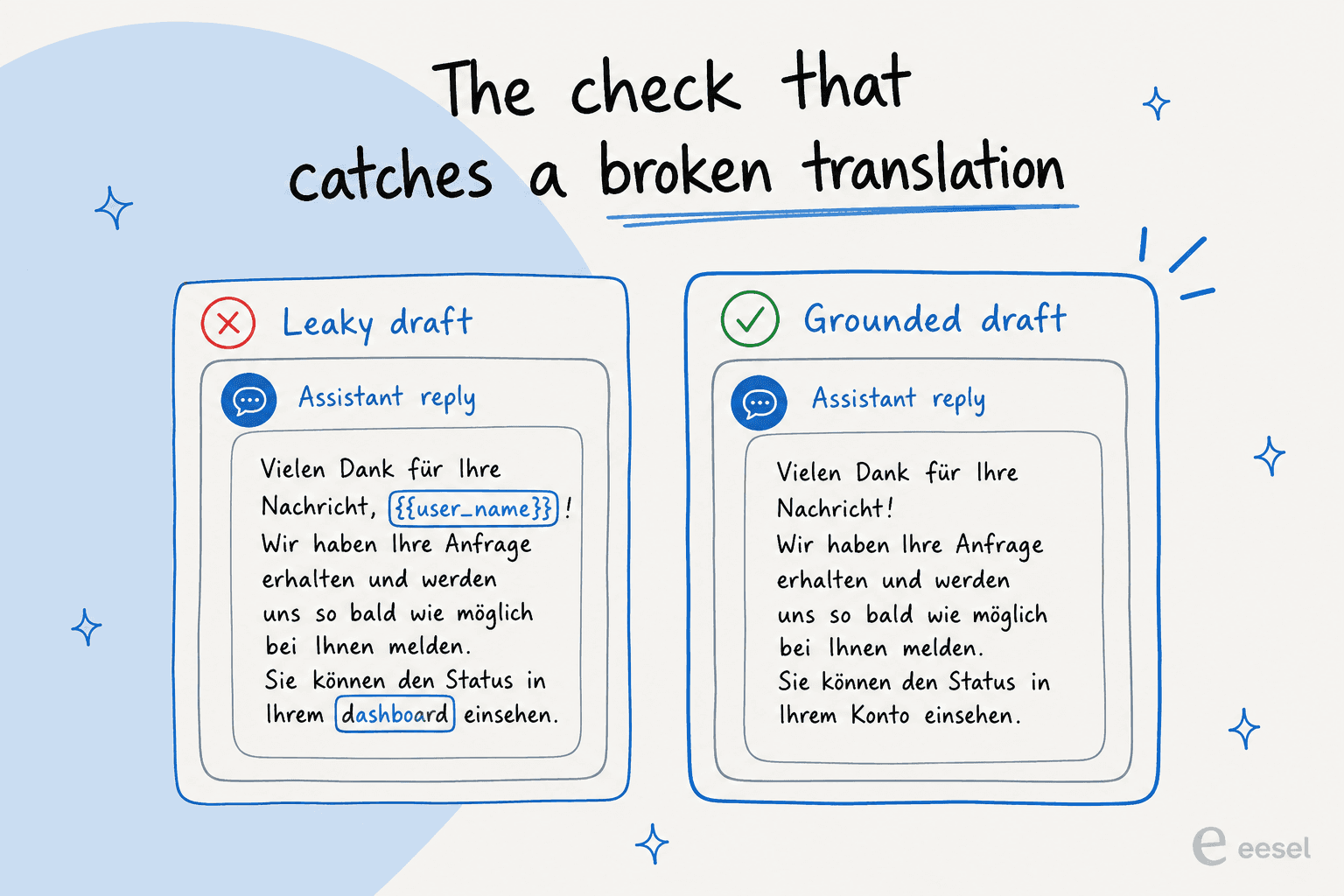
The first failure is the leaked placeholder. A reply goes out in fluent German with a raw {{ticket.requester.first_name}} or an [Employee Name] sitting unfilled in the middle of it. I've seen this exact thing land in customer-facing drafts for German- and Dutch-language stores across Belgium, Germany, and the Netherlands, and it's trust-destroying in a way a small grammar slip never is, because it screams "a robot wrote this and nobody read it."
The second is the stray interface word. Internal UI text, the kind of label that should never leave the building, leaks into a translated reply, so an otherwise-clean German message suddenly contains an English word that has no business being there. Same root cause: the localization was treated as an afterthought instead of part of the answer.
There's a related, cheaper trap that catches stores early: the English-only widget. The AI answers in German beautifully, but the chat bubble it lives in, the "suggested questions," the buttons, all render in English. One German-market team called exactly this a "show-stopper," and they were right to. Your customer doesn't separate "the AI's language" from "the widget's language," it's all just your brand to them.
The takeaway isn't "don't trust AI." It's that the thing to QA in a multilingual rollout is not the model's grammar, it's the plumbing around it: placeholders, interface strings, and the widget chrome. Run a handful of real tickets per language and read the whole reply, end to end, before you let anything go out unsupervised.
How to roll it out without burning customer trust
Knowing the failure modes, the rollout almost designs itself. The teams that do this well don't flip a switch, they earn their way to autonomy.
- Start in copilot mode. Let the AI draft replies for a human to review and send first. You get the speed of a draft in the right language with a human catching any leaked placeholder before a customer does.
- Simulate on your real past tickets, per language. Before going live, run the agent against your historical tickets and look at coverage by language and topic. eesel's simulation mode shows you exactly where the answers are solid and where the knowledge base has a German-shaped hole, so you fill it before launch rather than after a complaint.
- Turn on autonomy narrowly. Give the agent full control only on the languages and ticket types where it's demonstrably confident, and let confidence-based routing hold everything else back as a draft. The buyers who want native-language answers on the easy stuff get them instantly, and the genuinely tricky ones still reach a person.
- Keep escalation clean. When the agent isn't sure, it should hand off to a human with the full context attached, in the customer's language, not dump the customer back to square one.
That sequence is also how you keep the cost down: you only route to AI the volume you're confident about, and you grow that share as the simulations prove out. It's the same playbook whether you're on Gorgias, Freshdesk, or Zendesk.
Try eesel for multilingual ecommerce support
If your store is going multilingual and you'd rather not build a payroll around it, this is squarely what eesel is for. It works as an AI assistant for ecommerce that learns from your existing tickets and help docs, answers in 80+ languages without per-language setup, and pulls live order data from Shopify so a "where's my order" in any language comes back with the real tracking status. The differentiator that matters here: you can simulate the whole thing on your own past tickets, in every language you support, and see the coverage before you commit, so the leaked-placeholder horror story stays a hypothetical. It's $0.40 per resolved ticket with no per-seat fee, and free to try until you've used $50 of usage, no credit card.
Frequently Asked Questions
What is AI multilingual support for ecommerce?
How many languages can an AI support agent actually handle?
Is AI multilingual support cheaper than hiring native-speaking agents?
Will AI translation embarrass my brand in other languages?
Does AI multilingual support work on Shopify and WhatsApp?
How do I roll out multilingual AI without risking customer trust?



Article by
Riellvriany Indriawan
Riell is a designer and writer at eesel AI with about two years of experience researching CX platforms, AI chatbots, and helpdesk software. She combines her design background with a sharp eye for how these tools actually look and feel in practice — making her comparisons unusually visual and user-focused.