

What is SmartBot?
SmartBot (listed as "SmartBot: Leading AI Chatbot") is an AI shopping assistant and support chatbot built only for Shopify. The developer is BestChat, which also makes the older BestChat live chat app and an AI product quiz called PickWhy, per its Shopify partner page. SmartBot went live on the App Store on August 1, 2023, and the listing pitches it as an "AI sales and support agent for growth" that learns from your store's "products, pages, orders, and policies."
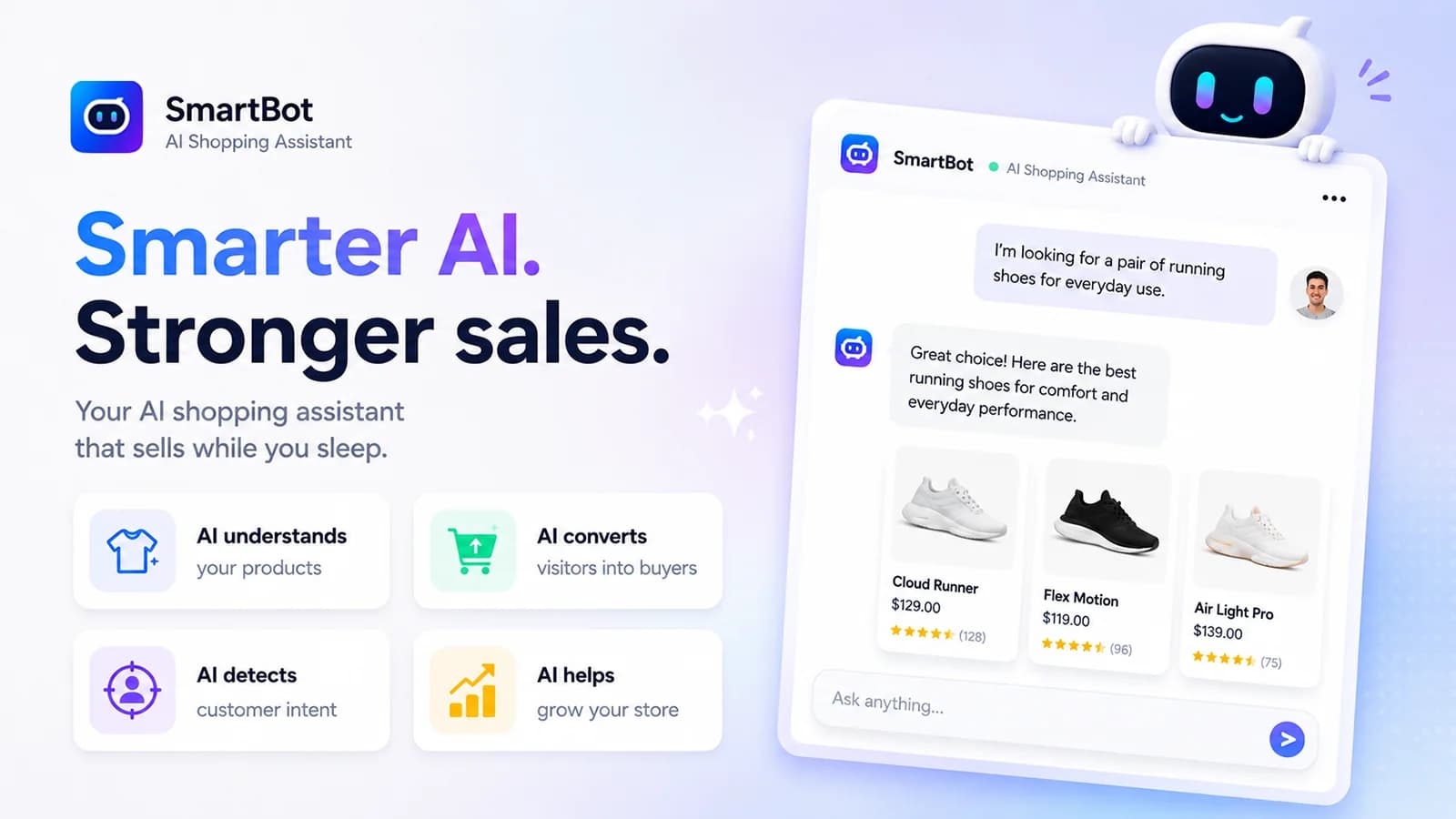
That framing matters. SmartBot is a storefront chat first, closer to a sales assistant than to a helpdesk. It sits in the same aisle as the apps in my Shopify chatbot roundup and as Shopify's own free Shopify Inbox, not next to a ticketing tool.
Its closest neighbors are other storefront chat apps I've reviewed in this series, like Chatty, Chatway and Tidio.
| SmartBot at a glance | |
|---|---|
| What it is | AI chatbot and shopping assistant for the Shopify storefront |
| Developer | BestChat, listed on the Shopify App Store since August 1, 2023 |
| Rating | 4.7 from 459 reviews: 367 five-star, 62 four, 18 three, 5 two, 7 one |
| Price | Free plan, then $30, $100, $300 and $680 a month |
| What sets the price | Number of products the bot learns, from 50 to unlimited |
| AI chats | Unlimited on every paid plan, 300 lifetime on Free |
| Handoff | WhatsApp, email, phone, or a Gorgias ticket |
| Works with | Shopify Flow, Checkout, Klaviyo, Gorgias, WhatsApp, ChatGPT, Gemini |
| Admin languages | 11, including English, French, German, Spanish, Japanese and Korean |
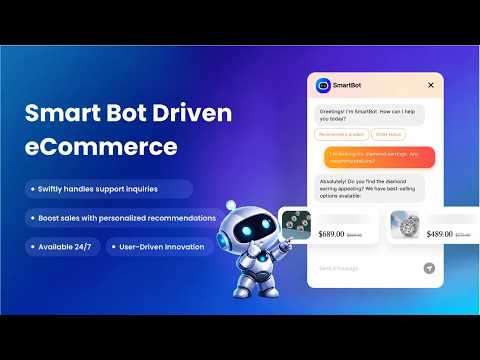
BestChat's product page also claims SmartBot can cut human support costs "at least by 70%," and its homepage says agents spend 87% less time. Neither figure comes with a method, so I would treat them as the vendor's best case, not a forecast. BestChat's own demo video shows the bot on a sample store:
How SmartBot works
Setup is the part reviewers praise most, and the reason is simple. You install from the App Store, approve the permissions, and SmartBot reads your store. There is no separate knowledge base to build before it can answer, which is a real difference from tools where you write Q&A pairs first, like the setup in my Zoko review. And the AI answers from the first message, unlike a classic live chat app where a person picks up.
What it learns from
The knowledge base screen splits store content into tabs: Products, Discounts, Policies, Pages, Blogs and Custom FAQs. Each product has a toggle, so you can switch individual items off, and a Sync now button pulls changes from Shopify.
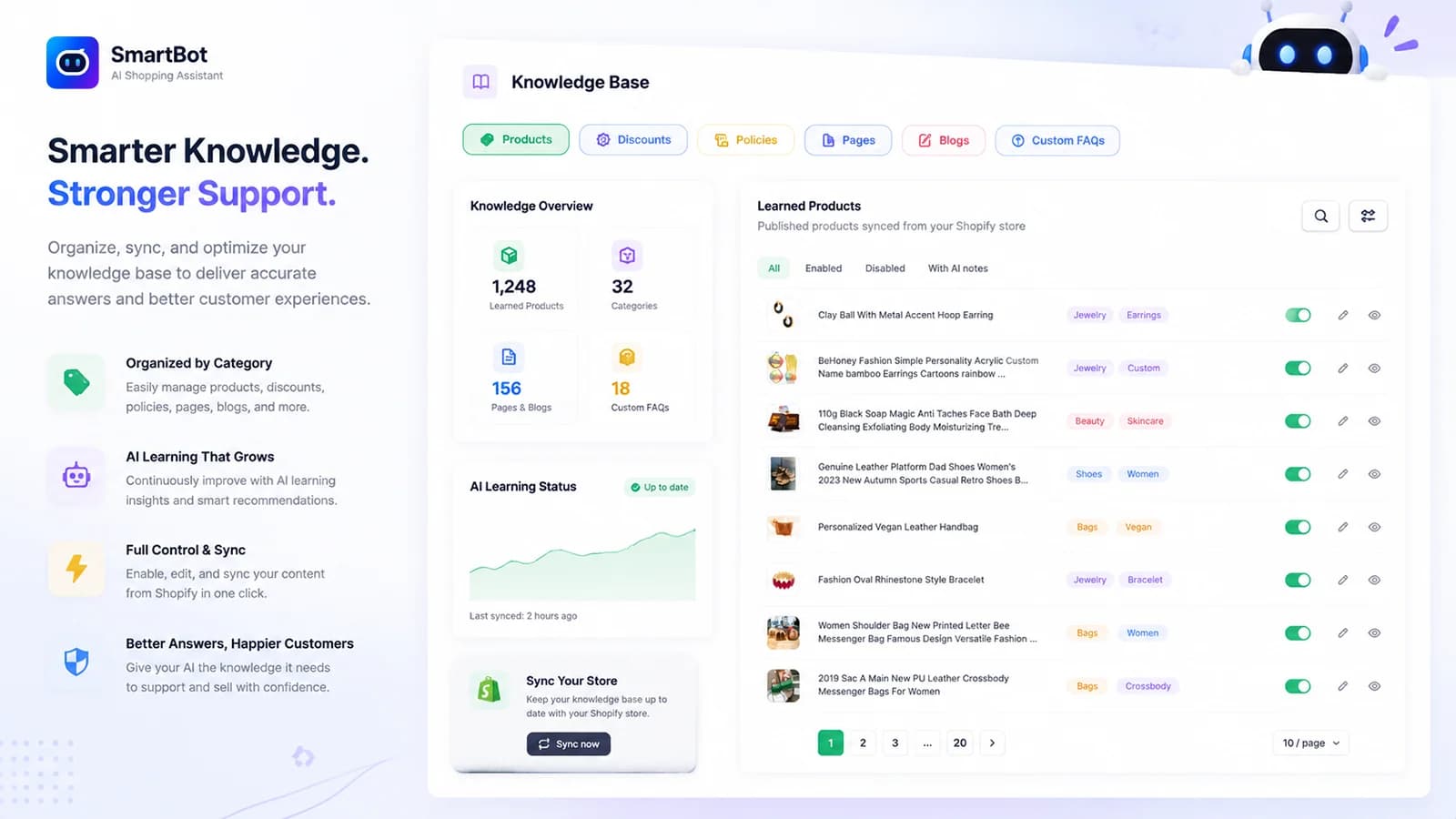
Which sources it reads depends on the plan. Per the pricing page, Starter learns FAQs and policies and lets you add a custom knowledge base, while learning from blogs and uploaded files starts at Growth. The source list is store content. Past support conversations are not one of the listed sources, which is fine for a new store and a gap for a store whose real answers live in two years of agent replies.
One reviewer with a technical catalog explained why the auto-learning still matters:
"Customers are actively using SmartBot to ask product and fitment-related questions before purchasing, which gives us another opportunity to capture buyers who may otherwise leave the site without contacting us."

Selling, not only answering
SmartBot leans hard into pre-sales. The bot recommends products in chat, and the Growth plan adds sales pop-ups ("Just now, someone bought this"), AI product highlight labels, best-selling and quick-pick carousels, and AI sales follow-up, a form of proactive support. That is the core job for the stores that love it, and it lines up with what I covered in AI for pre-purchase questions: most storefront chats are "will this fit, does this work with that" questions, not complaints.
The AI email reply on Growth is worth reading closely. The listing graphic shows it with an "Add to Chrome" button, so it is a browser extension that drafts replies inside your email tool, not an AI that works your inbox on its own.
Handoff to a person
When a shopper wants a human, SmartBot points them to the channels you switch on: WhatsApp, email or phone. On the connected-apps side, a Gorgias connection creates a Gorgias ticket when a customer asks for a person, Klaviyo receives the contact details the bot collects, and Shopify Flow can trigger automations. A Shopify Sidekick connection is listed in beta.
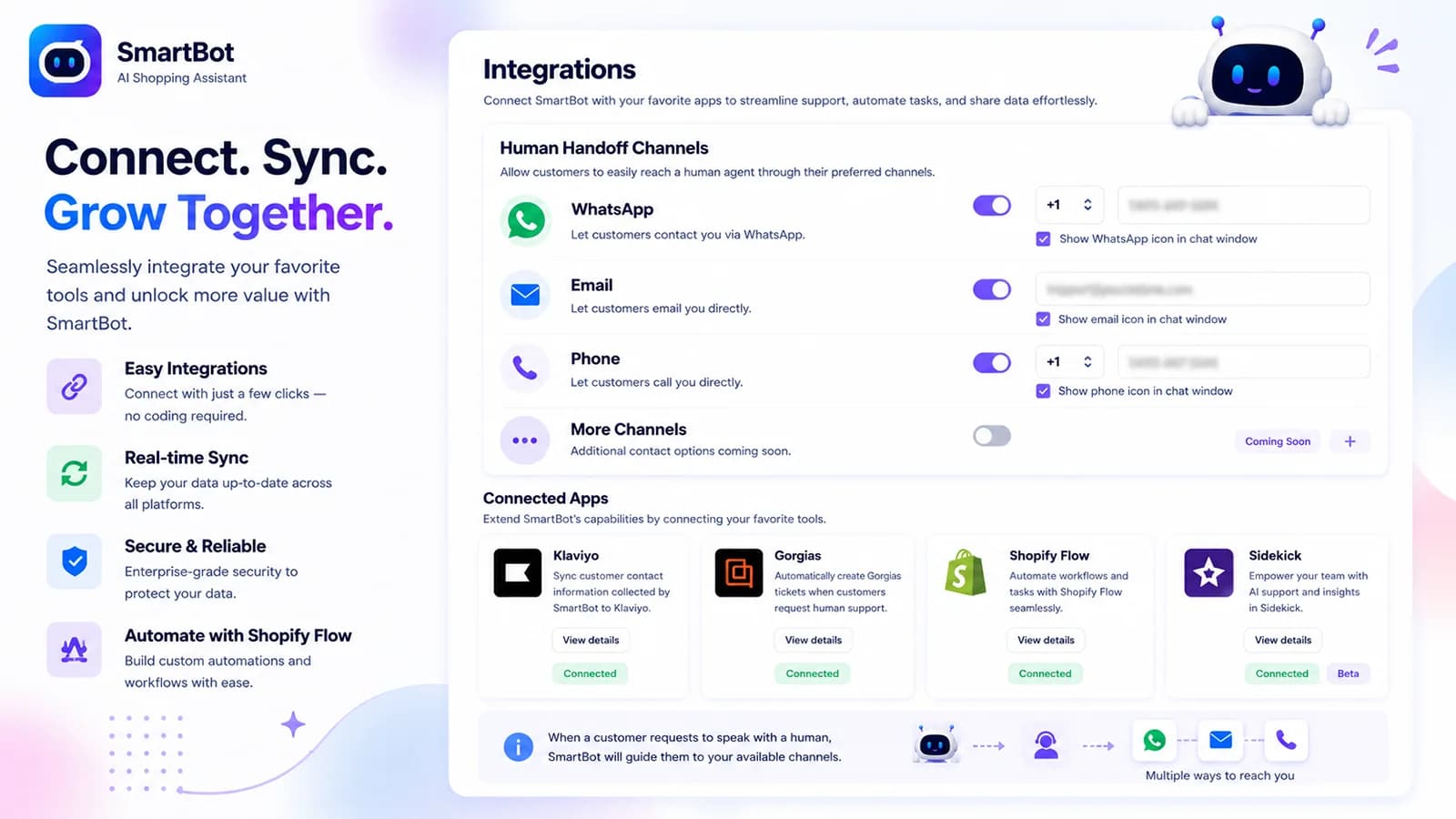
This is a sensible design for a small team. It does mean the conversation leaves SmartBot at the hard part: the refund, the damaged parcel, the angry customer lands in WhatsApp or in Gorgias for a person to pick up. If you run Gorgias, the handoff is clean. If you don't, you are routing people to a phone number or a WhatsApp chat, which my WhatsApp chatbot guide covers from the other side. Collecting an email before the handoff is worth setting up either way, as in my note on collecting contact details.
SmartBot pricing
SmartBot's price does not follow chat volume. Every paid plan includes unlimited AI chats, and the tiers step up by how many products the bot can learn, plus features. These are the vendor's prices from bestchat.com and the Shopify listing, in USD and billed every 30 days.
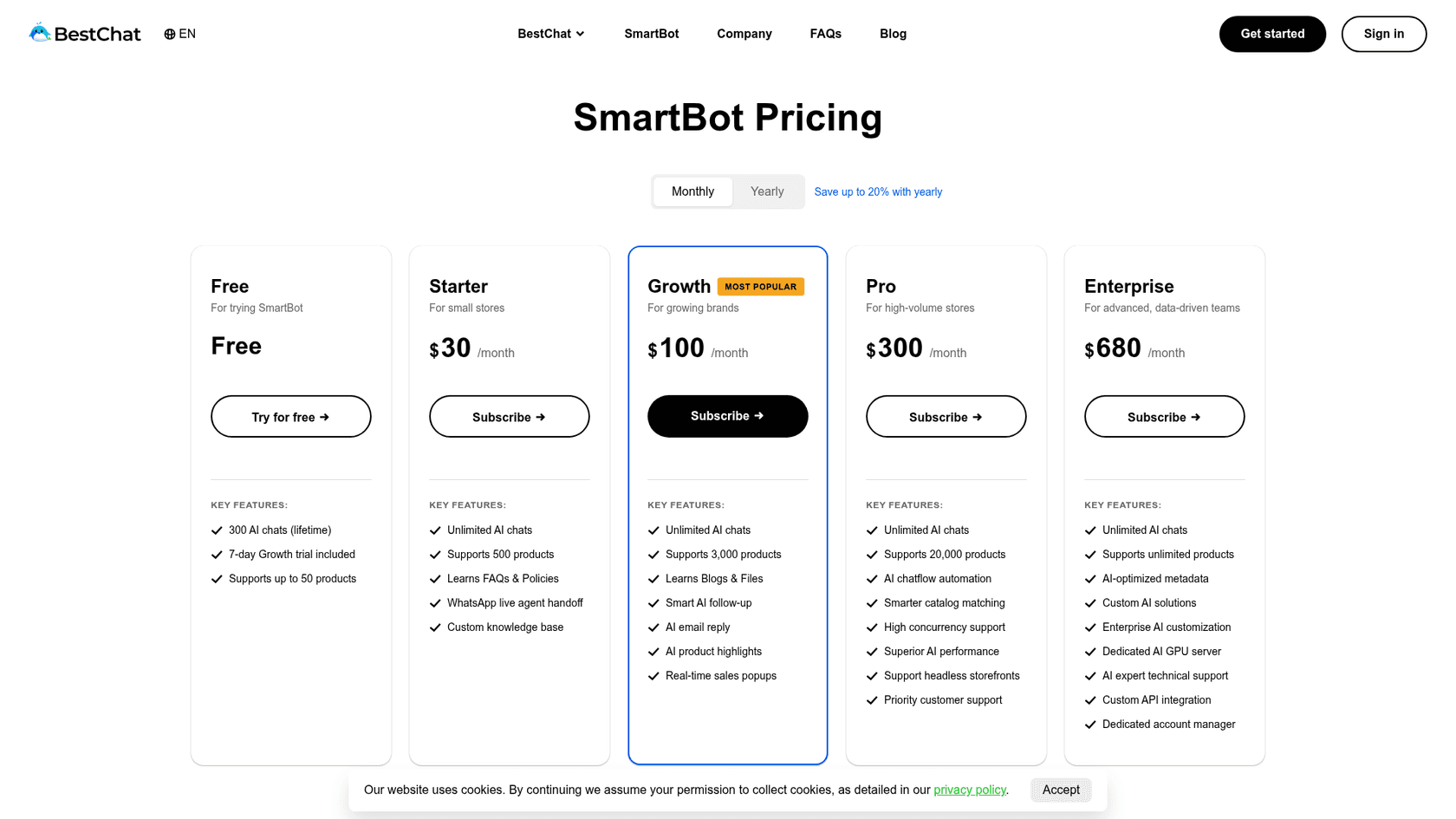
| Plan | Monthly | Paid yearly | Products | AI chats | What it adds |
|---|---|---|---|---|---|
| Free | $0 | $0 | 50 | 300, lifetime | 7-day Growth trial |
| Starter | $30 | $24/mo ($288/yr) | 500 | Unlimited | Learns FAQs and policies, WhatsApp handoff, custom knowledge base |
| Growth | $100 | $80/mo ($960/yr) | 3,000 | Unlimited | Learns blogs and files, AI sales follow-up, AI email reply, product highlights, sales pop-ups |
| Pro | $300 | $240/mo ($2,880/yr) | 20,000 | Unlimited | Chatflow automation, smarter catalog matching, high concurrency, headless storefronts, priority support |
| Enterprise | $680 | $544/mo | Unlimited | Unlimited | Dedicated AI GPU server, custom API integration, custom AI work, account manager |
Enterprise appears on BestChat's pricing page but not on the Shopify listing, which shows four plans. Headless storefront support sits on Pro, which matters if you run Hydrogen or another custom front end; my post on headless AI support covers why that setup needs extra care.
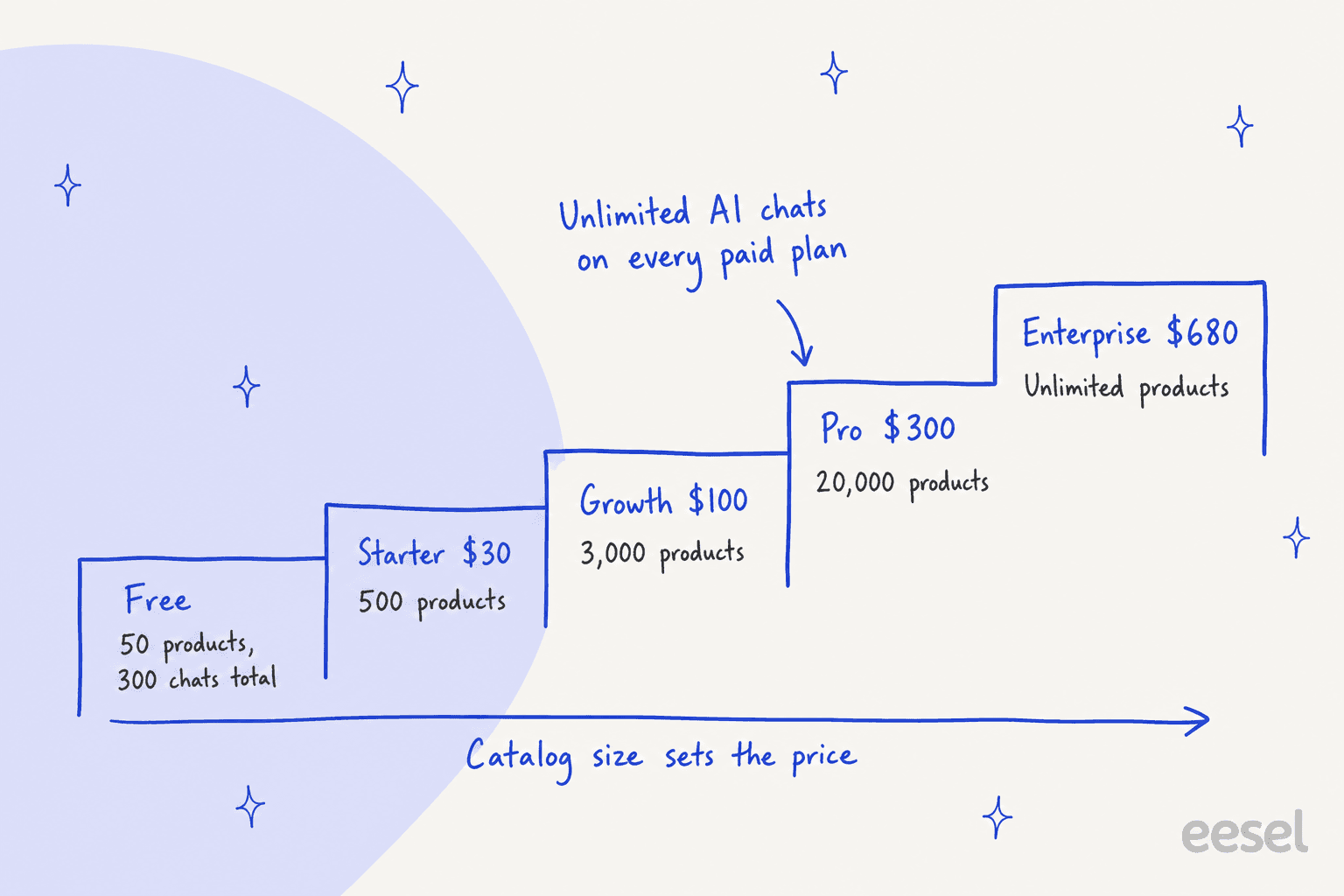
What this means in practice:
- A busy store with a small catalog wins. A 300-product store taking thousands of chats a month pays $30. Few chat tools are that cheap per conversation.
- A big catalog jumps tiers fast. A store with 600 products is past Starter and pays $100, whether it gets 50 chats or 5,000. A store with 3,500 products pays $300.
- Features and product count are bundled. Want blogs and files learned on a 200-product store? That is Growth at $100, even though Starter covers the catalog.
Compare that with per-resolution pricing, where every answered chat has a meter, like Gorgias AI Agent pricing. Flat pricing removes the "what counts as a resolution" question my deflection vs resolution rate explainer gets into. It also means there is no usage signal telling you whether the bot is earning its fee, so look at the analytics tab.
The free plan has changed shape
Read the Free plan as a trial. Today it is 300 AI chats for the life of the account, not per month. That has moved over time: a 2024 reviewer described a "100 monthly free limit," and Shopify's AI summary of the reviews still says merchants praise "the free plan with unlimited chats." One 2025 reviewer felt the label was misleading:
"Don't indicate it's free, it's actually a 7-day free trial after installation."
The current listing is clear about the 300-chat cap, so this is less of a trap now. Still, if you are judging SmartBot on older review praise for a free tier, budget for Starter.
What Shopify merchants say in their SmartBot reviews
The headline numbers are strong. Of 459 reviews, 367 are five-star and only 12 are one or two stars. The praise is consistent: quick setup, natural-sounding answers, clean design, and a responsive support team. One German store wrote that the support team gave "Super fast responses, incredibly friendly," and a store that has run SmartBot for about a year described a real sales chat going well:
"It explained promotions correctly, responded politely when the customer said the product was too expensive, and even asked follow-up questions to be more helpful."
When the reviews were written
Here is the part I did not expect. Each Shopify review shows how long the store had used the app when it wrote the review, so I counted. Of the 60 newest reviews (April 27 to October 18, 2026), 54 were written within the first 7 days and 22 within the first day. 31 of the 60 have no text at all, only stars.
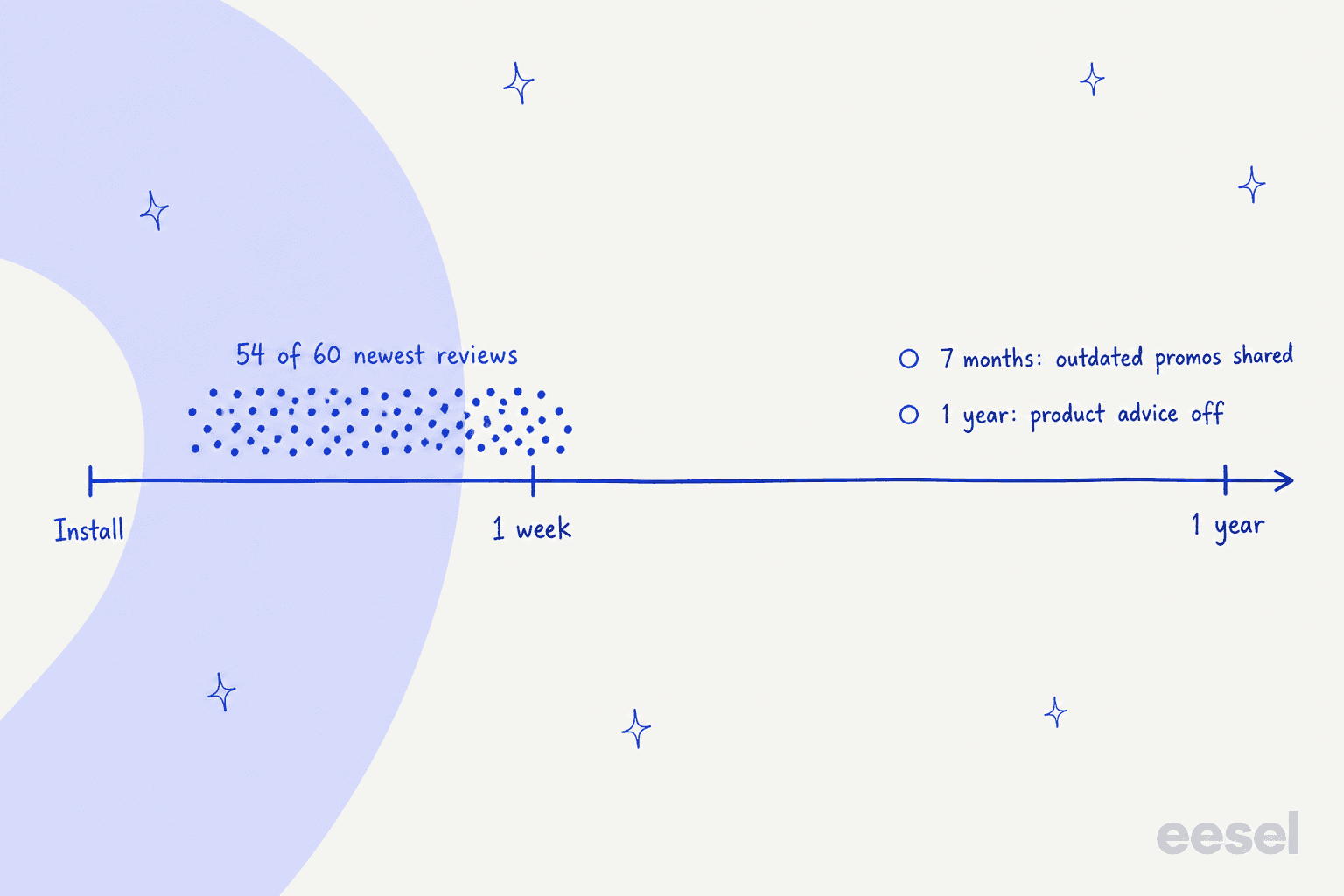
That is normal for Shopify App Store apps, which ask for reviews early, and it does not make the praise wrong. It does mean the 4.7 mostly measures setup and first answers. The questions that matter in month six, like "is it still right after the returns policy changed," show up mainly in the longer-tenure reviews. One Australian store said as much after 3 days:
"I haven't seen any customers interact with it yet at all and I have fairly decent daily traffic."
What long-term users flag
The critical reviews cluster around accuracy over time. A US store, after 7 months:
"the chatbot sometimes provides customers with expired promotional details, which creates confusion when we have to explain that the offer is no longer valid."
A French store that had used it for about a year wrote that the product advice, convincing at first, had become "très très approximatif voir faux" (very rough, even wrong), even though they kept feeding it, and that they were looking to switch. Older reviews from 2025 raise related points: a shipping-cost answer that contradicted the shipping policy, no way to stop suggestions the store didn't want, and a sales pop-up a store could not find how to turn off. BestChat replied to that last one with instructions by email.
Some of these predate features that exist now. The 2025 complaint that you "can't upload any documents" is answered by file learning on Growth, and the per-product toggles address picking what it learns. The pattern underneath them is not about one feature, though. A bot that learns your store in 30 seconds also re-learns your mistakes in 30 seconds, and a discount you ended last month lives on until the sync catches it. My guide to preventing AI hallucinations covers the checks that catch this.
Testing before it goes live
Another theme is that SmartBot starts answering shoppers as soon as it is installed. A Canadian workwear store wrote that "i wasn't expecting it to go live right away before i did testing." On a store with real traffic, I would install it during a quiet hour, ask it your 20 most common questions yourself, and only then promote it. My checklist for testing an AI agent works for a storefront bot too.
Pros and cons
| Pros | Cons |
|---|---|
| Learns products, policies, pages and discounts on install, no Q&A to write | Past support conversations are not a listed knowledge source |
| Unlimited AI chats on every paid plan | Price jumps with catalog size, 600 products already means $100 |
| Strong pre-sales features: recommendations, highlights, pop-ups | Long-term reviewers report stale promos and drifting product advice |
| Built for Shopify badge, 4.7 from 459 reviews | Most reviews are written in the first week |
| Hands off to WhatsApp, email, phone or a Gorgias ticket | Goes live on install, so test in a quiet window |
| Reviewers praise fast, friendly vendor support | AI email reply is a Chrome extension, not an inbox agent |
Who SmartBot fits, and who should skip it
Pick SmartBot if you run a Shopify store with a catalog under 500 products, most of your customer questions arrive in the storefront chat before purchase, and you want something live today for $30 a month. Stores with technical products, where shoppers need reassurance on fit or compatibility, get the most out of it. Add the Gorgias connection if you already use Gorgias, and the Klaviyo sync if you want chat leads in your email flows.
Skip it, or pair it with something else, if most of your support is post-purchase email and social DMs in a helpdesk. SmartBot answers in the widget and hands the hard tickets to people. If your team already drowns in WISMO tickets by email, a storefront bot does not touch that queue, and an ecommerce helpdesk with AI inside it does. The same goes for a large catalog, where the price is set by your product count before the bot has answered anything.
Watch for: promotions and policy changes. Make "update SmartBot" part of every promo launch and every policy edit, and spot-check its answers monthly. That one habit addresses the most common complaint in the long-term reviews.
My SmartBot verdict: 4 out of 5
SmartBot does what a small Shopify store most wants from a chatbot: it goes live fast, knows the catalog, sells politely, and costs $30 a month without a per-chat meter. That earns it a 4 out of 5 for storefront pre-sales chat. I take a point off for two things: the knowledge comes only from store content, so it can't learn from how your team actually answers, and the reviews that last past month six describe answers drifting out of date. For a support-heavy brand, I would score it closer to 3, because the queue that costs the most time sits outside the widget.
How eesel compares for Shopify support
eesel is an AI helpdesk teammate rather than a storefront widget. It plugs into the helpdesk where your tickets already live, like Gorgias or Zendesk, and connects to Shopify for orders and the catalog.
It learns from your past tickets, help center and docs as well as your store. It also has a chat bubble for the storefront, so you don't need two tools to cover both.
The difference from SmartBot is where the work happens. Some examples from real eesel customers:
- Question Beauty runs eesel on Gorgias and Shopify. Between August 8 and September 8, 2026 it handled about 990 Gorgias tickets, sent about 960 replies, and looked up about 290 Shopify orders before answering. Refunds, complaints and chargebacks go to a person with a note.
- Rúngne, a Norwegian climbing apparel brand, runs three agents on Gorgias: one tags, one drafts, one answers plain questions from Shopify order and stock data. It handled about 2,100 tickets in the same month.
- STIL Classics has eesel leave a draft on every Gorgias ticket after checking the order, and a person sends it. About 230 Shopify orders were looked up in that month.
| SmartBot | eesel | |
|---|---|---|
| Main job | Storefront sales and support chat | Helpdesk tickets plus storefront chat |
| Learns from | Products, policies, pages, discounts, blogs, files | Store data, past tickets, help center, docs, macros |
| Where it answers | Shopify chat widget | Gorgias, Zendesk, Freshdesk, email, chat bubble |
| Handoff | WhatsApp, email, phone, Gorgias ticket | Assigns the ticket with a note in your helpdesk |
| Testing | Live on install | Simulate on past tickets before going live |
| Pricing | $30 to $680 a month by product count | From $299 a month for 500 credits, one ticket or chat is 1 credit |
On price, I'll be straight: for a small store whose only need is a storefront chat, SmartBot's $30 plan is cheaper than eesel's $299 plan. eesel pays off when the tickets in your helpdesk are the cost, because that is the queue it works. If that is you, my comparison of the best AI helpdesks for Shopify and the head-to-head with Gorgias AI go deeper.
Try eesel on your Shopify support
If your Shopify support lives in Gorgias or Zendesk, eesel can read the order, check the policy and draft or send the reply inside the ticket, learning from how your team already answers. Before anything reaches a customer, you can run it against your past tickets and see what it would have said. That is the check SmartBot's long-term reviewers wished they had run on their own promos. You start with 100 free credits, no card.
Try eesel free, or see how the Shopify integration works.
Frequently Asked Questions
Is SmartBot worth it? What does a fair SmartBot review conclude?
For a small or mid-size Shopify store that wants a pre-sales chat on the storefront, yes: Starter is $30 a month with unlimited AI chats, and it holds 4.7 stars from 459 reviews. My SmartBot review scores it 4 out of 5 for that job, lower for stores whose support volume lives in email and a helpdesk. Compare it with other Shopify chatbot apps before you commit.
How much does SmartBot cost?
Per SmartBot's pricing page: Free, Starter $30, Growth $100, Pro $300 and Enterprise $680 a month, or 20% less paid yearly. Plans differ by how many products the bot can learn (50, 500, 3,000, 20,000, unlimited), not by chat count. My Shopify helpdesk roundup compares how other tools bill.
Is SmartBot free?
There is a Free plan, but it is a trial in practice: 300 AI chats for the life of the account, up to 50 products, and a 7-day Growth trial. Every paid plan has unlimited AI chats. For other free options, see my list of the best ecommerce chatbots.
What does SmartBot learn from?
SmartBot syncs your Shopify products, discounts, policies, pages and blogs, plus custom FAQs you write. Blogs and uploaded files need the Growth plan or higher. It does not list past support conversations as a source, which matters if your best answers live in old tickets, as my guide to training AI on past tickets explains.
Does SmartBot work with Gorgias?
Yes. SmartBot's integrations panel shows a Gorgias connection that creates a Gorgias ticket when a shopper asks for a person. The ticket is then worked in Gorgias by your team. If you want AI on the Gorgias side too, see the eesel Gorgias integration and my Gorgias review.
Can SmartBot track orders?
Yes, order tracking is one of SmartBot's listed jobs and it reads your Shopify order history. A 2024 reviewer noted it needed both the order number and the email to find an order, so test that flow with real orders. My guide to WISMO automation covers what good order answers look like.
What are the best SmartBot alternatives?
It depends on the job. For a storefront sales chat, look at other apps in my Shopify AI chatbot list. For support across email, social and chat inside a helpdesk, an AI helpdesk teammate that works your Gorgias or Zendesk queue fits better than a widget.