
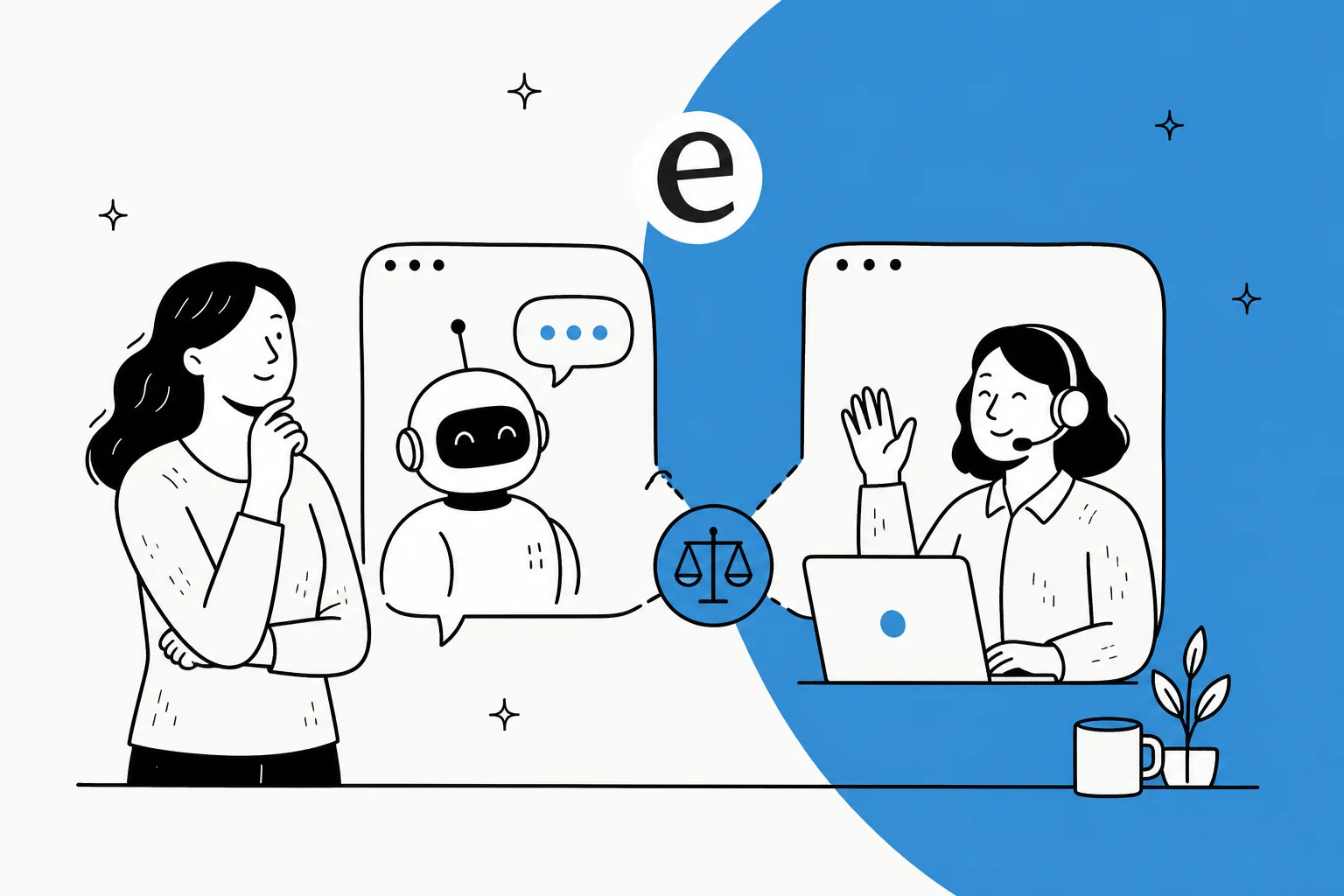
First, what each thing actually is
Before pitting them against each other, it is worth being precise, because half the confusion in the AI chatbot vs live chat debate comes from people comparing a great version of one to a terrible version of the other.
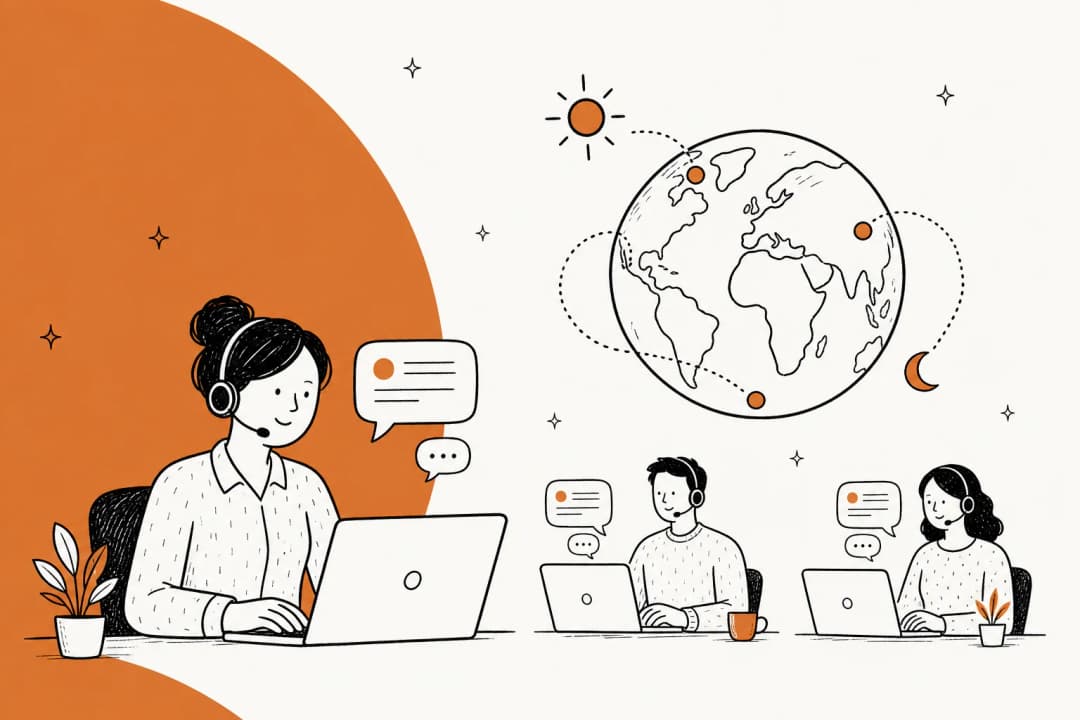
Live chat is a real-time text channel, usually a widget in the corner of your site or app, where a customer types and a human agent on your team types back. That is it. The value is entirely in the human: empathy, judgment, the ability to improvise when the question is one nobody anticipated. The cost is also entirely in the human, you can only answer as many chats as you have people, and people sleep. If you want the lay of the land on tooling, our roundup of AI live chat software and the broader live chat trends piece both go deeper than I will here, and there is a dedicated one on live chat for ecommerce.
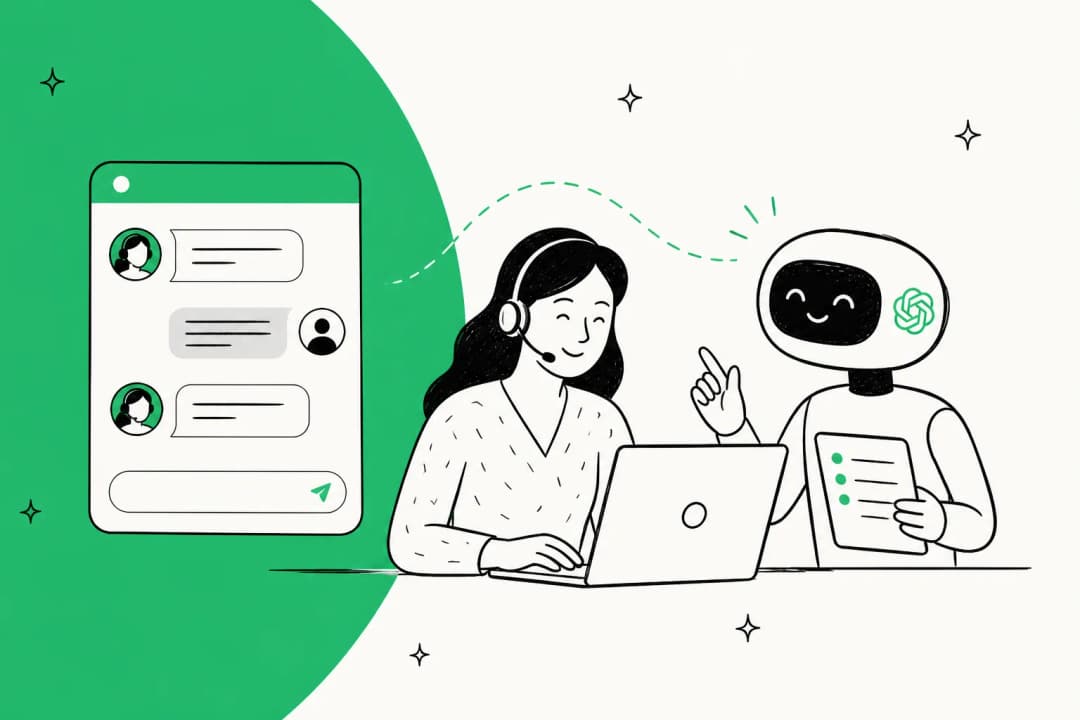
An AI chatbot is software that reads the customer's message and generates a reply on its own, no human required. Modern ones are not the rule-based decision trees of 2018 that made everyone hate the word "chatbot". A good AI chatbot for customer service is trained on your knowledge base, your macros, and your resolved tickets, and it answers in natural language with sources. The catch is that it is only as good as what it was trained on and how carefully it is gated, which is exactly why so many of them answer incorrectly when they are rushed into production.
AI chatbot vs live chat: the honest head-to-head
Here is how the two stack up on the dimensions a support lead actually cares about.
| Dimension | AI chatbot | Live chat (human) |
|---|---|---|
| Response time | Instant, every time | Seconds to minutes, depends on queue |
| Availability | 24/7, no gaps | Staffed hours only (or pricey night shifts) |
| Scales with volume | Yes, a spike costs almost nothing | No, capped by headcount |
| Cost per conversation | Low and flat (often cents) | High, dominated by agent salary |
| Repetitive questions | Excellent, never bored | Wasteful, burns out agents |
| Emotional / angry customers | Risky, can feel cold | Excellent, this is the human edge |
| Complex, multi-step issues | Hit and miss | Excellent, can improvise |
| High-value sales conversations | Weak | Excellent, trust is built person to person |
| Setup effort | Real, needs good knowledge and tuning | Low, just staff the widget |
| Risk of a wrong answer | Real if ungated | Lower, humans hedge and check |
Read that table and the punchline jumps out: the columns are almost mirror images. The chatbot is strongest exactly where humans are weakest (volume, speed, 3am, the hundredth identical question), and humans are strongest exactly where the bot is shakiest (emotion, ambiguity, money on the line). Picking one and forcing it to do the whole job means accepting its entire weakness column. That is the real cost of treating this as a versus.
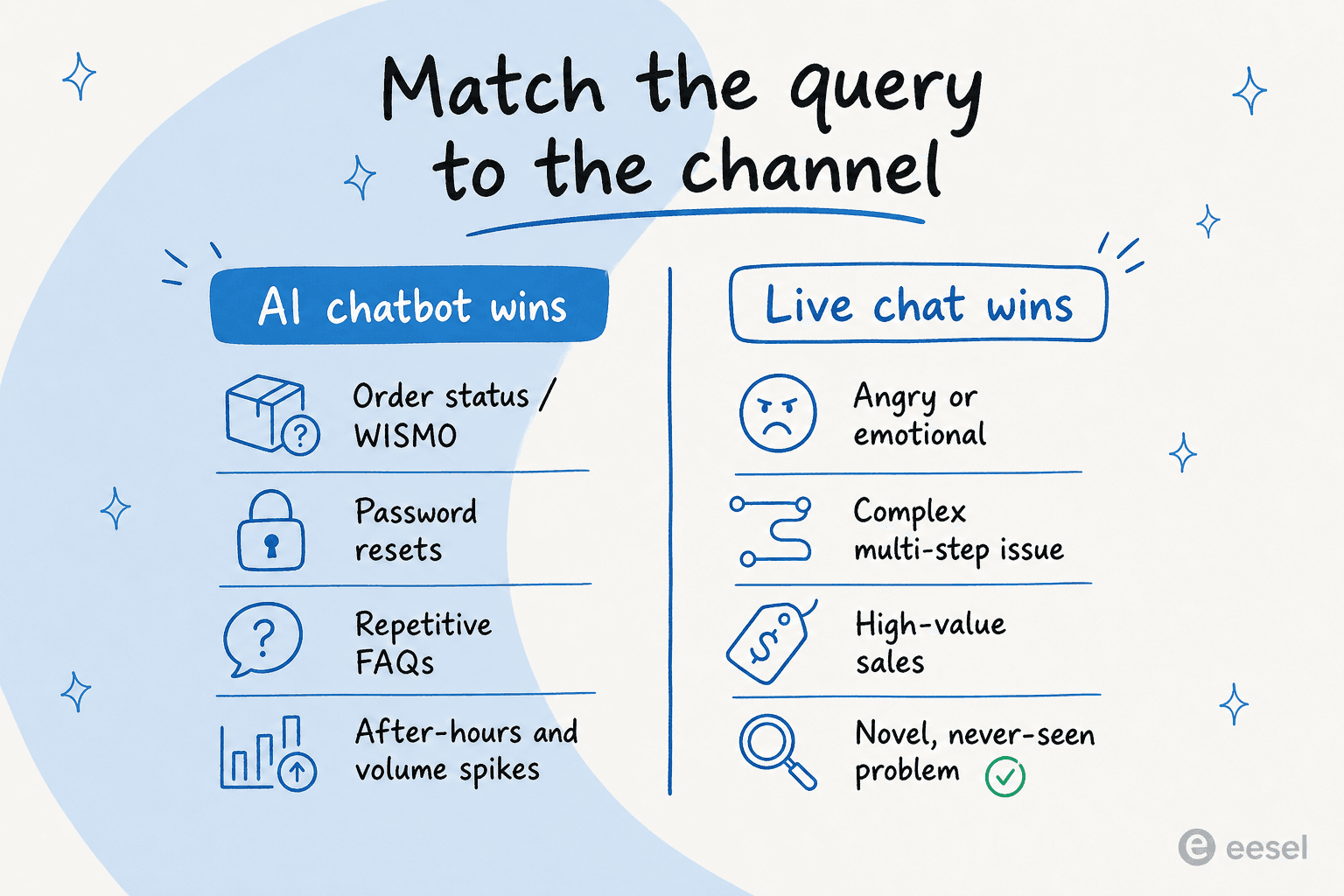
Where each one breaks (the part vendors skip)
The marketing pages never show you the failure modes, so here they are from the queue.
Live chat breaks under load and around the clock. A customer who waits four minutes for an agent has often already rage-refreshed or left. One buyer I came across, running roughly 500 Zendesk tickets a day at an e-commerce company, was so fixated on chats feeling human that he asked for the AI's output to stream word by word and even slow down, his reasoning was that "people don't want to speak with AI, they want real people." He is not wrong about the preference. But no amount of human-feel fixes the fact that ten agents cannot hold a thousand simultaneous conversations. Live chat alone leaves a coverage hole, and customers fall into it at exactly the moments (launches, outages, holidays) when you can least afford it. This is the gap that AI live chat apps are built to close.
AI chatbots break when they are confidently wrong. This is the nightmare, and it is real. We have watched a confident-sounding bot quietly hand out a wrong answer, which is the single fastest way to torch trust, and it is why we now simulate every rollout against historical tickets before a customer ever sees it. The fear is well founded: the biggest objection I hear from buyers is not "will it work", it is "will it answer something it shouldn't". As one DTC supplements support lead put it, the AI "will never be able to answer 100% of the questions... I need an AI who is only handling the tickets that it's confident to handle and all the other ones, leave them alone." That instinct is the whole game.
The answer is deflect-then-handover, not either/or
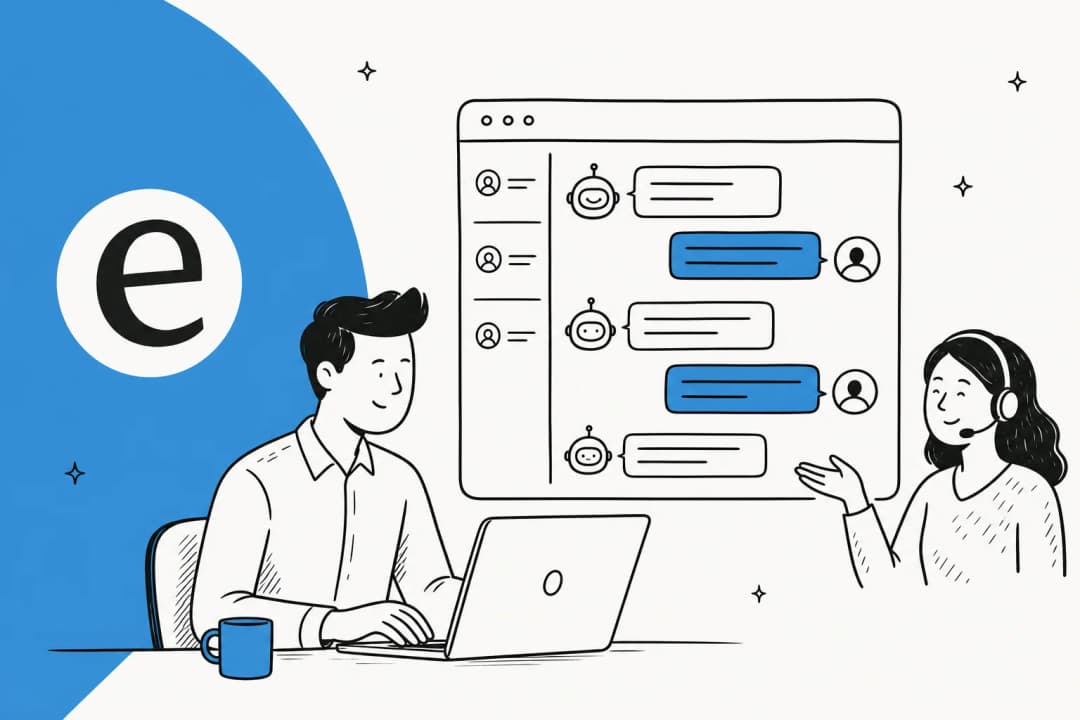
So if both break when forced to work alone, the design that works is to let each do its half. The AI sits at the front, answers what it is confident about, and the moment it is unsure, or the customer asks for a person, it hands off to live chat with the full thread attached. No "please repeat your issue to the agent", no lost context.
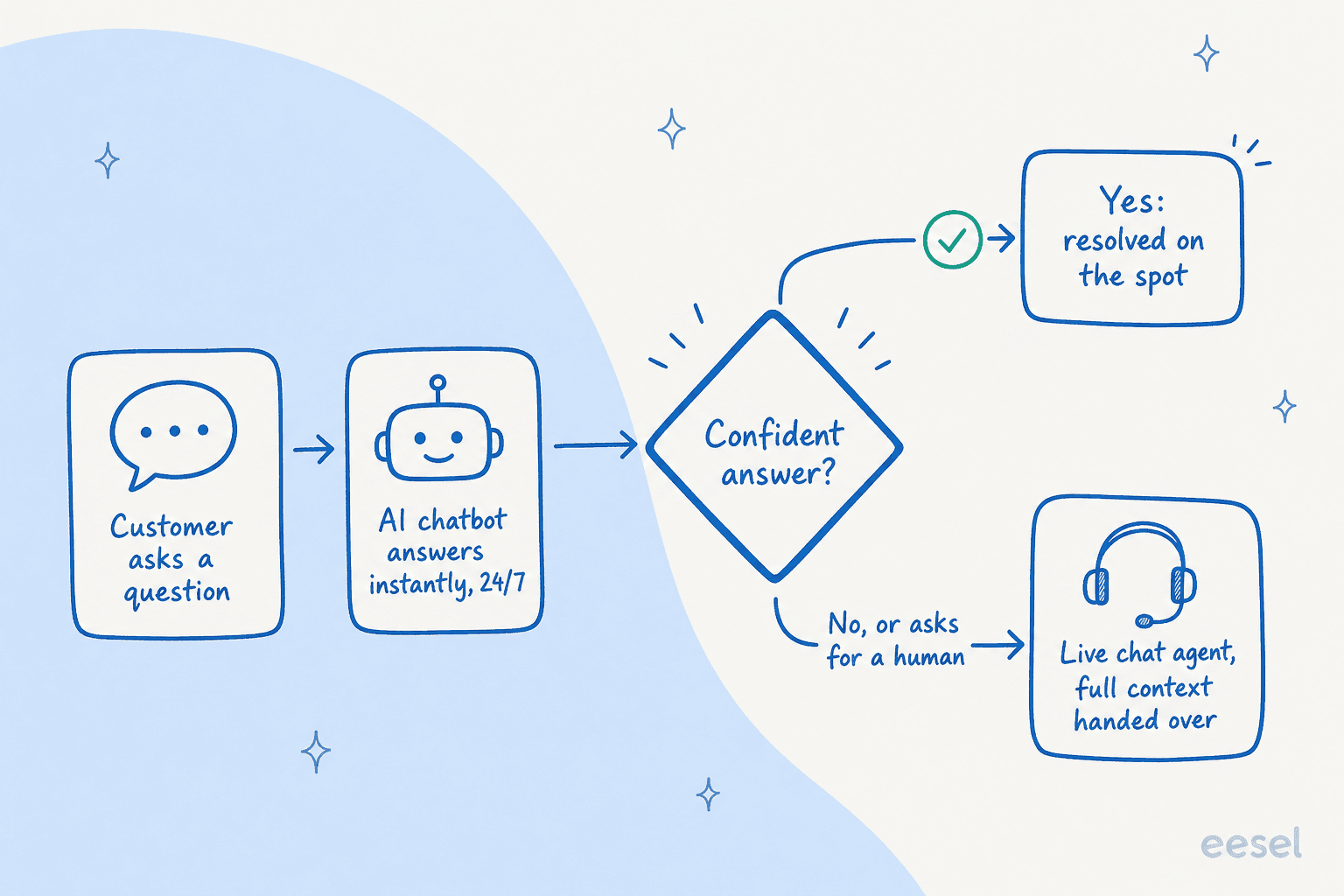
This is not theory, it is what the good chats look like in practice. Here is a real one from an SEO tool's website widget, anonymized: an end-user on a chat bubble got two self-serve doc answers in seconds, then the instant they asked for a person, the bot escalated:
"How do I delete keywords from my project?" ... "How do I delete search engines?" ... "Can I talk to a human?"
The agent answered the two how-to questions from the docs, then called handover the moment the user asked for a human. Real chat, eesel deflect-then-handover
That is the pattern you want: the AI chat escalation is the safety valve, not an afterthought. The customer never hits a dead end, and your agents never see the questions a doc could have answered.
What this does to your live chat queue
The reframe that matters for anyone staffing a team: a good AI front line does not replace your live chat agents, it changes what lands in their queue. Instead of every conversation hitting a human, the repetitive majority resolves automatically and your people inherit the conversations that genuinely need them.
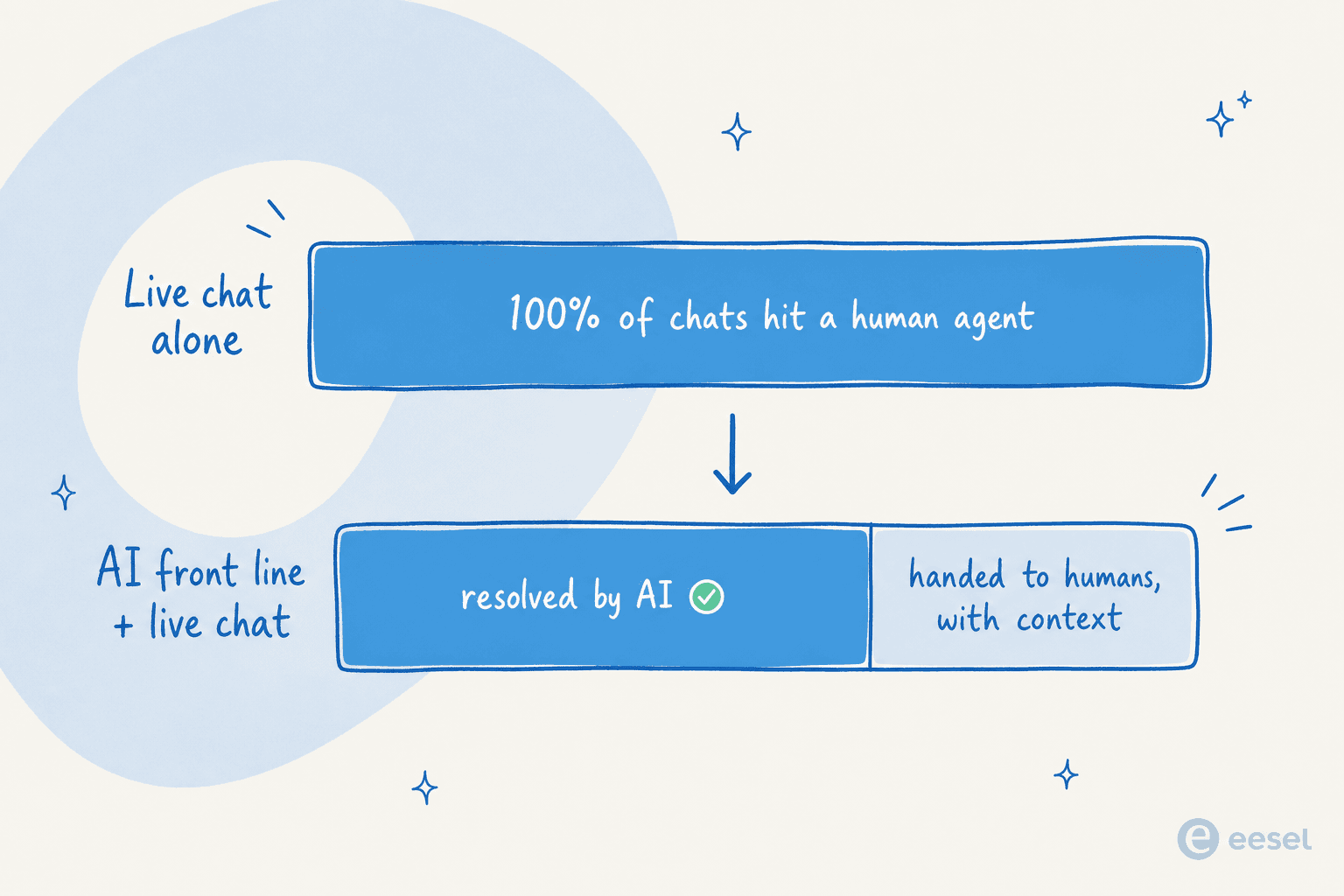
The numbers back this up. Gridwise, a gig-economy driver analytics app, saw eesel resolve 73% of tier-1 requests in the first month, with results landing during a 7-day trial. An internal IT helpdesk at InDebted started at 15% deflection on the way to a 55% target. The point is not the exact percentage, it is the shape: when the bot absorbs the tier-1 load, live chat stops being a firehose and becomes a place where skilled humans do high-judgment work. That is a better job for them, not a vanishing one.
So which do you actually need?
If you are choosing where to put your next dollar, here is the frank version. Use the picker, then read the verdict under it.
The verdict in one line: if your pain is volume, hours, or cost, start with the chatbot; if your pain is the quality of hard conversations, protect live chat and gate the AI tightly. Almost everyone ends up wanting both, which is why the tool you choose should do the handover natively rather than bolting a bot onto a separate live chat product.
What to look for in a tool that does both
Not every "AI + live chat" product is equal. From sitting with this daily, the things that actually separate a good setup from a frustrating one:
- It learns from your past tickets, not just help-center articles. The bots that feel smart were trained on how your team actually resolved things. Help-doc-only bots stay shallow.
- Confidence-based routing is built in. The bot should know what it does not know and escalate rather than guess. This is the single most-requested control I hear from buyers.
- Handover preserves context. The human picks up the full thread, no re-asking.
- It sits on your existing helpdesk. If you already run Zendesk, Freshdesk, or Gorgias, you should not have to migrate. The AI layer should plug into Zendesk and the rest, not replace them.
- You can test it before going live. Simulating against historical tickets tells you the real deflection rate before a customer is ever exposed to it.
If you want to go deeper on the tooling itself, our guides to the best AI helpdesk agent, the best AI chatbot builders, and the AI customer service workflow each cover a slice of this in detail.
For broader shortlists, the AI customer service chatbot roundup and the best AI knowledge base tools guide are good next reads, and if you want proof it works at scale, see companies using AI for support.
Try eesel for the deflect-then-handover model
The reason I keep coming back to this split is that it is what eesel is built to do. It is an AI layer that sits on top of the helpdesk you already run, learns from your past tickets and help docs on day one, answers the repetitive front line through a chat bubble or your existing channels, and hands the rest to your live chat agents with the whole conversation attached. Because it is usage-based at about $0.40 per conversation with no per-seat fees, you pay for what the bot actually resolves rather than a flat platform tax.
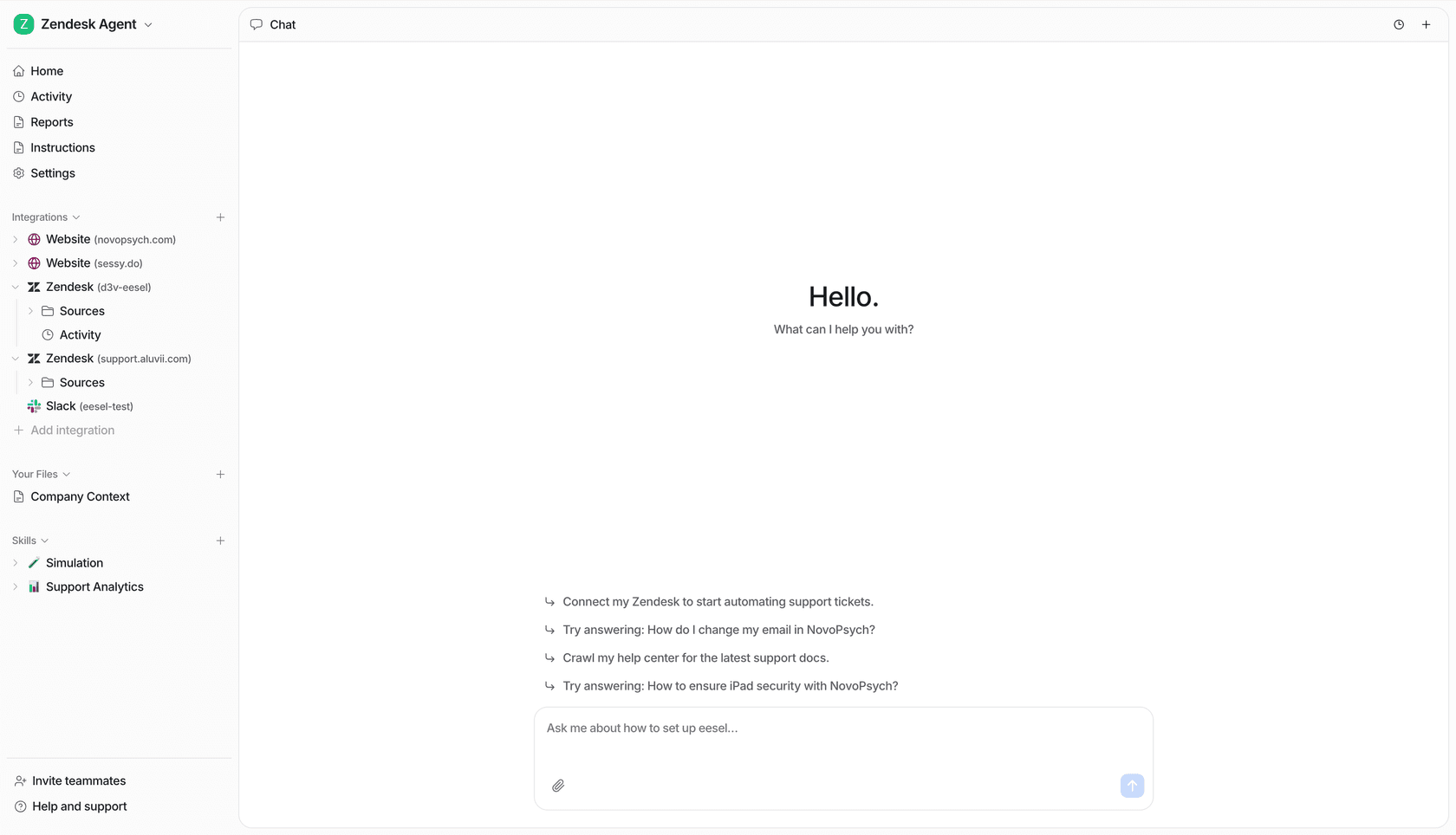
The part I would not skip is the simulation. Before anything goes live, you can run the AI against your own historical tickets to see exactly what it would have resolved and where it would have escalated, so you tune the gate before a real customer meets it. That is how you get the deflection without the confidently-wrong horror story. Here is eesel working inside Zendesk, where most teams already live:
You can try eesel free, connect it to your helpdesk, and simulate it on your real tickets before deciding anything. That is a more honest way to settle the AI chatbot vs live chat question than any comparison table, including mine: run it on your own queue and watch where the line between bot and human actually falls.
Frequently Asked Questions
What is the difference between an AI chatbot and live chat?
Is an AI chatbot better than live chat for customer service?
Can an AI chatbot replace live chat agents?
How does an AI chatbot hand over to live chat?
How much does it cost to add an AI chatbot on top of live chat?


Article by
Riellvriany Indriawan
Riell is a designer and writer at eesel AI with about two years of experience researching CX platforms, AI chatbots, and helpdesk software. She combines her design background with a sharp eye for how these tools actually look and feel in practice — making her comparisons unusually visual and user-focused.