
The Shopify login page isn't just a form, it's the front door to your entire business. Getting the hang of your Shopify Admin is step one, but the real magic happens when you start thinking about what your customers experience after they log into their accounts on your store.
This guide will walk you through everything you need to know about the Shopify login, from getting into your dashboard on any device to fixing those annoying little issues that can pop up. We'll also dig into how you can use automation to completely change the game for your post-login customer experience, turning simple questions into sales.
What is the Shopify login?
Simply put, the Shopify login gets you into your Shopify Admin, which is the command center for your entire operation. It's the secure back-office area that your customers never see, built for you and your team to manage every piece of your store.
From the admin dashboard, you'll handle all the core parts of your business: adding products, processing orders, managing shipments, looking at sales data, and tweaking your store's design. Making sure you can get in securely and reliably is a big deal for keeping things running smoothly.
How to use the Shopify login on any device
Shopify makes it easy to manage your store whether you're at your desk or on the go. You can log in through any web browser or use the Shopify mobile app. Here’s a quick look at how each method works.
Logging in from a desktop or mobile browser

The most common way to get into your store is through a web browser on your computer or phone.
-
Head over to the official Shopify login page.
-
Enter your store address, then the email address connected to your Shopify account, and continue with your password (or a passkey, if you set one up).
-
If you have two-step authentication (2SA) turned on (which you should), you’ll be asked for a security code.
-
If that email is tied to more than one store, Shopify will ask you to pick which one you want to manage.
For an even quicker route, you can go straight to your store's admin panel by adding /admin to the end of your store’s URL (like yourstore.myshopify.com/admin).
Logging in with the Shopify mobile app

The Shopify mobile app lets you run your business from pretty much anywhere. It’s available for iOS, iPadOS, and Android devices.
The process is super simple: open the app, tap "Log in," and enter your email and password. The app also works with biometric logins like Touch ID or Face ID, making access even faster and more secure. Once you're in, you can manage orders, update products, and see real-time sales data while you're out and about.
Securing your account and solving common Shopify login problems
While logging into Shopify is usually a breeze, things can go wrong from time to time. Here’s how to handle the most common hiccups and beef up your account security to avoid them altogether.
How to recover your Shopify login
Forgotten Password: We've all been there. If you forget your password, just click the "Forgot password?" link on the login page. Shopify will send you an email with a link to set a new password. If you created your account through a third-party login service and never set a password, the page might not offer that link.
Forgotten Email or Store URL: If you can't remember which email you used or your store's URL, Shopify has a Store Recovery page for that. Just enter an email address, and Shopify will send you a list of all the stores connected to it. If you’ve tried every email you can think of and still can't find your store, you'll need to reach out to Shopify Support.
Enhancing Shopify login security with two-step authentication (2SA)
Two-step authentication (2SA) adds an extra layer of security to your Shopify login. It asks for a second piece of information after your password, which helps protect your business data even if someone gets ahold of your password.
Shopify supports a few different 2SA methods, as illustrated below, and you can set them up from the Security page in your admin. Passkeys are a separate secure sign-in option that lets you log in with your face, fingerprint, PIN, or screen lock, and a passkey only works where it's saved, so keep a backup method too:
-
Authenticator app: Use an app like Google Authenticator or Duo Mobile to get a fresh code every time you log in.
-
SMS delivery: Get a code sent to your phone via text message. Shopify no longer lets you set this up as a new method, but accounts already using it can keep it.
-
Shopify Mobile prompts: Approve login attempts with a quick tap inside the Shopify app, available as a backup method.
-
Security key: Use a physical hardware key (like a YubiKey) for authentication.
-
Built-in authenticator: Use your device's built-in security, like Face ID or a PIN.
It’s a really good idea to set up a backup authentication method and stash your recovery codes somewhere safe, just in case.
Managing multiple stores with the store switcher
If you’re juggling multiple Shopify stores under the same email, the store switcher is your best friend.
On a desktop, you'll find a dropdown menu at the top of your Shopify admin that lets you hop between stores. In the Shopify app, you can add all your stores to a list and switch between them from the store tab. If one of your stores isn't showing up, double-check that it's linked to the right email address. You can also use external login services such as Apple, Facebook, Google, or WhatsApp, or set up a Shopify ID for single login access across stores.
Enhancing the customer experience post-login
Okay, so you’re logged in and everything's running well on your end. But what about your customers? Once they log into their account on your storefront, their journey is just getting started. They usually have simple, urgent questions like, "Where's my order?" or "How do I make a return?"
Answering these questions right away is a huge part of building trust. If they have to wait around or dig for answers, they get frustrated, which can lead to bad reviews and lost future sales. This is where automation can be a lifesaver.
Automating post-login questions with an AI chatbot
Instead of making customers send an email and wait, an AI-powered chatbot can give them instant, 24/7 help with all those common post-login questions. And we're not talking about basic bots that just spit out FAQ answers. Modern chatbots can connect directly to your store’s data to give personalized, real-time help.
For instance, the eesel AI chatbot for ecommerce from eesel AI, Inc. uses a deep Shopify integration to take real actions for the customer. When someone asks about their order, the chatbot can pull up the exact status. It can also start returns, process cancellations, and answer detailed product questions by tapping into your live catalog.
Turning support chats into sales opportunities
A smart AI chatbot doesn't just put out fires, it can actually help you make more money. By looking at a customer's order history and what they've been browsing, it can suggest products they might actually like.
With eesel AI, you can set up the bot to pivot a support chat into a sales conversation. After it helps a customer with an order question, the bot can show them a visual carousel of related products. With an "Add to Cart" button right there in the chat, it makes it incredibly easy for them to buy, turning a potential support cost into a new sale.
A quick overview of Shopify pricing plans
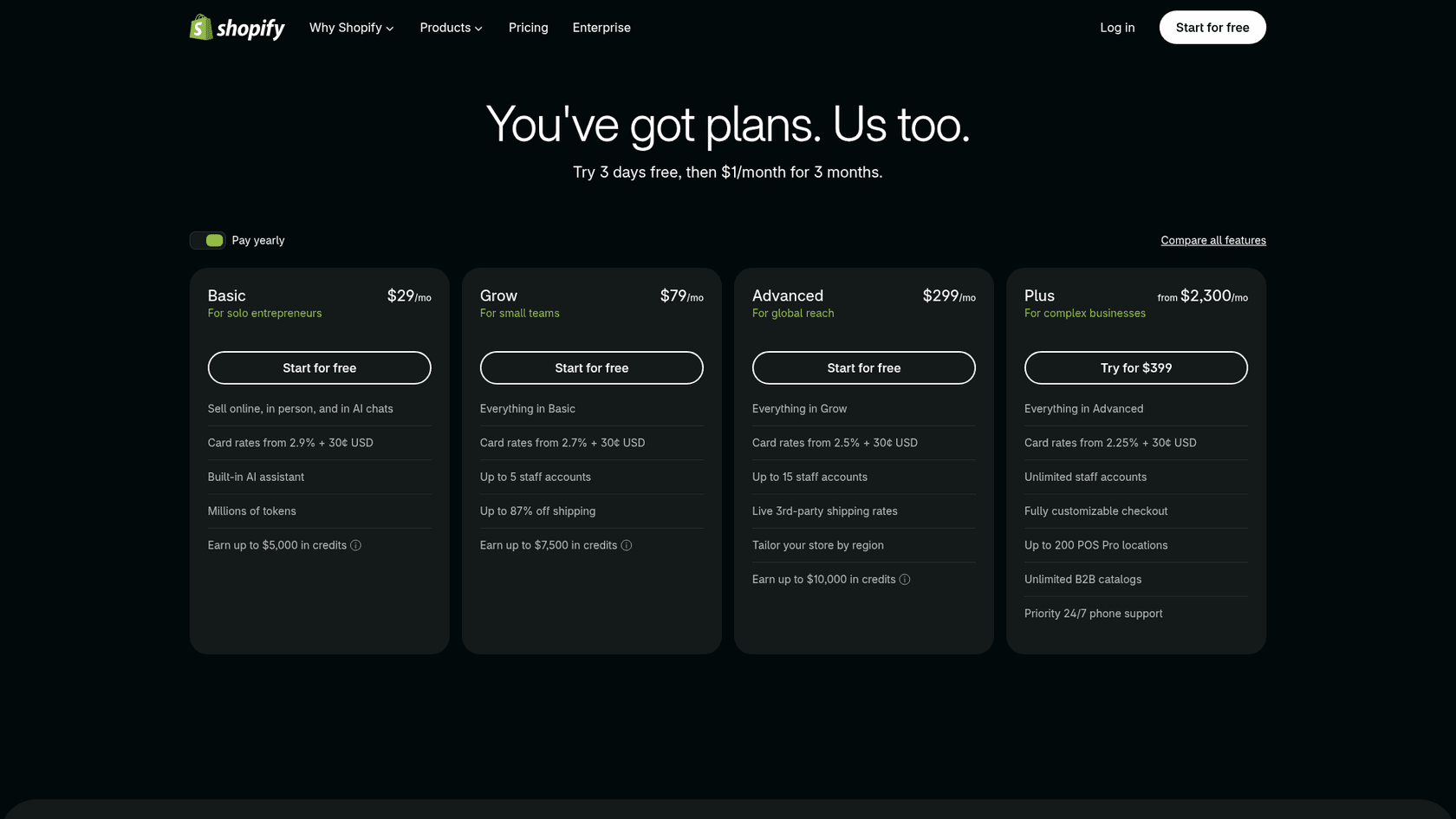
To round things out, it helps to know a bit about Shopify's pricing. The best plan for you really depends on the size and stage of your business, since each tier comes with different features, transaction fees, and staff accounts.
Here’s a quick summary of Shopify's main plans, with their monthly prices. Keep in mind that you can save up to 25% if you pay for a full year upfront ($29, $79 and $299 per month on yearly billing), and new stores can try 3 days free, then pay $1/month for 3 months.
| Plan Name | Price (Monthly) | Best For | Key Feature Highlight |
|---|---|---|---|
| Basic | $39 USD/mo | New businesses or entrepreneurs just starting out. | Owner login only (no extra staff accounts), basic reports, up to 87% shipping discount. |
| Grow | $105 USD/mo | Small teams and growing businesses selling both online and in-store. | 5 staff accounts, professional reports, lower transaction fees. |
| Advanced | $399 USD/mo | Scaling businesses that need advanced reporting and the lowest fees. | 15 staff accounts, custom report builder, lowest transaction fees. |
Note: These prices are for monthly billing. For the latest details and features, it's always best to check the official Shopify pricing page.
Making the most of your Shopify login and store
Your Shopify login is the key to a really powerful platform. By understanding how to log in from anywhere, keeping your account safe with 2SA, and knowing how to fix common problems, you can make sure managing your store is always a smooth process.
But the store owners who really succeed are the ones who think beyond their own login and focus on what their customers are experiencing. By automating post-login support with smart tools, you can answer questions in a heartbeat, make things easier for your customers, and build the kind of loyalty that helps you grow for years to come.
Ready to offer 24/7 support and turn more customer chats into sales? Try the eesel AI Sales Chatbot for Shopify and see what it can do for your customer experience.
Frequently asked questions
What is the primary purpose of the Shopify login for store owners?
The Shopify login grants you secure access to your Shopify Admin, which serves as the central control panel for managing your entire online store. From here, you handle everything from product listings and order processing to sales data analysis and store design adjustments.
How can I perform a Shopify login on a mobile device?
You can easily complete a Shopify login using the official Shopify mobile app, available for iOS, iPadOS, and Android. Simply open the app, tap "Log in," and enter your credentials, or use biometric options like Touch ID or Face ID for quicker access.
What steps should I take if I forget my password for my Shopify login?
If you forget your password for your Shopify login, click the "Forgot password?" link on the official login page. Shopify will then send a password reset link to the email address associated with your account. If you signed up through a third-party login service and never set a password, the link might not be offered.
How can I enhance the security of my Shopify login to protect my business data?
To significantly enhance your Shopify login security, enable two-step authentication (2SA) through your admin settings. This adds an essential extra layer of protection by requiring a second verification method after you enter your password.
Is it possible to manage multiple Shopify stores using a single Shopify login?
Yes, if multiple Shopify stores are linked to the same email address, you can manage them efficiently. After your initial Shopify login, use the "store switcher" feature within the admin dashboard or mobile app to easily switch between your different stores.
How can automation improve the customer experience after they log in to their store account?
Automation, particularly with an AI chatbot, can drastically improve the customer experience by providing instant, 24/7 support for common post-login questions. This allows customers to get immediate answers about orders, returns, or product details without waiting for a human agent.
What are the benefits of integrating an AI chatbot for post-login customer support?
An AI chatbot offers benefits like real-time, personalized support by integrating directly with your store's data to answer specific inquiries or even process actions. It can also transform support interactions into sales opportunities by recommending relevant products based on customer history.