AI for Gorgias: the two routes and what each really costs

Rama Adi

Katelin Teen
Last edited October 14, 2026

What "AI for Gorgias" actually means
When people search for AI for Gorgias, they usually mean one of two projects, and it is worth being clear which one you are starting, because the setup work and the bill look nothing alike.
You can switch on the AI Agent Gorgias ships itself, which is deeply wired into Shopify and priced per resolution. Or you can keep Gorgias as your inbox and bring your own AI layer that plugs in over the API and works your tickets alongside your human team. Both put an AI in front of your queue. They just make different trade-offs on price, setup, and how much of your existing knowledge the AI can actually use.
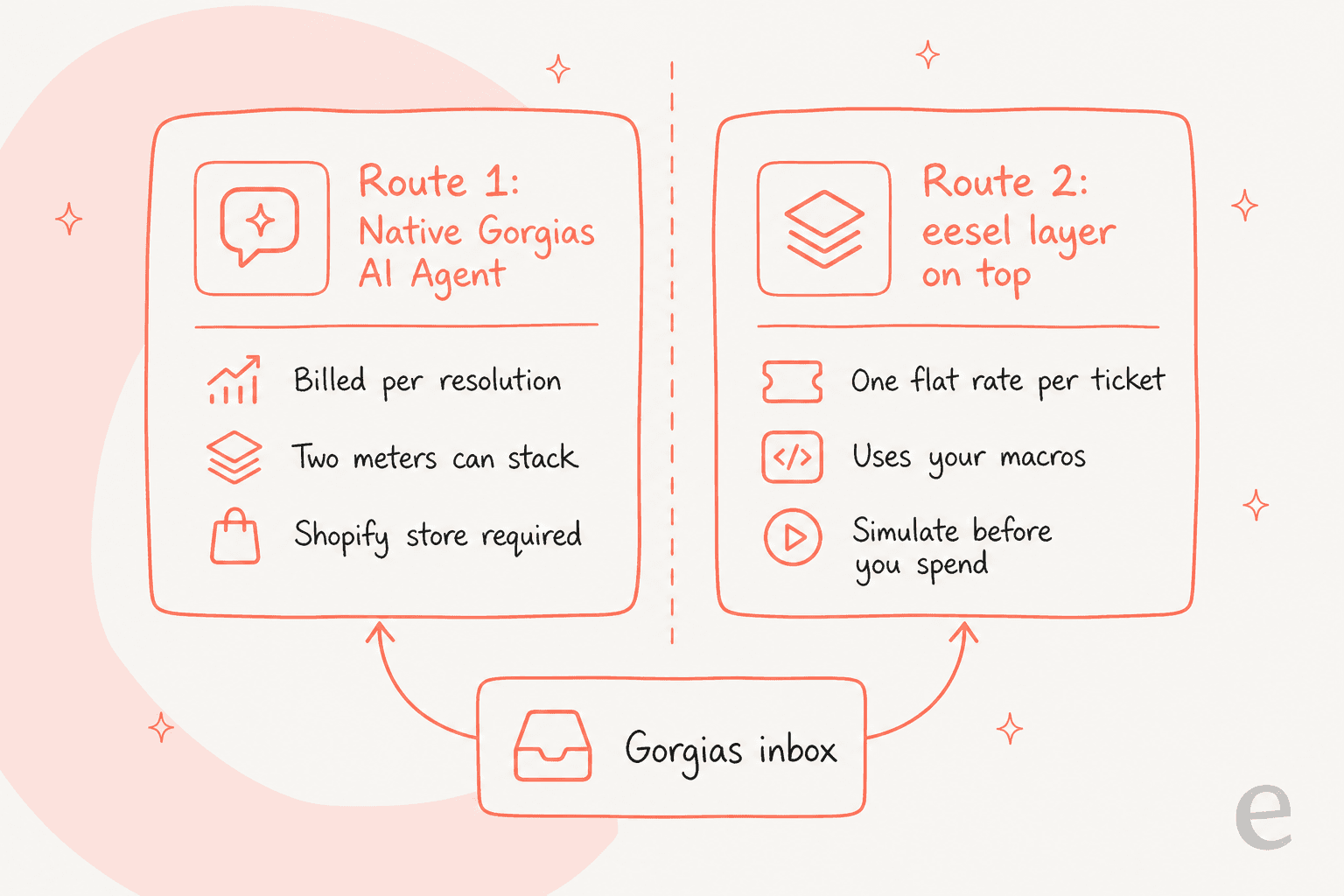
I build integrations for a living, so my instinct is always to read past the marketing page to what the connection and the billing actually do. That is the lens for the rest of this post. Let me take each route in turn.
Route 1: Gorgias's native AI Agent
Gorgias is an ecommerce-first helpdesk that powers customer conversations for 40% of Shopify brands, and its AI Agent is built on a direct OpenAI partnership. Because orders, customers, and store data already live inside Gorgias, the native agent starts with context most bolt-on tools have to go fetch.
How the native AI Agent works
The agent reads the incoming message, grounds a response in your Help Center and configured knowledge, and, when it needs to do something rather than just say something, runs an Action. Actions are where the Shopify wiring pays off: it can look up an order, cancel a subscription, or apply a discount, then write the reply. Every reply also has to clear a second AI model's confidence check before it is sent, which is the anti-hallucination guardrail.
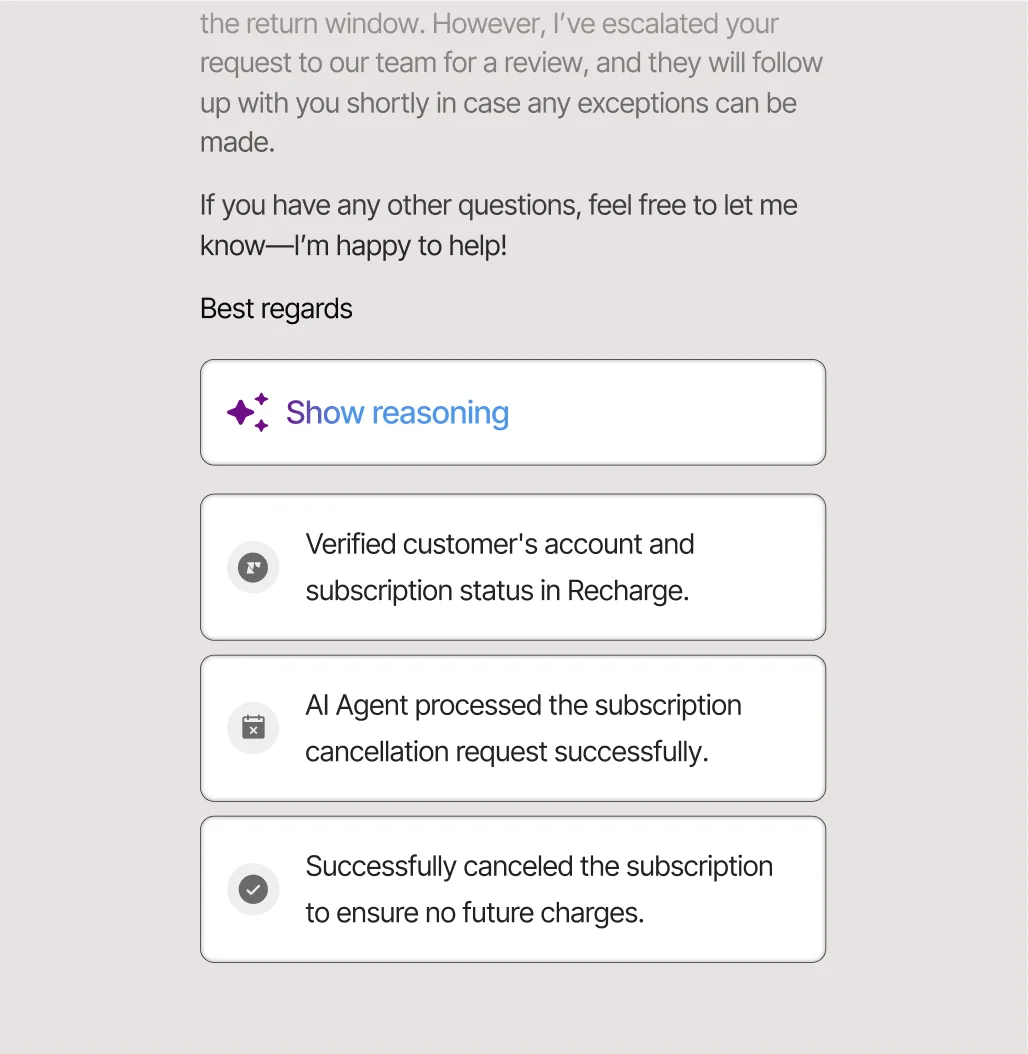
Alongside the agent, Gorgias runs Flows and Order Management for deterministic paths like order tracking, plus a Shopping Assistant that answers pre-sales questions to turn browsers into buyers. It is a capable setup, especially for a store whose tickets are mostly order-related.
What the native AI Agent costs
This is the part worth slowing down on, because Gorgias's pricing is genuinely different from a flat per-agent SaaS fee, and the difference catches teams out.
Gorgias bills two products on one invoice: Helpdesk (per billable ticket) and AI Agent (per automated interaction). A billable ticket is any ticket with at least one message sent from the helpdesk, counted once no matter how long the thread. An automated interaction is one the AI resolves with no human needed within 72 hours. The important bit is how they combine on a single ticket.
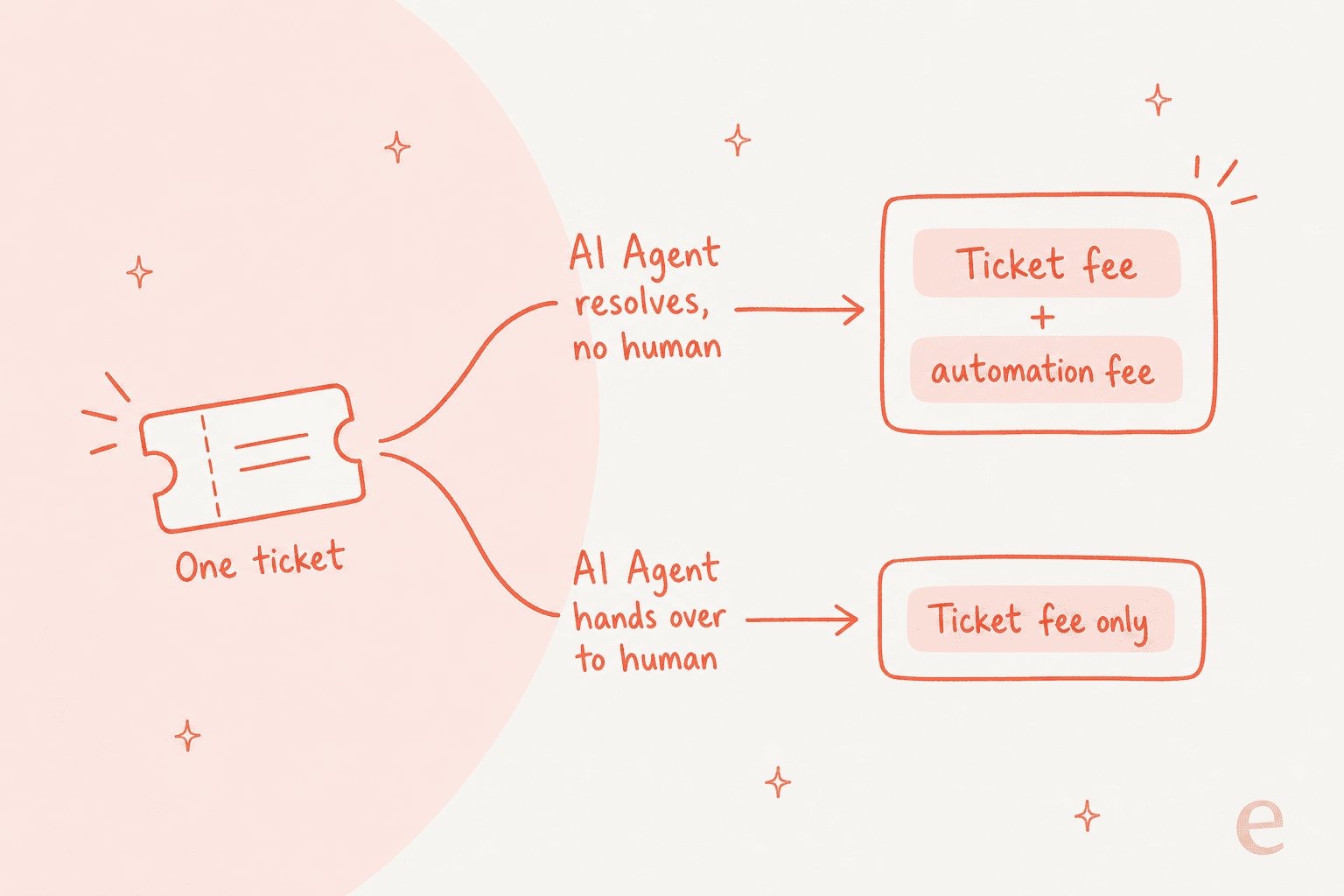
So a ticket the AI fully closes is charged twice, once on each meter. A ticket the AI touches but hands to a human is charged once (Gorgias confirms you are "not charged for both" in that case). That is a fair model, but you have to price it as a per-resolution cost, not a per-ticket one. Accounts created before May 28, 2025 that have not subscribed to AI Agent and upgraded may still be on legacy pricing, where a ticket counts toward one meter, not both.
Here is the current self-serve ladder, taken from the live pricing page:
| Plan | Bundled price (annual) | Tickets / mo | Automated interactions / mo | Extra ticket | Per automated interaction |
|---|---|---|---|---|---|
| Starter | $40/mo (monthly only) | 50 | 30 | +$0.40 | $1.00 |
| Basic | $77/mo | 300 | 30 | +$0.40 | $0.90 |
| Pro | $471/mo | 2,000 | 190 | +$0.36 | $0.90 |
| Advanced | $1,227/mo | 5,000 | 530 | +$0.36 | $0.85 |
| Enterprise | Custom | 5,000+ | Custom | Not published | Not published |
The plan comparison table lists the real per-interaction rate: $1.00 on Starter, $0.90 on Basic and Pro, and $0.85 on Advanced. Each automated interaction also counts as a billable ticket, so the two meters add up on a busy month.
One thing worth saying plainly: older comparison posts quote "$1.50 per AI interaction", but the live pricing page now lists $0.85 to $1.00 by plan. Our full Gorgias AI pricing breakdown has the worked examples if you want to model a specific volume.
Where the native agent gets tricky
The native agent is good at what it is built for. It is worth being honest about the edges, because they decide whether Route 1 is the right call for you.
It is Shopify-centric by design. AI Agent requires a connected Shopify store, and its conditions and variables draw primarily from Shopify order and customer fields. If you are on BigCommerce, Magento, or a custom cart, you are leaning on custom HTTP actions rather than the supported path. Multi-store brands get one agent per store and configure each separately.
It does not use your macros. The AI Agent generates its own responses and ignores your macro library entirely, which only human agents can apply. If your team has spent years refining canned replies, the native agent starts from your Help Center instead of that work.
Setup is real configuration, not a switch. You write Skills, build Actions with authentication and sequential steps, author Guidance, and reconcile your existing Rules so the AI and an auto-reply rule do not both fire and send the customer two messages. Switching an Action to advanced options is also one-way, and test actions can mutate real order data unless you point them at a fake profile.
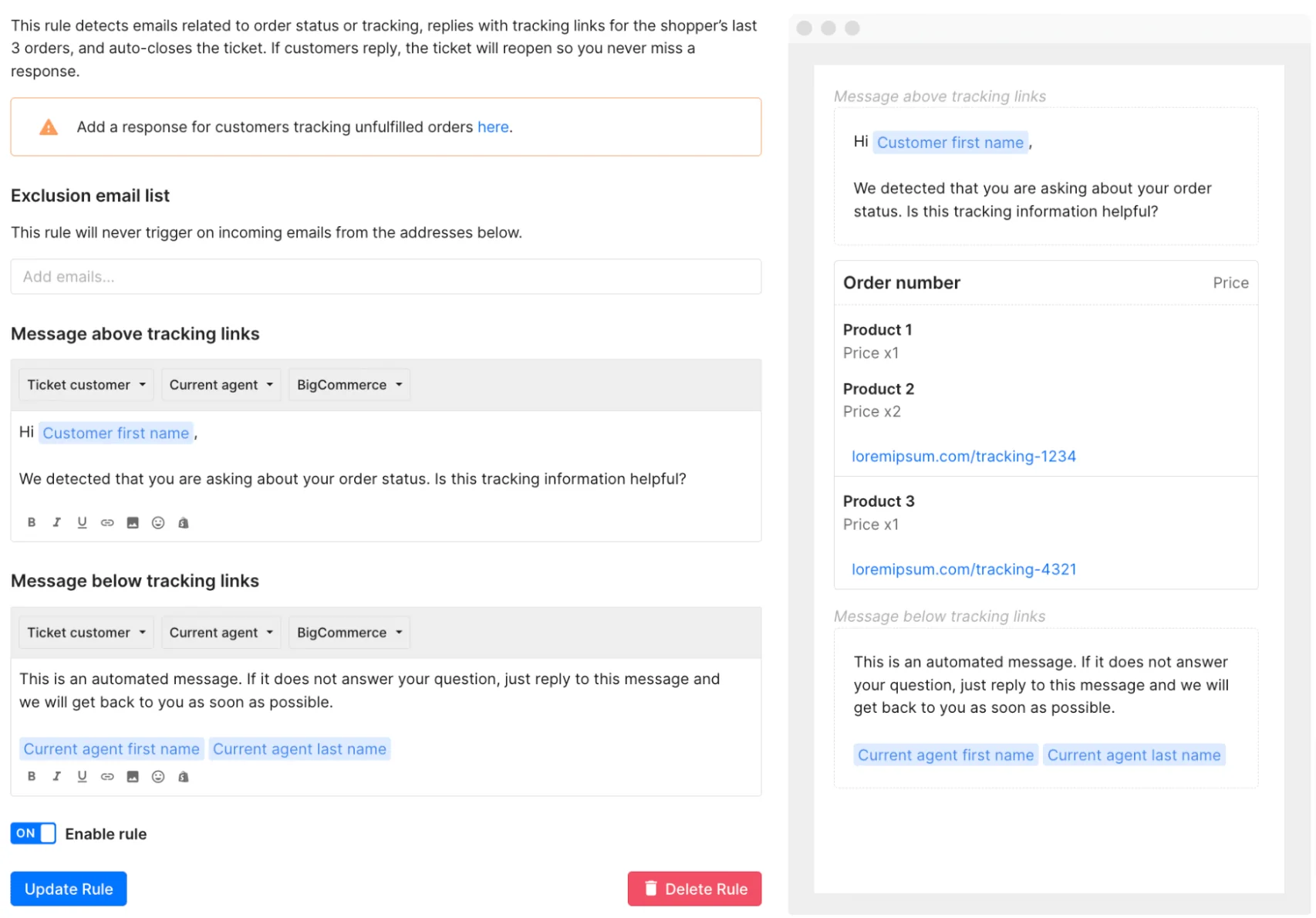
There is a stated ceiling. Gorgias's own marketing caps automation at about 60% of email and chat conversations, so plan for humans to still carry roughly the other 40%.
None of this is a knock on the product. It is a good agent for a Shopify store whose tickets are action-heavy. But the per-resolution pricing is a real consideration, and it is the thing support leads on Reddit keep circling back to:
"The price adds up quick once your volume grows."

The rough consensus in that thread is that Gorgias pays off when 40% or more of your tickets need direct Shopify actions like refunds and cancellations. If your queue is mostly conversational, the second route is worth a serious look.
Route 2: adding an AI layer on top of Gorgias
The second option keeps Gorgias exactly as it is and adds the AI as a layer. This is what eesel does: it is an AI teammate platform, and the helpdesk teammate joins your Gorgias inbox as a real AI Agent rather than a separate widget or a second inbox to babysit.
How eesel plugs into Gorgias
You connect Gorgias to eesel over OAuth in the dashboard, and it imports your Help Center articles, past Gorgias tickets, and macros automatically. From there it reads tickets, drafts and sends replies, leaves internal notes, updates tags and status, and pulls Shopify order data into every reply. The whole connection is designed to take under 30 minutes with no code.
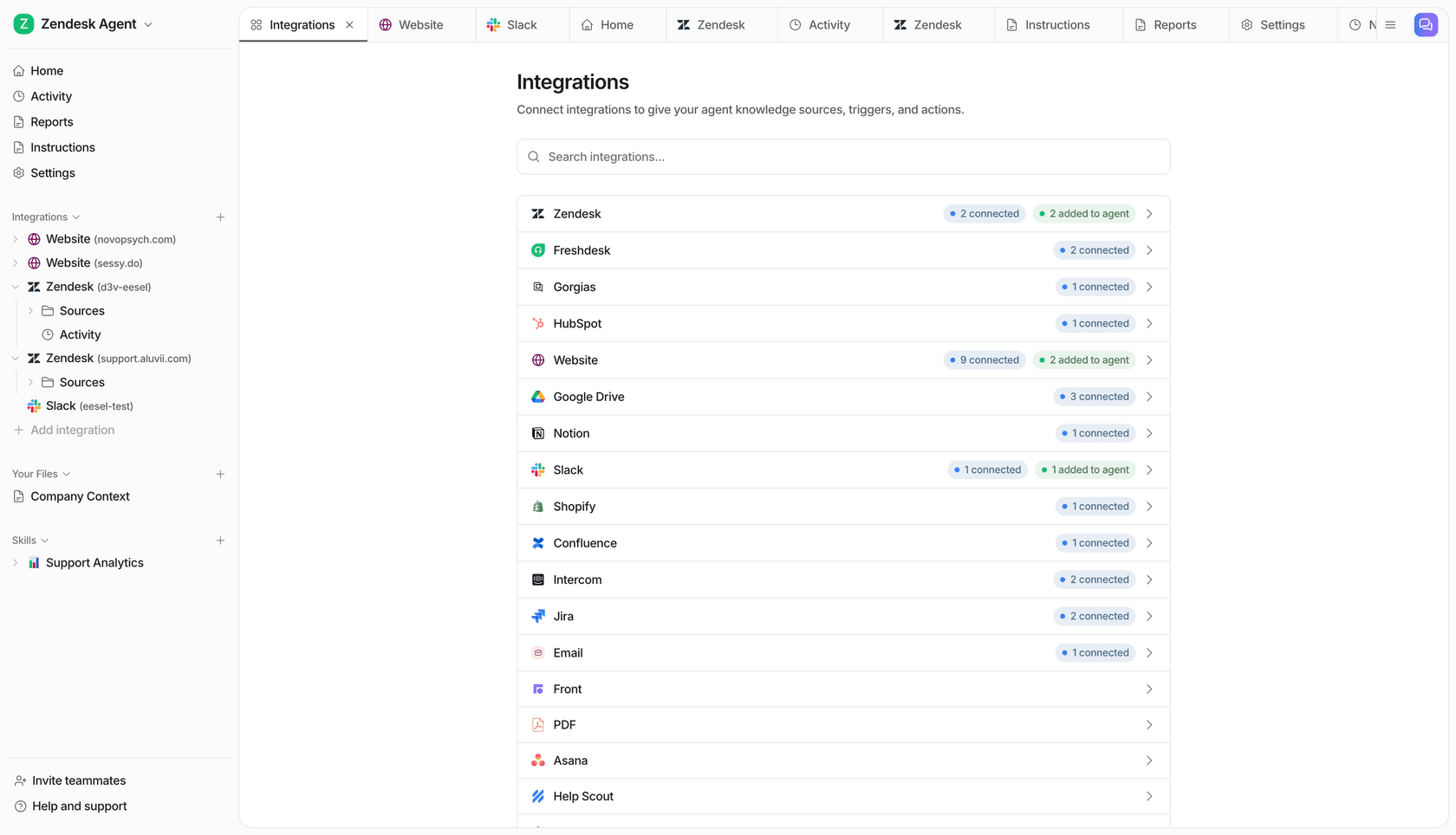
Two differences from Route 1 stand out to me as someone who wires these things together. First, eesel uses your macros as a knowledge source rather than ignoring them, so the years your team spent on canned replies are not wasted. Second, it works alongside your existing Gorgias Rules and automation rather than asking you to rebuild them. It also runs on every channel Gorgias supports (email, chat, Instagram, Facebook, SMS), and you scope exactly which tickets it touches by channel, tag, or intent.
Simulate before you spend
This is the feature I would not want to run a rollout without. Before eesel touches a live ticket, you can run it over your past Gorgias tickets, compare its answers to what your team actually sent, and get an accuracy score plus a gap report. You see where it is strong on WISMO, returns, and product questions, find the weak spots, and only go live when it clears your bar. Your customers never see a bad answer during testing, and you can do all of it on a free trial before any spend.
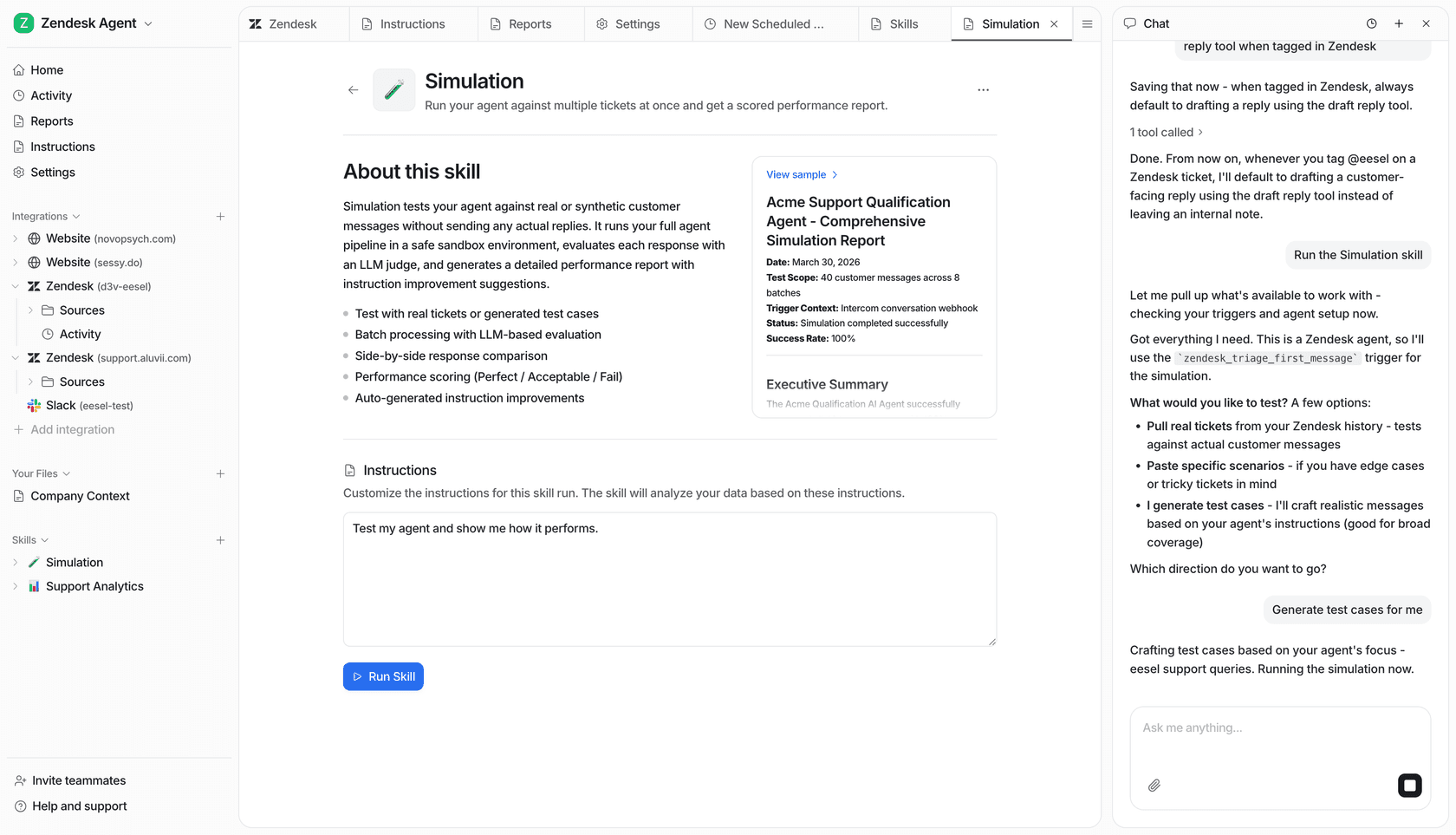
We built simulation because we learned the hard way, across years of putting AI on live support queues, that a confident-sounding bot will quietly give wrong answers if you let it loose untested. Running it against real history first is the difference between a launch and a cleanup.
What eesel costs
eesel is one fixed monthly price sized to volume: 1 credit per ticket or helpdesk conversation the AI handles, counted once including all the back-and-forth, not per reply. There is no platform fee, no per-seat fee, and no separate automation charge stacked on top. Only tickets the AI actually works use credits, so a partial rollout where humans still handle most of the queue fits a smaller plan.
| Tickets handled by AI / mo | eesel plan | Monthly cost |
|---|---|---|
| Up to 100 | Free plan (100 credits) | $0 |
| Up to 500 | 500 credits | $299 |
| Up to 1,000 | 1,000 credits | $499 |
| Up to 2,500 | 2,500 credits | $999 |
Source: the eesel pricing page. The point of a fixed monthly price is predictability: you pick the plan that fits your volume, and any overage is optional and capped at a limit you set. For a mostly-conversational Shopify queue, that usually lands cheaper than paying a ticket fee plus a per-resolution automation fee on the same conversations.
The honest limits
To hold eesel to the same standard as Gorgias: PII redaction on the Gorgias path follows your workspace default when past tickets sync, but it has no toggle of its own yet (the toggle lives on Zendesk today). And eesel is a layer, not a helpdesk, so it does not replace Gorgias's inbox, ticketing, or Shopify-native storefront features. It sits on top of them. If you want the whole stack from one vendor, that is an argument for Route 1.
So which route should you pick?
Here is the call, without the hedging.
Pick the native Gorgias AI Agent if you are all-in on Shopify, a large share of your tickets need real store actions (order edits, cancellations, refunds), and you want AI and helpdesk from a single vendor. The per-resolution pricing is fair for action-heavy queues, and the Shopping Assistant angle is a genuine plus if you want AI to help sell, not just support.
Pick an AI layer like eesel if your volume is mostly conversational, you want a fixed, predictable monthly bill, you want to keep using the macros your team already built, or you are not on Shopify at all. The ability to simulate against your own tickets before spending is the tiebreaker for most teams I talk to, because it turns "we think this will work" into a number you can see before you commit.
You are not locked in either way. The lowest-risk move is to run an eesel simulation on your real Gorgias history first: it costs nothing, and whatever it shows makes the decision for you.
Try eesel on your Gorgias helpdesk
If you want an AI for Gorgias that works like a new hire rather than a rip-and-replace, eesel plugs into your existing inbox in under 30 minutes, learns from your past tickets, macros, and Shopify order data, and lets you simulate it on real history before it touches a single customer. It starts at $299/month for 500 credits (1 credit per ticket), with no platform fee and no per-seat pricing, so you can size the plan to the volume you actually route to it. Gridwise put it simply after their first month:
"In the first month, eesel is resolving 73% of our tier 1 requests. Our team implemented and achieved results quickly during our 7-day trial."
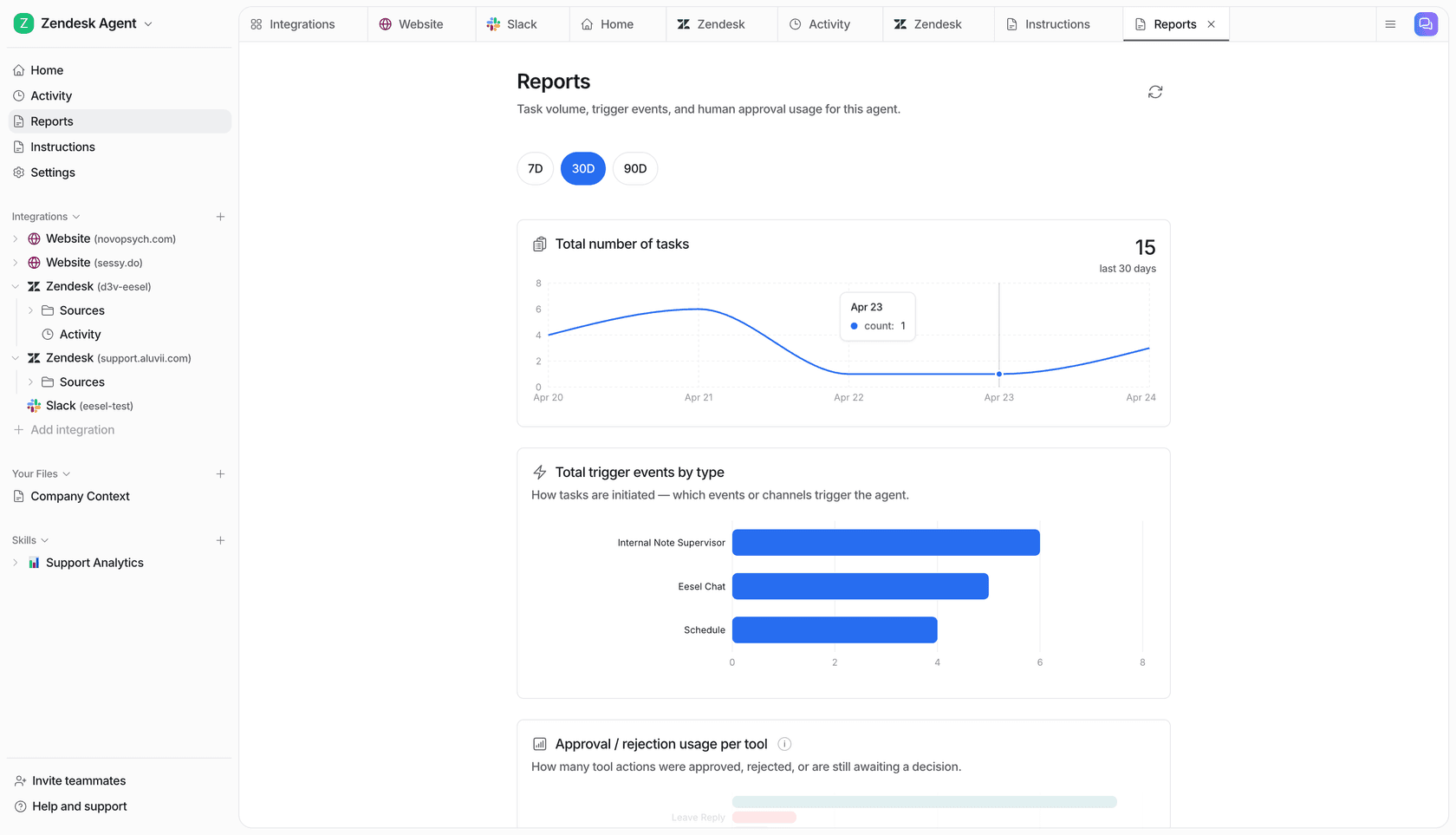
You can start free and run your first simulation without a credit card. Whichever route you land on, test it on your own tickets before you trust it with your customers.