Gorgias AI vs Siena AI: which fits your ecommerce support in 2026?

Kurnia Kharisma Agung Samiadjie

Katelin Teen
Last edited September 22, 2026

The quick version: what each one actually is
I've spent the last three-plus years helping put AI agents on live ecommerce support queues, and the single most common mix-up I see in "Gorgias vs Siena" searches is treating them as two versions of the same thing. They're not.
Gorgias is a full helpdesk: a shared inbox across email, chat, SMS, and social, with an AI Agent baked into the same product. When you buy Gorgias, the AI and the place your agents work are one system. Siena is different. It's an "AI CX operating system" that overlays your existing helpdesk, so it plugs into Zendesk, Gorgias, Gladly, Dixa, and others and works the conversations there. That means Siena can literally run on top of Gorgias.
So the honest framing is: one of these is your helpdesk, and the other is a layer you add to a helpdesk. That changes everything downstream, from how you're billed to how hard it is to leave.
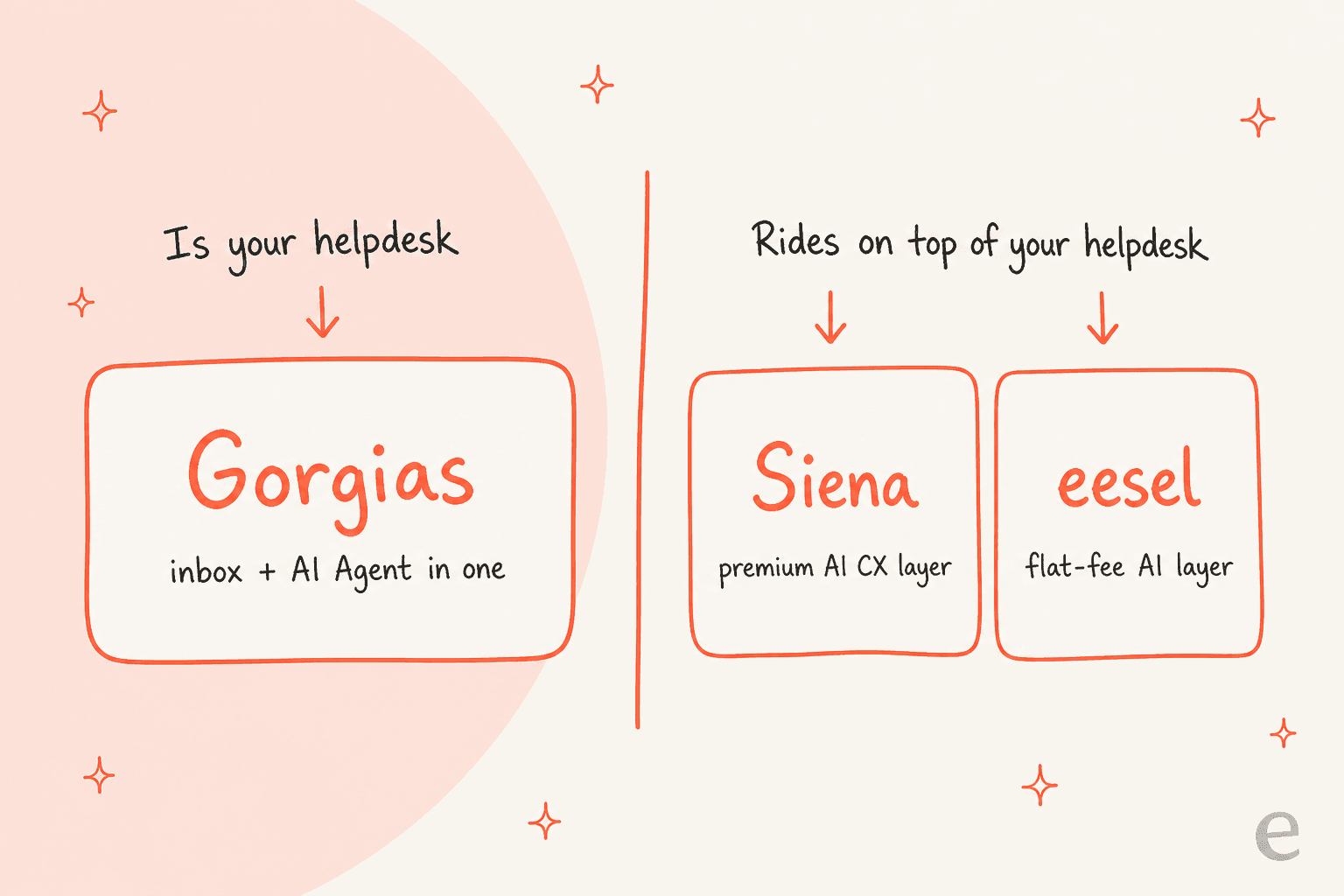
That's also why I've put a third name on that diagram. eesel is an AI helpdesk teammate that, like Siena, layers on top of your current helpdesk, but it bills like nothing on this page. Keep it in the back of your mind as the "what if I want the layer model without the premium floor" option.
Gorgias AI: the Shopify-native helpdesk
Gorgias is the incumbent in ecommerce support for a reason. It powers customer conversations for a big slice of Shopify brands, and its whole design is built around one idea: your support tool should know your store. Orders, customers, and subscription data live inside Gorgias natively, so an agent (or the AI) can cancel an order, apply a discount, or process a return without leaving the ticket.
The AI Agent is pre-trained on a huge corpus of ecommerce conversations and built on a direct OpenAI partnership. It resolves pre- and post-sale FAQs, edits orders and subscriptions, generates dynamic discounts, and escalates to a human with context when it can't finish the job. The nice touch is that it shows its work.
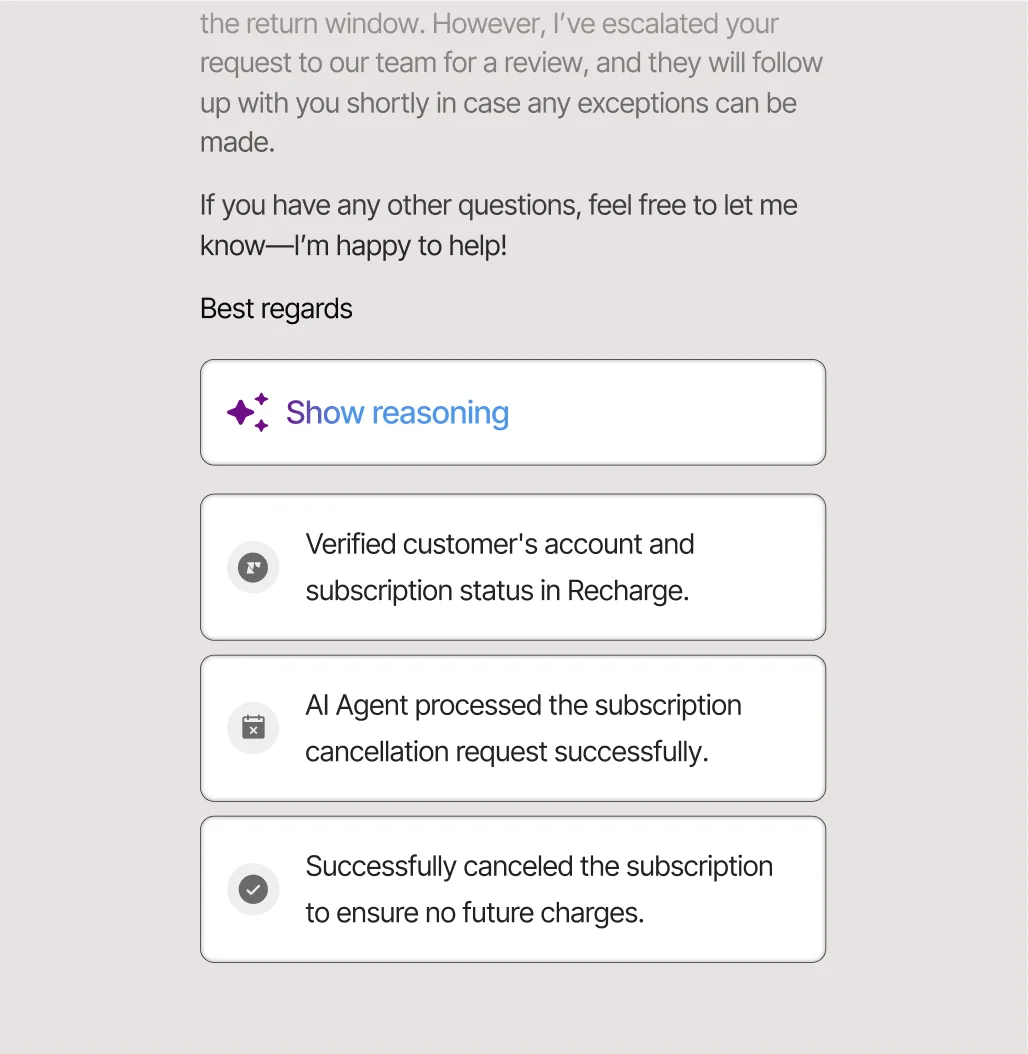
That "show reasoning" trail, where the AI verifies a customer in Recharge, processes the cancellation, and confirms it, is the kind of concrete, in-store action Gorgias does well. It's the payoff of everything being one platform.
The community view is consistent. On a Shopify helpdesk thread, one ten-year ecommerce veteran laid out the decision rule cleanly:
"I've been around ecommerce for 10+ years and this is honestly how I'd choose: 40%+ tickets need Shopify actions → I'd lean Gorgias. Mostly conversational support → Zendesk is fine."

The recurring objection is price, and it's about scaling, not the sticker:
"Gorgias is awesome if you're super deep into Shopify workflows... The downside is the price adds up quick once your volume grows."
Gorgias pricing
Gorgias sells two metered products on one bill: Helpdesk (per billable ticket) and AI Agent (per automated interaction). Every plan card bundles an AI Agent allowance into the headline price. Here's the self-serve ladder from the pricing page.
| Plan | Bundled price (annual) | Tickets/mo | Automated interactions included | Overage per automated interaction |
|---|---|---|---|---|
| Starter | $40/mo (monthly only) | 50 | 30 | $1.50 |
| Basic | $77/mo ($924/yr) | 300 | 30 | $1.50 |
| Pro | $471/mo ($5,652/yr) | 2,000 | 190 | $1.50 |
| Advanced | $1,227/mo ($14,724/yr) | 5,000 | 530 | $1.50 |
| Enterprise | Custom | 5,000+ | Custom | Not published |
The part that catches people is the double meter. Per the billing docs, a fully automated conversation is charged a ticket fee and an automation fee. If the AI hands off to a human, you're not billed twice, but the moment it resolves on its own, both meters tick. Inside your plan allowance the effective automated rate lands around $0.90; past it, every extra automated interaction is $1.50.
Siena AI: the premium AI layer for consumer brands
Siena, founded in 2022 by Andrei Negrau and Lisa Popovici, takes the opposite architectural bet. Instead of being your helpdesk, it's "the AI CX operating system for consumer brands", one intelligence layer running several agents across support, shopping, reviews, QA, and voice-of-customer. It's given a personified identity ("Siena", "her"), and the pitch leans hard on empathy and brand voice.
That brand-voice angle is the real differentiator. Siena's AI Personas are tuned to your tone, and reviewers repeatedly describe replies that sound like a teammate rather than a bot.

You can hear the personality in that reply, playful, warm, on-brand. It's the thing Siena's happiest customers rave about:
"Siena handles thousands of tickets for us each month, responding just like a member of our team. She has the perfect balance of empathy and information."

Siena scores 4.8/5 across 28 reviews on G2 (92% five-star), with strong marks for quality of support and a customizable, user-friendly dashboard. It's genuinely well-liked. The pool is small, though, and the profile is unclaimed, so read it as a shallow-but-honest signal rather than a deep one.
The consistent gripe is escalation, which matters a lot for this comparison and I'll come back to it. It's also worth knowing Siena is deep on DTC integrations, Recharge, Skio, Loop Returns, AfterShip, Okendo, so if your stack is subscription-heavy, it speaks your language.
Siena pricing
Siena doesn't publish a self-serve plan table. Final pricing is quote-based behind a sales form, but the page does disclose the components:
| Component | What it covers | Price |
|---|---|---|
| Platform fee | Core AI engine + unlimited sandbox | $750/month flat |
| Automation Pack | Usage on automated tickets | $0.90 per automated ticket |
| Support & Implementation | Onboarding + dedicated Slack support | Not disclosed |
There's no free plan and no published minimum beyond the $750/month platform fee. "Automated ticket" isn't precisely defined (resolution vs conversation), which makes true cost comparison harder until you're in a sales call. Siena itself argues for outcome-based pricing, which is a fair position, just know the floor is real before you start.
Pricing head-to-head
Here's where the category difference shows up in your invoice. Three products, three billing shapes.
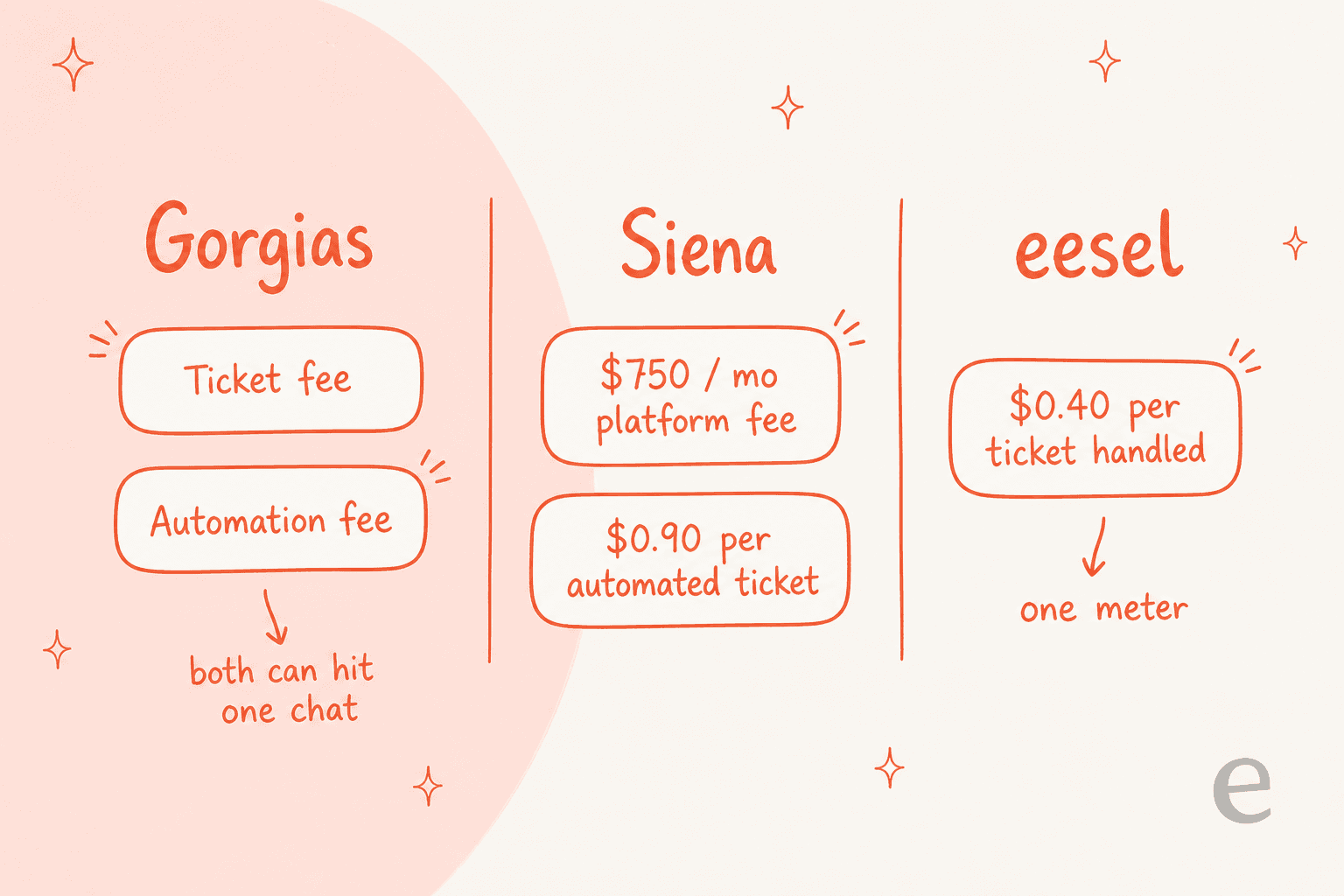
Gorgias stacks a ticket fee and an automation fee. Siena adds a fixed $750/month floor to a per-ticket rate. The flat-rate model on the right, which is how eesel prices, runs a single meter with no floor. To see what that means at your volume, plug your own numbers in:
Take a mid-sized Shopify brand at 2,000 tickets a month with half handled by AI. Siena lands around $1,650/month once you add the platform fee. Gorgias climbs fast because every automated interaction past the plan allowance is $1.50. A flat $0.40-per-ticket layer sits far below both. The gap isn't marketing spin, it's just what happens when one model has a fixed floor, one double-meters automation, and one runs a single rate.
One more honest note on units: Gorgias and Siena bill per automated resolution, while eesel bills per ticket handled regardless of outcome. If your AI resolves most of what it touches, the flat rate wins comfortably. If it barely deflects anything, per-resolution can look cheaper on paper, which is exactly why you want to test resolution before you commit.
The thing buyers actually decide on: confidence and control
Features and price get the headlines, but I'll tell you what actually closes or kills these deals in ecommerce, because I've watched it happen. It's whether the AI only answers what it's confident about, and hands everything else to a human.
We lost a deal once with a DTC brand on Gorgias doing about 7,000 tickets a month. They went with a competitor we couldn't beat on one thing: we couldn't demonstrate confidence-based routing at the time. Their reasoning was simple and correct: they could not risk a confident-sounding bot firing wrong answers at customers. It's the sharpest lesson we've had, and it rebuilt how we think about rollouts.
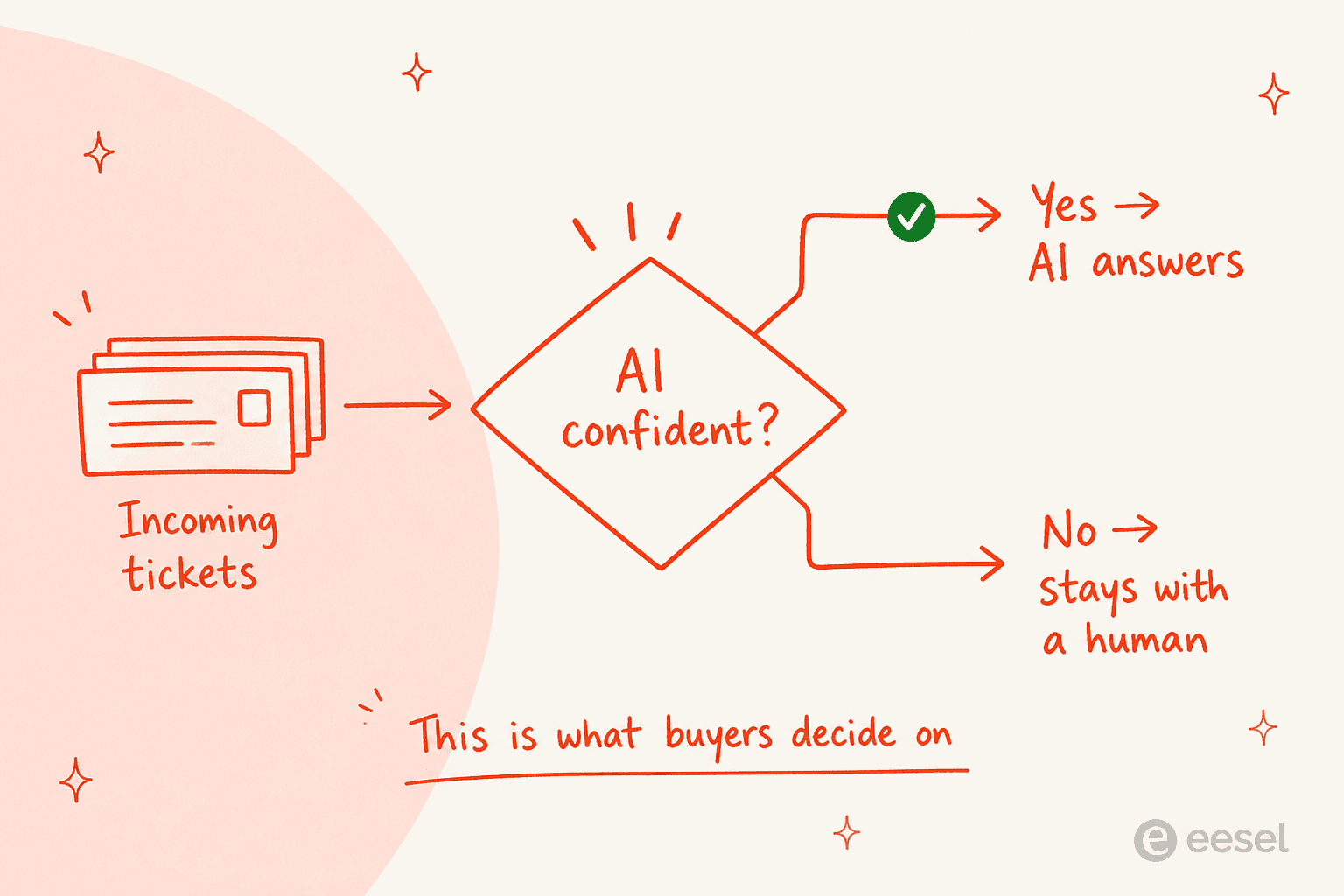
This is exactly where Siena's reviews get pointed. Escalation is the single most-repeated complaint on its G2 profile:
"There are times where Siena will route a conversation to our live agents, but continue responding thinking that it's a 'new' conversation. It adds confusion..."
The lowest-scored review on the profile is built entirely around it, and the title says it all: "Good 93% of the time, really bad the other 7%." When AI over-answers instead of escalating cleanly, that 7% is the part your customers remember.
Gorgias handles the handoff differently: when the AI can't resolve a conversation, it shifts back to your Helpdesk plan and a human picks it up. That's cleaner by design, though you're still trusting the AI to know when it's out of its depth.
The general principle for both: before you let any AI auto-reply to customers, you want to see how it behaves on your tickets, not a vendor demo. That's the whole reason simulation on past tickets matters, it replays your real history and scores the AI's answers against what your team actually sent, so you find the gaps before a customer does instead of after. It's also the cheapest insurance against AI hallucinations in support.
Gorgias vs Siena: which should you pick?
Here's the straight version, with a fair read on each.
| If you're... | Lean toward |
|---|---|
| All-in on Shopify and want inbox + AI on one platform | Gorgias |
| A single or small team where the automation overage stings | Reconsider Gorgias volume, or a flat-rate layer |
| A fast-growing consumer brand that wants a very on-brand AI persona | Siena |
| Subscription-heavy (Recharge, Skio) and fine with a sales quote | Siena |
| Keeping your current helpdesk but adding AI without a $750 floor | An AI layer like eesel |
| Nervous about wrong answers going out | Whichever proves confidence routing on your tickets first |
Both are good at what they're built for. Gorgias is the strongest pick if you want everything in one Shopify-native system and your ticket mix is heavy on order actions. Siena is the strongest pick if brand voice is the thing you'd fight for and you've got the budget for the platform floor. The trap with either is committing before you've seen how it routes and resolves on your own history.
Try eesel for your Gorgias or Shopify support
If you read all that and thought "I want the layer model, without the $750 floor or the double meter," that's the gap eesel fills. It's an AI helpdesk teammate that joins your existing helpdesk, Gorgias, Zendesk, Freshdesk, or Front, learns from your past tickets and live Shopify order data, and drafts or sends replies right inside the inbox your agents already use.

The two differences that matter here: it bills one flat $0.40 per ticket handled, no platform fee, no per-seat fee, no minimum, and it lets you run a simulation on your own tickets so you can see the resolution rate and catch the misses before it ever replies to a customer. You get $50 of free usage to start, no card required. If you're weighing this specifically against Gorgias' built-in agent, there's a deeper Gorgias comparison here.
Frequently Asked Questions
What is the difference between Gorgias AI and Siena AI?
How much does Siena AI cost compared to Gorgias AI?
Is Siena AI good for Shopify stores?
Does Gorgias AI or Siena AI handle escalation to humans better?
What is the best AI for Gorgias if I do not want two meters?



Article by
Kurnia Kharisma Agung Samiadjie
Kurnia is a software engineer and writer at eesel AI with two years of SEO experience, writing about AI tools, helpdesk software, and customer support. He pairs a developer's understanding of how these products are built with search-driven research into what actually ranks and resonates with the people searching for them.