The 12 best Gorgias AI alternatives and third-party AI agents in 2026

Riellvriany Indriawan

Katelin Teen
Last edited October 14, 2026

Why ecommerce teams leave Gorgias AI Agent
Let me start with the honest part: Gorgias is genuinely good at what it does. It powers customer conversations for 40% of Shopify brands, its AI Agent is pre-trained on 18+ ecommerce verticals, and because orders and customer data live natively inside the tool, it can cancel, refund, and edit orders inside a chat without a clunky sync. If most of your tickets are "where is my order" and "I need to change my address," Gorgias earns its keep.
So why do people leave? I work the support queue every day, and I hear the same two stories from ecommerce teams switching off it.
The first is the bill. The Gorgias AI Agent is included on every plan and priced per automated interaction, at $0.85 to $1.00 per resolved conversation depending on plan ($1.00 on Starter, $0.90 on Basic and Pro, $0.85 on Advanced). That sounds fine until you read the next line: each AI Agent interaction also counts as one billable helpdesk ticket against your plan's allowance. So one automated resolution can draw down two meters at once. Accounts created before May 28, 2025 that have not subscribed to AI Agent and upgraded may still be on legacy pricing, which counts a ticket on one meter, not both. One founder I saw run a trial ran twelve clean test chats, loved how the agent handled them, then opened the billing page and immediately asked to cancel:
The agent performed well in every test. Then I saw what it would actually cost at our volume and I panicked. Please cancel my subscription.
A Gorgias trial user, paraphrased from an internal eesel sales call (anonymized)
That is not a knock on the product working. It is a pricing-model problem, and it is the single most common reason the ecommerce teams I talk to start shopping for alternatives.
The second story is about trust. A confident bot that guesses wrong on a refund policy is worse than no bot, because you cannot afford to re-check every answer it sends. One CX lead running roughly 7,000 tickets a month on Gorgias put the requirement perfectly:
The AI will never be able to answer 100% of the questions, but if it just answers 'sorry I don't know,' I cannot go and check all my 7,000 tickets to see if the AI made a good answer. I need an AI that only handles the tickets it is confident about and leaves all the others alone.
A DTC CX lead running ~7,000 Gorgias tickets a month, from an internal eesel sales call (anonymized)
That is the bar. The best Gorgias alternatives give you a real way to predict behaviour before go-live and a real way to keep the bot quiet when it is unsure. Keep those two things in mind as you read.
How I picked, and what to compare
I limited this list to tools that can actually resolve ecommerce support tickets end to end, not just draft replies, and I focused on the dimensions that decide the real cost and the real risk:
- How it bills you. Per resolution, per conversation, per session, or per ticket are not the same thing, and the difference can be 3x on the same volume.
- Shopify and ecommerce depth. Can it read order data and take actions, or just answer FAQs?
- Testing before go-live. Sandbox scenarios you write yourself are fine. A replay of your own past tickets is much better.
- Setup effort. Does it bolt onto your current stack, or force a migration?
Here is the whole field at a glance.
| Tool | Best for | How the AI bills | Starting plan | Ecommerce depth | Test before launch |
|---|---|---|---|---|---|
| eesel AI | Keeping your helpdesk, fixing the AI | From $299/mo (500 credits) | 100 free credits | Shopify order lookups + actions | Simulation on your past tickets |
| Richpanel | Shopify-native all-in-one | Fixed, one invoice | Custom / guarantee-based | Deep (refunds, cancels, returns) | AI ramp-up / copilot mode |
| Re:amaze | SMB multichannel | $0.85 / resolution | $29/seat (Basic) | Order data in-conversation | AI Beta sandbox |
| Zendesk AI | Enterprise scale | $1.50-$2.00 / resolution | $55/agent (Suite Team) | Via Shopify app | Sandbox (higher tiers) |
| Freshdesk Freddy | Email-first teams | $49 / 100 sessions | $19/agent (Growth) | Via marketplace apps | Studio preview |
| Tidio Lyro | Small live-chat stores | $0.50 / conversation | $0 (50 free convos) | Catalog + Smart Actions | Playground |
| Help Scout | Simple human-feel inbox | $0.75 / resolution | $25/user (Standard)* | Via integrations | Private scenario test |
| Zoho Desk Zia | Zoho-ecosystem teams | Enterprise-tier bundle | $14/user (Standard) | Via integrations | Sandbox (Enterprise) |
| Yuma AI | AI agent inside Gorgias | ~$1.20-$0.75 / full resolution (annual) | $14,400/yr (Starter) | Shopify, Recharge, Loop + more | First 30 days free |
| Siena AI | Consumer brands, many channels | $0.90 / automated ticket + $750/mo platform fee | Quote | Shopify, Recharge, Loop + more | Unlimited sandbox |
| Forethought | Larger multi-agent setups | Quote-only | Quote (Team plan) | Via custom actions | Proof of concept |
| Decagon | Enterprise agent builders | Quote-only | Demo-led | Via integrations | Simulations |
*Help Scout seat pricing varies by plan and volume; the AI Answers add-on is the $0.75 line item on top.
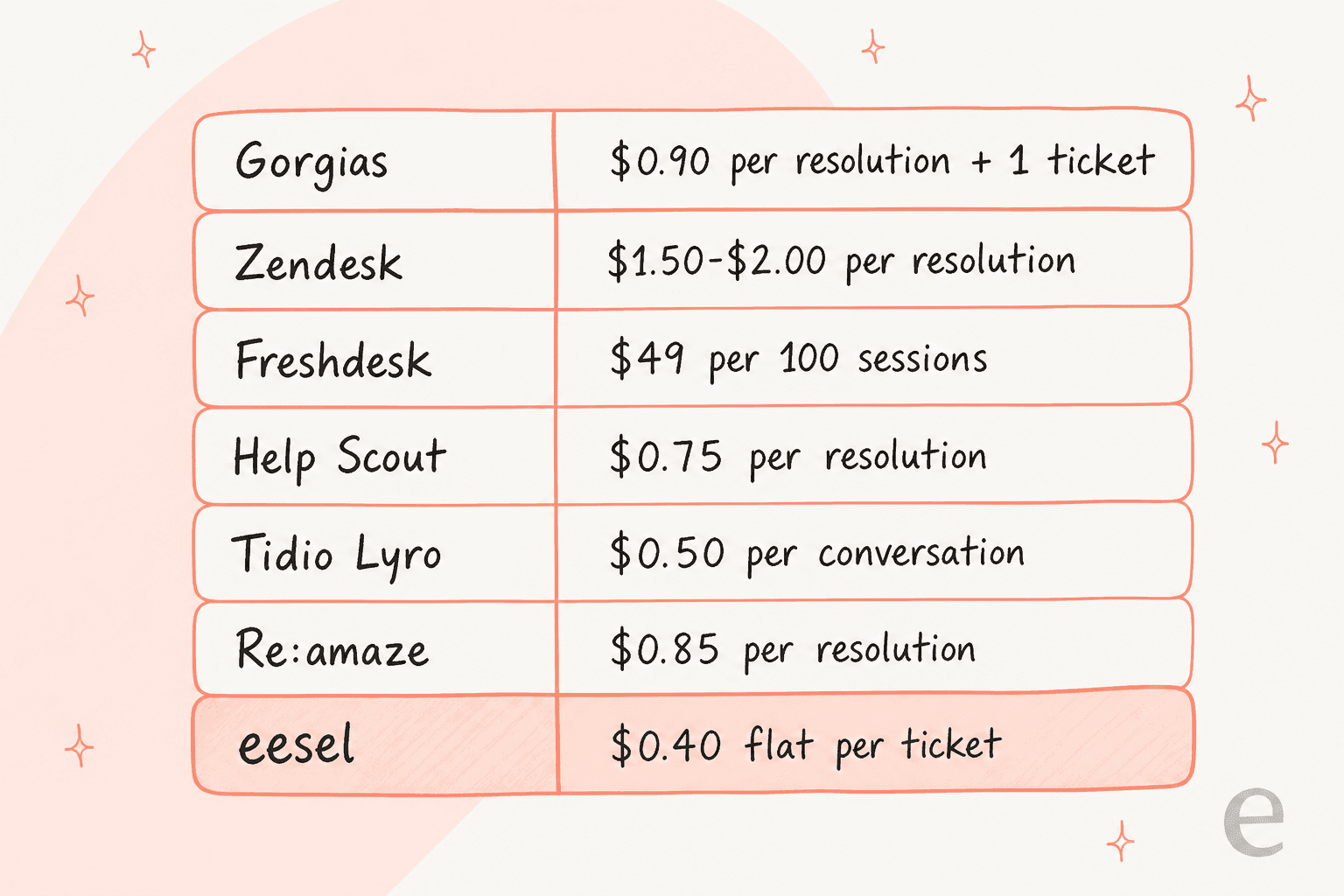
The billing column is the one to stare at. Now let me go through each option in detail.
1. eesel AI - best for keeping your helpdesk and just fixing the AI
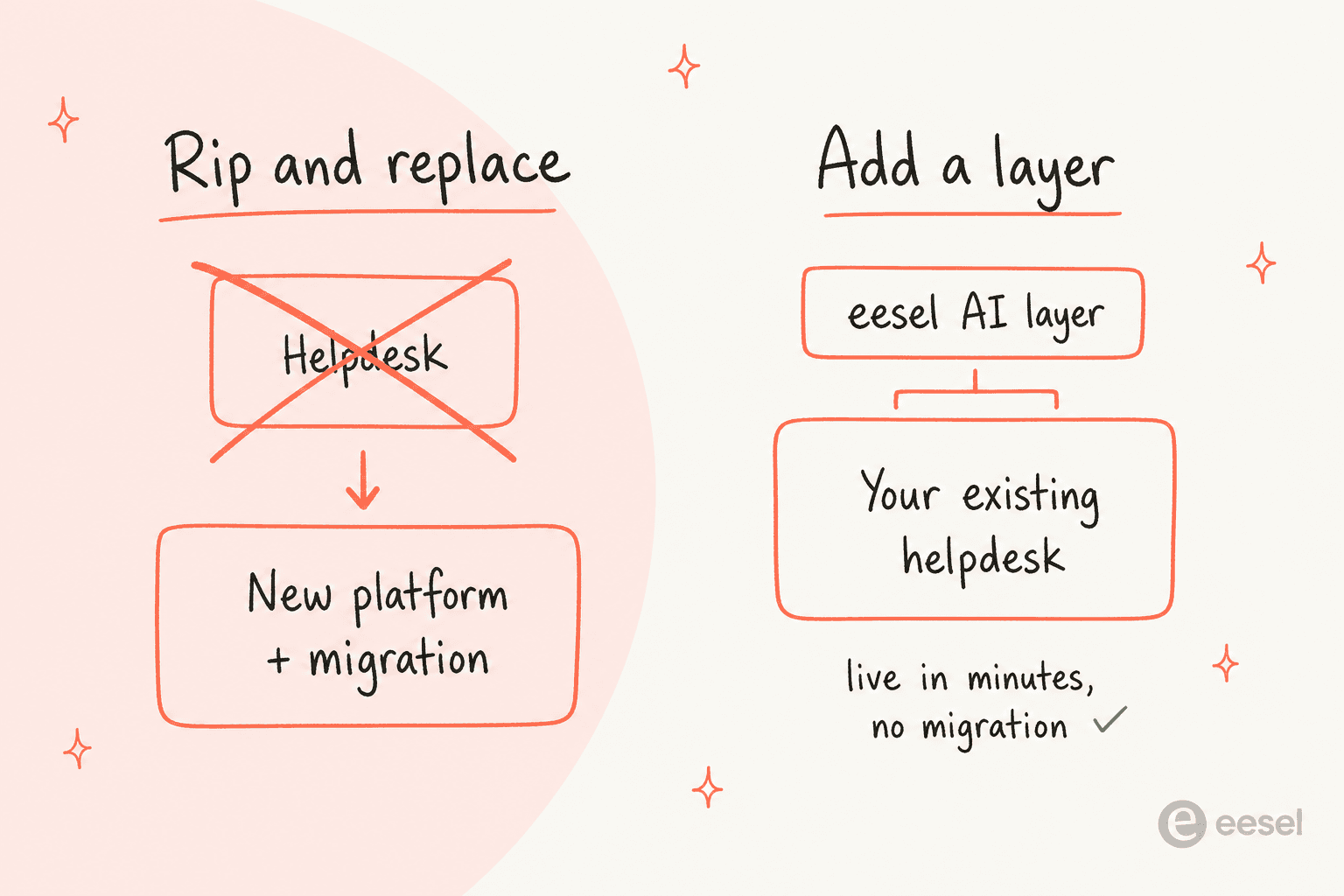
Most Gorgias alternatives ask you to move house. eesel does the opposite: it is an AI layer that plugs into the helpdesk you already run and resolves the front line, so you keep your inbox, your macros, your history, and your team's muscle memory. If the reason you are leaving Gorgias is the AI bill and not the helpdesk itself, this is the least disruptive fix on the list.
Features. eesel trains on your past tickets, help center, and docs, and connects to Shopify to look up orders and take action inside a conversation. Its standout feature is simulation: it replays your real historical tickets in a sandbox, scores each answer against what your team actually sent, and shows you where it is weak before a single reply goes out. That directly answers the "I can't re-check 7,000 tickets" problem, because you see the behaviour up front. It also lets you dial exactly which topics the AI handles and leaves the rest for humans, so it stays quiet when unsure. eesel lists 1000+ integrations and works with Gorgias, Zendesk, Freshdesk, and Help Scout.
Pros. No migration, live in minutes. Flat, predictable pricing. Simulation on your own tickets is rare at this price. You only pay for tickets you actually route to AI.
Cons. It is an AI layer, not a full helpdesk, so if you also want to replace your inbox this is not that. It is newer than the incumbents, so it has fewer decade-old marketplace integrations than Zendesk.
Pricing. One fixed monthly price on the Teammate plan, with no per-seat fees and no platform fee. One credit is one ticket no matter how many messages go back and forth. You start free with 100 credits, no credit card. If your team handles 1,000 tickets a month but routes only 200 to AI, you use 200 credits and fit the 500-credit plan at $299/month, never paying for the tickets humans handle. Paying a year upfront gets two months free, and SSO, priority support and data residency are available as add-ons.
| Monthly credits | Price |
|---|---|
| 100 | Free |
| 500 | $299/mo |
| 1,000 | $499/mo |
| 2,500 | $999/mo |
| 5,000 | $1,899/mo |
Our take: pick eesel if your helpdesk is fine and it is the AI economics that broke. With one fixed monthly price, no double billing and a simulation you can trust, it is the most forgiving way off Gorgias AI Agent, and you do not have to explain a platform migration to your team.
2. Richpanel - best for a Shopify-native all-in-one rebuild
If you do want to replace the whole thing, Richpanel is the closest like-for-like to Gorgias: an ecommerce-first platform that combines the helpdesk and the AI agent on one invoice, aimed squarely at Shopify brands. Its whole pitch is built around switching off Gorgias, and it names Gorgias directly in its comparisons.
Features. AI agents that resolve end to end (refunds, cancellations, order actions), a self-service portal, an AI ramp-up mode that starts by drafting every reply then goes autonomous when you are ready, and a Voice of Customer AI that reads every conversation to surface your top contact drivers. It ships a migration wizard that imports from Gorgias, Zendesk, Help Scout, and Kustomer, with a one-to-two-week go-live.
Pros. Genuinely ecommerce-native, on the Shopify App Store with a 5-star rating across 152 reviews. The commercial hook is bold: a "Double-Savings" money-back guarantee of at least 30% automation in the first 30 to 60 days or a full refund, even on annual. Named customers like Snow report 40% fewer tickets after moving from Gorgias.
Cons. It is a full platform switch, so you inherit all the switching cost you were avoiding. Public pricing is quote-led rather than a clean per-unit rate, so you need a call to know your number.
Pricing. Fixed pricing on one invoice, structured around the automation guarantee rather than a published per-resolution meter. Onboarding splits by team size (under 30 agents vs 30 or more).
Our take: pick Richpanel if you are committed to leaving the Gorgias platform entirely and want another Shopify-native home with a hard automation guarantee. If you only wanted to fix the AI, this is more change than you need.
3. Re:amaze - best for SMB ecommerce multichannel
Re:amaze is a friendly, bright multichannel helpdesk built for small-to-mid ecommerce teams, owned by GoDaddy but run as its own brand. It unifies email, chat, social, SMS, and even video and push campaigns into one inbox, with AI layered on top.
Features. A shared multichannel inbox, native live chat and chatbots (a Welcome Bot and Order Bot ship in the box), real-time customer activity monitoring with shopping data, and a 24/7 AI Agent. One thing to know: Re:amaze labels its whole AI suite as Beta, which is honest of them but worth weighing if AI is the main reason you are switching.
Pros. Chat, chatbots, proactive cues, and co-browsing all ship as first-party features rather than paid add-ons. BuiltBar reported support speed up 5.6x after adopting it. The flat Starter plan is unusually generous for larger teams with low volume.
Cons. The AI being in Beta means it is less battle-tested than Gorgias or Zendesk. External knowledge is FAQ-driven, and its ecommerce actions are lighter than Gorgias's deep Shopify write-backs.
Pricing. Starter is $59 flat per month for all seats (500 conversations); Basic is $29/seat, Pro $49/seat, and Plus $69/seat. AI Agent resolutions are included at 5, 10, and 20 per user per month depending on plan, with overage at $0.85 per resolution. There is a 14-day free trial, no card. See our Re:amaze review for the deep dive.
Our take: pick Re:amaze if you are a small DTC team that wants a warm, all-in-one multichannel inbox and can live with AI that is still officially Beta. If you want more options in this lane, our Re:amaze AI alternatives post lines them up.
4. Zendesk AI - best for larger teams that need enterprise depth
Zendesk is the enterprise standard, and its AI agents are mature, deeply configurable, and backed by a huge marketplace. For an ecommerce brand it usually connects to Shopify via an app rather than natively, so it trades a bit of out-of-the-box order magic for enormous breadth everywhere else.
Features. Autonomous AI agents, a Copilot for human agents, a knowledge base that can generate articles from tickets, and analytics that go as deep as you want. A useful recent change: since May 2026, only "verified" resolutions (where an LLM confirms the request was actually solved) draw down your resolution allowance, so escalations and unverified attempts no longer cost you.
Pros. The most complete platform here, with the biggest integration ecosystem and the strongest reporting. If you are scaling past a few dozen agents, it holds up.
Cons. Cost. The AI is $1.50 per resolution committed and $2.00 pay-as-you-go, on top of seat licenses that start at $55/agent. That is the priciest AI meter in this roundup, and one high-volume ecommerce operator I spoke to tried native Zendesk AI, found it "expensive and inadequate," and switched away.
Pricing. Suite Team is $55/agent/month (billed yearly), Suite Professional $115, and Enterprise is quote-only. Included automated resolutions are stingy (5 per agent per month on lower tiers, 10 on Professional), so most teams pay the per-resolution rate quickly.
Our take: pick Zendesk if you are a large operation that needs enterprise governance and depth and can absorb the AI cost. If you like Zendesk the helpdesk but not its AI bill, this is a classic case for layering eesel on top instead of paying the $2.00 rate.
5. Freshdesk Freddy - best for email-first teams
Freshdesk is Freshworks' help desk, with a mature ticketing and email core and an agentic AI layer branded Freddy. It is trusted by 74,000+ businesses and is a solid fit if most of your support lives in email rather than live chat.
Features. Freddy splits into three: an AI Agent (customer-facing, built no-code in AI Agent Studio, with a dedicated Email AI Agent), a Copilot that assists human agents, and Insights for leaders. The Email AI Agent's billing quirk is worth knowing: a session is a 72-hour window from the customer's first email, and every AI reply inside that window counts as one session.
Pros. Real email and ticketing heritage, a genuinely free on-ramp for up to 2 agents, and a no-code studio so you can launch email deflection without engineering.
Cons. Consumption pricing on the AI Agent can surprise you after the free allowance, and community users report Freddy handling simple tickets well but stumbling on nuanced ones, pushing teams back to assist mode. Copilot is an extra $29/agent line item on top of seats.
Pricing. Standalone Freshdesk is Growth $19, Pro $55, Enterprise $89 per agent/month (annual); Freshdesk Omni runs higher. The Freddy AI Agent gives the first 500 sessions free (included on Growth, Pro, and Enterprise), then $49 per 100 sessions. Our best Freshdesk alternatives post covers the wider field.
Our take: pick Freshdesk if you are an email-first team that wants a proven ticketing backbone with optional, no-code email AI you can switch on when volume justifies it. It is less ecommerce-native than Gorgias, so pair it with Shopify apps if you need order actions.
6. Tidio Lyro - best for small, live-chat-first stores
Tidio is a live-chat-first platform for SMBs and small stores, and its AI agent, Lyro, is the reason it belongs on this list. It is the friendliest on-ramp here for a small team that mostly does chat.
Features. Lyro is powered by Claude plus Tidio's own models, answers only from your support content to limit hallucinations, and includes Smart Actions (order updates, lead qualification) and real-time product recommendations pulled from your catalog. It works across live chat, WhatsApp, Instagram, and Messenger, and you can even buy Lyro standalone to bolt onto Shopify or another helpdesk.
Pros. The pricing is refreshingly simple and cheap, and Tidio publishes a 67% average resolution rate with a money-back guarantee if it does not lift you to at least 50%. Unlimited replies per conversation, so one chat is one charge no matter how chatty.
Cons. It is built for smaller volumes and simpler support than a high-volume ecommerce operation, and cross-platform integrations require the Premium plan. It is a chat-first tool at heart, so email-heavy queues are less of a fit.
Pricing. $0.50 per Lyro conversation, with 50 free conversations to start. A conversation is one customer interaction with at least one AI reply, and multiple replies still count as one. See our Tidio AI pricing breakdown, or the best Tidio Lyro alternatives if it is close but not quite right.
Our take: pick Tidio if you are a small, chat-led store that wants cheap, simple AI with a resolution guarantee. It is the easiest and lowest-commitment option here, but it will feel light if you are running thousands of email tickets a month.
7. Help Scout - best for a simple, human-feeling inbox
Help Scout has always been the pick for teams that want support to feel personal rather than like a ticket factory. Its AI, AI Answers, is a customer-facing agent that sits on top of that clean shared inbox.
Features. AI Answers resolves customer questions from your knowledge base, web sources, and custom instructions, responds in 50+ languages, and includes a "Test in private" scenario runner so you can see how it handles conversations before launch. Help Scout is SOC 2 Type 2 and HIPAA certified and states it never trains AI with your data.
Pros. One of the cleaner, more human-feeling inboxes in the category, with a published 73.19% average resolution rate and a generous 3 months of free, unlimited AI Answers for new accounts. Spend caps let you disable AI for the rest of the cycle when you hit a limit.
Cons. It is seat-priced, so the per-user fee stacks on top of the AI. It is less ecommerce-native than Gorgias (Shopify actions come via integrations), and its AI improves through a review loop rather than by ingesting your full ticket history.
Pricing. Per user per month for the helpdesk, plus AI Answers as an add-on at $0.75 per resolution (only one resolution charged per conversation). See our Help Scout pricing guide, or Gorgias vs Help Scout for the head-to-head.
Our take: pick Help Scout if a warm, simple inbox matters more to you than deep Shopify write-backs, and you want a fair, per-resolution AI rate with real security certifications. It is a lovely tool that just is not ecommerce-first.
8. Zoho Desk Zia - best for cost-conscious teams in the Zoho ecosystem
Zoho Desk is the value pick, especially if you already live in Zoho's ecosystem of CRM and business apps. Its AI, Zia, plus the Answer Bot, handles self-service and agent assistance, and the whole thing is priced well below the others.
Features. Zia turns past tickets into knowledge base articles, runs content checks, and powers an Answer Bot that surfaces answers to customers and agents. The knowledge base auto-translates into 50+ languages, and a multi-brand help center lets you run separate self-service portals per brand.
Pros. Genuinely cheap seats, deep integration with the rest of Zoho, and 125,000+ companies on the platform. If you want AI support without a big line-item jump, it is the most budget-friendly here.
Cons. The native Answer Bot starts at the Standard tier, but Zia Actions and the pre-built AI agents are reserved for Enterprise. It is not ecommerce-native, so Shopify actions come through integrations, and its AI is less aggressive than a dedicated agent like Gorgias or eesel.
Pricing. Standard is $14/user/month, Professional $23, with Standard adding the native Answer Bot and Enterprise adding Zia Actions, pre-built AI agents and the multi-brand help center. Our Zoho Desk AI pricing post has the full tier map, and Gorgias vs Zoho Desk compares them directly.
Our take: pick Zoho Desk if budget is the driver and you are already a Zoho shop. Just know the strongest AI is gated to Enterprise, and you will lean on integrations for real ecommerce actions.
9. Yuma AI - best for an ecommerce AI agent that runs inside Gorgias
Yuma AI is an ecommerce AI agent that connects to the helpdesk you already run, and Gorgias is one of its live integrations. Like eesel, it is a third-party AI layer, so you keep Gorgias as the helpdesk and swap out the AI that works the queue.
Features. The Gorgias integration lets Yuma read live customer, order, return and subscription data and take actions such as refunds, reships and order edits inside Gorgias tickets. It connects to the wider commerce stack (Shopify, Recharge, Loop Returns, ShipStation, Klaviyo and others), applies brand voice and policy guardrails, and hands off to a human agent with full context when a case is sensitive or unclear. Its plans also list a Yuma MCP for Claude and ChatGPT.
Pros. Built for ecommerce and DTC. The billing unit is narrow: Yuma only charges for a full resolution, meaning a ticket it handled end to end with no human involved, and escalations are free. There is no implementation fee, and the first 30 days are free.
Cons. Every plan carries a 12-month commitment, and the entry plan is sized for brands with real volume, so it is a bigger upfront decision than a monthly tool. Your exact bundle is quoted from your ticket forecast on a demo call.
Pricing. Yuma lists illustrative annual prices, paid upfront: Starter at $14,400/year for 12,000 resolutions (about $1.20 each), Growth at $40,000/year for about 48,000 (about $0.83), and Scale at $90,000/year for about 120,000 (about $0.75). Higher volumes drop toward a $0.55 floor. Monthly plans pay $1.50 per over-quota ticket, and annual plans have no overage.
Our take: pick Yuma if you want to keep Gorgias, you run enough volume to commit to a year, and you like paying only when no human touched the ticket. If you want to start smaller or month to month, compare its entry plan with a fixed monthly option first.
10. Siena AI - best for consumer brands that want one AI layer across channels
Siena AI describes itself as an AI CX operating system for consumer brands: one AI layer that powers agents for support, shopping, social, QA and voice of customer. It sits on top of your helpdesk, and Gorgias is one of the helpdesks it supports.
Features. The Gorgias integration automates replies across email, SMS, WhatsApp, Instagram, Facebook, chat and contact forms, imports your existing Gorgias macros, and lets you choose which channels get automated and exclude specific email addresses. It can skip conversations where a team member is mentioned, and you can toggle automation off during incidents or launches. Siena also connects to Shopify, Recharge, Loop Returns, Skio, Yotpo and others from its integrations list.
Pros. Brand voice is the focus, with AI personas built on your tone and customer language. Importing macros means you build on what your team already uses. The platform fee includes an unlimited sandbox for testing.
Cons. There is a fixed platform fee before the first ticket is automated, so it suits brands with steady volume more than small stores. Final pricing comes through a form and a call.
Pricing. Siena's pricing page lists a $750/month platform fee plus an automation pack at $0.90 per automated ticket, with expert onboarding and dedicated Slack support. You submit your ticket volume and helpdesk to get a quote.
Our take: pick Siena if you are a consumer brand on Gorgias that cares about on-brand replies across many channels and has the volume to justify a platform fee. At 1,000 automated tickets a month, that is $750 plus $900, or $1,650/month.
11. Forethought - best for larger teams that want a multi-agent setup
Forethought is a customer service AI platform built around several AI agents that work together: one that resolves conversations, one that classifies and routes tickets, a copilot for human agents, and one that finds knowledge gaps. Gorgias appears on its integrations page alongside the larger helpdesks.
Features. Forethought says its agents learn from your past tickets and help center content, reason with your business policies, and take actions to resolve tickets end to end across chat, email, voice and more. Triage tags and prioritises tickets with pre-built or custom models, and Assist gives human agents suggested next steps inside the helpdesk. Discover surfaces knowledge gaps and suggests new articles.
Pros. It covers more of the support workflow than the customer-facing bot alone. Training on past tickets means it starts from how your team actually answers. Forethought offers a proof of concept before you commit.
Cons. Some features sit on higher plans: email, voice and Slack agents are on Professional, and knowledge gap detection is on Enterprise. It is a general CX platform rather than one built only for ecommerce.
Pricing. All three plans (Team, Professional and Enterprise) are quote-only, and add-ons like multibrand and the Analytics API are quoted too.
Our take: pick Forethought if you run a larger support team on Gorgias and want triage, a copilot and an AI agent from one vendor. If you only want the customer-facing agent, a narrower tool may be quicker to set up.
12. Decagon - best for enterprise teams that write their own agent workflows
Decagon builds AI agents for large consumer businesses across chat, email and voice, with retail among its industry focuses. Its pitch is control: you write agent behavior in plain language and test it before it goes live.
Features. Agent Operating Procedures (AOPs) let you define workflows in natural language, the same way you write SOPs for human agents, with guardrails for brand voice and escalations. Simulations test agent behavior across channels before deploying and after every update, with scheduled test runs and alerting. Its integrations page names Salesforce and Zendesk among the helpdesks it connects to.
Pros. Detailed testing and visibility tools: you can see why the agent did what it did at each step. Engineering teams can version workflows with Git.
Cons. Gorgias is not among the helpdesks named on Decagon's integrations page, so confirm Gorgias support with their team before you shortlist it. It is built for enterprise scale, which makes it a heavier project than the other Gorgias add-ons here.
Pricing. Decagon does not publish pricing. You get a number through a demo.
Our take: pick Decagon if you are a large brand that wants to write and test complex agent workflows and can confirm the helpdesk connection up front. For most Gorgias stores, a tool with a live Gorgias integration will be quicker to get running.
So which Gorgias AI Agent alternative should you pick?
The honest answer depends entirely on why you are leaving, which is why I opened with those two stories. Map your reason to the tool.
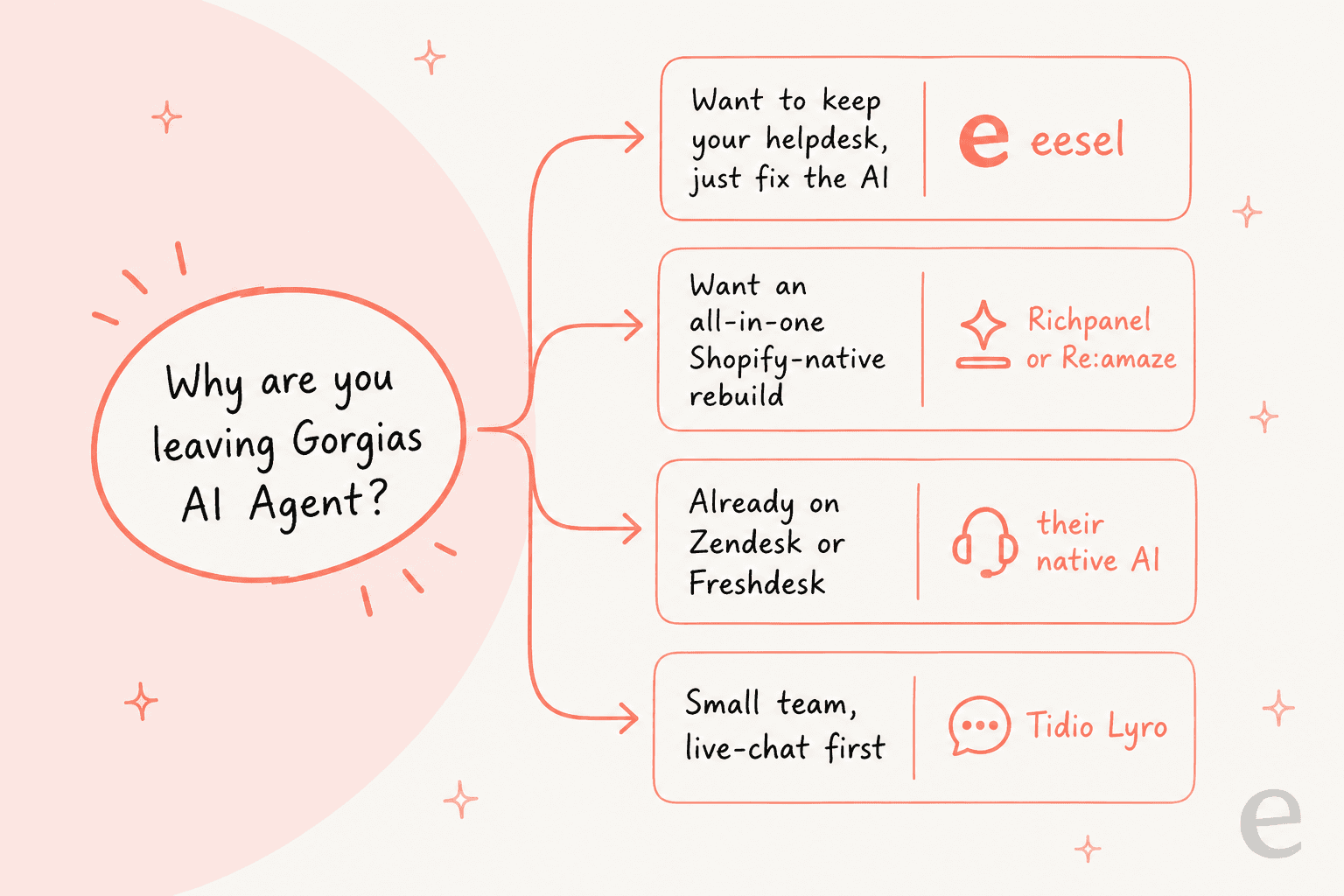
- If your helpdesk is fine and the AI bill broke it, do not migrate. Layer eesel on top from $299 a month and keep everything else.
- If you want to keep Gorgias and add a third-party AI agent, eesel, Yuma, Siena and Forethought all connect to it.
- If you want a Shopify-native rebuild, look at Richpanel or Re:amaze.
- If you are already big on Zendesk or Freshdesk, their native AI may be simplest, cost aside.
- If you are a small, chat-first store, Tidio Lyro is the cheapest, gentlest start.
The one thing I would not do is switch platforms just to escape an AI meter. That is trading a pricing problem for a migration project, and the ecommerce teams I see happiest six months later are the ones who fixed the actual problem, not the whole stack.
Try eesel on top of Gorgias
If the product you are frustrated with is the AI economics and not Gorgias itself, eesel is built for exactly this moment. It plugs into Gorgias (and Zendesk, Freshdesk, and Help Scout) in a few minutes, learns from your help center and past tickets, and resolves the front line on one fixed monthly price from $299 for 500 credits, with no per-seat fee and no interaction billed twice.

The part that answers the "I can't re-check 7,000 tickets" worry: before you go live, eesel runs a simulation against your own historical tickets, scores each answer against what your team actually sent, and shows you exactly where it is confident and where it should stay quiet. You start free with 100 credits, no credit card, no sales call. It is the least risky way to find out whether a cheaper AI can do the job before you ever think about leaving your helpdesk. Try eesel.