BoldDesk pricing in 2026: the real cost once AI is switched on

Kurnia Kharisma

Katelin Teen
Last edited August 19, 2026
What BoldDesk actually charges
BoldDesk leads its pricing page with "One Plan. Every Feature Included. Priced by Your Team Size." That is not a marketing softening, either: the page literally prints Starter, Growth, Pro and Enterprise with strikethroughs over them, then replaces the lot with the line "Just BoldDesk." Every "Try for free" button in every price row points at the same plan id, which is about as strong a confirmation of a single-plan model as you can get from the outside.
I have spent the last few years watching AI get bolted onto live support queues, and the first thing I check now is not the sticker at all. It is how many separate meters are running behind it. BoldDesk has three of them, and only one is the flat price everyone quotes.
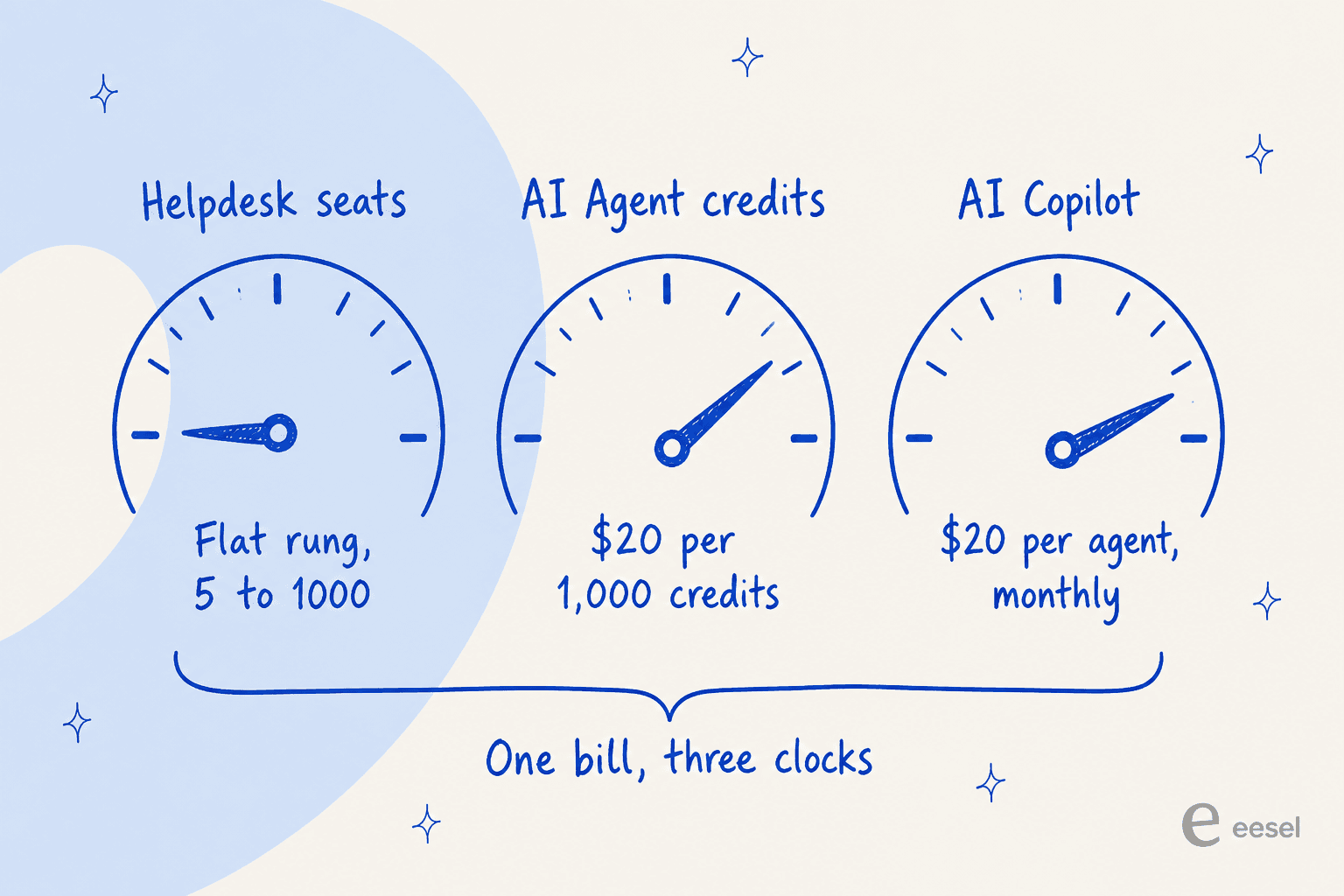
The seat meter is flat, and predictable with it. The other two are usage. That one distinction is basically the whole post.
Every published BoldDesk price
Here is the full ladder as printed, both billing cycles included. The per-agent column is BoldDesk's own rounding off the page, not my arithmetic. The credits column matters much less than it looks, for reasons I get to in a moment.
| Agents | Yearly (per month) | Billed yearly | Per agent (yearly) | Monthly | Per agent (monthly) | AI credits/mo (first 3 months only) |
|---|---|---|---|---|---|---|
| 5 | $99 | $1,188 | ~$20 | $124 | ~$24.80 | 500 |
| 10 | $199 | $2,388 | ~$20 | $249 | ~$24.90 | 1,000 |
| 25 (most popular) | $349 | $4,188 | ~$14 | $436 | ~$17.44 | 1,500 |
| 50 | $499 | $5,988 | ~$10 | $624 | ~$12.48 | 2,000 |
| 75 | $749 | $8,988 | ~$10 | $936 | ~$12.48 | 2,500 |
| 100 | $999 | $11,988 | ~$10 | $1,249 | ~$12.49 | 3,000 |
| 200 | $1,998 | $23,976 | ~$10 | $2,498 | ~$12.49 | 4,000 |
| 300 | $2,999 | $35,988 | ~$10 | $3,749 | ~$12.50 | 5,000 |
| 400 | $3,999 | $47,988 | ~$10 | $4,999 | ~$12.50 | 6,000 |
| 500 | $4,999 | $59,988 | ~$10 | $6,249 | ~$12.50 | 7,000 |
| 600 | $5,999 | $71,988 | ~$10 | $7,499 | ~$12.50 | 8,000 |
| 700 | $6,999 | $83,988 | ~$10 | $8,749 | ~$12.50 | 9,000 |
| 800 | $7,999 | $95,988 | ~$10 | $9,999 | ~$12.50 | 10,000 |
| 900 | $8,999 | $107,988 | ~$10 | $11,249 | ~$12.50 | 11,000 |
| 1,000 | $9,999 | $119,988 | ~$10 | $12,499 | ~$12.50 | 12,000 |
Above 1,000 agents there is no published number. The page routes you to a "Talk to Sales, 1000+ Agents" popup for a custom quote.
Two things are worth to pull out of that table. First, the per-agent rate flattens at 50 seats and then just stops improving, so a 1,000-agent customer pays the same $10 per seat that a 50-agent one does. Unusual, and for the smaller buyer quite friendly. Second, the annual discount is better than advertised. The toggle says "save up to 20%", but run the numbers on any row and it is a flat ~20% everywhere: $124 to $99 is 20.2%, $436 to $349 is 19.9%, $12,499 to $9,999 is exactly 20%. So the "up to" undersells it, which is a rare direction for a pricing page to be wrong in.
One cost detail that catches teams out is that the licences are not only for frontline staff. BoldDesk's FAQ states that "each agent, admin, or manager requires their own license." If you have two admins and a support lead who never touch a ticket, they are billable seats.
The rung problem, or what your 11th agent costs
The ladder is stepped rather than linear, and down at the bottom the steps sit far apart. There is a rung at 10 agents. The next published one is 25.
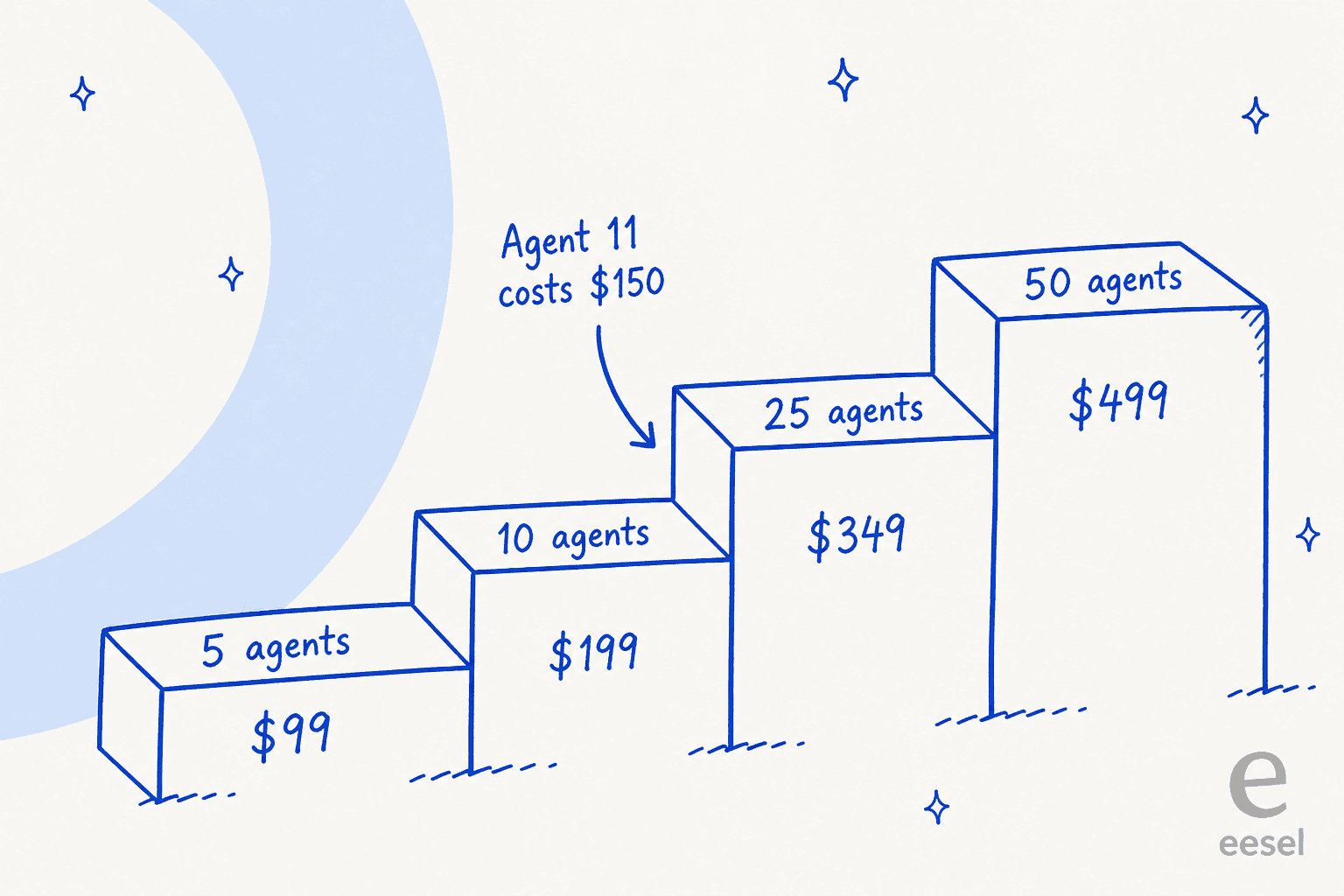
Read as published, a team growing from 10 to 11 agents moves from $199/month to $349/month. That is $150 a month, $1,800 a year, for one hire, and it takes the effective rate from $19.90 per agent up to $31.73 until you have grown into the rung. Anyone sizing a support team into the 11 to 24 range wants to know that before they sign.
I want to be careful here, though, because BoldDesk's FAQ also says "you have the option to add as many agents as you want," and that reads like intermediate counts are possible even where no rung exists for them. The pricing page does not resolve the two statements. If your team sits between two rungs, ask sales in writing whether seat 11 is pro-rated or priced at the 25-agent rung. It is a two-minute question, worth up to $1,800 a year, and the answer is nowhere on the website.
The same logic repeats at 26 agents, and again at 51, and at 76 too, though the damage shrinks as the per-agent rate flattens out. It is the bottom of the ladder where the steps really bite.
What the AI costs after month three
This is the part I would want a buyer to read twice over, because the pricing table presents it in a way which is easy to misread.
The credits column in the table above carries a tooltip. Its text, verbatim: "Limited-time offer: Subscription AI credits are included for the first 3 months from your subscription start date. Additional credits can be purchased thereafter." The column header itself is annotated "(Included for first 3 months)." BoldDesk's AI credits documentation adds that the promotional credits apply to subscriptions starting on or after June 1, 2026, and that they expire monthly with no rollover.
So the 500 to 12,000 credits a month sitting in that column is a 90-day introductory allowance. From month four onward, credits become a purchase.
The two AI meters, priced
| Item | Price | Unit | Cap behaviour |
|---|---|---|---|
| AI Agent (customer-facing) | $20 | per 1,000 credits, packs never expire | Responses stop immediately at zero credits |
| AI Copilot (agent-facing) | $20 | per agent per month | "Unlimited AI, no usage caps" |
| Promotional credits | Free | 500 to 12,000/month by team size | First 3 months only, no rollover |
| Trial credits | Free | 100, one-time | Does not reset during the 15-day trial |
Note how differently the two of them are metered. The customer-facing AI agent is usage-billed in credits. The agent-facing AI Copilot is a flat per-seat charge with unlimited use, which is the better-value half of the two, assuming your agents will actually lean on it.
What burns a credit
Credits get consumed per generated response, and BoldDesk is upfront about the fact you cannot predict the rate: "Because each interaction differs, exact credit usage cannot be predicted or manually configured." The documented bands are about 1 credit for a simple response, 2 to 3 for a moderate one, and 4 to 5 for a detailed or multi-step answer. Greetings and welcome messages burn credits as well, and so do follow-ups and suggested solutions.
At $0.02 per credit, a moderate reply works out around 4 to 6 cents. Cheap, per reply, and I want to give BoldDesk credit for that. The problem is a conversation is not one reply. A chat that opens with a greeting and runs three moderate answers is nearer 8 credits, or 16 cents, and a chatty customer costs more than a terse one for identical outcomes. Your bill tracks how talkative the customers are, which is not really a variable you control.
When credits hit zero, "AI-generated responses stop immediately," while manual ticket handling carries on unaffected. Alerts fire at 50, 60, 70, 80, 90 and 100%, and auto-purchase can top up below a threshold you set. Worth knowing before a Black Friday queue: a hard stop is safer than a surprise invoice, but it means your first-response automation goes dark mid-spike unless auto-recharge is armed, and any live chat deflection stops with it.
One more limit out of the docs, easy to miss and relevant to whether the AI works at all. AI input is capped at 4,096 tokens, roughly 12,000 characters. Long policy documents want chunking rather than dumping in whole.
Work out your real BoldDesk bill
The published table only gives you the first of three numbers. Put your own team size and AI volume in below to see the other two.
At the defaults above, a 25-agent team routing 1,500 conversations a month to the AI lands here:
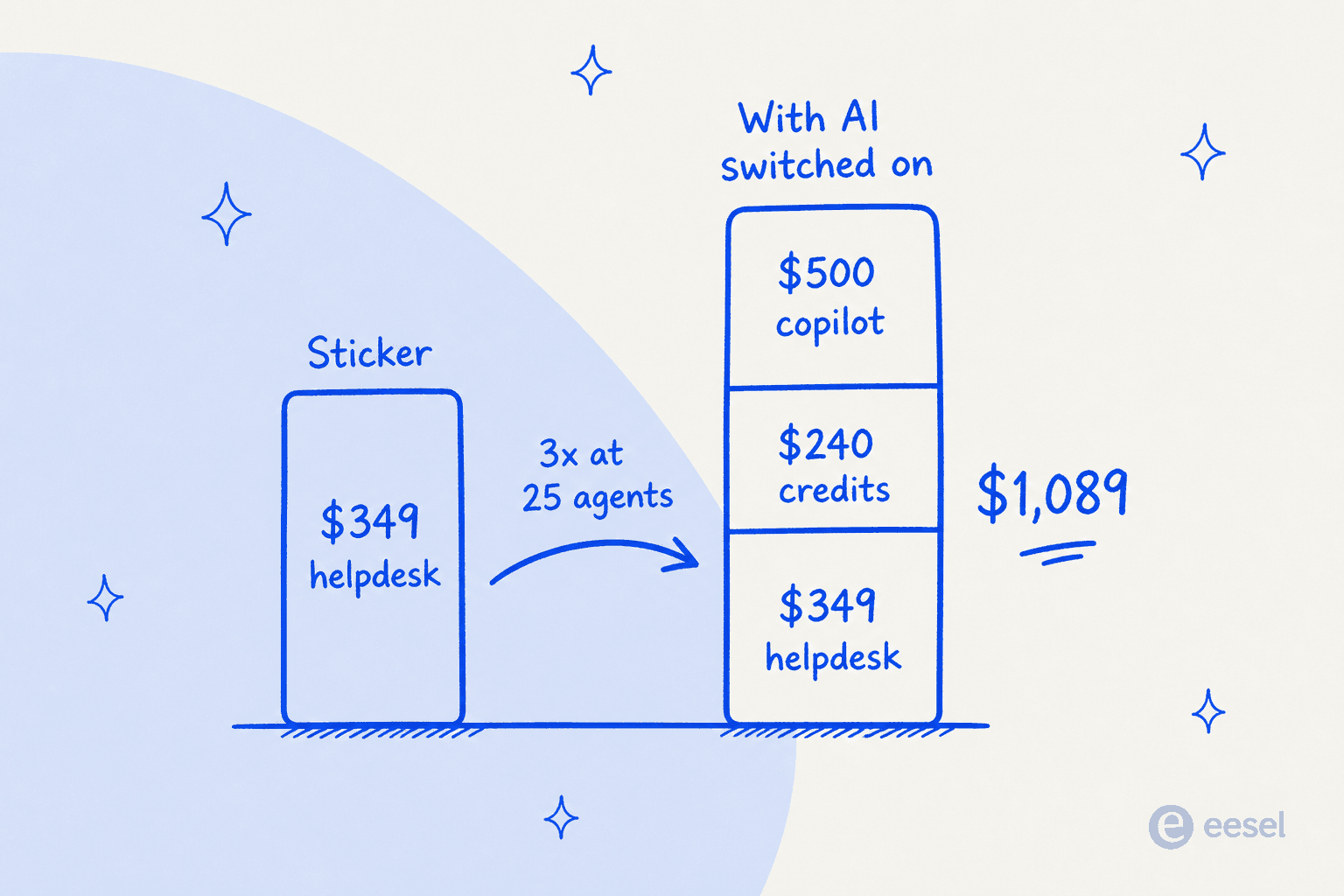
$349 for the helpdesk, $240 for 12,000 credits, $500 for 25 copilot seats. $1,089 a month, or $43.56 per agent against the $14 printed on the pricing page. None of that is a hidden fee, every number is published somewhere. It is just not the figure a buyer carries away from a pricing page.
One G2 reviewer noticed this before I did, and said it more bluntly than I would:
"They initially present both the AI Agents and the AI Copilot as included functionalities. However, in practice, the AI Agents operate through a credit system with extra costs, and the AI Copilot requires an additional payment of 20 USD per agent. In a license for 5 agents, this ends up doubling the total cost."

The same reviewer also reports that auto-merging tickets sat behind an additional payment on their account. I could not confirm that against BoldDesk's own published materials, so treat it as the one customer's experience rather than a documented gate, and check it on your own quote.
What the credits actually buy
Price is only the half of a purchasing decision. The other half is what the money actually does, and here is where I would slow a buyer down.
BoldDesk markets the agent as resolving "up to 70% of inquiries automatically." G2 publishes an independent AI agent performance score for the same product, measured by Swept.ai, and it reads differently: an overall score of 58, flagged as 8 points below the category average, with a wrong escalation rate of 70% against a correct escalation rate of 30%.
Those two 70% figures point in opposite directions, and the second one is the third-party measurement, which is why I treat a vendor-stated AI resolution rate as a claim rather than a number. A 70% wrong-escalation rate means the agent's judgement on when to hand off to a human is wrong roughly seven times out of ten, which is precisely the behaviour that turns AI escalation management from a feature into a daily cleanup job. If you are buying credits mainly to reduce agent workload, then mis-escalation is the failure mode which quietly hands that workload straight back.
None of this makes BoldDesk's AI unbuyable, to be clear. Benchmarks are snapshots, and a support agent tuned against a good knowledge base behaves quite differently to one tested cold. But it does change the order of operations: test the resolution quality before you commit to the credit spend, not after. Chat escalation is the specific behaviour to watch.
Which brings up the trial maths. This is the sharpest practical problem with evaluating BoldDesk's AI at all.
The trial cannot test the thing you are buying
The trial is 15 days, no credit card, full feature access, and BoldDesk retains your data for 7 days afterwards. Generous terms, those. Then the docs specify the trial's AI allowance: 100 AI credits, one-time, which "do not reset during the trial period."
At the documented 2 to 3 credits for a moderate response, 100 credits is roughly 30 to 50 AI answers for the entire trial.
That is not enough to evaluate an AI agent with. I know the shape of this problem from our own sales calls. One buyer, an email-security company running Freshdesk and scaling toward 20,000 tickets a year, burned through 200 interactions in a single day of testing and then wanted to talk about what that meant at 9,000 interactions a month. On BoldDesk's trial allowance, that person's first test day would have exhausted the entire 15-day credit budget before lunch, four or five times over.
The workaround is to buy a pack and test during a paid month, which is fine in itself, except it means the real evaluation happens after the money changes hands. Anyone who has run an AI ticket deflection rollout knows that ordering is backwards, and the cost savings only show up once quality is proven. The test you want is a replay against your own historical tickets, where you can see what the AI would have said to real customers before it says anything to a live one. Even simple FAQ deflection is worth measuring that way rather than guessing.
What is actually included
I have spent most of this post on the AI meters, so let me be fair about the rest of it. The flat plan is unusually complete, and that is the reason to consider BoldDesk at all.
| Included at every rung | Detail as published |
|---|---|
| Tickets | Unlimited, no monthly cap published |
| Knowledge base articles | Unlimited |
| Channels | Email, live chat, WhatsApp, Facebook, Instagram, Telegram, voice, SMS, LINE, described as 10+ |
| Automation | Workflow rules, macros, time-based automations, SLA reminders |
| Routing | Round robin, load and skill routing, agent shift management |
| Security | SSO, 2FA, role-based permissions, audit logs, IP restriction, PII and PHI redaction |
| Compliance | SOC 2 Type II, HIPAA, GDPR, regional data centres |
| Languages | 40+ including right-to-left |
| Migration and onboarding | Free, with 3M+ tickets migrated claimed |
| Uptime | 99.9% SLA |
The ticketing side has no volume cap at all, and getting SOC 2 Type II and HIPAA at the $99 rung is rare. Most vendors reserve compliance for an enterprise tier, so a 5-agent healthcare or fintech team that would otherwise be forced onto a $115-per-seat plan elsewhere should take that seriously. The free migration is real value as well, and it is aimed squarely at buyers who are mid-contract: BoldDesk's Zendesk alternative page closes with "Your Renewal Quote is Coming. Have a Better Answer Ready" and offers to let you pay nothing until your current contract ends.
A few things are not published anywhere at all, and you want to ask about them:
- Attachment storage is listed as a feature with no GB figure attached.
- The REST API rate limit is listed as a line item with no requests-per-minute number.
- There is no on-premise or self-hosted option on the pricing page, only cloud data-residency choice.
- Payment is card only: Visa, MasterCard and Maestro. Companies that cannot pay by card are directed to email sales.
- Downgrades carry no refund for the unused portion and take effect at the end of the cycle.
There is also no free plan. The trial is the only free path, which puts BoldDesk behind Freshdesk's free tier for teams that want to sit on a free plan indefinitely. For the wider field at this price, our helpdesk software reviews run through the options.
BoldDesk against the obvious alternatives
BoldDesk's own calculator makes the comparison for you, and it is worth to read with the footnote in hand. At its default of 25 agents it claims $1,375/month for Zendesk Suite Team against $349 for BoldDesk, a stated saving of $12,312 a year, and $2,875 for Suite Professional against the same $349, an 88% saving. The hero headline on the same page promises "up to 70%", which is a lower number than the calculator's own output, so the two do not agree with each other.
More importantly, the footnote reads: "Excludes add-ons, taxes, and negotiated contracts." Almost nobody buying 25 seats of Zendesk is paying list, so the real gap comes in narrower than 88%, though still large. Our own Zendesk pricing breakdown has the current plan detail, and if the renewal quote is what pushed you here, Zendesk pricing being too expensive covers the usual escape routes.
| Dimension | BoldDesk | Typical suite competitor |
|---|---|---|
| Billable unit for the helpdesk | Agent-count rung, flat | Per seat, per tier |
| Feature gating by tier | None, single plan | Standard |
| Entry price | $99/mo for 5 agents | Usually higher per seat |
| Compliance at entry price | SOC 2 Type II, HIPAA, GDPR | Usually enterprise-gated |
| Customer-facing AI unit | Credits, per generated response | Often per resolution |
| Agent-facing AI | $20 per agent per month | Often per-seat add-on |
| Free plan | None | Varies, Freshdesk has one |
| Comparable mid-market rates | $10 to $20 per agent | Front pricing sits nearest |
| Lighter-weight alternative | Not applicable | Help Scout pricing |
| G2 rating | 4.5 on 148 reviews | 4.3 to 4.4 on thousands |
That last row deserves a caveat, and I would rather flag it myself than let it flatter anyone. BoldDesk's 4.5 sits on 148 reviews against Zoho Desk pricing territory where competitors carry thousands, only one of those 148 reviewers is from an enterprise, and nearly every recent review on page one is tagged "Incentivized" and "Source: Seller invite." One reviewer described the process directly:
"Sales team are very persitant and sent nearly 20 emails consistently asking to be reviewed on G2, despite asking to be unsubscribed I was not."
The praise in those reviews still reads as real, and it clusters consistently: ease of use, fast setup, and value for money are named far more than anything else. Just do not read that 4.5 as the equivalent of a 4.4 earned across 7,000 organic reviews.
Who this pricing is right for
Having been through the whole page, here is where I land on it.
Buy BoldDesk if you want a complete helpdesk at a low, predictable seat price and you are treating AI as a later, separate decision. A 5 to 10 agent team that needs SOC 2 or HIPAA, multi-channel omnichannel support, a knowledge base and real help desk automation for $99 a month is getting a deal that is hard to match. CSAT tracking is in there too. The free migration makes the switch cheap, and the "renews at your price" commitment answers a real fear. One budget-conscious buyer I spoke with had watched a previous vendor's price more than double and wanted contractual price locks before they would sign anything, and BoldDesk's flat-rung model speaks directly to that person.
Think harder if your team sits between rungs, especially in the 11 to 24 range, until you have a written answer on pro-rating. Same if AI is the reason you are switching: price the credits and copilot seats into the comparison from the start, and treat the G2 benchmark as a reason to test before you commit rather than a reason to walk away.
Look elsewhere if you need a free plan indefinitely, an on-premise deployment, deep custom reporting, or heavy API work. Teams that mainly want a helpdesk chatbot rather than a full desk have cheaper routes. Reporting depth and API surface are the two most consistent complaints in the reviews, and anyone who wants granular CSAT reporting should test it before signing:
"The built-in analytics are fine for basic stuff, but if you're really into detailed reports or custom dashboards, you might feel a little limited."
If you are comparing more broadly rather than just pricing BoldDesk, our roundup of the best AI helpdesk software has the wider field, and small-business AI helpdesks narrows it to teams at BoldDesk's entry size.
A different way to pay for support AI
There is a version of this decision which does not involve moving helpdesks at all, and it is worth naming, because the AI bill is usually the thing that sends people looking in the first place.
I build eesel, and eesel is not a helpdesk. It is an AI layer that sits on the one you already run. The supported list today is Zendesk, Freshdesk, Front, Gorgias, Help Scout, Jira Service Management, Kustomer and Slack, all wired through the same set of helpdesk integrations. To be straight with you: BoldDesk is not on that list. If you have already decided to move to BoldDesk, eesel is not your AI layer, and I would rather say that than pretend otherwise.
Where it does become relevant is the comparison you are probably actually making. If you are on Zendesk or Freshdesk and shopping BoldDesk mostly to escape an AI bill, the cheaper move might be keeping the helpdesk and changing the AI. Two differences matter for the arithmetic in this post.
First, the unit. eesel pricing is one fixed monthly price sized to volume, from $299/month for 500 credits. 1 credit covers a ticket or chat, not each reply and not each generated response, so a chatty conversation and a terse one cost the same. No platform fee, no per-seat charge, and only the tickets you actually route to the AI use credits. Second, the testing order: you replay the agent against your own historical tickets before it answers a live customer, which is the evaluation BoldDesk's 100 trial credits cannot give you. You can start on 100 free credits without a card.
Fair is fair, though: eesel counts a credit per handled ticket regardless of outcome, so a ticket the AI gets wrong still uses one. And at 25 agents doing 1,500 AI conversations a month, eesel's $699 plan (1,500 credits) is not dramatically below BoldDesk's $740 of AI charges. What differs is the predictability and the simulation step, plus not having to migrate a helpdesk to get either one.
If you want to run the arithmetic on your own numbers, our AI customer service cost breakdown and the cost per resolution comparison do the modelling.
And once it is live, measuring ROI on AI support covers what to actually track. If you are building the business case from scratch, chatbot ROI is the other figure a CFO will ask for.
Frequently Asked Questions
How much does BoldDesk cost per month?
Is BoldDesk's AI included in the price?
What is BoldDesk pricing for a small team?
How do BoldDesk AI credits work?
Is BoldDesk cheaper than Zendesk?


Article by
Kurnia Kharisma
Kurnia is a software engineer and writer at eesel AI with two years of SEO experience, writing about AI tools, helpdesk software, and customer support. He pairs a developer's understanding of how these products are built with search-driven research into what actually ranks and resonates with the people searching for them.