AGO AI pricing: plans, the €500 minimum, and what it really costs

Kurnia Kharisma

Katelin Teen
Last edited August 29, 2026
What AGO actually charges
AGO (from useago.com, "The Customer Agent OS") sells an AI support agent that lives inside your own product and takes real actions, refunds, record updates, workflow triggers, rather than just answering FAQs. On pricing, it has done something most of its category avoids: it published an actual number.
That number is €0.50 per conversation, with a €500 monthly minimum, per AGO's pricing page. There is one usage tier marked "Most popular" and one custom enterprise tier for high volume. No plan ladder, no per-seat line, no hidden add-ons. For a market where "contact sales" is the default answer, that clarity is genuinely nice to see.
Here is the full picture in one table.
| Pay per conversation | High volume (enterprise) | |
|---|---|---|
| Price | €0.50 / conversation | Custom quote ("Let's talk") |
| Monthly minimum | €500 / month | Negotiated |
| Best for | Teams under ~10,000 conversations/month | Teams over 10,000 conversations/month |
| Seats | Unlimited, no per-user fee | Unlimited |
| AI agents | Unlimited | Unlimited |
| Languages | 24+ | 24+ |
| Onboarding | Dedicated onboarding support | Dedicated success manager |
| Engineering | Standard | Forward-deployed engineers |
| Security | SOC 2 Type II, GDPR | SOC 2 report + security reviews |
| SLA | Standard | Custom SLA |
| Signup | Book a demo / contact | Contact sales |
Both tiers route to the same contact form, so there is no way to swipe a card and start today. That is the first thing to know before we get into whether €0.50 is a good deal.
AGO's pricing structure, step by step
The model has three moving parts, and they stack in a specific order.
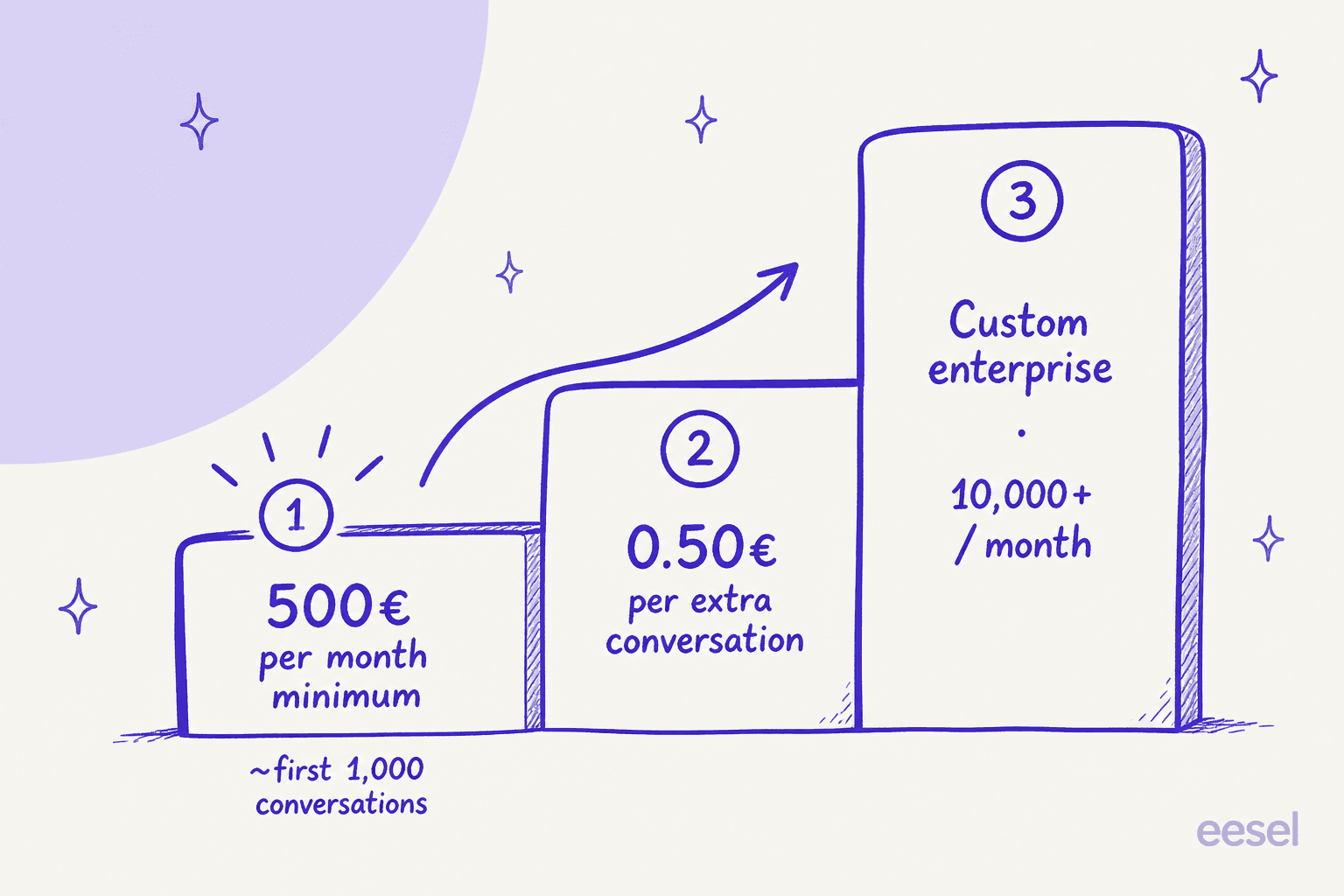
- The €500 floor. Every month starts at €500 whether you use it or not. At €0.50 each, that covers roughly the first 1,000 conversations before any incremental billing kicks in.
- €0.50 per conversation above the floor. Once you pass the conversations the minimum covers, each additional one adds €0.50. Flat, linear, no tiers in between.
- Custom enterprise above 10,000/month. AGO says teams processing more than 10,000 conversations a month move to enterprise pricing with volume discounts, a dedicated success manager, and forward-deployed engineers.
What is refreshing here: unlimited seats are included, with no per-user fee. A lot of helpdesk AI charges you per agent and then again per resolution, so a flat usage number with unlimited seats is a cleaner story. What you trade for that clean story is the floor, and the floor is where smaller teams should look closely.
What counts as a "conversation"
This is the single most important line in AGO's pricing, and it is easy to skim past. AGO bills per conversation, which it defines as being "counted when a customer starts an interaction." It explicitly says there is no resolution concept, "no complex resolution tracking or hidden metrics."
That is a real design choice with real consequences, so it is worth seeing next to the alternatives.
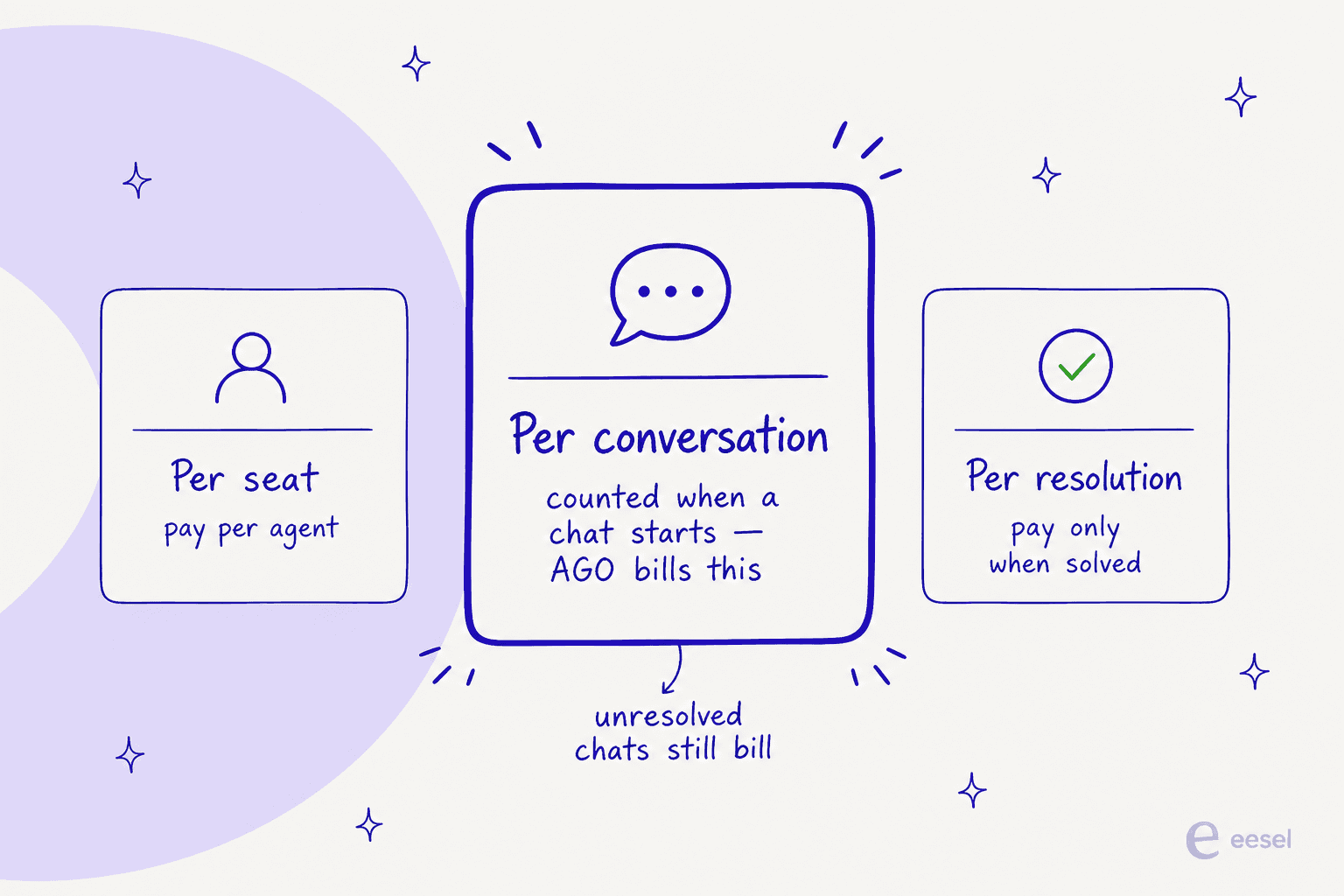
The upside of per-conversation billing is honesty and predictability: you always know the unit, and you are not arguing with a vendor about what counts as a "resolution." Plenty of buyers have been burned by fuzzy resolution definitions, so a flat conversation count is easy to reason about, especially compared with a typical AI chatbot for customer service that meters differently on every plan.
The downside is that an unresolved chat still bills. If a customer opens a conversation, the agent misfires, and a human has to take over anyway, that conversation counted. Per-resolution models (like Zendesk's AI agents) only charge when the AI actually closes the loop, which shifts the risk onto the vendor to make the agent good. AGO's model puts a little more of that risk on you, in exchange for never having a "was that really resolved?" billing dispute. Neither is wrong; they just reward different things.
Where the €500 minimum bites
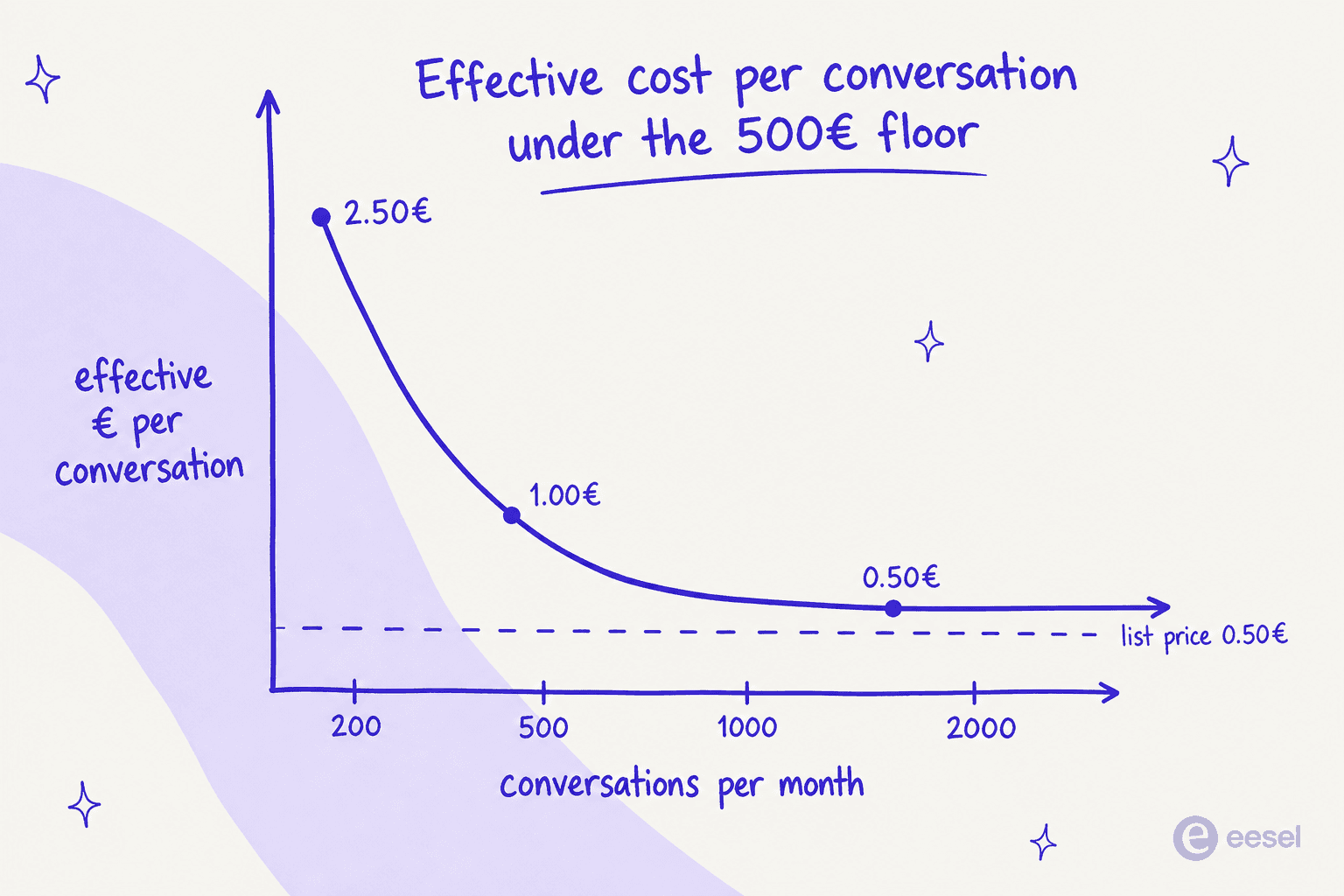
Now the part the pricing page does not spell out. Because the €500 floor is fixed, your real cost per conversation depends entirely on volume, and at low volume it is nowhere near €0.50.
Here is the same thing as concrete monthly bills:
| Conversations / month | What you pay | Effective cost each |
|---|---|---|
| 200 | €500 (minimum) | €2.50 |
| 500 | €500 (minimum) | €1.00 |
| 1,000 | €500 | €0.50 |
| 2,500 | €1,250 | €0.50 |
| 5,000 | €2,500 | €0.50 |
So the sticker price of €0.50 is only your true price once you are reliably over 1,000 conversations a month. Below that, you are subsidising the floor. A team doing 200 conversations a month is effectively paying €2.50 per conversation, five times the headline rate. That is not a gotcha, it is just how minimums work, but it means AGO is priced for teams with steady, mid-to-high volume, not for a small shop dipping a toe in.
Plug your own numbers in below to see where you land.
What you actually get for the price
The price only means something next to what it buys, and AGO's platform is more than a chat widget. It is pitched as an in-product agent that answers, acts, and sits in front of your existing helpdesk.
For the €0.50 per conversation, the "Pay per conversation" tier includes:
- Unlimited AI agents and unlimited seats, no per-user charge.
- Full integration with your stack: Notion, Confluence, Zendesk, HubSpot, Help Scout, Slack, Jira, and a custom API.
- Actions, not just answers, the agent can process refunds, update customer records, and trigger workflows through your own systems.
- 24/7 availability in 24+ languages.
- Analytics and reporting, a live dashboard with resolution rates, topic trends, and quality scoring.
- SOC 2 Type II certification and GDPR compliance, with EU hosting.
AGO also leans hard on a service angle: a "co-construction" model where a dedicated AI engineer reviews failed conversations weekly and ships tuning. That is unusual, and it explains the €500 floor. You are not just buying software minutes, you are buying a bit of a team. OpenAI even published a story about AGO's work with Mirakl, which reported a 96% CSAT score. For a company that wants the vendor in the loop every week, that is a real selling point. For a company that wants to self-serve and move on, it is overhead you are paying for.
The per-conversation trade-off, from experience
I have spent the last few years watching teams put AI on live support queues, and pricing model is where a lot of deals quietly break. The pattern is consistent: per-interaction billing looks cheap on the demo and gets scary at scale.
One case sticks with me. An ops lead at a payouts and money-transfer fintech, running on Zendesk and handling roughly 7,000 to 8,000 escalated tickets a month, told us plainly that per-interaction pricing was a non-starter for them versus session or resolution-based billing:
Per-interaction pricing penalizes the highest-value, highest-volume customers. At our volume, we can't have the meter running on every single exchange, we need it tied to sessions or resolutions.
Ops lead at a payouts/money-transfer fintech (Zendesk, ~7-8K escalated tickets/month), from eesel customer research
To be fair to AGO, its "conversation" is closer to a session than to a single message, so it dodges the worst version of that problem, one conversation is one unit no matter how many messages fly back and forth. But the underlying tension is real: if your volume is high and your resolution rate is anything less than perfect, you are paying for the misses as well as the wins. That is the number to model before you sign, not the €0.50.
The community read on this is the same. In a widely-shared r/CustomerSuccess thread on whether AI has actually solved support, one operator's warning was about exactly this trap:
The ones who say it failed? Usually thought 70-90% deflection rate was a successful metric when it's unrealistic without proper training, knowledge resources, testing, continuous improvement.

Under a per-conversation model, that gap between hoped-for and real deflection is not just a quality problem, it is a line item.
How AGO pricing stacks up
AGO does not have an independent review footprint yet, its G2 profile is unclaimed with zero reviews, so there is no public chorus on whether the price feels fair in practice. That is normal for a newer vendor, but it means you are pricing this on the vendor's numbers and your own volume, not on a wall of user verdicts.
For comparison, a few reference points from tools with public pricing:
- Zendesk AI bills per automated resolution on top of seat licenses, so your total is seats plus resolutions, a different shape from AGO's flat conversation fee.
- HubSpot's AI bundles a monthly cap of resolutions into higher-tier plans, then charges overage, which favors HubSpot customers already paying for Service Hub.
- Free-plan tools let you start with no floor at all, which is where small and spiky-volume teams and most free AI for customer service seekers tend to land.
If you want the full menu, our AGO alternatives roundup and the broader best AI agents list for customer service both go deeper on where each option makes sense.
Try eesel for support pricing without the floor
If AGO's €500 minimum or its demo-only signup is giving you pause, eesel is worth pricing out. It is an AI helpdesk teammate that joins your existing queue in Zendesk, Freshdesk, Gorgias, or HubSpot, and it is built around the two things AGO's pricing makes you weigh: cost predictability and testing before you commit.
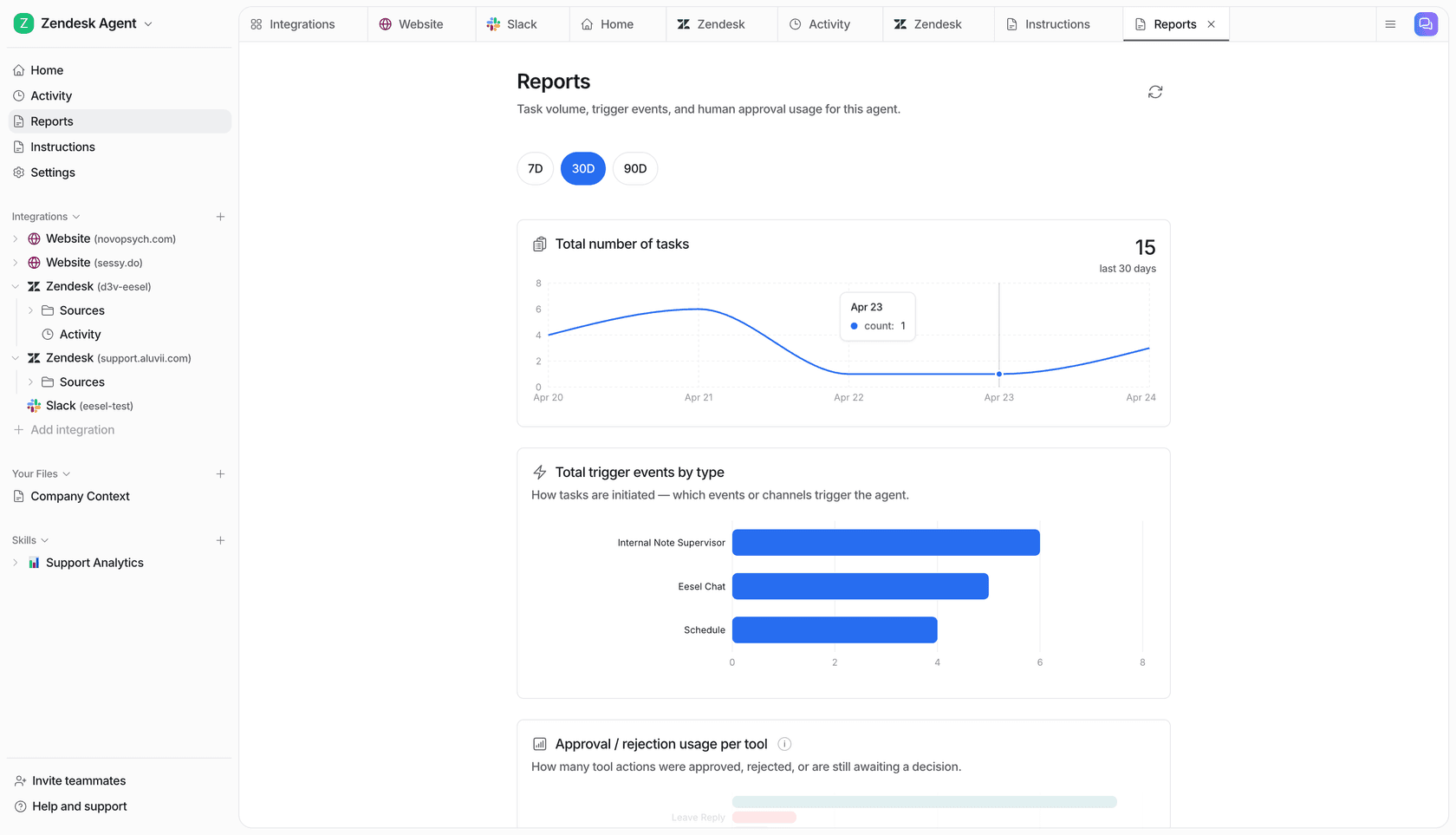
eesel starts with 100 free credits, then plans from $299/month for 500 credits, with no platform fee and no per-seat fee. A credit is one ticket or chat no matter how many replies it takes, and only tickets the agent actually works on count, so a small or seasonal team can start on the free plan and pick a plan sized to its volume. Before any of that, you can simulate the agent on your past tickets to see the real resolution rate and cost on your own data, and start with a free self-serve trial rather than booking a demo.

None of that makes AGO a bad tool, its in-product agent and weekly co-construction are a genuinely different bet. But if your volume is low, spiky, or you just want to see the numbers on your own tickets first, try eesel before you commit to a minimum.