The 9 best Sierra AI alternatives for customer service in 2026

Rama Adi

Katelin Teen
Last edited October 6, 2026

Sierra is one of the best AI customer service agents money can buy, and that last part is the catch. It is enterprise-only, sold through a sales team, priced on outcomes it will not publish, and it takes months to stand up. If you are Rocket Mortgage or Sonos, that is fine. If you are a 20-person support team, you never get past the demo form.
So this is a list for everyone Sierra was not built for. I have spent the last few years putting AI agents on live support queues, and the single most common thing I hear is some version of "the native helpdesk AI was too weak, and the flagship vendor was too heavy." That gap in the middle is where most teams actually live, and it is crowded with good options now.
My short version: if you want Sierra-grade automation without the six-figure contract and the multi-month rollout, eesel AI is the closest thing to "Sierra you can turn on this afternoon", on one fixed monthly price from $299 for 500 credits. If you have the budget and the volume, Decagon and Ada are the enterprise peers worth demoing alongside it. The other six below each win a specific lane. The full comparison table is a few scrolls down.
Why teams look for a Sierra alternative
Let me be fair to Sierra first, because it earns the reputation. Co-founded by Bret Taylor, former co-CEO of Salesforce and current chair of OpenAI's board, and Clay Bavor after 18 years at Google, Sierra raised $950M at a $15.8B valuation in May 2026 and says its agents now serve 40%+ of the Fortune 50. The product is excellent: agents that complete tasks rather than just deflect, handle real concurrency, and stay on-brand across channels.

The reasons people go looking for something else are almost never about quality. They are about access.
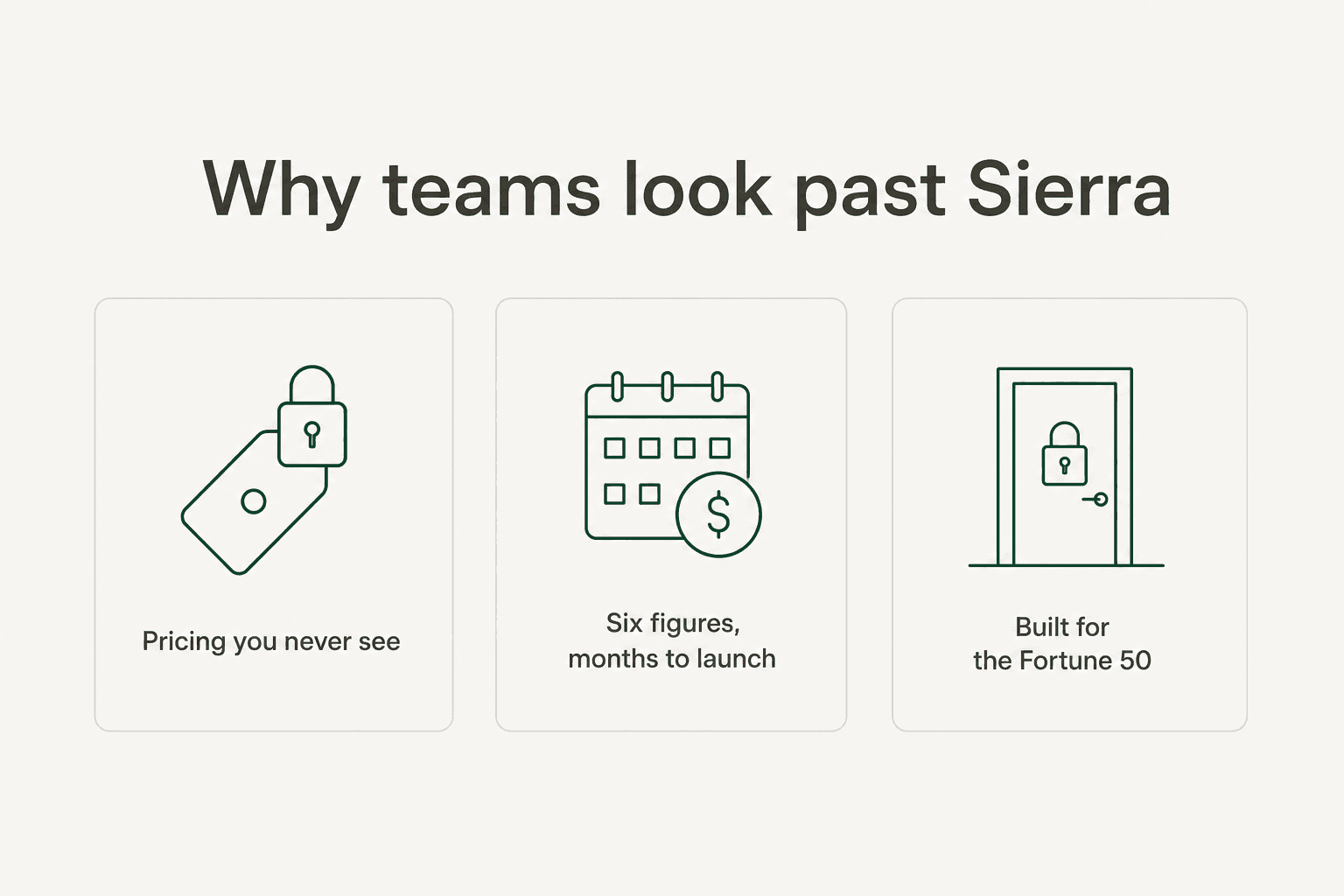
The pricing is a black box. Sierra runs on outcome-based pricing, which it describes as "pay for a job well done." There is no public rate card, no per-seat price, no free tier, and no self-serve sign-up. In its own Outcomemaxxing post, Sierra admits the model "is more complex than seat-based or consumption pricing, operationally, contractually, accounting-wise," and that "people telling you it's simple are selling something." That is refreshingly honest, but it also means you cannot know what you will pay until you are deep in a sales cycle. Third-party roundups float year-one figures in the $200k-$350k range, but since Sierra publishes nothing, treat those as rumor, not fact.
The setup is a project, not an install. Because agents are custom-built with Sierra's team and an SOW, time-to-first-outcome is measured in weeks to months, not the same afternoon.
It is built for the Fortune 50. Sierra's whole motion is top-down enterprise. That shows up in the reviews too. On G2 it sits at roughly 4.1-4.3 across just 17 reviews, and the recurring gripes are exactly what you would expect from a young, enterprise-only vendor:
"Expensive and hard to evaluate long-term cost and scalability."

I hear the mirror image of this on almost every call. One CX lead I spoke with, running a US healthcare platform with a few thousand patients, had already "kicked the tires on native helpdesk AI and found it largely inadequate and overpriced," then found the flagship agent vendors quoting numbers that made no sense for their size. That squeeze, native AI too weak on one side, Sierra-tier too heavy on the other, is the exact space these nine tools compete in.
How I picked these alternatives
Same lens I use whenever a team asks me to shortlist. Five things:
- Pricing you can actually see. Can you model your bill before a sales call, or not?
- How it bills. Per outcome, per conversation, per resolution, or per ticket. These are not the same, and the difference can be 3-5x on the same volume.
- Time to live. Self-serve in minutes, or a multi-month implementation.
- Whether it fits your stack. Does it layer onto your existing helpdesk, or force a migration?
- Whether you can trial it. A free trial or sandbox versus "book a demo" as the only door. The fairest test is to run every tool on the same few hundred historical tickets.
Here is where the first eight land on the two axes that matter most, price transparency and deployment speed.
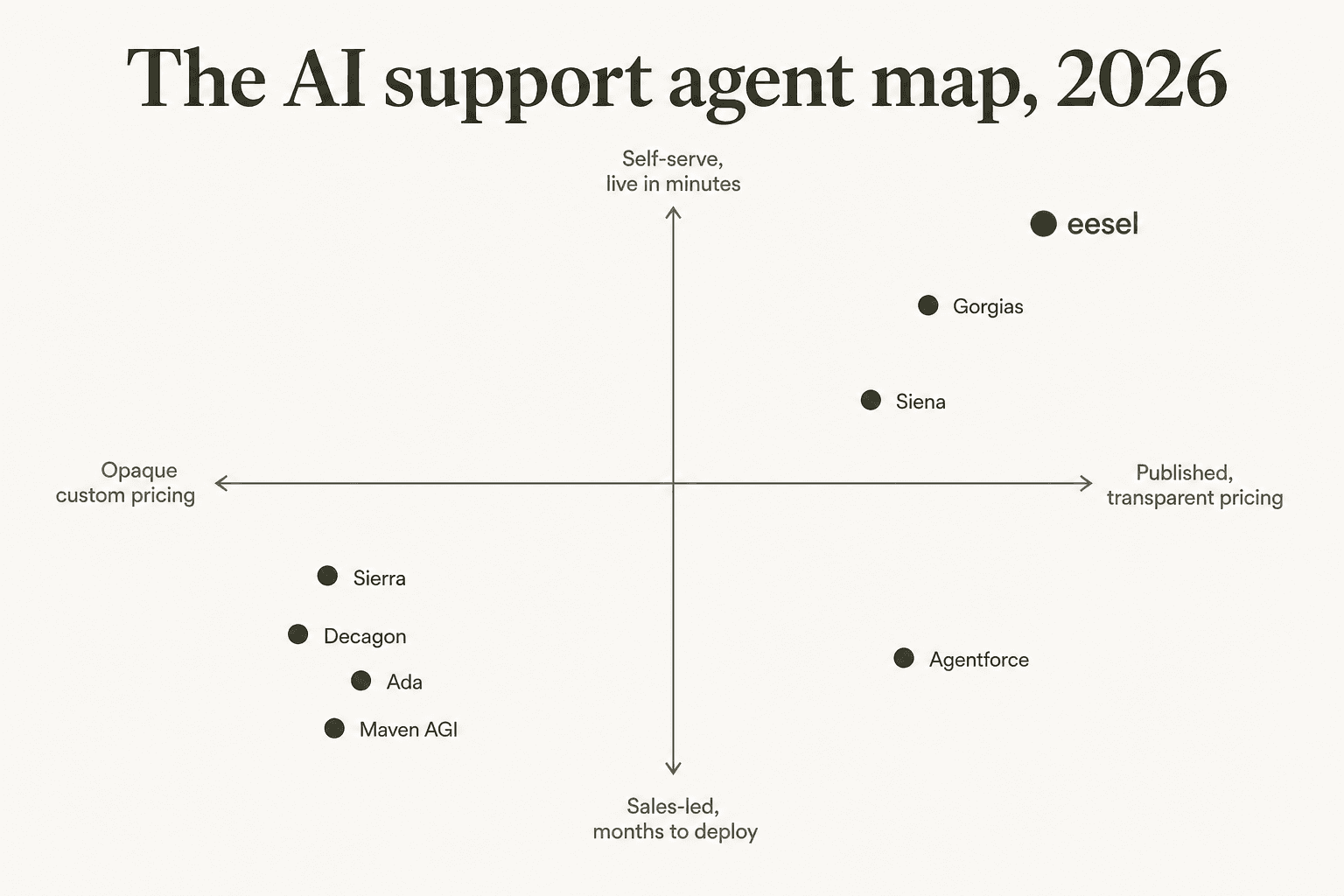
The best Sierra AI alternatives at a glance
| Tool | Best for | How it bills | Entry price | Time to live | Self-serve trial |
|---|---|---|---|---|---|
| eesel AI | Teams on an existing helpdesk who want fast, transparent automation | 1 credit per ticket or chat | From $299/mo (500 credits), no seats | Minutes to hours | Yes, 100 free credits |
| Decagon | Large brands wanting best-in-class omnichannel (chat + voice) | Per conversation or per resolution | Custom, six figures | Weeks, eng-led | No |
| Ada | Enterprises with 300k+ conversations a year | Platform fee + per resolution | ~$30k/yr platform + usage | Weeks to months | No |
| Salesforce Agentforce | Teams already all-in on Salesforce | Per action or per conversation | $0.10/action or $2/conversation | Weeks | Free Foundations tier |
| Maven AGI | Enterprises layering AI over an existing helpdesk | Custom (volume-based) | Custom quote | Weeks, sales-led | No |
| Forethought | Mid-market teams wanting a packaged multi-agent suite | Platform fee + outcome | Custom quote | Days to weeks | No (POV instead) |
| Gorgias | Shopify and ecommerce brands | Per resolved conversation | From $10/mo, $0.90/resolution | Same day | Yes, 7-day trial |
| Siena AI | DTC brands wanting brand-voice, empathy-first agents | Platform fee + per ticket | $750/mo + $0.90/ticket | Days | Demo only |
| Zendesk AI agents | Teams already running support on Zendesk | Per automated resolution, on top of agent seats | Suite from $55/agent/mo (annual), AI included with an allowance | From day one, per Zendesk | Yes, 14-day trial |
Now the detail on each.
1. eesel AI

Best for: support, IT, and ops teams that already run a helpdesk and want autonomous tier-1 automation live this week, on pricing they can model in a spreadsheet.
Full disclosure, this is our tool, so read the next section skeptically and check the sources. But eesel exists for exactly the person who bounced off Sierra's demo form. It is a self-serve platform of AI agents that plug into your helpdesk, Slack, docs, and email, learn from your past tickets, help articles, and macros on day one, and then draft, resolve, triage, and escalate on their own.
The philosophical difference from Sierra is the absence of a sales cycle. You sign up, connect Zendesk or Front or Freshdesk, and start resolving tickets, no SOW, no implementation team. Ecosa reported full Zendesk integration in under an hour; Sierra's builds run for weeks.
The feature I would point a nervous buyer to first is simulation. eesel replays your agent against thousands of your real historical tickets before a single customer sees it, and shows coverage and resolution rate by topic so you can find the gaps and fix them. I have watched confident-sounding bots quietly give wrong answers, so being able to prove accuracy against your own history first is the whole ballgame. From there you grant autonomy gradually: low-confidence cases draft for review or escalate instead of guessing.
Pros:
- Truly self-serve and fast. Connect and go live in minutes to hours, no sales call.
- Transparent, fixed pricing you can model before you commit: from $299/month for 500 credits (1 credit per ticket or chat), no seats, no platform fee.
- Simulation over your real ticket history plus confidence-based routing lets you de-risk before launch.
Cons:
- Not built for the deeply-custom, professional-services-led enterprise agent programs Sierra specializes in.
- SOC 2 is listed as in progress rather than certified; enterprise buyers with a hard SOC 2 gate should confirm current status (SSO and MFA are available as add-ons, and HIPAA on request).
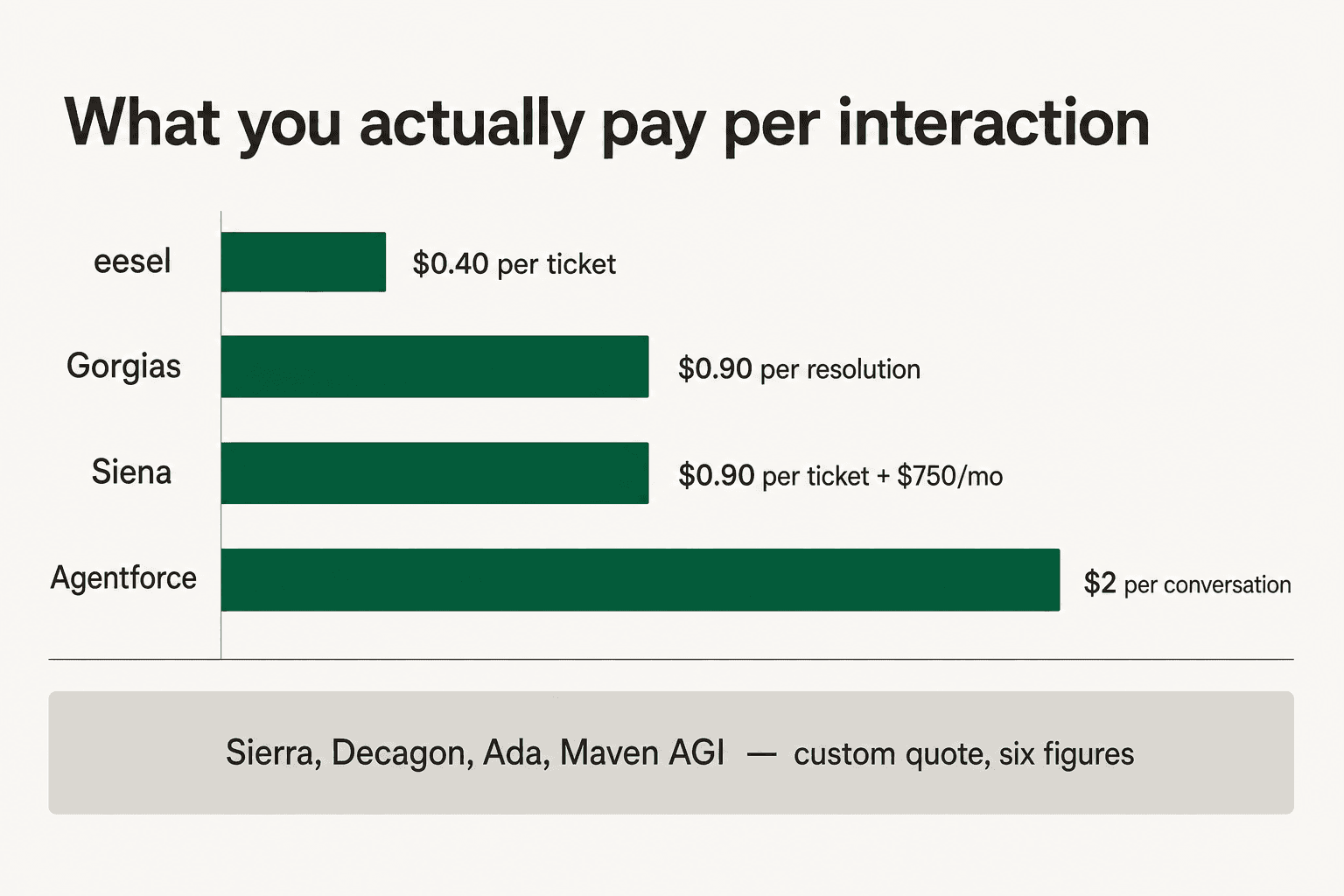
Pricing: the Teammate plan is one fixed monthly price sized to volume. 1 credit covers a ticket or chat, however many messages are inside it. 500 credits is $299/mo, 1,000 is $499/mo, and 5,000 is $1,899/mo. No per-seat fee, no platform fee. There is a free plan with 100 credits, pay a year upfront and get two months free, and add-ons include SSO and MFA from $199/mo.
Verdict: pick eesel if you run an existing helpdesk and want tier-1 automation live fast, on pricing you can predict, with a way to prove accuracy first. One customer, Gridwise, saw 73% of tier-1 requests resolved in the first month, results they measured inside a 7-day trial. Skip it if you specifically want a bespoke, managed enterprise build with a dedicated services team, which is the lane Sierra owns and eesel deliberately does not chase.
2. Decagon
Best for: large consumer and enterprise brands that want best-in-class omnichannel depth, chat and voice from one runtime, and can absorb a six-figure contract.
If Sierra has a true head-to-head rival, it is Decagon. Founded in 2023 by Jesse Zhang and Ashwin Sreenivas, it raised a $250M Series D at a $4.5B valuation in January 2026, roughly tripling its valuation in seven months. Both companies are AI-native, enterprise-first, and priced on outcomes rather than seats.
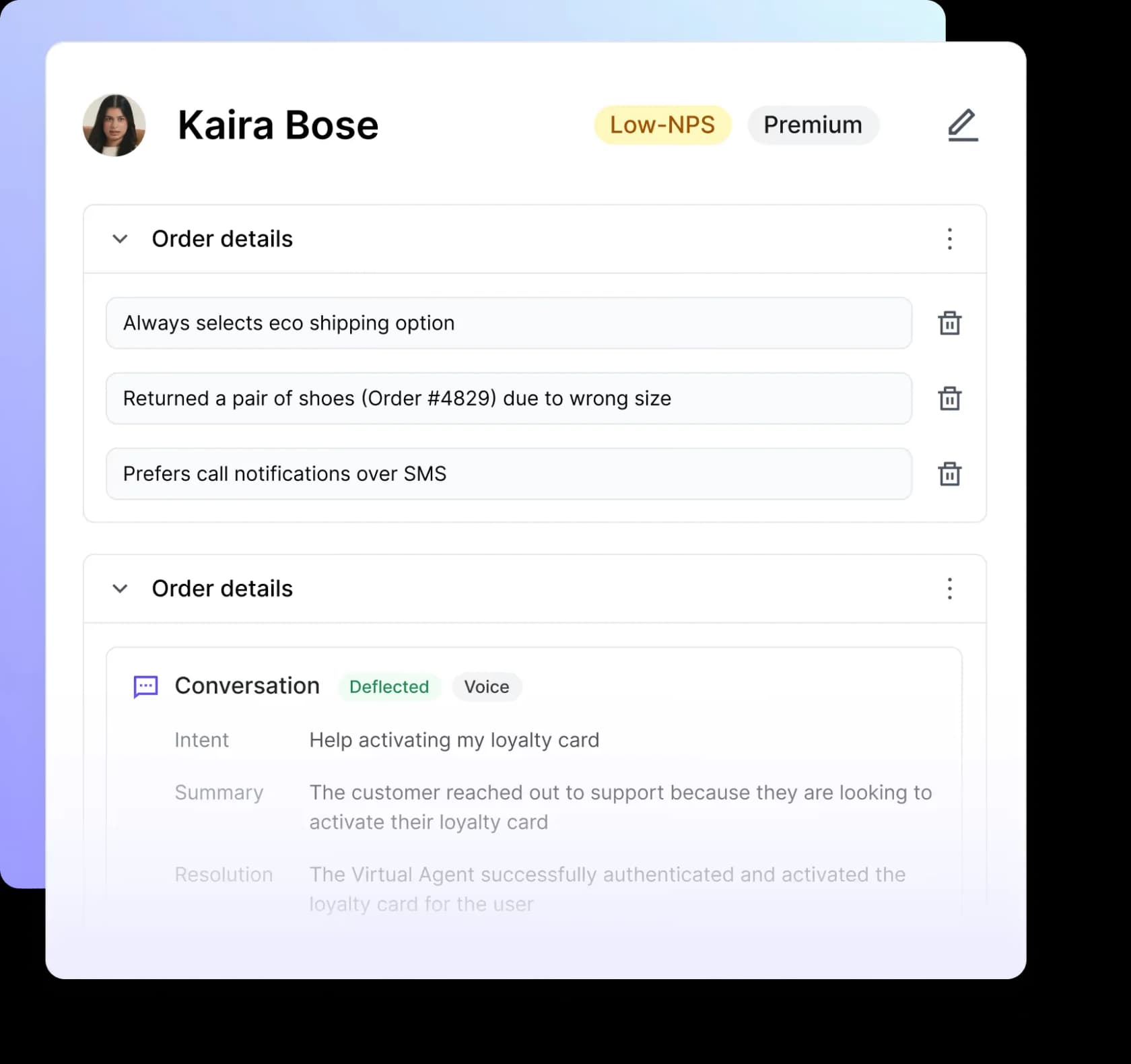
Decagon's signature idea is Agent Operating Procedures: natural-language instructions that "compile into code," so CX teams can author, inspect, and iterate agent logic while engineers keep the guardrails and integrations. Its other real edge is omnichannel parity, one agent across chat, voice (built with ElevenLabs), email, and SMS with cross-channel memory. The customer proof is strong, with Decagon citing 70% resolution across chat and voice at Chime and 80% deflection at Duolingo.
"With the previous vendor, at least half my week was dedicated to maintaining their system. With Decagon, it's been a night-and-day difference."
Ian Riggins, Senior Operations Manager, Duolingo, via Decagon
Pros:
- True omnichannel from one runtime, with voice and email as first-class channels.
- AOP authoring lets non-technical CX teams build real workflows without an engineering sprint per change.
- Heavy capitalization and brand-name proof lower the platform-risk worry for enterprise buyers.
Cons:
- Significant upfront engineering and a steep learning curve to stand up, the most common review complaint.
- Fully opaque, sales-led pricing with no free tier, so you cannot try before a six-figure commitment.
Pricing: no public numbers. Decagon explains two models, per conversation or per resolution, and its demo form buckets prospects by monthly ticket volume, which tells you everything: this is volume-bracketed enterprise contracting. Third-party estimates put median annual spend in the high six figures, but those are not Decagon's numbers.
Verdict: demo Decagon if you are a high-volume brand that needs deep omnichannel (especially voice) and has the budget and engineering bandwidth for a white-glove rollout. If opaque pricing or setup lift is a dealbreaker, this is precisely where a lighter, self-serve option wins. If you are weighing the two giants directly, our Decagon vs Sierra breakdown goes deeper.
3. Ada
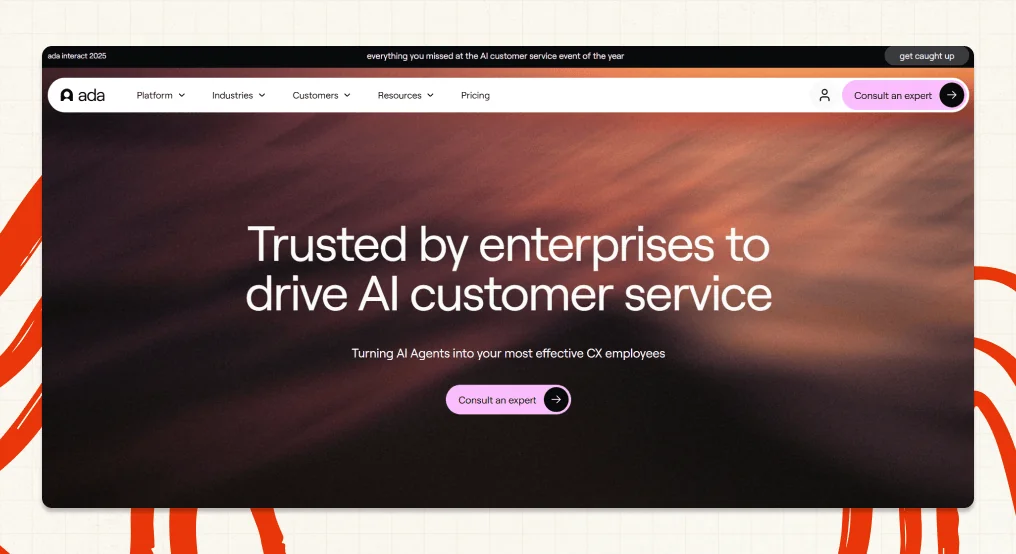
Best for: large enterprises with very high contact volume (Ada's own floor is 300,000+ annual conversations) that want an autonomous AI layer, including voice, over their current helpdesk.
Toronto-based Ada is one of the more mature players here, branding its category as "Agentic Customer Experience." It is a standalone AI agent layer that integrates with Zendesk, Salesforce, ServiceNow, and others rather than owning ticketing itself. Ada draws a sharp, useful line between containment and what it calls automated resolution, a three-part bar of relevance, accuracy, and safety, and claims an 84% automated resolution rate on chat.
Its technical wedge over Sierra is a multi-LLM Reasoning Engine that is not locked to one model, strong autonomous voice in 40+ languages, and serious AI-specific compliance including SOC 2 Type II, HIPAA, and the AIUC-1 standard with zero data retention.
One nuance worth knowing: operators rate Ada highly (4.6/5 on G2 across 173 reviews), while end-customer satisfaction on Trustpilot skews much lower. The people who run it love it; some of the people who talk to it do not. Watch that gap.
Pros:
- Multi-LLM Reasoning Engine, so you are not betting on a single model.
- Strong autonomous voice, omnichannel coverage, and deep AI compliance (AIUC-1, zero retention).
- Proven at real scale with praised implementation and support teams.
Cons:
- Enterprise-only, expensive, and opaque, with no self-serve trial.
- Implementation is a project, and some reviewers flag a "stuck" UX in the Playbooks builder.
Pricing: sales-led and gated at 300k+ annual conversations. The Salesforce AppExchange listing shows a ~$30,000/year platform floor, with usage on top; Ada's own blog anchors resolutions at $1.50 each versus $0.35 per conversation. Before signing anything, pin down exactly what counts as a "resolution," because that definition is what you are paying against. Our Ada pricing guide has the full picture.
Verdict: a clean Sierra alternative on the enterprise axis. Pick Ada if you are at 300k+ conversations, already on a major helpdesk, and want autonomous voice plus strict AI compliance. Skip it if you need transparent pricing, a trial, or you are anywhere below enterprise scale.
4. Salesforce Agentforce
Best for: teams already standardized on Salesforce Service Cloud, Sales Cloud, and Data Cloud who want AI agents living inside the same CRM.
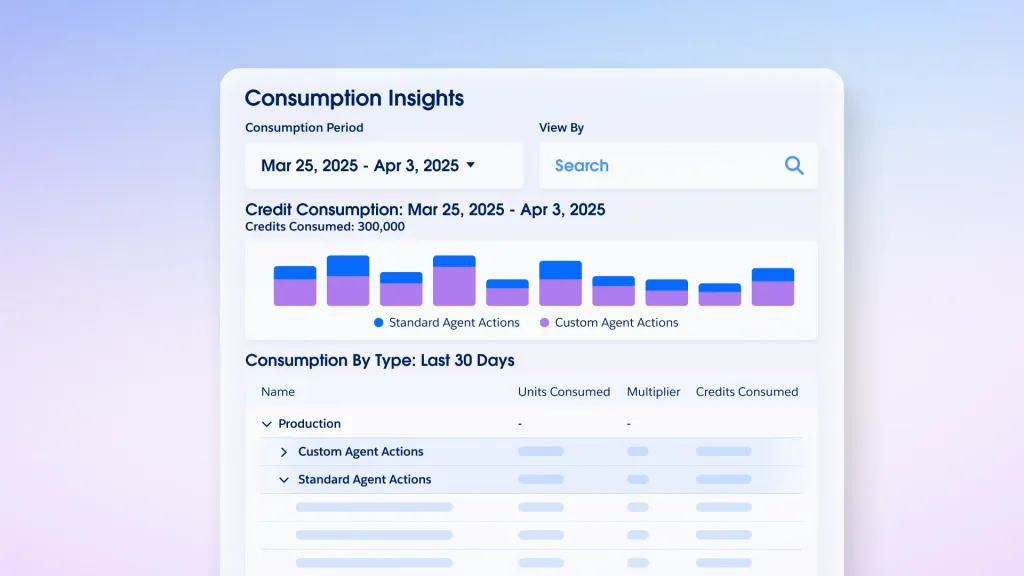
Agentforce is Salesforce's agentic platform, and its whole value proposition is being native to Salesforce, its Atlas Reasoning Engine grounds agents in CRM objects and Data 360 data out of the box. If your customer data and your reps already live in Salesforce, that is real leverage. If they do not, it is a wall.
Credit where due: Agentforce has the most transparent published pricing in the enterprise tier, a genuine rarity here. But the flip side is a metering model that stacks. Per-action or per-conversation charges sit on top of Einstein Requests and Data Cloud credits, and the total gets hard to forecast, a complaint that dominates its community threads.
"Not even Salesforce can tell you how much Agentforce will cost. They are too busy marketing and selling it to worry about a pesky detail like how much it will cost their customers."

Pros:
- Deeply native to Salesforce, with CRM grounding and Flow actions that work immediately for existing orgs.
- Published list pricing plus a free Foundations tier to start building.
- Granular per-action metering means simple tasks cost less and no-action interactions are free.
Cons:
- Total cost is hard to forecast because charges stack across multiple meters.
- Locked to the Salesforce ecosystem; outside it, the main advantage evaporates.
Pricing: $0.10 per action via Flex Credits, or $2 per conversation, plus optional user licenses and add-ons from $125/user/mo. A free Foundations tier includes the builder. Watch the gotchas: unused Flex Credits do not roll over, and illustrative examples exclude Data Cloud consumption. See our full Agentforce pricing breakdown and whether Agentforce is worth the cost.
Verdict: if you already live in Salesforce, Agentforce is the incumbent-native Sierra alternative and the CRM grounding is a real edge. If you are not on Salesforce, the ecosystem tax makes it the wrong tool, and a helpdesk-agnostic option with flat pricing will fit better.
5. Maven AGI

Best for: large or publicly-traded enterprises that want an autonomous CX agent layered over an existing helpdesk, with a heavy compliance stack.
Maven AGI positions its flagship Agent Maven as an "intelligence layer" between enterprise data, AI models, and human teams, deploying on top of Zendesk, Salesforce, or Freshdesk rather than replacing them. It has raised $78M to date, a $28M Series A led by M13 and a $50M Series B led by Dell Technologies Capital, so it is a smaller war chest than Sierra's but a credible one, led by founders Jonathan Corbin and Sami Shalabi.
The proof points are solid, with Maven claiming Tripadvisor autonomously handles 90% of incoming queries and Exclaimer cut ticket volume 18%. Its compliance coverage is a standout: SOC 2 Type 2, the full ISO 27001 family, HIPAA, PCI DSS, GDPR, and CCPA.
Pros:
- Strong autonomous-resolution claims backed by named enterprise logos.
- Deep enterprise compliance stack, useful for regulated buyers.
- Layers on top of your existing helpdesk instead of forcing a migration.
Cons:
- Opaque, quote-only pricing with no free tier; one reviewer flatly said "pricing is not good."
- Thin public track record, with only ~16 G2 reviews for a 2023 company, and reports it "needs continuous maintenance."
Pricing: fully sales-led. The /pricing page 404s and every path is a book-a-demo flow; third-party marketplaces indicate cost scales with conversation volume and integration complexity. No published rate, no self-serve.
Verdict: pick Maven if you are a large enterprise with a procurement team, a heavy existing helpdesk investment, and appetite for a high-touch rollout in exchange for enterprise-grade compliance. Skip it if you want to price the tool yourself and self-onboard.
6. Forethought

Best for: mid-market to enterprise teams already on a major helpdesk that want a packaged multi-agent suite with a hands-on rollout.
Forethought markets itself as a "multi-agent CX automation system," a coordinated set of agents (Solve, Triage, Assist, Discover, and Agent QA) rather than a single chatbot. Its reasoning engine, Autoflows, interprets intent and reasons through your business policies instead of running rigid decision trees. It is the more packaged, tier-based option next to Sierra's fully-bespoke builds, layering onto Zendesk, Salesforce, or Freshchat via 70+ connectors.
"Forethought's chat widget is a valuable tool that allows our Customer Support team to proactively solve over 70% of inbound support cases."
The most-praised element across its 166 G2 reviews is the hands-on CSM and proof-of-value rollout. The most common complaint is speed: recurring reports of UI latency and a steeper-than-expected learning curve.
Pros:
- Genuinely multi-agent and broad, with five agents, 70+ integrations, and enterprise security.
- Deep customization through Autoflows and Custom Actions, with a well-liked workflow builder.
- Hands-on rollout with a proof-of-value run against your own data.
Cons:
- Recurring speed and configuration friction, from slow saves to a real learning curve.
- Opaque, sales-led pricing with no free trial.
Pricing: quote-only across three tiers (Team, Professional, Enterprise). Forethought states its model is "a blend of platform access fees and an outcome-based pricing cost," with usage overages on top. No free trial, but a proof-of-value against your data. Our Forethought pricing guide covers the tiers.
Verdict: a good fit for a mid-market or enterprise team on Zendesk or Salesforce that wants an agentic multi-agent layer plus a high-touch rollout. Skip it if you need transparent self-serve pricing and same-day setup. If you are comparing it against the incumbent, see Sierra vs Forethought.
7. Gorgias

Best for: Shopify and ecommerce brands where a big share of tickets need direct store actions, refunds, cancellations, order edits.
Gorgias is the odd one out here, and deliberately so. It is not an enterprise agent platform; it is an ecommerce-first helpdesk with a strong AI Agent bolted in, and it is the self-serve, sign-up-today answer to Sierra's enterprise motion. It claims to power 40% of Shopify brands, and its whole advantage is that store data lives natively inside the tool, so the AI can cancel an order, issue a refund, or apply a discount inside the ticket.
The AI Agent is pre-trained on 1B+ ecommerce conversations and priced per resolved conversation, an outcome-style model you can actually see. It sits at 4.6/5 on G2 across 560+ reviews, with the strongest praise for its Shopify integration.
"If a meaningful chunk is WISMO, address changes, cancels, refunds, exchanges, Gorgias usually feels worth it because the agent can do the work inside the ticket with Shopify context right there."
Pros:
- The deepest Shopify-native integration of any helpdesk, with in-ticket store actions.
- Transparent self-serve pricing, a real free trial, and per-resolution AI billing.
- An AI Agent built for commerce (support plus upsell), not a generic bot.
Cons:
- Volume-based pricing can run roughly 3x a general helpdesk for similar loads, and it punishes high-but-simple ticket volume.
- No named SOC 2 or ISO 27001 certification and no published uptime SLA.
Pricing: published and self-serve. Plans start at $10/mo (Starter) and scale to Advanced at $750/mo, billed on tickets. The AI Agent is a usage add-on at $0.90 per resolved conversation (annual) or $1.00 (monthly), and each AI resolution also counts as a billable ticket, worth doing the math on.
Verdict: the deciding factor is what share of your tickets need to do something in the store. Above ~40% order-action tickets, Gorgias's in-ticket commerce depth earns its premium. Below that, a cheaper general helpdesk plus an AI layer wins on economics. If you want other options, see our best Gorgias alternatives.
8. Siena AI

Best for: fast-growing DTC and subscription brands on Shopify plus Gorgias or Kustomer that want a warm, on-brand AI persona rather than a neutral corporate bot.
Siena AI calls itself "the AI CX operating system for consumer brands," and its whole personality, literally, is the differentiator. Founded in 2022, it runs multiple agents (support, shopping, reviews, QA) on one layer, and leans hard into brand-voice AI Personas that customers "ask for by name." It overlays your existing helpdesk (Zendesk, Gorgias, Kustomer, Gladly) rather than replacing it, with deep ecommerce and subscription integrations (Recharge, Skio, Loop Returns).
The proof is real for its niche: Coterie automates 60-65% of email volume with CSAT matching or exceeding humans, and Siena sits at 4.8/5 on G2 across 28 reviews. The one recurring weakness is escalation:
"There are times when Siena will draw out a conversation instead of routing it to a Human to solve, as well as closing out tickets when a customer asks..."
Pros:
- Best-in-class brand-voice and empathy match, its most-cited strength.
- Ecommerce-native depth with a deep subscription-tool stack and autonomous post-purchase workflows.
- Transparent unit pricing and a fast-shipping, responsive team.
Cons:
- Escalation and routing is the number one complaint, keeping conversations going past the point of handoff.
- It overlays a helpdesk rather than being one, and supports a narrower set of desks.
Pricing: unusually legible for a sales-led tool. A $750/month platform fee plus $0.90 per automated ticket (conversation-based, not outcome-based). No free plan; the unlimited sandbox is bundled into the platform fee.
Verdict: pick Siena if you are a DTC or subscription brand that wants a warm, on-brand voice and autonomous post-purchase workflows without replacing your helpdesk. Skip it if you are an enterprise or a B2B team (Sierra fits better there), or if the routing reliability gap worries you.
9. Zendesk AI agents
Best for: teams that already run their support on Zendesk Suite and want AI agents inside the same helpdesk and the same bill.
Zendesk AI agents are the native option for the many teams that already live in Zendesk. They are included in every Suite and Support plan, work across messaging, email, and voice, ground answers in your help center plus sources like Google Drive or PDFs, and can take actions in other systems. Zendesk now also sells Forethought's agents as a standalone layer for teams on other platforms.
Billing is per automated resolution: you pay only when the AI agent resolves a request without escalation to a human. Since May 18, 2026, Zendesk groups these into resolution tiers. An assisted escalation or a contained resolution does not count against your allowance; a verified resolution, confirmed by an LLM check after the conversation ends, does.
Pros:
- Native to Zendesk, so there is no extra vendor or integration to manage.
- Self-serve, with a 14-day free trial and no credit card.
- Escalated conversations do not draw down the resolution allowance.
Cons:
- AI usage sits on top of per-agent seat pricing, so cost scales with team size as well as resolutions.
- The per-resolution rate is not on the public pricing page, which makes usage beyond the allowance harder to model.
Pricing: Suite Team is $55/agent/month and Suite Professional $115/agent/month, paid yearly. AI agents are included with a resolution allowance, and resolutions beyond it are billed on top. The trial runs on Suite Professional.
Verdict: pick Zendesk AI agents if you are on Zendesk and want one vendor for ticketing and AI. Skip them if you are not on Zendesk, or if you want AI pricing that does not move with seat count. If you want to stay on Zendesk but pay one fixed monthly price for the AI, eesel's Zendesk integration is the other route.
Which Sierra alternative should you choose?
Strip away the marketing and it comes down to a few honest questions.
What do you actually pay per interaction? This is where the field splits hardest. The enterprise tier, Sierra, Decagon, Ada, and Maven AGI, hides its numbers behind a sales cycle, which usually means six figures. The rest publish.
- You are an enterprise brand with the budget and volume. Demo Decagon and Ada alongside Sierra. Decagon for omnichannel and voice depth, Ada for scale and AI compliance.
- You already live in Salesforce. Agentforce is the native pick, just budget for the stacked meters.
- You are an ecommerce or DTC brand. Gorgias if a lot of tickets need store actions; Siena if brand voice is the priority.
- You want Sierra-grade automation without the sales cycle. This is the biggest group by far, and it is where eesel AI is built to win: transparent fixed pricing, live in minutes on your existing helpdesk, and a simulation so you can prove it works before you commit.
The honest meta-point: Sierra is a fantastic product aimed at a narrow, very large customer. Most teams are not that customer, and the good news in 2026 is that they no longer have to pretend to be.
Try eesel for AI support automation
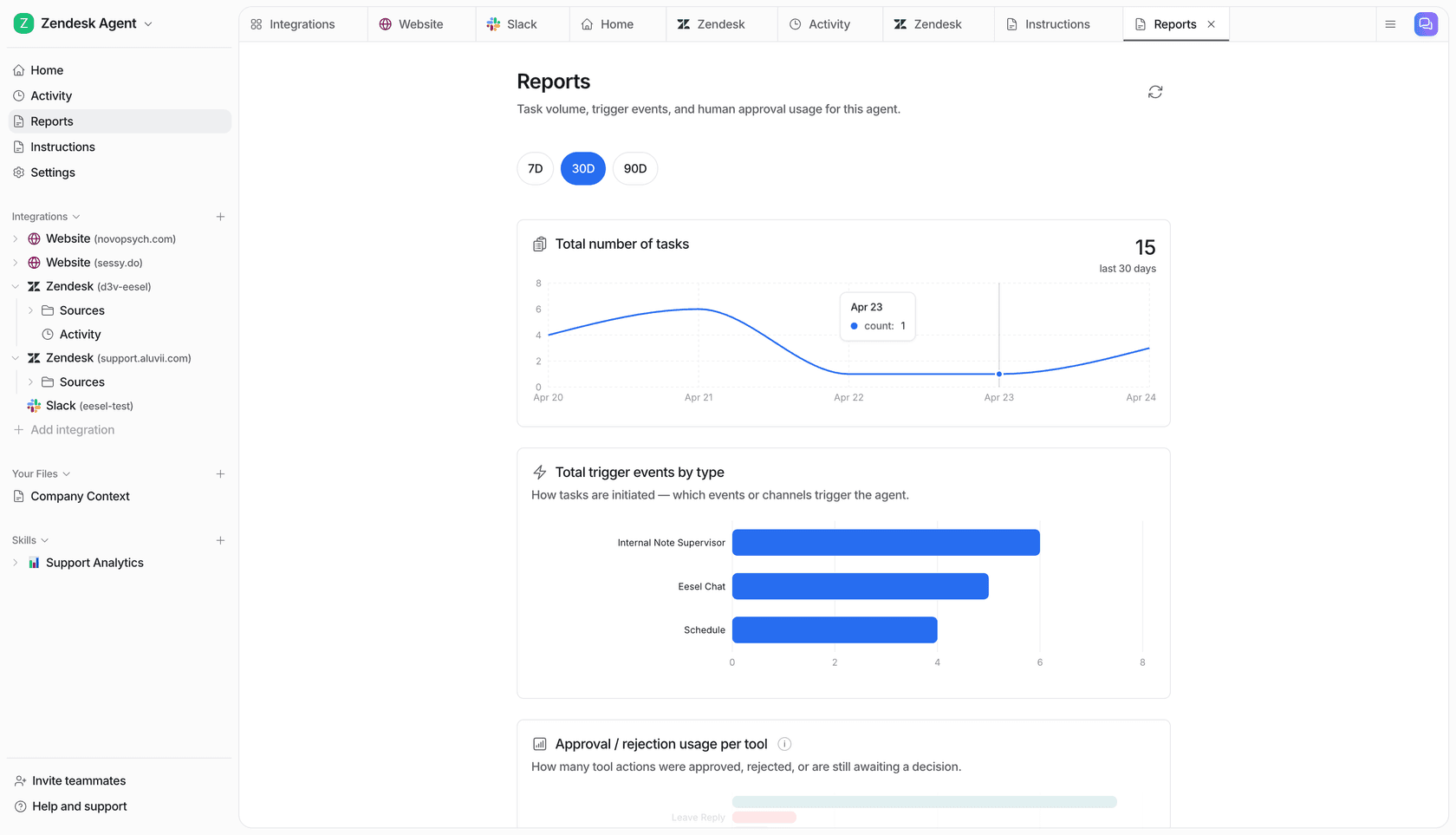
If you looked at Sierra and balked at the sales form and the unpublished pricing, eesel AI is built for you. It plugs into Zendesk, Freshdesk, Front, and more in minutes, learns from your past tickets and help docs on day one, and lets you simulate against your real ticket history before it ever talks to a customer. Pricing is one fixed monthly price from $299 for 500 credits (1 credit per ticket or chat), no seats and no platform fee, so you can model your bill on the back of a napkin. You can start free and route just a slice of your tickets to the AI while you build trust in it. Try eesel free, or book a demo if you want a walkthrough first.