The 9 best Yellow.ai alternatives and competitors for 2026

Kurnia Kharisma

Katelin Teen
Last edited October 6, 2026

Why I spend so much time inside these tools
I build and write about AI for the helpdesk, and the team behind eesel has spent the last three-plus years putting AI agents on live support queues, across thousands of real tickets and customer rollouts. That history is the reason for the one rule we now treat as non-negotiable: simulate every rollout against historical tickets before it ever touches a customer. We've watched confident-sounding bots quietly hand out wrong answers, and it turns out the fastest way to lose trust in AI support is to skip that step.
That's the lens I'm judging Yellow.ai alternatives through. Not "which demo looked slickest," but which one a real support team can stand up, trust, and afford, without a four-month project plan attached.
Why teams look past Yellow.ai
Let's be fair to Yellow.ai first, because it earns its spot. The no-code builder is the single most-praised feature in its reviews ("lives up to the word no code low code"), the multilingual and omnichannel breadth is real, and VoiceX is a serious voice product with 135+ languages. For a large enterprise with the budget and the runway, it's a legitimate choice.
The reasons people go shopping are just as real, and they cluster into three:
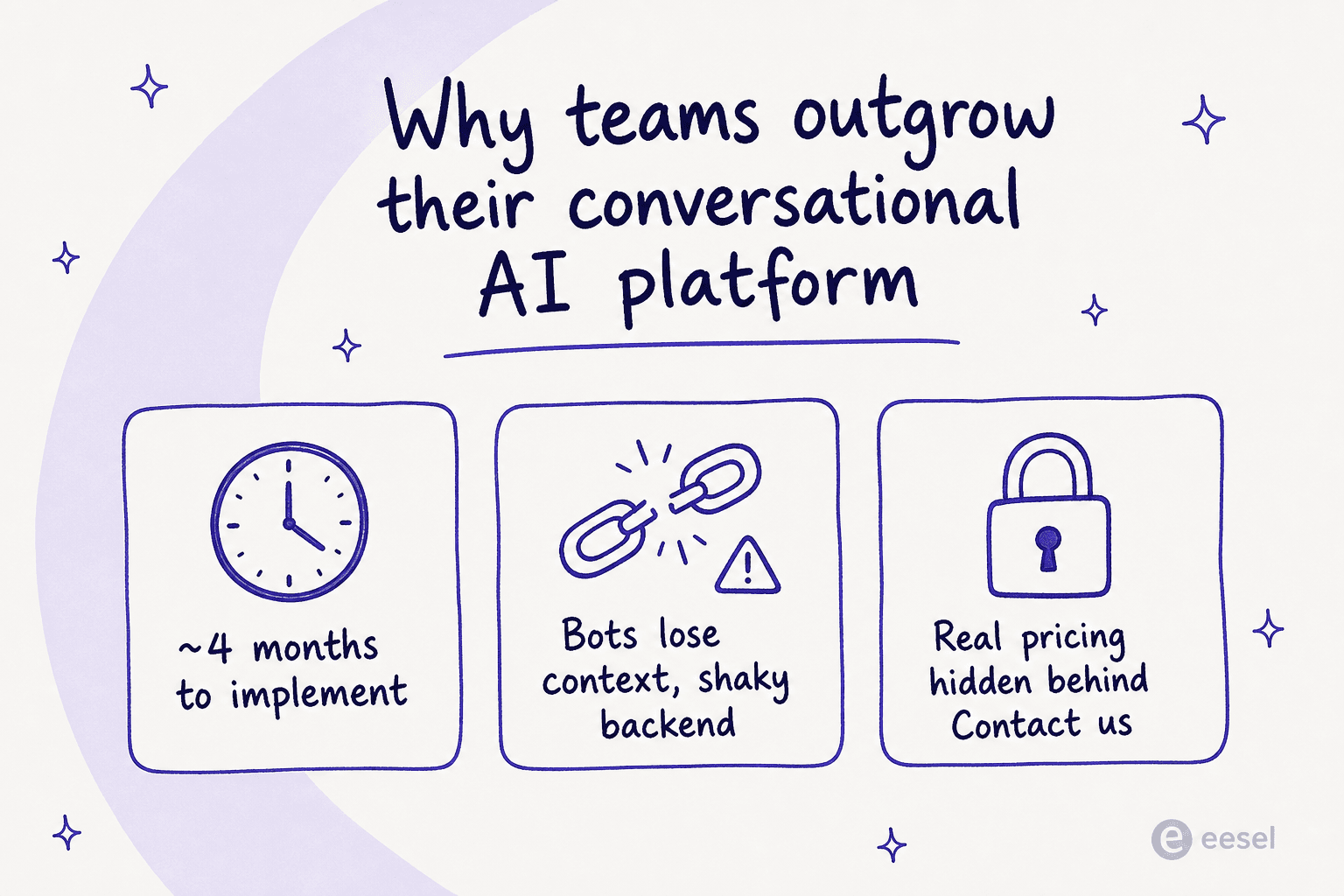
Implementation is a project, not a plug-in. G2's own averaged metric lists roughly four months to implement, and reviewers describe onboarding as "resource-intensive." That's a full quarter before you see value.
Reliability gripes show up in the reviews. The recurring negative theme is bots that "lose context and don't always do a good job at intent matching," plus backend instability. When your automation is the first thing a customer touches, that's the worst place to be shaky.
The real price is invisible. One starter number is public. Everything that makes Yellow.ai Yellow.ai is quote-gated. Here's how one reviewer put the cost question:
"The platform is powerful, but pricing made it difficult for us to justify compared to leaner solutions."

None of this makes Yellow.ai bad. It makes it heavy. And heavy is exactly the thing a lot of teams are trying to escape.
What I looked for in an alternative
Before the list, here's the scorecard, because a good AI support agent lives or dies on a few things that demos rarely show. It's the same bar I'd hold any AI agent to:
- Time to first value. Can you get a working agent this week, or is it a rollout?
- Pricing you can actually see. Published rates beat "book a call" every time when you're trying to build a budget.
- A safe way to test before going live. Simulation on real historical tickets is the difference between confidence and hope.
- Fit with your existing helpdesk. The best tools sit on top of Zendesk, Freshdesk, or Gorgias, not replace them.
- The right modality. Chat and ticket automation is a different job from inbound voice. Match the tool to your volume.
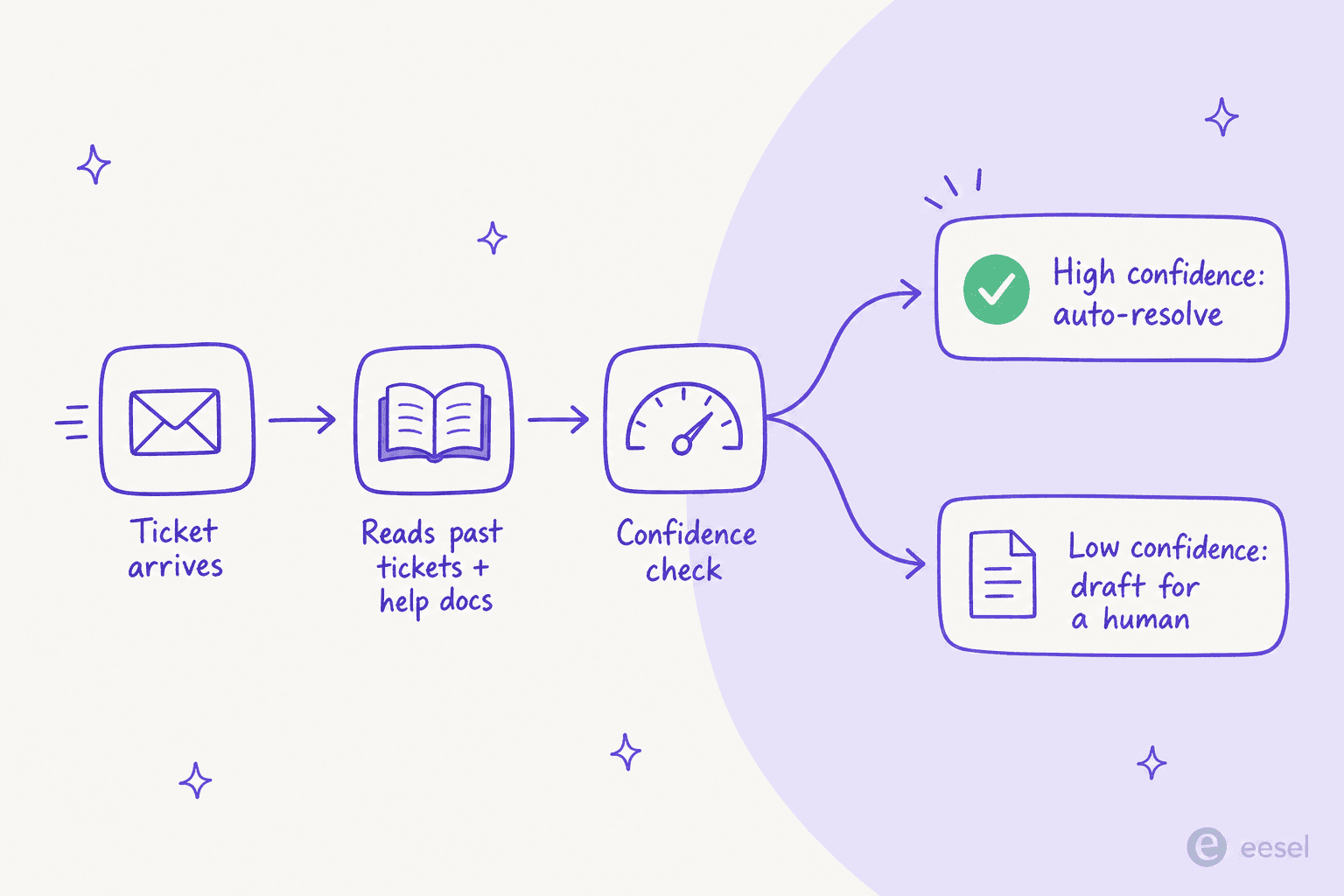
Under the hood, the mechanism that separates a trustworthy agent from a risky one is confidence-based control, deciding when to answer and when to escalate:
The 9 best Yellow.ai alternatives at a glance
| Tool | Best for | Pricing model | Public price anchor | Voice | Typical setup | Compliance |
|---|---|---|---|---|---|---|
| eesel AI | Self-serve tier-1 automation on your helpdesk | Fixed monthly plan, published | From $299/mo (500 credits) | Chat/ticket | Minutes | SOC 2 in progress, HIPAA on request |
| Ada | Large enterprise agent layer | Quote-gated | ~$30k/yr floor (AppExchange) | Yes | Weeks (a project) | HIPAA, SOC 2, GDPR, AIUC-1 |
| Sierra | AI-first outcomes for big brands | Outcome-based, quote-only | None public | Yes | Weeks-months | SOC 2, ISO 27001/42001, HIPAA |
| Decagon | Mid-market to enterprise CX | Per-conversation or per-resolution, quote-only | None public | Yes | Weeks | SOC 2, enterprise-grade |
| Kore.ai | Regulated enterprise platform | Tiered + custom, quote-gated | None public | Yes | Weeks-months | Enterprise-grade |
| Forethought | Multi-agent CX on your stack | Platform fee + outcomes, quote-only | None public | Yes | Weeks | SOC 2, enterprise-grade |
| Parloa | Enterprise voice contact centers | Custom, quote-only | None public | Voice-first | 1-3 months | ISO 27001, SOC 2, PCI, HIPAA |
| PolyAI | Complex inbound phone automation | Per-minute, quote-only | None public | Voice-only | Weeks | SOC 2, HIPAA, GDPR, PCI |
| Aisera | Enterprise IT, HR, and customer service agents | Custom, quote-only | None public | Chat, email, Teams | Not published | SOC 2, ISO 27001, HITRUST (via Automation Anywhere) |
One pattern jumps out of that table: only one row has a number you can act on without emailing a sales team. Keep that in mind as you read on.
Not sure which fits? Start here:
<div class="ymatch">
  <style>
    .ymatch { background:#fff; border:1px solid #e7e4f7; border-radius:16px; padding:28px 26px; font-family:Inter,-apple-system,BlinkMacSystemFont,'Segoe UI',sans-serif; color:#474739; max-width:720px; margin:8px auto; }
    .ymatch h4 { margin:0 0 4px; font-size:19px; color:#2c2350; }
    .ymatch p.sub { margin:0 0 18px; font-size:14px; color:#6b6a5c; }
    .ymatch label { display:block; border:1px solid #e7e4f7; border-radius:10px; padding:13px 15px; margin:8px 0; cursor:pointer; font-size:15px; font-weight:600; transition:all .15s ease; }
    .ymatch label:hover { border-color:#5C42FC; }
    .ymatch input { position:absolute; opacity:0; pointer-events:none; }
    .ymatch .rec { display:none; margin-top:16px; padding:18px 18px; border-radius:12px; background:#E5E1FE; border-left:4px solid #5C42FC; }
    .ymatch .rec h5 { margin:0 0 6px; font-size:16px; color:#2c2350; }
    .ymatch .rec p { margin:0; font-size:14px; line-height:1.5; }
    .ymatch .rec a { color:#5C42FC; font-weight:700; }
    #ym1:checked ~ label[for="ym1"], #ym2:checked ~ label[for="ym2"], #ym3:checked ~ label[for="ym3"], #ym4:checked ~ label[for="ym4"], #ym5:checked ~ label[for="ym5"] { border-color:#5C42FC; background:#f6f4ff; color:#2c2350; }
    #ym1:checked ~ #r1, #ym2:checked ~ #r2, #ym3:checked ~ #r3, #ym4:checked ~ #r4, #ym5:checked ~ #r5 { display:block; }
  </style>
  <h4>Which Yellow.ai alternative fits you?</h4>
  <p class="sub">Pick what pushed you to look. The recommendation updates below.</p>
  <input type="radio" name="ymatch" id="ym1">
  <input type="radio" name="ymatch" id="ym2">
  <input type="radio" name="ymatch" id="ym3">
  <input type="radio" name="ymatch" id="ym4">
  <input type="radio" name="ymatch" id="ym5">
  <label for="ym1">I want to be live this week, no sales call</label>
  <label for="ym2">I mostly need to automate inbound phone calls</label>
  <label for="ym3">I'm a large enterprise running a formal RFP</label>
  <label for="ym4">I need pricing I can see and budget for</label>
  <label for="ym5">I want the deepest AI-native, agentic platform</label>
  <div class="rec" id="r1"><h5>eesel AI</h5><p>Self-serve, plugs into your helpdesk, and simulates on your past tickets in minutes. Published pricing from $299/month for 500 credits. <a href="https://www.eesel.ai/ai-helpdesk-agent">See how it works.</a></p></div>
  <div class="rec" id="r2"><h5>PolyAI or Parloa</h5><p>PolyAI answers calls end to end on its own voice models; Parloa is built for enterprise contact centers. Both are voice specialists, both quote-gated.</p></div>
  <div class="rec" id="r3"><h5>Ada or Kore.ai</h5><p>Both are heavyweight platforms built for enterprise procurement, with deep compliance and large-integration footprints. Expect a multi-week implementation.</p></div>
  <div class="rec" id="r4"><h5>eesel AI</h5><p>Almost every enterprise platform here is quote-gated. eesel publishes a fixed monthly price with no seat fees, so you can model the cost before talking to anyone. <a href="https://www.eesel.ai/pricing">Check the pricing.</a></p></div>
  <div class="rec" id="r5"><h5>Sierra or Decagon</h5><p>Both are AI-native platforms (the agent is the product), with strong founder pedigree and outcomes-style pricing. Powerful, but a real project to stand up.</p></div>
</div>
1. eesel AI: the self-serve, per-ticket alternative

Best for: support, IT, and ops teams already on a helpdesk who want fast tier-1 automation without an enterprise contract.
eesel AI sells configurable "AI teammates" that live inside the apps you already use. Connect Zendesk, Freshdesk, Gorgias, HubSpot, or Front, and it learns from your past tickets and help docs on day one, then drafts, triages, escalates, and takes actions. It's the anti-Yellow.ai on the axis that matters most here: you set it up yourself, and you see the price before you talk to anyone.
Key features
- Simulation mode runs the agent against your past tickets to show coverage by theme and surface gaps before it goes live. This is the "test before you trust" step I care about most.
- Confidence-based routing keeps a low-confidence answer as a draft instead of an auto-send, which is the guardrail against the exact hallucination problem that shows up in enterprise-bot reviews.
- Natural-language setup for when to jump in, tone, and whether to draft or send autonomously.
- 100+ integrations and 80+ languages out of the box, with multiple agents under one account.
Pros
- Live in minutes, fully self-serve, no RFP or implementation project.
- Transparent published pricing with no seat fees and no platform fee.
- Simulation plus gradual autonomy makes for a genuinely low-risk rollout.
Cons
- It's focused on chat and ticket automation, not a heavyweight inbound-voice platform like PolyAI or Parloa.
- SOC 2 is listed as in progress rather than certified, and HIPAA is available on request.
- It isn't built for the 300k-conversation, regulated-enterprise RFP motion the way Ada or Kore.ai are.
Pricing: one fixed monthly price, published on the pricing page. The free plan gives you 100 credits with no credit card. After that, 1 credit covers one ticket or one chat, however many messages it takes, and plans start at $299/month for 500 credits. Everything is included: every integration and channel, unlimited agents and seats. Paying a year upfront gets you two months free. SSO and MFA are add-ons from $199/month, and HIPAA is available on request. A team handling 1,000 tickets a month pays $499/month.
Our take: if your reason for leaving Yellow.ai is time, cost transparency, or rollout risk, this is the one to try first, precisely because trying it costs you a trial signup and an afternoon rather than a quarter. The real proof is that teams like Gridwise saw 73% of tier-1 requests resolved in the first month, and Smava runs a fully automated Zendesk agent on 100,000+ German-language tickets a month. It's not the pick for enterprise inbound voice, and that's fine, it's honest about what it's for.
2. Ada
Best for: large enterprises (Ada's own floor is 300,000+ annual conversations) that want a standalone AI agent layer on top of an existing helpdesk.
Ada is a Toronto-based "Agentic Customer Experience" platform. Rather than being a helpdesk feature, it's a standalone agent layer that sits on top of Zendesk, Salesforce, or ServiceNow, structured as a Reasoning Engine, a Conversation Hub, a Performance Center, and a developer toolkit.
Key features
- The Reasoning Engine does multi-LLM orchestration with multi-layer safeguards.
- Playbooks are multi-step SOPs the agent reasons through; Coaching lets it apply review notes automatically.
- Omnichannel across voice, email, chat, WhatsApp, and Instagram, plus an MCP-native developer toolkit.
- Leading compliance, including HIPAA, SOC 2, GDPR, and the AI-specific AIUC-1 certification.
Pros
- Deflects a high volume of the FAQ long tail, and customers like monday.com report 42% lower handle time.
- Strong API and out-of-box integrations, plus responsive account teams.
Cons
- Setup is a project, not a plug-in, and AI quality is gated on knowledge-base hygiene.
- Reviewers flag "stuck" Playbook UX, and pricing is opaque and expensive.
Here's a fair, positive read from a real user:
"Ada is able to take on the small stuff. So much of support is made up of monotonous, easy-to-answer inquiries... it has cut our teams response time into a third of what it was pre-Ada."
Pricing: no public price list; the pricing page is a consultation form. The one anchor is a Salesforce AppExchange listing that starts at $30,000/year, and Ada's own blog uses an illustrative $1.50 per resolution. Everything real is quote-gated. Ada holds a strong 4.6/5 across 173 G2 reviews.
Our take: a serious, well-funded platform ($130M Series C at a $1.2B valuation) that's a good fit if you're a large enterprise with the volume to clear its floor. If you're smaller or want to move fast, the 300k-conversation starting point tells you it isn't aimed at you. See more in our Ada alternatives breakdown.
3. Sierra
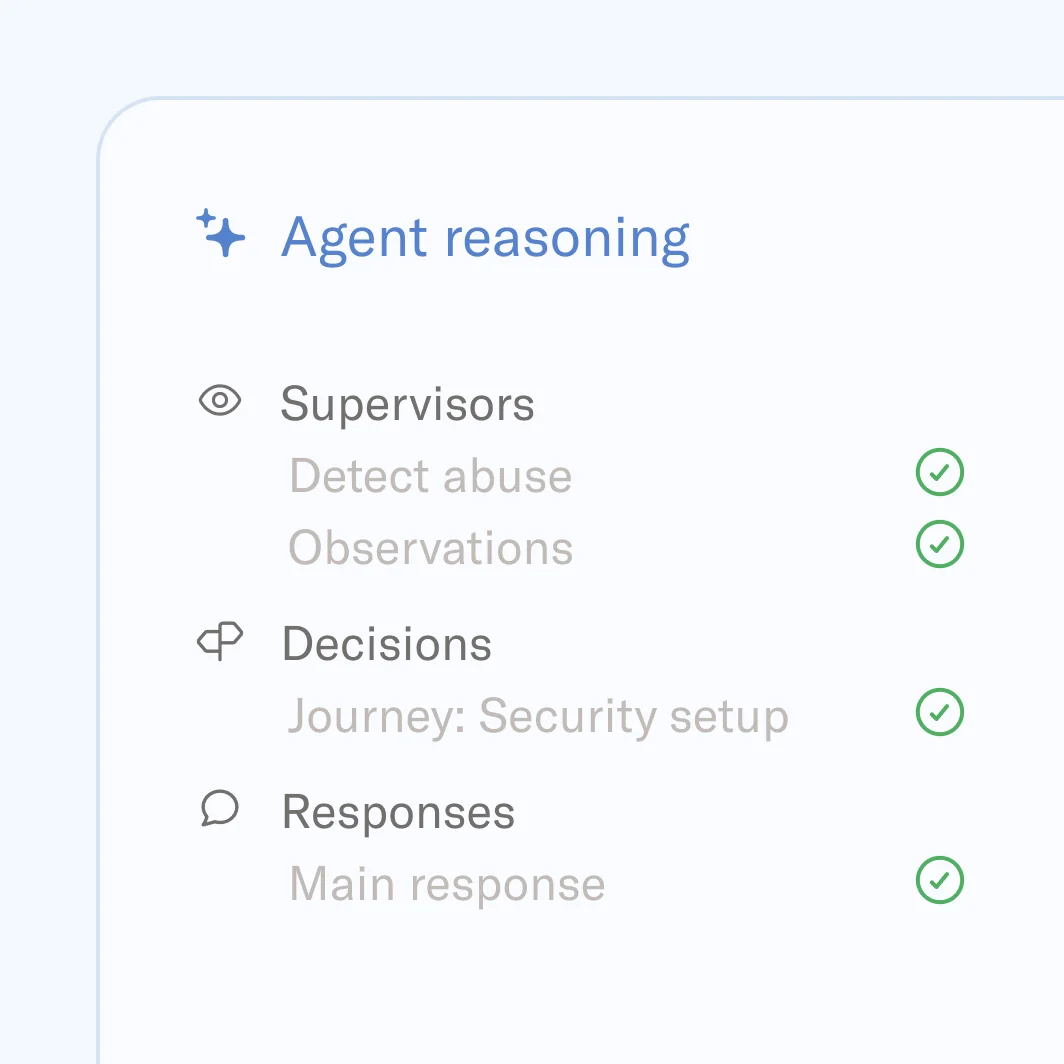
Best for: Fortune 500 and large consumer or regulated brands that want an AI-first, outcomes-priced agent platform.
Sierra is AI-agent-native, meaning the agent is the product with no ticketing underneath. It was co-founded in early 2023 by Bret Taylor (ex-co-CEO of Salesforce, OpenAI board chair) and Clay Bavor (ex-Google Labs), and the pedigree shows in the logo list.
Key features
- Ghostwriter builds agents from SOPs, transcripts, or plain-English goals, which collapses the usual build cycle.
- Both an Agent SDK (code-first) and Agent Studio (no-code).
- Omnichannel across chat, voice, SMS, WhatsApp, and email, and deployable through ChatGPT.
- Deep compliance, including SOC 2, ISO 27001, and ISO 42001 for AI management systems.
Pros
- AI-first architecture with outcomes pricing that shifts risk onto Sierra.
- Founder and investor credibility that opens doors in regulated industries.
Cons
- Expensive and hard to forecast, with a complex initial setup.
- Overkill for SMB and mid-market, with some context-loss reports in long conversations.
The scale is genuinely eye-watering, straight from the founder:
"Sierra is raising $950 million... at a valuation of over $15 billion. We now have more than $1 billion to invest..."
Pricing: outcomes-based (you pay per resolved outcome), with no public price list, no free trial, and sales-only access. Sierra now serves 40%+ of the Fortune 50 and holds a small-sample G2 rating around 4.1-4.3.
Our take: if you're a huge brand that wants the most-hyped AI-native platform and can absorb a six-figure commitment, Sierra is a credible bet. For everyone else it's aspirational. Our Decagon vs Sierra comparison is a good next read if you're weighing the AI-native pair.
4. Decagon
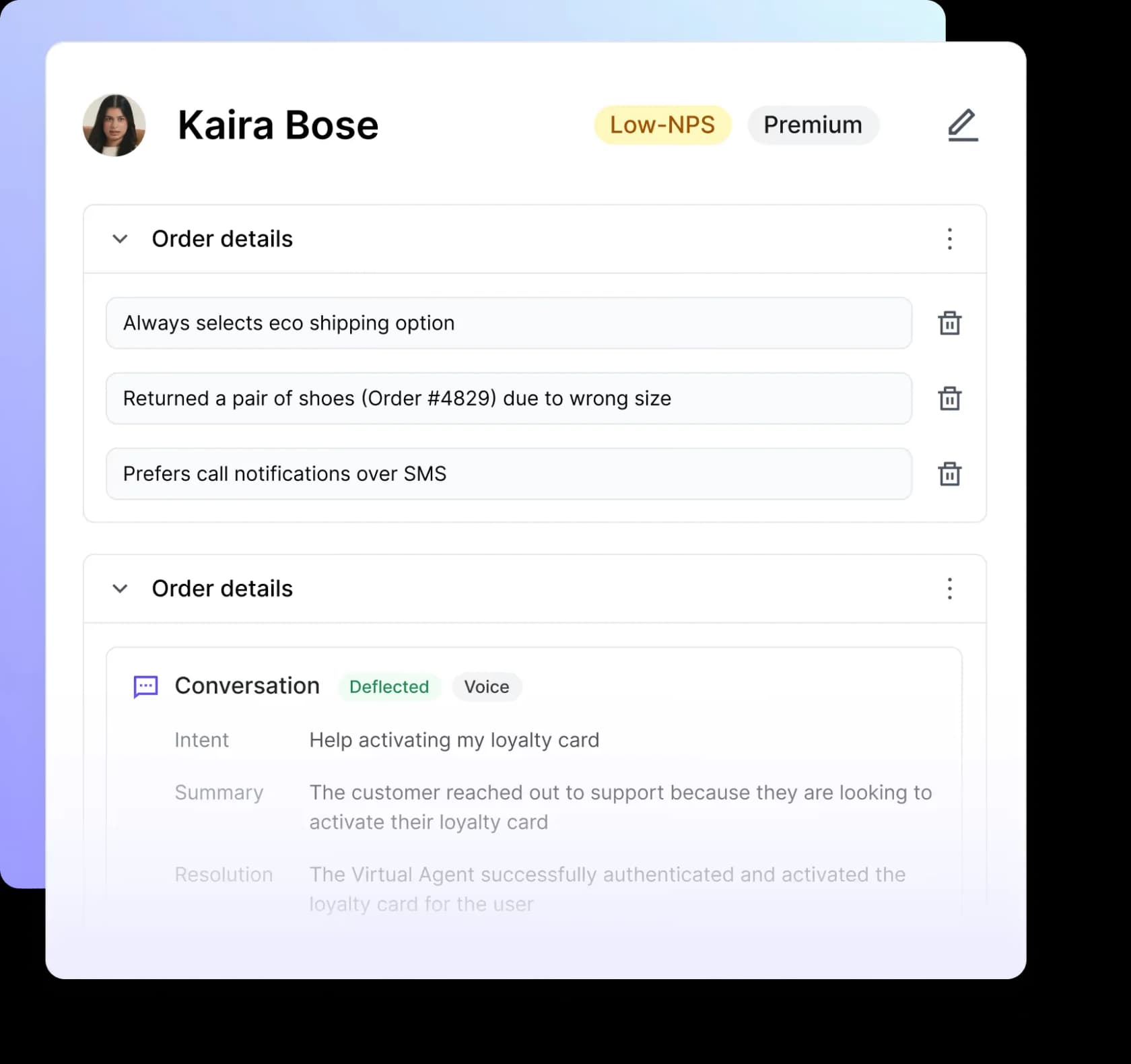
Best for: mid-market to large enterprise CX teams replacing a brittle bot or flow vendor.
Decagon is a US AI-native conversational platform, founded in 2023 by Jesse Zhang and Ashwin Sreenivas. Its wedge is Agent Operating Procedures, natural-language agent logic that compiles down to executable code.
Key features
- AOPs turn plain language into deterministic, executable agent logic.
- An omnichannel runtime (chat, voice, email, SMS) from a single agent.
- User Memory for persistent context, plus Watchtower for real-time audit and fraud detection.
- Simulated-conversation QA and full observability with tracing.
Pros
- Fast time-to-value and intuitive for CX teams to manage without deep technical skill.
- Deterministic workflows and a low hallucination rate, with a stellar 9.7 support score.
Cons
- Standing it up takes real upfront engineering resources (the top complaint).
- Limited transparency into why the agent made a given decision.
The founder is refreshingly blunt about what actually matters in production:
"Every AI agent needs a rigorous evaluation engine. You can't just test responses. We evaluate entire agent workflows to ensure real performance at scale"
Pricing: no public pricing (the pricing page 404s and every CTA is a demo). Decagon publishes two models, per-conversation and per-resolution, but the numbers are quote-only. It raised a $250M Series D in January 2026 at a $4.5B valuation and holds a ~4.9/5 on a small G2 sample.
Our take: one of the strongest AI-native platforms, with real logos like Duolingo and Notion. If you have engineering to spare and want deterministic agent logic, it's excellent. If you don't, that setup cost is the catch. More in our Decagon alternatives guide.
5. Kore.ai
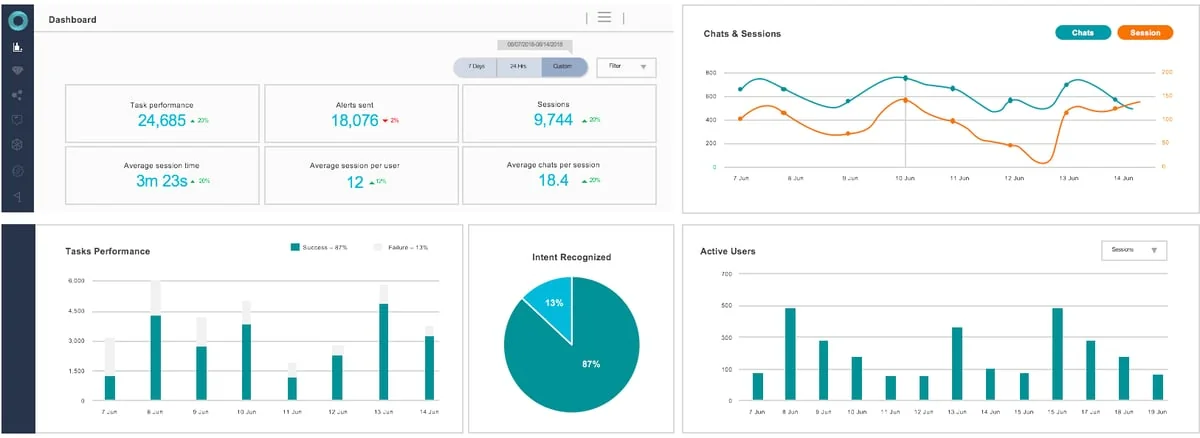
Best for: large regulated enterprises (banking, healthcare, telecom) wanting a no-code and low-code conversational and voice platform with pre-built vertical apps.
Kore.ai is an enterprise "Agent Platform" for building customer- and employee-facing AI agents, with pre-built apps for banking, healthcare, retail, HR, and IT. It was named a Leader in the 2025 Gartner Magic Quadrant for conversational AI, and it's the closest true peer to Yellow.ai on this list.
Key features
- A no-code and low-code visual flow builder, plus Arch, which turns plain-language intent into an agent system.
- Multi-channel voice and chat, with SmartAssist (CCaaS) and AgentAssist.
- Deep Microsoft (Azure, Copilot Studio) and AWS (Bedrock, Connect) partnerships.
Pros
- A single unified build, deploy, test, and monitor platform.
- Strong NLP that handles messy natural language rather than acting like a basic FAQ bot.
Cons
- A steep learning curve despite the "no-code" branding, so it needs technical resources.
- Performance lag under multi-integration load, and some agent-runtime stability bugs.
A mid-market engineer sums up the value fairly:
"It offers no-code, drag-and-drop features, along with extensive support for deploying the app across various channels. AI is smart enough to understand messy, natural language rather than just acting like a basic FAQ bot. The ROI is clear: it deflects a ton of manual support tickets."
Pricing: no public page. In-product docs list Essential, Advanced, and Enterprise tiers with custom pricing, billed by 15-minute Automation sessions or per agent seat for the contact-center products. It holds a strong 4.6/5 across 474 G2 reviews, though the reviewer base skews toward Asia. See our Kore.ai pricing rundown for the details.
Our take: if you're a Fortune 2000 bank or insurer that needs vertical depth and can staff the build, Kore.ai is a real Yellow.ai substitute. For a lean support team, the same "no-code but needs engineers" gap that dogs Yellow.ai applies here too.
6. Forethought
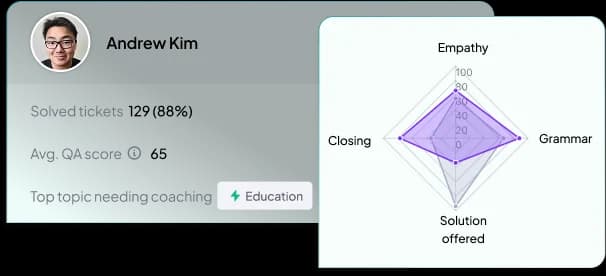
Best for: mid-market to enterprise support teams that want a multi-agent CX system trained on historical data, not a single chatbot.
Forethought is an enterprise support platform built around Autoflows, an agentic engine that interprets intent and business policy end to end. Its products are Solve (customer-facing), Assist (agent copilot), and Discover (insights and knowledge-gap detection).
Key features
- Solve runs action-based Autoflows across chat, email, voice, and Slack, not just FAQ answers.
- Assist is an in-helpdesk copilot that drafts replies and summarizes tickets.
- Discover detects knowledge gaps and auto-drafts KB articles.
- 70+ connectors across Zendesk, Salesforce, Freshworks, Front, and Gorgias.
Pros
- Deep customization via Autoflows, with a consistently praised, hands-on POV team.
- High deflection while maintaining CSAT (YAZIO reports 80% deflection).
Cons
- Web UI latency and slow saves show up in reviews.
- Reporting depth is limited, and the learning curve runs higher than expected.
A candid Reddit description of how it actually fits into a stack:
"Forethought: Think of it like an AI layer on top of your support stack. It scans historical tickets, learns your voice, and auto-responds to..."

Pricing: no public prices. Team, Professional, and Enterprise tiers are all "Get a Quote," and the model is a blend of platform access fees and outcome-based pricing. There's no free trial, but Forethought offers a Proof of Value on your own data. Check our Forethought pricing notes for more.
Our take: a strong choice if you want a multi-agent system layered on your existing helpdesk and value a white-glove team. Just budget for the setup complexity and the quote process. If you want the same "layer on your stack" idea without the sales cycle, that's the eesel angle.
7. Parloa
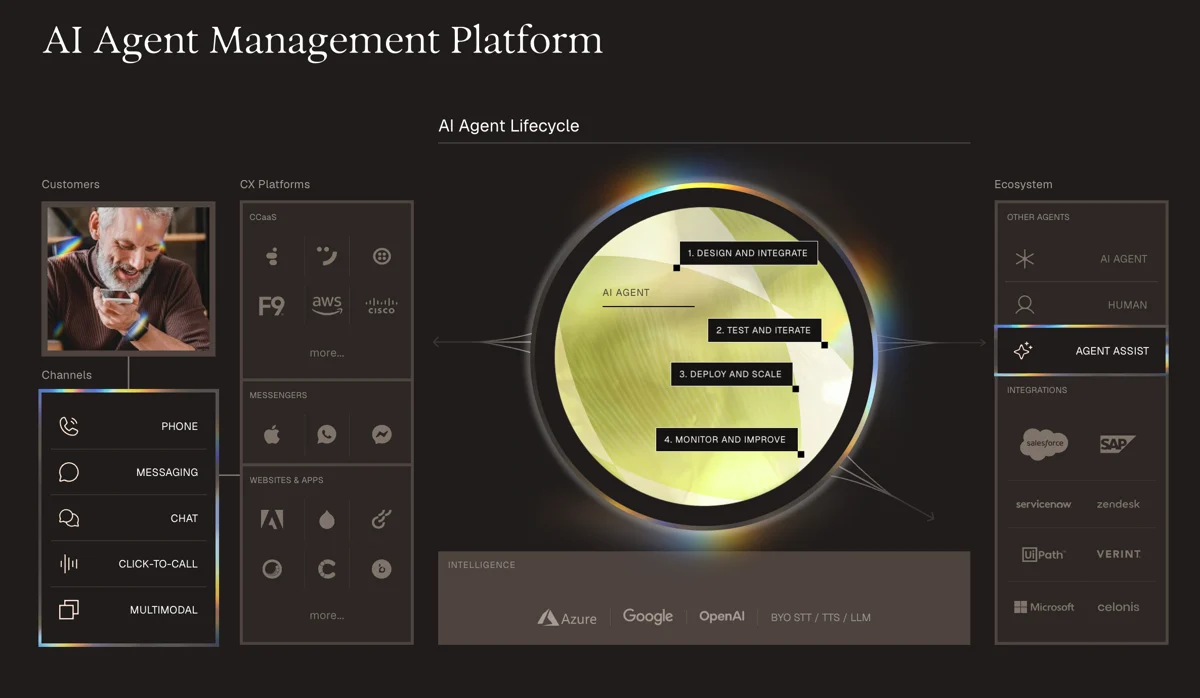
Best for: enterprises running high-volume, voice-first contact centers in telecom, insurance, travel, or retail.
Parloa is a Berlin- and New-York-based agentic AI platform, purpose-built for enterprise contact centers and voice-first. Its flagship is the AI Agent Management Platform (AMP), and it was founded in 2018 by Malte Kosub and Stefan Ostwald.
Key features
- AMP runs a full lifecycle: design and integrate, test and iterate, deploy and scale, monitor and improve.
- Parloa Studio builds agents from pre-built and custom Skills.
- Model orchestration with bring-your-own STT, TTS, and LLM.
- Simulation agents run thousands of synthetic conversations for testing.
Pros
- Genuinely purpose-built for enterprise voice, with strong simulation and eval tooling.
- A deep compliance footprint (ISO 27001, SOC 2, PCI DSS, HIPAA).
Cons
- Enterprise-only and demo-gated, with no self-serve option.
- Deployments run one to three months, and the builder needs technical oversight.
It's worth noting Parloa's public review density is near zero (a single verified G2 review), so lean on the funding signal instead: it raised a $350M Series D in January 2026 at roughly a $3B valuation.
Pricing: no public pricing, enterprise and contact-sales only, with custom quotes and no free trial. If you want the voice-focused comparison, our Sierra vs Parloa piece is useful.
Our take: if inbound voice is your core problem and you have enterprise budget, Parloa is one of the most focused options out there. It is not a chat or ticket-deflection tool, so don't shortlist it for that job.
8. PolyAI

Best for: enterprise contact centers automating complex inbound phone calls in banking, healthcare, hospitality, or utilities.
PolyAI is voice-first conversational AI that answers inbound service calls end to end on its own proprietary models (its flagship, Raven, is trained on 1B+ enterprise conversations). It's explicit that it is "not a chatbot, not voice bolted onto chat." Founded in 2017 by three Cambridge ML researchers.
Key features
- Full-stack voice dialog agents that handle fraud, outage triage, billing, and reservations.
- A no-code Agent Builder plus a developer ADK on one runtime.
- Compliance including SOC 2, HIPAA, GDPR, and PCI DSS as standard.
- A 99.9% uptime SLA on phone lines.
Pros
- Human-like, non-robotic voice, which is its number-one compliment.
- Proprietary models rather than a thin wrapper, with concrete day-one deflection.
Cons
- Occasional slowness and lag under load.
- Voice-only, with fewer omnichannel options and a less flexible customization UI.
A review that captures the day-one impact:
"From day 1 it handled 87% of these calls allowing agents to focus on revenue calls and reduce customer hold times."
Pricing: no list price and no self-serve; the only CTA is "Request a demo." Billing is per-minute of voice-agent use, bundling support, security, and the 99.9% SLA. PolyAI raised an $86M Series D in December 2025 at roughly a $750M valuation, and holds a tiny-sample 5.0/5 on G2.
Our take: if your problem is literally the phone line, PolyAI is one of the best in the category. Like Parloa, it's the wrong tool for chat and ticket automation, so match it to your channel mix before you shortlist it.
9. Aisera
Best for: large enterprises that want one agentic platform covering IT, HR, and customer service, especially if they already run Automation Anywhere.
Aisera builds AI agents and assistants for enterprise teams, and since November 2025 it has been part of Automation Anywhere, which acquired it for its self-service agents in IT service management, HR, and customer service. Aisera lists itself among enterprise conversational AI platforms on Gartner Peer Insights, which makes it a closer peer to Kore.ai than to the AI-native newcomers.
Key features
- Agent Composer builds custom agents in natural language, alongside a library of pre-built ones (Aisera).
- Aisera Unify connects outside agents, apps, and tools over open standards including A2A and MCP.
- Agent Assist gives human agents in-context help, such as surfacing similar cases or drafting a knowledge article.
- The customer support solution covers omnichannel case intake, multilingual triage and resolution, and works across ServiceNow, Salesforce, and Zendesk.
Pros
- One platform for employee and customer support, with agents that work in Microsoft Teams, email, and web portals.
- Backed by Automation Anywhere, which lists SOC 1 Type 2, SOC 2 Type 2, ISO 27001, HITRUST, and ISO 22301 on its security page.
Cons
- Most of the case studies on its homepage are internal IT and HR deployments, so customer service is one use case among several.
- The product is mid-move into the Automation Anywhere portfolio, and several aisera.com pages now point to automationanywhere.com, so expect the packaging to keep shifting.
Pricing: no public pricing; every CTA is a demo request. Automation Anywhere says it "charges for work done rather than underutilized seats," but the numbers are quote-only. On its homepage, Aisera reports that LifeScan auto-resolves 65% of incoming support requests. It holds a 4.4/5 across 146 G2 reviews on G2.
Our take: if your support team sits inside a larger enterprise that wants the same agent platform for IT, HR, and customers, Aisera is worth a demo. If you only need customer support automation on your helpdesk, a more focused tool will be quicker to stand up.
Where each one lands
Reading nine profiles is a lot, so here's the whole field on the two axes that actually decide a switch away from Yellow.ai: how fast you can launch, and whether you can see the price.
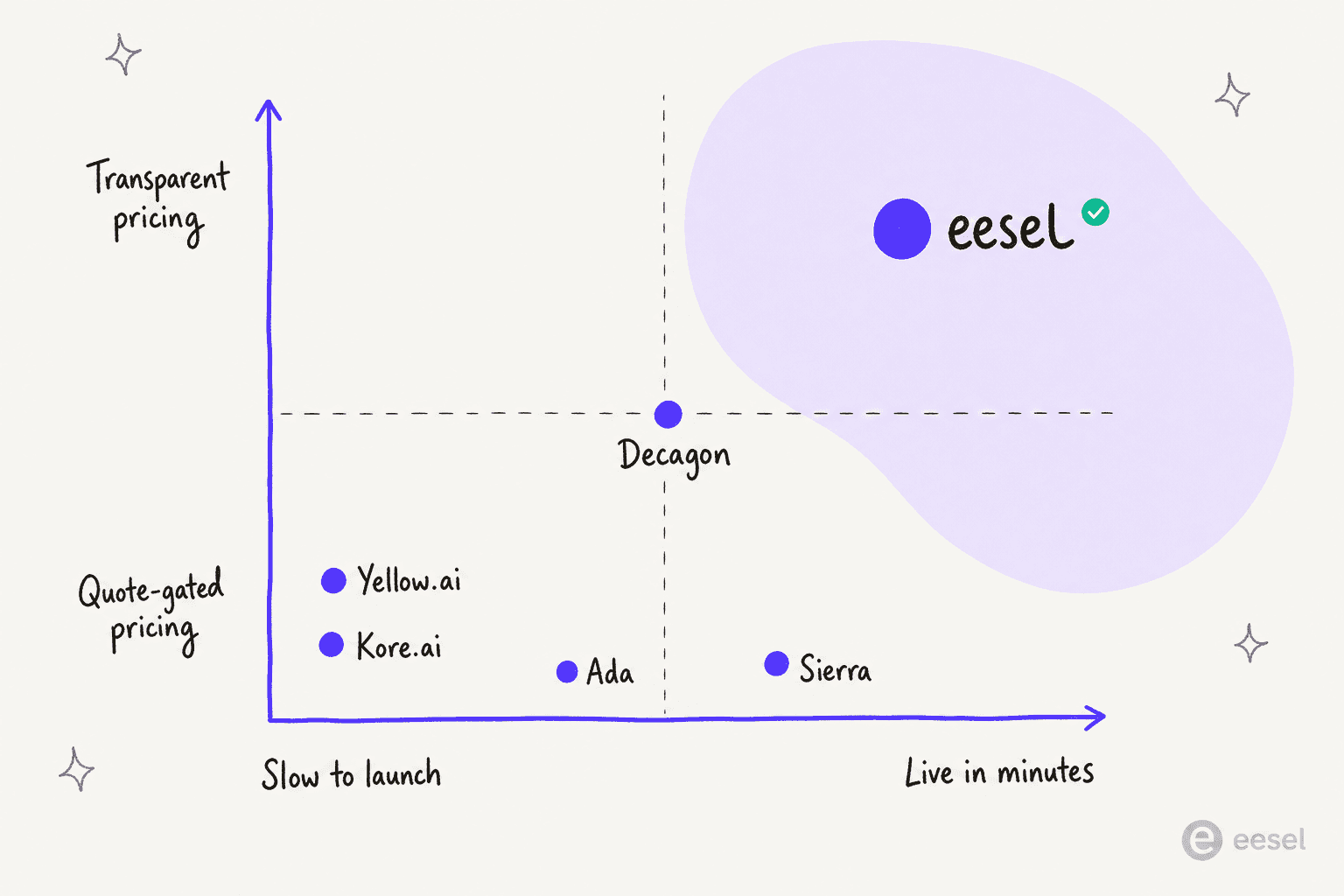
The enterprise platforms cluster in the bottom-left for a reason: they're built for a procurement process, and that process is slow and quote-gated by design. It's a pattern you see across most conversational AI platforms. That's the right trade for a Fortune 500 with a year-long rollout budget. It's the wrong trade for a support team that needed help last quarter. The takeaway isn't that one corner is "better," it's that you should pick the corner that matches your situation, and be honest about which one you're actually in.
Try eesel AI
If your reason for leaving Yellow.ai is any version of "too slow, too opaque, too risky to roll out," eesel AI is built for exactly that. It plugs into your existing helpdesk (Zendesk, Freshdesk, Gorgias, HubSpot, Front), learns from your past tickets and help docs on day one, and lets you run a simulation on your real ticket history to see coverage before a single customer touches it. No four-month implementation, no "book a call to see pricing." It's from $299/month for 500 credits, no seat fees, and you can start on the free 100-credit plan today.
The one thing I'd hold onto from all this research: the best AI support tool isn't the one with the longest feature list, it's the one you can actually test, trust, and afford before you commit. Try eesel and see your own coverage number this week.