The 12 best Moveworks alternatives for IT and customer support in 2026

Rama Adi

Katelin Teen
Last edited October 6, 2026

Why teams leave Moveworks in the first place
Let me be fair to Moveworks first, because it earned its reputation. It pioneered the "one conversational front door for the whole workforce" idea, it has genuinely impressive numbers behind it (Amadeus cut support calls 44%, CVS Health reported a 50% drop in live-agent chats in under 30 days), and it's trusted by 350+ organizations including 10% of the Fortune 500. If you're a 20,000-person enterprise with a messy internal-support problem, Moveworks is a serious tool.
The reasons people start looking elsewhere are pretty consistent, though.
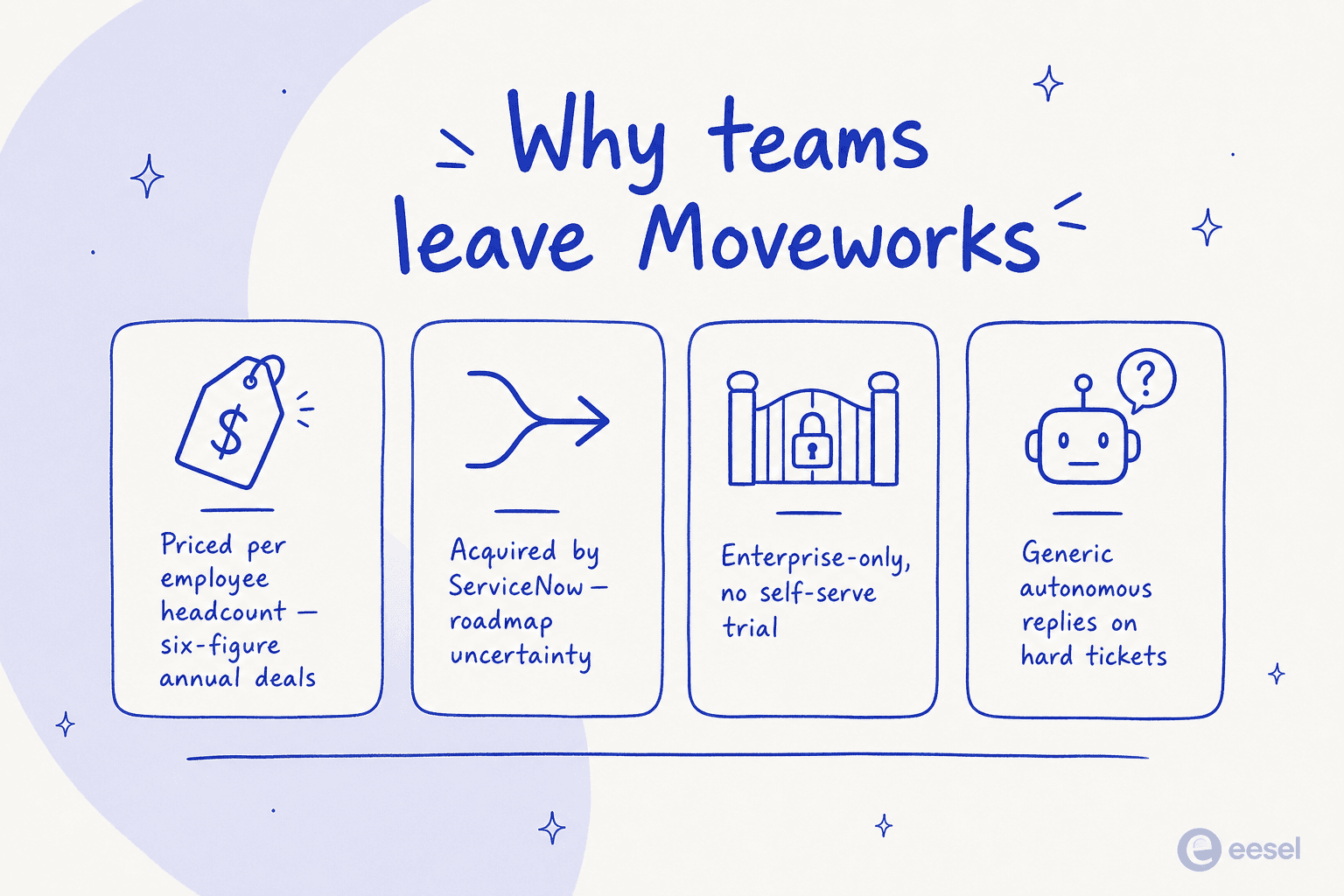
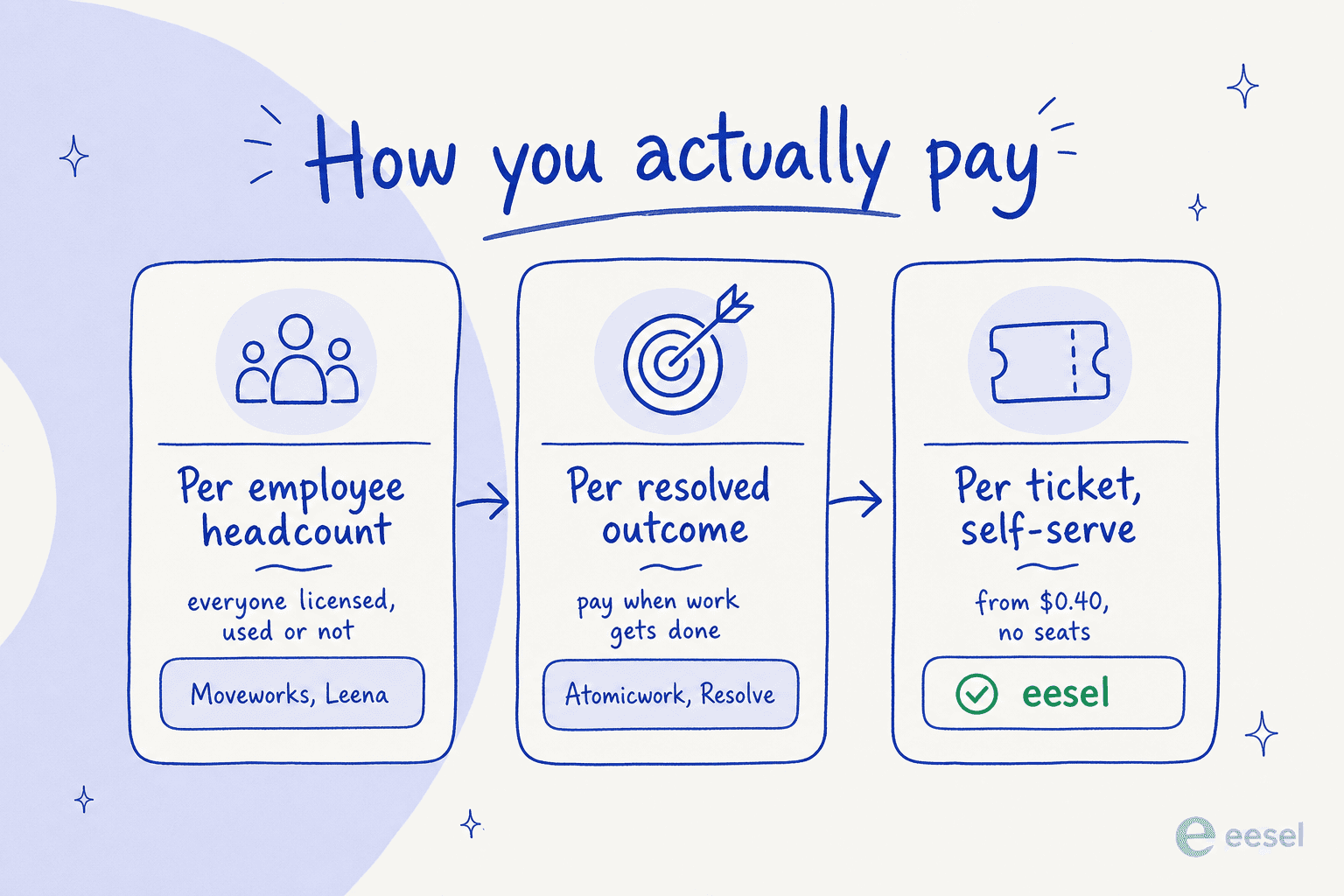
The pricing model. Moveworks bills on total employee headcount, not on how many people actually use it or how many tickets it resolves. So you license everyone, used or not, as a flat annual fee. Vendr puts the median deal at ~$130,000 a year across 31 purchases, and a 3-year all-in total cost of ownership for a 5,000-employee org commonly lands at $1.5M–$3.5M once you add implementation. There's no free tier and no self-serve trial.
The ServiceNow question. The ~$2.85B acquisition closed in December 2025, and on r/servicenow you can watch current customers worry out loud about roadmap velocity, support quality, and whether the "EmployeeWorks" rebrand is just Moveworks with a ServiceNow logo. That uncertainty alone is enough for a lot of buyers to run a fresh evaluation.
It's enterprise-only. Reviewers consistently describe Moveworks as built for thousands-of-employees orgs with six-figure budgets, and a poor fit for anyone smaller. If you're mid-market, you're not really the customer.
I'll add one thing from our own side of the fence. I work on the product at eesel, and we've spent years putting AI agents on live support queues. The single most common thing I hear from teams evaluating these big platforms is a build-vs-buy anxiety, best summed up by one customer:
"We could try to write our own LLM application but we didn't want to invest our time into that. We wanted something that we would not have to maintain."
Karel, GENERAL BYTES (eesel case study)
A heavy, headcount-priced platform can feel like the opposite of that: a big commitment before you've seen it work on your own tickets. That's the lens I'd carry into the list below.
The 12 best Moveworks alternatives at a glance
Here's the quick comparison before the detail. I've included the columns that actually matter when you're comparing enterprise AI support tools, not just price.
| Tool | Best for | Primary scope | Deployment | Pricing model | Public price? | Free trial |
|---|---|---|---|---|---|---|
| eesel AI | Any helpdesk, fast self-serve rollout | Customer + internal support | Layers on your helpdesk | Fixed monthly, credits (1 per ticket or chat) | Yes, from $299/mo (500 credits) | Yes (100 credits) |
| Aisera | Large enterprises consolidating IT+HR+CX | Cross-functional service | Alongside system of record | Quote-based, annual | No | No |
| ServiceNow Now Assist | Orgs already all-in on ServiceNow | IT/employee service (ITSM) | Native in ServiceNow | Pro Plus add-on, per seat | No | No |
| Atomicwork | Mid-market replacing legacy ITSM | ITSM + ESM | Replace or overlay ITSM | Credits or per outcome | Partly, from $25k/yr | Via demo |
| Leena AI | HR and back-office employee experience | IT/HR/Finance | Overlays your systems | Quote-based, headcount | No | No |
| Glean | Enterprise knowledge search + agents | Work AI / search | Indexes your apps | Per seat + FlexCredits | No | No |
| Espressive (Resolve) | Deep ServiceNow deflection | IT service desk | In front of ServiceNow | Quote-based, per employee | No | No |
| Maven AGI | Customer-facing CX automation | Customer support | Layers on your helpdesk | Quote-based | No | No |
| Sierra | Consumer brands that want agents taking autonomous actions | Customer support | Connects to your systems of record | Outcome-based | No | Via demo |
| Decagon | High automation across chat, email and voice | Customer support | Integrates with your helpdesk and CRM | Quote-based | No | Via demo |
| Forethought | Teams that want to keep their current help desk | Customer support | Layers on your helpdesk (70+ integrations) | Quote-based, three tiers | No | Via demo |
| Ada | Enterprise CX across many channels | Customer support | Integrates with Zendesk, Salesforce, Twilio | Per conversation | No | Via demo |
One pattern jumps out immediately: almost everything in the Moveworks category is sales-led and quote-gated. That's not an accident. These are enterprise products with enterprise buying motions. The two exceptions on transparency (Atomicwork's published floor and eesel's published plans) are worth keeping in mind as you read on.
1. eesel AI
Best for: teams that want an AI agent across any helpdesk (customer or internal) without an enterprise contract or a months-long rollout.
I'll be upfront that this is our product, so read the verdict with that in mind. The reason eesel AI belongs at the top of a Moveworks-alternatives list is that it attacks the two biggest Moveworks pain points directly: it's self-serve and it has one fixed monthly price.

Where Moveworks is a whole platform you commit to, eesel is an AI helpdesk agent that layers on top of the tools you already run, Zendesk, Freshdesk, Freshservice, HubSpot, Gorgias, Front, Slack, Microsoft Teams, Confluence, and more, across 100+ integrations. It learns from your past tickets and help docs on day one, drafts and sends replies, triages, and escalates, and you can point the same agent at an internal IT/HR queue or a customer-facing one.
The feature I'd point a nervous buyer to is simulation mode: you run the agent against thousands of your historical tickets before it goes live, see exactly what it would have answered and what coverage you'd get by theme, then fill the gaps and re-run. It's the antidote to the "confident bot gives wrong answers" fear that comes up in every one of these evaluations.
Pros:
- Truly self-serve, with a free trial and no sales call required.
- Fixed monthly pricing from $299/month for 500 credits (1 credit per ticket or chat), no per-seat fees, no headcount minimum.
- Works across any helpdesk and both internal and customer support.
- Simulation on your real tickets before go-live, plus confidence-based routing so low-confidence answers draft instead of send.
Cons:
- Not a full ITSM platform with its own CMDB, so if you want to replace ServiceNow rather than put AI in front of your helpdesk, that's not the pitch.
- SOC 2 is listed as in progress rather than certified, worth checking against your procurement bar.
- Newer brand than the enterprise incumbents, so it carries less Gartner-quadrant weight in a formal RFP.
Real results are easy to point to. Gridwise saw eesel resolve 73% of tier-1 requests in the first month, with signal showing up inside a 7-day trial:
"In the first month, eesel is resolving 73% of our tier 1 requests... results quickly during our 7-day trial."
Kim Simpson, Gridwise (eesel, G2)
Verdict: If your goal is "AI on my support queue this week, priced on what it actually does," eesel is the most direct answer to a Moveworks search. If your goal is "rip out and replace a Fortune-500 ITSM stack," keep reading.
2. Aisera
Best for: large enterprises that want a single cross-functional AI platform spanning IT, HR, customer service, and finance.
Aisera is the closest like-for-like Moveworks competitor, and the two show up on the same shortlists constantly (we even wrote up the Aisera vs Moveworks matchup separately). It's an enterprise AI Service Experience platform where a Universal Agent orchestrates domain agents across business functions.
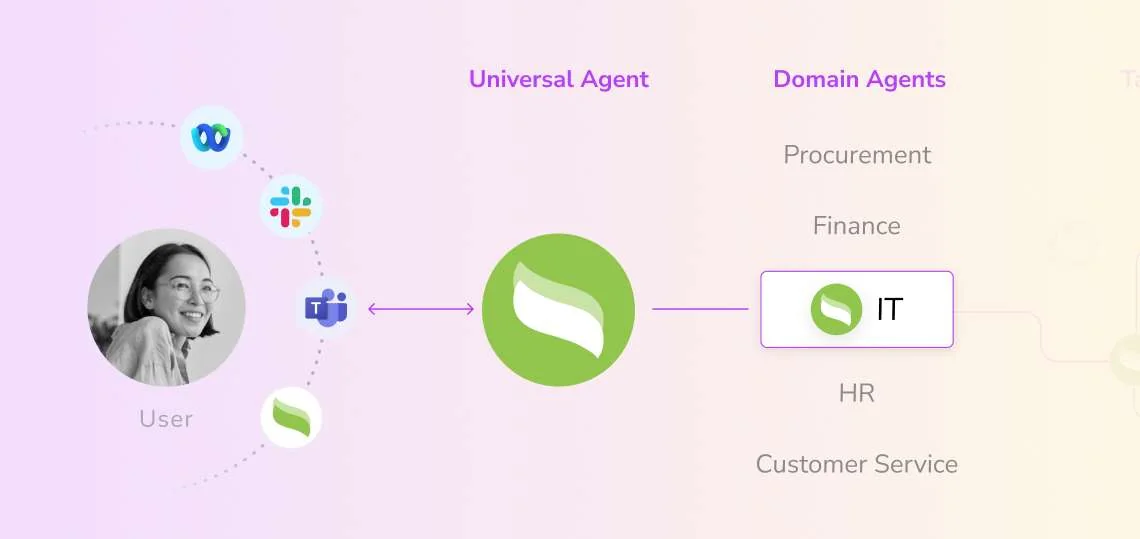
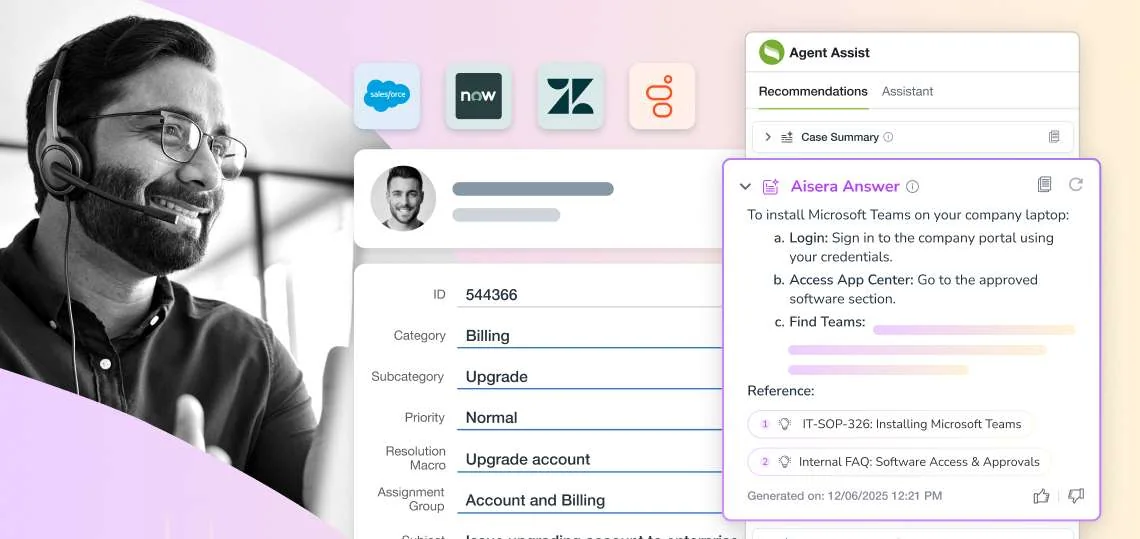
The architecture is genuinely broad: an LLM gateway that supports Aisera's own model, foundational models, or bring-your-own, an open-standards orchestration layer, and the TRAPS governance framework. Named customers include Adobe, Cisco, Nokia, and Zoom, and outcomes like LifeScan auto-resolving 65% of support requests are on the record. In November 2025 Aisera was acquired by Automation Anywhere, so like Moveworks it's now part of a bigger platform.
Pros:
- Genuinely cross-functional (IT + HR + CX + finance) from day one.
- BYO-LLM flexibility with observability.
- Deep analyst recognition and Fortune-500 references.
Cons:
- No public pricing;
/pricing404s and buying is annual-contract, contact-sales. - Too heavy a buy for CX-only or smaller teams.
- Post-acquisition, its go-to-market is increasingly bundled into Automation Anywhere, another roadmap in flux.
Verdict: For a 5,000-plus-employee org consolidating everything onto one agent platform, Aisera is a legitimate Moveworks swap. For anyone smaller, it's the same "enterprise-only, quote-gated" problem in a different logo. See our full Aisera reviews write-up if it's on your list.
3. ServiceNow Now Assist
Best for: organizations that already run ServiceNow and want the AI layer native inside it.
There's an irony worth naming: Moveworks is ServiceNow now. So one of the most obvious "alternatives" is ServiceNow's own agentic layer, Now Assist, embedded directly in the ITSM workflow. If you're already a ServiceNow shop, this is the path of least resistance.
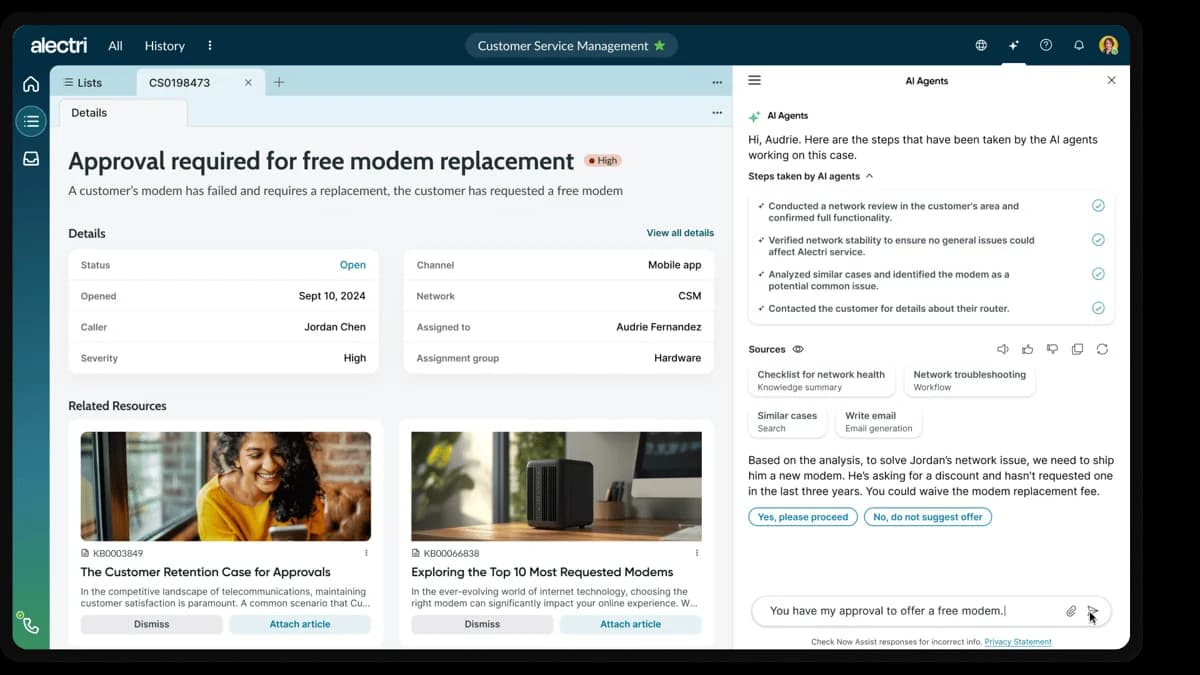
Now Assist covers the virtual agent, incident summarization, AI search over your knowledge base, and autonomous AI agents, all on the platform 85% of the Fortune 500 already use. The catch is well documented on r/servicenow.
Pros:
- Native to ServiceNow, so no separate integration if you're already on it.
- Backed by the market-leading ITSM platform and its data model.
- One vendor, one contract if consolidation is your goal.
Cons:
- Now Assist is a Pro Plus / Enterprise add-on at a reported ~60% premium over the underlying license, kept private to avoid sticker shock.
- The top community complaint is that deflection underdelivers, still kicking most tier-1 requests to a human.
- Only makes sense if you're already committed to ServiceNow; it's a poor standalone ITSM AI buy otherwise.
Verdict: If you're on ServiceNow and the Moveworks acquisition just made you nervous, staying inside the Now Assist ecosystem is the safe political choice, but budget for the add-on premium and temper deflection expectations.
4. Atomicwork
Best for: mid-market teams that want to modernize or replace a legacy ITSM without a multi-quarter migration.
Atomicwork is the most interesting "modern alternative" story here. It's an agentic ITSM + ESM platform built as an AI-native replacement for ServiceNow and Jira Service Management, and it's happy to either overlay your existing ITSM or replace it outright.
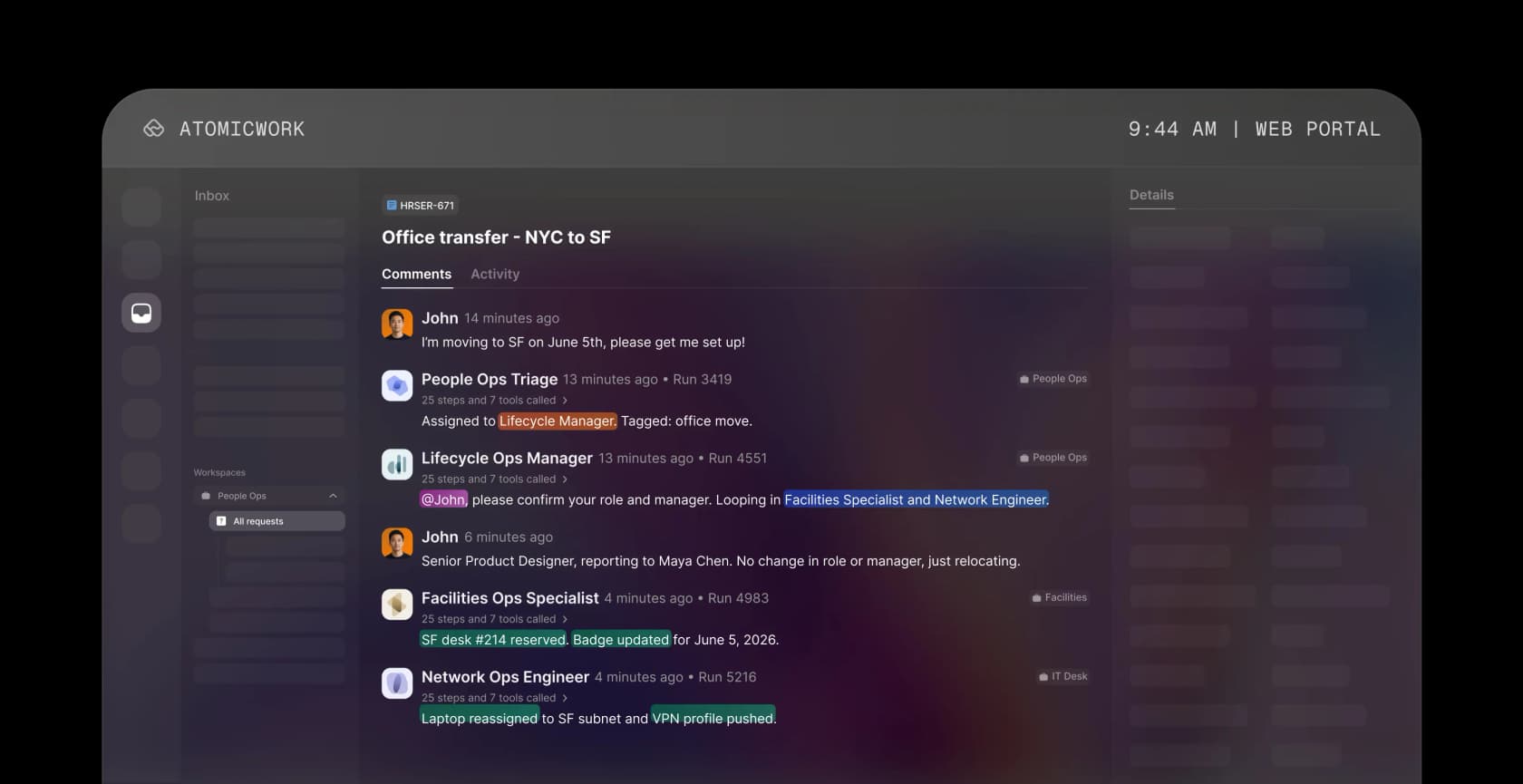
Its assistant, Atom, lives in Slack, Teams, browser, email, and even inside Claude and ChatGPT, and its AI Workforce lets you deploy role-scoped AI coworkers governed through a control plane. The proof points are concrete: Pepper Money replaced ServiceNow in six weeks, and Zuora replaced JSM across 15 offices.
Pros:
- Rare public pricing floor: Professional from $25,000/year, plus an outcome-based option ($1/knowledge, $2/access, from $3/service-resolution).
- Can run on top of ServiceNow or JSM with no migration and no platform fee, then expand.
- Modern, Slack/Teams-native, fast enterprise rollout.
Cons:
- Still enterprise-scoped; no true mid-market self-serve tier.
- Thin independent review base so far (small n on G2 and Gartner).
- BYO-model means answer quality depends on your configuration.
Verdict: If you're mid-market or enterprise and the real problem is "our legacy ITSM is slow and expensive," Atomicwork is the sharpest modern pick on this list, and the only enterprise option here that shows you a starting price. Compare it against the field in our best AI for ITSM guide.
5. Leena AI
Best for: HR and back-office employee experience across IT, HR, and finance.
Leena AI started life as an HR chatbot and has repositioned as an enterprise agentic-AI platform with pre-built "AI Colleagues", Iris for IT, Harrison for HR, Fiona for finance, that answer questions and execute transactions across Workday, ServiceNow, SAP, and more.
Its "pre-built, pre-trained, pre-integrated, live in 45 days" pitch is aimed squarely at Moveworks buyers, and it's explicit about positioning against Moveworks, Copilot Studio, and Glean. It leans hard on employee-onboarding and HR-desk use cases, and holds a solid G2 rating of 4.6/5 across 151 reviews.
Pros:
- Strong HR and back-office focus with three ready-made AI Colleagues.
- 200+ pre-built enterprise connectors; can overlay ServiceNow or help retire an HR desk.
- Plain-English "Agent Operating Protocols" so business owners, not engineers, run the colleagues.
Cons:
- Fully quote-gated, headcount-based pricing with implementation fees on top; no public number.
- Reviewers cite heavy dependence on Leena's implementation team and lengthy customization cycles.
- Broadest value is internal-facing; it's not a customer-support tool.
Verdict: If your pain is specifically HR and employee experience rather than general IT deflection, Leena AI is a better-fit Moveworks alternative than a generic ITSM tool, provided you're comfortable with an enterprise services engagement.
6. Glean
Best for: enterprises whose core problem is finding knowledge scattered across dozens of apps.
Glean approaches the problem from a different angle. It's a "Work AI" platform built on a permissions-aware company knowledge graph across 100+ connectors, with an Assistant and a no-code agent builder on top. Where Moveworks leads with action-taking, Glean leads with search and synthesis.
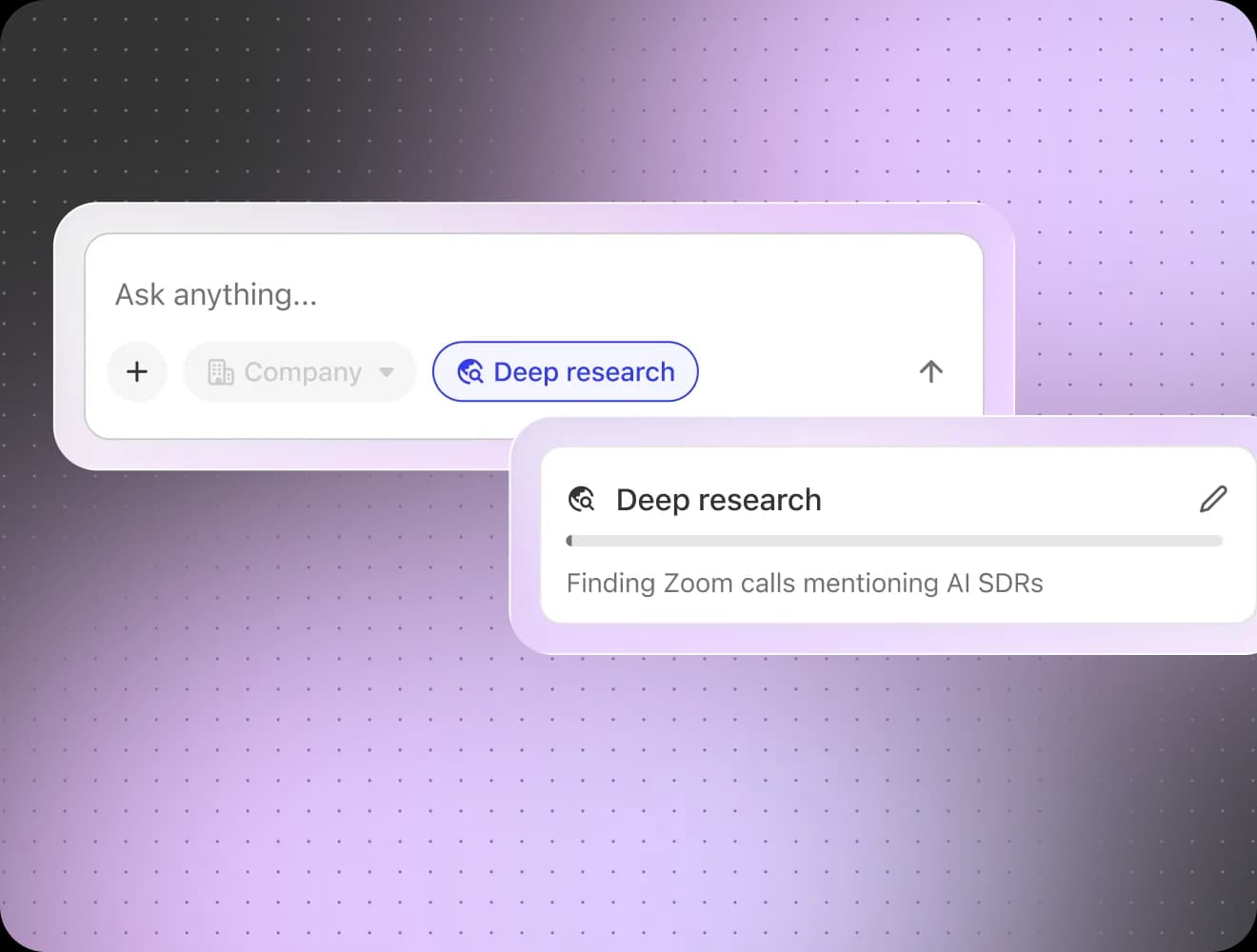
It's a well-funded heavyweight, $150M Series F at a $7.2B valuation and past $100M ARR, with customers like Databricks and Grammarly. When it works, it's magic:
"It consumes all of our knowledge sources including Slack, Google docs, wiki, source code and provides answers to complex specific questions in a way that's downright magical."

But the recurring knock is reliability on precise queries:
"It's very very very slow in providing answers. It's also not always consistent. I can query it the same prompt on different occasions and it will use totally different ways to get to an output."

Pros:
- Best-in-class enterprise knowledge search with permission awareness.
- 100+ turnkey connectors and strong governance.
- End-user surfaces (Assistant, Chrome extension, voice) for non-technical staff.
Cons:
- Contact-sales only, per-seat plus FlexCredits, with no published credit-to-dollar conversion.
- Reviewers report slow, inconsistent answers on structured queries.
- More a knowledge layer than a ticket-resolving service-desk agent.
Verdict: If "our people can't find anything" is the real problem, Glean is excellent. If "resolve and action support tickets end-to-end" is the goal, it's adjacent to what Moveworks does rather than a direct swap.
7. Espressive (now part of Resolve)
Best for: ServiceNow-centric IT service desks that want deep, deflection-focused conversational AI.
Espressive built Barista, a conversational virtual support agent for employee self-help, and it was a 2024 Forrester Leader. Its founder is a former ServiceNow SVP, which is why its ServiceNow integration has always been its center of gravity, reviewers single it out as the feature that lives up to the hype.
The important status change: Espressive was acquired by Resolve in September 2025, and Barista is being merged into Resolve's agent lineup (primarily RITA). So you're now buying into Resolve's roadmap, with Espressive's deflection track record (70–80% per department, per reviewers) underneath.
Pros:
- Deep, genuinely praised ServiceNow integration with KB auto-identification.
- Strong real-world deflection numbers (70–80% reported per department).
- Multi-channel: chat, portal, Teams, Slack.
Cons:
- Quote-gated, per-employee; one buyer described it as roughly "two full-time salaries per department."
- Onboarding is slow, expect around six months to configure well.
- Brand and roadmap are in transition post-Resolve acquisition.
Verdict: For a ServiceNow-anchored IT org that wants best-in-class deflection and can absorb a longer rollout, Espressive-in-Resolve is a strong, if now less independent, choice.
8. Maven AGI
Best for: teams whose primary need is customer-facing CX automation rather than internal IT.
Maven AGI opens the customer-support end of this list: its heart is customer support, not the internal employee desk. Its Agent Maven sits as an intelligence layer on top of Zendesk, Salesforce, and Freshdesk, and it claims up to 93% of customer queries answered autonomously. It's well-funded ($78M raised, Series B led by Dell Technologies Capital) and led by ex-HubSpot and ex-Google founders.
I'm including it because plenty of Moveworks searches are really "enterprise AI support agent" searches, and if your queue is external customers rather than employees, Maven is a more natural fit. It's newer, though, with a thin ~16-review base on G2, and the honest customer voice reflects that:
"Pricing is not good and Need continuous maintenance."
Pros:
- Purpose-built for customer support and CX, with voice, chat, and email.
- Strong enterprise security posture (SOC 2 Type 2, ISO, HIPAA).
- Layers on existing helpdesks rather than replacing them.
Cons:
- Quote-only, no free tier, book-a-demo to get a number.
- Reviewers flag ongoing maintenance and tuning burden.
- Thin independent track record for a risk-averse enterprise buyer.
Verdict: If you landed on Moveworks by accident and actually need customer-support automation, Maven AGI (or a self-serve option like eesel) is the better lane. For internal IT/HR, the ITSM-focused tools above fit better.
9. Sierra
Best for: large consumer brands that want a customer-facing agent that takes autonomous actions, not only answers questions.
Sierra calls itself a conversational AI platform for businesses, and its customer list leans toward big consumer names like SiriusXM, Rocket Mortgage, ADT and Sutter Health. It says 40% of the Fortune 50 partner with it. One agent runs across chat, SMS, WhatsApp, email, voice, and ChatGPT, in 59 languages.
The focus is on tasks that go end to end. Sierra connects to your systems of record, from order management to CRM, so the agent can do things like process an insurance claim, return an order, or originate a mortgage. Its Ghostwriter tool builds or edits the agent from SOPs, transcripts or a plain-English description, and Explorer answers questions about agent performance.
Pros:
- Built for complex customer-facing tasks across voice and digital channels.
- Outcome-based pricing, so you pay when the agent achieves an agreed outcome.
- Comes with an agent development team that works alongside you on the deployment.
Cons:
- No public price list; you go through sales to get a number.
- Aimed at large enterprises, and buying starts with a demo rather than a self-serve signup.
- Built for customer-facing support; Sierra doesn't position it for the internal IT and HR desk Moveworks was built for.
Verdict: If your Moveworks evaluation was really about external customer support at enterprise scale, Sierra belongs on the shortlist, especially where the agent needs to complete transactions rather than just answer questions.
10. Decagon
Best for: enterprise CX teams that want high automation across chat, email, and voice from one agent.
Decagon builds AI agents for customer support and lists customers like Deutsche Telekom, American Airlines, Delta, Chime and Ticketmaster. Its main idea is Agent Operating Procedures (AOPs): you define agent workflows in natural language, and the team can change behavior without an engineering sprint.
Chat, voice and email share one intelligence layer, and the platform adds live A/B experiments, simulation-based testing, and an always-on QA monitor called Watchtower. On the integration side it syncs tickets and customer data from Salesforce, Zendesk and other helpdesks, pulls knowledge from Confluence and Contentful, and hands calls to human agents through CPaaS tools like Amazon Connect and RingCentral.
Pros:
- One agent across chat, email and voice, with cross-channel memory of the customer.
- Natural-language AOPs keep workflow changes in the hands of the CX team.
- Testing, experiments and QA are part of the platform.
Cons:
- No public pricing (decagon.ai/pricing returns a 404); it's demo-led.
- Enterprise-focused, and buying starts with a demo rather than a self-serve signup.
- Built for customer-facing support; Decagon doesn't position it for internal IT or HR.
Verdict: Decagon fits a larger CX org that wants a high automation rate across every channel and is happy with a sales-led rollout. For an internal employee desk, the ITSM-focused tools above fit better.
11. Forethought
Best for: support teams that want to keep their current help desk and add AI agents on top of it.
Forethought is a multi-agent system for customer support with four parts. Solve is the AI agent that resolves inquiries end to end. Triage classifies and routes tickets, and handles the handoff to a human when Solve can't resolve something. Assist is a copilot for human agents inside the helpdesk, and Discover finds knowledge gaps in your ticket history and drafts articles to fill them.
It plugs into 70+ helpdesks, knowledge sources and connectors, including Zendesk, Salesforce, ServiceNow, Freshworks, Gorgias, Help Scout, Kustomer and Jira. That makes it one of the easier options here if you don't want to move off your existing helpdesk.
Pros:
- Works inside the helpdesk you already run, with a long integration list.
- Covers the whole flow: resolution, triage, agent assist and QA.
- Plans cover chat and mobile on Team, with email, voice and Slack from Professional up.
Cons:
- All three plans (Team, Professional, Enterprise) are quote-only.
- Discover, Multibrand and the Analytics API are add-ons on some plans.
- Customer-support focused rather than a full internal ITSM replacement.
Verdict: If your support stack is staying put and you want AI layered on top of it, Forethought is a practical pick. Budget time for a sales cycle, since there's no public number.
12. Ada
Best for: enterprise CX teams that need one AI agent across many channels and languages.
Ada is an agentic customer experience platform that says it serves 350+ global enterprises. Its Reasoning Engine powers one agent across voice, email, chat, Messenger, WhatsApp, SMS, Instagram, in-app, and custom channels, and Ada reports an 84% automated resolution rate across its customers.
For actions, Ada Computer gives the agent API, code and MCP tools to complete tasks in your business systems, under your controls. It connects to systems like Zendesk, Salesforce, and Twilio, and there's an MCP server for managing the agent from Claude or ChatGPT.
Pros:
- Very wide channel coverage, including voice and social messaging.
- Conversation-based pricing: you pay per conversation the AI agent has, which is easy to forecast.
- Long enterprise track record, with published case studies.
Cons:
- The pricing page is a demo booking form, so there's no public rate.
- Aimed at high-volume enterprise CX, so the demo form starts by asking your yearly contact volume.
- Built for customer-facing support; Ada doesn't position it for internal IT or HR.
Verdict: Ada suits a high-volume, multi-channel customer support operation that wants predictable per-conversation billing. As with Sierra and Decagon, it's a customer-facing alternative, not an internal service desk.
So which Moveworks alternative should you pick?
The honest summary is that this category splits along one line: how much enterprise weight (and budget, and rollout time) you're willing to take on.
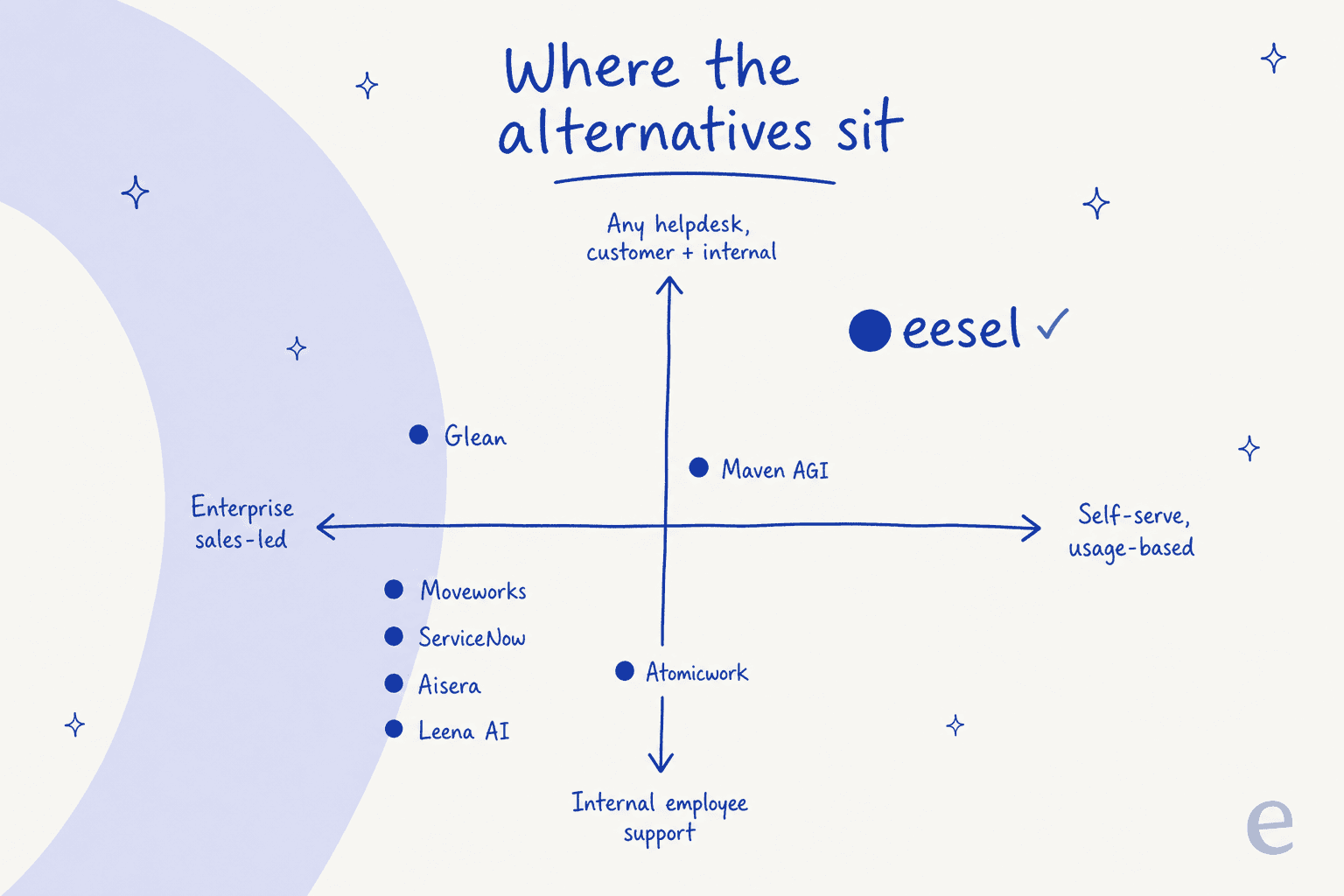
The bottom-left cluster (Moveworks, ServiceNow, Aisera, Leena) is where you go for a heavyweight, all-in enterprise platform. The further right and up you move, the faster and more flexible things get. If you're not sure where you land, the widget below walks you through it.
Try eesel for a Moveworks alternative you can actually test first
If the thing that put you off Moveworks was the six-figure commitment before you'd seen it touch your own tickets, that's exactly the gap eesel AI is built for. It connects to your helpdesk (or your internal Slack and Teams channels), learns from your history, and lets you simulate on real past tickets so you know your deflection rate before it ever replies to a live user.
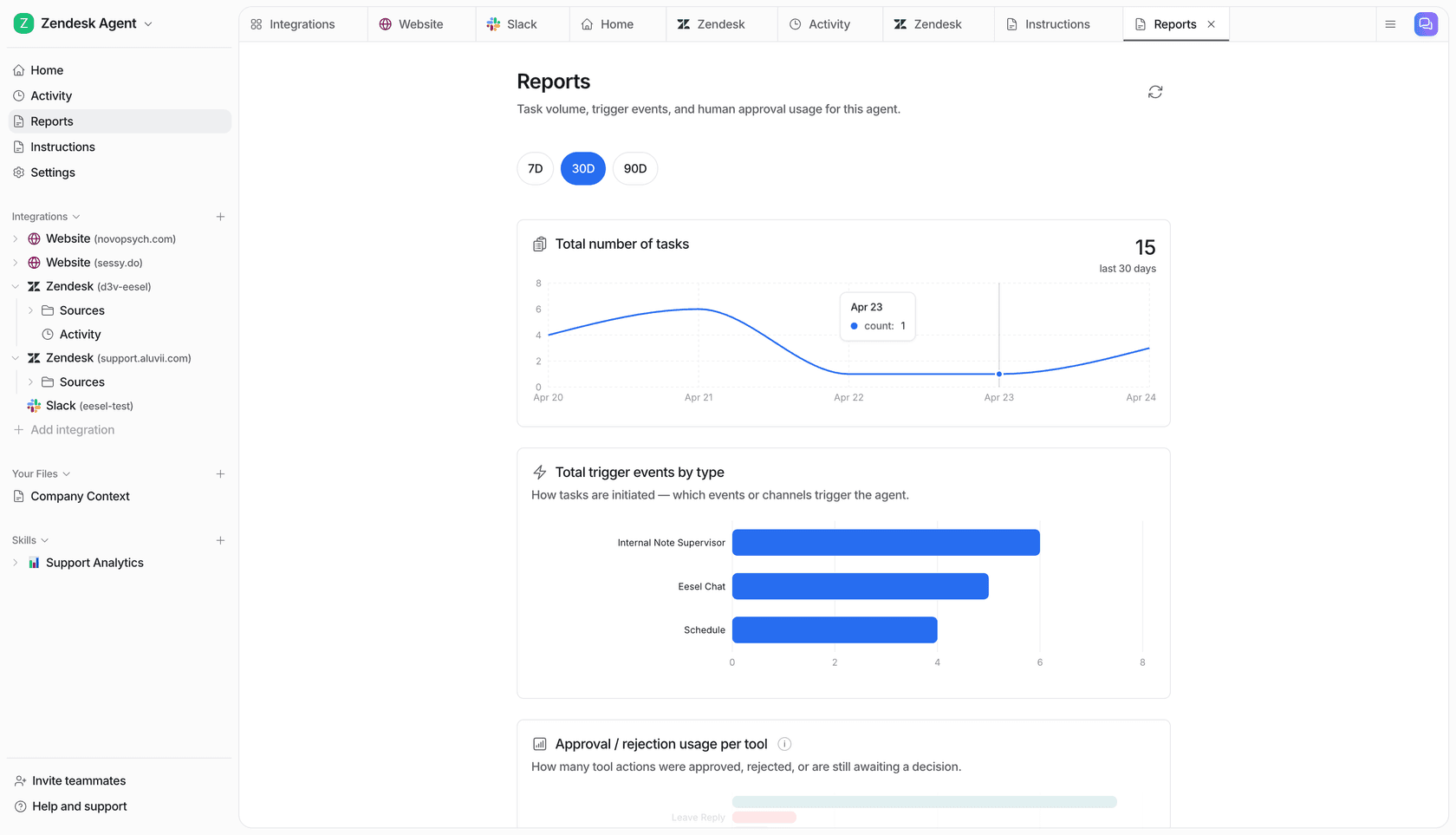
And because it's one fixed monthly price from $299 for 500 credits (1 credit per ticket or chat) with no per-seat fee, you pay for the tickets the AI works on, not for every employee on the payroll. You can start on the free plan with 100 credits today, no sales call, and see coverage on your own data this week. Try eesel.