IT service desks are drowning in tickets. Between password resets, access requests, and system outages, teams are stretched thin trying to keep up. The old way of manually routing every ticket and writing every response just doesn't scale anymore.
AI for ITSM fills that gap. The right AI tool can automate ticket triage, draft responses, and even resolve common issues without human intervention. But with so many options on the market, choosing the right one isn't easy.
We researched and compared the best AI tools for IT service management to help you find the right fit. Whether you're looking to add AI to your existing setup or replace your whole platform, this guide breaks down what matters.
What is AI for IT service management?
AI for IT service management (ITSM) applies artificial intelligence to the processes IT teams use to deliver services across an organization. Where traditional ITSM relies on manual input at every step, AI-powered tools handle repetitive work automatically, like classifying tickets, routing requests, and suggesting solutions.
The payoff is more time for agents to focus on work that actually requires human judgment. According to the 2026 State of AI in IT report, 74% of organizations already have AI working in at least one service management team, and 82% who have invested say they have seen tangible results.
How we chose the best AI tools for ITSM
To cut through the noise, we evaluated each tool on what actually matters for modern IT teams:
- Integration capabilities How easily does it connect to your existing ITSM platforms?
- Core AI features Does it offer autonomous agents, copilots for human agents, smart triage, and predictive analytics?
- Ease of implementation Can you layer it on top of your current setup, or do you need to rip and replace everything?
- Scalability and pricing Is the pricing transparent and does it let you grow without breaking the bank?
Comparison at a glance
| Tool | Best for | Key AI features | Pricing from | Key integrations |
|---|---|---|---|---|
| eesel AI | Adding AI to existing ITSM | AI agent, AI copilot, AI triage | $239/mo | Zendesk, Jira, Freshdesk, ServiceNow, Slack, Teams |
| ServiceNow | Large enterprises | Autonomous AI agents, predictive analytics | Quote-based | Full platform ecosystem |
| Jira Service Management | Atlassian ecosystem teams | Rovo AI, virtual agent, AIOps | $20/agent/mo | Confluence, Jira Software, Opsgenie |
| Freshservice | Fast AI time-to-value | Freddy AI agent, copilot, insights | $19/agent/mo | Freshworks suite |
| SysAid | AI throughout ticket lifecycle | Emotion detection, agent guidance | Quote-based | Microsoft tools |
| Moveworks | Enterprise self-service | Conversational AI, workflow automation | Quote-based | ServiceNow, Jira, Workday, Slack |
| Aisera | Fully autonomous ITSM | Agentic AI, unsupervised NLP | Quote-based | ServiceNow, Salesforce, Zendesk |
The 7 best AI tools for ITSM
Here's a closer look at each platform and where it fits best.
1. eesel AI
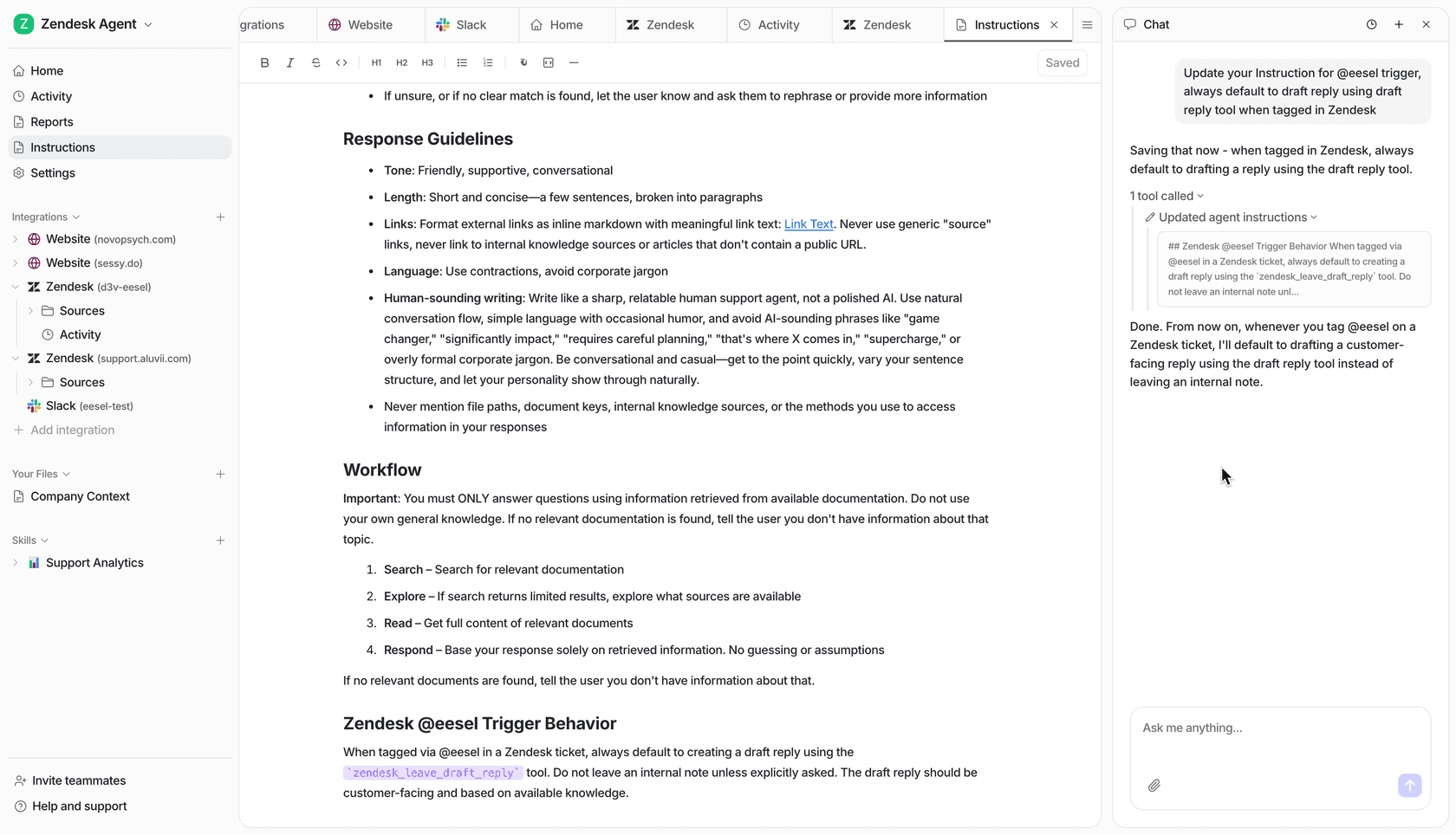
eesel AI works as an AI layer on top of your existing ITSM tools. Instead of forcing you to migrate to a new platform, it plugs into your help desk and learns from your past tickets, help center articles, and connected documentation. Within minutes, it understands your business context and can start handling tickets.
The platform offers three core AI products: an AI agent that resolves tickets autonomously, an AI copilot that drafts replies for human agents, and AI triage that automatically tags, routes, and prioritizes tickets. You can also explore our AI for IT service management guide for a deeper dive into how these tools work together.
What's particularly useful is the simulation mode. You can test the AI on your historical tickets to see exactly how it would have performed before going live. This lets you verify quality and tune responses without touching real customer interactions.
Key features:
- Works with existing help desks including Zendesk, Jira Service Management, Freshdesk, and ServiceNow
- Learns from help centers, past tickets, Google Docs, PDFs, and Confluence
- Simulation mode for testing before deployment
- Plain-English escalation rules (no code required)
- Slack and Microsoft Teams integration for internal support
Pricing:
| Plan | Annual price | Interactions/mo | Key features |
|---|---|---|---|
| Team | $239/mo | 1,000 | Website/docs training, Copilot, Slack, reports |
| Business | $639/mo | 3,000 | Past tickets, Teams, AI Actions, bulk simulation |
| Custom | Contact | Unlimited | Multi-agent orchestration, custom integrations |
Why we chose it: Best for teams who want powerful AI capabilities without the headache of replacing their core ITSM platform. The interaction-based pricing is also more predictable than per-agent models.
2. ServiceNow
ServiceNow is an enterprise-grade platform that positions itself as "the AI control tower for business reinvention." Its autonomous AI agents handle complex workflows across IT, HR, customer service, and more, acting as a unified layer for governing AI activity across the organization.
The platform's AI Control Tower gives you a single interface to monitor and govern all AI activity. Meanwhile, its no-code tools make the platform accessible to non-technical users. For large organizations managing service delivery at scale, it covers a wide range of operational use cases beyond ITSM alone.
Key features:
- AI Agents that act autonomously across IT, customer service, and HR workflows
- AI Control Tower for monitoring and governing all AI activity
- AI Agent Fabric for connecting agents across platforms
- Predictive Intelligence for proactive issue detection
- No-code and low-code workflow automation
Pricing: Quote-based modular pricing depending on users, modules, and environments.
Why we chose it: Best for large enterprises needing comprehensive AI governance and cross-department coverage. The platform is powerful but requires significant investment and implementation effort.
3. Jira Service Management
Jira Service Management is Atlassian's ITSM platform, built for teams already working within the Atlassian ecosystem. Its AI capabilities are powered by Rovo, Atlassian's AI layer, which works across the platform to help agents triage, respond to, and resolve tickets faster.
The platform covers the full service management lifecycle, from self-service request handling through incident management and post-incident review. If your team already lives in Jira Software and Confluence, the integration is seamless.
Key features:
- Rovo AI for ticket triage, prioritization, routing, and AI-drafted responses
- AI-powered virtual agents that resolve common requests
- AIOps for proactive incident detection and root cause analysis
- Automated knowledge base maintenance
- Smart identification of subject matter experts
Pricing:
| Plan | Price | Key features |
|---|---|---|
| Free | $0 | Up to 3 agents, 100 customers, 2 GB storage |
| Standard | $22.05/agent/mo | Unlimited customers, 250 GB storage, basic automation |
| Premium | $49.35/agent/mo | Advanced incident management, asset management |
| Enterprise | Custom | Enhanced security, data residency |
Why we chose it: Best for DevOps and Agile teams already using Atlassian products. The free tier for up to 3 agents makes it accessible for small teams.
4. Freshservice
Freshservice is Freshworks' IT service management platform, built around a native AI layer called Freddy AI. Unlike platforms where AI capabilities feel bolted on, Freddy is woven into the service desk from the ground up, pre-equipped with IT domain knowledge.
It suits IT teams looking for fast time-to-value from their AI investment. The platform focuses on delivering AI features that employees can access 24/7, helping reduce ticket backlogs and improve response times.
Key features:
- Freddy AI Agent for conversational self-service across Slack, Teams, and portals
- Freddy AI Copilot for ticket triaging, summarization, and response suggestions
- Freddy AI Insights for automated trend monitoring
- IT asset management with real-time tracking
- Enterprise service management extending beyond IT
Pricing:
| Plan | Annual price | Key features |
|---|---|---|
| Starter | $19/agent/mo | Basic ITSM, incident management, knowledge base |
| Growth | $49/agent/mo | Problem management, change management |
| Pro | $99/agent/mo | Freddy AI Agent, IT asset management |
| Enterprise | Custom | Freddy AI Copilot + Insights, orchestration |
Why we chose it: Best for teams wanting integrated AI without complex configuration. The pricing is transparent and competitive for SMBs and mid-market companies.
5. SysAid
SysAid is an IT service management platform that embeds AI directly into the agent workflow. The platform revolves around the idea that AI should be present at every stage of a ticket's life, from the moment it arrives to the moment it closes.
This makes it a practical option for IT teams that want AI woven into daily operations without building custom workflows to get there. The emotion detection feature is particularly interesting, flagging sensitive or high-risk tickets before they escalate.
Key features:
- AI-driven ticket categorization, priority scoring, and context summarization
- Emotion detection that flags sensitive or high-risk tickets
- SysAid Copilot for real-time agent guidance
- Nearly 100 prebuilt AI agents for routine tasks
- AI agent builder for custom automation
Pricing: Quote-based with three tiers: Standard, Pro, and Enterprise.
Why we chose it: Best for IT teams wanting AI guidance woven into daily operations. The emotion detection and real-time agent assistance are standout features.
6. Moveworks
Moveworks is an enterprise-level conversational AI that automates support across the whole company, not just IT. It gives employees a single place to get help with IT, HR, finance, and facilities issues.
Its real strength is understanding everyday language to sort out complex, multi-step problems inside chat tools like Slack or Microsoft Teams. The Agent Studio lets you build custom AI agents, while the Agent Marketplace offers 100+ pre-built agents for rapid deployment.
Key features:
- Conversational AI in 100+ languages
- Agent Studio for building custom AI agents
- Agent Marketplace with 100+ pre-built agents
- Integrates with ServiceNow, Jira, Workday, Slack, Teams
- End-to-end task automation (not just search)
Pricing: Quote-based enterprise pricing.
Why we chose it: Best for large organizations wanting unified employee support across multiple departments. The multilingual support and agent marketplace are particularly valuable for global enterprises.
7. Aisera
Aisera offers an AI-powered service desk focused on building fully autonomous workflows. It uses domain-specific LLMs built with your unique data and a UniversalGPT interface that lets employees use everyday language to ask questions.
The platform emphasizes proactive service with predictive capabilities, analyzing historical service interactions to provide personalized responses and insights.
Key features:
- Agentic AI for autonomous multi-step task execution
- Domain-specific LLMs trained on your data
- Unsupervised NLP (no manual training required)
- Proactive service with predictive intelligence
- RPA integration for task automation
Pricing: Quote-based enterprise pricing.
Why we chose it: Best for enterprises focused on building fully autonomous resolution workflows. The unsupervised NLP means less upfront training work.
Tips for choosing the right AI for ITSM
With seven solid options, how do you pick the right one? Here are a few practical considerations. If you are also evaluating customer support solutions, our guide to AI for customer service covers related tools and strategies:
Start with your current stack. If you are happy with your existing ITSM platform but want AI capabilities, a layered solution like eesel AI lets you enhance what you have without migration. If you are looking to replace everything, ServiceNow or SysAid might be better fits.
Consider your team size and budget. Per-agent pricing (Jira, Freshservice) works well for smaller teams with predictable headcount. Interaction-based pricing (eesel AI) scales better for teams with fluctuating volumes. Enterprise solutions (ServiceNow, Moveworks, Aisera) require custom quotes and typically suit larger organizations.
Think about time-to-value. Some platforms like Freshservice and eesel AI can be operational within days. Others like ServiceNow require months of implementation and configuration. For a broader look at automation options, see our overview of AI service desk solutions.
Evaluate AI capabilities against your needs. Do you need full autonomous resolution, or is agent assistance sufficient? Do you want AI triage and routing, or just response drafting? Match the tool's strengths to your actual pain points. Read more about ticket summarization and AI monitoring and alerting to understand how AI can enhance your workflows.
Getting started with AI for IT service management
AI for ITSM is not just a nice-to-have anymore. With 74% of organizations already using AI in service management and 82% seeing tangible results, it is becoming table stakes for competitive IT operations.
The good news is you do not need to rip out your existing tools to get started. Solutions like eesel AI let you add powerful AI capabilities to your current help desk, learning from your existing tickets and documentation to start delivering value within minutes.
Whether you choose a layered approach or a full platform replacement, the key is starting with a clear understanding of what you are trying to solve. Pick one or two use cases, run simulations or pilots, and expand from there as you see results.
Ready to see how AI can transform your IT service management? Explore eesel AI's ITSM solution or check out our detailed guide on AI for IT service management to learn more. You can also browse our customer stories to see how teams like yours are using AI to improve their operations.