
IT leaders are under more pressure than ever to prove that technology investments deliver measurable business value. Boards want to see numbers, not just promises. If you're evaluating Freshservice for your organization, you're probably asking the same question every CFO asks: what's the actual return on investment?
Freshservice has some compelling answers. According to a Forrester Total Economic Impact study commissioned by Freshworks, organizations using Freshservice achieved a 356% ROI over three years with a payback period of less than six months. Those are bold claims, and this guide will break down what they mean, how to calculate your own potential returns, and what factors actually impact whether you'll see similar results.
We'll also look at how modern AI alternatives fit into the picture. At eesel AI, we approach ITSM automation differently. Our AI solution for ITSM learns from your existing tickets and documentation in minutes, not weeks. But more on that later. Let's start by understanding what Freshservice actually offers.
What is Freshservice?
Freshservice is the IT service management platform from Freshworks, designed to give mid-market and enterprise organizations enterprise-grade ITSM capabilities without the complexity that typically comes with them. It's part of the broader Freshworks ecosystem that includes Freshdesk for customer support, CRM tools, and other business applications.
The platform covers the full ITSM lifecycle: incident management, service request management, change management, problem management, and knowledge management. It also extends into IT asset management through the Device42 integration and IT operations management with capabilities like alert and event management.
Freshservice positions itself for organizations with 250 or more employees who need robust ITSM but don't want the implementation headaches and specialized staffing requirements that come with legacy enterprise tools. The pitch is simple: get up and running quickly, start seeing value within weeks, and scale as your needs grow.
Understanding the Freshservice ROI data
The 356% ROI figure gets a lot of attention, so let's look at where it comes from and what it actually means.
The Forrester TEI study
Freshworks commissioned Forrester Consulting to conduct a Total Economic Impact study, which is a standard methodology Forrester uses to evaluate technology investments. The study created a composite organization based on interviews with actual Freshservice customers and modeled the financial impact over three years.
The results: 356% ROI with a payback period of under six months. Forrester identified several quantified benefit categories:
- Agent productivity gains from faster ticket resolution and automated workflows
- Reduced ticket resolution time through AI assistance and better routing
- Cost savings from consolidating multiple tools into one platform
- Improved self-service adoption deflecting tickets from agents
The study methodology is rigorous, but keep in mind it's a composite scenario. Your actual results depend on your specific implementation, ticket volumes, and how effectively you use the platform.
Real customer outcomes
Beyond the Forrester model, Freshservice publishes customer case studies with specific metrics:
| Customer | Result |
|---|---|
| University of Aberdeen | 81% faster ticket resolution |
| Frasers Group | 20,000 hours saved annually through automation |
| Tata Consumer Products | 73% reduction in incident resolution time |
These are impressive numbers, but they're from mature deployments at organizations that have fully implemented Freshservice's capabilities. Early-stage implementations typically see more modest gains that grow over time as teams optimize their processes.
Comparison context
Freshservice frequently positions itself against ServiceNow, the dominant enterprise ITSM platform. The comparison points are consistent across Freshservice marketing materials:
- 60%+ cost reduction compared to ServiceNow
- 6-week implementation versus 6-12 months for ServiceNow
- Training time measured in hours rather than weeks
ServiceNow's undeniably powerful for large enterprises with complex requirements, but that power comes with complexity. Freshservice targets organizations that want robust ITSM without needing dedicated specialists to maintain and customize the platform.
How to calculate your Freshservice ROI
Documented case studies are useful, but you'll need to calculate your own potential ROI based on your specific situation. Here's how to approach it.
The basic ROI formula
The standard ROI calculation is straightforward:
ROI = [(Benefits - Costs) / Costs] × 100
For example, if your Freshservice investment costs $50,000 annually and delivers $150,000 in benefits, your ROI is 200%.
Cost components to track
Be thorough about capturing all costs:
| Cost Category | What to Include |
|---|---|
| Subscription fees | Annual or monthly agent licenses based on Freshservice pricing tiers |
| Implementation | Setup, data migration, initial configuration |
| Training | Agent onboarding, admin training, documentation |
| Administration | Ongoing management, workflow updates, reporting |
| Integrations | Development or professional services for custom connections |
Freshservice offers a free tier for up to 10 agents, which can help with initial testing. Paid tiers range from $19 per agent per month (annual billing) for the Growth plan to $89 per agent per month for Enterprise.
Benefit categories
Quantifying benefits is where most ROI calculations fall short. Be specific about what you're measuring:
- Time savings: Track before-and-after resolution times. If your average ticket resolution drops from 8 hours to 4 hours, calculate the labor cost savings.
- Cost avoidance: Fewer escalations mean less senior engineer time spent on routine issues. Reduced agent workload might mean delayed hiring.
- Productivity gains: Agents handling more tickets per day, or self-service deflection reducing incoming ticket volume.
- Business impact: Reduced downtime has direct revenue implications for many businesses. Improved employee satisfaction affects retention.
Key metrics for ITSM ROI
To make your calculation credible, track these metrics before and after implementation:
- Mean time to resolution (MTTR)
- First-call resolution rate
- Ticket deflection rate through self-service
- Cost per ticket
- Agent utilization rate
- Employee satisfaction with IT support
The key is establishing baseline metrics before you implement Freshservice. Without pre-implementation data, you cannot prove ROI to leadership.
Factors that impact Freshservice ROI
Not every organization achieves 356% ROI. Several factors determine whether you'll see strong returns.
Implementation approach
A phased rollout typically delivers better ROI than a big-bang deployment. Starting with core incident management, proving value, then expanding to change management and asset management lets you build momentum and fix issues before they scale.
Data migration complexity matters too. If you're coming from a legacy system with years of messy ticket data, cleaning and migrating that data takes time and money that affects your initial ROI.
Organizational readiness
Your existing process maturity significantly impacts results. Organizations with well-defined ITIL processes see faster time-to-value because they're optimizing existing workflows rather than building them from scratch.
Change management effectiveness is equally important. If agents resist adoption or continue using old processes, your ROI will suffer. Freshservice's intuitive interface helps, but you still need active change management.
Usage patterns
Ticket volume and complexity affect ROI calculations. High-volume, repetitive ticket types benefit most from automation and self-service. Complex, unique issues requiring human judgment show less dramatic improvements.
Self-service portal adoption is critical. Freshservice's knowledge management and virtual agent capabilities only deliver value if employees actually use them. Many organizations underinvest in promoting self-service to end users.
Scope expansion
Starting with basic ITSM and expanding to broader enterprise service management (ESM) typically improves ROI over time. Adding IT asset management through the Device42 integration, or enabling business teams like HR and Facilities to use the platform, spreads costs across more value streams.
AI features like Freddy AI Copilot add cost but can accelerate productivity gains. The key is measuring whether the additional investment delivers proportional benefits.
Maximizing your Freshservice investment
Once you've implemented Freshservice, several strategies can help you extract maximum value.
Quick wins in the first 90 days
Focus on automation that eliminates repetitive manual work. Set up workflow rules for common ticket types, deploy the self-service portal with your most frequently asked questions, and establish SLA policies that create accountability.
These foundational elements deliver immediate time savings while you work on more complex optimizations.
Medium-term optimizations
After the initial setup, implement change management processes to reduce incidents caused by poorly managed changes. Add asset management to track hardware and software, which helps with compliance and cost optimization.
Expanding to business teams through enterprise service management multiplies your return by serving more departments with the same platform investment.
Long-term value drivers
Advanced analytics help you identify patterns and continuously improve. AI-powered automation through Freddy AI can handle routine queries without human intervention. Cross-departmental service delivery breaks down silos and improves overall organizational efficiency.
The organizations seeing 300%+ ROI typically treat Freshservice as a platform for continuous improvement rather than a one-time implementation.
Freshservice alternatives to consider
Freshservice isn't the right fit for every organization. Here are alternatives worth evaluating.
ServiceNow for complex enterprise needs
ServiceNow remains the gold standard for large enterprises with complex, customized ITSM requirements. If you need extensive custom workflows, have dedicated development resources, and can absorb longer implementation timelines, ServiceNow offers capabilities Freshservice cannot match.
The trade-off is cost and complexity. ServiceNow implementations typically take 6-12 months and require specialized roles for ongoing maintenance.
TOPdesk for European organizations
TOPdesk is a European ITSM provider with over 25 years of experience. They emphasize local in-house support, best practices-based implementation, and a regressive pricing model that becomes more cost-effective as you scale.
For European organizations prioritizing local support and GDPR compliance, TOPdesk offers a compelling alternative to both Freshservice and ServiceNow.
eesel AI for modern ITSM automation
At eesel AI, we take a different approach to ITSM automation. Rather than requiring weeks of configuration and training, our AI solution for ITSM connects to your existing help desk and learns from your past tickets, documentation, and knowledge base in minutes.
You start with AI drafting replies for agent review, then gradually expand to full autonomous resolution as the AI proves itself. Control everything in plain English rather than complex workflow builders. And because we integrate with Freshservice, Zendesk, and other platforms, you can augment your existing ITSM investment rather than replacing it.
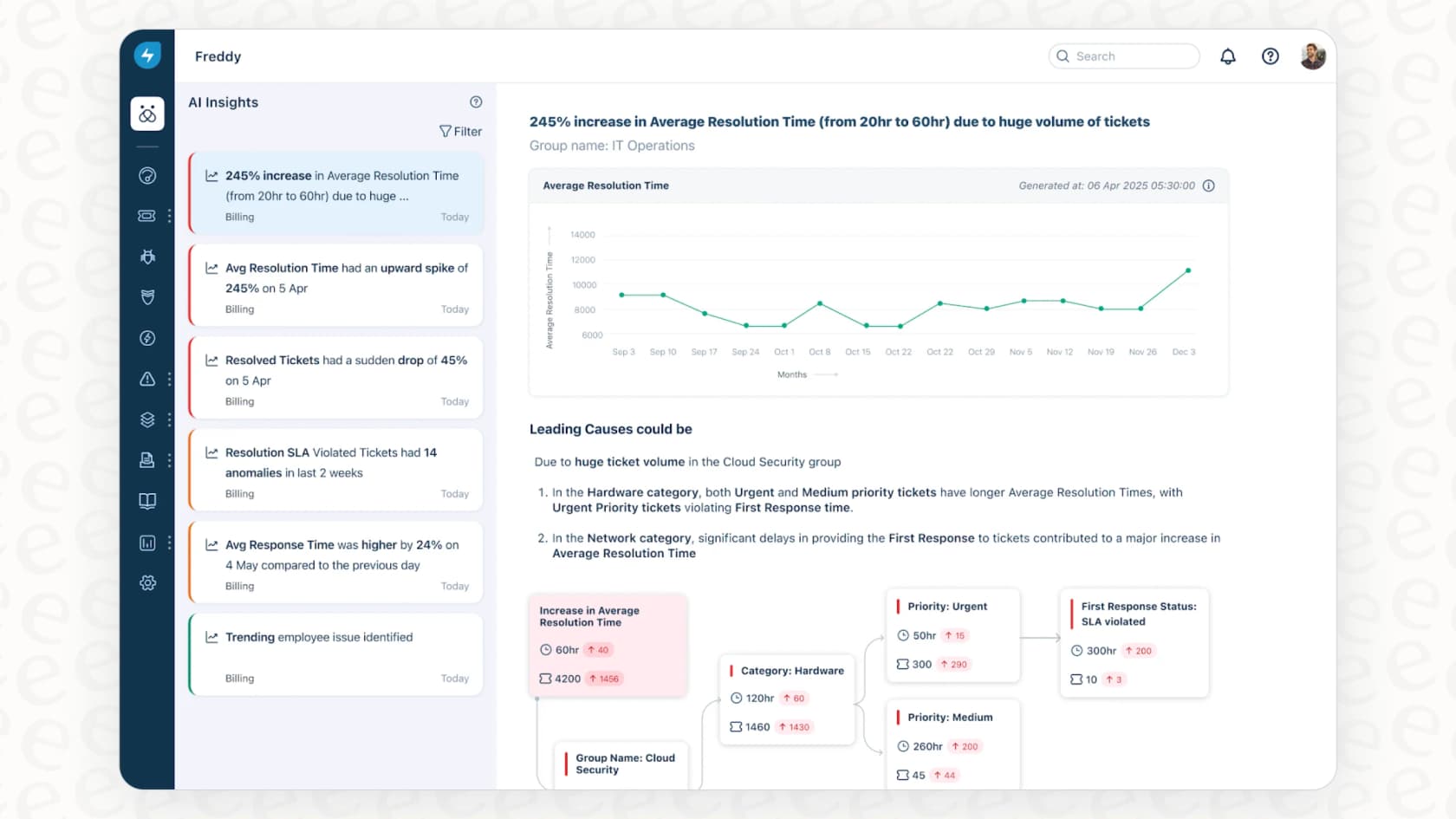
Our AI Agent handles frontline support autonomously, while AI Copilot drafts replies for human agents. The teammate model means you hire eesel like a new team member, starting with guidance and leveling up to autonomy based on performance.
Check our pricing to see how we compare.
Making the ROI case for Freshservice
Building a business case for Freshservice requires more than citing the 356% Forrester figure. You'll need to show leadership how it applies to your specific situation.
Start with a trial. Freshservice offers a 14-day free trial that lets you test core functionality and gather baseline metrics. Use this period to demonstrate concrete improvements in resolution times or agent productivity.
Track metrics that matter to CFOs: cost per ticket, labor hours saved, and time-to-value. Technical metrics like ticket volume mean less to finance leaders than dollars saved or revenue protected through reduced downtime.
Freshservice makes the most sense for mid-market organizations that've outgrown basic ticketing tools but aren't ready for ServiceNow's complexity and cost. If that describes your situation, the documented ROI is achievable with proper implementation and adoption.
The key is treating Freshservice as a platform for continuous improvement rather than a quick fix. The organizations seeing the highest returns are those that optimize their processes over time, expand usage across departments, and leverage automation to reduce manual work.