
In the world of SEO, having a mountain of data isn't the golden ticket anymore. The real challenge is turning that data into high-quality content that actually ranks on Google, and doing it quickly. It’s all about execution.
This brings us to two tools that tackle this from completely different angles: SEO.ai and Ahrefs. SEO.ai is an AI-powered platform built to basically put your entire content strategy on autopilot. Think of it as your content team in a box. On the other hand, Ahrefs is the industry heavyweight for deep data analysis and checking out what your competitors are up to. It's the ultimate toolkit for SEO pros who love digging into the numbers.
This guide will break down the core differences in the SEO.ai vs Ahrefs matchup, helping you decide if you need an automated "execution engine" or a powerful "analysis toolkit." Both tools can point you toward a solid strategy, but they diverge when it comes to the time-consuming task of creating great articles at scale. We'll look at how each one handles this problem and introduce a specialized tool built to take a keyword and turn it directly into a blog post ready for publishing.
What is SEO.ai? The execution engine
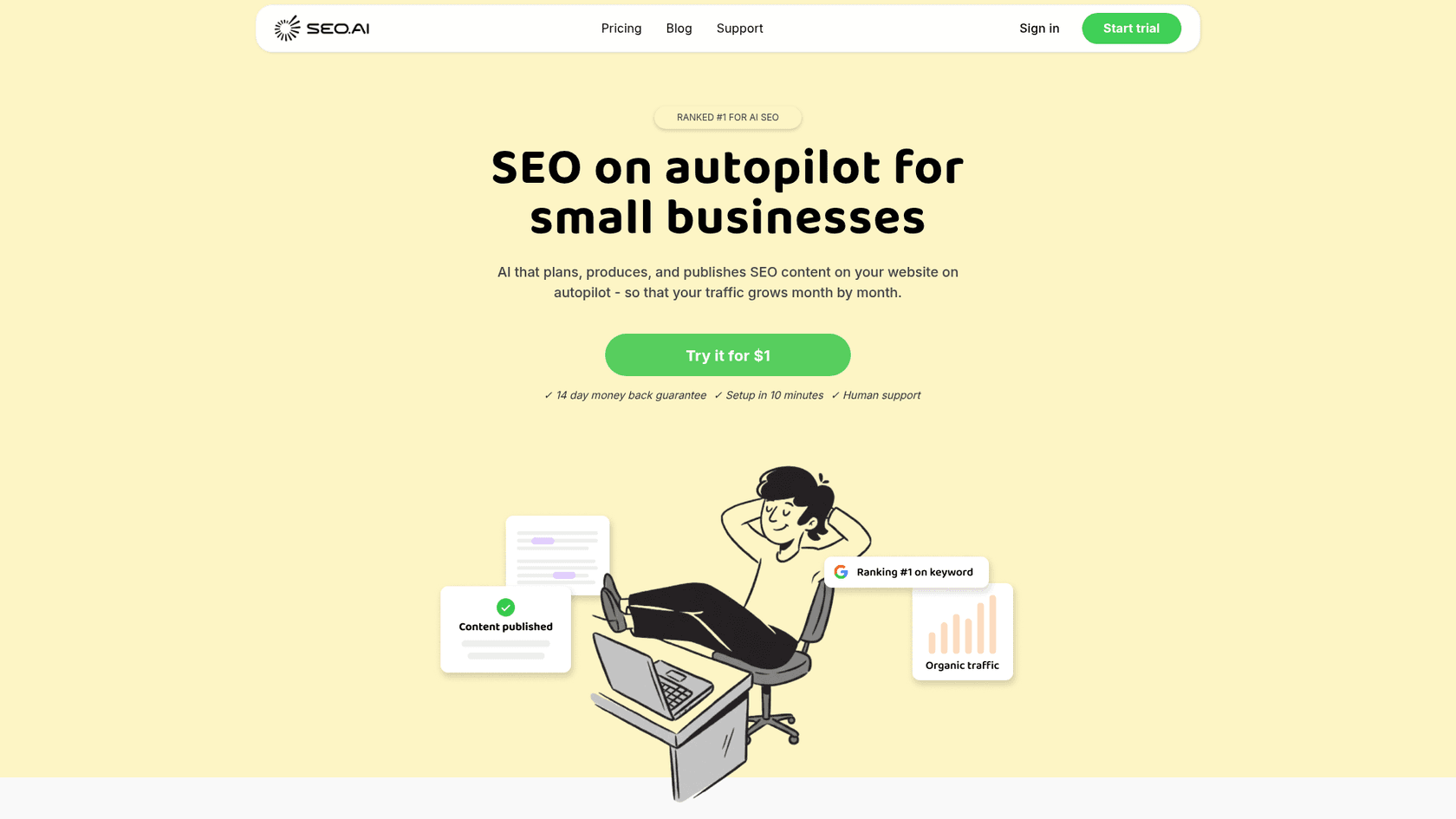
SEO.ai is designed from the ground up to be a "done-for-you" solution. Its main purpose is to take the entire SEO content workflow off your hands, from research all the way to hitting "publish," so you can focus on running your business. It's built for small businesses that want their SEO on autopilot.
So, how does it actually work? For a flat monthly fee, the AI gets busy with a set of automated tasks. It starts by learning about your business and finding clusters of keywords that your potential customers are searching for, no matter where they are in their buying journey.
Here’s a quick look at its key features:
- Automated gap analysis: The AI crawls your website and your competitors' sites to find content opportunities you're missing.
- Full content creation: It doesn't just give you a rough draft. It researches topics, writes informative articles that follow Google's E-E-A-T (Experience, Expertise, Authoritativeness, Trustworthiness) guidelines, and naturally includes keywords and internal links.
- Auto-publishing: This is a huge time-saver. It connects directly to your CMS, like WordPress, Shopify, or Webflow, and automatically publishes the finished articles for you, complete with all the necessary metadata and images.
- Personalized AI visuals: The AI can even create unique images for your articles that use your brand's colors and style.
It's a great fit for business owners and small teams who need to consistently publish fresh, optimized content without getting stuck in the manual grind. It’s a true set-it-and-forget-it solution.
What is Ahrefs? The analysis toolkit
If SEO.ai is the execution engine, Ahrefs is the analysis toolkit. It's made for SEO professionals who need a ton of data to make smart, strategic decisions. Its superpower is its deep competitor intelligence and what many consider the best backlink data available.
I have always found Ahrefs data to be more accurate... so as long as you know what to do with it... thats your winner. Don't use hrefs to crawl sites and don't listen to their rubbish around 'link quality' etc.

Ahrefs is a suite of tools for experts who prefer to do the research, analysis, and execution themselves. It provides the raw data and insights you need to build and run your SEO campaigns manually.
Let's look at its core features:
- Site Explorer: This is the go-to tool for taking a deep dive into any competitor. You can see their organic traffic, their entire backlink profile, and even their paid search campaigns.
- Keywords Explorer: A massive database of keywords that helps you find content ideas, check out the Keyword Difficulty (KD), and get a real feel for search intent.
- Best-in-class backlink data: When it comes to analyzing backlinks and finding link-building opportunities, Ahrefs is pretty much the gold standard.
- AI Content Helper: This is an important distinction. Ahrefs has an AI tool, but it's more of an assistant that helps you optimize drafts you've already written. It scans top-ranking articles for a keyword, shows you what core topics they cover, and scores your content based on how well you've addressed them. It's not built to write content from scratch.
Ahrefs is perfect for SEO specialists, agencies, and in-house marketing teams who need detailed data for manual research, link building, and in-depth competitor analysis.
Core differences: Automated execution vs. manual analysis
The biggest difference between these two platforms comes down to their core philosophy.
SEO.ai is all about proactive automation. It’s built to run the full cycle for you: find an opportunity, create the content, and publish it. Its value is in the work it does for you.
Ahrefs is about providing powerful intelligence. It gives you the data, charts, and reports to find those opportunities yourself. Its value is in the insights it gives to you.
Here’s a table to make it even clearer:
| Aspect | SEO.ai | Ahrefs |
|---|---|---|
| Primary Goal | Automate the entire SEO content workflow | Provide comprehensive data for manual analysis |
| Main Output | Published, SEO-optimized articles | Dashboards, reports, and data exports |
| Workflow | Automated: Research → Create → Publish | Manual: Research → Analyze → Strategize → Execute |
| User Role | Business owner overseeing results | SEO professional performing tasks |
| Best For | Hands-off SEO for small businesses | Deep, granular analysis for SEO experts |
Feature comparison: SEO.ai vs. Ahrefs
Let's dig a little deeper into how each tool handles specific SEO tasks.
Keyword research and content planning
Ahrefs: Its Keywords Explorer is an absolute beast. It gives you a huge database to find search volume, keyword difficulty, and tons of related terms. It's fantastic when you want to do deep, manual research and build a content strategy from the ground up. The user is in control, responsible for turning all that raw data into a plan.
SEO.ai: It flips the script with an automated approach. The AI analyzes your business, finds relevant keyword clusters based on the customer journey, and crawls your site to find content gaps. From there, it automatically generates a publication plan, prioritizing the topics for you. It’s all about automated opportunity discovery instead of raw data exploration.
Content creation and optimization
Ahrefs: As mentioned, its AI Content Helper is an assistant, not a generator. It’s a great tool for helping a human writer, allowing them to optimize an existing draft by identifying topic gaps based on what's already ranking. It doesn't do the heavy lifting of initial research and writing.
SEO.ai: This is where it shines. Its core function is to generate a complete, long-form article from just a topic. It handles everything: the research, writing, structuring, internal linking, and even image creation, all automatically. This is the key difference, moving from optimization support to full-cycle creation.
Technical SEO and backlink analysis
Ahrefs: This is Ahrefs' home turf, where it's the undisputed champ. Its backlink checker is legendary, and its Site Audit tool (which flags over 170 technical SEO issues) is the industry standard for link-building campaigns and checking technical site health.
SEO.ai: This platform isn't trying to be a technical audit or backlink tool. Its philosophy is different. It focuses on creating high-quality, information-rich content that's designed to earn backlinks organically over time. The focus is on creating assets, not on technical analysis or outreach.
Pricing breakdown: SEO.ai vs. Ahrefs
The pricing for these tools directly reflects what they do.
Bro it’s not AI, it’s ROI… for them. Ahrefs be like '$699 or your keywords won’t rank.' Semrush out here saying '$99 and chill.' I know which one my broke self is picking.
Ahrefs pricing
- Lite: $129 per month
- Standard: $249 per month
- Advanced: $449 per month
Ahrefs uses a traditional SaaS subscription model. You pay a monthly fee for access to its data and tools. The plans are tiered based on things like data limits, feature access, and the number of users. It's also worth noting they use a credit-based system, which means heavy usage can sometimes lead to extra pay-as-you-go charges.
SEO.ai pricing
- Single Site: $149 per month
- Multi Site: $299 per month (for up to 3 websites)
The debate between traditional SEO data tools and newer AI-driven platforms is heating up. While we're comparing SEO.ai and Ahrefs, understanding the broader landscape of AI features in established tools like Semrush provides valuable context. The following video explores how industry leaders are integrating AI, which helps frame the unique approaches of both automated engines and analysis toolkits.
Beyond analysis and automation: A dedicated AI blog writer
So, SEO.ai automates the whole process, and Ahrefs gives you the data to do it yourself. But what if your main bottleneck isn't strategy or data, but just the painful task of turning great keywords into high-quality, publish-ready blog posts?
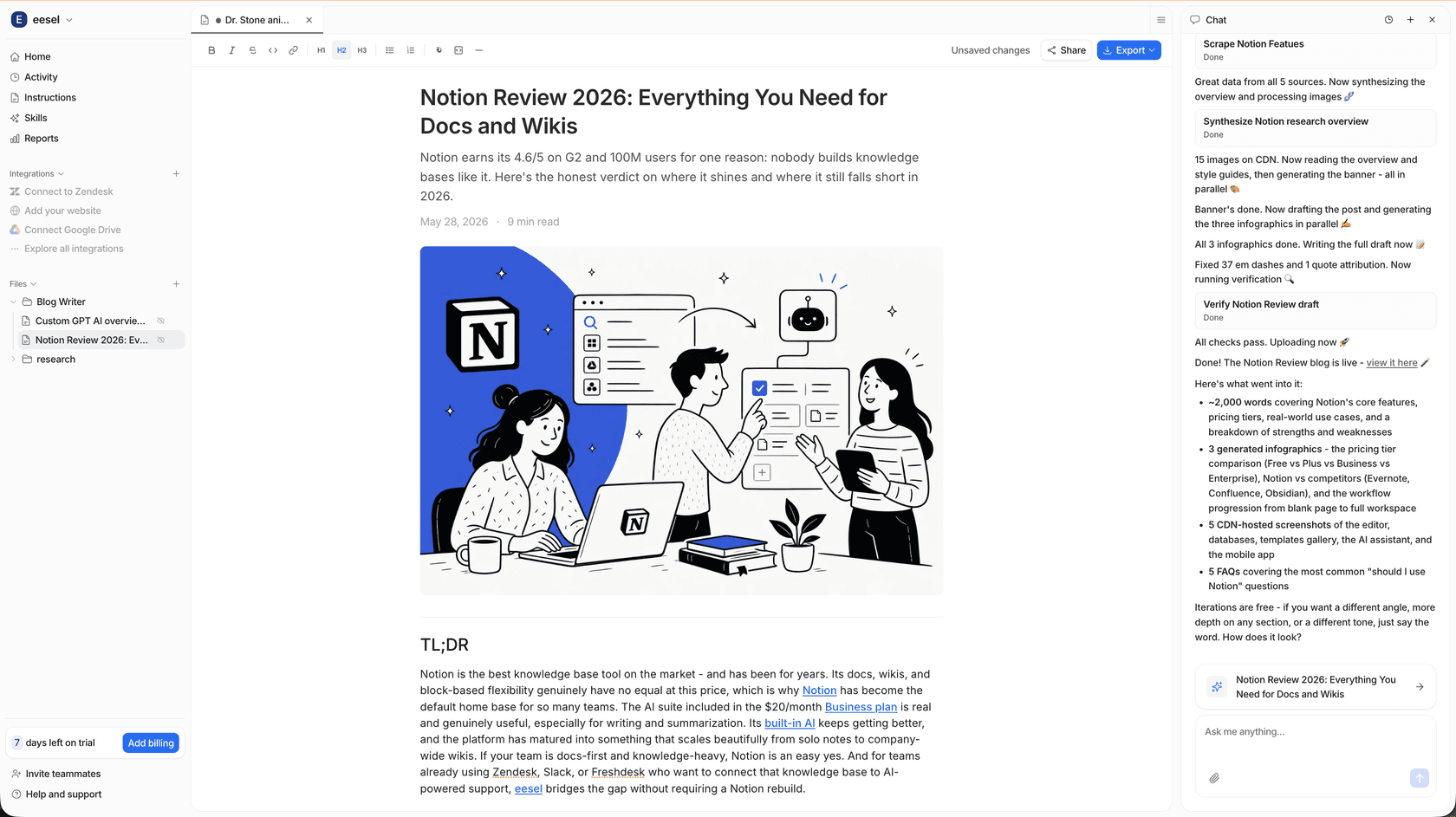
Here’s what makes it a powerful alternative:
- From keyword to finished post: It doesn't just give you a messy draft. You get a fully structured article with an introduction, proper headings, a conclusion, and even an FAQ section.
- Automatic assets included: The tool generates and embeds relevant assets like AI-created images, infographics, and data tables directly into the post. No more searching for stock photos.
- Real-world context: To make content more trustworthy and engaging, it automatically finds and embeds relevant YouTube videos and real quotes from Reddit threads.
- Answer Engine Optimization (AEO): The content is structured to be easily understood and featured by AI answer engines like Google's AI Overviews, which is becoming increasingly important.
We’re not just talking theory here. We used the eesel AI blog writer to grow our own organic impressions from 700 a day to over 750,000 in just three months.
The pricing is simple and focused on what you get. The Early Bird plan is $99 for 50 complete blog posts. It's completely free to try, so you can generate your first post and see the quality for yourself.
SEO.ai vs. Ahrefs: Which tool is right for you?
When you boil it all down, the choice between SEO.ai and Ahrefs really depends on your main need: automation or analysis.
- Choose Ahrefs if... you're an SEO professional, an agency, or part of a team with the expertise to turn top-tier data into manual action. It's the ultimate toolkit for deep research, competitor analysis, and link building.
- Choose SEO.ai if... you're a business owner or a small team that wants to put your SEO content strategy on autopilot. It’s for anyone who values consistent execution and real results without getting lost in the data.
- And if your main challenge is just scaling high-quality content... an AI blog generator like the eesel AI blog writer offers the most direct path from a keyword to a published article, packed with all the assets you need to rank.