
If you're evaluating IT service management platforms for your organization, you've likely come across Freshservice. It's one of the more established names in the ITSM space, with over 74,000 businesses using the platform worldwide. But when it comes to enterprise pricing, things get murky fast.
Most vendors in this space follow a similar playbook: list transparent pricing for small teams, then hide enterprise costs behind "contact sales" forms. Freshservice is no exception. The gap between their Pro plan ($99 per agent monthly) and their Enterprise plan (custom pricing) leaves IT leaders guessing about budget impact.
This guide breaks down exactly what you can expect to pay, what features justify the enterprise tier, and where the hidden costs hide. We'll also look at how modern alternatives approach pricing differently.
What is Freshservice and who uses it?
Freshservice is Freshworks' IT service management platform. It helps IT teams handle incidents, manage assets, automate workflows, and deliver employee support across multiple channels. The platform follows ITIL best practices and targets organizations that need structured IT service delivery.
The customer list includes recognizable names like Databricks, University of Oxford, Kansas City Chiefs, and AMC Theatres. These aren't just logos on a website. Databricks reported a 23% ticket deflection rate after implementing Freshservice, while another customer cited 405 working days saved annually through automation.
Freshservice sits in a competitive space alongside ServiceNow, Jira Service Management, and Zendesk. It positions itself as a middle ground: more enterprise-ready than basic helpdesk tools, but simpler to deploy than ServiceNow's sprawling platform.
For organizations already using other Freshworks products (Freshdesk, Freshsales, Freshmarketer), there's an obvious integration advantage. You can often negotiate 10-15% discounts when bundling multiple products under one contract.
Freshservice pricing plans at a glance
Freshservice uses a four-tier pricing model for IT teams. All prices shown are for annual billing, which saves approximately 17-20% compared to monthly payments.
| Plan | Price (annual) | Price (monthly) | Best for |
|---|---|---|---|
| Starter | $19/agent/month | $29/agent/month | Small teams starting their first service desk |
| Growth | $49/agent/month | $59/agent/month | Growing teams building foundational IT practices |
| Pro | $99/agent/month | $119/agent/month | Larger organizations with complex IT operations |
| Enterprise | Custom pricing | Custom pricing | Mature IT organizations needing AI and enterprise controls |
Let's look at what each tier actually includes.
Starter plan
At $19 per agent monthly (billed annually), Starter covers the basics: incident management, knowledge base, SLA management, and workflow automation. You get 1,000 orchestration transactions per month and access to the self-service portal.
This tier works for small teams moving away from shared email inboxes. But you'll hit limits quickly. There's no service catalog, no asset management, and no change or problem management. If you need ITIL-aligned processes, you'll need to upgrade.
Growth plan
Growth jumps to $49 per agent monthly and adds significant functionality. You get the service catalog, asset management (limited to 100 managed assets), purchase order management, and employee onboarding workflows. MSP mode becomes available, letting you manage multiple client portals from one instance.
Orchestration transactions double to 2,000 per month. This tier also introduces portal customization, multiple SLA policies, and approval workflows.
For many mid-sized organizations, Growth hits a sweet spot. You get ITIL basics without the complexity (and cost) of higher tiers. The 100-asset limit on asset management is the main constraint to watch.
Pro plan
At $99 per agent monthly, Pro unlocks the full ITIL feature set. Problem management, change management, and release management all become available. You also get project management capabilities, software license management, contract management, and major incident management.
Analytics upgrades to "Analytics Pro" with custom reports and advanced filtering. Orchestration increases to 5,000 transactions monthly. Team dashboards and workload management help with capacity planning.
Here's where pricing gets complicated. Freddy AI Copilot, Freshservice's AI assistant for agents, isn't included in the $99 price. It's a $29 per agent monthly add-on. So a Pro plan with AI Copilot actually costs $128 per agent monthly.
Enterprise plan
The Enterprise tier moves to custom pricing, which typically ranges from $5,000 to $70,000 annually depending on agent count and requirements. This opacity frustrates budget planners, but it's standard practice for enterprise software.
What justifies the upgrade? Three main additions:
- Freddy AI Agent: The virtual agent for self-service (not to be confused with Copilot). Enterprise includes 1,200 sessions per year per license. A session counts as any interaction a unique user has with the AI Agent within a 24-hour period.
- Sandbox environment: Test configuration changes safely before deploying to production.
- Audit logs: Track all changes under the Admin section for compliance.
You also get 20,000 orchestration transactions monthly, four times the Pro allocation.
The hidden costs of Freshservice enterprise
The base price is just the starting point. Here are the add-ons that inflate your total cost:
| Add-on | Cost | When you need it |
|---|---|---|
| Freddy AI Copilot | $29/agent/month | If you want AI assistance on Pro plan |
| Additional managed assets | Custom quote | When you exceed 100 assets on Growth |
| Day passes | Starting at $3 each | For occasional agents who need temporary access |
| Orchestration transaction packs | Custom quote | When you exceed monthly limits |
| E-signatures | Add-on pricing | For HR and document management workflows |
| Connector app tasks | Add-on pricing | For advanced integrations |
| Business projects | Add-on pricing | Additional project management licenses |
The Freddy AI Copilot pricing deserves special attention. Freshservice markets AI capabilities heavily, but the Copilot features (reply suggestions, ticket summarization, writing assistance) cost extra on the Pro plan. Only Enterprise includes Freddy AI Agent by default.
Day passes offer flexibility for seasonal or contract workers. Instead of paying for a full agent license year-round, you purchase day passes when temporary access is needed. At $3+ per day, the math works in your favor for occasional use but adds up quickly if someone needs access for weeks.
What you get with Freshservice enterprise
Let's break down the Enterprise-exclusive features in more detail.
Freddy AI Agent
This is Freshservice's conversational AI for end-users. It integrates with Slack, Microsoft Teams, email, and the self-service portal. The AI can handle routine requests, answer questions from the knowledge base, and create tickets when human intervention is needed.
Enterprise includes 1,200 sessions per license annually. If you have 50 Enterprise licenses, that's 60,000 total sessions per year across your organization. Sessions reset at the start of each billing cycle.
The AI Agent differs from Copilot in its audience. Agent serves end-users directly, while Copilot assists your IT staff with drafting responses and summarizing tickets.
Sandbox environment
Making configuration changes in a live ITSM platform is risky. The sandbox lets you test workflow changes, field modifications, and automation rules in an isolated environment. Once validated, you sync changes to production.
This feature matters most for organizations with strict change management processes. It reduces the risk of breaking live workflows during updates.
Audit logs
For compliance-heavy industries, audit logs track every change made in the Admin section. You can see who modified what, when, and what the previous values were. This visibility is essential for security audits and regulatory requirements.
Increased orchestration limits
At 20,000 transactions monthly, Enterprise provides four times the automation capacity of Pro. Each "transaction" represents an action taken via the App node in Workflow Automator. If you're heavily automating integrations with other systems (Azure, AWS, ServiceNow, etc.), these limits matter.
How Freshservice enterprise pricing works
Since Freshservice doesn't publish Enterprise pricing, you need to understand what drives the quotes you'll receive.
Agent count is the primary lever. More agents mean higher total cost, though per-agent rates often decrease at volume. A 500-agent deployment typically gets better per-agent pricing than a 50-agent deployment.
Feature requirements also affect pricing. If you need specific add-ons, custom integrations, or premium support tiers, these get bundled into your quote.
Contract length impacts pricing too. Multi-year agreements usually secure better rates than annual contracts.
Negotiation tips
Based on third-party research from negotiation services like Spendflo, here are tactics that work:
- Bundle with other Freshworks products. Purchasing Freshdesk, Freshsales, or Freshmarketer alongside Freshservice can unlock 10-15% discounts.
- Pay annually. The 17-20% savings versus monthly billing is substantial.
- Ask about non-profit or education discounts. Freshservice offers reduced rates for qualifying organizations.
- Time your purchase around fiscal year-end. Sales teams have quotas to hit and may offer better deals.
- Request credits for referrals. Some organizations have earned account credits by referring other companies that become customers.
Is Freshservice enterprise worth the cost?
The honest answer: it depends on your organization's complexity and IT maturity.
Freshservice Enterprise makes sense when:
- You need full ITIL process coverage (change, problem, release management)
- Compliance requirements demand audit logs and sandbox testing
- You're heavily invested in workflow automation and need 20,000+ orchestration transactions
- You want AI-powered self-service without managing a separate chatbot platform
- Your team is large enough that per-agent pricing is manageable
User feedback from Capterra reviews highlights both strengths and frustrations. One infrastructure specialist praised the included consultant support that comes with subscriptions. But an ITS service coordinator noted frustration with the tiered payment system: "You see a cool feature and want to try it out, only to find that your particular tier does not support it."
The value equation changes based on team size. A 20-agent team paying Enterprise rates faces a very different cost structure than a 200-agent team. Smaller organizations may find themselves paying enterprise prices for features they rarely use.
A simpler alternative for modern IT teams
Traditional ITSM platforms like Freshservice were built for a different era. They assume IT teams want to configure workflows, build automation rules, and manage complex deployments. For many modern organizations, this approach creates more overhead than value.
We built eesel AI to work differently. Instead of treating AI as an add-on, we made it central to how the platform operates. You don't configure eesel. You invite it to your team and let it learn your business.
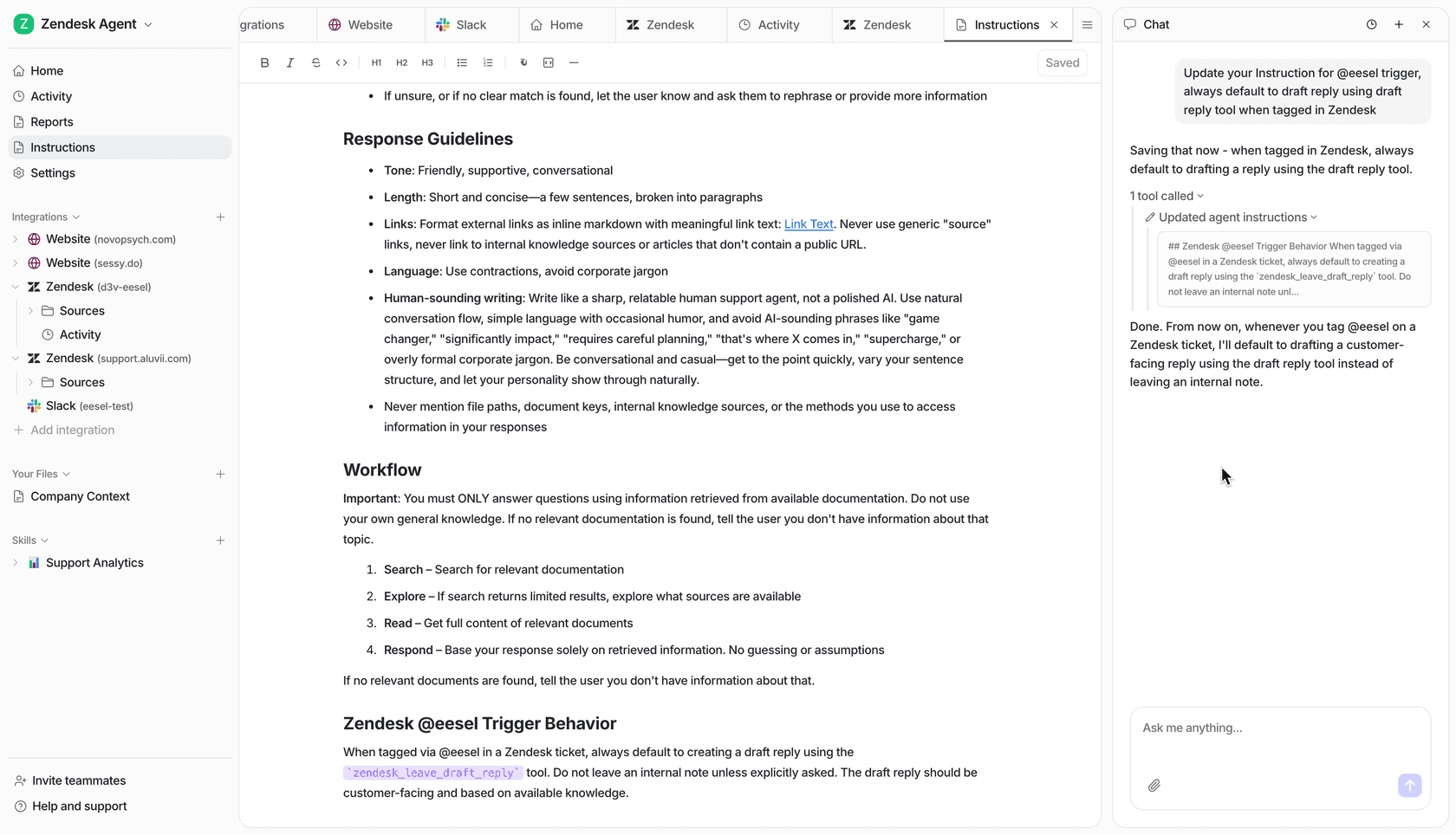
Here's how the approach differs:
Setup time: Freshservice implementations typically take weeks or months. eesel connects to your existing helpdesk (including Freshservice itself) and learns from your past tickets in minutes.
Pricing model: Freshservice charges per agent, which penalizes growth. We charge per AI interaction. You pay for value delivered, not seats purchased.
AI capabilities: Freddy AI Copilot costs an extra $29 per agent monthly on Pro plans. Our AI Agent, Copilot, and Triage capabilities are included without per-agent add-ons.
Autonomous resolution: Mature eesel deployments achieve up to 81% autonomous resolution. The AI handles routine tickets end-to-end, escalating only what truly needs human attention.
If you're already using Freshservice, eesel integrates directly via our Freshservice AI integration. You can augment your existing setup with modern AI capabilities without replacing your ITSM platform.
For organizations considering a complete rethink of IT support, our AI for ITSM solution offers a different path. One that prioritizes autonomous resolution over workflow configuration.
Choosing the right ITSM pricing model for your team
Selecting between Freshservice tiers (or alternatives) comes down to three factors:
Team size and growth trajectory. Per-agent pricing scales linearly with headcount. If you're growing fast, consider whether that pricing model aligns with your budget planning.
Process complexity. Do you need full ITIL compliance with change advisory boards and release management? Or do you need fast, effective employee support? The answer points to different solutions.
AI requirements. If AI is central to your strategy, evaluate whether add-on pricing (Freddy AI Copilot at $29/agent) or inclusive pricing (eesel's interaction-based model) fits better.
Freshservice Enterprise delivers value for mature IT organizations with complex requirements. The sandbox, audit logs, and increased orchestration limits serve specific enterprise needs. But those needs don't apply to every organization.
If you're looking for faster deployment, simpler pricing, and AI that works autonomously from day one, explore how eesel AI approaches IT support. You can start with a free trial and see how the platform learns your business without lengthy implementation projects.


