
Choosing the right IT service management platform means balancing capabilities with cost. Freshservice has become a popular choice for teams moving beyond basic ticketing, but understanding what each plan actually delivers (and what it'll cost you) can be tricky.
The Growth plan sits in the middle of Freshservice's four-tier lineup. At $49 per agent per month, it promises to bridge the gap between simple ticket tracking and full ITSM maturity. But is it the right fit for your team?
Here's exactly what you get, what you don't, and how the real costs stack up.
What is Freshservice?
Freshservice is a cloud-based IT service management platform built by Freshworks Inc., a publicly traded software company. Launched in 2014, it now serves over 74,000 businesses worldwide, including organizations like the University of Oxford, Databricks, and the Kansas City Chiefs.
The platform covers the full ITSM spectrum: incident management, problem tracking, change control, asset management, and project coordination. It's built around ITIL best practices but emphasizes ease of use compared to traditional enterprise tools.
Freshservice positions itself as the middle ground. It's more robust than basic help desks but less complex (and expensive) than full enterprise suites. The modern UI and quick deployment are major selling points for teams that need ITIL compliance without months of implementation.
Freshservice pricing plans at a glance
Freshservice uses a per-agent pricing model with four tiers. Annual billing saves roughly 17% compared to monthly payments. Here's how the plans stack up:
| Plan | Annual Price | Monthly Price | Best For |
|---|---|---|---|
| Starter | $19/agent/month | $29/agent/month | Small teams just getting started |
| Growth | $49/agent/month | $59/agent/month | Teams building foundational ITSM practices |
| Pro | $99/agent/month | $119/agent/month | Organizations needing full ITIL maturity |
| Enterprise | Custom pricing | Custom pricing | Large enterprises with complex requirements |
Source: Freshservice pricing
The Growth plan specifically targets "IT teams building foundational practices to move from reactive to streamlined service delivery." That positioning is key. It tells you this tier is designed for teams transitioning from basic ticketing to more structured ITSM, not those already running mature processes.
See full Freshservice pricing details
Starter plan: The basics
The entry tier covers core ticketing functionality: incident management, a self-service portal, knowledge base, and basic SLA management. You get 1,000 orchestration transactions per month for automation. What's missing? Asset management, change management, and problem management are all locked behind higher tiers.
Growth plan: The middle ground
This is where asset management enters the picture. You also get the service catalog, MSP mode for managed service providers, approval workflows, and employee onboarding capabilities. Orchestration doubles to 2,000 transactions per month. The catch: you're limited to 100 managed assets.
Pro plan: Full ITSM
Problem management, change management, and release management all become available at this tier. You also get project management, SaaS management, and 5,000 orchestration transactions. This is the plan for teams that need complete ITIL coverage.
Enterprise plan: AI included
The top tier adds Freddy AI (Freshservice's AI assistant), a sandbox environment for testing, audit logs, and 20,000 orchestration transactions. Pricing is custom and requires contacting sales.
What's included in the Freshservice Growth plan
The Growth plan's value proposition centers on three capabilities that Starter lacks: asset tracking, structured service delivery, and multi-client support.
Asset management (with a 100-asset cap)
This is the headline feature. The Growth plan lets you track hardware, software, and cloud resources through an integrated CMDB. Discovery happens via integrations with tools like Intune, Jamf, Automox, and cloud platforms (AWS, Azure, GCP).
Here's the limitation: you can only manage 100 assets before hitting the cap. For a team of 10-15 people, that might be fine. But if you're managing laptops, monitors, phones, and software licenses for a growing team, you'll likely need asset packs at $75 per month for each additional 500 assets.
Service catalog
Instead of employees emailing "my computer is broken," the service catalog creates a structured menu of IT services. You can define request types, set approval workflows, and route requests automatically. It turns chaotic inbox requests into trackable, measurable service items.
Employee onboarding
The Growth plan includes automated onboarding workflows. When HR adds a new hire, Freshservice can trigger provisioning tasks across IT systems. It's a practical feature for growing companies where onboarding has become a bottleneck.
MSP mode
For managed service providers, MSP mode lets you create separate portals for different clients while managing everything from a single instance. Each client sees only their tickets and assets. This is a significant value-add if you're supporting multiple organizations.
Approval workflows and business rules
Growth adds conditional automation. You can set rules like "software purchases over $500 require manager approval" or "VIP users get priority routing." The workflow automator uses a drag-and-drop interface, so you don't need coding skills.
Check out Freshservice integrations
Hidden costs and limitations to know
The sticker price rarely tells the full story with Freshservice. Here are the costs that creep in after you commit:
Asset overages. That 100-asset limit on Growth sounds generous until you count everything: laptops, monitors, docking stations, phones, software licenses, cloud instances. At $75 per month for each additional 500 assets, costs add up fast.
Orchestration limits. Growth includes 2,000 orchestration transactions per month. Each automated action (sending a notification, updating a field, calling an API) counts as one transaction. Busy teams can hit this ceiling, forcing an expensive upgrade to Pro.
AI add-ons. Want Freddy AI Copilot to draft responses? That's approximately $29 per agent per month on top of your base plan. Freddy AI Insights costs extra too. Only Enterprise includes AI features by default.
Business agents. If HR or Facilities wants limited access, business agent licenses cost less than full IT agents but come with restrictions. They're only available on Growth and above.
Day passes. Occasional agents (contractors, temporary help) need day passes at $7 each on the Growth plan.
Real-world total cost examples
Let's look at what a Growth plan deployment actually costs:
| Team Size | Base Cost | Likely Add-ons | Monthly Total |
|---|---|---|---|
| 10 agents | $490 | Asset pack ($75) | $565 |
| 15 agents | $735 | Asset pack ($75) + Freddy Copilot ($435) | $1,245 |
| 25 agents | $1,225 | 2 Asset packs ($150) + Freddy Copilot ($725) | $2,100 |
These estimates assume you need asset management beyond the 100-asset cap and want AI assistance. Your actual costs will vary, but the pattern is clear: plan for 30-50% above the base price.
Who should choose the Growth plan?
The Growth plan makes sense for specific scenarios:
Teams of 5-20 agents. Below 5 agents, Starter probably covers your needs. Above 20, you'll likely want the ITIL features in Pro.
Organizations transitioning from reactive to proactive IT. If you're moving from shared inboxes to structured ITSM but don't need full change management boards yet, Growth hits the sweet spot.
MSPs managing multiple clients. The MSP mode is genuinely useful if you're supporting several organizations from a single platform.
Teams needing asset tracking without enterprise complexity. If you want to track hardware and software but don't need advanced ITIL processes, Growth delivers.
When to upgrade to Pro. You'll need Pro if you require problem management (root cause analysis for recurring issues), change management (controlled IT changes with CAB approval), or release management. These are core ITIL disciplines that Growth simply doesn't include.
A modern alternative: eesel AI as your IT support teammate
Freshservice takes a traditional approach: you configure workflows, set up automation rules, and manage the system. There's value in that structure, but it's not the only way to handle IT support.
At eesel AI, we think about this differently. Instead of configuring a tool, you hire an AI teammate that learns your business.
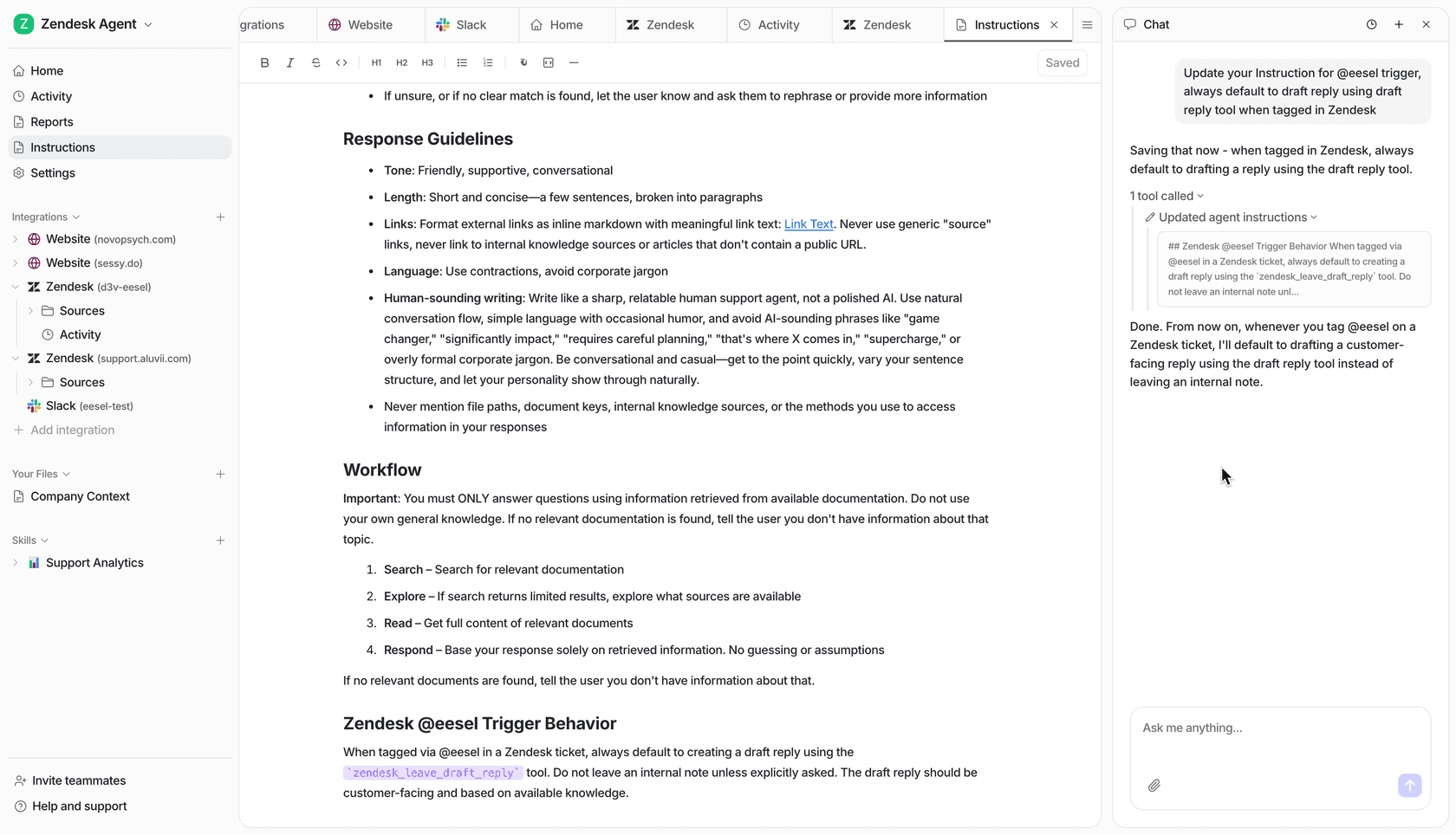
Here's how it works. Connect eesel AI to your help desk, and it immediately learns from your past tickets, help center articles, and documentation. No manual training, no uploading documents, no configuration wizards. What takes a human weeks to learn, eesel AI learns in minutes.
You start with guidance. Have eesel AI draft replies that your agents review before sending. Limit it to specific ticket types or queues. Set business hours when it can respond. This isn't a limitation it's how you verify eesel AI understands your business before expanding its role.
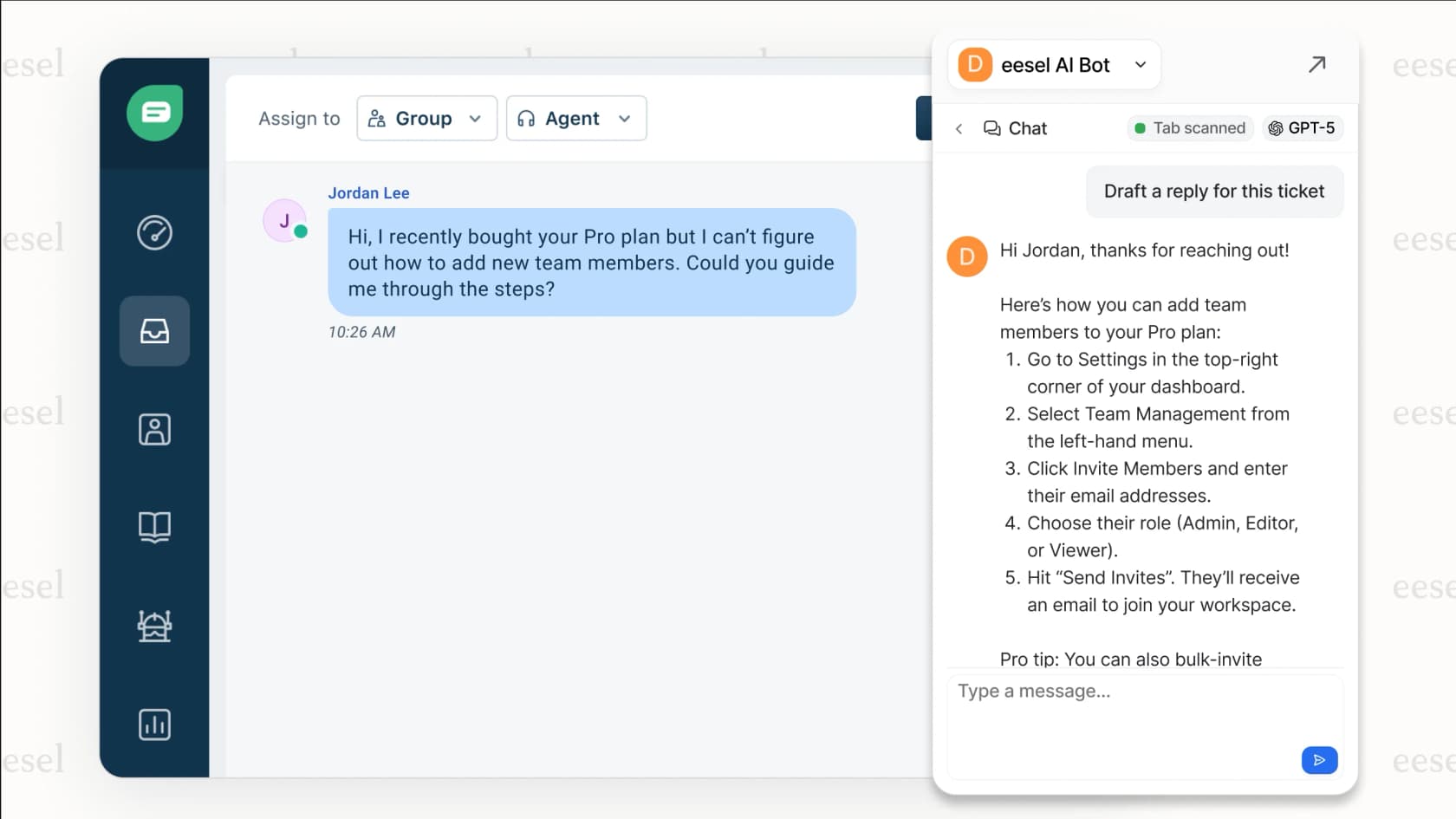
As eesel AI proves itself, you level up to autonomous operation. It sends replies directly. It handles all frontline support. It works 24/7. You decide when to promote eesel AI based on actual performance, not guesswork.
The control is in plain English. Tell eesel AI: "If the refund request is over 30 days, politely decline and offer store credit." Or: "Always escalate billing disputes to a human." No code, no rigid decision trees.
Our pricing is based on interactions, not agents. That means predictable costs that scale with your actual usage, not your headcount.
See how eesel AI works as an AI Agent or explore our AI Copilot for teams that want AI assistance without full automation.
Making the right choice for your IT team
The Freshservice Growth plan fills a genuine gap. It gives growing IT teams asset management, service catalogs, and basic automation without the complexity (and cost) of full ITIL suites.
But go in with realistic expectations about total cost. That $49 per agent per month becomes $60-75 once you factor in asset packs and the AI features you'll likely want.
Choose Growth if:
- You're a growing team (5-20 agents) outgrowing basic ticketing
- You need asset tracking but not full change management
- You're an MSP supporting multiple clients
- You want structured ITSM without enterprise complexity
Consider Pro instead if:
- You need problem, change, or release management
- You have more than 20 agents
- Your orchestration needs exceed 2,000 transactions monthly
Or consider a different approach entirely. If the idea of configuring workflows and managing automation limits sounds like overhead you'd rather avoid, an AI-native solution like eesel AI might be worth exploring. The teammate model (start with guidance, level up to autonomous) offers a fundamentally different path to the same goal: resolving employee issues faster with less manual work.
The best choice depends on your team's maturity, your budget reality, and how you want to spend your time: managing a system or managing outcomes.