
Choosing the right IT service management platform can feel like picking between a Swiss Army knife and a specialized tool. Both ServiceNow and Freshservice promise to streamline your IT operations with AI, but they serve fundamentally different needs. Let's break down what each platform actually delivers so you can make an informed decision.
What is ServiceNow AI?
ServiceNow has been the dominant force in enterprise ITSM since 2004. The platform runs on the Now Platform, a comprehensive framework that extends far beyond IT into HR, customer service, security operations, and more.
The company's AI offering, Now Assist, positions itself as more than just a chatbot. It includes AI agents that can complete tasks autonomously, predictive intelligence for forecasting issues before they escalate, and an AI Control Tower that gives executives visibility into AI-driven value across the organization. The virtual agent supports multiple NLU engines including IBM Watson, Microsoft LUIS, and Google DialogFlow.
ServiceNow's sweet spot is Fortune 500 companies and large enterprises with complex, multi-departmental workflows. If your organization has dedicated IT resources, needs deep customization through JavaScript scripting, and requires a platform that can handle thousands of users across multiple regions, ServiceNow is built for you.
What is Freshservice AI?
Freshservice comes from Freshworks, a company founded in 2010 that has built a reputation for user-friendly business software. Unlike ServiceNow's everything-to-everyone approach, Freshservice focuses specifically on making IT service management accessible to mid-market companies and growing teams.
The platform's AI capabilities center around Freddy AI, which includes three main components: Freddy Copilot for agent assistance, Freddy AI Agent for employee self-service, and Freddy Insights for trend analysis. The interface emphasizes no-code automation through a drag-and-drop workflow builder, so IT teams without dedicated developers can build sophisticated automations.
Freshservice targets organizations that want enterprise-grade capabilities without enterprise-grade complexity. The platform is particularly popular among companies that need to move fast, prefer transparent pricing, and want their IT team focused on service delivery instead of platform administration.
Freshservice AI vs ServiceNow AI: Capabilities compared
When you put these platforms side by side, the differences in their AI approaches become clear.
Virtual agents and chatbots
ServiceNow's virtual agent offers more flexibility in terms of NLU model selection, allowing you to choose between IBM Watson, Microsoft LUIS, Google DialogFlow, or ServiceNow's own model editor. This matters if you have specific natural language requirements or existing investments in particular AI ecosystems.
Freshservice's Freddy AI Agent takes a more opinionated approach, focusing on out-of-the-box functionality for common IT scenarios like password resets, software requests, and knowledge base lookups. It works well for standard use cases but offers less customization for unique conversational flows.
Predictive intelligence and analytics
ServiceNow has invested heavily in predictive capabilities. The platform can forecast resolution times, identify potential incidents before they impact users, and assess risks associated with change initiatives. The AI Control Tower gives leadership a consolidated view of AI-driven efficiencies across departments.
Freshservice's Freddy Insights focuses more on operational analytics, helping managers understand ticket trends, agent performance, and service desk bottlenecks. It's less about predicting the future and more about understanding the present.
Agent assistance and copilot features
Both platforms offer AI assistance for human agents, but with different implementations. ServiceNow's Now Assist can draft responses, suggest knowledge articles, and automate routine tasks. The platform also offers AI copilot capabilities for teams that want AI assistance without full automation.
Freshservice's Freddy Copilot provides similar functionality but with a stronger emphasis on ticket summarization and categorization. The AI can highlight relevant knowledge base entries and suggest responses based on historical ticket data.
Automation and workflow AI
ServiceNow's Flow Designer supports custom scripting for reusable automation actions and dynamic subflows for complex logic. The IntegrationHub connects to hundreds of enterprise systems, and the platform includes native robotic process automation tools.
Freshservice's Workflow Automator keeps things simpler with a visual, drag-and-drop interface that doesn't require coding knowledge. While this limits some advanced use cases, it also means faster iteration and less dependency on specialized technical resources.
Integration with external LLMs
ServiceNow allows integration with external LLMs through API connections or MID servers, giving organizations flexibility to use their preferred AI models. Freshservice doesn't explicitly support external LLM integration, keeping users within the Freddy AI ecosystem.
Pricing and total cost of ownership
Understanding the true cost of these platforms requires looking beyond the sticker price.
ServiceNow pricing
ServiceNow operates on a custom enterprise pricing model. You won't find public pricing on their website; instead, you'll need to contact sales for a quote based on your specific requirements.
The platform uses a modular structure where ITSM is just the starting point. Additional capabilities like IT Operations Management (ITOM), IT Asset Management (ITAM), HR Service Delivery, and Security Operations each carry separate licensing fees. Organizations consistently cite pricing transparency as a concern with ServiceNow's custom quote model compared to competitors with public pricing.
The hidden costs extend beyond licensing. Implementation typically takes 6-12 months and often requires specialized consultants or dedicated internal resources. Annual maintenance fees, customization costs, and ongoing administration add to the total cost of ownership. For detailed information, see ServiceNow pricing.
Freshservice pricing
Freshservice takes the opposite approach with fully transparent pricing. See the Freshservice pricing page for current rates:
| Plan | Monthly Price | Annual Price | Key Features |
|---|---|---|---|
| Free | $0 | $0 | Up to 10 agents, basic ticketing |
| Blossom | $29/agent | $19/agent | Incident management, knowledge base, automation |
| Growth | $59/agent | $49/agent | + Problem, change, and asset management |
| Pro | $119/agent | $99/agent | + Project management, orchestration, Freddy AI Copilot |
| Enterprise | Custom | Custom | Sandbox, IP whitelisting, dedicated account manager |
Freddy AI features require additional investment. Freddy AI Copilot costs $29 per agent per month and is only available on Pro and Enterprise plans. The Freddy AI Agent is included in Pro and Enterprise tiers. See the Freddy AI page for full details.
The total cost picture looks different from ServiceNow. Implementation averages 6 weeks instead of 6-12 months. There's no additional cost for updates (they're automatic and included). And you won't need specialized developers for routine customization.
For a team of 50 agents comparing Pro tiers, Freshservice runs approximately $6,400 monthly ($99 base + $29 Freddy AI = $128 per agent), while ServiceNow typically starts at significantly higher price points with additional module costs on top.
Implementation and time to value
The gap in implementation timelines between these platforms is substantial.
ServiceNow deployments typically span 6-12 months for full implementation. The platform's power comes from its configurability, but that same flexibility means every workflow, form, and integration needs to be designed and built. Organizations need dedicated administrators, often with JavaScript expertise, to maintain and extend the platform.
Freshservice advertises an average implementation of 6 weeks, with some customers going live in as little as a day for basic configurations. The no-code workflow builder means IT teams can iterate on processes without filing tickets with a development team. Training requirements are also lighter, with most agents productive after under an hour of onboarding compared to weeks for ServiceNow.
One IT manager summarized the difference well: "Freshservice is extremely impressive for teams not wanting to worry about a ton of administrative problems... Being able to configure designs and features for end users or agents without being a developer is something that I think a lot of the major players miss on."
That said, ServiceNow's longer implementation can be worth it for organizations that need the depth of customization it provides. As one enterprise reviewer noted, "ServiceNow offers extensive flexibility, enabling users to tailor the product to meet specific organizational requirements... This level of customization makes the tool feel like it's specifically built for one's own needs."
Which platform should you choose?
The right choice depends on your organization's size, complexity, and resources.
Choose ServiceNow if...
- You're a large enterprise with complex, multi-departmental workflows
- You need deep customization through scripting and low-code development
- You have dedicated IT resources to support the platform
- You require extensive cross-system integration and orchestration
- You need advanced capabilities like predictive intelligence and AI-driven risk assessment
Choose Freshservice if...
- You're a mid-market company or growing team
- You want fast implementation and time-to-value
- You prefer transparent, predictable pricing
- You need AI features without enterprise complexity
- Your IT team lacks dedicated developers
Consider eesel AI as an alternative
There's a third option worth considering, especially if you're drawn to the AI capabilities of both platforms but concerned about their respective trade-offs.
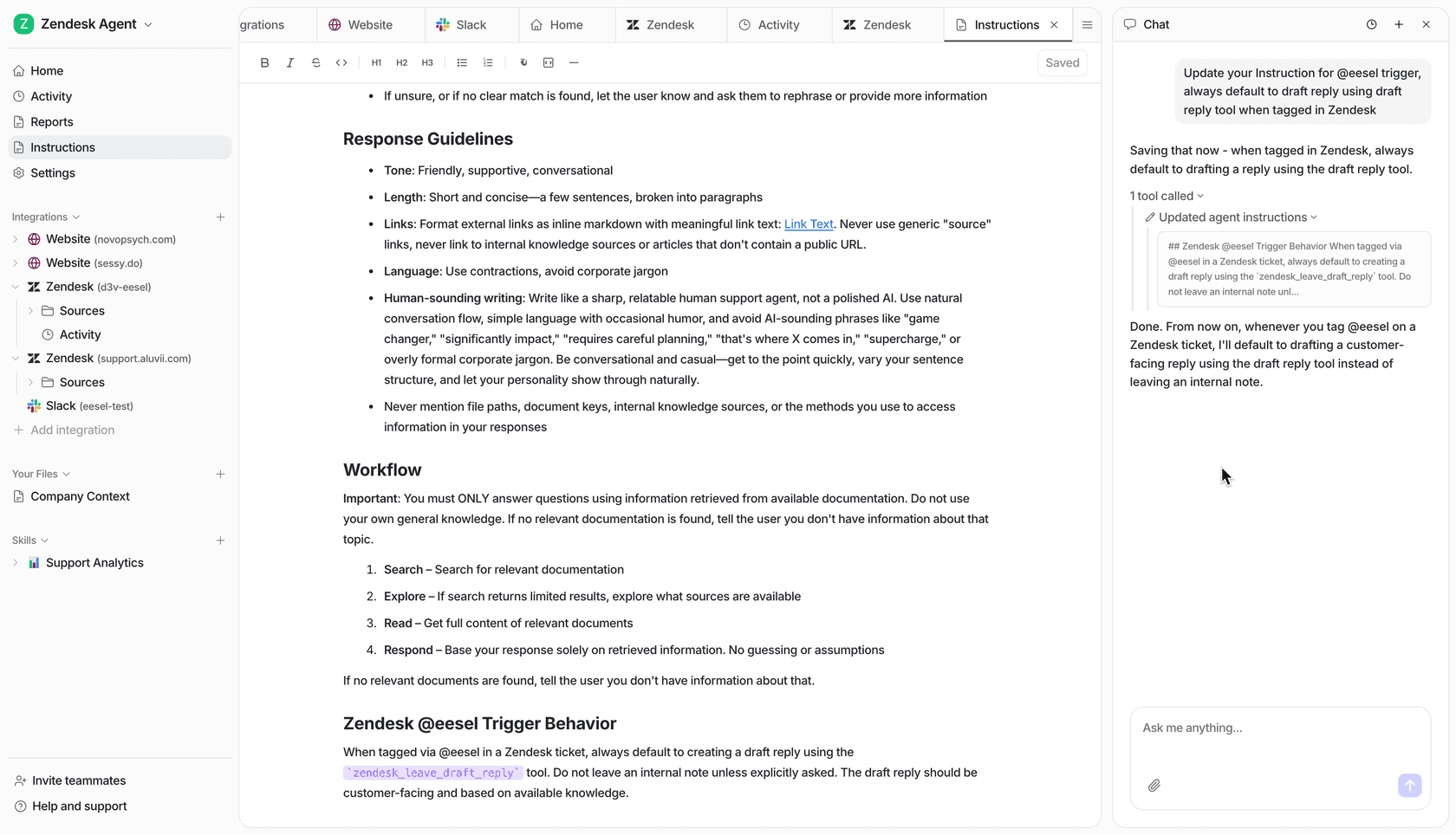
eesel AI approaches IT service management differently. Instead of treating AI as a feature layered on top of a traditional ticketing system, we're built as an AI teammate from the ground up. Our platform connects to your existing help desk (whether that's Freshservice, ServiceNow, Zendesk, or others) and learns from your past tickets, help center articles, and macros.
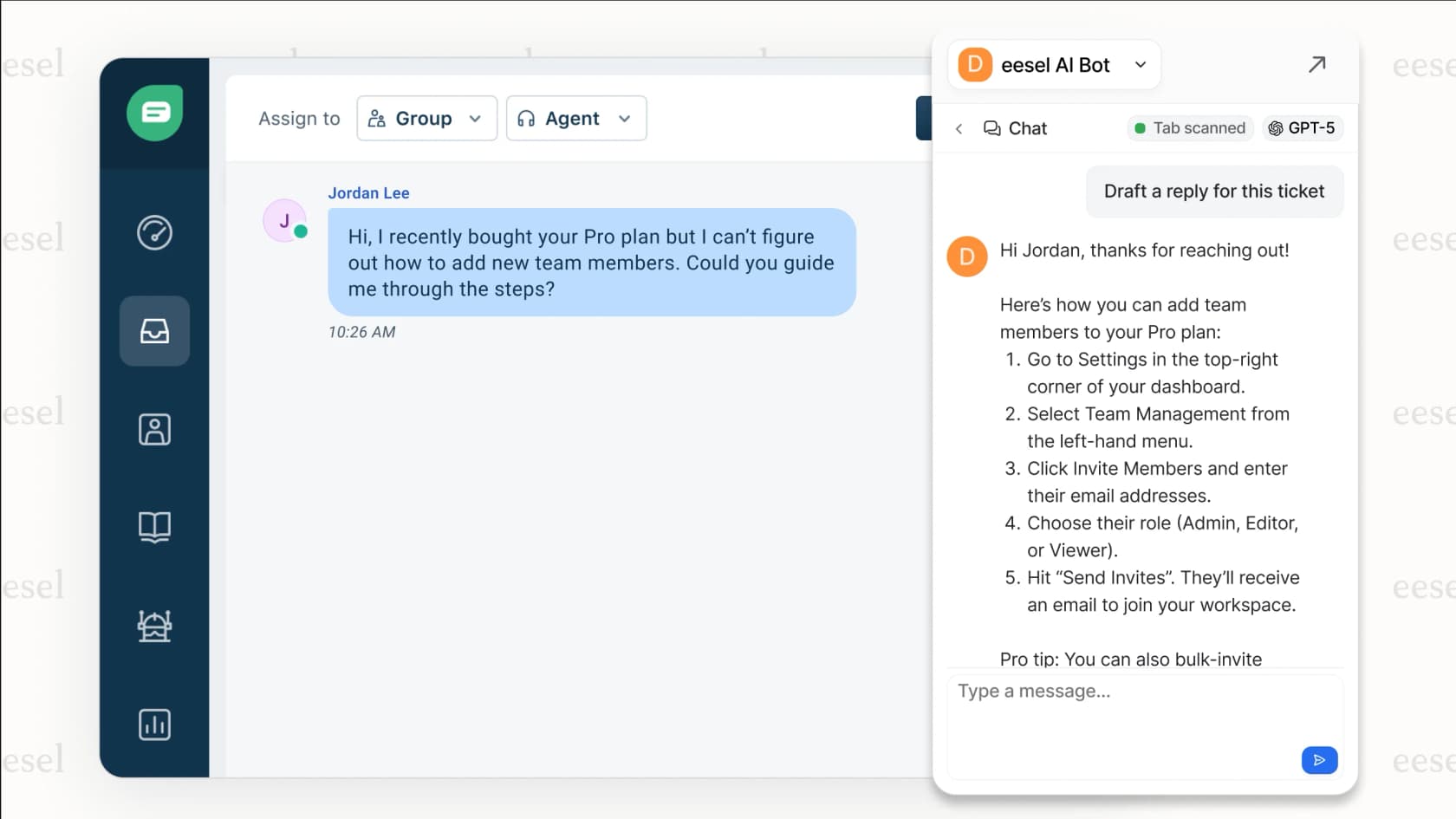
Here's how it works: you invite us to your team like you would a new hire. We learn your business context, tone, and common issues from your existing data. You start with oversight, having us draft replies for review before sending. As we prove ourselves, you expand our scope until we're handling frontline support autonomously.
Our AI Agent can resolve tickets end-to-end, not just draft responses. Our AI Copilot assists human agents with context-aware suggestions. And unlike platform-specific AI features, we work across the tools you already use. Learn more about our AI for ITSM solution.
Pricing is one fixed monthly price from $299/month for 500 credits (1 credit per ticket or chat) with no platform fee and no seats, significantly less than enterprise AI add-ons from traditional platforms. You can try eesel AI free with 100 credits, no card or check pricing details to compare.
Making the right choice for your IT team
Both ServiceNow and Freshservice are capable platforms that have earned their places in the ITSM market. ServiceNow remains the gold standard for enterprises that need maximum flexibility and have the resources to support it. Freshservice offers a compelling alternative for organizations that want powerful ITSM capabilities without the overhead.
The decision ultimately comes down to your team's specific needs. If you need deep customization, have complex multi-departmental workflows, and can invest in dedicated platform expertise, ServiceNow delivers. If you prioritize speed of implementation, transparent costs, and ease of use, Freshservice is likely the better fit.
For teams looking for a more modern approach to AI in IT service management, we offer an alternative that works with your existing tools rather than requiring a platform migration. Our teammate model means you can start seeing value quickly while maintaining control over how AI interacts with your customers and employees.
Whichever path you choose, the key is aligning the platform's strengths with your organization's actual needs instead of getting distracted by features you'll never use.