
Choosing between Freshservice and ServiceNow feels a bit like picking between a sports car and an 18-wheeler. Both will get you where you need to go, but they are built for completely different journeys. One prioritizes speed and agility. The other is designed for maximum payload and custom configuration.
Here is the short version: Freshservice wins for mid-market teams that want modern ITSM without the enterprise baggage. ServiceNow is the choice for large organizations with complex requirements, deep pockets, and the technical resources to match. But that summary glosses over a lot of nuance that could make or break your decision.
Let's break down what actually differentiates these platforms, from pricing transparency to AI capabilities to real-world implementation experiences. Along the way, we will look at how modern AI for ITSM is changing the equation for teams that want intelligent automation without the traditional trade-offs.
What is ServiceNow?
ServiceNow is a Fortune 500 company that positions itself as "the AI control tower for business reinvention." It is the dominant player in enterprise ITSM and digital workflow automation, powering 80 billion workflows annually for 85% of the Fortune 500.
Unlike Freshservice's focus on simplicity, ServiceNow leans into comprehensiveness. The platform spans ITSM, ITOM, ITAM, HR service delivery, customer service management, security operations, and even includes a low-code application development environment. It is designed to be the single platform that connects any industry, any AI, any data, any workflow, any system, any cloud (their words, not ours).
This breadth comes with complexity. ServiceNow implementations typically take months and often require specialized consultants or partners. The platform is highly configurable, which is exactly what large enterprises need, but that flexibility creates a steeper learning curve.
Feature comparison: what you actually get
Both platforms cover the ITSM basics: incident management, problem management, change management, service catalogs, knowledge bases, and SLA management. But the depth and breadth diverge significantly.
| Feature | Freshservice | ServiceNow |
|---|---|---|
| Incident management | Modern UI, automated routing | Enterprise-grade with advanced correlation |
| Problem management | Root cause analysis workflows | Advanced CMDB integration |
| Change management | CAB workflows, risk assessment | Extensive customization, advanced risk modeling |
| CMDB | Core capabilities | Industry-leading with dependency mapping |
| ITOM | Available on Pro+ plans | Comprehensive AIOps and event management |
| ESM | Extend to HR, facilities, finance | Full HR, customer service, field service modules |
| Low-code development | Limited | App Engine for custom workflows |
| Security operations | Basic integrations | Full SecOps module with threat intelligence |
Freshservice takes an "everything you need, nothing you don't" approach. The features are well-integrated and work out of the box. ServiceNow takes a "everything you could possibly want, and the ability to build what we did not think of" approach. The trade-off is implementation complexity and cost.
A global data center director recently shared results from their ServiceNow deployment: 92% improvement in mean time to repair (MTTR) and 30% self-service adoption. Those are impressive numbers, but they come from an organization with the resources to fully implement and optimize the platform.
AI capabilities: Freddy AI vs ServiceNow AI Platform
AI has become a major battleground for ITSM platforms. Both vendors have invested heavily, but their approaches reflect their broader philosophies.
Freshservice Freddy AI
Freshservice's AI suite, branded Freddy AI, focuses on practical automation for IT support teams. It has three components:
- Freddy AI Agent handles routine tickets end-to-end, learning from historical data to resolve issues without human intervention
- Freddy AI Copilot assists human agents with suggested responses, automated categorization, and contextual recommendations
- Freddy AI Insights provides predictive analytics to identify issues before they escalate and recommends knowledge base improvements
The AI Agent is only available on the Enterprise plan. AI Copilot comes with Pro and Enterprise. This tiered approach makes sense for Freshservice's target market, teams can start with assisted AI and graduate to full automation as they grow.
ServiceNow AI Platform
ServiceNow takes a more ambitious approach with its AI Platform, which includes four core components:
- AI Experience provides a unified interface for voice, text, image, and web agents across the entire platform
- AI Agents are autonomous agents that proactively solve business challenges across IT, HR, CRM, and security
- AI Agent Fabric connects AI agents and tools from any platform for centralized governance
- AI Control Tower offers a single pane of glass for monitoring, managing, and governing any AI across the enterprise
ServiceNow also offers Now Assist, which embeds generative AI across all workflows with text-to-code capabilities, automated documentation, and intelligent search.
The key difference is scope. Freddy AI is purpose-built for IT support. ServiceNow's AI Platform is designed to orchestrate AI across the entire enterprise. If you are looking for sophisticated IT automation, both deliver. If you need to govern AI initiatives across multiple departments and vendors, ServiceNow has the broader vision.
Pricing comparison: transparency vs customization
Pricing is where these platforms diverge most dramatically.
Freshservice pricing
Freshservice offers transparent, per-agent pricing with four tiers:
| Plan | Price (annual billing) | Key features |
|---|---|---|
| Starter | $19/agent/month | Basic ITSM, incident/problem/change management, knowledge base |
| Growth | $49/agent/month | + IT asset management, project management, SLA management |
| Pro | $99/agent/month | + ITOM, ESM, Freddy AI Copilot, advanced analytics |
| Enterprise | Custom pricing | + Freddy AI Agent, dedicated account manager, advanced security |
Annual billing saves roughly 20% compared to monthly. A 50-person IT team on the Pro plan would pay $4,950/month ($59,400/year). That same team on Starter would pay $950/month.
ServiceNow pricing
ServiceNow does not publish pricing. At all. You must contact sales for a custom quote, and industry sources suggest entry points around $100/user/month with significant variation based on modules, user count, and implementation scope.
What we know: ServiceNow typically requires annual enterprise agreements. Implementation costs are substantial, often requiring specialized consultants. The total cost of ownership can be 3-5x the software license cost when you factor in implementation, training, and ongoing maintenance.
For a 500-person organization, Freshservice might cost $50,000-100,000 annually. ServiceNow could easily run $500,000-1,000,000+ when you include implementation and professional services.
The pricing transparency gap is significant. Freshservice lets you calculate costs yourself. ServiceNow requires a sales conversation and likely a procurement process. For budget-conscious teams, this alone can be a deciding factor.
Ease of use and implementation
Freshservice consistently scores higher for ease of use. The modern interface requires minimal training, and most teams can deploy basic ITSM functionality within days. The setup wizard guides you through connecting email, importing assets, and configuring SLAs without requiring technical expertise.
ServiceNow has improved its user experience significantly, but the platform's power creates inherent complexity. Implementations typically span months and often require certified implementation partners. The platform is highly configurable, which is an advantage for enterprises with unique processes, but that flexibility means more decisions to make and more setup to do.
A Gartner Peer Insights reviewer captured the Freshservice experience well: "Freshservice is extremely impressive for teams not wanting to worry about a ton of administrative problems with their ESM tool. Agents that aren't administrators find it really easy to start picking up tickets."
On the ServiceNow side, another reviewer noted: "ServiceNow offers extensive flexibility, enabling users to tailor the product to meet specific organizational requirements." That flexibility is the benefit. The cost is complexity.
Integration ecosystems
Both platforms offer extensive integrations, but with different emphases.
Freshservice provides 1,000+ pre-built integrations through its marketplace, covering collaboration tools (Slack, Microsoft Teams), identity management (Azure AD, Okta), development platforms (Jira, GitHub, GitLab), monitoring tools (Datadog, New Relic, PagerDuty), and cloud providers (AWS, Azure, GCP). The REST API and webhook support enable custom integrations when needed.
ServiceNow connects to 450+ enterprise systems through IntegrationHub, with deeper integration into ERP systems (SAP, Oracle, Workday), CRM platforms (Salesforce, Microsoft Dynamics), and security tools (CrowdStrike, Palo Alto Networks). The Flow Designer enables low-code automation across these integrations, and ServiceGraph Connector provides sophisticated CMDB federation.
For most mid-market teams, Freshservice's integration catalog is more than sufficient. For enterprises with complex, heterogeneous environments, ServiceNow's enterprise connectivity and orchestration capabilities are hard to match.
Who should choose Freshservice?
Freshservice is the right choice for:
- Mid-market companies (500-5,000 employees) that need capable ITSM without enterprise complexity
- Growing organizations that want quick time-to-value and can scale up as they grow
- Teams prioritizing user experience for both agents and end-users
- IT departments modernizing from spreadsheets or legacy tools that are no longer sufficient
- Organizations needing ITIL compliance without the implementation overhead typically associated with it
If your primary concerns are speed of deployment, ease of use, and predictable pricing, Freshservice delivers. The platform grows with you, and the path from basic ticketing to full ITSM with AI assistance is straightforward.
Who should choose ServiceNow?
ServiceNow is the right choice for:
- Large enterprises (5,000+ employees) with complex, multi-department requirements
- Fortune 500 companies that need a platform that can handle global scale
- Organizations with mature ITIL processes that require extensive customization
- Companies undergoing digital transformation that want to consolidate multiple point solutions
- Enterprises with complex regulatory requirements that need robust governance and compliance features
If you have the technical resources, implementation budget, and organizational complexity to justify it, ServiceNow provides unmatched capability. The platform can become the central nervous system for your entire organization's service delivery.
eesel AI: a modern alternative for ITSM automation
While Freshservice and ServiceNow represent the established choices, the rise of AI-native support solutions has created new options for teams that want intelligent automation without the traditional trade-offs.
eesel AI approaches IT service management differently. Instead of replacing your existing help desk, eesel AI integrates with platforms like Freshservice and ServiceNow to add autonomous AI capabilities.
Here is how it works: eesel AI connects to your existing help desk and learns from your past tickets, help center articles, and internal documentation. Within minutes, it understands your business context, tone, and common issues. You can then deploy eesel AI as an AI Agent that handles tickets end-to-end, an AI Copilot that drafts replies for human review, or AI Triage that automatically routes, tags, and prioritizes incoming requests.
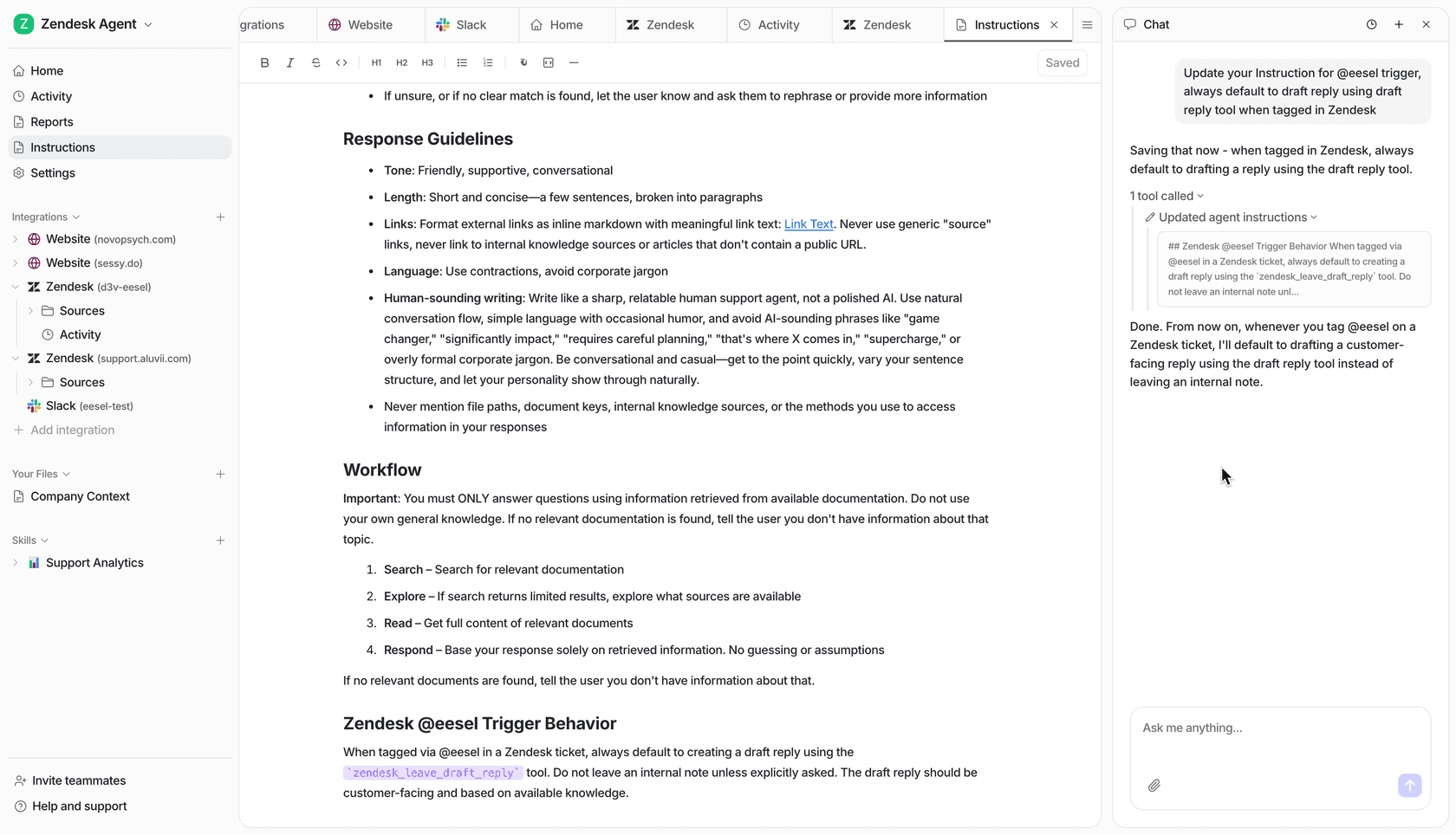
The key difference is the teammate model. Rather than configuring automation rules, you "hire" eesel AI and level it up based on performance. Start with AI Copilot drafting replies for review. Once you are confident in the quality, graduate to full AI Agent mode where eesel handles routine tickets autonomously. Define escalation rules in plain English: "Always escalate billing disputes to a human" or "For VIP customers, CC the account manager."
For teams already using Freshservice or ServiceNow, eesel AI can augment those platforms with more sophisticated AI capabilities. For teams evaluating their options, eesel AI offers a path to autonomous IT support that works with the tools you already have.
Making your decision
The Freshservice vs ServiceNow decision ultimately comes down to organizational fit.
Choose Freshservice if you want modern ITSM that just works, with transparent pricing and quick deployment. It is the pragmatic choice for growing organizations that need solid capabilities without enterprise overhead.
Choose ServiceNow if you have complex requirements, deep resources, and the need for a platform that can serve as the backbone of your entire organization's service delivery. It is the power user's choice, with capabilities that justify the complexity for the right organizations.
Consider augmenting either platform with eesel AI if your priority is intelligent automation. The AI landscape is evolving rapidly, and modern AI agents can deliver autonomous resolution rates up to 81% with payback periods under two months.
Bottom line? There is no universally "best" platform. There is only the platform that best fits your team size, technical resources, budget, and growth trajectory. Evaluate based on where you are today and where you want to be in three years, not just on feature checklists.