Choosing the right IT service management platform is a significant decision for any growing organization. With multiple pricing tiers and feature sets to consider, it's easy to feel overwhelmed by the options. If you're evaluating Freshservice for your team, you've likely noticed they offer four distinct plans, with the Pro tier sitting squarely in the middle of their pricing structure.
The Pro plan is positioned as the sweet spot for "advancing teams breaking silos and unifying service management across functions." But what does that actually mean for your day-to-day operations? And more importantly, is it worth the jump from the Growth plan, or should you consider going all-in on Enterprise?
Let's break down exactly what you get with the Freshservice Pro plan, how the pricing works, and whether it aligns with your team's needs.
What is Freshservice and who uses it?
Freshservice is an IT service management (ITSM) platform built by Freshworks, designed to help IT teams deliver better employee service through a unified, AI-powered solution. It combines IT service desk functionality with asset management, operations management, and enterprise service management capabilities in a single platform.
The platform serves over 74,000 businesses worldwide, including notable organizations like Databricks, Marvel, University of Oxford, and AMC Theatres. It's particularly popular among IT teams looking to move away from shared inboxes and spreadsheets toward a more structured, ITIL-aligned approach to service management.
Freshservice targets organizations of various sizes, from small teams just starting their first service desk to large enterprises managing complex, multi-department IT operations. The platform emphasizes ease of use and quick time-to-value, claiming 356% ROI in under 6 months according to their Forrester Total Economic Impact study.
Freshservice pricing plans at a glance
Before diving into the Pro plan specifically, let's look at how Freshservice structures their pricing across all tiers. All plans use a per-agent, per-month model with significant discounts for annual billing.
| Plan | Monthly (per agent) | Annual (per agent) | Best For |
|---|---|---|---|
| Starter | $29 | $19 | Small teams starting their first service desk |
| Growth | $59 | $49 | Growing teams needing asset management |
| Pro | $119 | $99 | Advancing teams with complex IT operations |
| Enterprise | Custom pricing | Custom pricing | Large organizations with AI requirements |
The annual billing option saves you approximately 35% compared to monthly billing, which is substantial for larger teams. Freshservice also offers a 14-day free trial with unrestricted access to all features, letting you test drive the platform before committing.
One thing to note: the jump from Growth to Pro is significant ($50 per agent monthly on annual billing). This pricing structure suggests Freshservice sees the Pro plan as a distinct tier for organizations with specific advanced needs rather than just "more of everything."
What's included in the Freshservice Pro plan?
The Pro plan unlocks several capabilities that aren't available in the Growth tier. Here's what you actually get:
Core ITSM features
The Pro plan adds three major ITIL-aligned capabilities that many established IT teams consider essential:
-
Problem management: Manage problems proactively with AI insights, linked incidents, and timeline-based root cause analysis. This helps you identify and resolve underlying issues rather than just treating symptoms.
-
Change management: Automate change control, assess impact with your CMDB (configuration management database), and track progress visually through every stage. This is crucial for organizations with formal change advisory boards or compliance requirements.
-
Release management: Plan, test, and document releases from beginning to end, helping improve workflow and letting team members own their parts of the production pipeline.
These three features together represent the core of ITIL service transition and service operation processes. If your organization follows ITIL practices (or plans to), these aren't nice-to-haves, they're requirements.
Asset and service management
While the Growth plan includes basic asset management (up to 100 managed assets), the Pro plan unlocks unlimited asset management when paired with asset packs. You also get:
- Contract management: Track contracts, spending, and license usage in one place to optimize renewals and ensure compliance.
- Software license management: Discover and optimize software usage by integrating identity provider and vendor data.
- Service catalog: A unified portal where employees can request services and track their status.
The asset management capabilities are particularly important for organizations managing hundreds or thousands of devices, software licenses, and cloud resources.
Advanced operations
The Pro plan includes several features designed for teams managing complex, multi-faceted IT environments:
- Analytics Pro: Build custom reports and dashboards with advanced filtering and visualization options.
- Access Controls Pro: More granular permission settings for larger teams with complex organizational structures.
- Alert management: Consolidate alerts from multiple monitoring tools into a single view with AI-assisted noise reduction.
- Team dashboards: Department-specific views that help different teams focus on their relevant metrics.
- IP range restrictions: Enhanced security controls for organizations with strict network access requirements.
Automation and integrations
Pro users get 5,000 orchestration transactions per month (compared to 2,000 in Growth). Orchestration transactions represent automated actions taken through the Workflow Automator, such as creating a ticket in another system, sending notifications, or updating records across integrated platforms.
The plan also includes access to Freshservice's marketplace of 1,000+ integrations and full API access for custom development.
Pro plan vs Growth plan: Key differences
The decision to upgrade from Growth to Pro usually comes down to whether you need the advanced ITIL features and increased automation capacity. Here's a side-by-side comparison:
| Feature | Growth | Pro |
|---|---|---|
| Price (annual, per agent) | $49/mo | $99/mo |
| Incident management | ✅ | ✅ |
| Knowledge management | ✅ | ✅ |
| SLA management | ✅ | ✅ |
| Service catalog | ✅ | ✅ |
| Asset management | 100 assets | Unlimited (with packs) |
| Problem management | ❌ | ✅ |
| Change management | ❌ | ✅ |
| Release management | ❌ | ✅ |
| Project management | ❌ | ✅ |
| Analytics Pro | ❌ | ✅ |
| Alert management | ❌ | ✅ |
| Access Controls Pro | ❌ | ✅ |
| Orchestration transactions | 2,000/mo | 5,000/mo |
| Sandbox | ❌ | ❌ |
| Freddy AI | ❌ | Add-on only |
The Growth plan covers the fundamentals: ticketing, basic asset tracking, knowledge base, and service catalog. The Pro plan adds the ITIL advanced practices (problem, change, release management) and significantly more powerful reporting and automation.
When should you upgrade? Consider Pro if:
- You're implementing or maturing ITIL processes
- You need project management integrated with your service desk
- Your team is outgrowing the 2,000 orchestration transaction limit
- You require advanced analytics and custom dashboards
- You need alert management for IT operations
What's NOT included in Pro (and what it costs extra)
While the Pro plan is comprehensive, some capabilities are reserved for Enterprise or available only as add-ons:
Freddy AI capabilities
Freshservice's AI features, branded as Freddy AI, are limited in the Pro plan:
- Freddy AI Agent: The conversational AI that provides 24/7 support on Slack and MS Teams is Enterprise-only. Enterprise licenses include 1,200 sessions per year per license.
- Freddy AI Copilot: Available as a $29 per agent per month add-on for Pro users. This assists agents with drafting responses, summarizing tickets, and building help content.
- Freddy AI Insights: Enterprise-only feature for AI-generated actionable insights and trend analysis.
If AI-assisted service management is a priority, you'll need to factor in the Copilot add-on cost or consider jumping to Enterprise.
Enterprise-only features
Several capabilities are strictly reserved for the Enterprise tier:
- Sandbox environment: A separate testing environment for trying changes without affecting production. Critical for organizations with formal change management processes.
- Audit logs: Detailed logging for compliance and security monitoring.
- Freddy AI Agent: Full AI agent capabilities as mentioned above.
Additional costs to factor in
Beyond the base per-agent pricing, consider these potential add-ons:
| Add-on | Price | When You Need It |
|---|---|---|
| Asset pack | $75/mo per 500 assets | Managing more than 100 assets |
| Unlimited assets | $1,500/mo | Very large asset inventories |
| Freddy AI Copilot | $29/agent/mo | AI assistance for agents |
| Orchestration pack | $250 per 1,000 transactions | Exceeding 5,000 monthly transactions |
| Day passes | $3-18 per pass | Occasional agents needing temporary access |
For a team of 20 agents needing asset management beyond the 100-asset limit and AI Copilot, your actual monthly cost would be:
- Base Pro: $1,980 (20 × $99)
- Freddy AI Copilot: $580 (20 × $29)
- Asset pack: $75 (for 500 additional assets)
- Total: approximately $2,635/month
Is the Pro plan worth it for your team?
Whether the Pro plan makes sense depends on your team size, maturity, and specific use cases.
Team size considerations
Small teams (5-15 agents): The Growth plan likely covers your needs. The basic asset management (100 assets), service catalog, and core ticketing features are sufficient for most small IT departments. The $50 per agent monthly jump to Pro is hard to justify unless you have specific compliance or process requirements.
Mid-sized teams (15-40 agents): This is where Pro starts making sense. At this size, you're likely dealing with more complex change management, multiple concurrent projects, and enough automation needs to exceed the 2,000 transaction limit. The advanced analytics also become more valuable as your data volume grows.
Large teams (40+ agents): You'll likely benefit from Pro, though you should also evaluate Enterprise. At this scale, the lack of a sandbox environment in Pro becomes a significant limitation, and the AI capabilities in Enterprise may justify the custom pricing.
Use cases that justify the upgrade
The Pro plan delivers clear value for specific scenarios:
Multi-department IT operations: If you're supporting multiple business units with different service catalogs, SLAs, and approval workflows, the advanced access controls and team dashboards become essential.
Complex change management: Organizations with formal CAB (Change Advisory Board) processes, compliance requirements, or high-stakes infrastructure changes need the structured change management that Pro provides.
Project portfolio management: If your IT team manages projects alongside support tickets, having project management integrated with your service desk eliminates tool switching and improves visibility.
IT operations with monitoring: Teams using multiple monitoring tools benefit from the alert management capabilities to consolidate and prioritize alerts before they become incidents.
ROI considerations
At $99 per agent per month (annual), a 20-person team pays $23,760 annually for Pro. Compare this to:
- The cost of a separate project management tool (potentially $10-30 per user per month)
- Separate change management or ITIL tools
- The operational cost of manual processes that could be automated
For many teams, consolidating these capabilities into Freshservice Pro is more cost-effective than maintaining multiple point solutions, not to mention the efficiency gains from integration.
eesel AI: A teammate-based approach to IT service management
While Freshservice offers a comprehensive, feature-rich platform for IT service management, it's worth considering whether a traditional ITSM tool is the right approach for your team. This is where we come in.
At eesel AI, we take a fundamentally different approach. Instead of configuring a complex tool, you hire eesel as an AI teammate. Here's how that changes things:
Instant learning vs. manual configuration: Freshservice requires you to configure workflows, set up automations, and build out your service catalog. With eesel, you simply connect your help desk and documentation. eesel reads your existing data (past tickets, help center articles, macros, Confluence docs) and understands your business context, tone, and common issues from day one. No configuration wizards, no manual training.
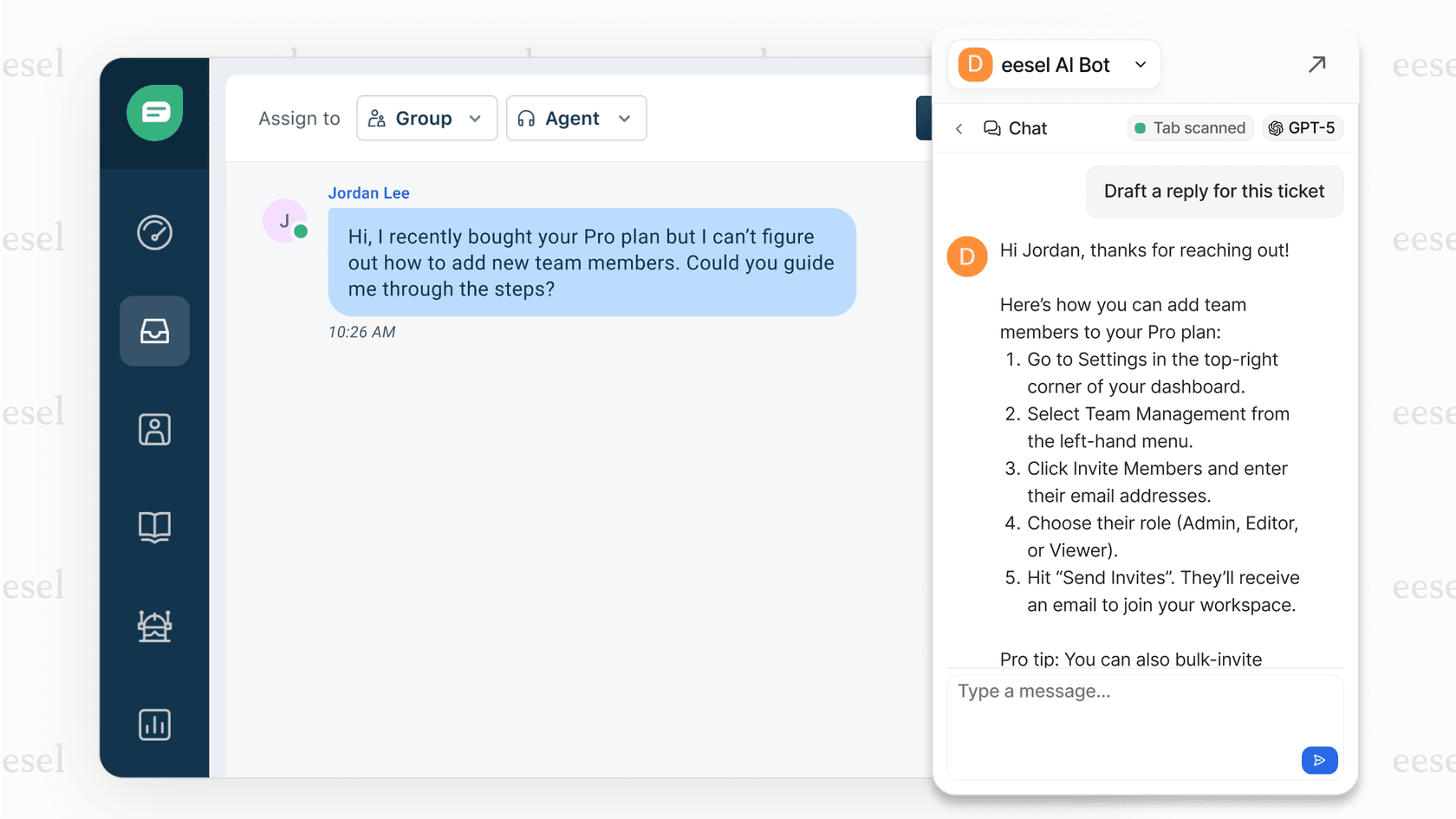
Progressive autonomy: Like any new hire, eesel starts with guidance. You can have eesel draft replies for agent review before sending, limit it to specific ticket types, or set business hours when it can respond. As eesel proves itself, you expand its scope until it's handling full frontline support autonomously. You're always in control of the pace.
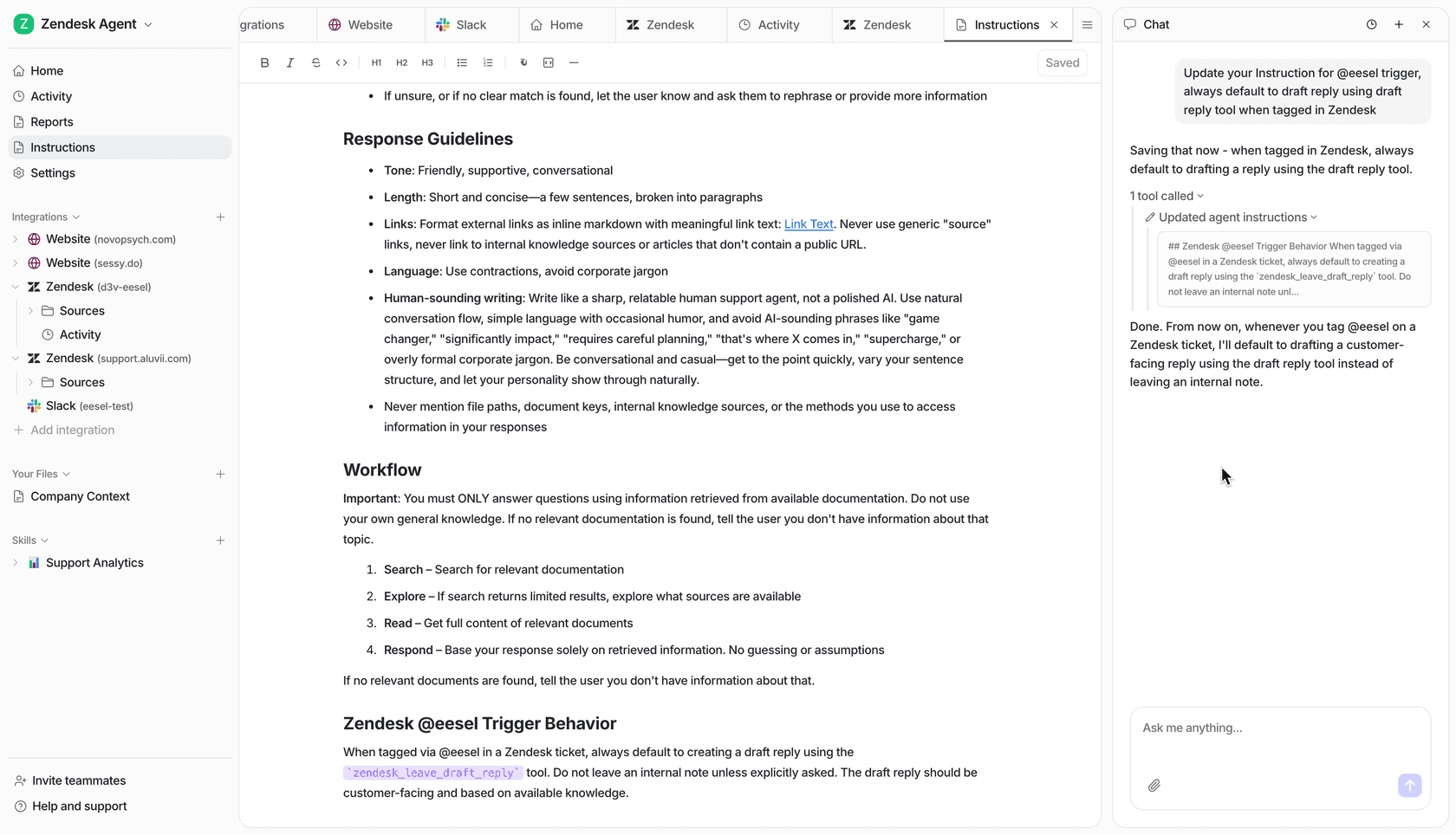
Plain-English instructions: Instead of building complex workflow automations, you simply tell eesel what to do in natural language: "If the refund request is over 30 days, politely decline and offer store credit" or "Always escalate billing disputes to a human." No code, no rigid decision trees.
Pre-go-live testing: Before eesel ever touches a real customer, you can run simulations on thousands of past tickets to see exactly how it would respond. Measure resolution rates, identify gaps, and gain confidence through data rather than hope.
When might eesel be a better fit than Freshservice Pro?
- If you want AI handling tickets end-to-end rather than just assisting agents
- If you need to go live quickly without a lengthy implementation
- If you prefer a teammate that learns continuously from corrections and feedback
- If you want to avoid the complexity of traditional ITSM platforms
See how eesel AI works or compare our pricing to see how we stack up.
Choosing the right Freshservice plan for your IT team
Let's put this all together with a practical decision framework:
Choose Starter if: You're a small team (1-5 agents) moving from shared inboxes to your first formal service desk. You need basic ticketing, knowledge base, and SLA management without the complexity of advanced features.
Choose Growth if: You're a growing team (5-20 agents) that needs asset management and a service catalog, but doesn't yet require formal change management or project management. The 100-asset limit and 2,000 orchestration transactions should cover your needs.
Choose Pro if: You're an established IT team (20-50+ agents) with mature processes. You need ITIL-aligned problem, change, and release management. You're managing multiple projects alongside support tickets. You need advanced analytics and have outgrown basic automation limits.
Choose Enterprise if: You're a large organization (50-100+ agents) that needs AI capabilities, sandbox environments for testing, audit logs for compliance, and the highest tier of support and customization.
The Pro plan sits in a unique position. It's significantly more capable than Growth, but lacks some of the enterprise polish (sandbox, full AI) that large organizations require. For mid-sized IT teams with genuine complexity, it's often the right choice. Just be sure to factor in the add-on costs for assets and AI if those are important to your operations.
If you're still evaluating options, remember that the best tool is the one your team will actually use. Freshservice's emphasis on ease of use and quick deployment is a genuine differentiator in the ITSM space. Take advantage of their 14-day trial to see if the Pro plan's capabilities align with your workflow before making the investment.