
Freshservice has been a go-to ITSM platform for years. But as teams scale and AI becomes table stakes, many are hitting walls. Per-agent pricing balloons with growth, rigid workflows do not bend to your needs, and AI features stay locked behind expensive tiers.
If you're evaluating Freshservice alternatives, you're not alone. We researched and compared seven leading ITSM platforms to help you find the right fit. Whether you need enterprise-grade ITIL coverage, DevOps-friendly workflows, or an AI-first approach that actually learns your business, there's an option here for you.
Let's break it down.
What is Freshservice?
Freshservice is a cloud-based IT service management (ITSM) platform from Freshworks. It's designed to help IT teams manage incidents, changes, assets, and service requests through an intuitive, ITIL-aligned interface.
The platform works well for mid-market companies that want straightforward ITSM without heavy configuration. But as organizations grow, common pain points emerge:
- Per-agent pricing gets expensive fast as teams scale
- Limited customization makes it hard to adapt workflows to specific needs
- Advanced features (AI, orchestration, analytics) require expensive plan upgrades
- Cloud-only deployment isn't an option for organizations with strict compliance requirements
These limitations drive many teams to explore alternatives that offer more flexibility, better AI capabilities, or more predictable pricing. If you are interested in how AI integrates with ITIL frameworks, read our guide on AI and the ITIL framework.
How we evaluated these Freshservice alternatives
We focused on criteria that matter when you're switching platforms:
- Pricing transparency: clear, published pricing (not "contact sales" for everything)
- AI capabilities: how advanced is the automation, and is it included or an add-on?
- Deployment options: cloud, on-premise, or both
- Ease of setup: time to value and implementation complexity
- Integration ecosystem: connections to tools you already use
Each alternative below serves a different use case. We've organized them to help you quickly identify which fits your situation.
Quick comparison: Freshservice alternatives at a glance
| Platform | Starting Price | Best For | Deployment | AI Approach |
|---|---|---|---|---|
| eesel AI | From $299/mo (500 credits) | AI-first automation | Cloud | Native AI teammate |
| ServiceNow | Custom quote | Large enterprises | Cloud | Enterprise AI add-ons |
| Jira Service Management | $21/agent/month | DevOps teams | Cloud/On-prem | Premium plan AI |
| ManageEngine | $0-13/tech/month | Budget-conscious | Cloud/On-prem | Limited built-in |
| Zendesk | $29/agent/month | Customer-facing IT | Cloud | Suite plans only |
| InvGate | $17/agent/month | Modern UI + AI | Cloud/On-prem | Included on Pro+ |
| SysAid | Custom quote | Asset management | Cloud/On-prem | All plans |
Now let's look at each option in detail.
1. eesel AI
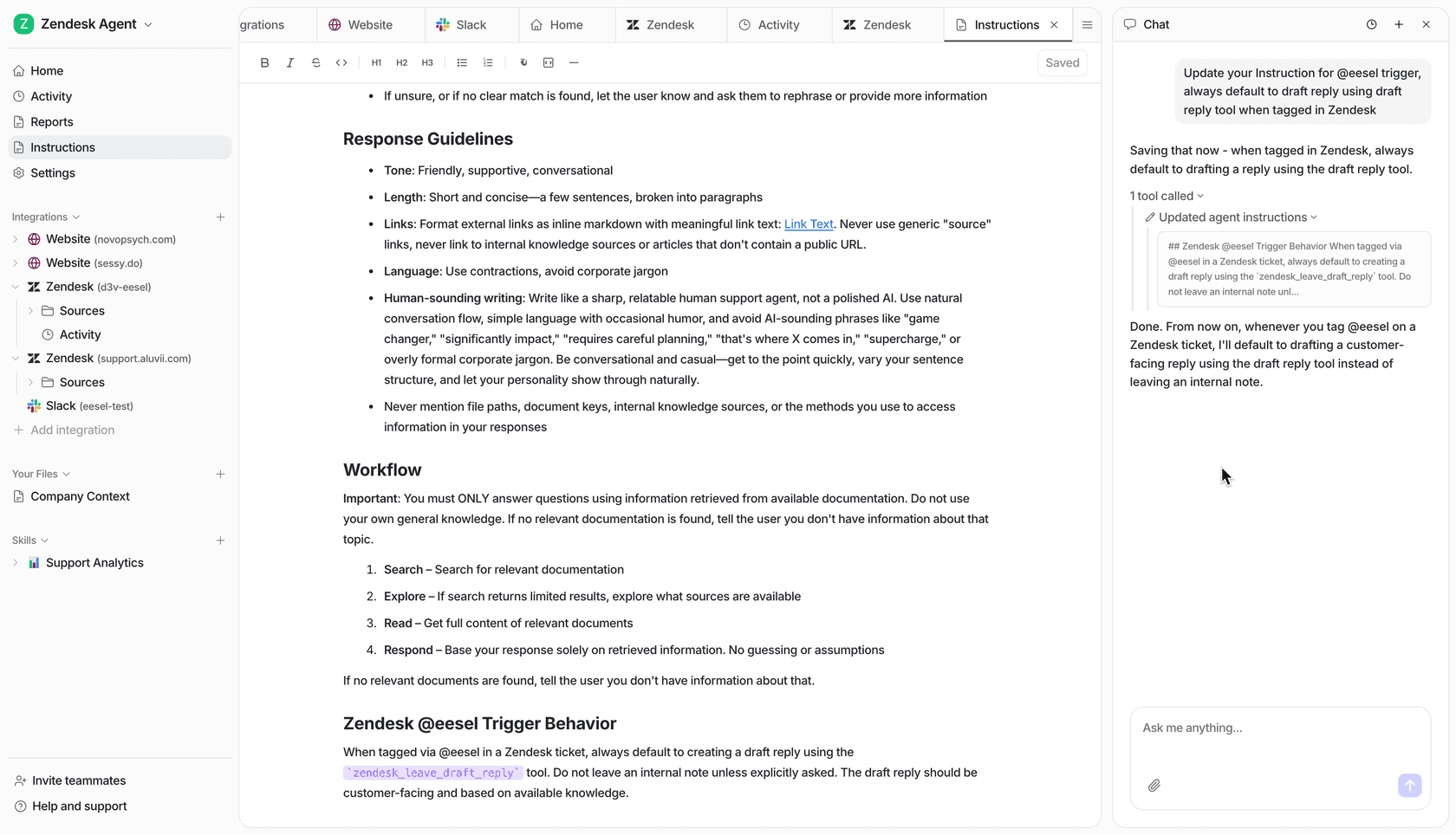
Best for: Teams wanting AI-first IT support that learns like a teammate, not a tool you configure
Here's the thing about traditional ITSM platforms: you don't use them, you configure them. Weeks of setup. Complex workflows. Hoping the AI understands your business context.
We take a different approach. eesel AI is an AI teammate you hire, not a tool you configure. It learns your business from past tickets, help center articles, and connected docs in minutes. Not weeks.
How eesel AI works
Like any new hire, eesel starts with guidance. You choose how:
- Have eesel draft replies that agents review before sending
- Limit eesel to specific ticket types or queues
- Set business hours when eesel can respond
As eesel proves itself, you expand its scope. Drafts become direct replies. Simple FAQs become full frontline support. Business hours become 24/7. You control the pace based on actual performance.
Key capabilities
- AI Agent: Handles frontline tickets autonomously. Mature deployments achieve up to 81% autonomous resolution
- AI Copilot: Drafts replies grounded in your knowledge for human agents to review and send
- AI Triage: Auto-tags, routes, merges, and closes tickets based on content, not just keywords
- Integrations: Works with Zendesk, Freshdesk, Slack, Teams, and 100+ other tools
eesel AI pricing
| Teammate plan (monthly credits) | Monthly Price | Included |
|---|---|---|
| Free | $0 | 100 credits, no card |
| 500 credits | $299 | Every integration and channel, unlimited agents and seats |
| 1,000 credits | $499 | Everything in 500 |
| 2,500 credits | $999 | Everything in 500 |
| 5,000 credits | $1,899 | Everything in 500 |
| More than 5,000 | Talk to us | Everything in 500 |
1 credit covers one ticket or chat, however long. We charge per volume, not per agent, so your costs stay predictable as your team grows.
Why teams choose eesel AI over Freshservice
The teammate model means you see how eesel performs before it's customer-facing. Run simulations on thousands of past tickets. Measure resolution rates. Identify gaps. Tune prompts. Gain confidence before touching real customers.
Most AI support tools are black boxes: you turn them on, hope for the best, and discover problems through customer complaints. Our approach means you verify quality first, then expand scope when you're confident.
Learn more about eesel AI for customer service
For a broader look at AI help desk options, see our guide to the best AI help desk software.
2. ServiceNow
Best for: Large enterprises with complex IT environments needing comprehensive ITIL coverage
ServiceNow is the gold standard for enterprise ITSM. If you're a Fortune 500 company with dedicated ITSM administrators and complex multi-department workflows, ServiceNow delivers capabilities other platforms can't match.
ServiceNow key strengths
- Single platform architecture unifies IT, HR, facilities, and other business functions
- AI agents autonomously complete tasks, route incidents, and provide recommendations
- Comprehensive ITIL modules including incident, problem, change, and service catalog management
- Predictive analytics for proactive service delivery
ServiceNow pricing
ServiceNow doesn't publish standard pricing. Enterprise contracts are negotiated based on user count, modules required, and implementation scope. Expect significant investment in both licensing and implementation resources.
Source: ServiceNow ITSM
ServiceNow limitations
- Steep learning curve for administrators and end-users
- High implementation costs and complexity
- Requires dedicated resources and specialized expertise
- Overkill for organizations under 500 employees
Bottom line? ServiceNow is powerful but complex. It's the right choice if you have the resources to fully implement it, but it's not a quick or easy switch from Freshservice.
3. Jira Service Management
Best for: DevOps teams and organizations already using Atlassian tools
If your development team lives in Jira Software and Confluence, Jira Service Management is the natural choice. It bridges IT service delivery with software development workflows in a way no other platform matches.
Jira Service Management key strengths
- Native Atlassian integration connects tickets directly to development work
- No-code form builder with 300+ templates for rapid setup
- ITIL capabilities including incident, problem, change, and asset management
- AI-powered automation with virtual agents for tier-one support
Jira Service Management pricing
| Plan | Price (Annual) | Key Features |
|---|---|---|
| Free | $0 | Up to 3 agents, basic features |
| Standard | ~$17.50/agent/month | 5,000 agents, basic ITSM |
| Premium | ~$37.50/agent/month | Asset management, advanced AI |
| Enterprise | Custom | Unlimited, advanced security |
Note: Standard plan starts at approximately $21-22/agent/month when billed monthly for 25 agents.
Source: Jira Service Management Pricing
Jira Service Management limitations
- Complex initial setup can overwhelm non-technical teams
- Advanced features (asset management, AI) require Premium plans
- Developer-centric interface may not suit pure IT support teams
If you're not already in the Atlassian ecosystem, the learning curve is real. But for DevOps-oriented organizations, it's hard to beat.
Read our complete Jira pricing guide
4. ManageEngine ServiceDesk Plus
Best for: Budget-conscious teams needing affordable ITSM with on-premise options
ManageEngine ServiceDesk Plus offers something increasingly rare: a genuinely free tier for small teams, plus on-premise deployment for organizations with compliance requirements.
ManageEngine key strengths
- Free Standard edition for up to 5 technicians
- Pink-verified incident and knowledge management
- Integrated asset management with CMDB and discovery
- Custom workflows for change management and service requests
ManageEngine pricing
Cloud Pricing (Annual):
| Plan | Starting Price | Key Features |
|---|---|---|
| Standard | $13/technician/month | IT help desk only |
| Professional | $27/technician/month | + Asset management |
| Enterprise | $67/technician/month | + Change, projects, CMDB |
Specific tiers (Cloud, Annual):
- 2 tech + 250 assets: $0 (Standard), $645 (Pro), $1,595 (Enterprise)
- 5 tech + 500 assets: $0 (Standard), $1,545 (Pro), $3,895 (Enterprise)
Add-ons: Service catalog ($1,195/year), Problem management ($1,195/year), Change management ($2,395/year)
Source: ManageEngine Pricing
ManageEngine limitations
- Interface can feel outdated compared to modern alternatives
- Mobile app has reported bugs and limitations
- Add-on costs can accumulate quickly
If budget is your primary concern and you need on-premise deployment, ManageEngine is worth serious consideration.
5. Zendesk
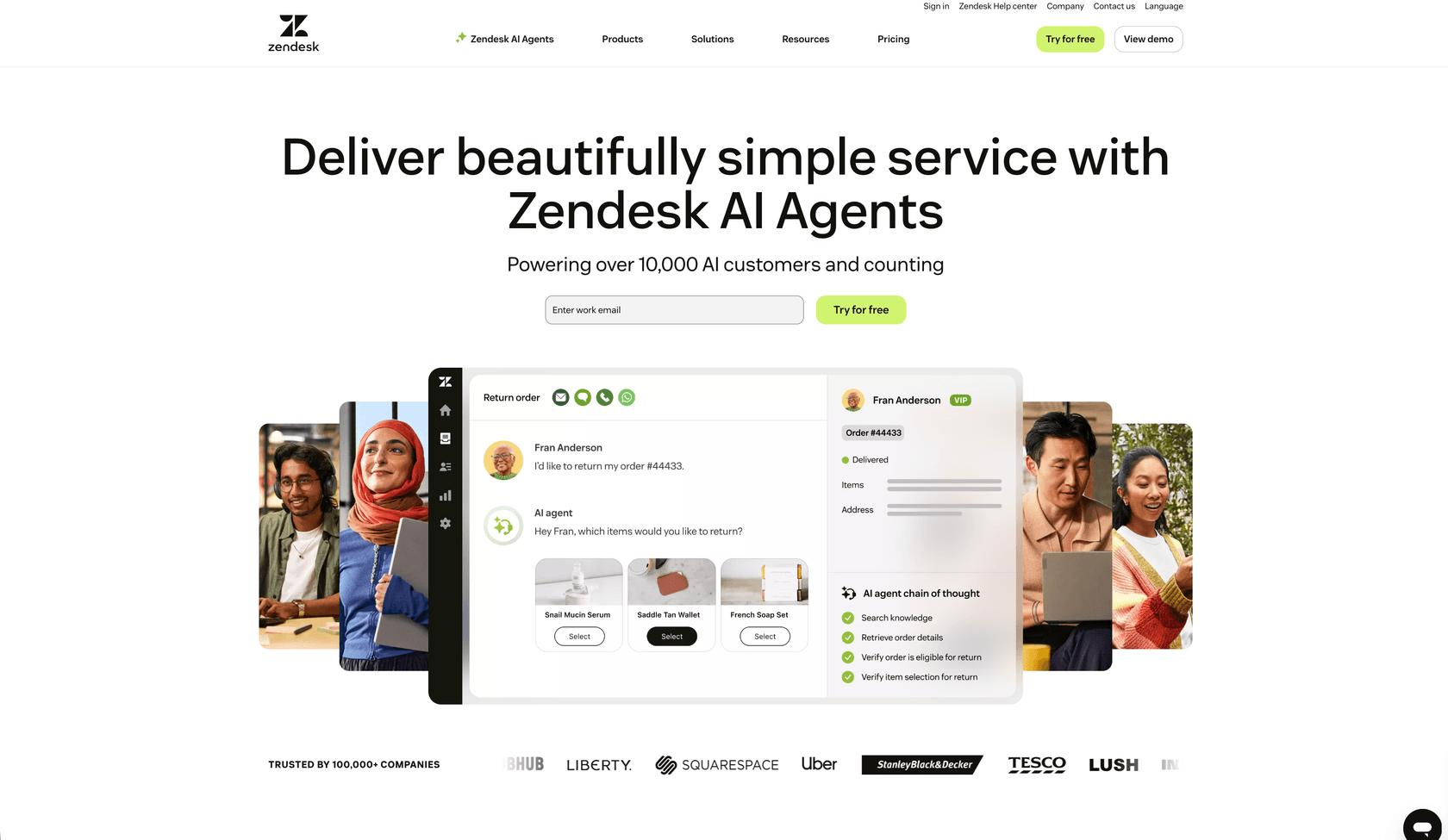
Best for: Teams blending customer service with internal IT support
Zendesk brings its customer service expertise to internal IT support. If you need a single platform for both customer-facing and internal support, Zendesk offers capabilities purpose-built for that dual role.
Zendesk key strengths
- Omnichannel support consolidates email, chat, Slack, and Teams into one workspace
- AI agents handle routine interactions with intelligent routing
- Self-service capabilities including knowledge bases and community forums
- Familiar, user-friendly interface reduces training time
Zendesk pricing
Suite Plans (recommended for IT):
| Plan | Monthly | Annual | Key Features |
|---|---|---|---|
| Suite Team | $39 | $29 | AI agents, self-service |
| Suite Growth | $79 | $59 | Light agents, custom workflows |
| Suite Professional | $125 | $99 | Advanced AI, custom analytics |
| Suite Enterprise | Custom (Talk to Sales) | Custom (Talk to Sales) | Advanced security, sandbox |
Note: Zendesk bills AI agents per automated resolution, at $1.50 committed or $2.00 pay-as-you-go.
Source: Zendesk Employee Service pricing
Zendesk limitations
- Pricing escalates quickly with advanced features
- Less depth in specialized ITSM features vs. dedicated platforms
- Per-agent model gets expensive at scale
If you're already using Zendesk for customer support, extending it to internal IT is a natural progression. But for IT-only use cases, dedicated ITSM tools may offer better value.
6. InvGate Service Management
Best for: Teams wanting modern UI with AI included (not extra)
InvGate takes a different approach to AI pricing: it's included on Pro and Enterprise plans, not sold as an expensive add-on. This transparency, combined with a modern interface, makes it appealing for teams frustrated with nickel-and-dime pricing.
InvGate key strengths
- AI Hub included on Pro/Enterprise plans (article generation, response assistance, Virtual Agent)
- Visual CMDB with native asset management integration
- No-code dashboards and reporting without SQL
- 2025 Gartner Peer Insights Customers' Choice for ITSM
InvGate pricing
| Plan | Price | Features |
|---|---|---|
| Starter | $17/agent/month | 5 agents max, basic features |
| Pro | $40/agent/month | 6-50 agents, AI Hub, automation |
| Enterprise | Custom | Unlimited, on-premise option |
All plans include free unlimited end users, approvers, and watchers. 30-day free trial available without credit card.
Source: InvGate Pricing
InvGate limitations
- Smaller ecosystem than Atlassian or ServiceNow
- Less name recognition in enterprise
- Starter plan limited to 5 agents
If you're tired of AI features being expensive add-ons, InvGate's approach is refreshing. The modern UI doesn't hurt either.
7. SysAid
Best for: Teams prioritizing asset management and AI-first automation
SysAid puts AI at the center of its platform, not as an afterthought. With nearly 100 prebuilt AI agents and comprehensive asset management, it's built for teams that want automation handling heavy lifting.
SysAid key strengths
- AI Copilot provides real-time ticket summaries and solution recommendations
- Agentic AI with nearly 100 prebuilt AI agents for common tasks
- Asset management includes 250 managed assets (expandable)
- Visual workflow designer for custom automation
SysAid pricing
SysAid uses custom pricing based on organization size and needs. Plans include:
| Plan | Target | Key Differentiator |
|---|---|---|
| Standard | Lean teams | AI-assisted ticket handling |
| Pro | Mid-sized teams | Customizable AI agents |
| Enterprise | Large organizations | 30-minute Priority 1 response SLA |
Reported metrics:
- 70% reduction in Average Time to Repair with SysAid Copilot
- 93% AI-contained resolution rate
- 70% of tickets resolved through self-service
Source: SysAid Pricing
SysAid limitations
- User interface can feel dated in some areas
- Mobile app less robust than web platform
- Custom pricing lacks transparency
If asset management and AI automation are top priorities, SysAid delivers capabilities that compete with platforms twice the price.
Choosing the right Freshservice alternative
Here's a simple framework to help you decide:
Choose eesel AI if: You want AI-first support that learns your business and can progressively automate up to 81% of tickets. You prefer hiring a teammate over configuring another tool.
Choose ServiceNow if: You're a large enterprise (500+) needing comprehensive ITIL coverage and have resources for complex implementation.
Choose Jira Service Management if: Your team lives in the Atlassian ecosystem and you need tight dev/IT alignment.
Choose ManageEngine if: Budget is tight, you need an on-premise option, or you want a free tier for small teams.
Choose Zendesk if: You need to blend customer service with internal IT support on a single platform.
Choose InvGate if: You want modern UI, included AI (not add-ons), and transparent pricing.
Choose SysAid if: Asset management is a top priority and you want AI-first automation.
Making the switch: practical next steps
Switching ITSM platforms is a significant undertaking. Here's how to approach it:
-
Run a pilot with past tickets: Most platforms let you import historical data. Test how each handles your actual ticket volume and types.
-
Factor in total cost of ownership: Subscription pricing is just one piece. Consider implementation time, training, and migration costs.
-
Start with a limited rollout: Do not migrate everything at once. Start with one department or ticket type, then expand.
-
Verify AI quality before going live: If AI is a key factor, test it thoroughly with your own data before exposing it to customers.