Disclosure: This article is published by eesel AI, a competitor of ServiceNow. We encourage you to read ServiceNow's own materials for their perspective.
ServiceNow Virtual Agent is a powerful enterprise platform, but some teams find its setup timeline and configuration requirements challenging. If you're exploring alternatives that offer faster time-to-value or more flexible pricing, you're not alone. Many IT and support teams are looking at options that work alongside their existing tools without a major platform change.
In this guide, we compare 7 Virtual Agent alternatives that deliver intelligent automation in 2026. Whether you want to enhance your existing help desk or move to a more modern platform, there's an option here that fits your situation.
What is ServiceNow Virtual Agent?
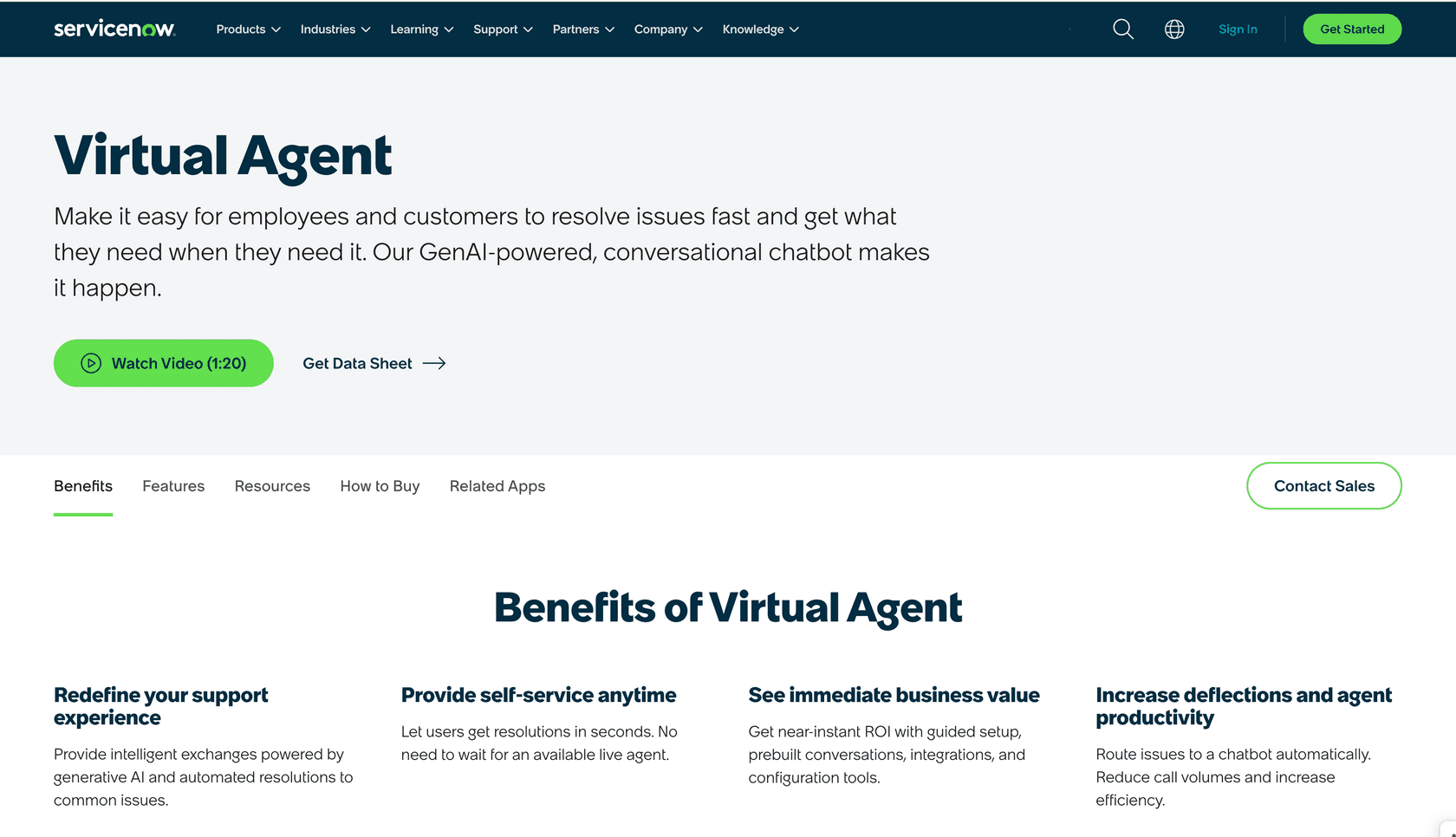
ServiceNow Virtual Agent is the platform's GenAI-powered conversational chatbot for IT and employee support. According to ServiceNow, it uses natural language understanding (NLU) to handle employee requests through chat interfaces, automate routine workflows, and provide self-service options that resolve issues without a live agent. (source)
The platform integrates with ServiceNow's broader ITSM ecosystem, enabling it to create tickets, query knowledge bases, execute predefined workflows, and trigger agentic AI workflows. It ships with a Conversation Designer for building and testing chatbot flows, supports third-party channels like Slack and Microsoft Teams, and handles multi-turn conversations with live agent handoff. For organizations already deeply invested in ServiceNow, it adds AI capabilities without leaving the platform. Pricing is not publicly listed; contact ServiceNow for a quote.
That said, G2 reviewers note that AI and intelligence features "can feel limited unless they are properly configured and licensed" (G2 reviews), and that the platform's complexity and cost are more clearly justified for larger organizations. Many teams seek alternatives that work out of the box, integrate with their existing tools, and have a shorter path from setup to resolution.
How we evaluated these ServiceNow Virtual Agent alternatives
To make this comparison useful, we looked at five key criteria that matter most when choosing an AI support solution:
-
AI capabilities Can the platform actually resolve issues autonomously, or does it just route tickets? We prioritized solutions with true AI agents over scripted chatbots.
-
Implementation speed Days and weeks beat months every time. We looked for platforms you can deploy quickly without lengthy consulting engagements.
-
Integration flexibility The best solutions work with your existing help desk (Zendesk, Jira, Freshdesk) rather than forcing you to migrate everything.
-
Total cost of ownership We considered not just licensing but implementation, training, and ongoing maintenance costs.
-
Time-to-value Can you prove ROI quickly? Platforms that let you test on historical data before going live scored higher.
ServiceNow Virtual Agent alternatives at a glance
| Alternative | Best for | AI approach | Starting price | Implementation | Key differentiator |
|---|---|---|---|---|---|
| eesel AI | Teams wanting AI without migration | AI teammate model | $0.40/task | Days | Works with existing help desk |
| Jira Service Management | Atlassian ecosystem users | Rovo AI | Free (3 agents) | Weeks | Deep dev workflow integration |
| Freshservice | SMBs wanting modern UI | Freddy AI | $19/agent/mo | Days | Balance of features and ease |
| Zendesk | Customer-centric teams | AI agents | $55/agent/mo | Weeks | Industry-leading knowledge management |
| Atomicwork | Enterprises replacing legacy ITSM | Agentic AI | Contact sales | Weeks | AI-native from ground up |
| Moveworks / EmployeeWorks | Large enterprises (now part of ServiceNow) | AI Assistant Platform | Contact sales | Months | Enterprise-scale AI across IT, HR, Finance |
| Resolve | Organizations prioritizing adoption | Proprietary LLM | Contact sales | Weeks | Highest employee adoption rates |
The 7 best ServiceNow Virtual Agent alternatives
1. eesel AI
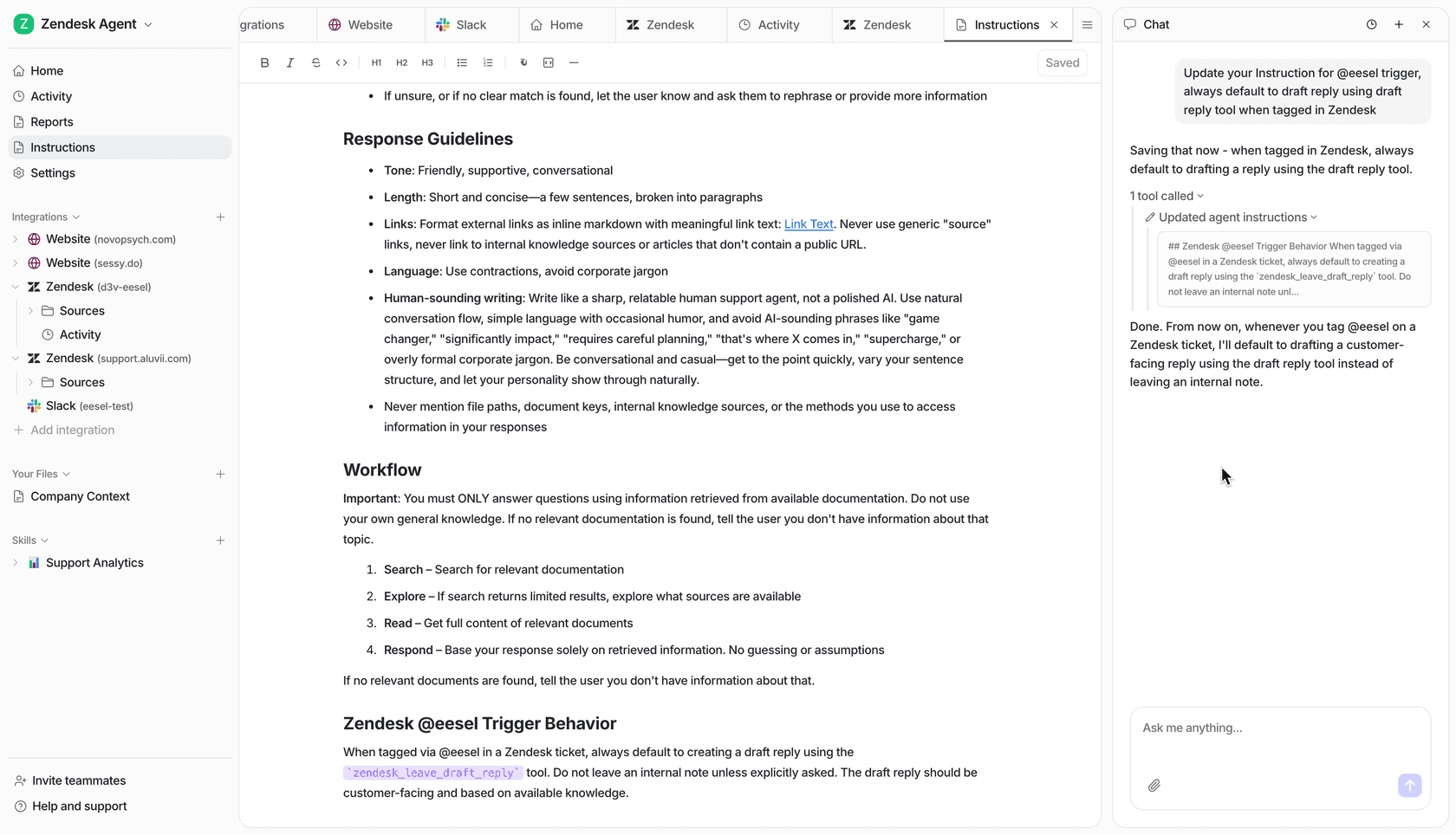
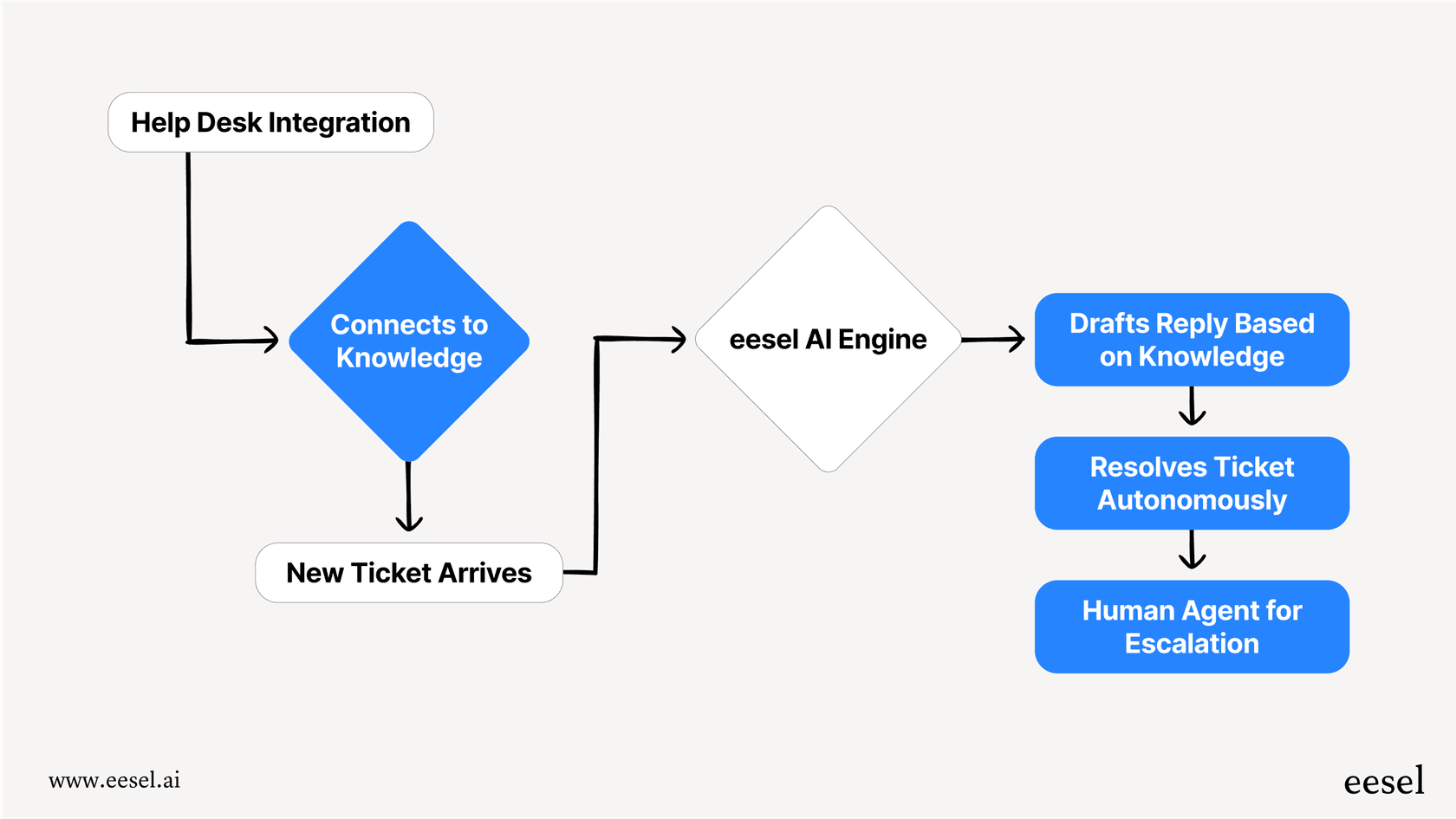
What it is: eesel AI is an AI teammate that plugs into your existing help desk rather than replacing it. Instead of migrating everything to a new platform, you invite eesel to work alongside your team in Zendesk, Jira, Freshdesk, or even ServiceNow itself.
Key AI features:
- AI Agent for autonomous ticket resolution (up to 81% in mature deployments)
- AI Copilot for drafting replies that agents review and send
- AI Triage for automatic tagging, routing, and prioritization
- Learns from your past tickets, help center, and connected docs in minutes
Best for: Teams who want AI automation without replacing their existing help desk infrastructure.
Pros:
- Works in minutes, not months
- 120+ integrations with popular tools
- No migration needed
- Progressive rollout: start with drafts, level up to full autonomy
- Plain-English control for escalation rules
Cons:
- Requires an existing help desk (not a standalone solution)
- Task-based pricing may not suit very high-volume teams without the annual commitment discount
Pricing:
| Task type | Price | Notes |
|---|---|---|
| Light tasks | Free | Dashboard questions, simple lookups |
| Regular tasks | $0.40/task | Support tickets, chat sessions |
| Heavy tasks | $4.00/task | Complex research, long-form content |
| Enterprise add-on | +$1,000/mo | SSO, HIPAA, dedicated support |
eesel uses task-based pay-per-use pricing with no per-seat fees and no monthly minimum. A $250/month default spending cap keeps costs predictable. Teams committing to at least $300/month annually receive a 25% discount.
Why it stands out: Unlike platforms that require choosing between your current help desk and AI, eesel enhances what you already have. You can integrate eesel with ServiceNow, Zendesk, Jira, or Freshservice without disrupting your existing workflows.
2. Jira Service Management
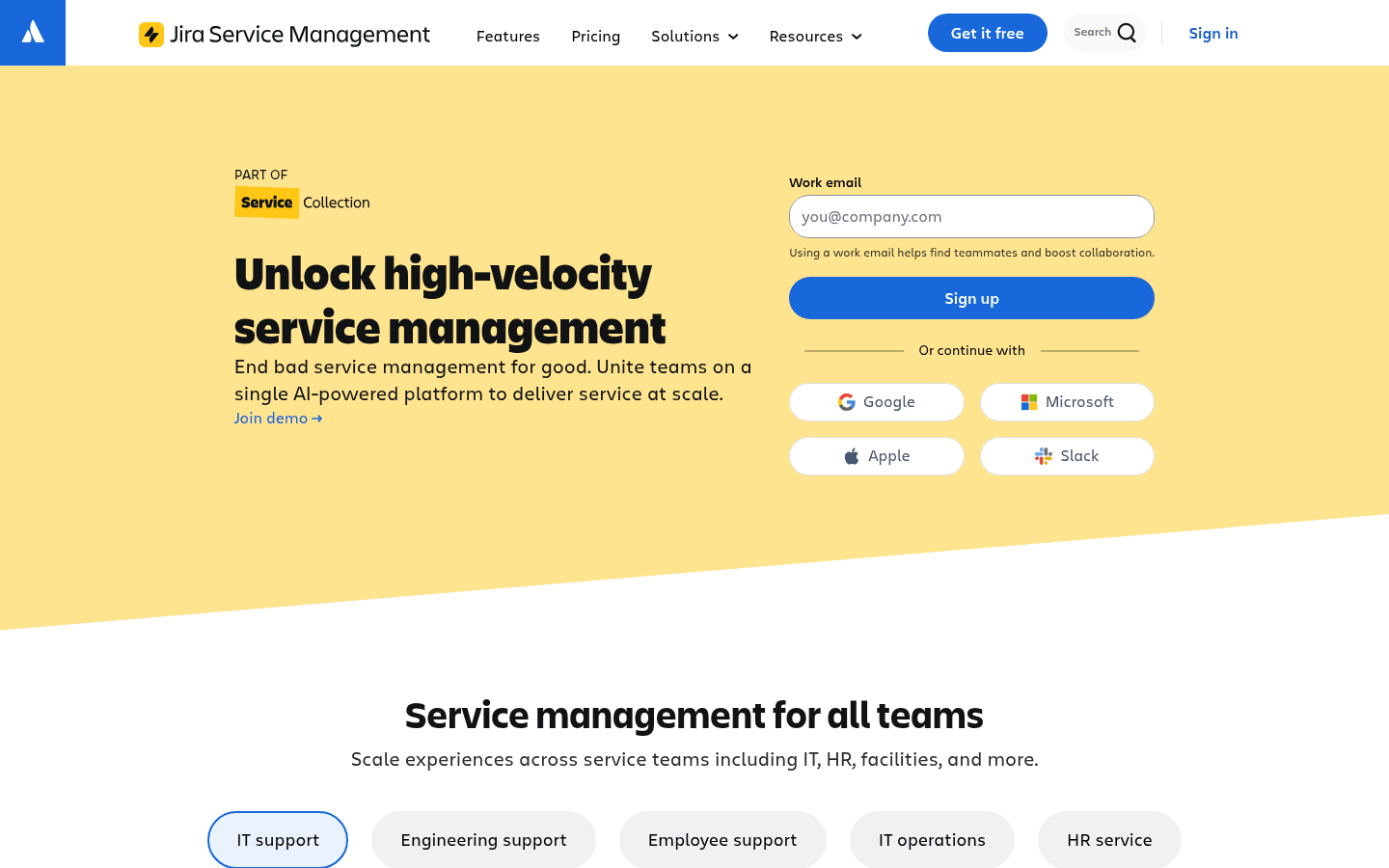
What it is: Atlassian's ITSM platform that brings AI capabilities through Rovo AI and Atlassian Intelligence. It's a mature solution that integrates deeply with Jira Software, Confluence, and the broader Atlassian ecosystem.
Key AI features:
- Rovo AI virtual agent for automated responses
- Atlassian Intelligence for ticket handling and categorization
- Smart search across Confluence and other Atlassian tools
- AI-powered insights and recommendations
Best for: Teams already using Jira Software, Confluence, or other Atlassian products.
Pros:
- Free for up to 3 agents
- Deep integration with development workflows
- ITIL-certified processes
- Strong asset management (Premium+)
- Familiar interface for technical teams
Cons:
- Can feel complex for non-technical users
- Advanced AI features require Premium plan
- Best value only if you're already in the Atlassian ecosystem
Pricing:
| Plan | Price/agent/mo | Key features |
|---|---|---|
| Free | $0 | Up to 3 agents, basic ITSM |
| Standard | $20 | 1,000 automations/agent |
| Premium | $51.42 | Advanced AI, asset management |
| Enterprise | Custom | Unlimited sites, dedicated support |
Why it stands out: For engineering-led organizations, the integration between Jira Service Management and Jira Software is unmatched. Development and support teams can work in the same ecosystem.
3. Freshservice
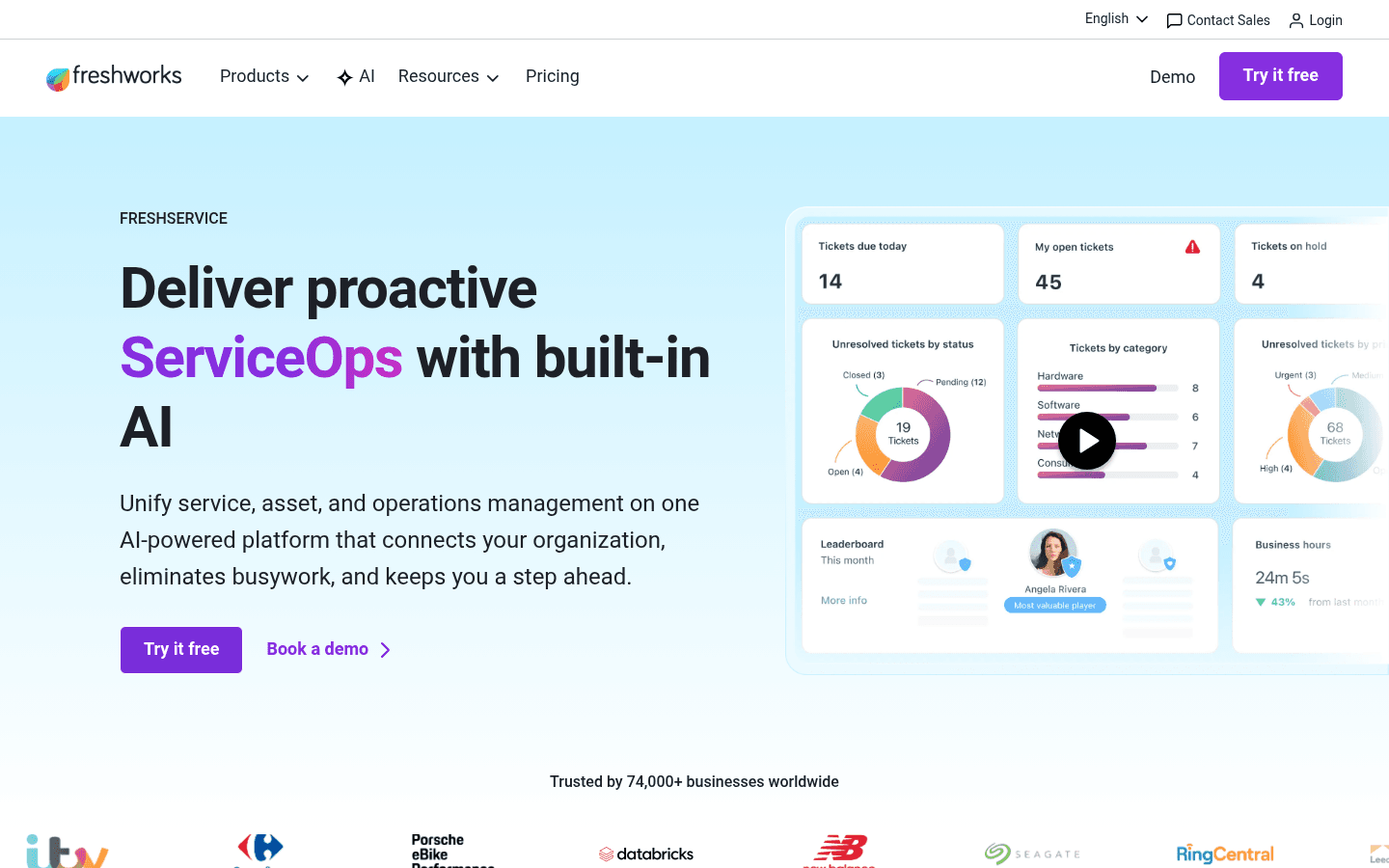
What it is: Freshworks' ITSM solution with Freddy AI built in from the ground up. It's designed for modern IT teams who want powerful capabilities without the complexity of legacy platforms.
Key AI features:
- Freddy AI Agent for 24/7 autonomous support
- Freddy AI Copilot for agent assistance
- Intelligent ticket routing and categorization
- Knowledge base article suggestions
Best for: SMBs and mid-market companies wanting fast setup with a modern, intuitive interface.
Pros:
- Cloud-native architecture
- Quick deployment (days, not months)
- Intuitive UI requires minimal training
- Strong automation capabilities
- Comprehensive asset management
Cons:
- Reporting features limited on lower tiers
- Advanced AI requires Pro or Enterprise plans
- Freddy AI add-ons add to cost
Pricing:
| Plan | Price/agent/mo (annual) | Key features |
|---|---|---|
| Starter | $19 | Basic ticketing, knowledge base |
| Growth | $49 | Automation, SLA management |
| Pro | $99 | + Freddy AI Agent available |
| Enterprise | Custom (contact sales) | Full AI capabilities |
Why it stands out: Freshservice strikes a balance between capability and usability. You get enterprise-grade ITSM without the enterprise-grade complexity.
4. Zendesk
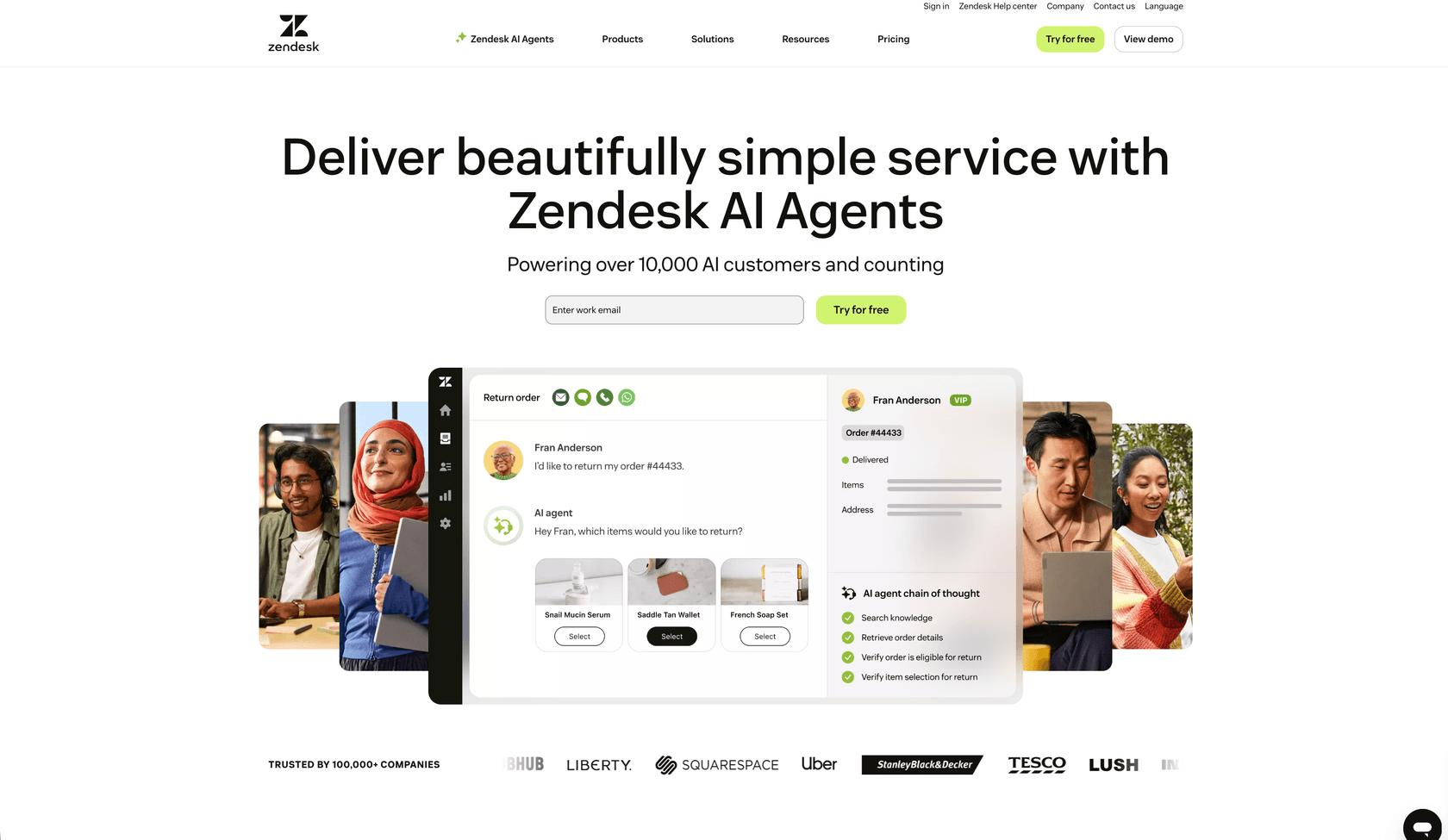
What it is: A customer service platform that has evolved into a comprehensive AI-powered solution. Zendesk AI agents can resolve 80%+ of interactions autonomously across any channel.
Key AI features:
- AI agents that reason, adapt, and act independently
- Zendesk Copilot for proactive agent assistance
- Admin Copilot for operational insights
- Omnichannel support (email, chat, social, messaging)
Best for: Customer-centric teams needing robust omnichannel support and industry-leading knowledge management.
Pros:
- Pre-trained AI works from day one
- 1,000+ app integrations
- Highly scalable for enterprise
- Strong knowledge base capabilities
- Proven customer results (UrbanStems saved $100K in 3 months)
Cons:
- Advanced AI requires higher-tier plans
- Costs scale quickly with agent count
- Can be overkill for simple use cases
Pricing:
| Plan | Price/agent/mo | Key features |
|---|---|---|
| Suite Team | $55 | Basic AI, messaging |
| Suite Professional | $115 | Advanced AI, skills routing |
| Suite Enterprise | $169 | Full AI suite, sandbox |
Why it stands out: Zendesk's knowledge management is industry-leading. If your support strategy relies heavily on self-service and knowledge bases, it's hard to beat.
5. Atomicwork
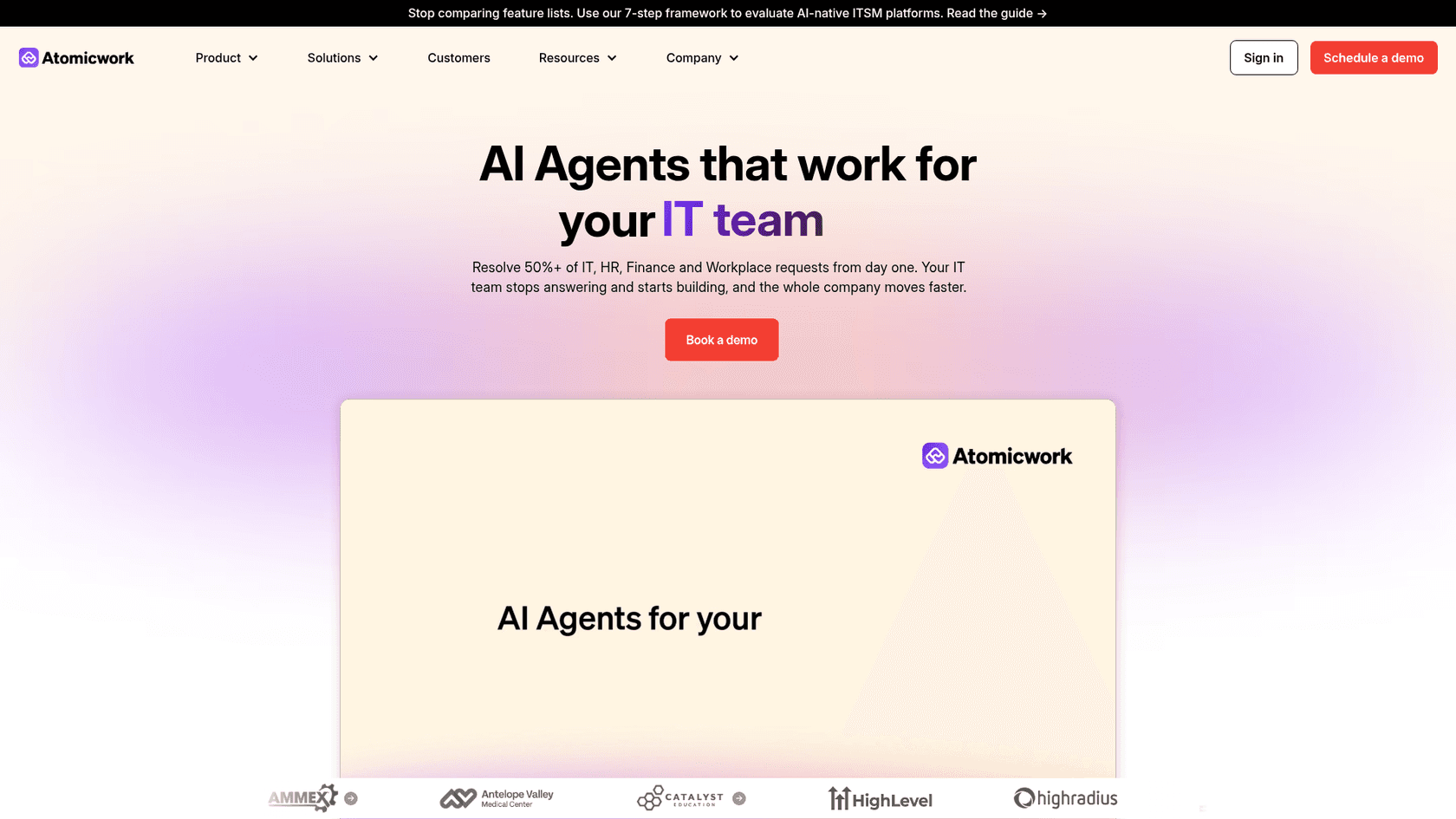
What it is: An agentic ITSM platform positioning itself as the modern ServiceNow alternative. Built with AI at the core rather than added on later, it emphasizes fast deployment and lower total cost of ownership.
Key AI features:
- Universal Agent (Atom) for employee support across channels
- Universal Context for real-time organizational intelligence
- Agentic workflows that self-heal and adapt
- One-click AI skills for common tasks
Best for: Enterprises looking to replace legacy ITSM with an AI-native platform.
Pros:
- AI-native architecture (not retrofitted)
- Deployment in weeks vs. longer ServiceNow timelines
- No-code administration
- Flow-of-work support (Slack, Teams)
- Claims ~30% of ServiceNow total cost of ownership for comparable teams
Cons:
- Newer platform with shorter track record
- Enterprise-focused (may be overkill for smaller teams)
- No public pricing
Pricing: Contact sales. Atomicwork positions itself as significantly more affordable than ServiceNow, though pricing is not public. (Atomicwork)
Why it stands out: Atomicwork is built for the agentic AI era. Unlike platforms adding AI to legacy architectures, it was designed from the ground up with AI as the foundation.
6. Moveworks / EmployeeWorks (now part of ServiceNow)
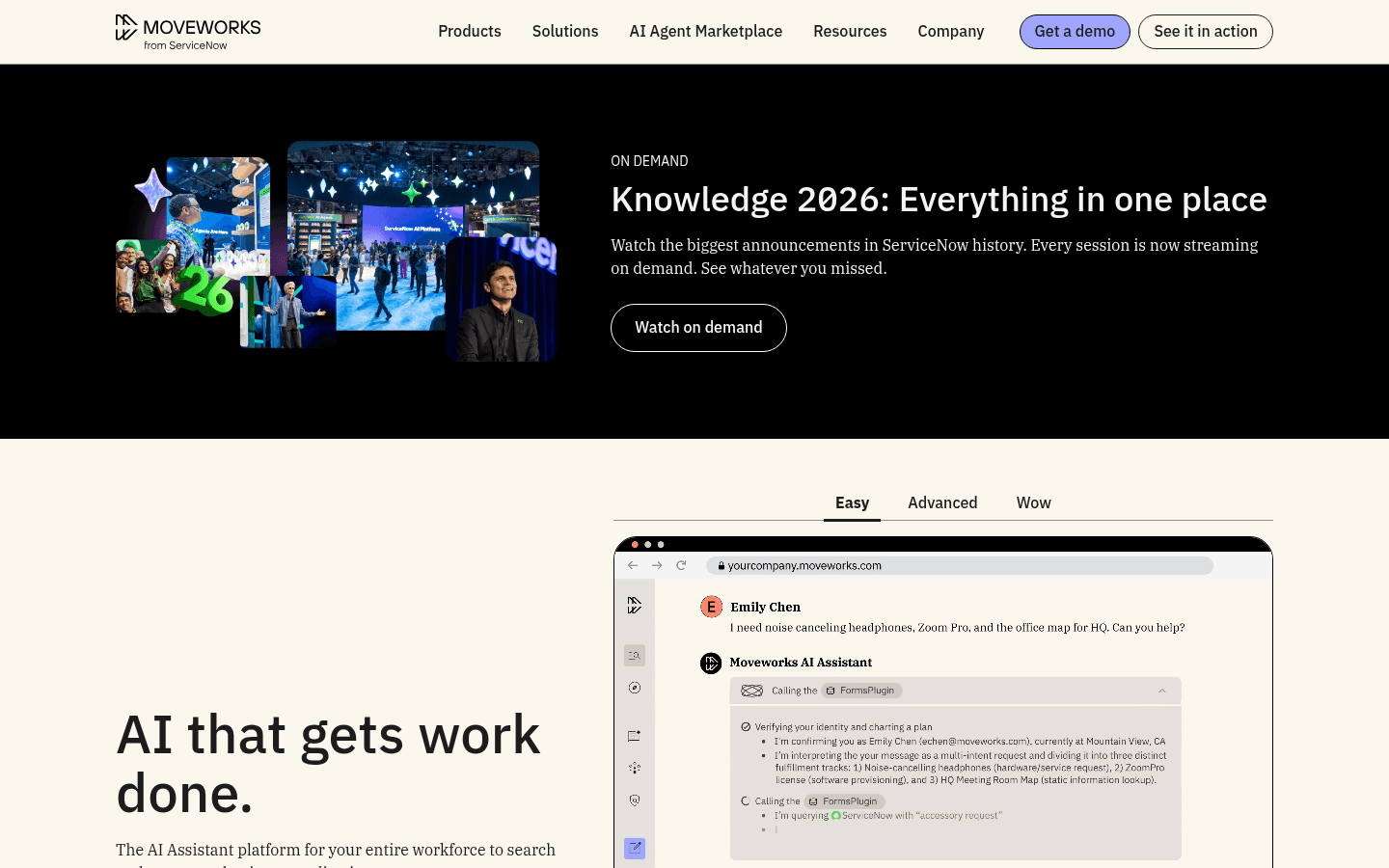
Note: Moveworks was acquired by ServiceNow in December 2025 and has been integrated into the ServiceNow platform as EmployeeWorks, launched February 2026. It is no longer an independent platform. Teams evaluating Moveworks should understand they are evaluating a ServiceNow product.
What it is: An AI Assistant platform purpose-built for enterprise IT support. It goes beyond chat to complete tasks end-to-end across your business applications. Since its ServiceNow acquisition, Moveworks functionality is available as the EmployeeWorks product bundled within the ServiceNow AI Platform.
Key AI features:
- Reasoning Engine that plans, executes, and adapts on the fly
- 1,000+ pre-built AI agents for common workflows
- Agent Studio for custom AI agent creation
- Enterprise-wide deployment across IT, HR, Finance, and more
Best for: Large enterprises with complex IT environments and 5,000+ employees that are evaluating or already using ServiceNow.
Pros:
- 5M+ employees rely on the platform
- 8 weeks typical time to value
- 90% enterprise-wide deployment rates
- Deep integrations across business applications
- FedRAMP authorized for regulated industries
Cons:
- Pricing not publicly listed; contact ServiceNow for a quote
- Now part of ServiceNow, not an independent vendor choice
- Requires significant implementation effort
- Scale of product may be overkill for smaller organizations
Pricing: Contact ServiceNow. Pricing is not publicly disclosed. EmployeeWorks is bundled into ServiceNow ITSM tiers (Foundation, Advanced, Prime) as a "Moveworks for ITSM" SKU at each tier.
Why it stands out: Moveworks/EmployeeWorks is the most sophisticated option for large enterprises that are already in the ServiceNow ecosystem. If you need AI automation across IT, HR, Finance, and other departments at massive scale and are building on ServiceNow, it's purpose-built for that.
7. Resolve
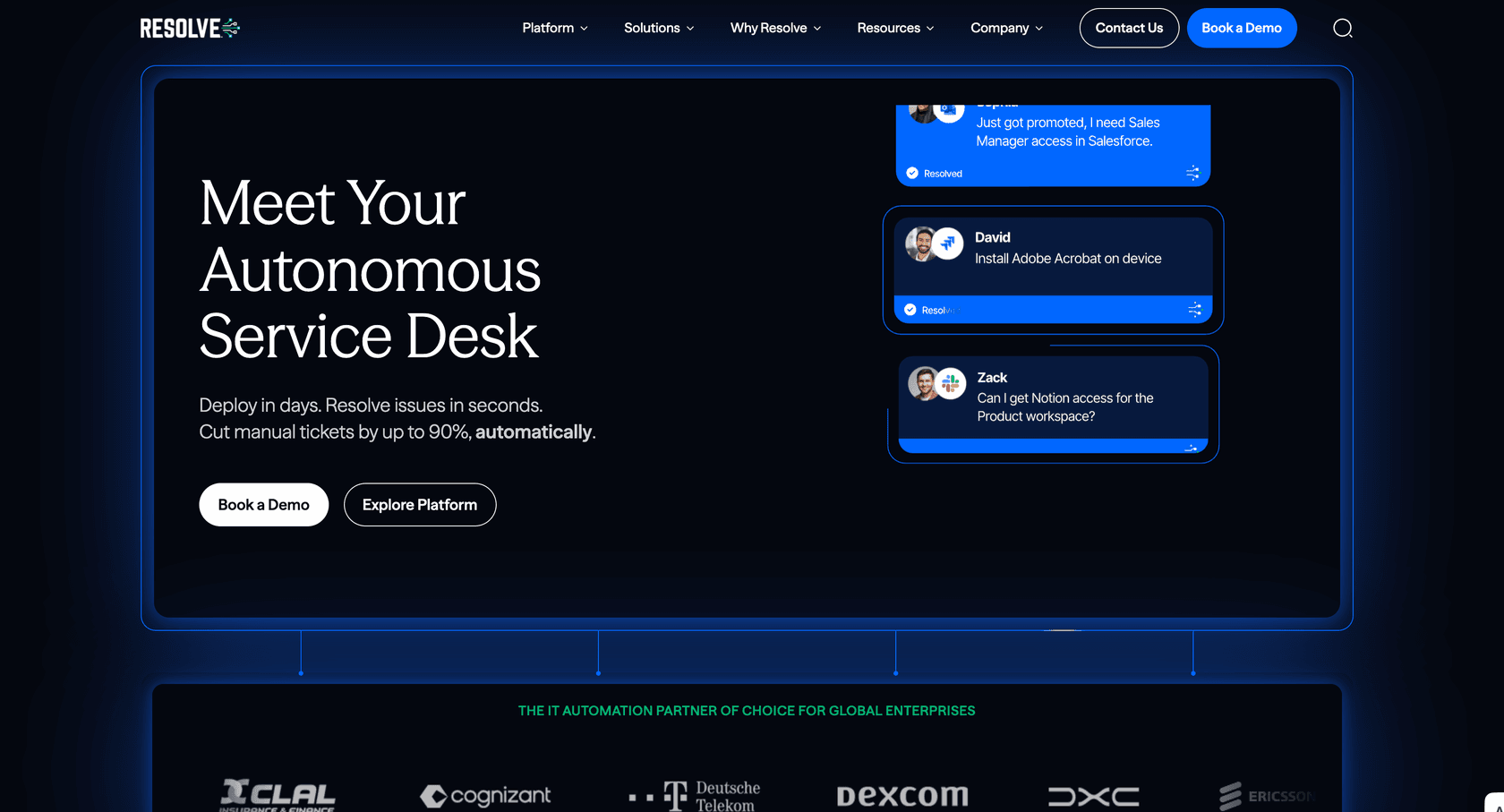
What it is: A virtual support agent platform (now also marketed as Resolve) focused on IT automation and orchestration. It resolves up to 90% of incidents automatically before they become tickets.
Key AI features:
- RITA (Resolution Expert) for AI-driven orchestration
- Jarvis for AI-enabled workflow creation
- Self-healing automation for common IT issues
- Integration with 100+ enterprise tools
Best for: Organizations prioritizing maximum automation and employee adoption.
Pros:
- 80-85% employee adoption rates
- 50-70% call volume reduction
- Agentic automation (not rules-based)
- Named Visionary in 2025 Gartner Magic Quadrant for SOAP
- Strong network and infrastructure automation
Cons:
- Narrow focus on IT support (not general customer service)
- Pricing not publicly listed; contact Espressive for a quote
- Recent Resolve rebrand may indicate strategic shifts
Pricing: Contact sales. Pricing is not publicly disclosed on Espressive's website.
Why it stands out: Espressive/Resolve achieves the highest employee adoption rates in the industry. If previous AI initiatives failed because employees wouldn't use them, this platform addresses that directly.
How to choose the right ServiceNow Virtual Agent alternative
With seven solid options, how do you pick the right one? Here's a practical framework:
Start with your workflow. Map your top 5 support requests. Are they simple password resets and software provisioning? Or complex troubleshooting requiring human judgment? The complexity of your requests should guide your choice.
Consider integration needs. What systems must the AI connect to? If you're heavily invested in Atlassian, Jira Service Management makes sense. If you want to keep your existing Zendesk setup, eesel's Zendesk integration lets you add AI without migration.
Evaluate time-to-value. Can you test and prove ROI in weeks? Look for platforms that let you run simulations on past ticket data before going live. This is especially important if you're pitching the investment to leadership.
Factor in total cost. Include implementation, training, and ongoing maintenance. A lower license price isn't a bargain if you need consultants to make it work. Note that ServiceNow pricing is not publicly listed; all deals are sized via custom quote.
Test before committing. The best platforms let you see how they'd handle your actual tickets. At eesel, we always recommend running our AI on your historical data first so you can measure quality before customers see it.
Finding your ServiceNow Virtual Agent alternative
The landscape for AI-powered support has changed significantly. You no longer need to settle for lengthy deployments to get intelligent automation.
Modern alternatives offer faster implementation, better AI capabilities, and more flexible pricing. Whether you choose an AI-native platform like Atomicwork, enhance your existing help desk with eesel AI, or go with an established player like Zendesk, the key is finding a solution that fits your specific needs.
If you're looking for AI automation that works with your existing help desk rather than replacing it, invite eesel AI to your team. You can try it free with $50 in credits (no credit card required) and see how it performs on your actual tickets before making any commitment.