
If you're evaluating AI solutions for your service desk, you've probably come across ServiceNow Virtual Agent. It promises to automate routine requests, deflect tickets, and provide 24/7 self-service. But is it actually worth the investment?
The short answer: it depends on what you're working with. ServiceNow Virtual Agent is a powerful tool, but it's built for a specific type of organization. If you're already deep in the ServiceNow ecosystem with dedicated developers on staff, it might be exactly what you need. If you're looking for something that works across multiple platforms with faster time-to-value, you'll want to consider alternatives like eesel AI.
Let's break down what ServiceNow Virtual Agent actually does, where it shines, where it falls short, and how to decide if it's right for your team.
What is ServiceNow Virtual Agent?
ServiceNow Virtual Agent is a conversational AI chatbot designed to handle routine IT, HR, and customer service requests. It's part of the broader ServiceNow Now Platform and comes in two flavors:
- Traditional Virtual Agent: Uses Natural Language Understanding (NLU) and the NLU Workbench to recognize intent based on keywords and trained models
- Now Assist in Virtual Agent: The newer LLM-powered version that uses Large Language Models for intent recognition instead of traditional NLU
The core idea is straightforward: users chat with the bot to resolve common issues like password resets, account unlocks, leave requests, or order status checks. When the bot can handle it, the ticket never reaches a human agent. When it can't, the conversation hands off to a live agent with full context.
ServiceNow claims the Virtual Agent can auto-resolve up to 80% of common issues and reduce operational costs by up to 60%. Those numbers sound impressive, but achieving them requires the right setup, data, and expertise.
What ServiceNow Virtual Agent does well
Deep ServiceNow Integration
This is the obvious strength. Virtual Agent is native to the ServiceNow platform, which means it can leverage your existing knowledge base, service catalog, and workflows without complex integrations. If you've already invested heavily in ServiceNow, the Virtual Agent can tap into that infrastructure immediately.
The bot pulls from your existing knowledge articles and catalog items, uses Now Platform data to personalize responses, and maintains a single security and compliance boundary. For organizations already running ServiceNow, this tight integration is a significant advantage.
Pre-built Conversation Topics
ServiceNow provides out-of-the-box conversation templates for common scenarios across IT, HR, and customer service. Password resets, account unlocks, leave balance checks, and order status inquiries come ready to deploy.
The platform also uses machine learning to analyze your incident data and suggest new conversation topics you might want to add. This can help identify patterns in your support requests that you hadn't automated yet.
Omnichannel Deployment
Virtual Agent works across multiple channels: Service Portal, mobile apps, Microsoft Teams, and Slack. Users can get help wherever they already work without switching contexts.
This omnichannel approach means your employees can ask for help in Teams, your customers can chat on your website, and your agents can manage everything from the same ServiceNow interface.
Agentic AI Workflows
The newer Now Assist capabilities enable more sophisticated automation. The Virtual Agent can trigger workflows performed by AI agents, handle multi-turn conversations with contextual recall, and generate synthesized responses from multiple knowledge sources.
Features like voice support by phone, live agent handoff with full context transfer, and dynamic language translation extend the platform's reach across different use cases and user preferences.
The real challenges you should know about
Complexity and Steep Learning Curve
Here's where things get complicated. ServiceNow Virtual Agent isn't a "flip the switch" solution. Building and maintaining conversation flows requires dedicated developers who understand the ServiceNow platform.
Even simple workflows can be surprisingly difficult to implement. The ServiceNow community has discussions about struggling to get basic logic working, like "if a ticket says 'pizza', add a note that says 'pizza order'." When experienced admins find simple conditionals challenging, that's a red flag for teams without deep platform expertise.
The NLU Workbench requires training data, ongoing tuning, and maintenance. The Conversation Designer, while marketed as "intuitive," still requires understanding ServiceNow's data model, workflow engine, and conversation logic. If you don't have ServiceNow developers on staff, you'll need to hire or contract them.
Pricing Opacity and Unpredictability
ServiceNow doesn't publish pricing for Virtual Agent. You have to contact sales for a quote, which typically means enterprise-level pricing with custom negotiations.
Based on user reports, the pricing model often works on a credit-based "per assist" system. Different AI actions consume different amounts of credits: a simple ticket summary might be cheap, but generating a complex workflow or using advanced AI features could cost significantly more. This makes monthly budgeting difficult and can lead to surprise bills if usage spikes.
For teams that need predictable costs, this model can be problematic. You won't know your actual spend until you've been running for a few months and can establish usage patterns.
Enterprise-First Design
ServiceNow Virtual Agent is built for large enterprises that are already committed to the ServiceNow ecosystem. The platform assumes you have:
- A robust, well-maintained knowledge base
- Dedicated ServiceNow administrators and developers
- The budget for enterprise software with custom pricing
- The patience for a multi-month implementation
If you're a mid-sized company without ServiceNow expertise, or if you need to move quickly, this can be a significant hurdle. One Reddit user, a new solo admin at a company with over 5,000 employees, described the experience as overwhelming.
AI Accuracy Concerns
Like any AI system, Virtual Agent is only as good as its training data. If your knowledge bases are inconsistent or your historical ticket data is messy, the AI will make mistakes. In a large platform like ServiceNow, controlling the AI and keeping it from generating incorrect responses can be challenging.
Users have reported concerns about AI hallucinations, where the system generates confident but incorrect answers. If your agents have to double-check everything the AI produces, you're not saving time, you're just adding another step to the process.
ServiceNow Virtual Agent pricing explained
ServiceNow doesn't publish public pricing for Virtual Agent. The product page directs you to "Contact Sales" with no tier information, feature limits, or starting prices available.
This lack of transparency is common for enterprise software, but it makes budgeting difficult. You'll need to go through a sales process to get a quote, which will likely depend on your organization size, expected usage volume, and existing ServiceNow licensing.
Based on secondary research, the pricing typically follows a credit-based model where different AI actions cost different amounts. Simple queries are inexpensive, but complex workflows and advanced AI features consume more credits. This usage-based approach means your costs scale with adoption, which can be good for growth but challenging for budget predictability.
For comparison, here's how eesel AI approaches pricing:
| Plan | Monthly Price | Annual Price | What's Included |
|---|---|---|---|
| Team | $299 | $239/month (20% savings) | Up to 3 bots, 1,000 interactions/mo, AI Copilot, Slack integration |
| Business | $799 | $639/month (20% savings) | Unlimited bots, 3,000 interactions/mo, AI Agent, bulk simulation, EU data residency |
| Custom | Contact Sales | Custom | Unlimited everything, multi-agent orchestration, custom integrations |
The flat monthly rate with no per-resolution fees makes budgeting straightforward. You know exactly what you're paying regardless of how many tickets the AI handles.
Who should use ServiceNow Virtual Agent?
It's a good fit if:
- You're a large enterprise already deep in the ServiceNow ecosystem
- You have dedicated ServiceNow developers and administrators on staff
- You need deep integration with ServiceNow workflows, knowledge bases, and service catalogs
- You have robust, well-maintained knowledge bases to train the AI
- You can handle unpredictable usage-based pricing and enterprise sales cycles
- You have the patience for a multi-month implementation with gradual rollout
Look elsewhere if:
- You're a small to mid-sized team without ServiceNow expertise
- You need fast time-to-value (weeks, not months)
- You want transparent, predictable pricing without sales negotiations
- You don't have dedicated technical resources for implementation and maintenance
- You need AI that works across multiple platforms (Zendesk, Freshdesk, Intercom, etc.) not just ServiceNow
- You want to test AI performance on your actual tickets before going live
eesel AI: A simpler alternative worth considering
If ServiceNow Virtual Agent sounds like overkill for your needs, eesel AI offers a different approach. Instead of requiring months of setup and dedicated developers, eesel AI is designed to be an AI teammate you hire and level up over time.
Key Differences
One-click integration across platforms
Where ServiceNow Virtual Agent only works with ServiceNow, eesel AI integrates with 120+ tools including Zendesk, Freshdesk, Intercom, Jira, Gorgias, Slack, Microsoft Teams, Confluence, Google Docs, and Shopify. You're not locked into a single ecosystem.
Learns in minutes, not months
eesel AI connects to your existing help desk, reads your past tickets, help center articles, macros, and documentation, and starts understanding your business immediately. No manual training data preparation or NLU Workbench required.
Transparent pricing
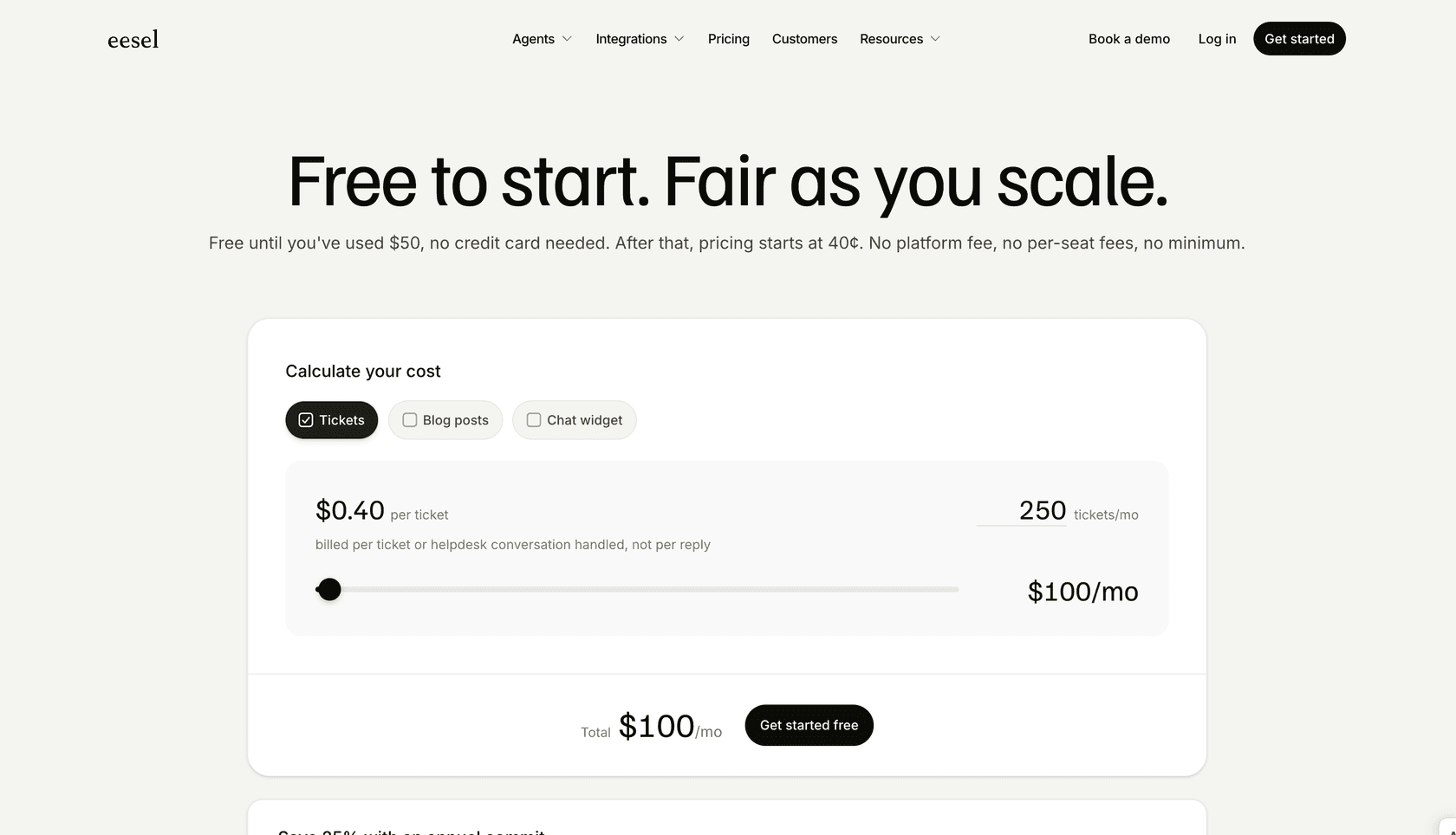
Flat monthly rates starting at $299/month with no surprise charges. You pay for interactions, not resolutions, so your costs are predictable regardless of how many tickets the AI handles.
Simulation mode for safe testing
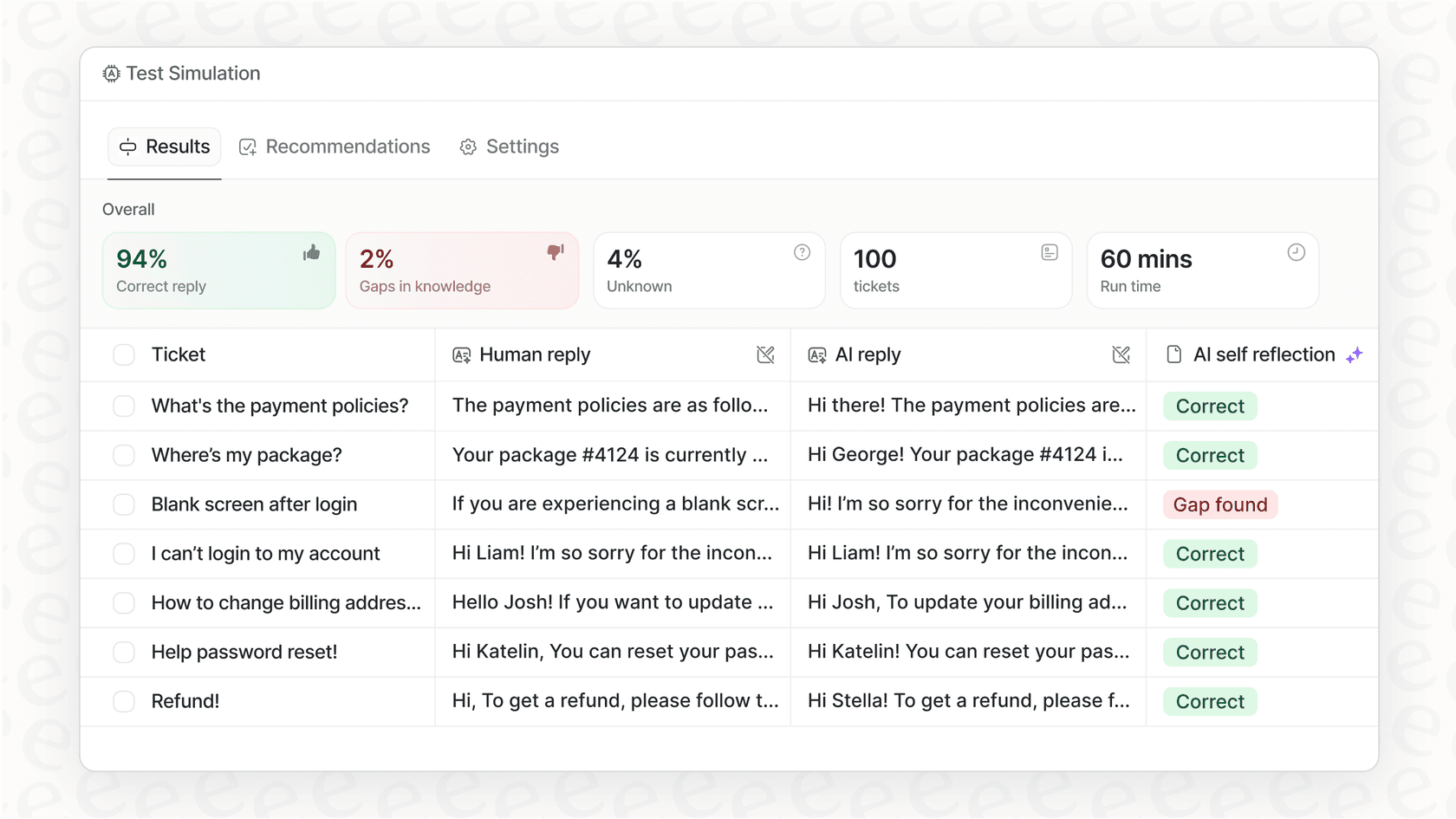
Before going live, you can run simulations on thousands of your past tickets to see exactly how the AI would perform. Measure resolution rates, identify knowledge gaps, and fine-tune responses without risking customer interactions.
Plain-English customization
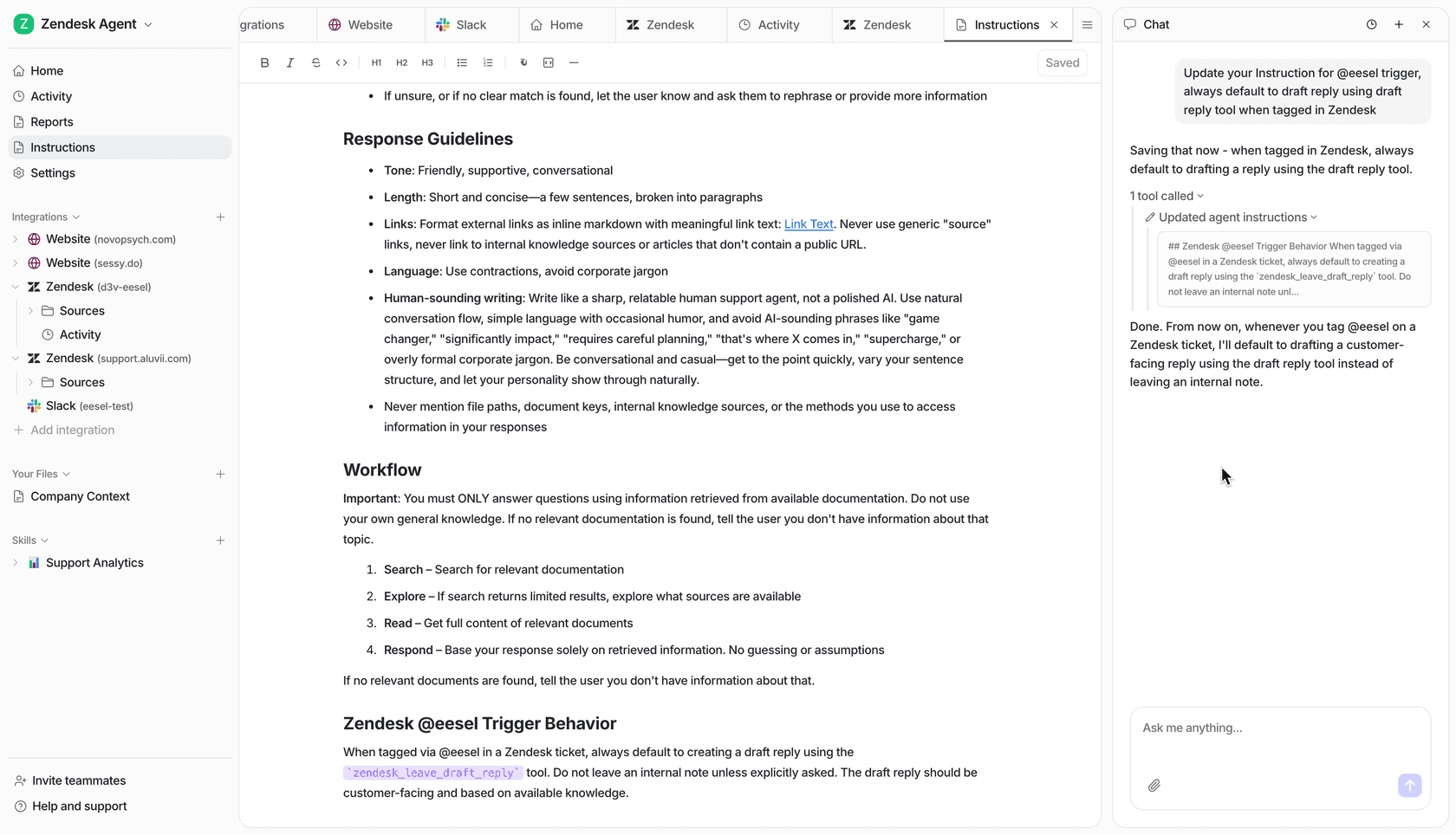
Instead of complex workflow builders, you describe what you want the AI to do in plain text. Want it to handle password resets but escalate billing issues? Just write that. No coding required.
Progressive Rollout Built In
eesel AI is designed to start small and expand as you build confidence:
- Start with guidance: Have the AI draft replies that agents review before sending
- Limit scope: Restrict the AI to specific ticket types or queues
- Expand gradually: As the AI proves itself, increase its autonomy
- Go fully autonomous: Eventually handle full frontline support with human escalation only for edge cases
This approach lets you verify the AI understands your business before it ever touches a real customer conversation.
Results Teams Are Seeing
According to eesel AI's published metrics:
- Up to 81% of support conversations autonomously resolved (mature deployments)
- Typical payback period under 2 months
- 70M+ tickets and chat sessions processed across 1,000+ customer service teams
- $124M+ in savings across customers
Making the right choice for your team
So is ServiceNow Virtual Agent worth it? The answer comes down to your current infrastructure and resources.
Choose ServiceNow Virtual Agent if:
- ServiceNow is already your core platform
- You have the technical resources to implement and maintain it
- You need deep, native integration with ServiceNow workflows
- You can navigate enterprise sales and pricing processes
Choose an alternative like eesel AI if:
- You want AI that works across multiple platforms
- You need to move fast with minimal technical resources
- You prefer transparent, predictable pricing
- You want to test thoroughly before going live
- You don't have dedicated ServiceNow developers on staff
Both platforms can deliver strong ROI, but the path to value differs significantly. ServiceNow Virtual Agent offers deep integration for ServiceNow shops willing to invest in implementation. eesel AI offers broader platform support and faster time-to-value for teams that need results quickly.
If you're curious how eesel AI would perform with your actual tickets, you can try it free for 7 days or book a demo to see it in action.



