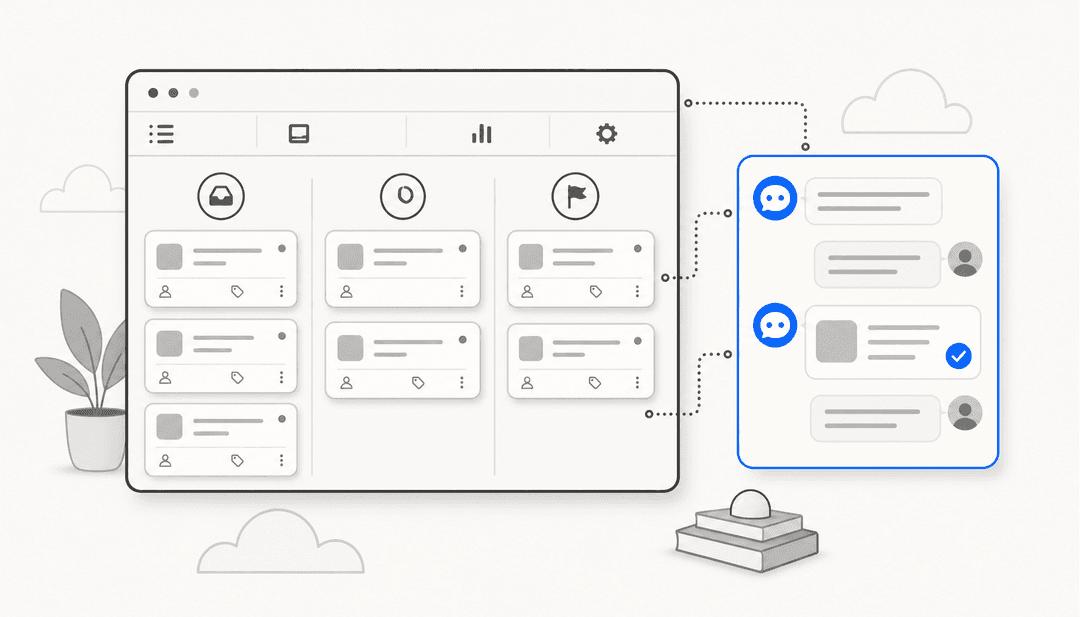
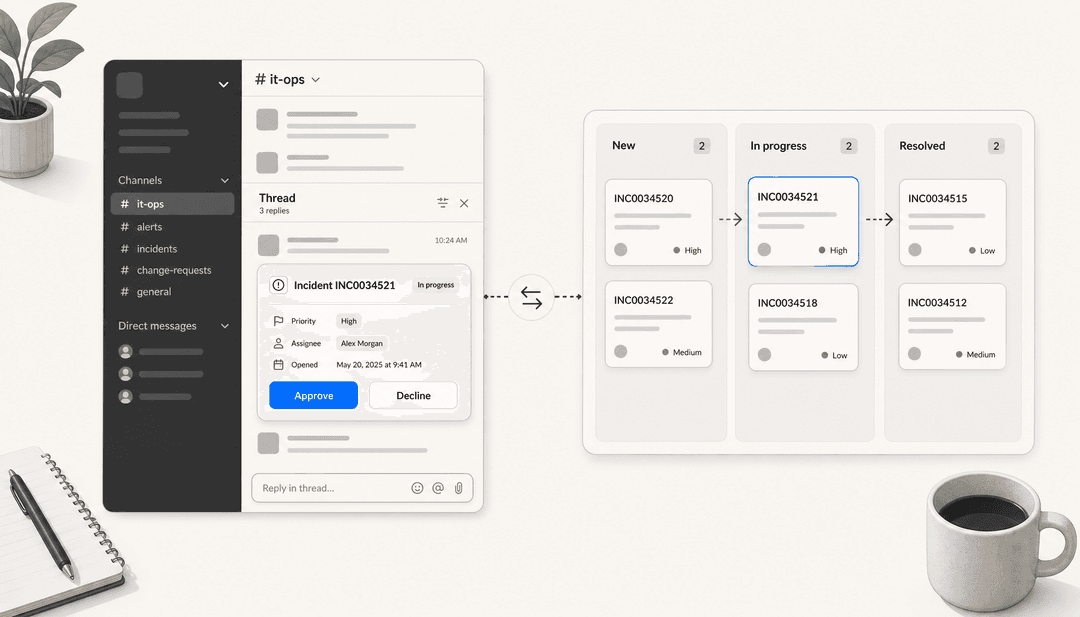
The race to deploy AI agents is accelerating. Gartner predicts 60% of businesses will implement AI agents for customer service by 2026, and enterprise software giants are positioning themselves to capture that demand. Two platforms dominate the conversation: Salesforce Agentforce and ServiceNow AI Agents.
Both promise autonomous AI that handles tasks without constant human oversight. Both integrate with existing enterprise systems. But they approach the problem from fundamentally different angles. Salesforce comes from the CRM world, focused on customer-facing interactions. ServiceNow built its reputation on IT service management, emphasizing internal workflows and governance.
This comparison breaks down how these platforms actually differ, what each does well, and which one fits your specific needs. We'll also look at whether you need an enterprise platform at all, or if a simpler alternative might work better.
What is Salesforce Agentforce?
Salesforce Agentforce is an AI agent platform launched in June 2024, built on top of Salesforce's Einstein 1 platform. It lets businesses create, deploy, and manage autonomous AI agents that handle both customer-facing and internal tasks.
The core idea is simple: agents use your existing Salesforce data to understand context, make decisions, and take action. The Atlas Reasoning Engine breaks down complex requests into smaller tasks, evaluates each step, and proposes execution plans until the job is done.
Key capabilities
- Pre-built agent templates for common roles: Service Agent, Sales Development Rep, Sales Coach, Personal Shopper, Campaign Optimizer
- Agentforce Builder provides a unified workspace for drafting, testing, and deploying agents with AI guidance
- Data 360 integration ingests structured, unstructured, and complex data from any source
- Cross-cloud reasoning works across Sales Cloud, Service Cloud, Marketing Cloud, and Commerce Cloud
- Einstein Trust Layer includes guardrails for data protection, toxicity detection, and zero data retention
Salesforce claims some impressive numbers: 16x faster deployment, 75% higher accuracy, and 7.5x faster model setup compared to DIY solutions. Customer examples include OpenTable, Heathrow Airport, and Indeed.
The platform's strength is its deep integration with Salesforce CRM. If you already live in the Salesforce ecosystem, Agentforce can leverage your customer data, sales pipelines, and service history without complex data migration.
What is ServiceNow AI?
ServiceNow AI Agents launched in March 2024 as part of the broader Now Platform. While Salesforce comes from customer relationship management, ServiceNow built its foundation on IT service management (ITSM). That heritage shapes everything about how their AI agents work.
ServiceNow AI Agents operate on a unified platform with a single data model. The standout feature is the AI Agent Orchestrator, which coordinates teams of specialized agents to work together on complex workflows. Rather than one agent trying to do everything, multiple agents collaborate like a digital workforce.
Key capabilities
- AI Agent Orchestrator guides teams of agents to collaborate on complex tasks
- AI Agent Studio lets you build custom agents using natural language
- AI Control Tower provides centralized governance for all AI assets (including third-party AI)
- AI Agent Fabric enables communication between ServiceNow and external AI agents via A2A protocol
- Workflow Data Fabric connects to 450+ enterprise systems
- Configuration Management Database (CMDB) tracks IT assets and dependencies
ServiceNow powers 80 billion workflows annually for 85% of the Fortune 500. Customer results include Hitachi Vantara (40% reduction in form building time), Griffith University (87% increase in self-service rate), and CANCOM (80% ticket deflection rate).
The platform emphasizes governance and control. AI Control Tower manages risk, compliance, and performance across your entire AI ecosystem. FedRAMP compliance makes it suitable for government and healthcare organizations with strict regulatory requirements.
Feature comparison: Salesforce Agentforce vs ServiceNow AI
| Capability | Salesforce Agentforce | ServiceNow AI |
|---|---|---|
| Build tools | Low-code/pro-code Agentforce Builder with AI guidance | Natural language AI Agent Studio |
| Pre-built agents | Service, SDR, Coach, Shopper, Campaign agents | IT, HR, CRM, Security, App Development agents |
| Orchestration | Cross-cloud reasoning within Salesforce ecosystem | AI Agent Orchestrator for multi-agent teams |
| Data integration | Data 360 for structured/unstructured data | Workflow Data Fabric (450+ systems) |
| Governance | Einstein Trust Layer with guardrails | AI Control Tower for enterprise-wide AI management |
| Deployment speed | Claims 16x faster deployment | Enterprise-wide rollout focus |
| Primary focus | Customer-facing interactions | Internal workflows and ITSM |
| Compliance | SOC 2, GDPR | FedRAMP, enterprise risk management |
The fundamental difference is philosophical. Salesforce wants to enhance customer interactions using rich CRM data. ServiceNow wants to orchestrate complex internal workflows across departments and systems.
Salesforce's Agentforce Script combines deterministic workflows with LLM flexibility, giving you hybrid reasoning that follows business logic while handling nuance. ServiceNow's orchestrator takes a different approach: multiple specialized agents working together, each handling what they do best.
For data, Salesforce emphasizes harmonizing customer data from any source into a unified view. ServiceNow focuses on connecting enterprise systems (450+ integrations) to orchestrate workflows across your existing tech stack.
Pricing and monetization models
Neither platform publishes straightforward pricing. Both operate on enterprise sales models where costs depend on your specific deployment.
Salesforce Agentforce pricing
Salesforce uses a use case-based approach with multiple pricing options:
| Pricing Model | Structure | Best For |
|---|---|---|
| Foundations | Free to get started | Testing and small deployments |
| Flex Credits | Consumption-based credits | Variable usage patterns |
| Conversations | Per-conversation pricing | Customer-facing agents |
| Per-User Licensing | Per-seat model | Employee-facing agents |
Source: Salesforce Agentforce Pricing
The key thing to understand: you'll need to contact sales for actual numbers. Pricing scales based on which agents you deploy, how complex they are, and your usage volume. Organizations with existing Salesforce contracts may have different pricing structures than new customers.
ServiceNow AI pricing
ServiceNow takes a different approach. AI capabilities are embedded in the platform and priced through enterprise agreements:
| Component | Pricing Approach |
|---|---|
| AI Agents | Included in platform subscription |
| AI Control Tower | Contact sales for package pricing |
| Enterprise-wide access | User-based licensing model |
Source: ServiceNow AI Control Tower
ServiceNow's model emphasizes predictable costs for enterprise-wide deployment. Rather than paying per agent or per conversation, you get broad access across your organization. The trade-off is less granularity in controlling costs for specific use cases.
Total cost considerations
Both platforms have hidden costs beyond the base price:
- Implementation and integration work to connect existing systems
- Developer resources for customization beyond out-of-the-box capabilities
- Training and change management to get teams using the new tools
- Ongoing administration to manage agents, guardrails, and performance
Salesforce claims faster time-to-value with pre-built templates. ServiceNow emphasizes governance and control that may require more upfront configuration but reduces risk at scale.
Use cases: When to choose each platform
Choose Salesforce Agentforce if:
-
You're heavily invested in Salesforce CRM. The integration is seamless, and agents can leverage your existing customer data, sales pipelines, and service history.
-
Customer-facing use cases are your priority. Pre-built agents for service, sales, and commerce are ready to deploy.
-
You need a unified customer 360 view. Data 360 harmonizes information from multiple sources into a single customer profile.
-
Sales, marketing, and service alignment matters. Cross-cloud reasoning works across departments that already use Salesforce.
-
You want pre-built industry templates. Salesforce offers specialized agents for healthcare, banking, retail, and other verticals.
Choose ServiceNow AI if:
-
IT Service Management is your core need. ServiceNow's heritage in ITSM means robust incident management, request fulfillment, and IT operations automation.
-
You're already on the ServiceNow platform. AI agents leverage your existing workflows, CMDB, and integrations.
-
Employee self-service and HR workflows are priorities. AI agents handle onboarding, policy questions, and benefits support.
-
You need CMDB and IT asset management. The Configuration Management Database provides a single source of truth for IT infrastructure.
-
Government or healthcare compliance is required. FedRAMP compliance and built-in risk management meet strict regulatory standards.
-
You want to orchestrate complex multi-agent workflows. The AI Agent Orchestrator coordinates specialized agents working together.
Implementation and deployment considerations
Salesforce claims you can deploy agents in weeks rather than months. Their Agentforce Builder includes AI guidance that helps you configure agents from natural language instructions. Pre-built templates reduce the work needed for common use cases.
ServiceNow focuses on enterprise-wide transformation. The AI Agent Studio uses natural language for agent creation, but the platform emphasizes governance and control from day one. This can mean more upfront configuration, but also more confidence when scaling across the organization.
Both platforms require integration work. Salesforce connects through MuleSoft APIs and the AppExchange ecosystem. ServiceNow uses Workflow Data Fabric to connect 450+ systems.
Developer resources depend on your customization needs. Both offer low-code tools for basic deployments, but complex workflows may require pro-code development. Salesforce uses Apex and JavaScript; ServiceNow uses scripts, flows, and subflows.
Training and adoption are often underestimated. Your teams need to learn how to work alongside AI agents, when to trust them, and when to escalate to humans. Both platforms provide supervision tools, but the cultural shift takes time regardless of technology.
A simpler alternative for mid-market teams
Enterprise AI platforms like Salesforce Agentforce and ServiceNow AI are powerful, but they're not the only option. For many teams, especially mid-market companies without dedicated AI engineering resources, these platforms can be overkill.
eesel AI offers an alternative approach. Instead of a platform you configure, think of it as an AI teammate you hire and level up over time.
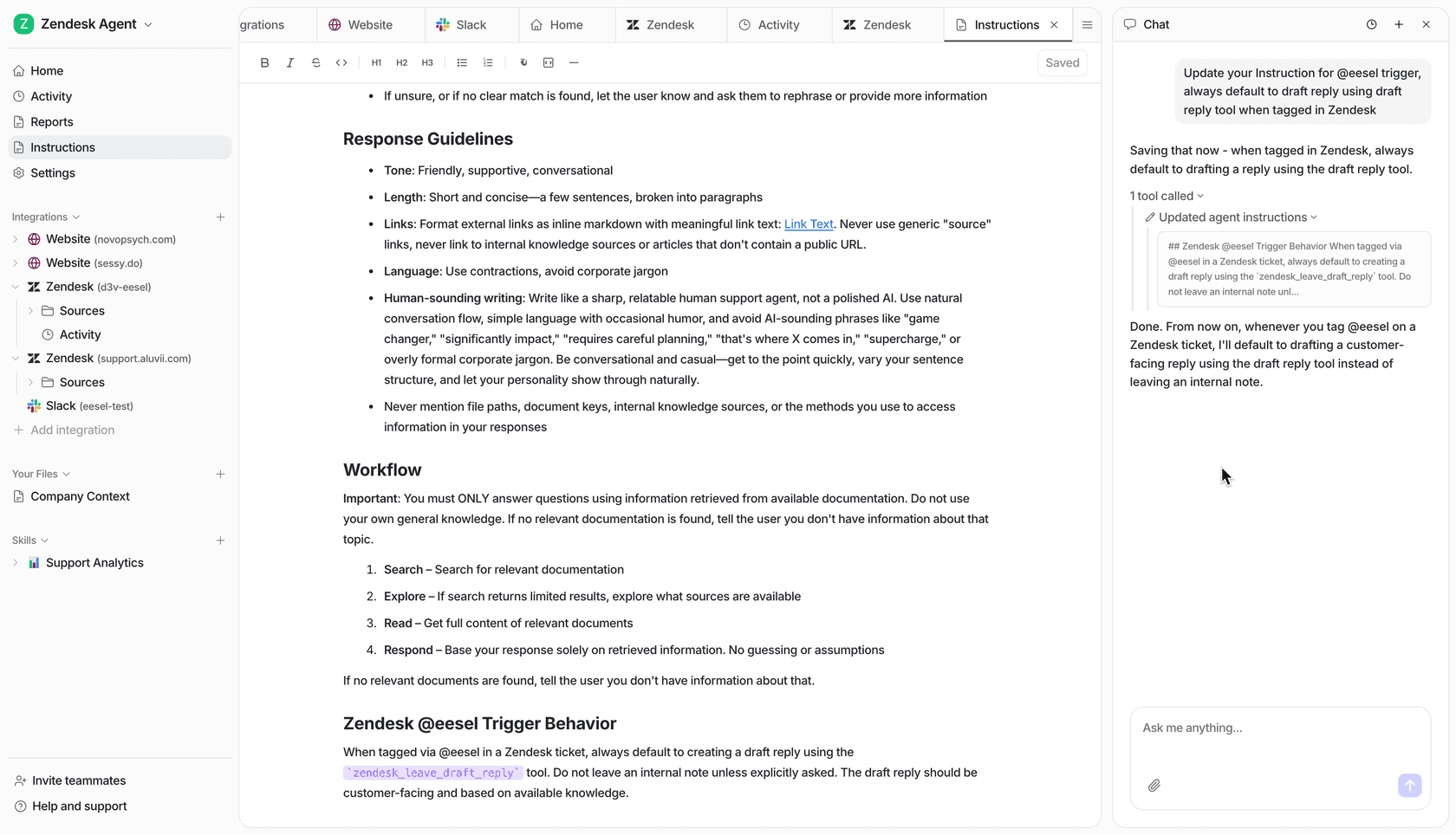
Here's how it differs:
-
Minutes to deploy, not weeks. Connect eesel to your help desk (Zendesk, Freshdesk, Gorgias) and it learns from your past tickets and help center immediately. No complex configuration or developer resources needed.
-
Works alongside your existing tools. You don't replace your help desk. eesel integrates with what you already use.
-
Progressive rollout. Start with eesel drafting replies for human review. As it proves itself, level up to full autonomy. You control the pace based on actual performance.
-
Pay per interaction, not per seat. Pricing scales with usage, not headcount. The Team plan starts at $299/month for 1,000 interactions.
-
Plain-English instructions. Define escalation rules and behavior in natural language. "Always escalate billing disputes to a human." No code required.
If you're evaluating Salesforce Agentforce or ServiceNow AI but worried about implementation complexity, try eesel AI as a lighter alternative. You can be up and running in minutes, not months.
Making the right choice for your business
Choosing between Salesforce Agentforce and ServiceNow AI comes down to three questions:
-
What is your existing tech stack? If you live in Salesforce, Agentforce is the natural choice. If ServiceNow runs your IT operations, their AI agents fit seamlessly.
-
What is your primary use case? Customer-facing interactions favor Salesforce. Internal workflows and ITSM favor ServiceNow.
-
What resources do you have? Both platforms require implementation effort, ongoing administration, and change management. Be realistic about your team's capacity.
For large enterprises with dedicated AI teams and complex multi-system environments, these platforms deliver serious capability. For mid-market teams that want AI benefits without enterprise complexity, lighter alternatives exist.
The key is matching the tool to your actual needs, not just buying the most powerful option available. An AI agent that handles 80% of your tier-1 support tickets reliably is more valuable than one that promises 99% capability but takes six months to deploy.