
SaaS companies face a unique support challenge. As your user base grows, so does the volume of questions, technical issues, and feature requests hitting your support queue. You need a system that scales without requiring you to hire an army of agents. Salesforce Service Cloud AI offers one approach.
Salesforce has evolved far beyond its CRM roots. Today, its Service Cloud platform offers AI-powered support capabilities designed to handle everything from routine inquiries to complex technical issues. For SaaS companies dealing with subscription management, feature adoption, and technical troubleshooting, the right support platform can mean the difference between a team that struggles and one that scales effectively.
In this guide, I'll break down what Salesforce Service Cloud AI actually does, how much it costs, and whether it makes sense for your SaaS business. I'll also look at how our AI agent solution offers a simpler alternative for teams that want powerful AI support without enterprise complexity.
What is Salesforce Service Cloud AI?
Salesforce Service Cloud is a customer service platform that combines traditional case management with advanced AI capabilities. Think of it as a command center where all your customer interactions live, from emails and chats to social media mentions and phone calls.
The AI component has evolved significantly since Salesforce first introduced Einstein in 2016. Here's the progression:
- 2016: Predictive AI for forecasting and lead scoring
- 2023: Generative AI with the Trust Layer for secure content creation
- 2024: Agentforce, moving from assistants to autonomous agents
- Present: The Agentic Enterprise, with over 11 trillion LLM tokens processed
For SaaS companies, this means you get three types of AI working together. Predictive AI spots patterns, like which customers might churn based on their support history. Generative AI drafts responses and summarizes conversations. Agentic AI (through Agentforce) actually takes action autonomously, resolving tickets without human intervention.

The platform integrates with your existing Salesforce data, so if you're already using Sales Cloud or Marketing Cloud, Service Cloud AI can tap into that customer history. It also connects to external data sources through Data Cloud, giving the AI a complete picture of each customer.
Key AI features for SaaS customer support
Here's what you actually get when you implement Salesforce Service Cloud AI. The capabilities break down into several categories, each addressing different parts of the support workflow.
Agentforce for Service
Agentforce is Salesforce's autonomous AI agent platform. Unlike basic chatbots that follow scripts, these agents can reason through problems and take actions on their own.
For SaaS companies, this translates to:
- 24/7 coverage across voice, SMS, WhatsApp, Apple Messages, Facebook Messenger, and web chat
- Multilingual support with local formatting for dates, currency, and numbers
- Autonomous resolution of routine issues like password resets, account lookups, and basic troubleshooting
Salesforce reports that Agentforce handles 85% of customer queries without human intervention and reduces response times by 65% for 90% of users. For a SaaS company with global users, this means your customers get instant help at 3 AM without you staffing overnight shifts.
The Atlas Reasoning Engine powers these agents. It breaks down customer requests into smaller tasks, evaluates each step, and proposes a plan to resolve the issue. If it hits something outside its scope, it escalates to a human agent with full context.
Einstein AI capabilities
Before Agentforce, there was Einstein. These AI features still exist and complement the newer agentic capabilities:
-
Einstein Bots: Handle routine inquiries through conversational interfaces. You can deploy these across channels with natural language understanding that handles 80+ languages.
-
Einstein Case Classification: Automatically categorizes and routes incoming tickets based on their content. This means technical issues go straight to your engineering-savvy agents while billing questions hit your finance team.
-
Einstein Article Recommendations: Suggests relevant knowledge base articles to agents based on case details. Instead of searching, agents get the right resource surfaced automatically.
-
Einstein Reply Recommendations: Analyzes past successful resolutions to suggest the best responses. Agents can send with one click or edit before sending.

Service Rep Assistant
This feature creates dynamic action plans for agents based on incoming case data. For SaaS support, this is particularly useful when dealing with complex technical issues.
The assistant considers:
- Customer engagement history
- Past similar cases and their resolutions
- Your company's knowledge base
- Company policies and procedures
It then generates step-by-step guidance for the agent, ensuring consistent service quality even when handling unfamiliar issues. This accelerates agent onboarding since new hires get AI guidance rather than relying solely on training materials.
Knowledge management
SaaS companies live or die by documentation. Salesforce's AI-powered knowledge features help you make the most of yours:
- AI-powered Search Answers: Grounds responses in your trusted knowledge base, displaying answers directly in the service console or customer self-service portal
- Auto-generated knowledge articles: Summarizes resolved support interactions and drafts new articles for your knowledge base
- Self-service portals: Let customers find answers without creating tickets
The system learns from every interaction. When an agent edits an AI-suggested response, that feedback improves future recommendations.
Salesforce Service Cloud pricing for SaaS teams
Pricing is where things get complicated. Salesforce uses a tiered model with multiple add-ons, and the AI capabilities come at a premium.
Service Cloud base pricing
| Plan | Price per user/month | Best for |
|---|---|---|
| Essentials | $25 | Small teams (up to 5 users) |
| Professional | $75 | Growing teams needing more robust CRM |
| Enterprise | $150 | Larger companies requiring customization |
| Unlimited | $300 | Enterprises needing unlimited features and sandbox testing |
Source: Assembled.com analysis
Agentforce pricing
To get the AI capabilities we've discussed, you need Agentforce for Service:
| Plan | Price | Key inclusions |
|---|---|---|
| Agentforce for Service | $125/user/month (billed annually) | Unmetered Employee Agent, generative replies, conversation summaries, knowledge creation, search answers, case classification, reply recommendations, customer signals intelligence |
Source: Salesforce Service AI Pricing
Regional pricing variations:
- EUR: 125€/user/month
- AUD: AU$175/user/month
- JPY: 15,000円/user/month
- GBP: £100/user/month
What's included at the Agentforce tier
| Feature | Allocation |
|---|---|
| Agentforce for Service | Unmetered Employee Agent capacity |
| Service Replies | Included |
| Conversation Summaries | Included |
| Knowledge Creation | Included |
| Search Answers (Agents + Customers) | Included |
| Next Best Action | Unmetered requests per user |
| Case Classification | Unmetered per user, 5 data segments per org |
| Case Routing | 2,000 routing predictions per user/month |
| Case Wrap-Up | Unmetered per user, 5 data segments per org |
| Reply Recommendations | Unmetered per user |
| Customer Signals Intelligence | Access to prebuilt dashboards |
Success plans (support tiers)
| Plan | Cost | What's included |
|---|---|---|
| Standard Success | Included with all licenses | Knowledge articles, documentation, Trailhead access, community |
| Premier Success | 30% of net license fees | Expert guidance, health checks, 24/7 support for critical issues |
| Signature Success | Contact sales | Dedicated Customer Success Manager, proactive monitoring, fastest response times |
The real cost for SaaS companies
If you're a SaaS company with 20 support agents, here's what you're looking at:
- Base Service Cloud (Enterprise): $150 × 20 = $3,000/month
- Agentforce for Service: $125 × 20 = $2,500/month
- Total: $5,500/month ($66,000/year)
That's before add-ons like Premier Success, additional Data Cloud credits, or custom integrations. For comparison, our pricing at eesel AI starts at $299/month for up to 3 bots and 1,000 interactions, with no per-seat fees.
Salesforce offers a 30-day free trial with no credit card required, which is worth exploring if you're evaluating options.
SaaS use cases and benefits
Let's get specific about how SaaS companies actually use these features.
User onboarding support
The first 30 days determine whether a customer stays or churns. Salesforce AI can:
- Automatically answer common setup questions
- Guide users through initial configuration with step-by-step instructions
- Proactively reach out when users get stuck (detected by inactivity or repeated failed actions)
- Route complex onboarding issues to customer success managers
A SaaS company with a complex product can deflect 60-70% of onboarding questions to AI, letting human agents focus on high-touch strategic accounts.
Technical issue resolution
When your app breaks or a feature isn't working, customers expect fast answers. Here's how the AI helps:
- Intelligent routing: Technical tickets automatically go to agents with the right skills
- Knowledge base suggestions: Agents see relevant troubleshooting articles without searching
- Swarming: For complex issues, the system can spin up a Slack channel with experts from engineering, product, and support
- Incident detection: Monitors for patterns that indicate widespread issues before customers report them
The Service Console gives agents a unified view of the customer's environment, subscription tier, and past issues, so they don't waste time asking for information the customer already provided.
Churn prevention
Predictive AI analyzes customer behavior to flag at-risk accounts:
- Declining product usage
- Increased support ticket volume (often a frustration signal)
- Negative sentiment in conversations
- Failed payment patterns
When the AI spots these signals, it can trigger proactive outreach, offer training resources, or escalate to a retention specialist.
Feature adoption
SaaS companies constantly launch new features. AI support helps drive adoption:
- Answers "how do I" questions about new functionality
- Suggests relevant features based on customer usage patterns
- Reduces support burden during major product launches
Key benefits summary
Salesforce publishes several metrics around their AI capabilities:
- 85% of customer queries handled without human intervention
- 65% reduction in response times for 90% of users
- 1M+ support requests solved by Agentforce (Salesforce's own deployment)
For SaaS companies, the main benefits are:
- Scale support without linear headcount growth
- Consistent 24/7 coverage across time zones
- Faster resolution times improving customer satisfaction
- Centralized data for better decision-making
Implementation considerations for SaaS companies
Salesforce Service Cloud AI is powerful, but it's not plug-and-play. Here's what you need to know before committing.
Setup complexity and timeline
Implementing Service Cloud AI typically takes 3-6 months for a mid-sized SaaS company. The process involves:
- Data migration: Moving existing tickets, customer data, and knowledge base content
- Integration: Connecting to your product, billing system, and other tools
- AI training: Configuring Agentforce with your specific business logic and tone
- Testing: Running simulations before going live
- Agent training: Getting your team comfortable with the new tools
This isn't a weekend project. You'll need dedicated technical resources or budget for Salesforce's Professional Services.
Integration requirements
Salesforce connects to most major tools, but integrations vary in complexity:
- Native integrations: Slack, Tableau, MuleSoft (Salesforce-owned products work seamlessly)
- AppExchange: Thousands of pre-built connectors for common SaaS tools
- Custom APIs: For proprietary systems, you'll need development work
The Data Cloud integration is critical for AI performance. Without unified data, the AI lacks context and gives generic responses. This means you need clean, structured data across all your systems.
When Salesforce makes sense
Salesforce Service Cloud AI is worth considering if:
- You have 50+ support agents and complex routing needs
- You're already invested in the Salesforce ecosystem
- You need enterprise-grade security and compliance (SOC 2, HIPAA, GDPR)
- You have the budget for both licensing and implementation services
- You need true omnichannel support (phone, email, chat, social, messaging)
When it might be overkill
Consider alternatives if:
- You have fewer than 20 support agents
- Your support needs are primarily email and chat (no phone)
- You want to get started quickly without a 6-month implementation
- Per-seat pricing would break your budget at scale
- You don't have dedicated technical resources for setup
Our team at eesel AI has worked with dozens of SaaS companies in this position. Many find they can get 80% of the value with 20% of the complexity using a more focused AI solution.
Salesforce Service Cloud AI alternatives
Salesforce isn't the only option for AI-powered SaaS support. Depending on your needs, several alternatives might fit better.
eesel AI: A simpler approach
We built eesel AI specifically for SaaS companies that want powerful AI support without enterprise complexity. Here's how we differ:
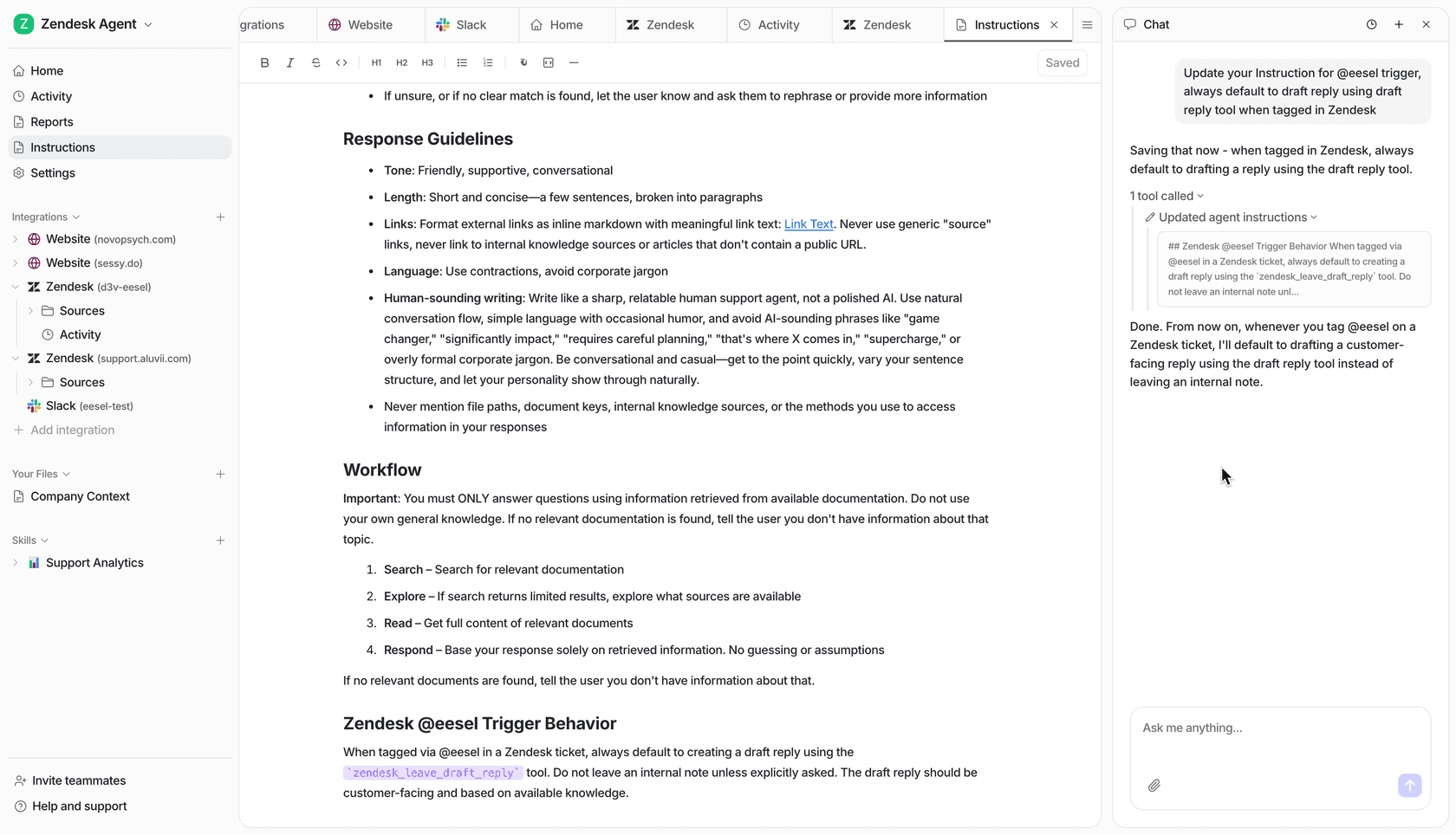
Setup time: Minutes, not months. Connect your help desk, and eesel learns from your existing tickets and documentation immediately.
Pricing: Pay per interaction, not per seat. Our Team plan starts at $299/month for up to 3 bots and 1,000 interactions. No per-agent fees means your costs don't explode as you grow.
Teammate model: Instead of configuring workflows, you "hire" eesel as a teammate. Start with AI drafting replies for review, then level up to autonomous responses as eesel proves itself.
Integrations: We connect to Zendesk, Freshdesk, Intercom, Gorgias, Slack, and 100+ other tools. Check our integrations page for the full list.
Progressive rollout: Run simulations on past tickets before going live. See exactly how eesel would respond, measure quality, and gain confidence before customers see it.
When to consider each option
| Factor | Choose Salesforce if... | Choose eesel AI if... |
|---|---|---|
| Team size | 50+ agents | 5-50 agents |
| Timeline | 3-6 months acceptable | Want to launch this week |
| Budget | $5,000+/month for AI | $300-800/month range |
| Complexity | Need phone, field service, complex routing | Email, chat, and self-service |
| Existing stack | Heavy Salesforce investment | Mix of best-of-breed tools |
Other alternatives
- Zendesk AI: Good if you're already on Zendesk, though advanced AI features require higher-tier plans
- Freshdesk Freddy AI: Budget-friendly option with basic AI capabilities
The right choice depends on your specific needs, existing tools, and growth stage. For a deeper comparison of AI help desk options, see our guide to best AI help desk software.
Getting started with AI-powered SaaS support
If you're considering Salesforce Service Cloud AI for your SaaS company, here's a practical path forward.
Evaluation steps
-
Audit your current support: How many tickets do you handle monthly? What's your average resolution time? Where do agents spend most of their time?
-
Define your goals: Are you trying to reduce costs, improve response times, or scale without hiring? Different goals lead to different solutions.
-
Calculate true costs: Include licensing, implementation services, training, and ongoing administration. Salesforce's sticker price is just the beginning.
-
Run a pilot: Salesforce offers a 30-day trial. Use it to test with a subset of your tickets before committing.
-
Compare alternatives: Evaluate 2-3 solutions against your specific use cases. Don't just compare feature lists; test actual workflows.
Starting with a pilot program
Whether you choose Salesforce or an alternative, start small:
- Pick one support channel (usually email or chat)
- Train the AI on your most common 20-30 ticket types
- Run parallel for 2-4 weeks, comparing AI responses to human responses
- Gradually expand scope as confidence builds
This approach minimizes risk and gives you real data to evaluate effectiveness.
How we can help
At eesel AI, we specialize in helping SaaS companies implement AI support that actually works. Our approach is different:
- No lengthy implementation: Connect your help desk and start seeing AI drafts within minutes
- Transparent pricing: Pay for interactions, not seats. Scale without surprise costs
- Progressive autonomy: Start with AI assistance, level up to full automation as it proves itself
- Built for SaaS: We understand subscription businesses, feature launches, and the unique challenges you face
If Salesforce's complexity and cost feel like overkill for your stage, try eesel free and see how quickly you can get AI handling your support. Most teams are up and running in under an hour.




