Staying current with Zendesk updates feels like trying to drink from a fire hose. The platform releases new features, fixes, and improvements every single week. Miss something important and you might find your team scrambling to catch up. But spend too much time tracking every minor update and you'll never get any actual work done.
This guide breaks down how to stay on top of Zendesk SaaS release notes without letting them consume your week. We'll cover where to find them, how to prioritize what matters, and what the latest AI features mean for your support operations.
Why Zendesk SaaS release notes matter for your team
Here's the short version: missing a critical update can break your workflows, while staying informed gives you a competitive edge.
Zendesk's weekly release cadence means something changes every Friday. Sometimes it's a minor bug fix you'll never notice. Other times it's a major feature that could transform how your team handles tickets. The challenge is telling the difference without spending hours reading through every update.
The cost of missing updates varies:
- Security patches Critical fixes that protect customer data
- API changes Breaking changes that can break your integrations
- New AI features Capabilities that could automate hours of manual work
- Deprecation notices Features being phased out that you need to migrate away from
Support teams using eesel AI alongside Zendesk often tell us they appreciate having a teammate that learns from their existing setup. Instead of manually tracking every platform change, they can focus on what matters: serving customers.
Understanding Zendesk's release cadence
Zendesk publishes release notes every Friday. This predictable schedule helps, but the volume of information can still feel overwhelming.
Where to find official Zendesk SaaS release notes
The primary source is support.zendesk.com. Release notes are organized by week and broken down by product area:
- Admin Center
- Support
- Voice
- Copilot
- AI Agents and Knowledge
- Messaging and live chat
- Analytics
- App Marketplace
- Zendesk QA
- Workforce Management
Each section lists what's new, what's fixed, and which products had no updates that week.
Different types of releases
Not all updates are created equal. Understanding the categories helps you prioritize:
Product updates Changes to core Zendesk functionality that affect how agents work day-to-day. These usually appear in the main release notes.
SDK releases Updates for developers building on Zendesk's platform. These live in the developer documentation and follow semantic versioning.
App Marketplace additions New integrations and apps that extend Zendesk's capabilities. The marketplace sees 15-20 new apps monthly.
EAP (Early Access Program) features Beta features available to select customers. These are marked clearly in release notes but may change before general availability.
For teams using eesel AI's Zendesk integration, platform changes get surfaced automatically. The AI learns your workflows and flags updates that might affect how you work.
Recent highlights from Zendesk SaaS release notes (Feb 2026)
February 2026 saw significant AI-focused updates. Here's what actually matters for support teams:
Copilot enhancements
Zendesk Copilot got two notable updates:
Auto-assist improvements Copilot can now execute selected custom actions without requiring agent approval. For teams using action flows, this removes a click and speeds up common workflows.
Capped capabilities for Professional plans Zendesk introduced limited Copilot features for Suite, Support, and Employee Services Professional plans at no extra cost. Each agent gets five uses of the generative AI writing tools per month. It's a taste of Copilot's capabilities, though heavy users will still need the full add-on.
AI Agents and Knowledge improvements
The AI Agents product line saw several meaningful updates:
RAG engine upgrade The Knowledge agent now runs on the latest version of Zendesk's retrieval-augmented generation engine. Response latency is faster and answer accuracy has improved.
Voice AI Agents EAP Perhaps the biggest news: Zendesk Voice now supports AI Agents in Early Access. This enables end-to-end phone support automation with human-like, real-time conversations. The system handles greeting, intent capture, triage, resolution, and wrap-up while preserving context for seamless handoff to live agents.
Procedure builder enhancements You can now link between procedures or from a procedure to a dialogue. Session variables can be shared across agents to maintain conversational context.
Improved conversation logs Logs now display the plan, reasoning, and knowledge sources behind each response. This gives administrators better visibility into how the AI makes decisions.
App Marketplace updates
February added over 20 new apps to the marketplace. Notable additions include:
- InDesk AI Automation platform with predictive intelligence and automated workflows
- commercetools by neteleven E-commerce integration showing customer orders in the ticket sidebar
- Smart Amazon Connect Contact Centre Voice integration for handling calls within Zendesk
- Fields Director FREE Ticket field management for administrators
When evaluating new marketplace apps, consider:
- Does it solve a specific problem you actually have?
- What's the ongoing cost (many are paid apps)?
- How well maintained is it (check reviews and update history)?
- Does it introduce any security or compliance concerns?
Best practices for tracking SaaS release notes
You don't need to read every word of every update. What you need is a system that surfaces what matters to your team.
Set up a systematic review process
Assign ownership Designate one person to monitor release notes weekly. This prevents the "I thought someone else was watching" problem. Rotate the responsibility monthly to prevent burnout.
Schedule calendar blocks Block 30 minutes every Friday afternoon for release note review. Friday works well because notes are published that day, and it lets you plan for the week ahead.
Create internal summaries The person reviewing should distill updates into a brief internal summary. Focus on:
- Security fixes (action required)
- Features relevant to your plan tier
- Changes affecting your integrations
- AI features that might improve your workflows
Share this summary via Slack, email, or your team wiki.
Use integration and monitoring tools
Slack notifications Set up a channel for platform updates. Many teams use RSS feeds or Zapier to pipe release notes into Slack automatically.
RSS feeds Subscribe to the release notes RSS feed for automated delivery to your feed reader or notification system.
AI-powered monitoring Tools like eesel AI can monitor your connected platforms and surface relevant updates in natural language. Instead of reading raw release notes, you can ask "What changed in Zendesk this week that affects ticket routing?" and get a contextual answer.
Prioritize what matters
Not every update deserves your attention. Use this framework:
Must know immediately:
- Security patches
- API breaking changes
- Features being deprecated
Good to know this week:
- New features in your plan tier
- Improvements to tools you use daily
- App Marketplace additions that solve known problems
Can wait:
- Updates to products you don't use
- EAP features (unless you're in the program)
- Minor UI tweaks
Check your plan tier Many AI features require specific plans or add-ons. Professional plans get capped Copilot capabilities. Voice AI Agents require the AI Agents Advanced add-on. Don't waste time researching features you can't access.
What Zendesk's AI push means for support teams
Zendesk is clearly betting big on AI. The February releases show a platform shifting from assisted support to increasingly autonomous capabilities.
The shift toward agentic AI
Traditional AI tools helped agents work faster. The new direction is AI that handles entire interactions end-to-end. Voice AI Agents can now:
- Greet callers and capture intent
- Triage issues automatically
- Resolve common problems without human intervention
- Escalate complex issues with full context preserved
This isn't just about efficiency. It's about extending support hours without extending headcount.
How Copilot and AI Agents work together
Think of the relationship this way: Copilot assists your human agents, while AI Agents work independently on the front line.
Copilot drafts responses, suggests next actions, and automates repetitive tasks. AI Agents handle the initial customer interaction, only escalating when they hit something they can't solve.
Together, they create a tiered system where simple issues get resolved instantly and human agents focus on complex problems that actually need their expertise.
Preparing your team for AI-assisted workflows
Rolling out AI features requires more than just flipping a switch. Teams that succeed:
- Start with specific use cases rather than turning everything on at once
- Train agents on how to work alongside AI (reviewing drafts, handling escalations)
- Set clear escalation rules so the AI knows when to hand off
- Monitor quality continuously and provide feedback to improve the system
Native AI vs. specialized AI teammates
Zendesk's native AI is convenient because it's built in. But it has limitations:
- It only knows what's in your Zendesk instance
- It can't take actions in other systems (Shopify, Salesforce, etc.)
- You're limited to Zendesk's roadmap and release schedule
Specialized AI teammates like eesel AI take a different approach. They plug into Zendesk but also connect to your other tools. They learn from your past tickets, help center, macros, and connected documentation. You can run simulations on past tickets to verify quality before going live, and you control the pace of adoption from drafting to full autonomy.
The choice depends on your needs. If you want simple, built-in assistance, Zendesk's native AI works well. If you need deeper integration across your tech stack or more control over the AI's behavior, a specialized teammate might serve you better.
Stay ahead of platform changes with the right teammate
Tracking release notes across all your tools is a part-time job. Most support teams use five or more platforms daily. Keeping up with updates for each one is nearly impossible.
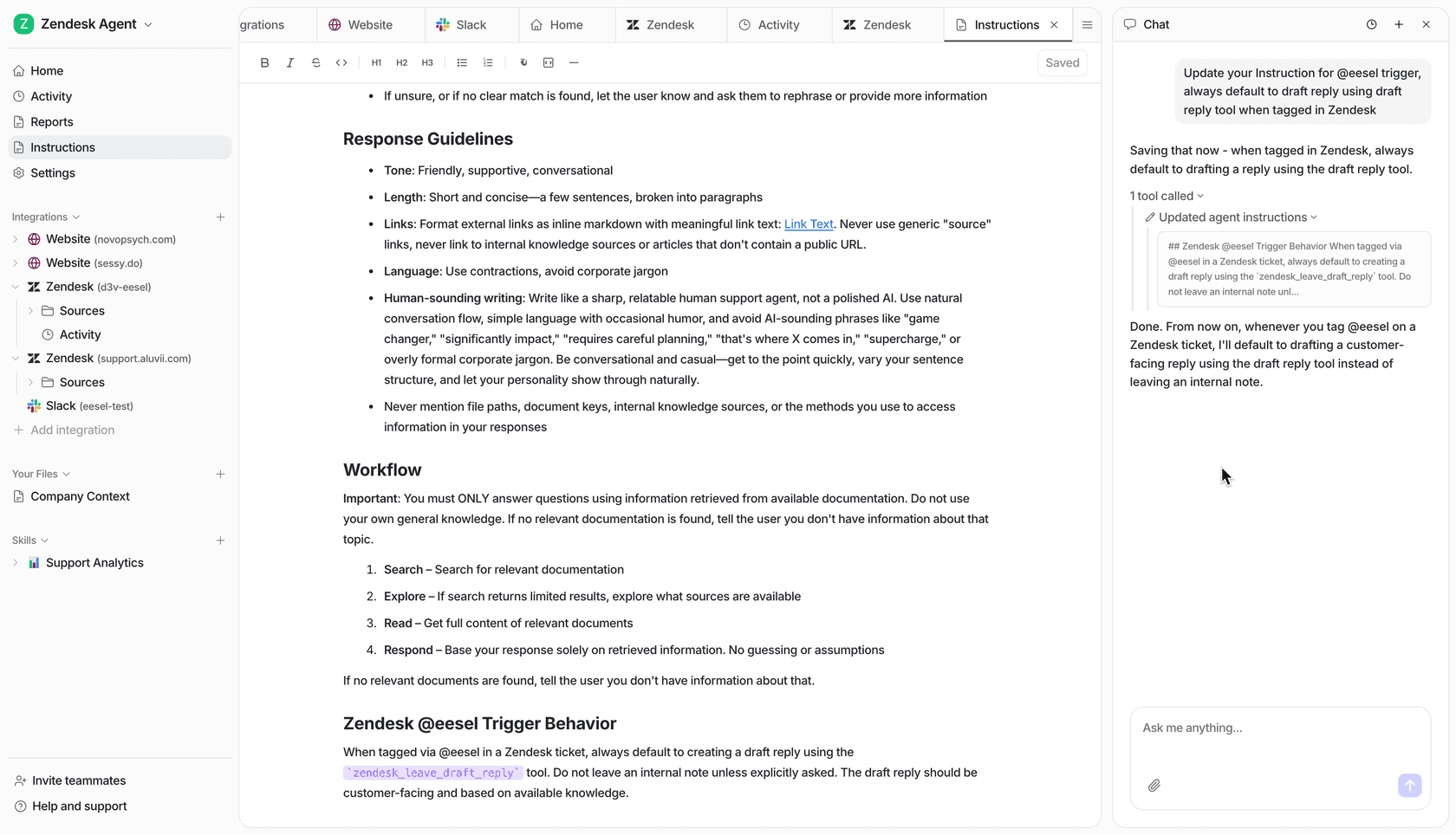
This is where having an AI teammate changes the game. Instead of manually monitoring Zendesk, Slack, Salesforce, and your other tools, you can have a system that learns your business and surfaces what matters.
With eesel AI, you connect your help desk and the AI learns from your existing data immediately. It understands your tone, policies, and common issues from day one. You can run simulations on past tickets to verify quality before going live. Start with the AI drafting replies for review, then expand to autonomous responses as confidence grows.
The best part? You define escalation rules in plain English. "Always escalate billing disputes to a human." "For VIP customers, CC the account manager." No code required.
If you're tired of playing catch-up with platform updates and want a teammate that learns your business instead of requiring constant configuration, try eesel AI or book a demo to see how it works with your existing setup.