SaaS companies face a unique challenge: their customers expect consumer-grade support experiences for complex, technical products. When your software powers someone's business, a delayed response or incomplete answer doesn't just frustrate them, it costs them money.
This is where dedicated customer service platforms come in. Zendesk has positioned itself as the go-to solution for companies needing to scale support without scaling headcount proportionally. But is it the right fit for your SaaS business?
Here's what Zendesk offers, how much it actually costs, and when you might want to consider alternatives like our AI-powered support platform at eesel AI.
What is Zendesk?
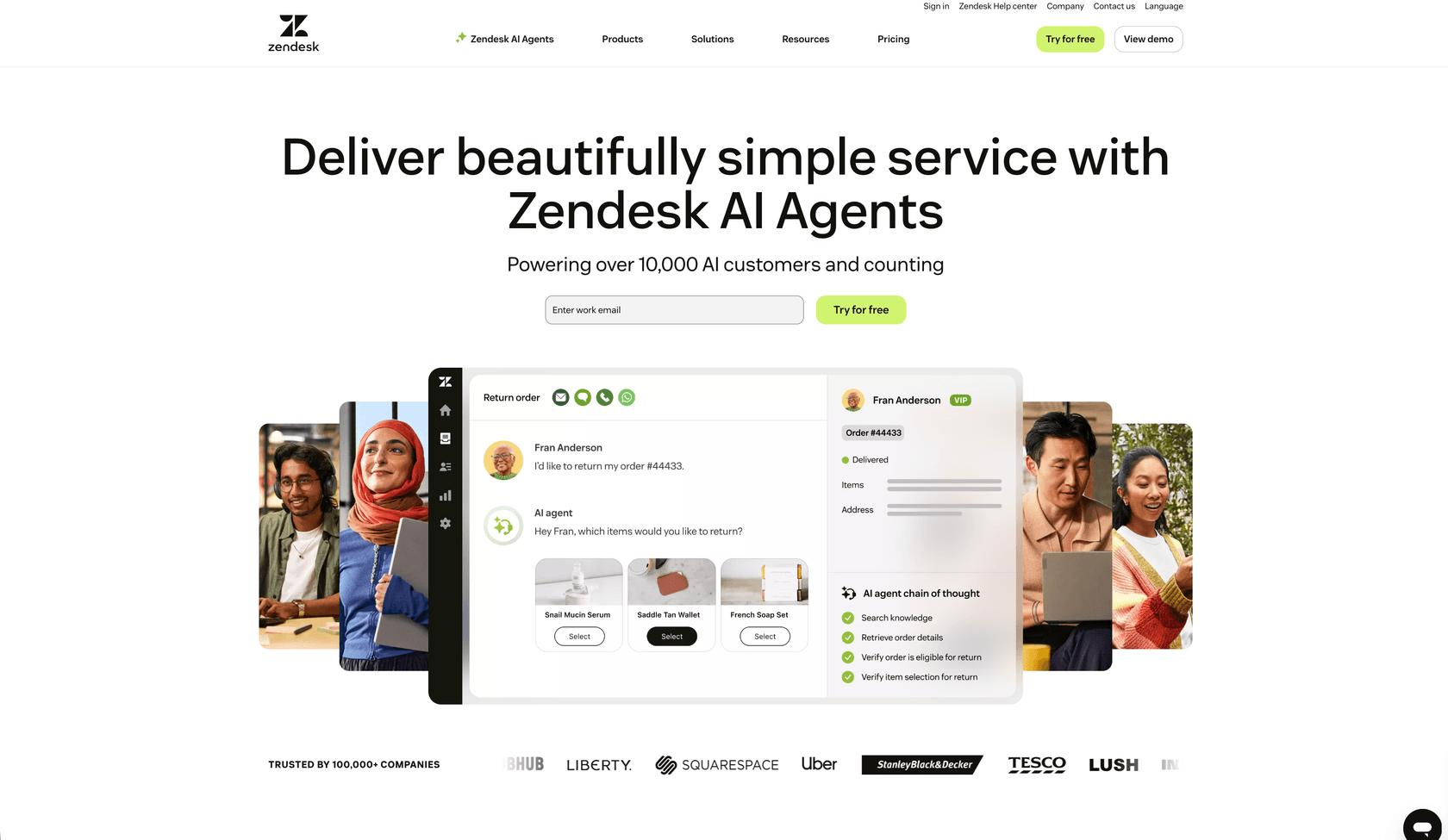
Zendesk is a SaaS company founded in Copenhagen in 2007, now headquartered in San Francisco. It provides customer service software that helps businesses manage support interactions across email, chat, phone, and social media.
The company serves over 100,000 businesses, ranging from small startups to enterprise giants like Uber, Siemens, and Staples. Its core value proposition is bringing all customer conversations into one place, giving agents the context they need to resolve issues efficiently.
What started as a simple ticketing system has evolved into a comprehensive platform with AI agents, automation workflows, self-service portals, and extensive integrations. For SaaS companies specifically, Zendesk offers features designed to handle the technical complexity and high ticket volumes that are typical of software businesses.
Key features for SaaS companies
Omnichannel support
SaaS customers expect to reach you wherever they are. Zendesk brings together email, live chat, phone, and social media (including Instagram, WhatsApp, and Slack) into a single workspace. Agents see the full conversation history regardless of which channel the customer used.
This matters for SaaS companies because your users might start with a quick chat question, follow up via email with technical details, then call for urgent issues. Without omnichannel support, each interaction starts from zero. With it, your agents pick up exactly where the conversation left off.
The platform also supports 40+ languages on higher-tier plans, which is essential if you're serving a global customer base.
AI and automation
Zendesk has heavily invested in AI capabilities, though the depth of features varies significantly by plan.
AI agents can handle routine conversations autonomously across messaging channels. On Suite Team and above, you get the "Essential" AI agent plan included, with 5-15 automated resolutions per agent per month depending on your tier. Beyond that, you pay $1.50 per resolution on committed plans or $2.00 pay-as-you-go.
Generative replies use AI to suggest responses based on your knowledge base and previous tickets. Copilot writing tools help agents expand and refine their messages, though these are limited to 5 uses per agent per month on Professional and Enterprise plans unless you purchase the unlimited Copilot add-on.
The AI features are genuinely useful for deflecting repetitive questions. However, there's a learning curve to configuring them properly, and you'll need to invest time in training the system on your specific product and common issues.
Self-service capabilities
For SaaS companies, a well-structured help center can deflect 30% or more of support volume. Zendesk's knowledge base tools let you create searchable articles, organize content with up to 6 levels of categorization (on Enterprise), and customize the appearance to match your brand.
The generative search feature uses AI to help customers find relevant articles even when their search terms don't exactly match your content. This is particularly valuable for technical products where customers might describe issues using different terminology than your documentation.
Suite Team includes one help center, Professional supports up to 5, and Enterprise allows up to 300. This multi-brand capability is crucial if you're managing multiple products or serving different customer segments with distinct needs.
Integration ecosystem
Zendesk connects with over 1,000 apps through its marketplace. For SaaS companies, key integrations include:
- CRM platforms like Salesforce and HubSpot to sync customer data
- Engineering tools like Jira and GitHub to escalate bugs and track fixes
- Communication platforms like Slack and Microsoft Teams for internal collaboration
- E-commerce platforms like Shopify for subscription and billing context
The API is available on all plans, though higher tiers get increased rate limits. Custom apps can be built using the App Builder (5-10 app conversations included on Professional+, with add-ons available).
Enterprise capabilities
Security and compliance
Enterprise SaaS companies can't compromise on security. Zendesk meets major compliance standards including SOC 2 Type II, ISO 27001, GDPR, and PCI. HIPAA compliance is available on Suite Professional and above.
Data residency options let you choose where your data is stored (US, EU, or APAC regions), which matters for regulatory compliance and data sovereignty requirements.
User management and SSO
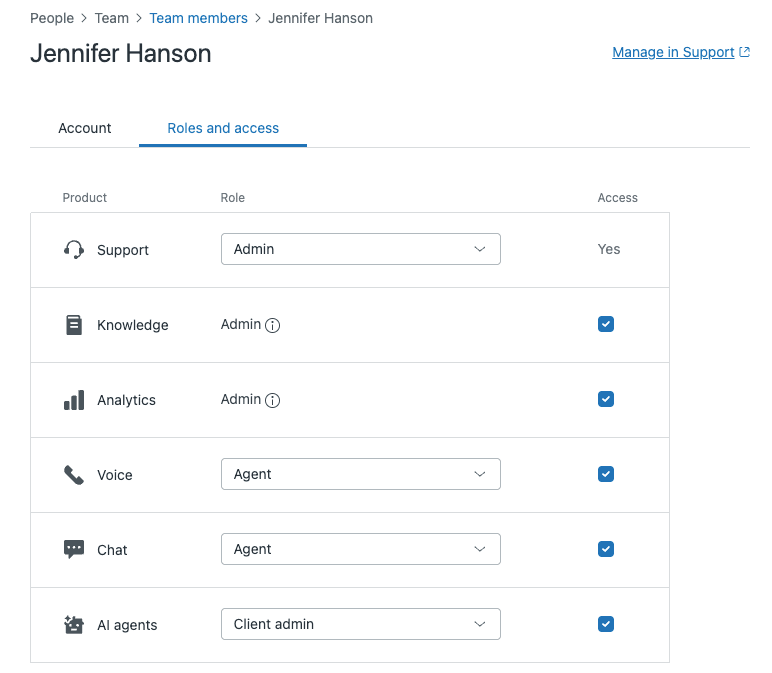
As your team grows, managing access becomes critical. Zendesk supports SAML and SCIM for single sign-on, integrates with Microsoft Entra ID for automatic user provisioning, and offers role-based access control.
Suite Enterprise includes custom agent roles and audit logs, giving you visibility into who accessed what and when. The sandbox environment (2 included on Enterprise) lets you test configuration changes before pushing them live.
Advanced analytics
Understanding support performance requires more than counting closed tickets. Zendesk's analytics suite includes prebuilt dashboards, custom reporting with real-time insights (on Professional+), and you can schedule dashboard deliveries.
Enterprise plans get live agent activity dashboards with customizable views and drill-down capabilities. This visibility helps managers identify coaching opportunities, spot agent knowledge gaps, and benchmark performance against industry standards.
Zendesk SaaS enterprise pricing breakdown
Let's talk numbers. Zendesk's per-agent pricing adds up quickly as you scale.
| Plan | Annual Price | Monthly Price | Best For |
|---|---|---|---|
| Support Team | $19/agent/mo | $25/agent/mo | Email-only support, basic needs |
| Suite Team | $55/agent/mo | $69/agent/mo | Growing teams needing AI and messaging |
| Suite Professional | $115/agent/mo | $149/agent/mo | Mid-market with custom reporting needs |
| Suite Enterprise | $169/agent/mo | $219/agent/mo | Large teams with complex requirements |
Key considerations:
- Annual billing saves 20% but requires upfront commitment
- AI resolutions have monthly caps (5-15 per agent depending on plan)
- Many advanced features require add-ons: Copilot ($50/agent), Quality Assurance ($35/agent), Workforce Management ($25/agent)
- Phone numbers and call minutes are additional costs on lower tiers
For a 20-agent team on Suite Professional with annual billing, you're looking at $2,300 per month before add-ons. Scale to 50 agents and you're at $5,750 monthly. This linear scaling is predictable but can become a significant budget line item.
Source: Zendesk Pricing
Implementation and time to value
Getting Zendesk running ranges from days for basic setups to weeks for complex enterprise configurations. The platform offers streamlined onboarding with on-demand training, but realizing full value requires investment in:
- Configuring workflows and automations
- Building out your knowledge base
- Training agents on the new system
- Integrating with your existing tools
Forrester Consulting's Total Economic Impact study (commissioned by Zendesk) found a composite organization achieved 301% ROI with payback in under six months. Real-world results from implementation partners like Premium Plus show 35% faster resolution times and 30% improvement in response times.
The key is starting with core functionality and expanding gradually. Trying to implement everything at once often leads to confusion and low adoption.
When to consider alternatives
Zendesk isn't the only option, and depending on your situation, alternatives might serve you better.
Freshdesk: Lower cost option
Freshdesk offers a free tier for up to 2 agents and paid plans starting at $19/agent/month. Their Pro plan at $55/agent matches Zendesk Suite Team's pricing but includes 500 AI agent sessions (compared to Zendesk's 5 resolutions per agent).
Freshdesk is worth considering if you're budget-conscious or have a very small team. The trade-off is a less mature ecosystem and fewer enterprise-grade features. You can explore their full feature set to see how it compares.
Source: Freshdesk Pricing
eesel AI: AI-first alternative
At eesel AI, we take a different approach to AI-powered support. Instead of per-agent pricing that scales with headcount, we charge per interaction. Our Team Plan starts at $299 per month for 1,000 interactions, regardless of how many agents you have.
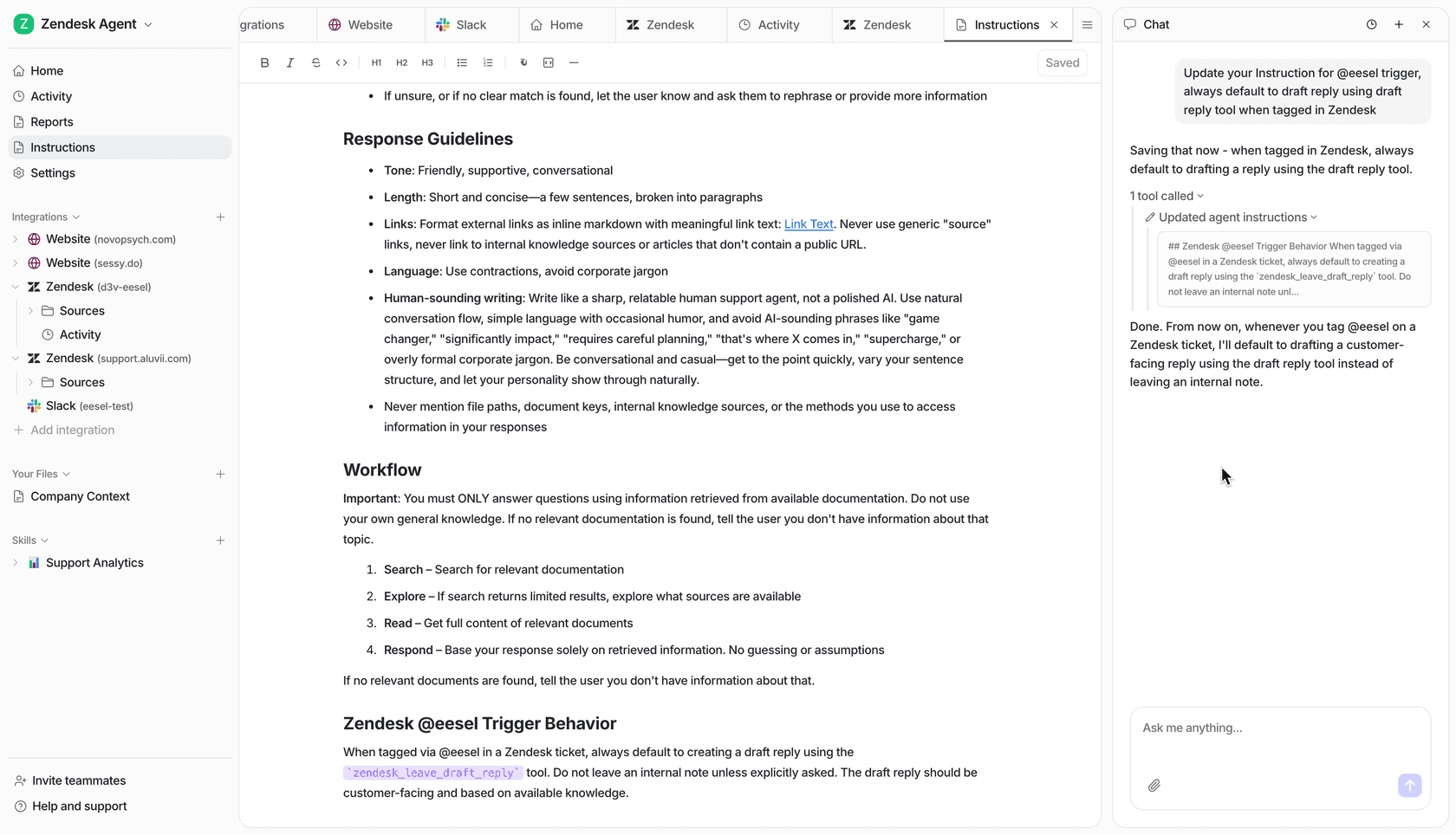
Here's how we differ from Zendesk:
Setup time: We connect to your help desk and learn from your existing tickets in minutes, not weeks. There's no complex configuration or training required.
Progressive rollout: Start with AI drafting replies for human review. Once you're confident in quality, expand to autonomous responses. You control the pace.
Pricing predictability: With per-interaction pricing, your costs scale with actual usage, not team size. A 50-agent team handling 1,000 tickets monthly pays the same as a 10-agent team handling the same volume.
Continuous learning: Our AI improves from every correction and conversation. Update policies by simply messaging the system: "We changed our refund policy to 60 days." No retraining cycles.
If you're intrigued by Zendesk's AI features but concerned about the per-agent cost or implementation complexity, our approach might be worth exploring.
Source: eesel AI Pricing
Making the right choice for your SaaS business
Choosing a support platform comes down to three factors: your current scale, your growth trajectory, and how you want to leverage AI.
Zendesk excels if you need a mature, full-featured platform with extensive integrations and you don't mind the per-agent pricing model. It's particularly strong for enterprises with complex requirements around compliance, multi-brand support, and advanced analytics.
However, if AI automation is your priority and you want to avoid the linear cost scaling of per-agent pricing, alternatives like eesel AI offer compelling value. The best approach is often to trial multiple solutions with your actual ticket data before committing.
Most Zendesk plans include a free trial, and we offer the same at eesel AI. Run them side by side with a subset of your tickets. The right tool will become obvious based on resolution quality, agent satisfaction, and total cost of ownership.