Trying to get your SaaS company noticed can be challenging. The market is crowded, and organic search is a primary channel for sustainable growth. This brings up a common challenge: navigating the large number of SEO tools available. Many businesses find themselves paying for multiple platforms with overlapping features or using software that doesn't directly contribute to their bottom line.
This guide is designed to cut through that clutter. We're going to walk through a curated, ROI-focused list of the SaaS SEO tools you actually need for research, technical site health, and getting content published. Strategy is great, but turning keywords into content that ranks is a different challenge. It's a bottleneck we addressed by building the eesel AI blog writer, the same tool we used to increase our own daily impressions from 700 to over 750,000.
What are SaaS SEO tools?
SaaS SEO tools are cloud-based (and sometimes desktop) applications built to help you rank higher on search engines like Google and, increasingly, in AI answer engines like Google's AI Overview or ChatGPT. Think of them as your behind-the-scenes crew for everything related to search.
They handle a few core jobs:
- Keyword research: Finding out what your potential customers are actually typing into Google.
- On-page optimization: Making sure your content is structured in a way that search engines can understand and appreciate.
- Backlink analysis: Seeing who is linking to you and, more importantly, to your competitors.
- Technical audits: Hunting down and fixing site issues that are quietly tanking your rankings.
- Performance tracking: Keeping an eye on your traffic and rankings to see what's working.
An infographic from our SaaS SEO tools guide explaining the five core jobs of SEO software: keyword research, on-page optimization, backlink analysis, technical audits, and performance tracking.
For any SaaS business, the goal isn't just clicks. It's about attracting the right kind of people who will sign up for a trial and stick around as paying customers.
Our criteria for this SaaS SEO tools guide
We were pretty picky about what made the cut for this list. We chose these tools based on a few core principles to ensure they're actually useful for a growing SaaS company.
- ROI-Focus: Does this tool help you land qualified leads and generate revenue? We skipped the ones that are all about vanity metrics.
- Job-Specific Functionality: Is it the best in its class at what it does? Whether that's technical crawling or content optimization, we looked for the specialists. As one person on Reddit noted, some tools are just for "[keeping] up with the competition," while others are for getting your "site's SEO in order." We focused on the second group.
- Ease of Use: Can your entire team, not just the SEO experts, get the hang of it without a week-long training seminar?
- Integration: Does it work well with the other tools you're already using, like your CMS or analytics platform?
SEO’s a long game, but focusing on content that actually solves problems always wins.

A quick comparison of SaaS SEO tools for 2026
| Tool | Best For | Key Feature | Starting Price |
|---|---|---|---|
| eesel AI blog writer | AI Content Generation | Publish-ready articles with assets | Free to try, then $99 for 50 blogs |
| Ahrefs | Competitor & Backlink Analysis | Largest backlink index & AI visibility tracking | $129/month |
| Semrush | All-in-One Marketing Suite | Integrated SEO, PPC & AI visibility tools | $199/month |
| Surfer SEO | On-Page Content Optimization | Real-time content editor & AI humanizer | $59/month |
| Screaming Frog | Technical SEO Audits | Deep website crawling | Free (up to 500 URLs) / $279/year |
| Google Search Console | Performance Monitoring | First-party Google data | Free |
The 6 best SaaS SEO tools
This isn't just a random list of software; it's a complete, lean stack that covers the entire SEO workflow. From figuring out your strategy and doing research to fixing technical problems and, most importantly, actually creating the content.
1. eesel AI blog writer
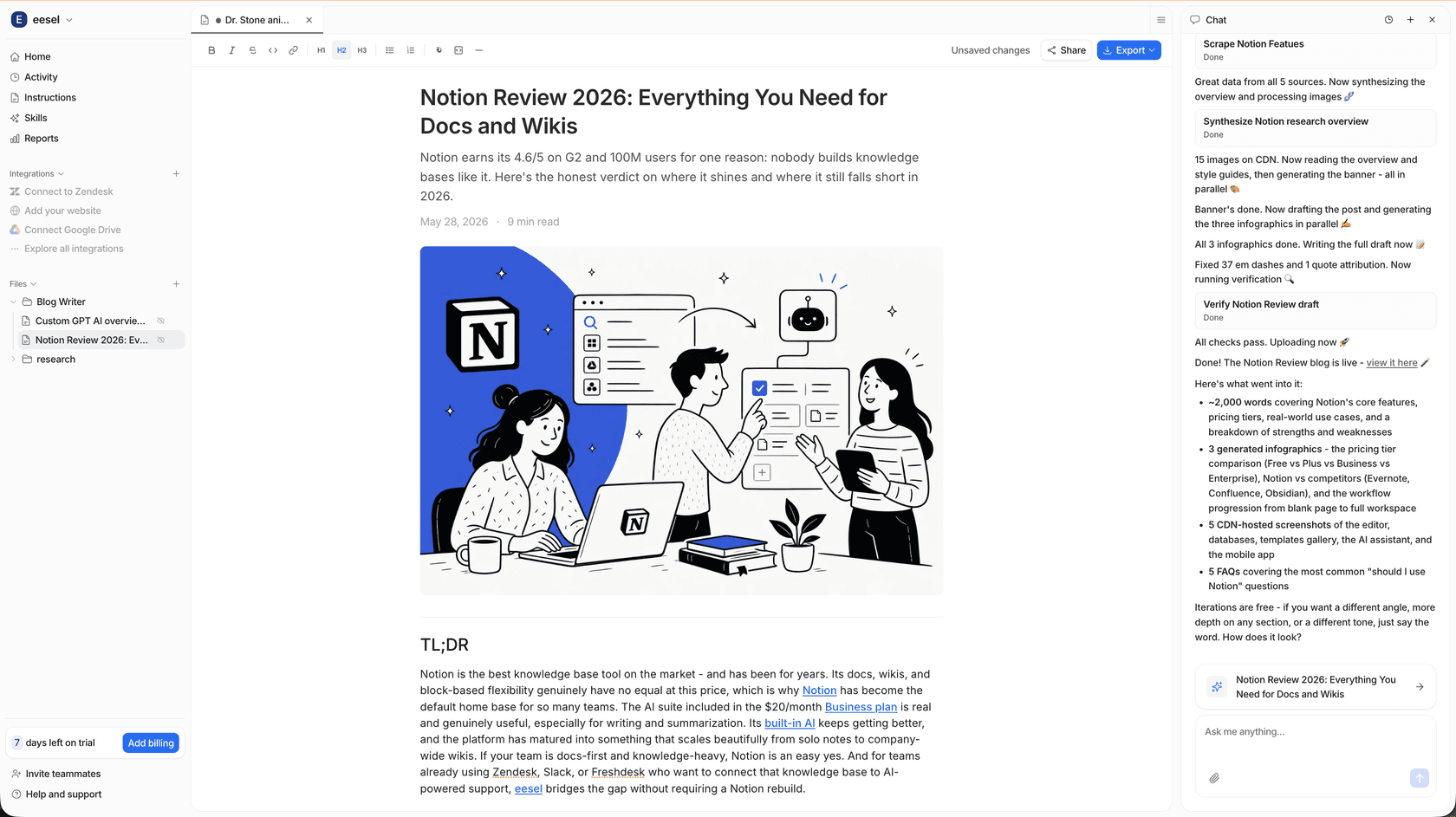
The eesel AI blog writer is the tool that connects your SEO strategy to published content. While other tools are great at finding keywords, eesel AI is built to take a single keyword and transform it into a complete, SEO-optimized, and publish-ready blog post. We know it works because it's what we used to grow our own traffic from 700 to 750,000 daily impressions in just three months.
Pros: eesel AI excels at creating content that sounds genuinely human because it learns from your existing business context. It doesn't just generate text; it automatically adds images, tables, and even embeds relevant Reddit quotes and YouTube videos to build reader trust. On top of that, its content is optimized for AI Answer Engines (AEO), so you're set for the next evolution of search.
Cons: It’s a specialist tool for content generation and optimization, and it doesn't pretend to be an all-in-one SEO suite. You'll still want a dedicated tool for deep-dive keyword research, backlink analysis, or comprehensive technical audits.
Pricing:
- It's completely free to try, so you can generate your first blog and judge the quality for yourself.
- After the trial, it's $99 for 50 blog credits.
Why we chose it: It addresses a significant challenge for many SaaS SEO strategies: creating enough high-quality, optimized content to move the needle. It's the perfect partner for a research tool, letting you act on your keyword strategy immediately instead of letting it gather dust in a spreadsheet.
2. Ahrefs
Ahrefs is widely considered a gold standard for competitor analysis. It's powered by what Cloudflare Radar calls the #1 SEO crawler on the web (right after Google, of course). It’s the platform you turn to when you need to figure out why your competitors are ranking and how you can leapfrog them. Now, it even helps you track your visibility in AI chat tools.
Pros: Ahrefs has a clean, intuitive interface and is known for its highly accurate data, a sentiment often shared by users on Reddit. Its Brand Radar feature is useful for seeing if your brand gets mentioned in AI chatbots, and the Site Explorer is perfect for dissecting a competitor's top pages and keywords.
Cons: The main drawback is the price. As many have noted, Ahrefs raised its prices significantly, and the plans can get expensive for smaller teams, especially when you factor in add-on costs for features like daily rank tracking.
I prefer Ahrefs for their deeper data but they sure do know how to price it right at the top of what is justifiable.
Pricing:
Why we chose it: You can't build a serious SaaS SEO strategy without a clear picture of your competitors and their backlink profiles. Ahrefs provides the best data out there for building a smart link-building strategy and reverse-engineering what's working for others.
3. Semrush
Semrush is much more than an SEO tool; it's a comprehensive digital marketing toolkit. Its main advantage is that it combines data from SEO, PPC, social media, and market research to give you a holistic view of your online presence. It’s a powerhouse trusted by 35% of Fortune 500 companies.
Both are great. I prefer Semrush's full suite of tools. I think they do a great job not just for keyword research, but also for competitor and market analysis. Neither is a bad choice, but I lean heavily towards Semrush.
Pros: Semrush's competitor analysis tools are excellent. You can see everything from their top organic keywords to the exact ad copy they're running. It also includes a robust site audit tool, position tracking, and features to measure your AI visibility on platforms like ChatGPT and Gemini. It's ideal for teams that are juggling multiple marketing channels.
Cons: Because it does so much, the interface can feel a bit cluttered if you're only interested in the core SEO features. Some users also report that its backlink data can lag a bit compared to more specialized tools.
Pricing:
- The Starter plan begins at $199/month (or $165.17/month if you pay annually).
Why we chose it: If you're a SaaS company that wants a single platform to manage your entire search marketing strategy, from organic to paid and AI visibility, Semrush is a solid choice.
4. Surfer SEO
Surfer SEO is a content intelligence tool designed to help you write articles perfectly tuned for search engines. It analyzes the top-ranking pages for your target keyword and then generates a data-backed brief with suggestions on everything from word count and structure to related terms you should include.
Pros: Surfer SEO integrates smoothly into your workflow, with plugins for Google Docs, WordPress, and ChatGPT. The real-time content score provides writers with live feedback, which is great for ensuring every article is on point. It also has neat features like an AI Content Humanizer to help polish AI-generated text and pass detection tools.
Cons: While the data-driven suggestions are useful, they can sometimes feel a bit restrictive. You still need a skilled writer to ensure the content flows naturally and doesn't sound overly formulaic. It's also strictly for on-page optimization, not a full SEO suite.
Pricing:
- The Discovery plan starts at $59/month (or $49/month if paid annually).
Why we chose it: It's a great tool for in-house content teams who want to embed SEO best practices directly into their writing process. It helps maintain consistency and gives every piece of content a better chance to rank.
5. Screaming Frog
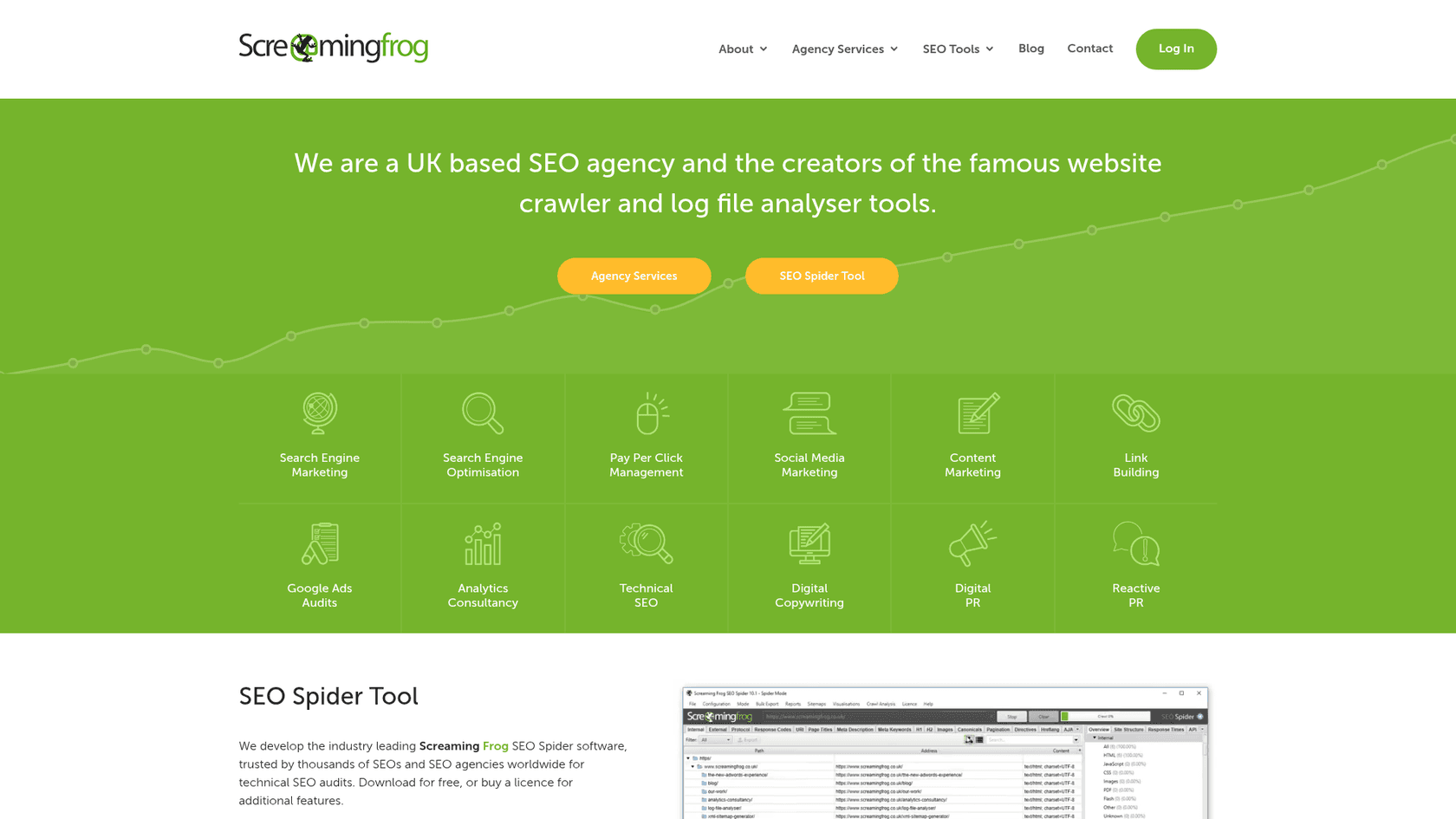
Screaming Frog's SEO Spider is the undisputed champion of technical SEO. It’s a desktop-based crawler that scours your website to find issues like broken links, redirect chains, and duplicate content. As one Reddit user put it, for technical SEO, a native crawler like Screaming Frog is the go-to tool.
Pros: Screaming Frog provides an incredible level of detail, uncovering deep technical issues that cloud-based tools might miss. It's highly customizable, and you can easily export the data for analysis. The paid version adds even more power with JavaScript rendering, Google Analytics integration, and crawl comparisons.
Cons: The user interface is all business, which can be intimidating for newcomers. And since it's a desktop app, the crawling speed and capacity are limited by your computer's resources, which can be an issue for massive websites.
Pricing:
- Free for up to 500 URLs.
- A paid license is $279/year for unlimited crawling and all advanced features.
Why we chose it: You can't have a solid SEO strategy without a powerful technical audit tool. Screaming Frog is the industry workhorse that ensures your site's foundation is strong and free of errors that could be holding you back.
6. Google Search Console
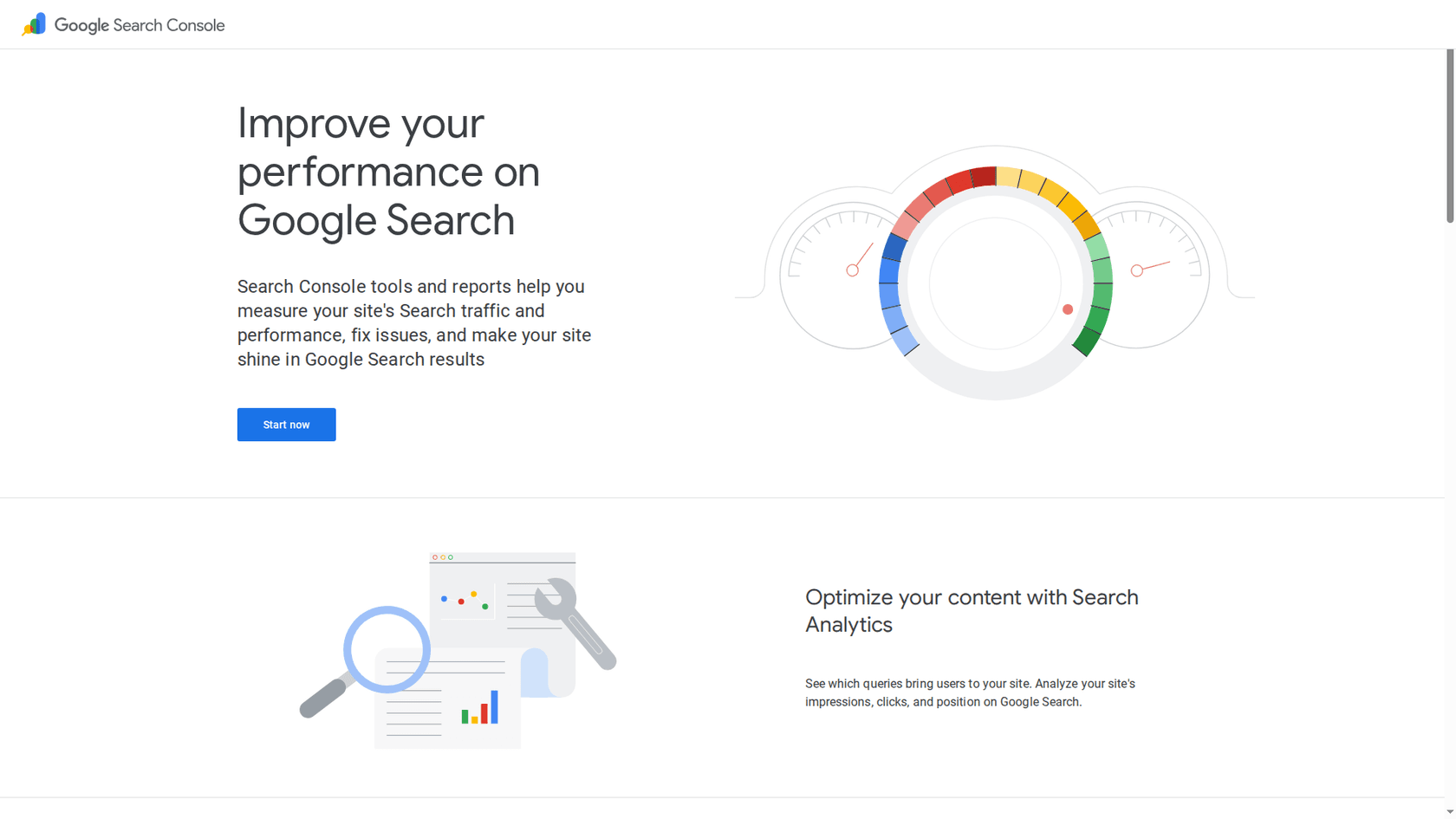
Think of Google Search Console (GSC) as the ultimate source of truth for your website's performance. As one SEO expert on Reddit perfectly stated, "For data on your own website - you use GSC. End of story." It’s a free service directly from Google that shows you exactly how the search engine sees your site, including which queries people use to find you, your click-through rates, and average positions.
Pros: GSC gives you invaluable first-party data you can't get anywhere else. It's the most accurate information available. You absolutely need it for monitoring your site's indexing status, submitting sitemaps, and identifying any crawl errors or penalties from Google.
Cons: The data is limited to the last 16 months, and it provides zero information about your competitors. It tells you what's happening on your site but doesn't really explain the why or offer the strategic insights you get from paid tools.
Why we chose it: It's the bedrock of any SEO strategy. Period. Without it, you’re flying blind. GSC provides the baseline performance data you need to measure whether all your other SEO efforts are actually paying off.
How to build a lean and effective SaaS SEO stack
Assembling the right set of tools is about being smart, not just spending money. Here’s how to build a stack that delivers results without draining your budget.
Next, squeeze every drop of value out of free tools like Google Search Console and the free version of Screaming Frog before you start paying for expensive subscriptions.
Finally, prioritize execution. A long list of keywords is useless if you can't turn it into content. Invest in tools that solve your biggest bottleneck. If that’s creating high-quality articles, a tool like the eesel AI blog writer will deliver a much higher ROI than another research platform.
To see how these different tools and strategies come together in a real-world workflow, the following video provides a comprehensive walkthrough of a modern SaaS SEO strategy.
Getting started with your SaaS SEO tools
Building the right SaaS SEO tool stack is about being strategic and focusing on what will actually drive growth. You don't need a dozen different subscriptions to succeed.
A solid stack begins with Google Search Console as your foundation, adds Ahrefs or Semrush for research and competitive analysis, uses Screaming Frog to keep your technical SEO clean, and most importantly, includes an execution tool to bring your strategy to life.
Because at the end of the day, the hardest part of SEO is consistently creating great content that people want to read and search engines want to rank.
Ready to turn your keyword research into articles that get noticed? Try the eesel AI blog writer for free and generate your first SEO-optimized post in minutes.