How to scale SaaS SEO growth: A practical guide

Stevia Putri

Katelin Teen
Last edited January 15, 2026
Trying to scale your SaaS SEO can feel like you're just doing more of the same things, hoping for a different result. The real goal is to build a reliable engine for organic growth that builds on itself. Get it right, and you can finally take your foot off the gas on those paid channels that drain your budget.
But most SaaS companies hit a plateau. They get a few traffic spikes, but can't seem to create a consistent flow of good leads. The culprit is almost always the same: the content bottleneck. Pushing out enough high-quality, targeted content is a massive hurdle.
This guide will walk you through a full-funnel strategy built on three main pillars: a solid technical base, a powerful content engine, and smart authority-building. This isn't just theory, either. It’s the same approach we used at eesel AI to jump from 700 to 750,000 daily impressions in just three months. Let's get into it.
Understanding SaaS SEO and its importance for growth
SaaS SEO isn't like other types of SEO. It’s designed for the software world, where customers don't just impulse-buy. They research, compare, and can take weeks or months to decide. You have to guide them through a full marketing funnel, from when they first notice a problem to when they're ready to sign up.
Unlike e-commerce, which often targets quick-buy keywords, SaaS SEO is about earning trust over the long haul. You need content for every stage, as illustrated in the graphic below:
- Top of Funnel (TOFU): For people just becoming aware of their problem.
- Middle of Funnel (MOFU): For those actively looking for solutions and comparing options.
- Bottom of Funnel (BOFU): For prospects who are ready to buy and just need to pick the right tool.
An infographic showing the TOFU, MOFU, and BOFU stages of the marketing funnel, an important concept for how to scale SaaS SEO growth.
So, why the focus on scale? Because you want to build a customer acquisition channel that works for you consistently, without needing a constant injection of cash for paid ads. A good SEO engine lowers your Customer Acquisition Cost (CAC) over time and becomes a reliable source of growth.
The problem, as always, is content. The sheer volume of work involved in manually researching, writing, and optimizing articles to cover the entire funnel is staggering. It's slow, it's expensive, and it's where most teams get stuck. That's the bottleneck we're here to talk about.
The three pillars of scalable SaaS SEO
Pillar 1: Technical health
Think of your website as the engine. If it's slow, clunky, or confusing for search engines, your content doesn't stand a chance. A shaky technical foundation will undermine everything else. Here’s what to focus on:
- Site Speed and Core Web Vitals: We've all abandoned a slow-loading page. A slow site kills user experience and rankings. Google favors sites with good Core Web Vitals, so your pages need to load fast, respond quickly, and be visually stable, especially for mobile users.
- Crawlability and Indexing: If search engines can't find and understand your content, it's invisible. This means having a clean XML sitemap, a logical URL structure, and a
robots.txtfile that isn’t accidentally blocking important parts of your site. - Schema Markup for SaaS: This one's a little more technical, but it’s huge for SaaS companies. Structured data (schema) is code you add to your site to give search engines more context. For software, specific types like
SoftwareApplicationandWebApplicationcan get you rich snippets in search results, showing details like pricing and user ratings.FAQPageschema is another great one for pages with common questions.
Pro tip
Don't wait for technical problems to find you. Run a quarterly technical audit with a tool like Screaming Frog or Ahrefs' Site Audit. It helps you find broken links, redirect chains, and other issues before they hurt your rankings.
Pillar 2: The content engine
Content is the fuel for your SEO engine. But throwing random blog posts at the wall won't work. You need a system that covers the whole buyer's journey and positions your brand as an authority.
- Mapping Content to the Funnel: You need different content for different stages.
- TOFU (Top of Funnel): Educational content for people just starting their research. Think "how-to" guides or posts that answer broad questions (e.g., "how to improve team productivity").
- MOFU (Middle of Funnel): This targets people comparing solutions. Here you'll find comparison posts, listicles, and alternative pages (e.g., "best project management tools").
- BOFU (Bottom of Funnel): This content is for people ready to buy. It includes case studies, product feature pages, and direct competitor comparisons (e.g., "product X alternatives").
- Building Topic Clusters: Instead of just writing standalone articles, organize your content into "topic clusters." This approach helps you build authority and shows search engines you know your stuff. You create a main "pillar" page on a broad topic (like "customer onboarding") and then surround it with "cluster" pages on more specific subtopics (like "customer onboarding checklists" or "best onboarding software"). All these pages link back to the pillar, creating a network of content that Google really likes.
A diagram explaining the topic cluster model with a central pillar page and surrounding cluster pages, a key strategy for how to scale SaaS SEO growth.
The challenge is obvious: how on earth do you create enough high-quality, optimized content to build out these clusters for every stage of the funnel? This is the scaling problem. Writing everything by hand is too slow, and hiring an army of freelancers gets expensive. It’s the point where most SEO plans grind to a halt.
Pillar 3: Authority and link building
Links are like the oil that keeps your SEO engine running. They're basically votes of confidence from other websites, telling search engines that your content is trustworthy. A smart linking strategy makes your whole site stronger.
- Internal Linking: This is the easiest place to start. Linking between your own relevant pages helps spread authority around your site, shows Google how your pages are related, and guides users through your funnel. Whenever you publish a new post, make sure to link to it from older, relevant articles.
- Backlinks (External Links): These are links pointing to your site from other websites. Getting high-quality backlinks from respected sites in your niche is a huge ranking factor. The focus should always be on quality over quantity. One link from a top industry blog is worth way more than a hundred from spammy directories.
We built relevant backlinks to product pages to get it in front of potential customers that are in the middle of the funnel. We also utilized getting featured on list posts that were relevant to our offers. In 4 months, we were able to double the traffic from these product pages + doubled the traffic overall on our domain.

prioritize your page load speed. link building, if handled right, can reflect substantial results. build free tools, i added them on my footer usePromptify.com
A practical plan for scaling SaaS SEO
Step 1: Conduct a keyword gap analysis
It's easy to get distracted by keywords with huge search volumes, but that's not always the best move. Focus on keywords that match what users are actually trying to do at each stage of the funnel. A keyword gap analysis is perfect for this.
Using a tool like Semrush or Ahrefs, you can run a keyword gap analysis that shows you all the relevant keywords your competitors rank for that you don't. It's a goldmine of proven topics your audience is already looking for.
While you're at it, pay attention to long-tail keywords. These are longer, more specific phrases like "project management software for remote creative teams." They have lower search volume, but the intent is much higher, which usually means better conversion rates.
Step 2: Solve the content bottleneck with eesel AI
Let's get back to the biggest problem: the content bottleneck. Manually writing dozens of articles every month just isn't feasible for most teams. It's the main reason SaaS SEO plans fail to get off the ground.
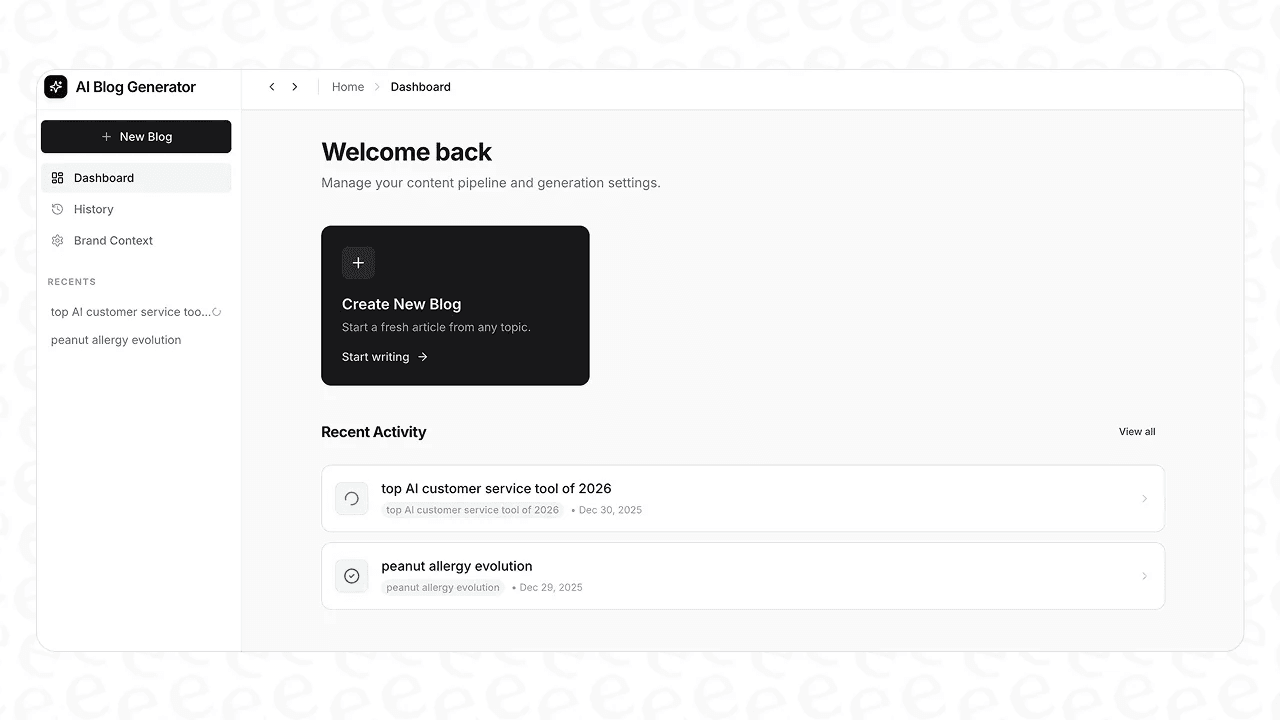
It is designed to address common challenges in AI content generation:
- It generates a full post: You get a complete article with a logical structure, headings, AI-generated images, data tables, and infographics. It’s ready to publish.
- It adds authentic social proof: To make the content feel more human and trustworthy, the tool automatically finds and embeds relevant YouTube videos and real quotes from Reddit discussions. This adds perspectives an AI writer alone could never generate.
- It’s optimized for modern search: The content is structured for traditional SEO and for AEO (Answer Engine Optimization). This helps you get cited in new features like Google's AI Overviews.
We don't just sell it, we run on it. It’s the tool we used at eesel AI to go from 700 to 750,000 daily impressions in just 3 months. It's free to try, so you can generate a post and judge the quality for yourself.
Step 3: Measure and iterate
SEO isn't something you can set up once and walk away from. To scale, you have to constantly measure your results and adjust your strategy. Use Google Search Console and a tool like Ahrefs Web Analytics to track the important stuff: organic traffic, keyword rankings, and conversions like trial sign-ups.
One of the best tactics for long-term growth is refreshing your content. Even your top articles can lose steam as they become outdated. Find articles with declining traffic and update them with new information, stats, and visuals at least once a year. This often gives them a nice bump in the rankings.
This creates a feedback loop: see what's working, create more of it, and keep your existing content fresh to maintain momentum.
Common mistakes to avoid when scaling SaaS SEO
As you ramp up your efforts, it's easy to fall into a few common traps. Here are some of the biggest ones to watch out for:
- Focusing Only on TOFU Content: A blog with only top-of-funnel educational content might get a lot of traffic, but very few conversions. You need a balance of MOFU and BOFU content to capture leads who are closer to making a decision.
- Ignoring Technical SEO: You can't build a skyscraper on a shaky foundation. If you neglect site speed, mobile experience, or crawlability, you'll sabotage your content efforts. A technically flawed site will always struggle to rank.
Biggest mistake not doing anything. Second. Probably expecting there is some black hat trick that some guru told you or you found in some corner of the internet. Third. It is probably just having a bad site.
For a deeper dive into building a comprehensive SaaS SEO strategy from the ground up, the following video offers a full walkthrough, covering everything from keyword research to building a pipeline that drives revenue.
Building your engine for sustainable SaaS SEO growth
Scaling your SaaS SEO isn't about finding a secret trick. It’s about moving from random marketing tasks to building a systematic, three-pillar engine that delivers predictable results.
It all comes back to those three pillars: a healthy technical engine, a steady supply of high-quality content fuel, and authority-building link oil to keep it all running.
The biggest hurdle for nearly every SaaS company is creating that fuel at scale. Writing content manually is too slow, and producing content that is both high-quality and human-readable can be a challenge.
If you’re ready to solve your content bottleneck and see how you can consistently produce SEO-optimized, human-readable articles in a fraction of the time, try the eesel AI blog writer for free. Generate your first complete blog post in minutes and start building your growth engine today.

Frequently Asked Questions
Share this article

Article by
Stevia Putri
Stevia Putri is a marketing generalist at eesel AI, where she helps turn powerful AI tools into stories that resonate. She’s driven by curiosity, clarity, and the human side of technology.