
If you're comparing Freshdesk vs Freshservice, you're already ahead of most buyers. Most people see the similar names, assume they're the same product with different branding, and pick whichever comes up first in search. That's a costly mistake.
Here's the short version: Freshdesk is for external customer support. Freshservice is for internal IT service management. Same parent company (Freshworks), completely different purposes. One helps you answer customer emails and tweets. The other helps your IT team manage infrastructure, assets, and employee requests.
Both products are mature platforms with strong AI capabilities through Freddy AI. This guide breaks down what each product does, who it's for, and how to make the right choice.
What is Freshdesk?
Freshdesk is a cloud-based customer support platform designed for external-facing teams. It's built to help businesses manage multi-channel customer conversations, track support tickets, and deliver fast resolutions.
The platform unifies email, chat, phone, social media, and messaging apps into a single shared inbox. Support agents can see customer history, collaborate with internal notes, and automate repetitive tasks like ticket routing and prioritization.
Freshdesk's core strengths center on speed and customer satisfaction. The platform emphasizes quick response times, omnichannel support, and self-service options like knowledge bases and community forums. It's designed for teams that need to handle high volumes of customer inquiries efficiently.
Key capabilities include:
- Multi-channel ticketing (email, chat, phone, social, messaging)
- Shared inbox with internal collaboration tools
- Knowledge base and customer self-service portal
- Workflow automation for routing and escalations
- SLA management with multiple policy support
- Custom reporting and real-time dashboards
- 1,000+ integrations via the Freshworks Marketplace
Freshdesk targets customer support teams, e-commerce businesses, SaaS companies, and any organization that needs to manage external customer relationships. The platform currently serves over 74,000 businesses worldwide, including brands like Bridgestone, Klarna, and Pearson.
What is Freshservice?
Freshservice is an IT service management (ITSM) platform built for internal teams. While Freshdesk faces outward toward customers, Freshservice faces inward toward employees and IT operations.
The platform provides ITIL-aligned processes for incident management, problem management, change management, and service request fulfillment. It includes a configuration management database (CMDB) for tracking IT assets, visual workflow automation, and enterprise service management capabilities that extend beyond IT to HR, facilities, and finance teams.
Freshservice's core strengths center on IT governance and structured workflows. The platform helps IT teams maintain compliance, manage infrastructure changes safely, and provide consistent service delivery across the organization.
Key capabilities include:
- Incident, problem, and change management
- IT Asset Management (ITAM) with auto-discovery and CMDB
- Service catalog for standardized request fulfillment
- IT Operations Management (ITOM) for monitoring and alerts
- Enterprise Service Management (ESM) for HR, facilities, and finance
- Project management for IT initiatives
- Workflow automation with orchestration
Freshservice targets IT departments, managed service providers, and enterprise teams that need formal IT service management processes. Notable customers include the University of Oxford, Marvel, Databricks, and the Kansas City Chiefs.
Feature comparison: Freshservice vs Freshdesk
Ticketing and communication
Freshdesk excels at multi-channel customer communication. It brings together email, live chat, phone calls, social media mentions, and messaging apps into one unified view. The platform is designed for high-volume customer interactions where speed and context matter.
Freshservice focuses on internal service delivery through email, employee portals, and integrations with Slack and Microsoft Teams. The ticketing system is built around ITIL best practices with structured categorization and escalation paths.
Automation and AI capabilities
Both platforms use Freshworks' Freddy AI, but the implementation differs based on use case.
Freshdesk applies AI to customer-facing automation. Freddy AI Agent handles conversational self-service, resolving up to 80% of routine queries without human intervention. Freddy AI Copilot assists agents with reply suggestions, sentiment analysis, and ticket summarization. The AI focuses on improving response quality and speed for customer interactions.
Freshservice applies AI to employee self-service and IT operations. Freddy AI Agent operates within Slack and Teams to answer employee questions and fulfill service requests. The platform achieves a 66% ticket deflection rate by handling routine IT requests automatically. Freddy AI Copilot helps IT agents draft responses and manage complex incidents.
Asset and change management
This is where the products diverge significantly.
Freshdesk offers basic asset tracking through integrations but doesn't include native IT asset management. If you need to track hardware lifecycles, software licenses, or configuration items, you'll need third-party tools.
Freshservice includes full IT Asset Management (ITAM) with auto-discovery, a CMDB for tracking configuration items and relationships, software asset management, and cloud resource management. The change management module provides visual workflows, impact assessment through the CMDB, and approval processes for infrastructure changes.
Reporting and analytics
Freshdesk focuses on customer support metrics: response times, resolution times, customer satisfaction scores, and agent performance. The platform provides pre-built reports and custom dashboards for tracking support operations.
Freshservice emphasizes IT service metrics: SLA compliance, first contact resolution, asset utilization, and IT operational efficiency. The platform includes analytics for identifying trends, detecting anomalies, and providing proactive insights to IT leaders.
Pricing comparison
| Plan | Freshdesk | Freshservice |
|---|---|---|
| Free | $0 (up to 2 agents for 6 months) | Not available |
| Growth | $19/agent/month (annual) | $19/agent/month (annual) |
| Pro | $55/agent/month (annual) | $99/agent/month (annual) |
| Enterprise | $89/agent/month (annual) | Custom pricing |
Freshdesk's Free Program makes it attractive for small teams and startups. It covers up to two agents for six months (it is not a standing free plan, and you reach it after the 14-day trial), so you can run core ticketing and a knowledge base without paying during that window.
Freshservice starts at $19 per agent with no free tier. The higher pricing on Pro and Enterprise plans reflects the additional complexity of ITSM features like change management, asset management, and advanced workflow automation.
Both platforms offer 14-day free trials. AI capabilities (Freddy AI) have usage caps on lower tiers, with additional sessions available as add-ons. Freshdesk includes 500 AI sessions on Pro and Enterprise plans, while Freshservice Enterprise includes 1,200 sessions per license per year.
Who should choose Freshdesk?
Freshdesk fits teams that need to manage external customer relationships. Consider it if:
- You run an e-commerce store and need to handle order inquiries, returns, and support requests
- You operate a SaaS business with customers reaching out via email, chat, and social media
- You're a small to medium business that wants to start on the Free Program and scale up
- Your priority is fast response times and high customer satisfaction scores
- You need multi-channel support without complex IT processes
The platform works best for customer support teams, help desks, and service teams that don't need ITIL-aligned processes or asset management.
Who should choose Freshservice?
Freshservice fits teams that need formal IT service management. Consider it if:
- You manage IT infrastructure and need incident, problem, and change management
- You track IT assets and need a CMDB for configuration management
- You follow ITIL processes and need compliance reporting
- You're extending service management to HR, facilities, or finance teams
- You're a mid-size to enterprise company with governance requirements
The platform works best for IT departments, managed service providers, and organizations that need structured service delivery processes.
A modern alternative: eesel AI
While Freshdesk and Freshservice solve different problems, what if you need both customer support and internal knowledge management? That's where we come in.
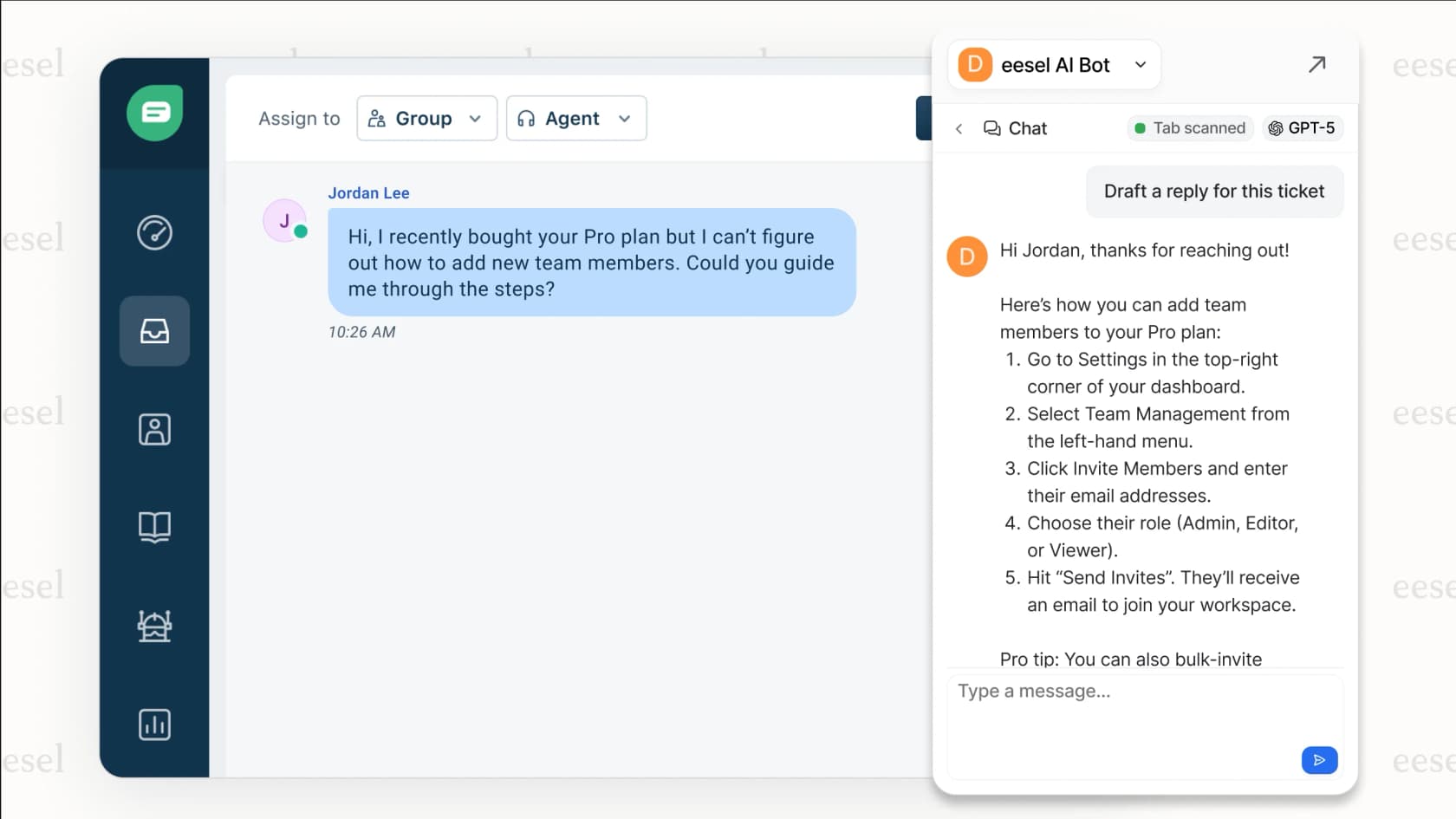
At eesel AI, we've built an AI teammate that works across both use cases. Our platform functions as an AI agent for customer support, an AI copilot for human agents, and an AI triage system for ticket management. But unlike traditional help desk tools, we also handle internal knowledge through Slack and Microsoft Teams integrations.
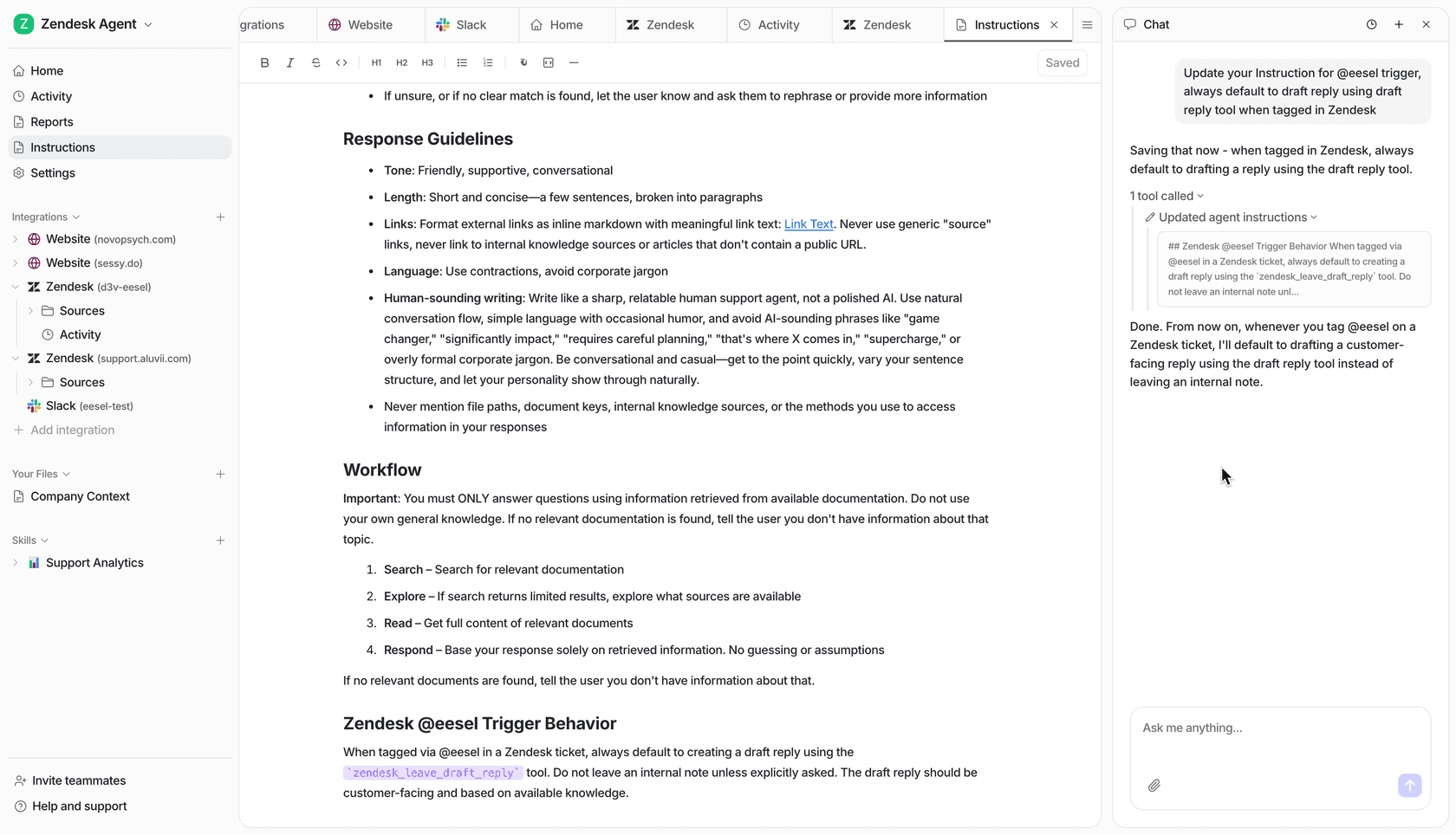
Here's how we're different:
Progressive rollout, not all-or-nothing deployment. You start with eesel drafting replies for agent review. As the AI proves itself on your actual tickets, you expand its scope until it's handling full frontline support autonomously. You control the pace based on performance, not a vendor's timeline.
Plain-English control. Instead of complex configuration wizards, you tell eesel what to do in natural language. "If the refund request is over 30 days, politely decline and offer store credit." "Always escalate billing disputes to a human." No code, no rigid decision trees.
Works with what you have. We integrate with Freshdesk, Freshservice, Zendesk, and 100+ other platforms. You don't rip and replace your existing help desk. You add an AI layer that makes it smarter.
If you're evaluating help desk solutions and thinking about AI capabilities, see how eesel AI compares as a modern alternative that bridges customer support and internal service management.
Making the right choice for your team
The Freshservice vs Freshdesk decision comes down to one question: are you serving external customers or internal employees?
- Choose Freshdesk for customer support, e-commerce, SaaS, and external-facing teams
- Choose Freshservice for IT service management, internal operations, and enterprise service delivery
Consider your team's technical maturity. Freshdesk is easier to set up and requires less process discipline. Freshservice delivers more value when you have established ITIL practices and dedicated IT staff.
Factor in budget constraints. Freshdesk's six-month Free Program lowers the barrier to entry for small teams. Freshservice's pricing reflects its enterprise feature set.
Think about future growth. Both platforms scale, but in different directions. Freshdesk scales toward more customer channels and advanced automation. Freshservice scales toward broader enterprise service management across departments.
Bottom line? Pick the tool that matches your primary use case today. You can always add the other later if your needs expand.