
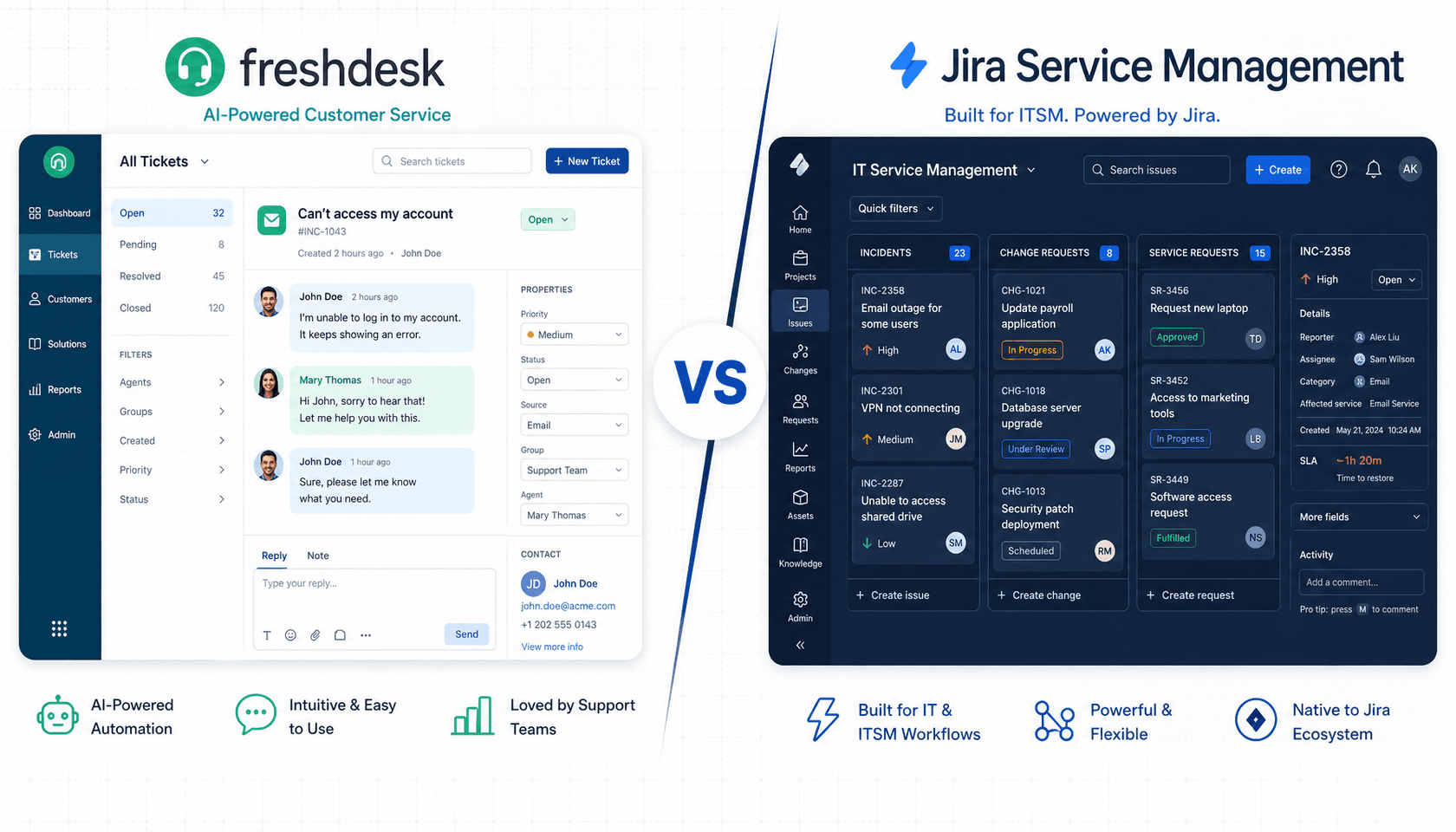
Freshdesk and Jira Service Management both have "service desk" in their DNA, but they're built for different audiences and different problems. Freshdesk is a customer support helpdesk -- built for external customers contacting a company for help. Jira Service Management is an ITSM platform -- built for IT teams managing infrastructure, changes, incidents, and internal employee requests. Comparing them directly is a bit like comparing a restaurant ordering system to a hospital patient intake system: similar surface-level vocabulary, radically different workflows underneath.
That said, there are real scenarios where the choice isn't obvious. Companies that use Jira Software for development sometimes wonder whether to extend JSM across customer support rather than paying for a second tool. IT teams that need a simpler, lighter service desk sometimes land on Freshdesk rather than dealing with JSM's configuration overhead. And both platforms have expanded their feature sets enough in 2026 that the overlap is genuine, even if the core use cases remain distinct.
This comparison covers both products in depth: what each is built for, how the AI features stack up, what the pricing actually looks like, and a clear guide on which one to choose depending on what your team does every day.
What is Freshdesk?
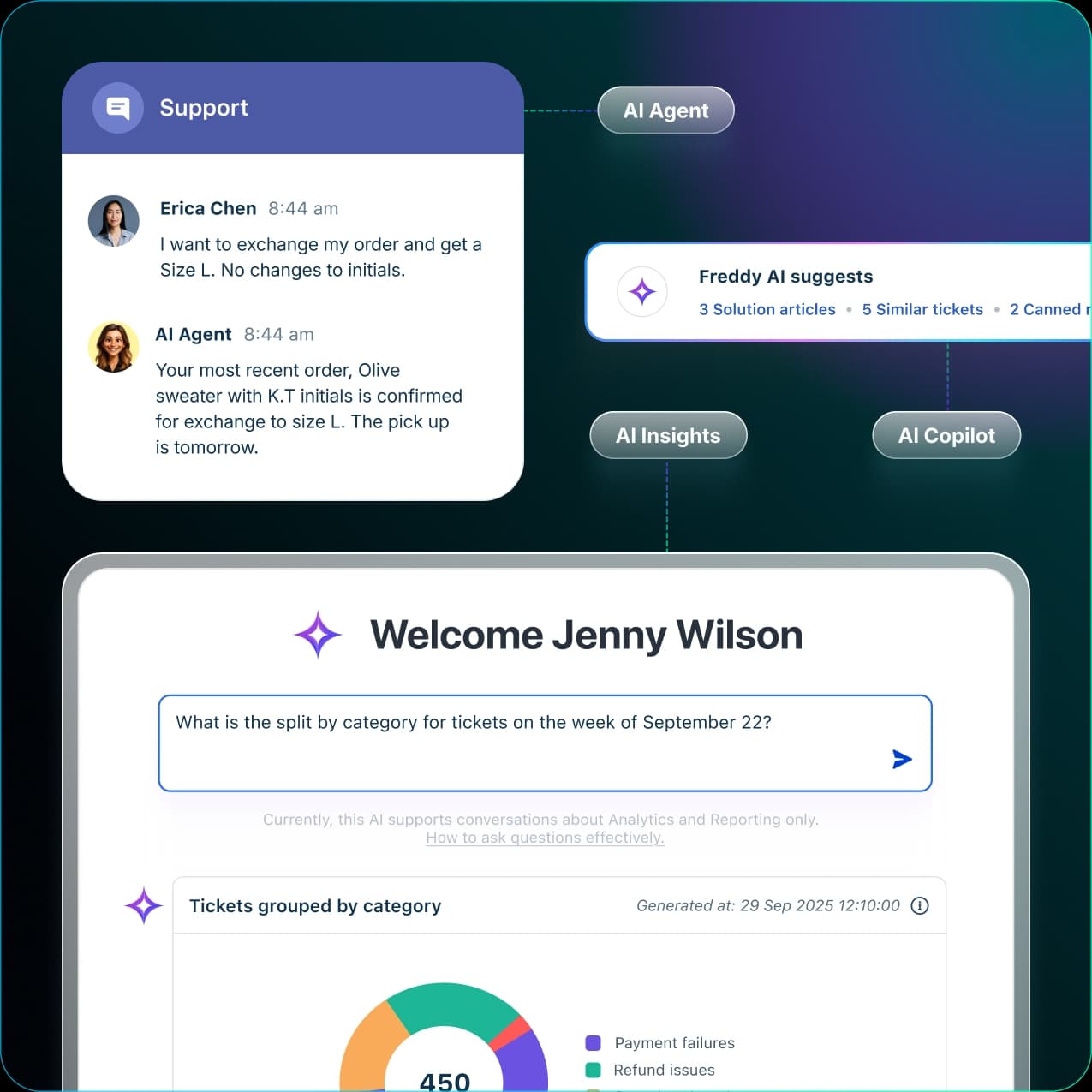
Freshdesk is Freshworks' customer service helpdesk, used to manage inbound support requests from external customers. It ships in two SKUs: standalone Freshdesk (email and ticketing) and Freshdesk Omni (full omnichannel, which bundles Freshdesk with Freshchat for messaging and voice). Its AI layer is branded Freddy AI and comes in three classes: Freddy AI Agent for autonomous customer-facing resolution, Freddy AI Copilot for agent assist, and Freddy AI Insights for analytics.
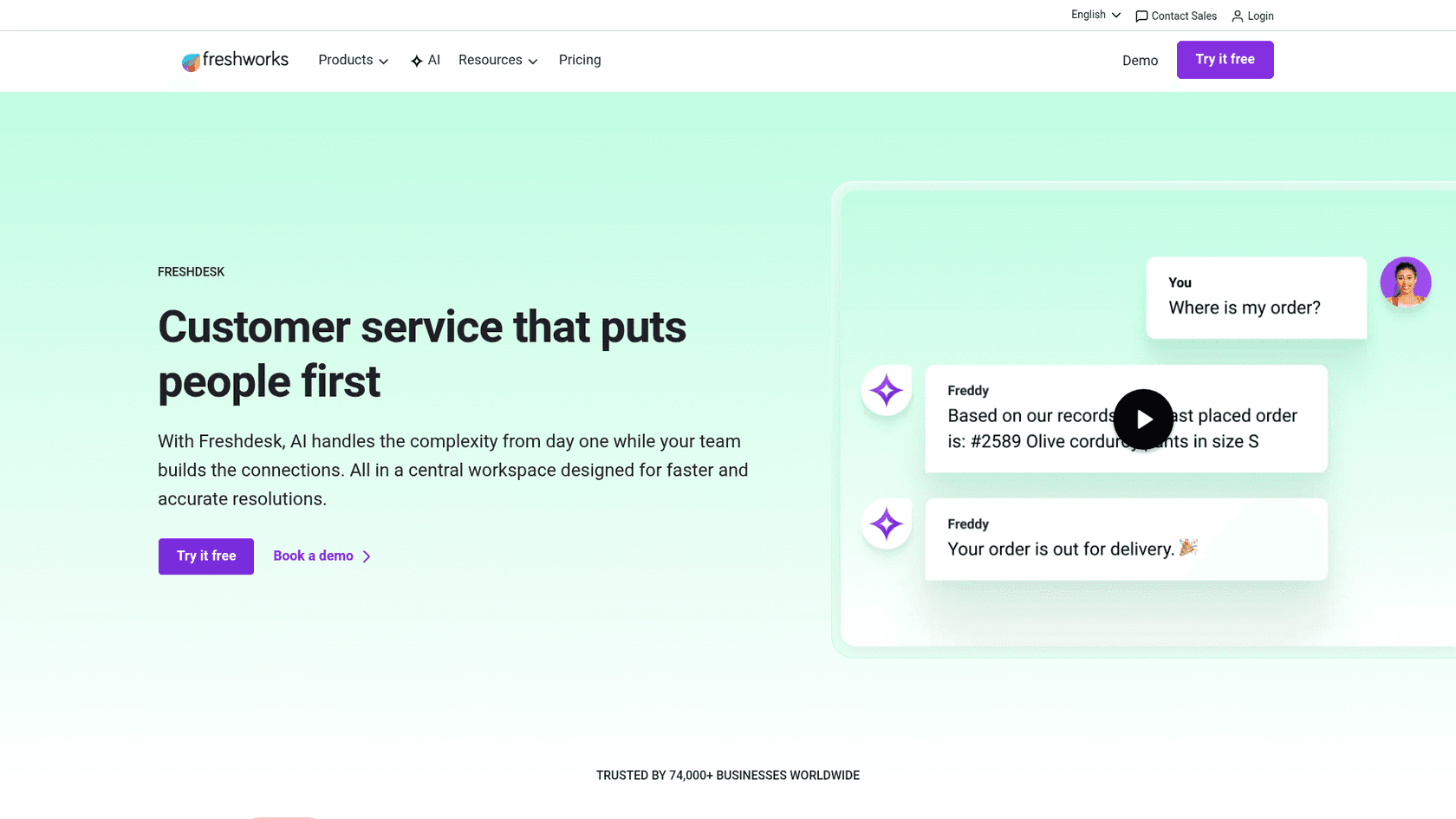
Freshworks' scale gives a sense of where Freshdesk sits. In its Q4 2025 earnings, the company reported that "more than 8,000 customers are now using Freddy AI", that "Freddy AI Agent conversations were up more than 80% to 3.5 million in Q4 within CX", and that "Freddy AI topped $25M ARR". Freshdesk itself carries a 4.4/5 rating across 3,728 G2 reviews.
The product is ticket-centric. Every inbound channel -- email, chat, WhatsApp, social, voice -- converts to a ticket that lives in a queue with an owner, priority, SLA, and status. The experience is fast to start (Freshworks offers a 14-day Enterprise trial, no credit card needed), reasonably easy to configure, and purpose-built for volume. If your team processes hundreds of customer support tickets per day, Freshdesk is designed exactly for that.
What is Jira Service Management?
Jira Service Management is Atlassian's ITSM platform, used primarily by IT operations, DevOps, and engineering-adjacent teams to manage infrastructure incidents, change requests, problem tracking, and internal employee service requests. It sits inside the Atlassian ecosystem alongside Jira Software, Confluence, and Statuspage, and integrates deeply with all of them.
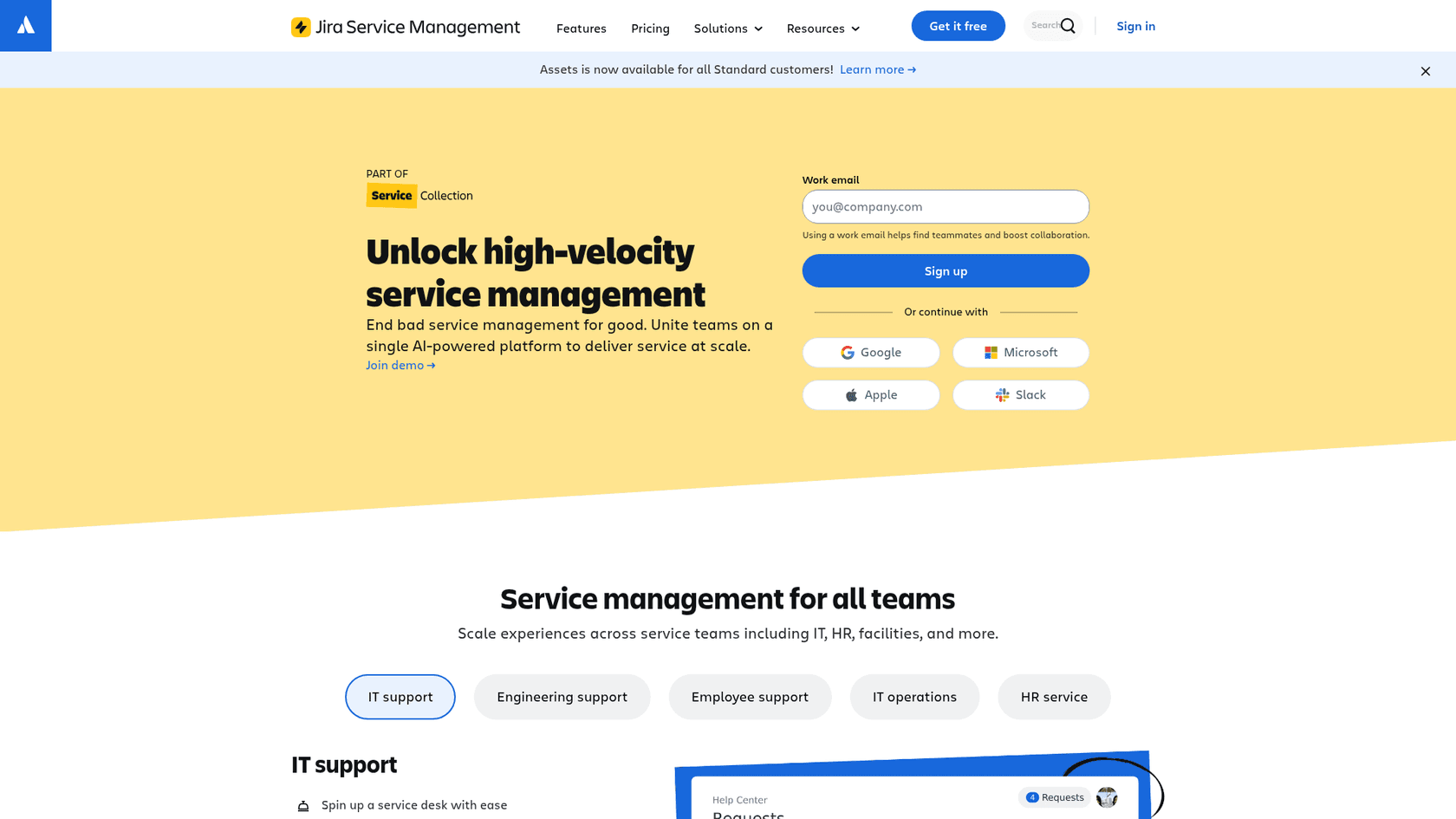
JSM claims 60,000+ customers and a Forrester-sourced 275% ROI over three years for enterprise deployments. On G2 it holds 4.3/5 from 973 reviews, with reviewers citing SLA tracking, customizable queues, and Atlassian-ecosystem integration as consistent strengths. The flip side of that same feedback: the setup is complex, the UI can feel overwhelming for new users, and the configuration of workflows, ticket types, and backend settings requires significant time investment.
Where Freshdesk abstracts most of that configuration away in favour of a faster setup, JSM leans into the power user. You get structured ITSM templates (IT service desk, HR service desk, facilities management), deep automation rules, CMDB-backed asset management, and a change management workflow that pulls deployment context directly from Jira Software. That power makes it the right call for IT teams with genuine ITSM needs. It's the wrong call for a customer support team that just needs a fast, clean queue for external requests.
How the two platforms compare
The sharpest summary before going deeper into each area:
| Freshdesk | Jira Service Management | |
|---|---|---|
| Primary audience | External customers (B2C/B2B support) | IT teams, DevOps, internal employees |
| Core workflow | Ticket queue, omnichannel inbound | Incident, problem, change, service request (ITSM) |
| AI: autonomous resolution | Freddy AI Agent (omnichannel, 50+ workflows) | Virtual service agent (Premium+) |
| AI: agent assist | Freddy AI Copilot (+$29/agent/month add-on) | Atlassian Intelligence / Rovo (Standard+) |
| ITSM workflows | Limited (ticketing + automation) | Incident, problem, change, CMDB, on-call |
| Asset management | No | Yes (Assets / Insight, CMDB) |
| Dev team integration | API / Jira connector | Native (same Atlassian platform) |
| Free plan | Yes (1-2 agents, 6 months) | Yes (up to 3 agents, no time limit) |
| Entry paid pricing | $19/agent/month (Growth, annual) | $20/agent/month (Standard, annual) |
| G2 rating | 4.4/5, 3,728 reviews | 4.3/5, 973 reviews |
Freshdesk features
Ticketing and omnichannel
Freshdesk handles ticket routing across email, web form, phone, chat, WhatsApp, Facebook, Instagram, and Twitter out of the box. The Omni bundle brings those channels into a unified agent workspace with conversation history across surfaces. Routing is rules-based (by keyword, priority, or customer segment) on Growth, with round-robin and skill-based routing on Pro and Enterprise.
Canned responses and macros cut repetitive typing. Internal notes let teammates collaborate on a ticket without the customer seeing the back-and-forth. The SLA tracking sets response and resolution targets by ticket type with escalation rules if a deadline slips. The reviews reflect that this UX works: "It helps me stay organized by keeping all tickets in one place and making it clear what needs priority. Features like canned responses and automation save a lot of time."
The known weak spots are load and reporting. "At times, Freshdesk can feel a bit slow or laggy, especially when handling multiple tickets at once... The reporting and search filters could also be more flexible and intuitive." The out-of-the-box reports cover the essentials, but building custom metrics requires exporting to a BI tool on most plans.
Freddy AI Agent
Freddy AI Agent is Freshdesk's customer-facing autonomous bot. It resolves tickets without a human, escalates with full context when it can't, and operates across every channel Freshdesk supports -- email, web chat, WhatsApp, Facebook, Instagram.
The knowledge side works through the AI Agent Studio, where you attach knowledge sources: files (.txt, .docx, .pdf up to 35MB, 200-file maximum per account), URLs (up to 10 per agent, up to 3,000 pages per URL, public-only), solution articles from the help centre, and Q&A pairs. There is no native connector for Confluence, Google Docs, Notion, or Slack -- any knowledge from those systems has to be exported and uploaded manually. For teams with a large, distributed knowledge base, that limit becomes a real ceiling.
The autonomous workflows are where Freddy AI Agent goes beyond simple FAQ deflection. The Vertical AI Agents come "pre-loaded with 50+ Agentic Workflows and integrations with Shopify, Stripe, PayPal, FedEx and more", covering order tracking, subscription changes, refunds, appointment rescheduling, and similar high-volume repetitive requests. Real-world performance numbers from Freshworks: "Freddy AI Agent deflected more than 50% of tickets for CX and EX customers" in Q4 2025.
Session pricing applies on top of plan fees: 500 free sessions (once per account on Pro/Enterprise), then $49 per 100 sessions for subsequent packs. The web chatbot rate was raised from $0.10 to $0.50 per interaction in early 2026 per the Q4 2025 earnings call, so budgeting for AI sessions is a real cost variable at scale.
Freddy AI Copilot
The agent-assist side of Freddy AI is Freddy AI Copilot, a $29/agent/month add-on (annual) available on Pro and Enterprise for Freshdesk Omni. It provides five in-ticket assistants: AI Writing Assistant (reply drafts from ticket context), AI Translation Assistant (60+ languages), AI Summarization Assistant (conversation summaries for handoffs), AI Resolution Assistant (similar ticket lookup and KB article suggestions), and AI Sentiment Assistant (real-time frustration and urgency detection).
One important constraint: the Copilot feature set on standalone Freshdesk ticketing is a strict subset of what you get on Freshdesk Omni. Conversation summarizer, auto-complete, live translation, and Conversational Knowledge Base are all "NA on standalone Freshdesk" -- they only activate with Omni or Freshchat. If you're on the ticketing-only SKU and evaluating Copilot, check the feature matrix first.
Freshworks reports "60% improved agent productivity" from Copilot usage, and the Copilot attach rate for customers over $30,000 ARR was above 50% in Q4 2025 per the earnings summary. The add-on model means you can roll it out to a subset of agents rather than the whole team.
Jira Service Management features
ITSM workflows
JSM's core feature set follows the ITSM framework: incident management, problem management, change management, and service request management. Freshdesk has no equivalent for three of those four.
Incident management in JSM runs a three-phase lifecycle: Respond (centralized alerts from monitoring tools, automatic categorization, multi-channel notifications via SMS/email/push/voice), Resolve (pre-built response templates, integrated video conferencing with Zoom/Slack/Teams, runbook attachment), and Learn (automatically generated incident timelines and postmortem reports, problem ticket creation, analytics for on-call optimization). That structure is designed for an IT team managing production infrastructure, not for a support team handling customer tickets.
Problem management links recurring incidents to a root cause record and tracks permanent resolution alongside temporary workarounds. Change management pulls deployment context from Jira Software -- so when a developer merges a PR and it causes a spike in support tickets, the change record surfaces that relationship without manual correlation. This dev-ops integration is the part that has no real parallel in Freshdesk.
A G2 reviewer who works in SysAdmin and compliance describes the day-to-day experience: "The customizable queues and automation rules really stand out. I use the SLA tracking and asset management every day for our SOC tickets and compliance audits. The drag-and-drop reassignments are quick and save me a couple of hours each week during incident response." The same reviewer notes the friction: "The reporting dashboard feels clunky when I need custom security metrics. Pulling SLA breach data requires extra filters and exports."
AI and Atlassian Intelligence
JSM's AI layer is called Atlassian Intelligence, with Rovo as the AI agent and search layer bundled into Standard and above. Virtual service agents (the autonomous customer-facing piece) are gated to Premium, not Standard -- that's a meaningful tier-lock for teams who want to automate routine requests without paying $51.42 per agent per month.
What Standard gets: Rovo Search and Chat (25 credits per user per month, 100 indexed objects per user), automated request triage, AI-powered agent suggestions, knowledge gap identification and draft article generation, and AI-assisted incident grouping and postmortem summaries. Premium doubles the Rovo allocation (70 credits, 250 indexed objects) and adds the virtual service agent.
The incident AI is genuinely useful for IT teams: JSM can correlate alerts from multiple monitoring tools, group related incidents into a single record, detect patterns in recurring issues, and generate postmortem reports automatically. That capability has no direct parallel in Freshdesk, which doesn't have an incident correlation layer at all.
For customer-facing AI resolution, Freshdesk's Freddy AI Agent is more developed. It handles more channels, has more pre-built autonomous workflows (50+ versus JSM's narrower IT-focused triage), and has been in production at larger scale. If "resolve customer tickets autonomously" is the primary AI goal, Freshdesk Omni is the more capable platform.
Asset management and CMDB
JSM includes Assets -- a configuration management database (CMDB) that tracks hardware, software, and infrastructure with ownership, lifecycle status, and relationships between items. An IT team can link a service request to the specific asset involved, see the configuration item's history, and understand blast radius during incidents.
Freshdesk has no equivalent. There is no asset tracking, no CMDB, no configuration item record. If your use case involves IT asset management, that is a hard technical reason to be on JSM.
Jira Software integration
The native connection between JSM and Jira Software is the strongest single differentiator JSM holds over any customer support tool. Incidents and service requests in JSM can link to Jira Software issues directly, giving development teams visibility into what's causing support volume and giving support teams visibility into fix progress. Change requests in JSM pull deployment context from Jira Software automatically -- so the ops team can see what changed before they approve.
If your company already uses Jira Software for engineering work, JSM extends that same issue-tracking model to IT and support work without requiring your teams to learn a second platform. If you're not already in the Atlassian ecosystem, that integration advantage doesn't exist yet -- and the setup overhead is real.
Pricing compared
Freshdesk pricing
Freshdesk has two pricing tracks:
Freshdesk (ticketing-only), billed annually:
| Plan | Price/agent/month | Notes |
|---|---|---|
| Free | $0 | 1-2 agents, 6-month limit, basic features |
| Growth | $19 | Ticketing, customer portal, reports |
| Pro | $55 | Custom portals, custom objects, advanced routing |
| Enterprise | $89 | Audit logs, approval workflows, skill-based assignment |
Freshdesk Omni (omnichannel), billed annually:
| Plan | Price/agent/month | Notes |
|---|---|---|
| Growth | $29 | Omnichannel + AI agents across web, SMS, messaging, email |
| Pro | $79 | Everything in Growth + custom portals, advanced reporting |
| Enterprise | $119 | Everything in Pro + audit logs, skills-based assignment |
Add-ons on top:
- Freddy AI Copilot: +$29/agent/month annual (Pro and Enterprise Omni only)
- Freddy AI Agent sessions: 500 free sessions (once per account), then $49 per 100 sessions
- Day passes: $5/pass for occasional agents
Jira Service Management pricing
JSM now sells as part of Atlassian's Service Collection, which bundles JSM with Customer Service Management, Assets (CMDB), and Rovo at a single per-agent price. The old standalone JSM pricing has been replaced with this collection:
| Plan | Price/agent/month | Key inclusions |
|---|---|---|
| Free | $0 | Up to 3 agents, basic request management, 2 GB storage |
| Standard | $20 | 100,000 agents max, 250 GB storage, 5,000 automation runs/month, Rovo (25 credits/user/month) |
| Premium | $51.42 | Unlimited storage, virtual service agent, 24/7 support, 70 Rovo credits/user/month, financially backed 99.9% SLA |
| Enterprise | Contact sales | 99.95% SLA, unlimited automations, multiple sites (up to 150), centralized governance |
The Atlassian Rovo inclusion is meaningful: Standard gets Rovo Search, Chat, and Agents at 25 credits per user per month and 100 indexed objects per user. Premium doubles that to 70 credits and 250 indexed objects. These aren't add-ons -- they're bundled in the base price.
The virtual service agent -- JSM's autonomous customer-facing bot -- is Premium-only. For Standard customers, there's no equivalent to Freshdesk's Freddy AI Agent unless you add a third-party tool.
Pricing summary
At the Growth/Standard entry tier, the two products cost almost the same ($19 vs $20). The gap opens in the middle: Freshdesk Omni Pro at $79 versus JSM Premium at $51.42. But that comparison isn't apples-to-apples. JSM Premium includes unlimited file storage, 24/7 premium support with one-hour response times, and the virtual service agent. Freshdesk Pro omnichannel at $79 requires an additional $29/agent for Copilot, plus session fees for Freddy AI Agent usage.
A ten-agent team on Freshdesk Omni Pro with Copilot for everyone: $79 + $29 = $108/agent/month = $1,080/month, plus AI session fees. The same team on JSM Premium: $51.42/agent/month = $514/month, with the virtual service agent already included. The JSM Premium number looks significantly better on paper, but JSM Premium is for an IT service desk, not an external customer support operation.
When to choose Freshdesk
Freshdesk is the right choice when:
- Your team handles external customer support -- orders, billing questions, product issues, onboarding requests from paying customers.
- You need omnichannel coverage across email, live chat, WhatsApp, social, and voice in one workspace.
- AI autonomous resolution is a priority and you want it on web chat and email without heavy engineering work. Freddy AI Agent's pre-built Shopify, Stripe, and FedEx workflows cover most ecommerce and SaaS support use cases.
- You want fast time to value -- Freshdesk's setup takes hours, not weeks. The free Enterprise trial lets you see the full product before committing.
- Your team is not using Jira Software and doesn't have ITSM needs like incident management, change requests, or asset tracking.
- You're comparing options for customer service ticketing systems and need deep omnichannel rather than internal IT process tooling.
Read the complete Freshdesk overview and the Freshdesk pricing breakdown for more detail. If you're also considering Freshservice -- Freshworks' ITSM product -- the Freshservice vs Freshdesk comparison covers that same internal vs external support question within the Freshworks family.
When to choose Jira Service Management
JSM is the right choice when:
- Your team is an IT operations or DevOps team managing incidents, change requests, on-call schedules, and infrastructure.
- You're already using Jira Software for engineering work and want the service desk on the same platform.
- You need ITSM workflows -- incident/problem/change management, CMDB, SLA management with ITIL-aligned processes.
- Asset management (hardware inventory, software licensing, CMDB) is a requirement.
- Your employees submit IT requests (device setup, access requests, software installs) and you need a structured service catalog to manage that volume.
- You're managing an enterprise with multiple departments (IT, HR, facilities) all running service desks on a single governance-grade platform.
JSM is not well-suited for teams whose primary job is handling inbound customer support at scale, especially if those customers reach you via chat, WhatsApp, or social. The portal is designed for internal users, the pricing model reflects that, and the setup assumes ITSM knowledge.
The AI gap -- and where both platforms fall short
Both products have real AI capabilities in 2026, but each has meaningful limits.
Freshdesk's Freddy AI Agent is capable and improving, but knowledge source ingestion is capped: 200 files per account, 10 URLs per agent. Teams with a distributed knowledge base across Confluence, Notion, Google Docs, and Slack have no native path to connect that content. Anything not in Freshdesk's own solution articles or uploaded as files is out of reach for the AI agent.
JSM's virtual service agent (Premium only) handles IT-specific triage well but doesn't have the autonomous workflow depth Freshdesk's agent has for customer-facing use cases. Rovo -- bundled in Standard -- is more of an AI assistant for agents than a resolution bot for customers.
If you're on either platform and want an AI layer that reads your existing knowledge base (wherever it lives) and resolves tickets accurately without session caps or plan upgrades, that's the gap a tool like eesel AI is designed to fill. It connects to Freshdesk, Jira, Confluence, Notion, Google Docs, and Slack, and handles repetitive tickets directly inside your existing helpdesk. There's also an existing Freshdesk-Jira integration pattern worth reading if your team uses both tools across different departments.
Freshdesk or JSM: the decision
The two products solve different problems, and most teams can make the call cleanly once they're honest about who they're supporting.
If your users are external customers -- and your goal is reducing ticket volume, improving response time, and automating routine queries -- choose Freshdesk. The UI is purpose-built for support teams, the AI is mature for customer-facing use, and the setup is fast enough to show value in a single sprint.
If your users are internal employees and your team does ITSM work -- managing infrastructure, change requests, incidents, and assets -- choose JSM. The ITSM workflow depth, Jira Software integration, and asset management capabilities have no real equivalent in Freshdesk, and the Atlassian ecosystem value compounds if you're already using their products.
The only genuinely contested middle ground is the company that does both: an IT team that wants to consolidate internal and external support on one platform. In that case, JSM's Customer Service Management module (bundled in the Service Collection) is worth evaluating against Freshdesk Omni. But that's the exception. For most teams, the question answers itself once you know who you're supporting.
Frequently Asked Questions
Can Jira Service Management replace Freshdesk for external customer support?
Which is cheaper: Freshdesk or Jira Service Management?
Does Freshdesk integrate with Jira?
Which tool has better AI in 2026?
Is there an AI agent that works with both Freshdesk and Jira Service Management?


Article by
Rama Adi Nugraha
Rama is a software engineer at eesel AI with two years of experience writing about B2B SaaS, AI tools, and customer support technology. Based in Bali, Indonesia, he brings a developer's perspective to product comparisons — cutting through marketing copy to what the integrations and APIs actually do.