Choosing a helpdesk for a healthcare organization is a different problem than choosing one for an e-commerce team or a software company. The wrong choice does not just mean missed SLAs or an awkward UI - it means potential HIPAA violations, OCR investigations, and penalties that run into the millions. The right platform has to earn a Business Associate Agreement, meet the HIPAA Security Rule's technical safeguards, and still work well enough that a front-desk team at a busy clinic will actually use it.
There are broadly two use cases inside healthcare: patient-facing support (appointment requests, billing questions, insurance issues, portal login help) and internal IT helpdesk (EHR access, clinical device support, change management). Some teams need both in one system. The platforms below cover both, with different strengths in each.
We looked at six options that can all sign a BAA and handle PHI: Zendesk, Help Scout, HappyFox, Freshdesk, Zoho Desk, and Jira Service Management. Here is what actually matters for healthcare and how each one stacks up.
What healthcare buyers look for
Six criteria drive the evaluation in healthcare that you would not weight as heavily elsewhere.
BAA availability and conditions. Under HIPAA, any vendor that creates, receives, maintains, or transmits PHI on your behalf must sign a BAA. The BAA is not optional and does not require the vendor to do anything dramatic - it just documents that they will handle PHI responsibly and report breaches within 60 days. The catch: not every vendor signs them on every plan, and some attach conditions (specific configurations, Enterprise-only eligibility) that matter.
Encryption and security certifications. AES-256 at rest, TLS 1.2 or higher in transit, and role-based access control are the floor. SOC 2 Type II is the standard certification to expect. ISO 27001 and FedRAMP signal higher investment in security governance.
Audit trails. Every access to PHI must be logged. Who read the ticket, who modified it, when, from where. These logs are the first thing an auditor requests after a breach.
AI and the BAA. AI-powered responses, auto-categorization, and ticket summarization are table stakes in 2026 - but AI features only hold up in healthcare if the vendor has covered them under the BAA and they are configured not to expose PHI to external model providers without consent.
Patient-specific workflows. Appointment reminders, multi-department inboxes, secure messaging, and omnichannel intake (email, chat, phone) across multiple clinic locations are table stakes for patient-facing teams.
EHR and clinical system integration. The faster an agent can pull patient context without re-keying data from a separate system, the better the support experience and the lower the risk of a manual data handling error.
Quick comparison
| Tool | Best for | HIPAA/BAA | Pricing from |
|---|---|---|---|
| Zendesk | Enterprise health systems and payers | BAA available; Suite Professional required + Advanced Compliance add-on | $115/agent/mo (Suite Professional) |
| Help Scout | Clinics, telemedicine, small to mid-size practices | BAA available; Pro plan only | $75/user/mo (Pro) |
| HappyFox | Mid-size healthcare orgs with complex workflows | BAA included; available across plans | From $21/agent/mo |
| Freshdesk | Mid-market teams wanting AI + omnichannel | BAA available; Enterprise plan only | Custom (Enterprise) |
| Zoho Desk | Budget-conscious teams and growing practices | BAA on request, any plan | From $14/user/mo (Standard) |
| Jira Service Management | Internal healthcare IT helpdesks | BAA available; AI must be disabled | $20/agent/mo (Standard) |
1. Zendesk
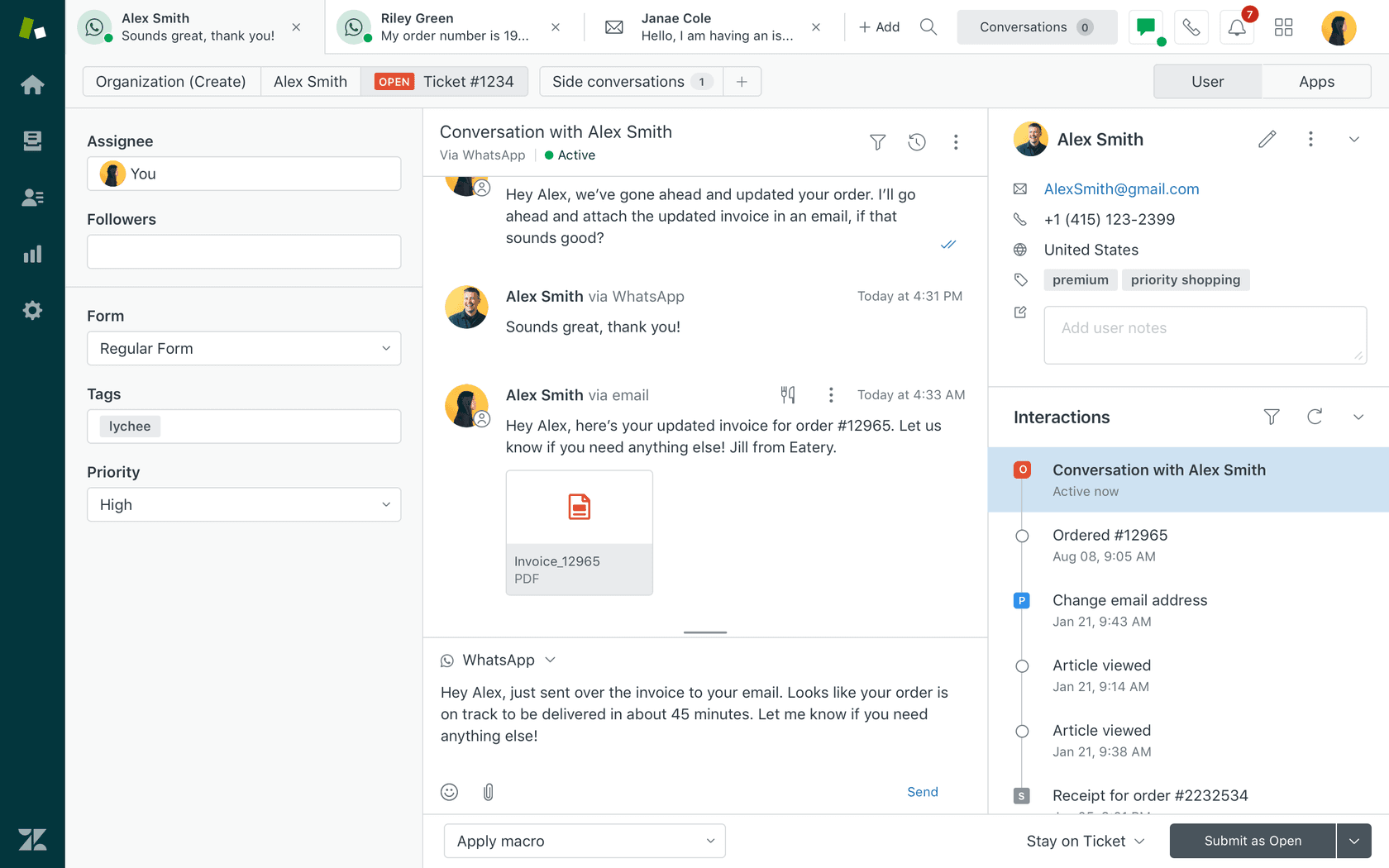
Zendesk is the largest pure-play customer service platform in this list, with 100,000+ companies running support on it. In healthcare specifically, it serves NHS Greater Glasgow and Clyde, Omada Health, One Medical, Veeva, mySugr, Fullscript, and Virgin Pulse - a range that spans public hospital systems, digital health companies, and life sciences vendors. That breadth of named healthcare customers is wider than any other platform on this list.
The healthcare industry page positions Zendesk around a "360-degree patient view" - pulling data from EHRs, appointment history, and partner systems into a single agent screen. Omnichannel intake (phone, chat, email, web form), skills-based routing, and the Explore analytics dashboard round out the patient-support story. For payer networks and distributed care teams, the side-conversation and collaboration features let internal teams coordinate without breaking the patient-facing thread.
Zendesk acquired Forethought in March 2026, folding agentic AI into the Resolution Platform. The practical effect for healthcare teams: AI Agents (autonomous resolution) and Copilot (agent assist) are now on the same platform. Both are covered under the BAA when the Advanced Compliance add-on is active, but they cannot be used to provide medical advice, diagnoses, or treatment recommendations - a constraint to wire into your configuration.
HIPAA compliance
Zendesk signs a BAA via DocuSign and extends coverage to Support, Guide, Gather, Chat/messaging, Explore, and Talk (voice). SMS/text is explicitly excluded - do not route PHI through it. Marketplace apps and social media channel integrations are also out of scope unless you execute a separate BAA with those providers.
The required plan is Suite Professional or Enterprise, plus the Advanced Compliance add-on. Mandatory post-BAA configurations include enforced 2FA for all agents, SSL always on, IP restrictions (or MFA as an alternative), and requiring authentication for attachment access. Legacy CSAT must be disabled. Full configuration requirements are in Zendesk's security guide.
Certifications: SOC 2 Type II, ISO 27001:2022, ISO 27018, ISO 27701, FedRAMP LI-SaaS.
Pricing
| Plan | $/agent/mo (annual) | HIPAA eligible |
|---|---|---|
| Suite Team | $55 | No |
| Suite Professional | $115 | Yes (+ Advanced Compliance add-on) |
| Suite Enterprise | $169 | Yes (+ Advanced Compliance add-on) |
| Advanced Data Privacy add-on | $50 | Required for BYOK, PII redaction |
Who it is for
Larger health systems, payers, and digital health companies that need an enterprise-grade omnichannel platform with strong security certifications and a proven healthcare track record. The cost makes it hard to justify for a single-location practice.
Where it falls short
HIPAA setup is not self-serve - it requires the Advanced Compliance add-on plus manual configuration of several security controls. Suite Professional at $115/agent/month is a meaningful budget commitment before the add-on. And SMS, which some patient communication workflows rely on, is excluded from BAA coverage entirely.
2. Help Scout
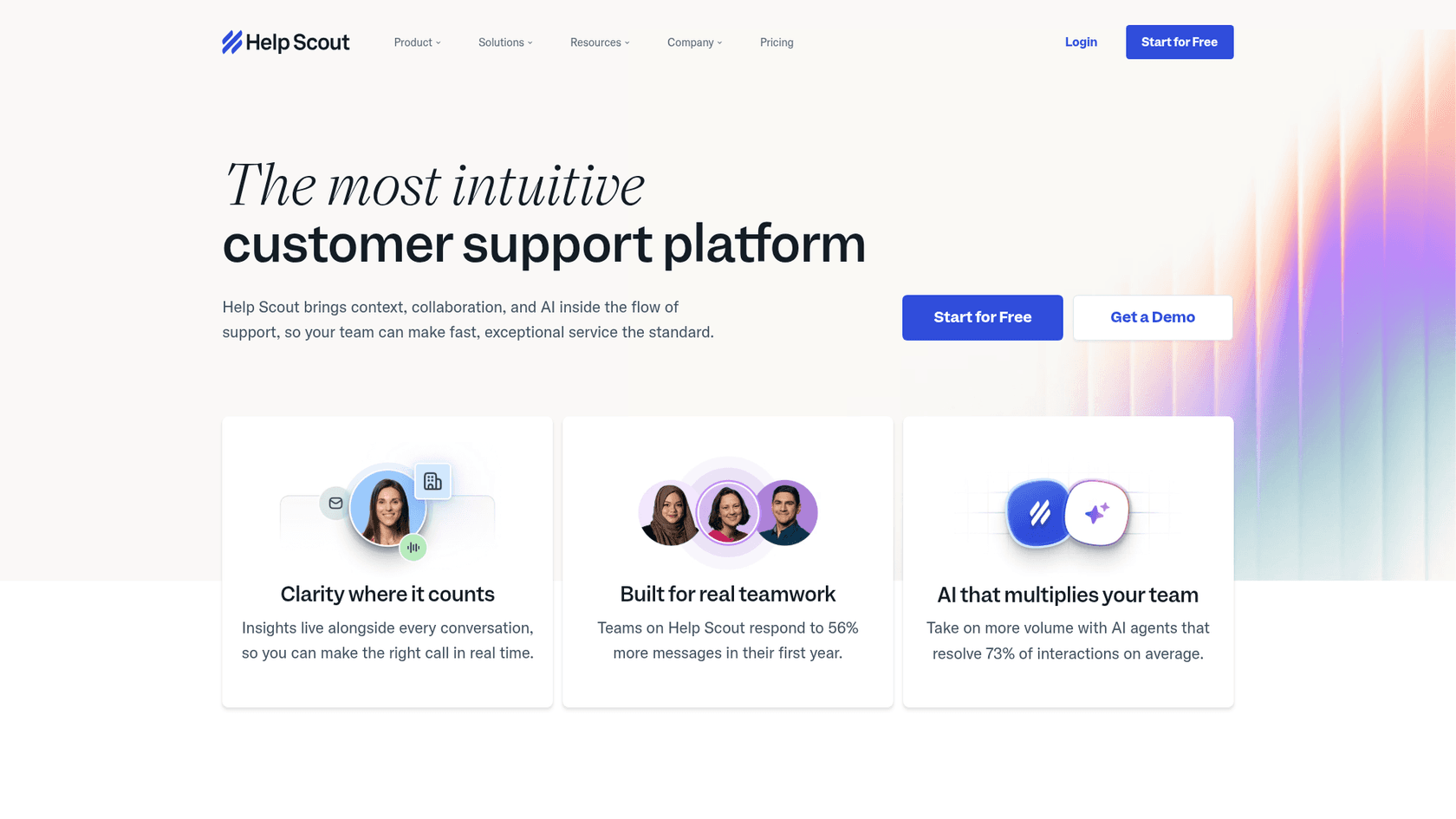
Help Scout takes a different approach than the enterprise platforms: simpler, more opinionated, and built for teams that want clean shared-inbox support without a long configuration phase. It has a dedicated healthcare landing page with a customer list that reads like a telemedicine directory: CityMD, Crossover Health, Defy Medical, SteadyMD, Valera Health, and Arizona Care Network. The mix of urgent care, direct primary care, telemedicine, mental health, and ACO customers suggests it has traction specifically with the modern, tech-forward end of healthcare delivery.
The core use case is patient-facing support: appointment requests, billing questions, insurance inquiries, and care coordination. Help Scout creates separate inboxes per department (patient care, billing, scheduling, individual locations), assigns conversations to specific agents, and uses collision detection to prevent two staff members from replying to the same patient simultaneously. Inbox-level access controls limit which staff members can see which inboxes - useful when you do not want billing agents reading clinical notes.
The Beacon widget drops into any webpage as a chat or contact form, with knowledge base content surfaced inline before a patient submits a request. For clinics that want to deflect "what are your hours," "where do I park," and "how do I access my patient portal" without routing them to a human, Beacon does the job cleanly.
Help Scout's AI Answers resolves an average of 73% of interactions autonomously - though its strength is self-service queries, not complex clinical or billing escalations.
HIPAA compliance
HIPAA support is Pro plan only. Help Scout offers two BAA documents: one for covered entities, one for subcontractors. Both are signed online; Help Scout cannot modify the standard terms.
AI features are disabled by default on HIPAA accounts and require signing an additional AI Feature Healthcare Addendum to activate. Help Scout Docs (the public knowledge base) is explicitly excluded from HIPAA compliance - use it for non-sensitive content (office hours, general FAQs) only. The Slack integration strips conversation content from notifications when HIPAA is active.
Certifications: SOC 2 Type 2 (Security and Availability), AWS-hosted infrastructure.
Pricing
| Plan | $/user/mo (annual) | HIPAA eligible |
|---|---|---|
| Standard | $25 | No |
| Plus | $45 | No |
| Pro | $75 (10-user minimum) | Yes |
| AI Answers | $0.75/successful resolution | Requires AI Healthcare Addendum |
Who it is for
Clinics, telemedicine platforms, and small-to-mid-size practices that handle primarily patient-facing communication (scheduling, billing, general inquiries) and want a clean, fast-to-deploy solution without the complexity of an enterprise platform.
Where it falls short
The 10-user minimum on the Pro plan locks out very small practices. Help Scout Docs being outside HIPAA scope is a meaningful limitation - you cannot use the knowledge base for anything that might include patient-specific details. Limited IT service management features make it a poor fit for internal hospital IT helpdesk work.
3. HappyFox
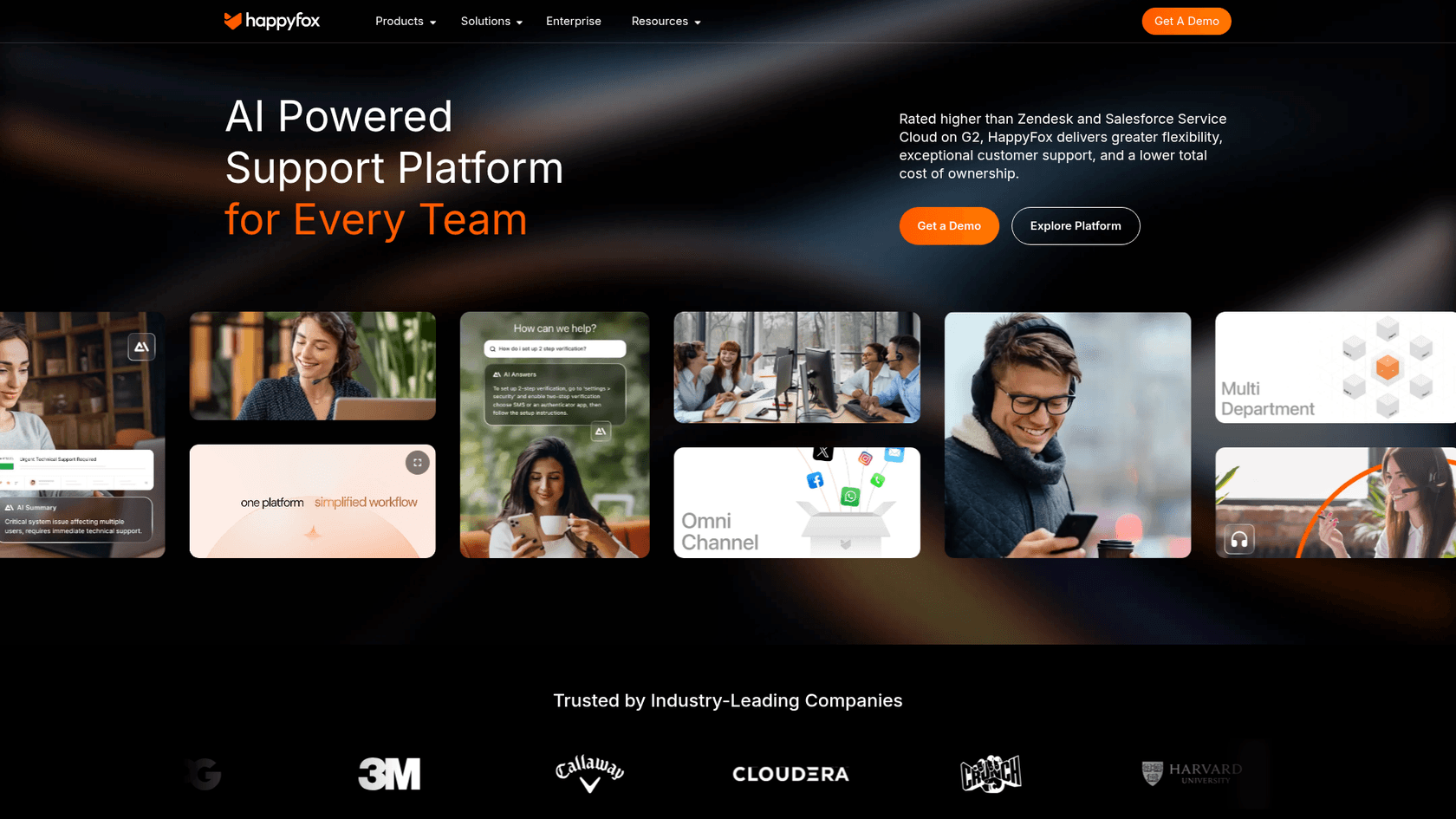
HappyFox has the most substantial documented healthcare track record of the mid-market platforms on this list. North Country Healthcare, a three-hospital consortium in the US, saved approximately $100,000 annually after consolidating service management across 13 departments onto HappyFox - covering IT, HR, Clinical Services, Facilities Management, and more. Medipulse Hospital in India reported a 60% improvement in patient feedback resolution time and a 45% reduction in equipment downtime after implementing the platform.
The healthcare solutions page maps out four specific use-case categories: patient support coordination (appointment scheduling, record transfers, feedback), insurance and billing management (claims, coverage verification, payment plans), compliance operations (audit trail management, breach tracking, regulatory reporting), and internal hospital operations (EMR/EHR support, staff onboarding, equipment maintenance). The specificity here is meaningful: most general-purpose helpdesks describe healthcare in vague terms; HappyFox has structured workflows for each of these.
The Smart Rules automation engine routes urgent patient inquiries automatically, sends appointment confirmation reminders, and triggers insurance verification follow-ups without manual steps. Role-based access controls let administrators define separate permission levels for physicians, nurses, billing staff, and management.
A Forrester Total Economic Impact study commissioned by HappyFox found 401% ROI over three years for power users, with cost savings from reduced manual work hours as the primary driver. The North Country Healthcare case study aligns with that framing: the savings came from eliminating thousands of hours of manual coordination across six departments, not from reducing headcount.
HIPAA compliance
HappyFox is explicitly HIPAA-compliant and provides a BAA as part of its healthcare offering. Coverage extends to HITECH and the platform holds SOC 2 Type II certification.
Security features: AES-256 encryption at rest and in transit, RBAC, 2FA, session timeouts, IP restrictions, comprehensive audit logging with modification history and failed-login alerts, and automatic deprovisioning for external collaborators.
HappyFox does not specify a minimum plan tier for the BAA on its public documentation - the healthcare solutions page states HIPAA compliance is available as part of the healthcare offering. Confirm the specific plan conditions during the sales conversation.
Pricing
| Plan | $/agent/mo | Notes |
|---|---|---|
| Basic | $21 | Annual billing |
| Team | $44 | Annual billing |
| Pro | $89 | Annual billing; agent scripting, advanced audit logs |
| Unlimited-agent plans | From $1,999/mo | Annual, volume-tiered |
A 10% discount is available for non-profits and educational healthcare institutions.
Who it is for
Mid-size healthcare organizations that need a single platform for both patient-facing support and internal operations (IT, HR, Facilities, EMR support) with compliance built in. The North Country Healthcare case study is a good reference point: three hospitals, 13 departments, moderate IT resources.
Where it falls short
G2 reviews note variable response times from HappyFox's support team on complex technical issues. The reporting module is cited by some customers as harder to work with than expected. No native EHR connectors - integrations rely on its API or the 100+ third-party integrations library, with custom work needed for unusual systems.
4. Freshdesk
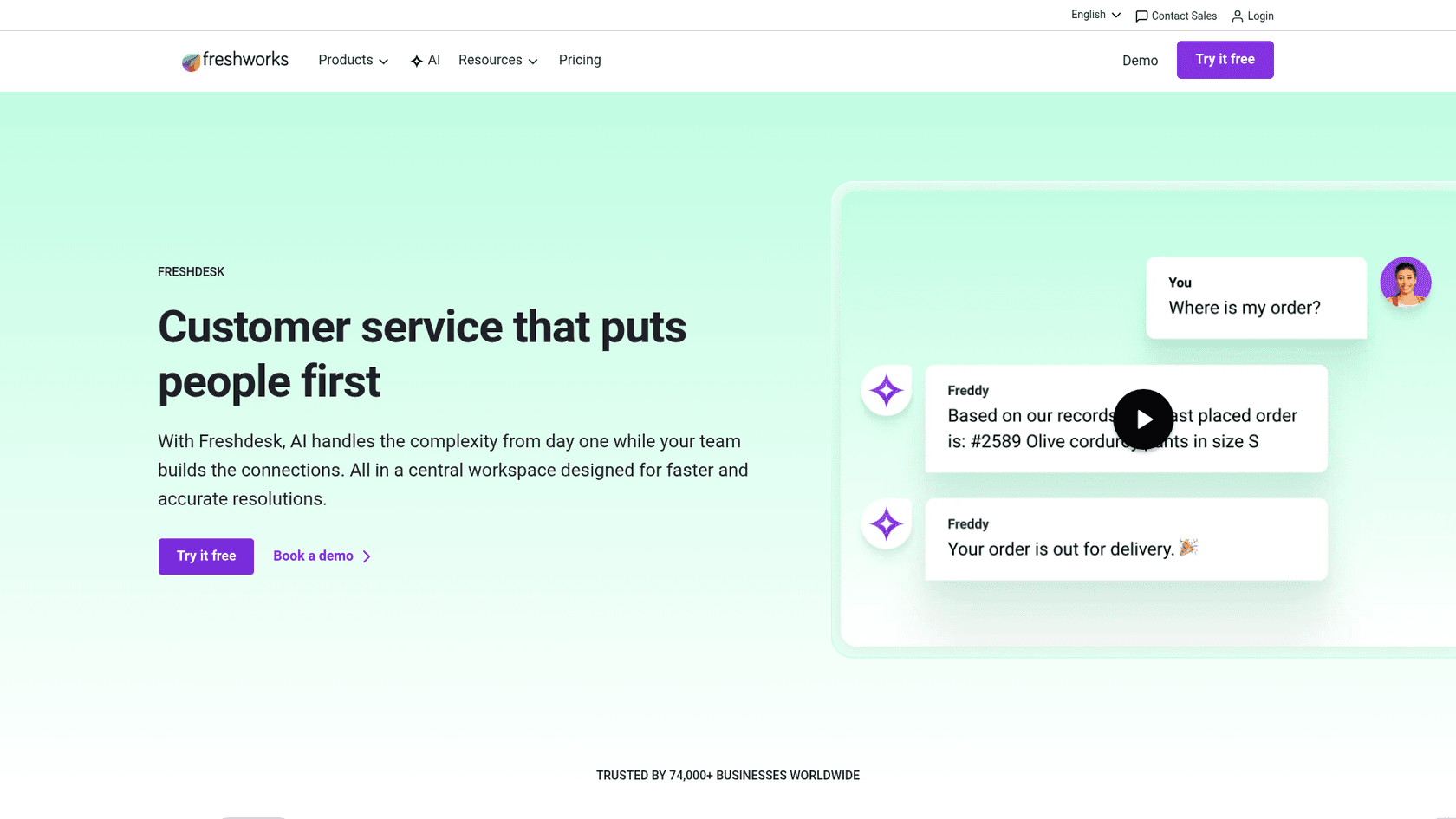
Freshdesk by Freshworks has a dedicated healthcare solutions page that maps out support scenarios for four groups: doctors and care staff, administrators, patients, and pharmaceutical/research teams. The patient-side story centers on chatbot-driven appointment booking, rescheduling, prescription refill requests, and bill payment - a broader self-service scope than most platforms in this list.
The AI layer is called Freddy. Freddy AI Agent handles customer-facing conversation autonomously across email, chat, and phone. Freddy AI Copilot assists human agents with reply drafts, sentiment analysis, and resolution suggestions. Q4 2025 earnings showed 3.5 million AI Agent conversations in the CX product, and Freddy AI is now above $25M ARR - not a research project.
Freshdesk markets itself as "the safest help desk for healthcare organizations" and describes role-based access controls across the care hierarchy, shift management for administrators, and workflow automation for billing and insurance processes. The most concrete published healthcare reference is Salinas Valley Memorial Healthcare System - a 2,000-staff California district healthcare system covering 600,000+ patients annually - though that case study involves Freshservice (the ITSM product) rather than Freshdesk specifically.
HIPAA compliance
Freshdesk signs a BAA, but only on the Enterprise plan. Free, Growth, and Pro tiers are ineligible. The BAA covers Freshdesk, Freshchat, Freshcaller, and Freshdesk Omnichannel - other Freshworks products (Freshsales, Freshmarketer) are explicitly excluded.
The BAA has conditions. Five mandatory configurations must remain active to keep the agreement valid: IP whitelisting, SAML SSO or an advanced password policy, a custom mailbox (own mail server), SSL, and Freshconnect disabled. Default form fields cannot be encrypted - PHI must go into custom encrypted fields. Letting any of these lapse can invalidate the BAA.
Certifications: ISO/IEC 27001, SOC 2, Cyber Essentials Plus.
Pricing
| Plan | $/agent/mo (annual) | HIPAA eligible |
|---|---|---|
| Freshdesk Growth | $19 | No |
| Freshdesk Pro | $55 | No |
| Freshdesk Enterprise | $89 | Yes |
| Freshdesk Omni Enterprise | $119 | Yes |
| Freddy AI Copilot add-on | $29/agent/mo | Pro/Enterprise only |
Who it is for
Mid-to-large healthcare teams that need strong AI-assisted support alongside HIPAA compliance and are willing to manage the Enterprise plan's mandatory configuration requirements. A good fit if you are already in the Freshworks ecosystem (using Freshservice for IT alongside Freshdesk for patient support).
Where it falls short
The five mandatory configurations are a real operational commitment - they must be actively maintained, not set once. The BAA scope is narrow: Freshchat, Freshcaller, and Freshdesk Omnichannel are covered, but other Freshworks tools are not. Enterprise pricing is custom-quoted, which means no transparent price to budget against.
5. Zoho Desk
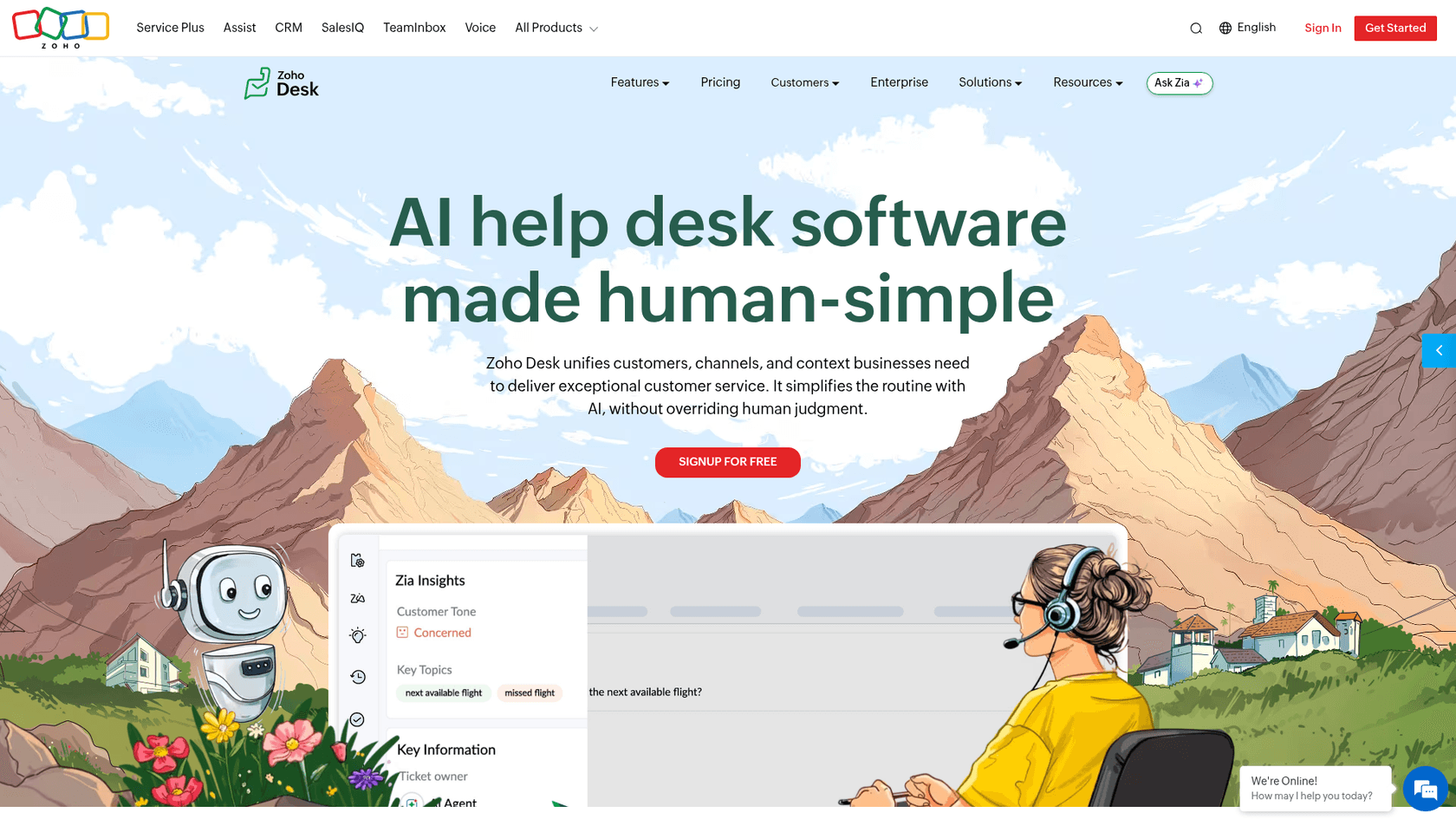
Zoho Desk is the most accessible HIPAA-compliant helpdesk on this list from a price and plan-eligibility perspective. The BAA is available on any plan - you email legal@zohocorp.com to request it. There is no Enterprise-only gating, no mandatory add-on, and no minimum seat count tied to compliance. For a small practice or a growing clinic watching spend, that matters.
Zoho has built a dedicated healthcare vertical that positions Desk alongside Practice Management Software, a Healthcare CRM, Home Healthcare software, and Patient Referral Management. For organizations already in the Zoho ecosystem, Desk connects to that stack directly. The most concrete live healthcare deployment found in research is Bastion HMO, a health maintenance organization that runs its provider FAQ and member support portal on Zoho Desk, with a 24-hour call center integration.
The feature that stands out for healthcare specifically is ePHI field management. Custom ticket fields can be flagged as ePHI in the layout editor, and marking a field ePHI automatically enables field-level encryption for that data. This is a precise, workflow-level compliance tool rather than a blanket account-level setting. Combined with the Guided Conversations healthcare use case - a documented template for patient self-service chatbot flows covering appointment FAQs and care routing - Zoho Desk has more healthcare-specific product depth than its price point might suggest.
The AI layer is called Zia. Zia includes response drafting, ticket summarization, sentiment analysis, and the Zia Answer Bot for self-service. Advanced Zia AI features are restricted to the Enterprise plan, but the bot and basic automation are available below that tier.
"NOOA Brasil saved 35% in licensing costs while increasing team productivity by 30%."
HIPAA compliance
Zoho Desk is HIPAA-eligible and will sign a BAA upon request via email. The BAA covers protection of PHI through encryption, ePHI field designation, RBAC administration, and audit trail exports. Zoho does not use customer PHI for its own purposes.
Security: AES-256 encryption at rest, TLS 1.2/1.3 in transit, MFA (biometric, TOTP, Yubikey), SAML SSO, audit logs retained for up to 1 year and exportable. Daily incremental and weekly full backups, AES-256 encrypted, 3-month retention.
No single-vendor compliance certifications page was verified in this research pass - confirm the current certification list with Zoho directly before committing.
Pricing
| Plan | $/user/mo (annual) | Notes |
|---|---|---|
| Free | $0 | 3 users |
| Standard | ~$14 | BAA available on request |
| Professional | ~$23 | BAA available on request |
| Enterprise | ~$40 | Zia AI Answer Bot + advanced AI |
Prices shown are approximate USD equivalents; verify current USD pricing at zoho.com/desk/pricing.html as Zoho displays regional pricing in local currency.
Who it is for
Small to mid-size practices, health plans, and growing clinics that need HIPAA compliance without Enterprise-tier pricing. Organizations already running other Zoho products get the tightest integration benefit.
Where it falls short
Advanced AI features are gated to Enterprise. The G2 data from this dossier was blocked by Zoho's scraping protection, so third-party review sentiment is less documented here than for some competitors. EHR integration relies on Zoho Marketplace apps or API work rather than native connectors.
6. Jira Service Management
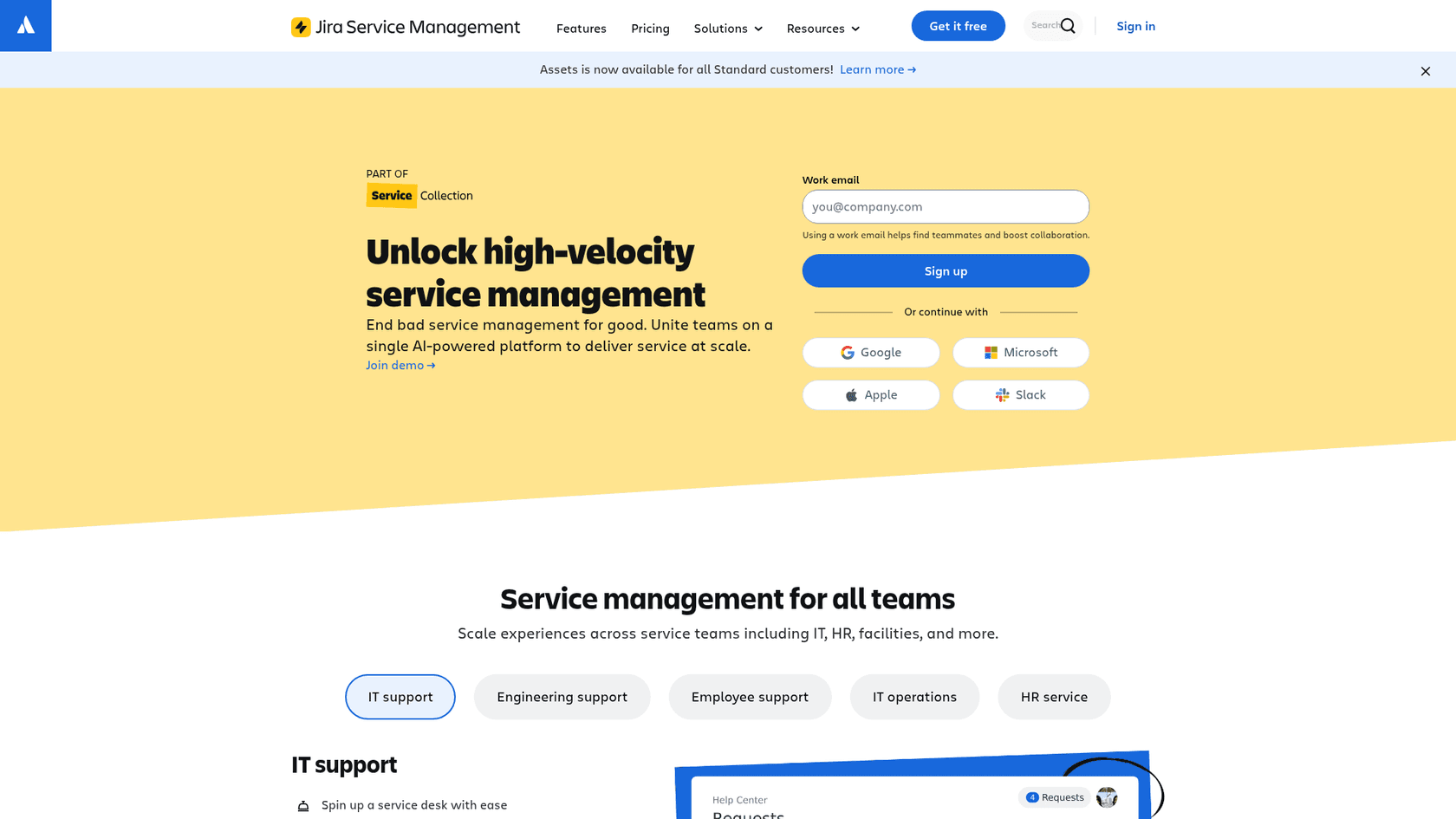
Jira Service Management (JSM) by Atlassian is the odd one out on this list in the best possible way: it is not primarily a customer-facing helpdesk, it is an ITSM platform. That makes it the best fit for the internal IT helpdesk use case in healthcare - managing EHR access issues, clinical device support, change management for hospital systems, and staff service requests.
The evidence for this is specific. CHG Healthcare, a healthcare staffing firm, was processing 40,000 service requests per month via email before moving to JSM. Post-migration: $120,000 in savings and 80% reduction in maintenance time. The California Department of Health Care Services (DHCS), running 4,000 users, cut one project's timeline from 18 months to 6 months and reduced cost from $2.8M to $600K - a $2.2M saving. ACT Health in Australia runs a live patient portal for Digital Health Record support directly on JSM.
For teams already in the Atlassian ecosystem (Jira Software for development, Confluence for documentation), JSM adds ITSM functionality at low marginal cost. Asset management is included in Standard, change management covers deployment gating via CI/CD integration, and incident management with Opsgenie handles on-call alerting for clinical infrastructure outages. The Gartner Peer Insights score is 4.5/5 from 1,458 verified reviews, reflecting broad deployment success.
The limitation that matters most in healthcare: Atlassian requires you to disable all AI features on HIPAA-tagged sites. That means no virtual agent, no Rovo AI, no AI-suggested responses. If AI-assisted support is a priority, JSM is the wrong choice for HIPAA accounts. If you just need solid ITSM with compliance, it is fine. For teams that want AI on top of JSM without compromising the HIPAA configuration, eesel AI can layer on top with its own BAA.
HIPAA compliance
Atlassian signs a BAA on Standard, Premium, and Enterprise plans. Standard and Premium use self-service signing through Atlassian Admin; Enterprise requires an account representative. Government Cloud cannot sign BAAs.
After signing, customers must: tag apps as HIPAA, follow the HIPAA Implementation Guide, and disable Atlassian AI on all HIPAA-tagged sites. The JSM-specific settings include enabling "Safe customer notifications" and the "HIPAA-compliant alert" toggle.
Security: Atlassian Guard handles SSO, audit logging, and policy enforcement. Cloud hosting means Atlassian handles patching and security updates automatically - a meaningful operational benefit for lean healthcare IT teams.
Pricing
| Plan | $/agent/mo (annual) | HIPAA eligible |
|---|---|---|
| Free | $0 (3 agents) | No |
| Standard | $20 | Yes |
| Premium | $51.42 | Yes |
| Enterprise | Contact sales | Yes |
Customers (end users submitting tickets) are always free - agent licensing only.
Who it is for
Healthcare IT teams managing internal service desks, clinical infrastructure requests, and change management for hospital environments. Especially strong if you are already in the Atlassian ecosystem. Not the right tool for patient-facing support.
Where it falls short
AI disabled on HIPAA plans is a significant trade-off for teams that want automation. Non-technical admins report a steep setup and administration learning curve. The platform's complexity is well-documented in community feedback: it is powerful when configured correctly and painful when it is not. And for small teams (under 10-20 people), the setup cost often outweighs the benefit.
Which one should you pick?
The decision mostly comes down to your primary use case and your budget for the compliance overhead.
For enterprise health systems, payers, and digital health companies with complex omnichannel needs and a dedicated IT team to manage the configuration: Zendesk is the most mature option with the widest healthcare customer base and the strongest compliance certifications. The eesel.ai Zendesk integration can extend its AI capabilities further if needed.
For clinics, telemedicine platforms, and direct-care practices handling primarily patient communication: Help Scout's dedicated healthcare focus, clean UI, and meaningful telemedicine customer base make it the lowest-friction choice. The 10-user Pro minimum is the main threshold to clear.
For mid-size healthcare organizations running support and internal operations on the same system: HappyFox's documented healthcare case studies (North Country Healthcare, Medipulse) and structured healthcare workflow categories give it the most specific real-world validation among the mid-market options.
For teams wanting strong AI + omnichannel at the Enterprise tier: Freshdesk's Freddy AI is the most capable AI layer in this group, but the five mandatory HIPAA configurations add operational overhead and the price is custom-quoted.
For smaller practices or organizations that need compliance without a big budget: Zoho Desk's no-plan-gating BAA availability makes it the most accessible starting point. Grow into the Enterprise features as the team scales.
For healthcare IT departments managing internal service desks: Jira Service Management at $20/agent/month (Standard, BAA-eligible) is strong - if you accept the AI trade-off and already have Atlassian familiarity. See our guide to AI solutions that integrate with Jira for options that can restore AI capability without touching your HIPAA configuration.
One pattern worth considering regardless of which platform you choose: most of the platforms here now compete on AI features that require separate add-ons or come with plan-tier restrictions. eesel AI is built to work on top of any of these helpdesks, adding AI ticket resolution and a knowledge-grounded support layer without requiring you to upgrade the underlying platform. For healthcare teams that need HIPAA-compliant AI alongside a platform that already works, that separation of layers is worth evaluating.
For a deeper comparison between two of the more affordable options, see our Freshdesk vs Zoho Desk guide. For a closer look at AI capabilities across the category, the best AI helpdesk agent comparison covers the current state of autonomous resolution in more depth.