
If you're running an ecommerce business, you've probably felt the pain of juggling customer messages across email, social media, live chat, and maybe even SMS. It's easy to lose track of conversations, duplicate responses, or let tickets slip through the cracks entirely.
That's the problem Re:amaze promises to solve. It's a unified customer service platform that brings all your support channels into one shared inbox. Founded in 2012 and serving over 40,000 websites (including brands like BuiltBar, Printful, and Caraway), Re:amaze has built a reputation as a solid, ecommerce-focused helpdesk.
But is it actually worth the investment? Let's break down what you get, what it costs, and whether it's the right fit for your team.
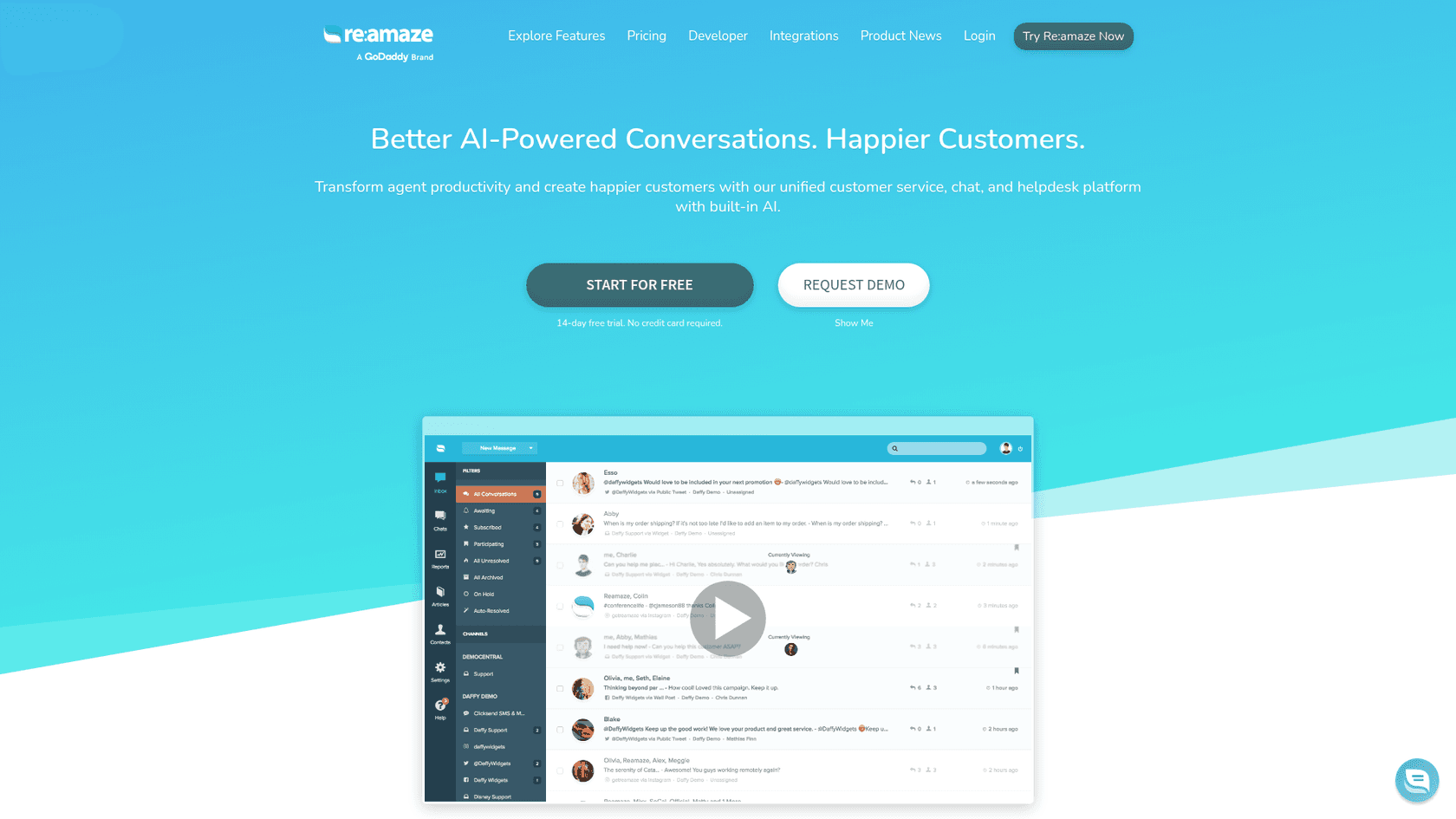
What is Re:amaze and who is it for?
Re:amaze is a cloud-based helpdesk platform designed primarily for online businesses. Its core value proposition is simple: combine email, live chat, social media messages, SMS, and even VoIP into a single dashboard where your team can collaborate.
The platform targets small-to-medium ecommerce teams, particularly those running on Shopify, BigCommerce, or WooCommerce. If you're currently managing support through a shared Gmail inbox or basic ticketing system, Re:amaze represents a significant step up in organization and capability.
That said, Re:amaze isn't the only option for teams looking to streamline support. At eesel AI, we take a different approach: instead of configuring another tool, you hire an AI teammate that learns your business and works alongside your human agents. More on that later.
Re:amaze pricing: What you'll actually pay
Re:amaze uses a per-agent pricing model, which means your costs scale linearly with your team size. Here's the breakdown:
| Plan | Monthly Price | Annual Price | Key Features |
|---|---|---|---|
| Basic | $29/agent/month | $26.10/agent/month | Unlimited inboxes, live chat, social channels, 1 brand, chatbots, basic reporting |
| Pro | $49/agent/month | $44.10/agent/month | All Basic features + unlimited brands, live visitor view, SMS/voice, advanced reporting, status page |
| Plus | $69/agent/month | $62.10/agent/month | All Pro features + Peek screensharing, departments, staff performance reporting, video calls |
| Starter | $59 flat/month | N/A | Basic features for unlimited users, limited to 500 conversations/month |
| Enterprise | Custom | Custom | White-glove service for high-volume businesses |
Source: Re:amaze Pricing
Cost at scale: The hidden math
The per-agent model looks reasonable for small teams but gets expensive quickly. Here's how the math works out:
- 3 agents: $87-207/month depending on plan
- 10 agents: $290-690/month
- 20 agents: $580-1,380/month
For comparison, volume-based alternatives like eesel AI start at $299/month for 500 credits (1 credit per ticket handled), with unlimited agents. If you're planning to scale your team, Re:amaze's pricing structure deserves serious consideration.
The 14-day free trial (no credit card required) lets you test all Plus features before committing, which is a nice touch.
What Re:amaze does well
Unified multichannel inbox
Re:amaze's strongest feature is its shared inbox. You can manage email, live chat, Facebook, Instagram, Messenger, SMS, and VoIP from one place. The interface shows who's handling what conversation, preventing duplicate responses and collision headaches.
Team collaboration features include internal notes, assignments, and shared views. For teams used to forwarding emails or using separate tools for different channels, this consolidation is genuinely useful.
Ecommerce integrations
Re:amaze shines when connected to your ecommerce platform. The Shopify integration (along with BigCommerce, WooCommerce, and Magento) pulls in customer order data directly into the conversation view. Agents can see order history, process refunds, and check shipping status without leaving the helpdesk.
The built-in FAQ and help center also integrate with live chat, letting customers browse self-service articles while chatting. This can deflect simple questions and reduce ticket volume.
Automation on all plans
Unlike some competitors that gate automation behind higher tiers, Re:amaze includes workflow automation and chatbots on every plan. You get:
- Response templates for common questions
- Workflow macros to automate repetitive tasks
- Pre-built chatbots (Hello Bot, FAQ Bot, Order Bot)
- Cues for proactive messaging based on customer behavior
This is a genuine value-add, especially for smaller teams that want to automate without upgrading to expensive plans.
Where Re:amaze falls short
Per-agent pricing that scales poorly
We've covered the math, but it's worth emphasizing: if you're planning to grow beyond 5-10 agents, Re:amaze gets pricey fast. There's no unlimited agent option except the Starter plan, which caps you at 500 conversations monthly.
For growing businesses, this creates a tension between hiring more support staff and controlling software costs. Usage-based pricing models (where you pay per conversation, not per seat) can make more sense for teams with fluctuating volume.
Interface and usability issues
User reviews consistently mention that Re:amaze's interface feels dated and has a steeper learning curve than modern alternatives. Specific pain points include:
- Limited search functionality: Finding old conversations or specific messages can be frustrating
- Clunky settings layout: Configuring complex workflows requires technical know-how
- Outdated knowledge base editor: No inline image uploads (you must link to external URLs)
These aren't dealbreakers, but they add friction that newer platforms have largely eliminated.
AI capabilities still in Beta
Re:amaze offers an AI Agent feature, but it's explicitly marked as "Beta" on their website. The AI can pre-draft replies, summarize conversations, and analyze sentiment, but there are no published resolution rates or performance guarantees.
Compare this to mature AI alternatives like Tidio's Lyro (which guarantees 50%+ resolution or your money back) or eesel AI (which achieves up to 81% autonomous resolution in mature deployments). Re:amaze's AI feels more like a helpful assistant than a true autonomous agent.
What real users say about Re:amaze
Re:amaze enjoys solid ratings across review platforms:
- Software Advice: 4.8/5 (53 reviews)
- Capterra: 4.8/5 (53 reviews)
- Shopify App Store: 4.4/5 (173 reviews)
Re:amaze had two key features that we needed: customer support case management across multiple channels and a knowledge base. Re:amaze seems like it's constantly getting new features without raising the modest prices.
Capterra
We used to love Re:amaze! We've been on the platform for about 5 years and we're getting increasingly frustrated! Customer support is very poor. The front line customer service team gate keep proper technical support.
Shopify Reviews
The Trustpilot rating of 1.5/5 deserves context: most of those reviews come from consumers who were scammed by merchants using Re:amaze, not actual platform users. It's not a fair reflection of the software itself.
Who should choose Re:amaze
Re:amaze makes sense for:
- Small ecommerce teams (2-5 agents): The per-agent pricing is manageable at this scale, and the ecommerce integrations deliver real value
- Multi-brand operations: Pro and Plus plans let you manage multiple businesses from one account
- Teams prioritizing human collaboration: If you want a shared inbox with robust team features rather than AI automation
- Businesses with stable agent counts: If you're not planning rapid team growth, the predictable per-seat pricing works fine
A modern alternative: eesel AI
If Re:amaze's limitations (per-agent pricing, limited AI, dated interface) are dealbreakers, there's a fundamentally different approach worth considering.
At eesel AI, we don't think of support as a tool you configure. We think of it as hiring an AI teammate that learns your business.
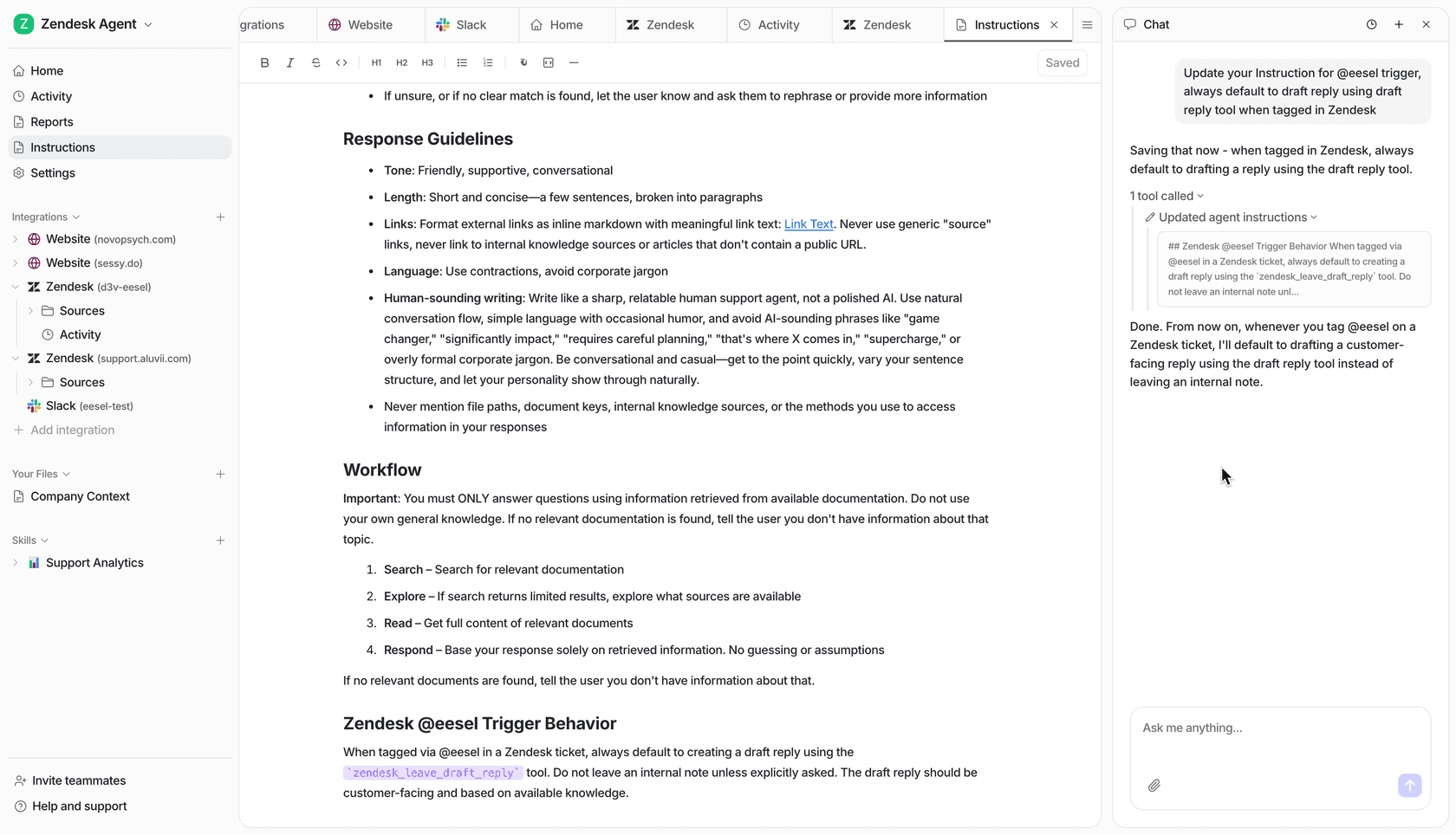
Here's how we differ:
Minutes to onboard, not weeks. Connect eesel AI to your helpdesk (Zendesk, Freshdesk, Gorgias, and others) and it immediately learns from your past tickets, help center articles, and macros. No manual training or documentation uploads.
Progressive autonomy. Start with eesel AI drafting replies for your team to review. As it proves itself, expand its scope to handle specific ticket types, then full frontline support. You control the pace based on actual performance.
Plain-English control. Define what eesel AI handles and when it escalates using natural language: "If the refund request is over 30 days, politely decline and offer store credit." No code, no rigid decision trees.
Test before going live. Run eesel AI on thousands of past tickets to see exactly how it would respond. Measure resolution rates and gain confidence before customers see a single AI reply.
Up to 81% autonomous resolution in mature deployments, with a typical payback period under two months.
If you're evaluating Re:amaze because you want better AI-powered support, eesel AI offers a fundamentally different paradigm.
Making the right choice for your team
So, is Re:amaze worth it? The honest answer: it depends.
For small-to-medium ecommerce teams that need solid multichannel support and aren't ready for AI automation, Re:amaze delivers genuine value. The unified inbox, ecommerce integrations, and automation features included on all plans make it a sensible upgrade from basic email or shared inboxes.
But the per-agent pricing creates a ceiling. Once you grow beyond 5-10 agents, the costs become harder to justify, especially when modern alternatives offer unlimited agents or usage-based pricing. And if AI-powered automation is a priority, Re:amaze's Beta AI Agent lacks the maturity and performance guarantees of dedicated AI platforms.
Bottom line? Try before you buy. Re:amaze's 14-day free trial lets you test the full feature set. And if you find yourself bumping against its limitations, consider whether an AI-native approach might better serve your team's future.